


1 Samuel 28:25
Bible text: King James Version (1769 Blayney text) · Public domain
Bible text: Berean Standard Bible · Public domain
Bible text: American Standard Version (1901) · Public domain
Bible text: World English Bible, Messianic edition · Public domain
Bible text: Geneva Bible (1599) · Public domain
Bible text: Young's Literal Translation · Public domain
- וַתַּגֵּשׁva·ta·Geshand she brought [them] nearH5066Conj-w ¦ V-Hiphil-ConsecImperf-3fsVerb Hiphil Consecutive Imperfect 3rd Singular Feminineוַandתַּגֵּשׁshe brought [them] near
- לִפְנֵיlif·nei<to> beforeH6440Prep-l ¦ N-mpcNoun Plural Masculine Constructלִ<to>פְנֵיbefore
- שָׁאוּלsha·'UlSaulH7586N-proper-mNoun Proper Masculine
- וְלִפְנֵיve·lif·Neiand <to> beforeH6440Conj-w ¦ Prep-l ¦ N-mpcNoun Plural Masculine Constructוְandלִ<to>פְנֵיbefore
- עֲבָדָיו'a·va·Davhis servantsH5650N-mpc ¦ 3msNoun Plural Masculine Constructעֲבָדָיservantsוhis
- וַיֹּאכֵלוּvai·yo·Khe·luand they ateH398Conj-w ¦ V-Qal-ConsecImperf-3mpVerb Qal Consecutive Imperfect 3rd Plural Masculineוַandיֹּאכֵלוּthey ate
- וַיָּקֻמוּvai·ya·Ku·muand they aroseH6965Conj-w ¦ V-Qal-ConsecImperf-3mpVerb Qal Consecutive Imperfect 3rd Plural Masculineוַandיָּקֻמוּthey arose
- וַיֵּלְכוּvai·ye·le·Khuand they wentH1980Conj-w ¦ V-Qal-ConsecImperf-3mpVerb Qal Consecutive Imperfect 3rd Plural Masculineוַandיֵּלְכוּthey went
- בַּלַּיְלָהba·Lay·lahon the nightH3915Prep-b ¦ N-msNoun Singular Masculine Absoluteבַּon theלַּיְלָהnight
- הַהוּאha·Hu'<the> thatH1931Art ¦ Pro-3msPronoun Personal 3rd Singular Masculineהַ<the>הוּאthat
English is a literal word-by-word gloss of the Hebrew, not the KJV's wording. Why?
This is the original text the KJV's translators worked from — each Hebrew word with its own literal English meaning in this verse, prepared by scholars at Tyndale House, Cambridge. The KJV translates whole sentences, not word by word, so its wording differs: one Hebrew word can become several English words, and the KJV may choose “the LORD” where the gloss reads “Yahweh”. Both are faithful — they answer different questions. For the KJV's own rendering, switch to the KJV text.
Details
See on the biblical-era map
Study this verse
Public-domain commentary
Matthew Henry
From his Commentary on the Whole Bible. Henry comments on passages, not single verses — this entry covers 1 Samuel 28:20–25. His two-level outline is real structure in the source text, so it is rendered as structure.
We are here told how Saul received this terrible message from the ghost he consulted. He desired to be told what he should do (Sa1 28:15), but was only told what he had not done and what should be done to him. Those that expect any good counsel or comfort otherwise than from God, and in the way of his institutions, will be as wretchedly disappointed as Saul here was. Observe,
I.How he sunk under the load, Sa1 28:20.
He was indeed unfit to bear it, having eaten nothing all the day before, nor that night. He came fasting from the camp, and continued fasting; not for want of food, but for want of an appetite. The fear he was in of the power of the Philistines (Sa1 28:5) took away his appetite, or perhaps the struggle he had with his own conscience, after he had entertained the thought of consulting the witch, made him to nauseate even his necessary food, though ever so dainty. This made him an easy prey to this fresh terror that now came upon him like an armed man. He fell all along on the earth, as if the archers of the Philistines had already hit him, and there was no strength in him to bear up against these heavy tidings. Now he had enough of consulting witches, and found them miserable comforters. When God in his word speaks terror to sinners he opens to them, at the same time, a door of hope if they repent: but those that apply to the gates of hell for succour must there expect darkness without any glimpse of light.
II.With what difficulty he was persuaded to take so much relief as was necessary to carry him back to his post in the camp.
The witch, it should seem, had left Saul alone with the spectre, to have his talk with him by himself; but perhaps hearing him fall and groan, and perceiving him to be in great agony, she came to him (Sa1 28:21), and was very importunate with him to take some refreshment, that he might be able to get clear from her house, fearing that if he should be ill, especially if he should die there, she should be punished for it as a traitor, though she had escaped punishment as a witch. This, it is probable, rather than any sentiment of kindness, made her solicitous to help him. But what a deplorable condition had he brought himself to when he needed so wretched a comforter!
1.She showed herself very importunate with him to take some refreshment. She pleaded (Sa1 28:21) that she had obeyed his voice to the endangering of her life, and why therefore should not he hearken to her voice for the relieving of his life? Sa1 28:22. She had a fat calf at hand (and the word signifies one that was made use of in treading out the corn, and therefore could the worse be spared); this she prepared for his entertainment, Sa1 28:24. Josephus is large in applauding the extraordinary courtesy and liberality of this woman, and recommending what she did as an example of compassion to the distressed, and readiness to communicate for their relief, though we have no prospect of being recompensed.
2.He showed himself very averse to it: He refused, and said, I will not eat (Sa1 28:23), choosing rather to die obscurely by famine than honourably by the sword. Had he laboured only under a defect of animal spirits, food might have helped him; but, alas! his case was out of the reach of such succours. What are dainty meats to a wounded conscience? As vinegar upon nitre, so is he that sings songs to a heavy heart, so disagreeable and unwelcome.
3.The woman at length, with the help of his servants, overpersuaded him, against his inclination and resolution, to take some refreshment. Not by force, but by friendly advice, they compelled him (Sa1 28:23), and of no other than such a rational and courteous compulsion are we to understand that in the parable, Compel them to come in, Luk 14:23. How forcible are right words, when men are pressed by them to that which is for their own interest! Job 6:25. Saul was somewhat revived with this entertainment; so that he and his servants, when they had eaten, rose up and went away before it was light (Sa1 28:25), that they might hasten to their business and that they might not be seen to come out of such a scandalous house. Josephus here much admires the bravery and magnanimity of Saul, that, though he was assured he should lose both his life and honour, yet he would not desert his army, but resolutely returned to the camp, and stood ready for an engagement. I wonder more at the hardness of his heart, that he did not again apply to God by repentance and prayer, in hopes yet to obtain at least a reprieve; but he desperately ran headlong upon his own ruin. Perhaps, indeed, now that rage and envy possessed him to the uttermost, he was the better reconciled to his hard fate, being told that his sons, and Jonathan among the rest, whom he hated for his affection to David, should die with him. If he must fall, he cared not what desolations of his family and kingdom accompanied his fall, hoping it would be the worse for his successor. Emou thanontos gaia michthetō puri - I care not if, when I am dead, the world should be set on fire. He begged not, as David, "Let thy hand be against me, but not against thy people."
Continue studying 1 Samuel 28:25 across the web’s major study libraries — every link below opens this exact verse, chapter, or book on the destination site.
Read & Compare
 BibleGatewayThis verse in more than 200 translations and 70 languages.
 Bible.comThe YouVersion reader — hundreds of translations, reading plans, and highlights.
 ESV.orgCrossway's official English Standard Version reader.
 NET BibleThe NET translation with 60,000+ translators' notes on every rendering decision.
 STEP BibleTyndale House's free study tool — original text, vocabulary, and scholarly resources.
 BibliaLogos Bible Software's free web reader.
 USCCBThe New American Bible (Revised Edition) with the U.S. bishops' study notes.
Commentaries
 BibleHub CommentariesDozens of classic commentaries on this verse, gathered on one page.
 StudyLightMore than 100 commentary sets — the largest collection on the web.
 BibleRefPlain-English commentary on what this verse means, verse by verse.
 Enduring WordDavid Guzik's free commentary on this chapter, widely used by Bible teachers.
 Bible Study ToolsVerse commentary alongside Greek and Hebrew study aids.
Original Language & Research
- BibleHub InterlinearThe verse word by word — original language, transliteration, and English.
- BibleHub LexiconEvery word's original-language definition and Strong's entry.
 Blue Letter BibleDeep-study tools — Strong's numbers, concordance, and word studies.
 SefariaThe Hebrew text with Rashi and centuries of Jewish commentary.
Sermons, Hymns & Audio


TrulyRandomVerse is not affiliated with these sites and doesn’t control their content. They’re linked because they’re genuinely useful.
Summary
1 Samuel 28:25 concludes the harrowing and illicit consultation between King Saul and the medium of Endor. Following the terrifying prophecy of his impending death and the transfer of his kingdom to David, a physically and spiritually broken Saul reluctantly accepts sustenance from the compassionate woman and his loyal servants. This seemingly mundane act of eating and departing under the cover of night serves as a poignant, final scene of Saul's tragic reign, ushering him towards his prophesied doom on the battlefield and marking a grim prelude to the end of an era.
Context
ShowHideLiterary Context
This verse immediately follows the climactic and devastating encounter between King Saul and the spirit of the prophet Samuel, conjured by the medium of Endor. In 1 Samuel 28:18-19, Samuel's apparition delivered a crushing verdict: God had departed from Saul, his kingdom would be torn from him and given to David, and both he and his sons would die in battle against the Philistines the very next day. Overwhelmed by this dire pronouncement, Saul "fell straightway all along the earth, and was sore afraid, because of the words of Samuel" (1 Samuel 28:20). He had been fasting and was physically weak. The woman and Saul's servants, witnessing his collapse, urged him to eat to regain strength for the journey back to the Israelite camp. The woman, displaying remarkable compassion and hospitality, quickly slaughtered a fatted calf and baked unleavened bread (1 Samuel 28:24). Verse 25 then records the simple act of them eating and departing, setting the stage for the battle detailed in 1 Samuel 31.
Historical & Cultural Context
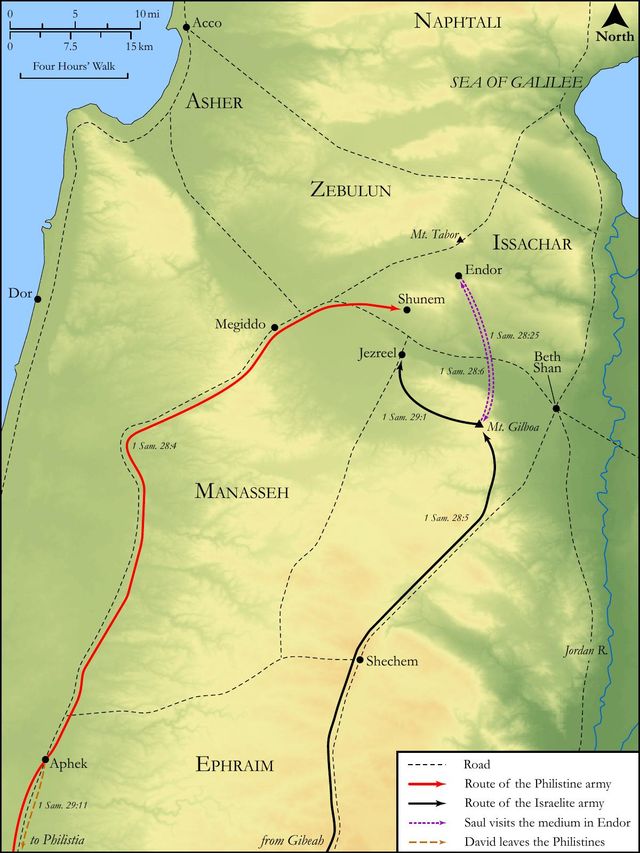
King Saul's visit to Endor occurs on the eve of a major battle with the Philistines, who had gathered their forces at Shunem (1 Samuel 28:4). Saul was in a state of extreme distress because God had ceased to communicate with him through any legitimate means—dreams, Urim, or prophets (1 Samuel 28:6). Desperate and fearing the Philistines, Saul resorted to necromancy, a practice explicitly forbidden and considered an abomination in Israel under the Mosaic Law (Deuteronomy 18:10-12). Ironically, Saul himself had previously purged the land of mediums and spiritists (1 Samuel 28:3). The woman's act of providing a meal, despite the danger of harboring a king who had outlawed her profession, highlights the strong cultural imperative of hospitality in Israel, even towards a perceived enemy or a king in disgrace. The departure "that night" was practical for secrecy and to reach the battlefield by morning, but also carries symbolic weight given the spiritual darkness of the preceding events.
Key Themes
ShowHideThis verse, though brief, contributes to several overarching themes in 1 Samuel. Firstly, it underscores the gravity of divine judgment and the inevitability of God's word. Samuel's prophecy, a direct consequence of Saul's persistent disobedience, particularly regarding the Amalekites (1 Samuel 15:23), is now set in motion, with the meal serving as a grim prelude to its fulfillment. Secondly, it highlights human desperation and frailty in the face of overwhelming spiritual and physical collapse. Saul's physical weakness mirrors his spiritual bankruptcy and the consequences of his rejection by God (1 Samuel 16:14). Thirdly, the woman's actions introduce a theme of unexpected human compassion amidst a narrative dominated by divine wrath and royal failure. Finally, the entire episode, culminating in this departure, signifies the end of an era—the end of Saul's kingship and the definitive transition of God's favor and the kingdom to David, God's chosen successor (1 Samuel 16:13).
Exposition and Analysis
ShowHideKey Word Analysis
ShowHideThis primitive root means "to be or come (causatively, bring) near." In this context, it emphasizes the woman's active role in presenting the food to Saul and his servants. It signifies her act of approaching them with sustenance, fulfilling the cultural imperative of hospitality, even to a king who had previously sought to eradicate her kind. It is an act of bringing comfort and practical aid in a moment of extreme distress.
This primitive root means "to eat (literally or figuratively); to consume, devour." While literally referring to the consumption of food, in this context, "eat" carries a deeper resonance. It represents a moment of grudging acceptance and physical restoration for Saul, who had refused food due to his despair (1 Samuel 28:20). The act of eating signifies a temporary regaining of strength, not for victory or renewed hope, but merely to face the inevitable. It is a final, shared meal before a king goes to his death, contrasting sharply with meals of celebration or covenant.
This primitive root means "to rise (in various applications, literal, figurative, intensive and causative); to stand up, establish." This verb implies rising from a prostrate or seated position, indicating a physical act of getting to one's feet. For Saul, who had fallen "all along the earth" (1 Samuel 28:20), "rose up" signifies a regaining of posture and a grim resolve to face his fate. It is not a rising in hope or triumph, but a somber preparation for the final confrontation, an act of strength merely to endure the path to judgment.
This noun refers to "night" literally, but also figuratively to "adversity." The specific mention of "that night" is significant. Practically, it allowed for a discreet departure and travel back to the Israelite camp under cover of darkness, preparing for the battle at dawn. Symbolically, "the night" reinforces the spiritual darkness that has enveloped Saul's reign, marking the end of his time in power under a shroud of judgment and despair. It is a night of finality, preceding the dawn of his destruction, and reflecting the figurative adversity that has consumed Saul's life.
Verse Breakdown
ShowHide"And she brought [it] before Saul, and before his servants;"
This clause highlights the woman's compassionate and practical act of hospitality. She brings the prepared meal—the fatted calf and unleavened bread—not just to Saul, but also to his servants, indicating a shared, if somber, repast. This shared meal underscores the human need for sustenance even in the most dire circumstances and the woman's role in facilitating Saul's physical recovery, however temporary. The act of "bringing before" emphasizes a respectful and attentive service to those in distress.
"and they did eat."
This simple declarative statement confirms that Saul and his entourage consumed the meal. It is a moment of physical nourishment that stands in stark contrast to the spiritual desolation Saul has just experienced. The act of eating provides the necessary strength for the journey ahead, a journey that will lead directly to his demise. It is a pause, a brief interlude of human normalcy, before the final, tragic act, a stark reminder that even in the face of divine judgment, basic human needs persist.
"Then they rose up, and went away that night."
This final clause describes the departure from Endor. "Rose up" implies a renewed, albeit temporary, physical capacity, a grim determination to face what lies ahead. Their departure "that night" signifies a swift, perhaps clandestine, exit from the scene of the dreadful prophecy. The darkness of the night provides practical cover for their movement and symbolically marks the end of Saul's desperate search for answers, leading him into the final, dark chapter of his life and reign, a journey into the literal and metaphorical night of his demise.
Literary Devices
ShowHideThe brevity of 1 Samuel 28:25 belies its rich use of literary devices. Irony pervades the entire narrative leading up to this verse: Saul, who once purged mediums from the land, now seeks one out in desperation, only to receive a prophecy of doom. The meal itself is an ironic act of sustenance, providing strength not for victory, but for the journey to death. Foreshadowing is powerfully present, as the act of eating and departing directly precedes the fulfillment of Samuel's prophecy in the very next chapter, leading to Saul's death. The phrase "that night" employs Symbolism, representing not only the literal darkness of their departure but also the spiritual and political darkness that has fallen upon Saul's kingdom, a shroud of judgment and despair. There is also a strong element of Pathos, as the reader witnesses the final, tragic movements of a once-powerful king, now reduced to a broken figure, accepting a final meal before facing his inevitable end, evoking pity for his desperate plight.
Theological and Thematic Connections
ShowHide1 Samuel 28:25, though seemingly a mundane detail, serves as a poignant theological marker. It demonstrates the inexorable nature of God's judgment once His warnings have been repeatedly ignored and His commands defied. Saul's desperate act of seeking forbidden counsel, a direct violation of God's law, sealed his fate, illustrating that God's word, whether of blessing or judgment, will ultimately come to pass. The scene underscores the futility of human attempts to manipulate divine will or escape consequences through illicit means. Even the act of eating, a basic human need, cannot alter the divine decree but merely provides the strength to walk into its fulfillment. It is a stark reminder that true strength and guidance come only from obedience and humble reliance on God, not from desperate, disobedient acts that attempt to bypass His sovereign will.
Reflection and Application
ShowHideThe final, somber departure of King Saul from Endor offers profound lessons for contemporary believers. It serves as a powerful cautionary tale against the dangers of persistent disobedience and the spiritual peril of seeking answers outside of God's revealed will. Like Saul, we can be tempted to seek quick fixes or forbidden knowledge when faced with fear, uncertainty, or divine silence. This verse reminds us that such desperate measures only deepen our spiritual darkness and hasten our downfall. Instead, we are called to humble ourselves, repent of our rebellion, and patiently wait on the Lord, trusting in His timing and His ways, even when they seem difficult or slow. The woman's compassion, though misplaced in its ultimate effect on Saul's destiny, reminds us of the human capacity for kindness even in morally ambiguous situations, prompting us to consider how we might extend grace without compromising truth. Ultimately, Saul's story challenges us to examine our own hearts: are we truly seeking God's will, or are we, like Saul, desperately trying to manipulate circumstances to our own ends, even if it means resorting to forbidden paths?
Questions for Reflection
ShowHideFAQ
ShowHideWhy did the woman offer Saul food after delivering such a dire prophecy?
ShowHideThe woman's actions are primarily driven by a combination of practical necessity and deep-seated cultural norms of hospitality, coupled with genuine compassion. Saul had been fasting for an extended period and was physically prostrate and terrified after Samuel's prophecy (1 Samuel 28:20). She recognized his extreme weakness and the immediate need for sustenance to enable him to travel. In Israel, hospitality was a sacred duty, even towards strangers or those in distress, regardless of their identity or the circumstances. Her plea, "Let me set a morsel of bread before thee; and eat, that thou mayest have strength when thou goest on thy way" (1 Samuel 28:22), reflects this deep cultural imperative. Her act was one of human kindness and practical care, demonstrating a basic empathy for a suffering individual, even if he was the king who had outlawed her profession.
What is the significance of "that night" in the verse?
ShowHideThe phrase "that night" carries both practical and symbolic significance. Practically, departing under the cover of darkness allowed Saul and his servants to travel discreetly and avoid detection, especially given the king's precarious position and the illicit nature of his visit. It also enabled them to reach the Israelite camp or a strategic position by morning, ready for the impending battle with the Philistines. Symbolically, "that night" reinforces the spiritual darkness that has enveloped Saul's reign and his life. His kingdom is ending in despair and judgment, and his final movements are shrouded in literal and metaphorical darkness. It marks the end of a long, dark chapter for Saul, leading directly into the dawn of his destruction. The night serves as a somber transition from the terror of the prophecy to its grim fulfillment, emphasizing the finality and secrecy surrounding this desperate, disobedient act.
Christ-Centered Fulfillment
ShowHideThe tragic narrative of Saul's final night, culminating in his desperate, disobedient meal and departure, stands in stark contrast to the perfect obedience and ultimate sacrifice of Jesus Christ. Saul, a king chosen by man, sought forbidden counsel in his fear, leading to his kingdom's demise and his own death. His "last supper" was one of despair, providing temporary physical strength for a journey into judgment. In profound contrast, Jesus, the King chosen by God, perfectly obeyed His Father, even unto death on a cross (Philippians 2:8). His "Last Supper" with His disciples was not a meal of desperation before judgment, but a covenant meal of institution, establishing the New Covenant in His blood, offering eternal life and true spiritual sustenance (Matthew 26:26-28). While Saul's departure into the night led to his kingdom's end and his physical death, Christ's journey into the darkness of Gethsemane and Golgotha led to the establishment of an eternal kingdom and the triumph over death through His resurrection (Colossians 1:13). Saul's story is a cautionary tale of human rebellion and its consequences; Christ's story is the glorious fulfillment of God's redemptive plan, offering light in our darkness and true life where Saul found only death (John 8:12).