


1 Samuel 28:23
Bible text: King James Version (1769 Blayney text) · Public domain
Bible text: King James Version with Strong's numbers · Public domain
Bible text: Berean Standard Bible · Public domain
Bible text: American Standard Version (1901) · Public domain
Bible text: World English Bible, Messianic edition · Public domain
Bible text: Geneva Bible (1599) · Public domain
Bible text: Young's Literal Translation · Public domain
- וַיְמָאֵןvay·ma·'Enand he refusedH3985Conj-w ¦ V-Piel-ConsecImperf-3msVerb Piel Consecutive Imperfect 3rd Singular Masculineוַandיְמָאֵןhe refused
- וַיֹּאמֶרvai·Yo·merand he saidH559Conj-w ¦ V-Qal-ConsecImperf-3msVerb Qal Consecutive Imperfect 3rd Singular Masculineוַandיֹּאמֶרhe said
- לֹאlo'notH3808NegParticle Negative
- אֹכַל'o·KhalI will eatH398V-Qal-Imperf-1csVerb Qal Imperfect 1st Singular common gender
- וַיִּפְרְצוּvai·yif·re·tzuand they urgedH6555Conj-w ¦ V-Qal-ConsecImperf-3mpVerb Qal Consecutive Imperfect 3rd Plural Masculineוַandיִּפְרְצוּthey urged
- בוֹvo<in> <the> himPrep-b ¦ 3msSuffix Personal 3rd Singular Masculineב<in> <the>וֹhim
- עֲבָדָיו'a·va·Davhis servantsH5650N-mpc ¦ 3msNoun Plural Masculine Constructעֲבָדָיservantsוhis
- וְגַםve·gamand alsoH1571Conj-w ¦ AdvAdverbוְandגַםalso
- הָאִשָּׁהha·'i·Shahthe womanH802Art ¦ N-fsNoun Singular Feminine Absoluteהָtheאִשָּׁהwoman
- וַיִּשְׁמַעvai·yish·Ma'and he listenedH8085Conj-w ¦ V-Qal-ConsecImperf-3msVerb Qal Consecutive Imperfect 3rd Singular Masculineוַandיִּשְׁמַעhe listened
- לְקֹלָםle·ko·Lamto their voiceH6963Prep-l ¦ N-msc ¦ 3mpNoun Singular Masculine Constructלְtoקֹלָvoiceםtheir
- וַיָּקָםvai·Ya·komand he aroseH6965Conj-w ¦ V-Qal-ConsecImperf-3msVerb Qal Consecutive Imperfect 3rd Singular Masculineוַandיָּקָםhe arose
- מֵהָאָרֶץme·ha·'A·retzfrom the groundH776Prep-m ¦ Art ¦ N-fsNoun Singular Feminine Absoluteמֵfromהָtheאָרֶץground
- וַיֵּשֶׁבvai·Ye·shevand he satH3427Conj-w ¦ V-Qal-ConsecImperf-3msVerb Qal Consecutive Imperfect 3rd Singular Masculineוַandיֵּשֶׁבhe sat
- אֶל'eltoH413PrepPreposition
- הַמִּטָּהha·mi·Tahthe bedH4296Art ¦ N-fsNoun Singular Feminine Absoluteהַtheמִּטָּהbed
English is a literal word-by-word gloss of the Hebrew, not the KJV's wording. Why?
This is the original text the KJV's translators worked from — each Hebrew word with its own literal English meaning in this verse, prepared by scholars at Tyndale House, Cambridge. The KJV translates whole sentences, not word by word, so its wording differs: one Hebrew word can become several English words, and the KJV may choose “the LORD” where the gloss reads “Yahweh”. Both are faithful — they answer different questions. For the KJV's own rendering, switch to the KJV text.
Details
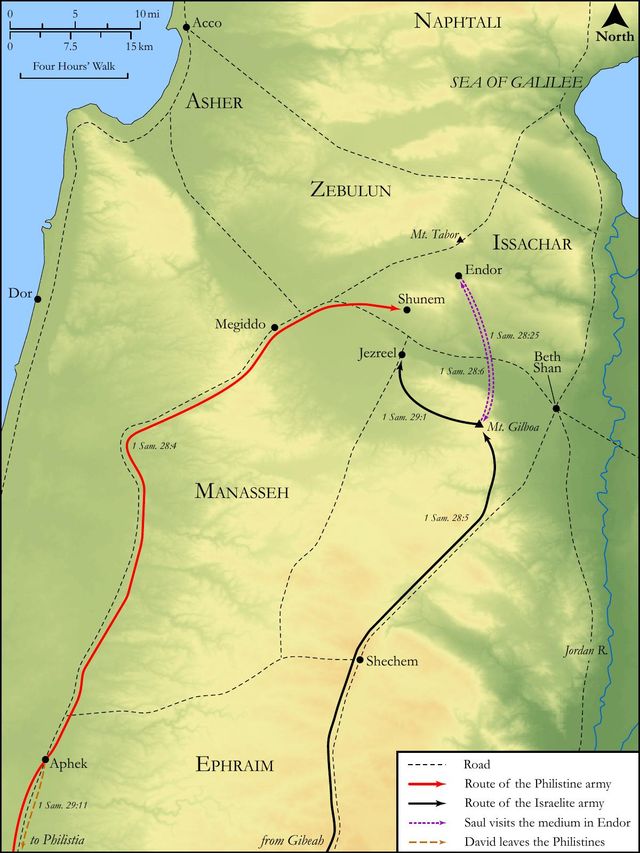
See on the biblical-era map
Study this verse
Public-domain commentary
Matthew Henry
From his Commentary on the Whole Bible. Henry comments on passages, not single verses — this entry covers 1 Samuel 28:20–25. His two-level outline is real structure in the source text, so it is rendered as structure.
We are here told how Saul received this terrible message from the ghost he consulted. He desired to be told what he should do (Sa1 28:15), but was only told what he had not done and what should be done to him. Those that expect any good counsel or comfort otherwise than from God, and in the way of his institutions, will be as wretchedly disappointed as Saul here was. Observe,
I.How he sunk under the load, Sa1 28:20.
He was indeed unfit to bear it, having eaten nothing all the day before, nor that night. He came fasting from the camp, and continued fasting; not for want of food, but for want of an appetite. The fear he was in of the power of the Philistines (Sa1 28:5) took away his appetite, or perhaps the struggle he had with his own conscience, after he had entertained the thought of consulting the witch, made him to nauseate even his necessary food, though ever so dainty. This made him an easy prey to this fresh terror that now came upon him like an armed man. He fell all along on the earth, as if the archers of the Philistines had already hit him, and there was no strength in him to bear up against these heavy tidings. Now he had enough of consulting witches, and found them miserable comforters. When God in his word speaks terror to sinners he opens to them, at the same time, a door of hope if they repent: but those that apply to the gates of hell for succour must there expect darkness without any glimpse of light.
II.With what difficulty he was persuaded to take so much relief as was necessary to carry him back to his post in the camp.
The witch, it should seem, had left Saul alone with the spectre, to have his talk with him by himself; but perhaps hearing him fall and groan, and perceiving him to be in great agony, she came to him (Sa1 28:21), and was very importunate with him to take some refreshment, that he might be able to get clear from her house, fearing that if he should be ill, especially if he should die there, she should be punished for it as a traitor, though she had escaped punishment as a witch. This, it is probable, rather than any sentiment of kindness, made her solicitous to help him. But what a deplorable condition had he brought himself to when he needed so wretched a comforter!
1.She showed herself very importunate with him to take some refreshment. She pleaded (Sa1 28:21) that she had obeyed his voice to the endangering of her life, and why therefore should not he hearken to her voice for the relieving of his life? Sa1 28:22. She had a fat calf at hand (and the word signifies one that was made use of in treading out the corn, and therefore could the worse be spared); this she prepared for his entertainment, Sa1 28:24. Josephus is large in applauding the extraordinary courtesy and liberality of this woman, and recommending what she did as an example of compassion to the distressed, and readiness to communicate for their relief, though we have no prospect of being recompensed.
2.He showed himself very averse to it: He refused, and said, I will not eat (Sa1 28:23), choosing rather to die obscurely by famine than honourably by the sword. Had he laboured only under a defect of animal spirits, food might have helped him; but, alas! his case was out of the reach of such succours. What are dainty meats to a wounded conscience? As vinegar upon nitre, so is he that sings songs to a heavy heart, so disagreeable and unwelcome.
3.The woman at length, with the help of his servants, overpersuaded him, against his inclination and resolution, to take some refreshment. Not by force, but by friendly advice, they compelled him (Sa1 28:23), and of no other than such a rational and courteous compulsion are we to understand that in the parable, Compel them to come in, Luk 14:23. How forcible are right words, when men are pressed by them to that which is for their own interest! Job 6:25. Saul was somewhat revived with this entertainment; so that he and his servants, when they had eaten, rose up and went away before it was light (Sa1 28:25), that they might hasten to their business and that they might not be seen to come out of such a scandalous house. Josephus here much admires the bravery and magnanimity of Saul, that, though he was assured he should lose both his life and honour, yet he would not desert his army, but resolutely returned to the camp, and stood ready for an engagement. I wonder more at the hardness of his heart, that he did not again apply to God by repentance and prayer, in hopes yet to obtain at least a reprieve; but he desperately ran headlong upon his own ruin. Perhaps, indeed, now that rage and envy possessed him to the uttermost, he was the better reconciled to his hard fate, being told that his sons, and Jonathan among the rest, whom he hated for his affection to David, should die with him. If he must fall, he cared not what desolations of his family and kingdom accompanied his fall, hoping it would be the worse for his successor. Emou thanontos gaia michthetō puri - I care not if, when I am dead, the world should be set on fire. He begged not, as David, "Let thy hand be against me, but not against thy people."
Continue studying 1 Samuel 28:23 across the web’s major study libraries — every link below opens this exact verse, chapter, or book on the destination site.
Read & Compare
 BibleGatewayThis verse in more than 200 translations and 70 languages.
 Bible.comThe YouVersion reader — hundreds of translations, reading plans, and highlights.
 ESV.orgCrossway's official English Standard Version reader.
 NET BibleThe NET translation with 60,000+ translators' notes on every rendering decision.
 STEP BibleTyndale House's free study tool — original text, vocabulary, and scholarly resources.
 BibliaLogos Bible Software's free web reader.
 USCCBThe New American Bible (Revised Edition) with the U.S. bishops' study notes.
Commentaries
 BibleHub CommentariesDozens of classic commentaries on this verse, gathered on one page.
 StudyLightMore than 100 commentary sets — the largest collection on the web.
 BibleRefPlain-English commentary on what this verse means, verse by verse.
 Enduring WordDavid Guzik's free commentary on this chapter, widely used by Bible teachers.
 Bible Study ToolsVerse commentary alongside Greek and Hebrew study aids.
Original Language & Research
- BibleHub InterlinearThe verse word by word — original language, transliteration, and English.
- BibleHub LexiconEvery word's original-language definition and Strong's entry.
 Blue Letter BibleDeep-study tools — Strong's numbers, concordance, and word studies.
 SefariaThe Hebrew text with Rashi and centuries of Jewish commentary.
Sermons, Hymns & Audio


TrulyRandomVerse is not affiliated with these sites and doesn’t control their content. They’re linked because they’re genuinely useful.
Summary
1 Samuel 28:23 captures a profoundly poignant moment in King Saul's final hours, illustrating the depth of his despair and physical exhaustion after receiving a devastating prophecy of his imminent death and the loss of his kingdom. Despite his initial refusal to eat, his compassionate servants and the woman who hosted him persistently urged him, recognizing his critical need for sustenance, leading to his reluctant compliance and a small, symbolic act of rising from the dust of his despair.
Context
ShowHideLiterary Context
This verse immediately follows the chilling prophecy delivered by the spirit of Samuel to Saul, conjured by the medium of Endor. In 1 Samuel 28:19, Samuel declared that God had torn the kingdom from Saul, given it to David, and that Saul and his sons would die with him in battle against the Philistines the very next day. Overwhelmed by this divine judgment, Saul collapsed to the ground, utterly drained and having fasted for a day and a night (1 Samuel 28:20). The narrative then shifts to the human response of the woman and Saul's servants, who, despite his royal authority and the grim prophecy, show practical compassion by urging him to eat, recognizing his desperate physical state. This act of care precedes Saul's final, fatal battle, setting a somber tone for the impending tragedy.
Historical & Cultural Context
Saul's consultation with the medium was an act of extreme desperation, directly violating his own earlier decree against such practices (1 Samuel 28:3). In ancient Israel, seeking guidance from mediums and necromancers was strictly forbidden by Mosaic Law as an abomination to the Lord (Deuteronomy 18:10-12). Saul's willingness to transgress this law underscores his profound spiritual abandonment by God (1 Samuel 28:6) and his fear of the Philistine army. The woman's act of hospitality, offering food and shelter to a distressed traveler, even a king in disguise, reflects a common cultural expectation of care for guests, especially those in distress. Her persistence, along with the servants, highlights a deep concern for the king's physical well-being, even in the face of his spiritual and emotional collapse.
Key Themes
ShowHideThe immediate context of 1 Samuel 28 and this verse contribute to several major themes in the book of Samuel. Firstly, it powerfully illustrates the consequences of disobedience and divine judgment, as Saul's persistent rebellion against God's commands culminates in his utter despair and the pronouncement of his demise. Secondly, it highlights the profound isolation and abandonment Saul experiences, both from God and, in a sense, from hope itself, as he faces an inevitable end. Thirdly, it subtly introduces the theme of human compassion and practical care in the face of overwhelming despair, as the servants and the woman offer physical sustenance to a man utterly broken. Finally, Saul's reluctant compliance underscores the fragility of human will when confronted with the crushing weight of divine decree and impending doom.
Exposition and Analysis
ShowHideKey Word Analysis
ShowHideThis verb signifies a strong, determined refusal, indicating Saul's deep-seated despair and perhaps a desire to simply give up. It portrays a man who has lost all will to live or to fight, overwhelmed by the prophecy of his impending death and the loss of his kingdom. His refusal to eat is not merely a lack of appetite but a profound rejection of life itself in that moment.
The verb here literally means "to break out," "to burst forth," or "to urge strongly." It conveys a sense of forceful persuasion, indicating that the servants and the woman were not merely suggesting but actively insisting and pressing upon Saul to eat. This highlights their deep concern for his physical state and their determined effort to restore his strength, even if only for a short while, before the inevitable battle.
This verb means "to hear intelligently," often with an implication of attention, obedience, or compliance. In this context, it signifies Saul's reluctant submission to the persistent urging of his companions. It suggests a moment where his profound despair is momentarily overridden by the practical necessity of sustenance and the compassionate will of those around him, allowing him to take a small step towards life, however brief.
Verse Breakdown
ShowHide"But he refused, and said, I will not eat."
This clause vividly portrays Saul's state of utter despair and resignation. Having received the devastating prophecy from Samuel, he is physically and emotionally broken, having fasted for a day and a night. His refusal to eat is a manifestation of his complete loss of hope and will to continue, a man consumed by the weight of divine judgment and impending doom.
"But his servants, together with the woman, compelled him;"
This part introduces an element of human compassion and intervention. Despite Saul's royal status and his desperate situation, his companions recognize his critical physical need. Their act of "compelling" him indicates a strong, persistent urging, born out of genuine care and a practical understanding that he needed nourishment to face what lay ahead, even if it was his death.
"and he hearkened unto their voice."
This signifies Saul's reluctant compliance. Overwhelmed and weakened, he eventually yields to the insistent pleas of those around him. It is a moment where basic human need and the compassionate will of others override his spiritual agony and despair, allowing him to take a small, yet significant, step towards physical recovery.
"So he arose from the earth, and sat upon the bed."
This final phrase describes the immediate physical consequence of his decision to eat. Rising from the ground, where he had collapsed in despair, and sitting upon the bed, indicates a slight restoration of his physical strength and a shift, however temporary, from utter prostration to a position of readiness. It marks a moment of transition from complete collapse to a posture of limited engagement with his circumstances.
Literary Devices
ShowHideThe passage employs several potent literary devices to convey Saul's tragic state and the dynamics of the scene. Pathos is powerfully evoked through Saul's abject despair, his refusal to eat, and his prostrate position, inviting the reader's sympathy for his brokenness, despite his past transgressions. There is a strong contrast between Saul's overwhelming despondency and the practical, compassionate persistence of his servants and the woman, highlighting the enduring human capacity for care even in the darkest circumstances. The act of Saul rising from the earth and sitting on the bed serves as a subtle symbolism of a momentary, albeit fleeting, return to a semblance of life and readiness, a brief respite before his ultimate demise. Furthermore, the entire narrative leading up to this point is steeped in irony, as Saul, who once purged mediums from the land, now desperately seeks one out, underscoring the tragic consequences of his spiritual rebellion and God's abandonment.
Theological and Thematic Connections
ShowHideThis verse, while depicting a moment of profound human despair, also subtly highlights the persistent nature of God's judgment when His commands are continually defied, as seen in Saul's tragic trajectory. It underscores the reality that while God is merciful, there are indeed grave consequences for persistent rebellion against His revealed will. Yet, amidst this divine judgment, the human compassion shown by the servants and the woman reminds us of the inherent value of human life and the call to care for the broken, even those who have fallen far from grace. This act of practical love, compelling Saul to eat, stands in stark contrast to his spiritual desolation, offering a glimpse of grace in a moment dominated by despair and doom.
Reflection and Application
ShowHideSaul's refusal to eat and his subsequent, reluctant compliance offer a powerful lesson about the interplay of spiritual and physical well-being, even in the direst circumstances. In moments of overwhelming despair, whether due to personal failure, external pressures, or spiritual distress, it is easy to neglect basic self-care, as Saul did. However, this passage reminds us that even when our spirit is crushed, attending to our physical needs—eating, resting, seeking medical help—can be a crucial step towards regaining a measure of strength to face our challenges. Furthermore, the compassionate persistence of Saul's companions serves as a profound model for us. We are called to be agents of practical grace, extending tangible help and unwavering support to those who are overwhelmed by despair, even when they resist. Our ministry to the broken often begins not with theological discourse, but with meeting fundamental human needs, providing a foundation upon which spiritual healing or acceptance can eventually be built.
Questions for Reflection
ShowHideFAQ
ShowHideWhy was Saul so desperate that he refused to eat?
ShowHideSaul's desperation stemmed from a confluence of overwhelming factors. God had ceased to answer him through traditional means like dreams, Urim, or prophets (1 Samuel 28:6). He faced an imminent and formidable battle against the Philistines, a battle he knew he was ill-equipped to win. Most profoundly, the spirit of Samuel had just delivered a chilling prophecy, confirming God's rejection of Saul, the transfer of his kingdom to David, and the certainty of his and his sons' deaths in the very next day's battle (1 Samuel 28:19). This crushing weight of divine judgment, spiritual abandonment, and impending doom completely broke his spirit, leading to his collapse and refusal to sustain himself.
What does it mean that his servants and the woman "compelled him"?
ShowHideThe Hebrew word for "compelled" (פָּרַץ, pârats) carries a strong sense of breaking through, bursting forth, or urging with great force and persistence. It's not a gentle suggestion but a determined insistence. This indicates that Saul's companions recognized the critical state of his physical health – he had not eaten for a day and a night and had collapsed from exhaustion and despair. They understood that he needed nourishment to regain any semblance of strength, even if only to face his inevitable fate. Their action highlights their deep concern and practical compassion, overriding his will to give up.
What is the significance of Saul finally eating and rising from the earth?
ShowHideSaul's eventual compliance and act of eating, followed by him rising from the ground and sitting on the bed, represents a small but significant shift from total prostration and despair to a reluctant acceptance of his immediate circumstances. It signifies a temporary, albeit brief, return to a state of readiness and engagement with life, even if that life was about to end. It also underscores the power of human compassion and the basic necessity of physical sustenance, even when one's spirit is utterly broken. While it doesn't change his ultimate fate, it allows him to face it with a minimal level of physical capacity.
Christ-Centered Fulfillment
ShowHideThe tragic narrative of Saul's despair and divine abandonment in 1 Samuel 28:23 stands in stark contrast to the perfect obedience and ultimate triumph of Jesus Christ. Saul, a king chosen by God, fell into despair and faced judgment due to his persistent disobedience and rejection of God's word. His desperate search for guidance outside of God's will led to a prophecy of death and the loss of his kingdom. In profound contrast, Jesus, the true King, perfectly obeyed the Father's will even unto death on the cross, never experiencing divine abandonment for His own sin, but rather bearing the abandonment for ours (Matthew 27:46). Where Saul collapsed in despair, Jesus, though experiencing immense suffering, remained steadfast, ultimately rising not from a bed to face death, but from the grave to conquer it (Matthew 28:6). Unlike Saul, who found no lasting comfort or hope, Christ offers true rest and sustenance to all who are weary and burdened, inviting them to come to Him and find life (Matthew 11:28). He is the Bread of Life who offers eternal nourishment, ensuring that those who come to Him will never hunger or thirst again (John 6:35), a stark and glorious contrast to Saul's temporary and despair-laden meal.