


Zechariah 10:1
Bible text: King James Version (1769 Blayney text) · Public domain
Bible text: King James Version with Strong's numbers · Public domain
Bible text: Berean Standard Bible · Public domain
Bible text: American Standard Version (1901) · Public domain
Bible text: World English Bible, Messianic edition · Public domain
Bible text: Geneva Bible (1599) · Public domain
Bible text: Young's Literal Translation · Public domain
- שַׁאֲלוּsha·'a·LuaskH7592V-Qal-Imp-2mpVerb Qal Imperative 2nd Plural Masculine
- מֵיְהוָהme·Yah·wehfrom YahwehH3068Prep-m ¦ N-properNoun Proper TitleמֵfromיְהוָהYahweh
- מָטָרma·TarrainH4306N-msNoun Singular Masculine Absolute
- בְּעֵתbe·'Etat [the] time ofH6256Prep-b ¦ N-cscNoun Singular common gender Constructבְּatעֵת[the] time of
- מַלְקוֹשׁmal·Ko·oshspring rainH4456N-msNoun Singular Masculine Absolute
- יְהוָהYah·wehYahwehH3068N-properNoun Proper Title
- עֹשֶׂה'o·Seh[is] makingH6213V-Qal-Prtcpl-msVerb Qal Participle Singular Masculine Absolute
- חֲזִיזִיםcha·zi·Zimthunder-cloudsH2385N-mpNoun Plural Masculine Absolute
- וּמְטַרu·me·tarand rain ofH4306Conj-w ¦ N-mscNoun Singular Masculine Constructוּandמְטַרrain of
- גֶּשֶׁםge·shemrainH1653N-msNoun Singular Masculine Absolute
- יִתֵּןyi·Tenhe givesH5414V-Qal-Imperf-3msVerb Qal Imperfect 3rd Singular Masculine
- לָהֶםla·Hemto themPrep-l ¦ 3mpSuffix Personal 3rd Plural Masculineלָtoהֶםthem
- לְאִישׁle·'Ishto everyoneH376Prep-l ¦ N-msNoun Singular Masculine Absoluteלְtoאִישׁeveryone
- עֵשֶׂב'E·sevvegetationH6212N-msNoun Singular Masculine Absolute
- בַּשָּׂדֶהba·sa·Dehin the fieldH7704Prep-b ¦ N-msNoun Singular Masculine Absoluteבַּin theשָּׂדֶהfield
English is a literal word-by-word gloss of the Hebrew, not the KJV's wording. Why?
This is the original text the KJV's translators worked from — each Hebrew word with its own literal English meaning in this verse, prepared by scholars at Tyndale House, Cambridge. The KJV translates whole sentences, not word by word, so its wording differs: one Hebrew word can become several English words, and the KJV may choose “the LORD” where the gloss reads “Yahweh”. Both are faithful — they answer different questions. For the KJV's own rendering, switch to the KJV text.
Details
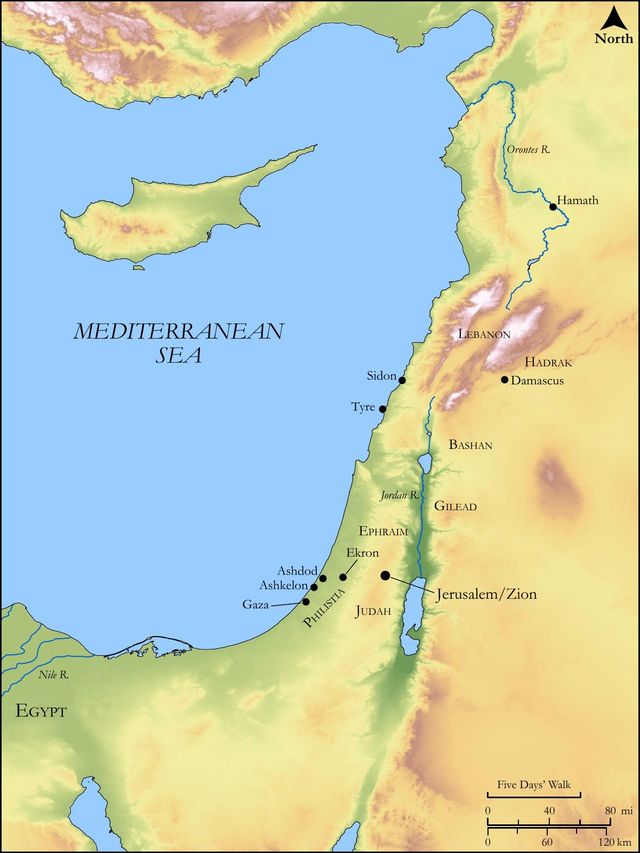
See on the biblical-era map
Study this verse
Public-domain commentary
Matthew Henry
From his Commentary on the Whole Bible. Henry comments on passages, not single verses — this entry covers Zechariah 10:1–4. His two-level outline is real structure in the source text, so it is rendered as structure.
Gracious things and glorious ones, very glorious and very gracious, were promised to this poor afflicted people in the foregoing chapter; now here God intimates to them that he will for these things be enquired of by them, and that he expects they should acknowledge him in all their ways and in all his ways towards them - and not idols that were rivals with him for their respects.
I.The prophet directs them to apply to God by prayer for rain in the season thereof.
He had promised, in the close of the foregoing chapter, that there should be great plenty of corn and wine, whereas for several years, by reason of unseasonable weather, there had been great scarcity of both; but the earth will not yield its fruits unless the heavens water it, and therefore they must look up to God for the dew of heaven, in order to the fatness and fruitfulness of the earth (Zac 10:1): "Ask you of the Lord rain. Do not pray to the clouds, nor to the stars, for rain, but to the Lord; for he it is that hears the heavens, when they hear the earth," Hos 2:21. Seasonable rain is a great mercy, which we must ask of God, rain in the time of the latter rain, when there is most need of it. The former rain fell at the seed-time, in autumn, the latter fell in the spring, between March and May, which brought the corn to an ear and filled it. If either of these rains failed, it was very bad with that land; for from the end of May to September they never had any rain at all. Jerome, who lived in Judea, says that he never saw any rain there in June or July. They are directed to ask for it in the time when it used to come. Note, We must, in our prayers, dutifully attend the course of Providence; we must ask for mercies in their proper time, and not expect that God should go out of his usual way and method for us. But, since sometimes God denied rain in the usual time as a token of his displeasure, they must pray for it then as a token of his favour, and they shall not pray in vain. Ask and it shall be given you. So the Lord shall make bright clouds (which, though they are without rain themselves, are yet presages of rain) - lightnings (so the margin reads it), for he maketh lightnings for the rain. He will give them showers of rain in great abundance, and so give to every one grass in the field; for God is universally good, and makes his rain to fall upon the just and the unjust.
II.He shows them the folly of making their addresses to idols as their fathers had done (Zac 10:2):
The idols have spoken vanity; the teraphim, which they courted and consulted in their distress, were so far from being able to command rain for them that they could not so much as tell them when they should have rain. They pretended to promise them rain at such a time, but it did not come. The diviners, who were the prophets of those idols, have seen a lie (their visions were all a cheat and a sham); and they have told false dreams, such as the event did not answer, which proved that they were not from God. Thus they comforted in vain those that consulted the lying oracles; all the vanities of the heathen put together could not give rain, Jer 14:22. Yet this was not the worst of it; they not only got nothing by the false gods, but they lost the favour of the true God, for therefore they went their way into captivity as a flock driven into the fold, and they were troubled with one vexation after another, as scattered sheep are, because there was no shepherd, no prince to rule them, no priest to intercede for them, none to take care of them and keep them together. Those that wandered after strange gods were made to wander, into strange nations.
III.He shows them the hand of God in all the events that concerned them, both those that made against them and those that made for them, Zac 10:3. Let them consider,
1.When every thing went cross it was God that walked contrary to them (Zac 10:3): "My anger was kindled against the shepherds that should have fed the flock, but neglected it, and starved it. I was displeased at the wicked magistrates and ministers, the idol-shepherds." The captivity in Babylon was a token of God's anger against them; in it likewise he punished the goats, those of the flock that were filthy and mischievous; they were set on the left hand, to go away into punishment. Though the body of the nation suffered in the captivity, yet it was only the goats and the shepherds that God was angry with, and that he punished; the same affliction to others came from the love of God, and was but a fatherly chastisement, which to them came from his wrath, and was a judicial punishment.
2.When things began to change for the better it was God that gave them the happy turn. "He has now visited his flock with favour, to enquire after them, and provides what he finds proper for them, and he has made them as his goodly horse in the battle, has beautified them, taken care of them, managed and made use of them, as a man does the horse he rides on, has made them valuable in themselves and formidable to those about them, as his goodly horse." It is God that makes us what we are, and it is with us as he appoints.
IV.He shows them that every creature is to them what God makes it to be (Zac 10:4): Out of him came forth the corner, out of him the nails.
1.All the power that was engaged against them was from God. Out of him came all the combined force of their enemies; every oppressor together (and the oppressors of Israel were not a few) did but what his hand and his counsel determined before to be done; nor could they have had such power against them unless it had been given them from above.
2.All the power likewise that was engaged for them was derived from him and depended on him. Out of him came forth the corner-stone of the building, the power of magistrates, which keeps the several parts of the state together. Princes are often called the corners of the people, as Sa1 14:38, marg. Out of him came forth the nail that fixed the state, the nail in the sure place (Isa 22:23), the nail in his holy place, Ezr 9:8. Out of him came forth the battle-bow, the military power, and out of him every oppressor, or exactor, that had the civil power in his hand; and therefore to God, the fountain of power, we must always have an eye, and see every man's judgment proceeding from him.
Historical interpretation
Historical reception
2 surviving comments on this verse. Each one is dated, so this reads as a timeline rather than a list.
Select a marker to jump to its quote. Markers stagger vertically where authors wrote within a few decades of each other.
Let us not, therefore, know God by halves or make his lovingkindness an excuse for our indolence; for this, his thunders, for this, his lightnings—that his goodness may not be held in despite. He who causes the sun to rise also strikes people with blindness. He who sends the rain also causes the rain of fire. By the one he manifests his goodness; by the other, his severity. For the one let us love him, for the other let us fear, that it may not be said also to us, “Or despise you the riches of his goodness and patience and longsuffering? Know you not that the mercy of God leads you to repentance? But according to your hardness and impenitent heart, you treasure up to yourself wrath against the day of wrath.”
(Chapter X, Verses 1 onwards) Pray to the Lord for late rain, and the Lord will send snow and rain showers, and every one will have grass in the fields. For the idols spoke in vain, and the diviners saw falsehood, and the dreamers spoke in vain, offering false consolation. Therefore, they have been led astray like a flock without a shepherd. They will be afflicted because they have no shepherd. Pray to the Lord for timely, seasonal, and late rain. The Lord has made illusions and will give them winter rain and grass to each one in the field. The ones who spoke have labored in vain, and the diviners have spoken false visions and false dreams, offering empty consolation. Therefore, they have withered like sheep and have been afflicted because there was no one to heal them. So the happiness that was promised in the time of the Maccabees, when the holy stones were raised up from the earth, and the Israelite nation grew greater, to the point that your virgins once again fed on the wheat of the Law, and were intoxicated with the wine of the Holy Spirit, is promised in part. However, because now is the last time of the prophets, and the world is approaching its end, and all that has been prophesied is awaiting its fulfillment: Ask the Lord to give you late rain: so that Christ, who was promised, may come and bestow upon you dews and snows, for which it is written in Hebrew Azizim (). And I do not know what they wanted, but perhaps they wanted to describe the greatness of grace and the admiration of gifts by the name of fantasy. Therefore, the Lord who makes snow and dryness for all the earth will be watered by the rain of the gospel preaching: He will give rain to the believers, and all things will be filled with abundance, so that after the nations have believed in Christ, they may understand that which they worshipped before is vain. Whether Israel itself understands, which once deceived, was held by the errors of idolatry, in vain it worshipped statues, and heard lies of the divine, and acquiesced in dreams, which Scripture commands not to believe (Deut. XIII). And for this reason they were led like a flock into captivity, and afflicted without the shepherd God, because they did not have knowledge of the Law. This whole passage is obscure and doubtful, and the reader must forgive us if in those things that are ambiguous, we proceed with a hesitant step. However, according to spiritual understanding, we can say that believers in Christ are encouraged by the Lord to ask for the latter rain at the end of the world, when the fullness of grace is to be given, and every herb will grow in its own field, so that they may say: The Lord is my shepherd, and I shall not want; he has set me in a place of pasture, he has nourished me on the waters of refreshment (Ps. 23:1-2). For all idols, both divine and dreamers, have spoken in vain and provided empty consolation. Those who speak about heretics, who do not understand the name Christian, nor about whom they speak, nor of whom they affirm, and they attend to erroneous spirits and the teachers of demons speaking lies in hypocrisy, and having their conscience seared (I Tim. IV): so that they are not led astray by the consolations of those who promise empty things, and for this reason they are handed over to Satan for the destruction of the flesh (I Cor. V), and taken captive by the king of Babylon, and afflicted, because they do not have Christ as their shepherd, whom they falsely promise to themselves under a fake name.
Continue studying Zechariah 10:1 across the web’s major study libraries — every link below opens this exact verse, chapter, or book on the destination site.
Read & Compare
 BibleGatewayThis verse in more than 200 translations and 70 languages.
 Bible.comThe YouVersion reader — hundreds of translations, reading plans, and highlights.
 ESV.orgCrossway's official English Standard Version reader.
 NET BibleThe NET translation with 60,000+ translators' notes on every rendering decision.
 STEP BibleTyndale House's free study tool — original text, vocabulary, and scholarly resources.
 BibliaLogos Bible Software's free web reader.
 USCCBThe New American Bible (Revised Edition) with the U.S. bishops' study notes.
Commentaries
 BibleHub CommentariesDozens of classic commentaries on this verse, gathered on one page.
 StudyLightMore than 100 commentary sets — the largest collection on the web.
 BibleRefPlain-English commentary on what this verse means, verse by verse.
 Enduring WordDavid Guzik's free commentary on this chapter, widely used by Bible teachers.
 Bible Study ToolsVerse commentary alongside Greek and Hebrew study aids.
Original Language & Research
- BibleHub InterlinearThe verse word by word — original language, transliteration, and English.
- BibleHub LexiconEvery word's original-language definition and Strong's entry.
 Blue Letter BibleDeep-study tools — Strong's numbers, concordance, and word studies.
 SefariaThe Hebrew text with Rashi and centuries of Jewish commentary.
Sermons, Hymns & Audio


TrulyRandomVerse is not affiliated with these sites and doesn’t control their content. They’re linked because they’re genuinely useful.
Summary
Zechariah 10:1 is a divine imperative calling the post-exilic community to seek rain from the Lord during the crucial time of the latter rains, rather than from pagan deities or human efforts. It simultaneously declares God's exclusive power and willingness to respond to their prayers by sending abundant showers, ensuring the growth of grass in the fields and thus sustaining their physical well-being and agricultural prosperity, underscoring His sovereignty over creation and His people's dependence on Him.
Context
ShowHideLiterary Context
Zechariah 10 stands within a larger section of the book (chapters 9-14) that shifts from earlier visions concerning the rebuilding of the temple and the restoration of Judah to more eschatological prophecies about the future of Israel and the nations. Chapter 9 speaks of the coming King and the restoration of Judah and Ephraim, while chapter 10 continues this theme of restoration, focusing on God's re-gathering of His people and their deliverance from oppressors. Verse 1, therefore, serves as a foundational call to acknowledge God as the sole source of blessing, both physical (rain) and spiritual (restoration), setting the stage for subsequent promises of divine intervention and leadership. It contrasts sharply with the idolatry and false leadership condemned later in the chapter, reinforcing the necessity of seeking God alone.
Historical & Cultural Context
The book of Zechariah was written during the Persian period, following the return of the Jewish exiles from Babylon to Judah (c. 520-518 BC). The community was rebuilding Jerusalem and the Temple under challenging circumstances, facing economic hardship, opposition from surrounding peoples, and spiritual apathy. Agriculture was the bedrock of their economy, and timely rainfall was absolutely critical for survival. The Canaanites, among others, often worshipped pagan deities like Baal, who was believed to control rain and fertility. The command to "Ask ye of the LORD rain" directly confronts such syncretistic tendencies and pagan practices, reminding the people that the God of Israel, Yahweh, is the true sovereign over creation and the exclusive provider of all necessities, including the vital "latter rain" (spring rains) essential for the ripening of crops before harvest.
Key Themes
ShowHideThis verse powerfully contributes to several overarching themes within Zechariah and the broader prophetic literature. Primarily, it emphasizes Divine Dependence, asserting that God alone is the source of all provision and blessing, directly countering the temptation to rely on idols or human ingenuity. This aligns with the call to trust God found in Psalm 20:7. Secondly, it highlights the Efficacy of Prayer, demonstrating that God desires His people to approach Him with their needs and promises to respond. This resonates with the New Testament teaching to ask, seek, and knock. Thirdly, the mention of the "latter rain" carries significant Symbolic and Eschatological Weight, often understood as a metaphor for a spiritual outpouring, revival, and the refreshing of God's Spirit, bringing spiritual fruitfulness, as seen in Joel 2:23. Finally, the verse underscores God's Faithfulness and Sovereignty, assuring the community that despite their struggles, God remains in control of creation and will provide for those who seek Him in faith, fulfilling His covenant promises to His people.
Exposition and Analysis
ShowHideKey Word Analysis
ShowHideA primitive root meaning to inquire, and by implication, to request or demand. In this context, it is an imperative, a direct command to petition God. It implies an active, intentional turning to the Lord as the sole source of supply, rather than passively waiting or turning to other gods.
Referring to the crucial spring rain (typically in April/May) that brought the crops to maturity before harvest. Without this rain, the harvest would fail, leading to famine. Its mention highlights the critical timing and the absolute necessity of God's provision for their agricultural and economic survival.
Meaning a flash of lightning or a thundercloud. This word suggests the powerful and visible manifestation of God's presence and power in bringing the rain. It implies not just a gentle shower, but a strong, undeniable display of divine intervention, signaling the effectiveness of their prayer and God's might.
Verse Breakdown
ShowHide"Ask ye of the LORD rain in the time of the latter rain;"
This opening clause is a direct, emphatic command (imperative plural) to the people. It specifies the object of their request ("rain") and the timing ("in the time of the latter rain"), which was agriculturally critical. Crucially, it directs their request "of the LORD" (Yahweh), explicitly setting Him apart as the exclusive source of this vital provision, challenging any reliance on pagan deities or human wisdom.
"so the LORD shall make bright clouds, and give them showers of rain, to every one grass in the field."
This second clause presents God's promised response, contingent on the people's obedient asking. It reiterates "the LORD" as the active agent who "shall make bright clouds" (signifying powerful, rain-bearing storm clouds) and "give them showers of rain." The result is universal provision: "to every one grass in the field," emphasizing the widespread and abundant nature of God's blessing, ensuring sustenance for both humans and livestock through healthy pastures.
Literary Devices
ShowHideZechariah 10:1 employs several significant literary devices. The most prominent is Imperative Mood, as the verse opens with the direct command "Ask ye," which serves as a forceful call to action and highlights the necessity of human petition in response to divine sovereignty. Metonymy is also present in "rain" and "latter rain," which stand not only for literal precipitation but also for the broader concept of divine blessing, provision, and spiritual refreshing. The phrase "bright clouds" (or "flashes of lightning") utilizes Symbolism, representing the powerful, visible, and undeniable manifestation of God's presence and active intervention. Furthermore, the verse demonstrates a clear Cause and Effect relationship: the people's asking of the Lord (cause) leads directly to the Lord's provision of rain (effect), underscoring the efficacy of prayer and God's responsiveness. There is also an implicit Contrast between the futility of seeking rain from idols (as was common in the region) and the guaranteed provision from the one true God, Yahweh.
Theological and Thematic Connections
ShowHideZechariah 10:1 profoundly articulates the theological truth of God's absolute sovereignty over creation and His intimate involvement in the lives of His people. It teaches that while God is sovereign and capable of providing without human intervention, He often chooses to work through the prayers of His people, desiring their active participation and trust. The "latter rain" not only signifies physical sustenance but also carries a rich prophetic meaning, often interpreted as a metaphor for the outpouring of the Holy Spirit, bringing spiritual revival, refreshing, and fruitfulness to God's people in the latter days. This verse thus serves as a timeless reminder that all true provision, both physical and spiritual, flows exclusively from the Lord, and our humble, dependent asking is the proper posture of faith.
Reflection and Application
ShowHideZechariah 10:1 serves as a profound and enduring call to radical dependence on God in every aspect of life. In an age where self-reliance, technological solutions, and human ingenuity are often glorified, this verse reminds us that our ultimate source of provision, blessing, and sustenance is not found in our own efforts or in the systems of the world, but solely in the Lord. Just as the ancient Israelites desperately needed physical rain for their crops, we too have vital needs—physical, emotional, relational, and spiritual—that only God can truly meet. This passage challenges us to examine where we place our trust when faced with scarcity, uncertainty, or deep longing. Do we first turn to our own resources, to worldly solutions, or to the God who controls the heavens and the earth? It encourages a posture of humble, persistent prayer, recognizing that God delights in hearing the requests of His children and is faithful to provide according to His perfect will and timing. Furthermore, the spiritual metaphor of the "latter rain" invites us to actively pray for and anticipate fresh outpourings of the Holy Spirit in our lives, churches, and communities, leading to renewed spiritual vitality, growth, and abundant fruitfulness for God's glory.
Questions for Reflection
ShowHideFAQ
ShowHideWhy is "latter rain" so important in this verse?
ShowHideThe "latter rain" (Hebrew: malqôwsh) refers to the crucial spring rains that fell in ancient Israel typically in April or May, just before the harvest. These rains were absolutely vital for swelling the grains and bringing the crops to full maturity. Without them, the harvest would fail, leading to famine and economic devastation. Therefore, the command to "Ask ye of the LORD rain in the time of the latter rain" emphasizes the critical nature of God's timely provision for their very survival and underscores that only He controls the natural processes essential for life in the land. It highlights their complete dependence on His divine intervention for their well-being, contrasting with the pagan belief that deities like Baal controlled such weather patterns. The concept also carries a spiritual metaphor, often linked to the outpouring of the Holy Spirit, as seen in Joel 2:23.
Christ-Centered Fulfillment
ShowHideZechariah 10:1 finds its ultimate fulfillment in Jesus Christ, who is the divine source of all provision and the one through whom the spiritual "latter rain" of God's Spirit is poured out. While the immediate context speaks of physical rain for agricultural sustenance, the New Testament reveals Christ as the "living water" (John 4:10-14) who quenches spiritual thirst and brings forth eternal life. The promise that "the LORD shall make bright clouds, and give them showers of rain" foreshadows the coming of the Holy Spirit, poured out by Christ after His ascension, beginning at Pentecost (Acts 2:1-4). This outpouring of the Spirit, the true "latter rain," empowers believers for spiritual fruitfulness and growth, enabling them to live lives that glorify God and bear witness to His truth (Galatians 5:22-23). Thus, the command to "Ask ye of the LORD rain" becomes a call to ask Christ, our ascended Lord, for the continued refreshing and empowerment of His Spirit, through whom all our needs, both physical and spiritual, are met according to His glorious riches (Philippians 4:19). He is the ultimate provider who ensures that His people, the true "grass in the field," flourish under His divine care.