


1 Chronicles 15:25
- וַיְהִיvay·Hiand it wasH1961Conj-w ¦ V-Qal-ConsecImperf-3msVerb Qal Consecutive Imperfect 3rd Singular Masculineוַandיְהִיit was
- דָוִידda·VidDavidH1732N-proper-mNoun Proper Masculine
- וְזִקְנֵיve·zik·Neiand [the] elders ofH2205Conj-w ¦ Adj-mpcAdjective Plural Masculine Constructוְandזִקְנֵי[the] elders of
- יִשְׂרָאֵלYis·ra·'ElIsraelH3478N-properNoun Proper Location
- וְשָׂרֵיve·sa·Reiand [the] leaders ofH8269Conj-w ¦ N-mpcNoun Plural Masculine Constructוְandשָׂרֵי[the] leaders of
- הָאֲלָפִיםha·'a·la·Fimthe thousandsH505Art ¦ N-cpNoun Plural common gender Absoluteהָtheאֲלָפִיםthousands
- הַהֹלְכִיםha·ho·le·Khim[were] the [ones who] wentH1980Art ¦ V-Qal-Prtcpl-mpVerb Qal Participle Plural Masculine Absoluteהַ[were] theהֹלְכִים[ones who] went
- לְהַעֲלוֹתle·ha·'a·Lotto bring upH5927Prep-l ¦ V-Hiphil-InfVerb Hiphil Infinitive Constructלְtoהַעֲלוֹתbring up
- אֶת'et<obj.>H853DirObjMParticle Object Indicator
- אֲרוֹן'a·Ron[the] ark ofH727N-mscNoun Singular Masculine Construct
- בְּרִיתbe·rit[the] covenant ofH1285N-fscNoun Singular Feminine Construct
- יְהוָהYah·wehYahwehH3068N-properNoun Proper Title
- מִןminfromH4480PrepPreposition
- בֵּיתbeit[the] house ofH1004N-mscNoun Singular Masculine Construct
- עֹבֵד'oedObed-H5654N-proper-mNoun Proper Masculine
- אֱדֹם'e·DomEdomH5654N-proper-mNoun Proper Masculine
- בְּשִׂמְחָהbe·sim·Chahwith joyH8057Prep-b ¦ N-fsNoun Singular Feminine Absoluteבְּwithשִׂמְחָהjoy
English is a literal word-by-word gloss of the Hebrew, not the KJV's wording. Why?
This is the original text the KJV's translators worked from — each Hebrew word with its own literal English meaning in this verse, prepared by scholars at Tyndale House, Cambridge. The KJV translates whole sentences, not word by word, so its wording differs: one Hebrew word can become several English words, and the KJV may choose “the LORD” where the gloss reads “Yahweh”. Both are faithful — they answer different questions. For the KJV's own rendering, switch to the KJV text.
Details
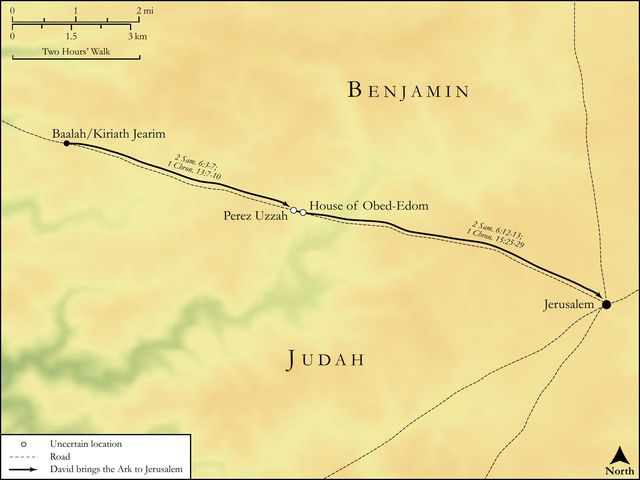
See on the biblical-era map
Study this verse
Public-domain commentary
Matthew Henry
From his Commentary on the Whole Bible. Henry comments on passages, not single verses — this entry covers 1 Chronicles 15:25–29. His two-level outline is real structure in the source text, so it is rendered as structure.
All things being got ready for the carrying of the ark to the city of David, and its reception there, we have here an account of the solemnity of this conveyance thither from the house of Obed-edom.
I.God helped the Levites that carried it.
The ark was no very great burden, that those who carried it needed any extraordinary help. But,
1.It is good to take notice of the assistance of the divine providence even in those things that fall within the compass of our natural powers: if God did not help us, we could not stir a step.
2.In all our religious exercises we must particularly derive help from heaven. See Act 26:22. All our sufficiency for holy duties is from God.
3.The Levites, remembering the breach upon Uzza, were probably ready to tremble when they took up the ark; but God helped them, that is, he encouraged them to it, silenced their fears, and strengthened their faith.
4.God helped them to do it decently and well, and without making any mistake. If we perform any religious duties so as to escape a breach, and come off with our lives, we must own it is God that helps us; for, if left to ourselves, we should be guilty of some fatal miscarriages. God's ministers that bear the vessels of the Lord have special need of divine help in their ministrations, that God in them may be glorified and his church edified. And, if God help the Levites, the people have the benefit of it.
II.When they experienced the tokens of God's presence with them they offered sacrifices of praise to him, Ch1 15:26.
This also he helped them to do. They offered these bullocks and rams perhaps by way of atonement for the former error, that it might not now be remembered against them, as well as by way of acknowledgment for the help now received.
III.There were great expressions of rejoicing used:
the sacred music was played, David danced, the singers sang, and the common people shouted, Ch1 15:27, Ch1 15:28. This we had before, Sa2 6:14, Sa2 6:15. Learn hence,
1.That we serve a good master, who delights to have his servants sing at their work.
2.That times of public reformation are, and should be, times of public rejoicing. Those are unworthy of the ark that are not glad of it.
3.It is not any disparagement to the greatest of men to show themselves zealous in the acts of devotion. Michal indeed despised David (Ch1 15:29); but her despising him did not make him at all despicable; he did not regard it himself, nor did any that were wise and good (and why should we covet the esteem of any but such?) think the worse of him.
Continue studying 1 Chronicles 15:25 across the web’s major study libraries — every link below opens this exact verse, chapter, or book on the destination site.
Read & Compare
 BibleGatewayThis verse in more than 200 translations and 70 languages.
 Bible.comThe YouVersion reader — hundreds of translations, reading plans, and highlights.
 ESV.orgCrossway's official English Standard Version reader.
 NET BibleThe NET translation with 60,000+ translators' notes on every rendering decision.
 STEP BibleTyndale House's free study tool — original text, vocabulary, and scholarly resources.
 BibliaLogos Bible Software's free web reader.
 USCCBThe New American Bible (Revised Edition) with the U.S. bishops' study notes.
Commentaries
 BibleHub CommentariesDozens of classic commentaries on this verse, gathered on one page.
 StudyLightMore than 100 commentary sets — the largest collection on the web.
 BibleRefPlain-English commentary on what this verse means, verse by verse.
 Enduring WordDavid Guzik's free commentary on this chapter, widely used by Bible teachers.
 Bible Study ToolsVerse commentary alongside Greek and Hebrew study aids.
Original Language & Research
- BibleHub InterlinearThe verse word by word — original language, transliteration, and English.
- BibleHub LexiconEvery word's original-language definition and Strong's entry.
 Blue Letter BibleDeep-study tools — Strong's numbers, concordance, and word studies.
 SefariaThe Hebrew text with Rashi and centuries of Jewish commentary.
Sermons, Hymns & Audio


TrulyRandomVerse is not affiliated with these sites and doesn’t control their content. They’re linked because they’re genuinely useful.
Summary
1 Chronicles 15:25 vividly portrays King David's second, meticulously prepared, and joy-filled endeavor to transport the Ark of the Covenant, the sacred emblem of God's presence, from Obed-Edom's residence to Jerusalem. This pivotal event, executed with the unified participation of Israel's leadership, signifies a profound national recommitment to proper worship and a deep reverence for God's holiness, culminating in a triumphant and spiritually rich re-establishment of the divine presence at the heart of Israel's capital.
Context
ShowHideLiterary Context
This verse is strategically placed within a critical narrative segment detailing the Ark of the Covenant's relocation. It directly follows David's careful preparations and the explicit instructions given to the Levites regarding the proper, lawful method of carrying the Ark on poles, as mandated by Mosaic Law (1 Chronicles 15:1-14). This deliberate adherence to divine command stands in stark contrast to the tragic first attempt recounted in 1 Chronicles 13, where Uzzah's death served as a severe consequence of disregarding God's specific commands for handling the Ark's sacredness. Therefore, the successful journey described in 1 Chronicles 15:25 marks a significant turning point, demonstrating David's humble submission and learned obedience, thereby setting the stage for the Ark's permanent placement in Jerusalem and the subsequent plans for the construction of the Temple.
Historical & Cultural Context
In ancient Israel, the Ark of the Covenant was the preeminent sacred object, embodying God's throne and His covenantal presence among His chosen people. Its handling was strictly governed by intricate Mosaic laws (e.g., Numbers 4:15). David's reign was a period characterized by the consolidation of the Israelite nation and the centralization of its religious life, with Jerusalem emerging as both the political and spiritual nexus. Bringing the Ark to Jerusalem was far more than a logistical maneuver; it was a profound theological declaration, signifying God's dwelling at the very core of the nation and validating David's kingship under divine mandate. The collective involvement of "the elders of Israel, and the captains over thousands" underscores the unified, national character of this sacred undertaking, reflecting a societal structure where religious and civil leadership were intricately interwoven.
Key Themes
ShowHideThe triumphant relocation of the Ark in this chapter is replete with profound thematic significance. Obedience to Divine Law is showcased as paramount, as David's meticulous adherence to the precise instructions for carrying the Ark (Numbers 4) directly contrasts with the earlier failure and ensures divine blessing. The Presence of God is a central theme, with the Ark serving as the tangible symbol of Yahweh's immanence among His people, bringing both holiness and blessing, as vividly demonstrated by the prosperity experienced in Obed-Edom's household (1 Chronicles 13:14). Furthermore, the "joy" mentioned in the verse highlights the theme of Joy in Righteous Worship. This joy is not superficial but a deep, communal celebration born from proper reverence and the tangible experience of God's favor, a stark departure from the fear and sorrow that followed Uzzah's death (1 Chronicles 13:12). Finally, the Unity of Leadership is emphasized by the inclusion of elders and captains, signifying a collective national commitment to seeking God's presence.
Exposition and Analysis
ShowHideKey Word Analysis
ShowHideAs per H1732, this name signifies "loving." In this context, David transcends merely a king; he embodies the repentant leader who has learned from a grievous error (Uzzah's death) and is now committed to executing God's will according to divine instruction. His leadership in this event demonstrates humility, spiritual maturity, and a deep desire to honor God above personal ambition.
As per H1285, this term refers to "a compact (because made by passing between pieces of flesh); confederacy, (con-) feder(-ate), covenant, league." In the phrase "ark of the covenant," it emphasizes the Ark's primary purpose as the repository of the tablets of the Law, symbolizing God's binding agreement with Israel. It underscores the foundational relationship between God and His people, established on His terms.
As per H8057, this word denotes "blithesomeness or glee, (religious or festival); [idiom] exceeding(-ly), gladness, joy(-fulness), mirth, pleasure, rejoice(-ing)." It signifies a profound, often communal, sense of gladness, delight, and festivity. In this context, it is not merely a fleeting emotion but a deep spiritual state, often associated with worship, divine blessing, or the celebration of God's acts of salvation, signifying the appropriate, Spirit-filled response to God's presence when approached with proper reverence and obedience.
Verse Breakdown
ShowHide"So David, and the elders of Israel, and the captains over thousands"
This opening clause powerfully highlights the unified and comprehensive nature of the undertaking. King David initiates and leads the endeavor, but he is joined by "the elders of Israel," who represent the civil and spiritual leadership of the various tribes, and "the captains over thousands," signifying the military and administrative leadership. This collective participation underscores the national importance and widespread support for bringing the Ark to Jerusalem, indicating a deliberate learning from the past where David initially acted with less collective counsel and adherence to divine protocol.
"went to bring up the ark of the covenant of the LORD"
This phrase clearly states the explicit purpose of their journey. The verb "bring up" (לְהַעֲלוֹת, from H5927 ʻâlâh) implies a solemn procession and elevation, signifying the Ark's exalted and sacred status. The full title "the ark of the covenant of the LORD" (combining H727 ʼârôwn, H1285 bᵉrîyth, and H3068 Yᵉhôvâh) reiterates its identity as the central symbol of God's tangible presence and His binding covenant relationship with Israel, emphasizing the supreme sacredness of the object and the gravity of the mission.
"out of the house of Obededom"
This specifies the Ark's temporary dwelling place. After the tragic death of Uzzah, the Ark had remained in the house of Obed-Edom the Gittite for three months (1 Chronicles 13:13), during which time God greatly blessed his household. This detail serves as a powerful testament to the blessings associated with God's presence when properly honored and approached, providing a positive backdrop and encouragement for this second, successful attempt to bring the Ark to its rightful place.
"with joy"
This concluding phrase encapsulates the prevailing atmosphere of the entire procession. Unlike the previous attempt, which ended in fear, sorrow, and judgment, this journey is characterized by exuberant "joy" (H8057 simchâh). This profound joy is a direct result of humble obedience to God's commands, the successful re-engagement with His holy presence, and the confident anticipation of His continued blessing. It reflects a national celebration of God's faithfulness and their renewed covenant relationship with Him.
Literary Devices
ShowHideThe verse masterfully employs several literary devices to convey its profound meaning and emotional resonance. Narrative Progression is prominently featured, as this verse marks a crucial advancement in David's overarching efforts to centralize Israel's worship in Jerusalem, building upon the previous failure and demonstrating a learned obedience. Symbolism is central to the verse's impact, with "the ark of the covenant of the LORD" serving as the preeminent symbol of God's tangible presence, His absolute holiness, and His enduring covenant relationship with Israel. The Ark's movement is thus not merely physical but deeply theological, representing the re-establishment of God's active dwelling among His people. There is also a strong element of Contrast between this joyous, successful endeavor and the previous disastrous attempt, powerfully highlighting the dire consequences of disobedience versus the abundant blessings of adherence to divine law. Finally, the inclusion of "the elders of Israel, and the captains over thousands" demonstrates Synecdoche, where a representative part (the unified leadership) stands in for the whole (the entire nation's collective effort and spiritual commitment).
Theological and Thematic Connections
ShowHide1 Chronicles 15:25 powerfully illustrates the profound theological principle that God's holiness demands reverence and obedience, and when approached rightly, His presence brings profound joy and blessing. David's journey from a misguided, presumptuous attempt to a meticulously obedient one underscores the timeless importance of seeking God on His terms, not ours. The Ark, as the dwelling place of God's presence, was not to be treated casually, but with the utmost respect for the divine instructions concerning its handling. The resulting "joy" is a testament to the deep delight found in aligning human will with divine will, a spiritual principle that transcends the Old Covenant. It teaches that true worship is both reverent and celebratory, rooted in a proper understanding of who God is and how He desires to be approached.
Reflection and Application
ShowHideThis verse offers a timeless and profound lesson in humility, obedience, and the very nature of true worship. David, despite being described as a "man after God's own heart," was not immune to mistakes, but his willingness to learn from failure and meticulously adhere to God's instructions is a powerful and enduring example for all believers. We are profoundly reminded that our approach to God must always be marked by deep reverence, not by casual presumption. While we no longer have a physical Ark as a tangible symbol of God's presence, the underlying principle remains eternally valid: God is holy, and He calls us to worship Him "in spirit and truth" (John 4:24). When we align our lives and our worship with His revealed will, the result is not burdensome obligation but profound, unadulterated joy. This joy is a precious gift of His presence, transforming our hearts, our families, and our communities. It also challenges leaders, whether in the church, family, or workplace, to prioritize spiritual integrity and to lead others in seeking God's presence according to His prescribed ways, thereby fostering an environment where obedience leads to collective celebration and divine blessing.
Questions for Reflection
ShowHideFAQ
ShowHideWhat was the significance of the Ark of the Covenant, and why was its transport so important?
ShowHideThe Ark of the Covenant was the most sacred object in ancient Israel, representing the very presence and throne of God among His people. It contained the tablets of the Law (symbolizing God's covenant), a pot of manna (symbolizing His provision), and Aaron's staff that budded (symbolizing His priestly authority). Its transport was of immense importance because bringing it to Jerusalem would establish the city as the spiritual capital of Israel, centralizing worship and profoundly signifying God's dwelling at the heart of the nation. It also legitimized David's kingship under divine authority and fulfilled the deep desire to have God's tangible presence at the center of national life. The meticulous nature of its transport, as described in 1 Chronicles 15, underscored its immense sacredness and the absolute necessity of adhering to God's specific instructions for handling it.
Why was the first attempt to move the Ark a failure, and what did David learn from it?
ShowHideThe first attempt to move the Ark, detailed in 1 Chronicles 13, failed disastrously because David and the people did not follow God's explicit instructions for transporting the Ark. Instead of having the Kohathite Levites carry it on poles (as prescribed in Numbers 4:15), they placed it on a new cart, a method used by the Philistines but forbidden for Israel. When the oxen stumbled, Uzzah, a non-Levite, reached out to steady the Ark and was struck dead by God for touching it, an act forbidden by divine law. David learned a profound and painful lesson about God's absolute holiness and the critical importance of strict obedience to divine commands, especially concerning sacred things. This led to his careful preparation and adherence to the Law in the second, successful attempt.
Who was Obed-Edom, and why was the Ark kept at his house?
ShowHideObed-Edom was a Gittite, likely a Levite of the family of Kohath, who was responsible for the storage and care of the Ark. After Uzzah's tragic death, David was afraid to bring the Ark into Jerusalem and instead diverted it to the house of Obed-Edom for three months (1 Chronicles 13:13). During this time, God greatly blessed Obed-Edom and his entire household, demonstrating that God's presence, when honored and approached correctly, brings abundant blessing and favor, not just judgment. This evident blessing likely encouraged David to proceed with the second, meticulously planned attempt to bring the Ark to Jerusalem.
Christ-Centered Fulfillment
ShowHideThe triumphant movement of the Ark of the Covenant, a tangible symbol of God's presence, into Jerusalem with such profound joy and reverence, powerfully foreshadows the ultimate dwelling of God among His people in the person of Jesus Christ. Just as the Ark represented God's immanence and covenant presence in the Old Covenant, Christ is Immanuel, literally "God with us" (Matthew 1:23). The meticulous care and perfect obedience required to approach the Ark point directly to the perfect obedience of Christ, who flawlessly fulfilled the Law and, through His sinless life and atoning sacrifice, made a way for humanity to draw near to a holy God without fear of judgment. The entire Old Testament tabernacle and temple system, with the Ark at its sacred core, served as a profound shadow of the true tabernacle, which is Christ Himself, for "the Word became flesh and dwelt among us" (John 1:14). Through His atoning sacrifice on the cross, Jesus became the ultimate mercy seat, the very place where God's perfect holiness and boundless mercy meet (Romans 3:25). The "joy" that accompanied the Ark's arrival in Jerusalem prefigures the far greater, eternal joy of salvation and the indwelling of the Holy Spirit in believers, making us living temples where God now dwells by His Spirit (1 Corinthians 6:19). The ultimate fulfillment of God's desire to dwell intimately among His people is found not in a physical box or building, but in the person of Christ and His Spirit-filled church, anticipating the glorious eternal reality of God dwelling directly with humanity in the New Jerusalem (Revelation 21:3).