


2 Samuel 6:16
Bible text: King James Version (1769 Blayney text) · Public domain
Bible text: King James Version with Strong's numbers · Public domain
Bible text: Berean Standard Bible · Public domain
Bible text: American Standard Version (1901) · Public domain
Bible text: World English Bible, Messianic edition · Public domain
Bible text: Geneva Bible (1599) · Public domain
Bible text: Young's Literal Translation · Public domain
- וְהָיָהve·ha·Yahand it wasH1961Conj-w ¦ V-Qal-ConsecPerf-3msVerb Qal Consecutive Perfect 3rd Singular Masculineוְandהָיָהit was
- אֲרוֹן'a·Ron[the] ark ofH727N-mscNoun Singular Masculine Construct
- יְהוָהYah·wehYahwehH3068N-properNoun Proper Title
- בָּאba'comingH935V-Qal-Perf-3msVerb Qal Perfect 3rd Singular Masculine
- עִיר'ir[the] city ofH5892N-fscNoun Singular Feminine Construct
- דָּוִדda·VidDavidH1732N-proper-mNoun Proper Masculine
- וּמִיכַלu·mi·Khaland MichalH4324Conj-w ¦ N-proper-fNoun Proper FeminineוּandמִיכַלMichal
- בַּתbat[the] daughter ofH1323N-fscNoun Singular Feminine Construct
- שָׁאוּלsha·'UlSaulH7586N-proper-mNoun Proper Masculine
- נִשְׁקְפָהnish·ke·Fahshe looked downH8259V-Niphal-Perf-3fsVerb Niphal Perfect 3rd Singular Feminine
- בְּעַדbe·'AdthroughH1157Adj-cscAdjective Numerical Singular common gender Construct
- הַחַלּוֹןha·cha·Lonthe windowH2474Art ¦ N-msNoun Singular Masculine Absoluteהַtheחַלּוֹןwindow
- וַתֵּרֶאva·Te·re'and she sawH7200Conj-w ¦ V-Qal-ConsecImperf-3fsVerb Qal Consecutive Imperfect 3rd Singular Feminineוַandתֵּרֶאshe saw
- אֶת'et<obj.>H853DirObjMParticle Object Indicator
- הַמֶּלֶךְha·Me·lekhthe kingH4428Art ¦ N-msNoun Singular Masculine Absoluteהַtheמֶּלֶךְking
- דָּוִדda·VidDavidH1732N-proper-mNoun Proper Masculine
- מְפַזֵּזme·fa·ZezleapingH6339V-Piel-Prtcpl-msVerb Piel Participle Singular Masculine Absolute
- וּמְכַרְכֵּרu·me·khar·Kerand dancingH3769Conj-w ¦ V-Piel-Prtcpl-msVerb Piel Participle Singular Masculine Absoluteוּandמְכַרְכֵּרdancing
- לִפְנֵיlif·Nei<to> beforeH6440Prep-l ¦ N-mpcNoun Plural Masculine Constructלִ<to>פְנֵיbefore
- יְהוָהYah·wehYahwehH3068N-properNoun Proper Title
- וַתִּבֶזva·Ti·vezand she despisedH959Conj-w ¦ V-Qal-ConsecImperf-3fsVerb Qal Consecutive Imperfect 3rd Singular Feminineוַandתִּבֶזshe despised
- לוֹlo<to> <the> himPrep-l ¦ 3msSuffix Personal 3rd Singular Masculineל<to> <the>וֹhim
- בְּלִבָּהּbe·li·Bahin her heartH3820Prep-b ¦ N-msc ¦ 3fsNoun Singular Masculine Constructבְּinלִבָּheartהּher
English is a literal word-by-word gloss of the Hebrew, not the KJV's wording. Why?
This is the original text the KJV's translators worked from — each Hebrew word with its own literal English meaning in this verse, prepared by scholars at Tyndale House, Cambridge. The KJV translates whole sentences, not word by word, so its wording differs: one Hebrew word can become several English words, and the KJV may choose “the LORD” where the gloss reads “Yahweh”. Both are faithful — they answer different questions. For the KJV's own rendering, switch to the KJV text.
Details
See on the biblical-era maps
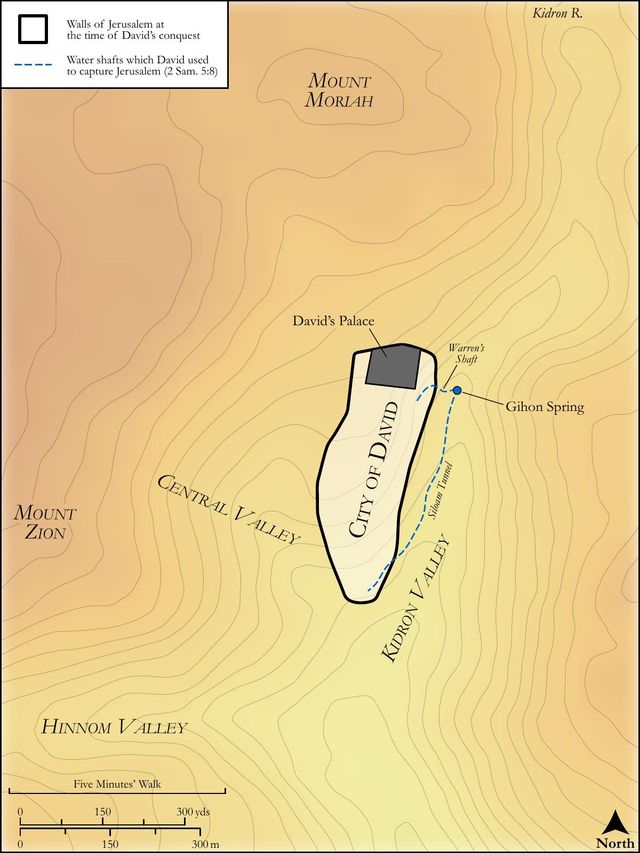
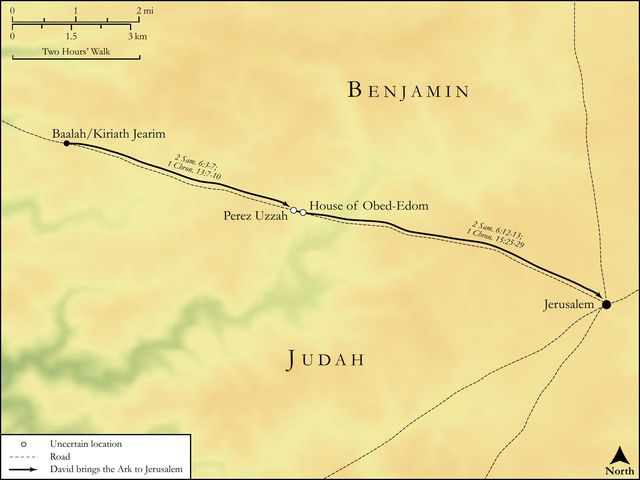
Study this verse
Public-domain commentary
Matthew Henry
From his Commentary on the Whole Bible. Henry comments on passages, not single verses — this entry covers 2 Samuel 6:12–19. His four-level outline is real structure in the source text, so it is rendered as structure.
We have here the second attempt to bring the ark home to the city of David; and this succeeded, though the former miscarried.
I.It should seem the blessing with which the house of Obed-edom was blessed for the ark's sake was a great inducement to David to bring it forward; for when that was told him (Sa2 6:12) he hastened to fetch it to him. For,
1.It was an evidence that God was reconciled to them, and his anger was turned away. As David could read God's frowns upon them all in Uzzah's stroke, so he could read God's favour to them all in Obed-edom's prosperity; and, if God be at peace with them, they can cheerfully go on with their design.
2.It was an evidence that the ark was not such a burdensome stone as it was taken to be, but, on the contrary, happy was the man that had it near him. Christ is indeed a stone of stumbling, and a rock of offence, to those that are disobedient; but to those who believe he is a corner-stone, elect, precious, Pe1 2:6-8. When David heard that Obed-edom had such joy of the ark, then he would have it in his own city. Note, The experience others have had of the gains of godliness should encourage us to be religious. Is the ark a blessing to others' houses? let us bid it welcome to ours; we may have it, and the blessing of it, without fetching it from our neighbours.
II.Let us see how David managed the matter now.
1.He rectified the former error. He did not put the ark in a cart now, but ordered those whose business it was to carry it on their shoulders. This is implied here (Sa2 6:13) and expressed Ch1 15:15. Then we make a good use of the judgments of God on ourselves and others when we are awakened by them to reform and amend whatever has been amiss.
2.At their first setting out he offered sacrifices to God (Sa2 6:13) by way of atonement for their former errors and in a thankful acknowledgment of the blessings bestowed on the house of Obed-edom. Then we are likely to speed in our enterprises when we begin with God and give diligence to make our peace with him, When we attend upon God in holy ordinances our eye must be to the great sacrifice, to which we owe it that we are taken into covenant and communion with God, Psa 50:5.
3.He himself attended the solemnity with the highest expressions of joy that could be (Sa2 6:14): He danced before the Lord with all his might; he leaped for joy, as one transported with the occasion, and the more because of the disappointment he met with the last time. It is a pleasure to a good man to see his errors rectified and himself in the way of his duty. His dancing, I suppose, was not artificial, by any certain rule or measure, nor do we find that any danced with him; but it was a natural expression of his great joy and exultation of mind. He did it with all his might; so we should perform all our religious services, as those that are intent upon them and desire to do them in the best manner. All our might is little enough to be employed in holy duties: the work deserves it all. On this occasion David laid aside his imperial purple, and put on a plain linen ephod, which was light and convenient for dancing, and was used in religious exercises by those who were no priests, for Samuel wore one, Sa1 2:18. That great prince thought it no disparagement to him to appear in the habit of a minister to the ark.
4.All the people triumphed in this advancement of the ark (Sa2 6:15): They brought it up into the royal city with shouting, and with sound of trumpet, so expressing their own joy in loud acclamations, and giving notice to all about them to rejoice with them. The public and free administration of ordinances, not only under the protection, but under the smiles, of the civil powers, is just matter of rejoicing to any people. 5. the ark was safely brought to, and honourably deposited in, the place prepared for it, Sa2 6:17. They set it in the midst of the tabernacle, or tent, which David had pitched for it; not the tabernacle which Moses reared, for that was at Gibeon (Ch2 1:13), and, we may suppose, being made of cloth, in so many hundred years it had gone to decay and was not fit to be removed; but this was a tent set up on purpose to receive the ark. He would not bring it into a private house, no, not his own, lest it should seem to be too much engrossed, and people's resort to it, to pray before it, should be less free; yet he would not build a house for it, lest that should supersede the building of a more stately temple in due time, and therefore, for the present, he placed it within curtains, under a canopy, in imitation of Moses's tabernacle. As soon as ever it was lodged, he offered burnt-offerings and peace-offerings, in thankfulness to God that the business was now done without any more errors or breaches, and in supplication to God for the continuance of his favour. Note, All our joys must be sanctified both with praises and prayers; for with such sacrifices God is well pleased. New, it should seem, he penned the 132nd Psa 6:1-10. The people were then dismissed with great satisfaction. He sent them away,
(1.)With a gracious prayer: He blessed them in the name of the Lord of hosts (v. 18), having not only a particular interest in heaven as a prophet, but an authority over them as a prince; for the less is blessed of the better, Heb 7:7. He prayed to God to bless them, and particularly to reward them for the honour and respect they had now shown to his ark, assuring them they should be no losers by their journey, but the blessing of God upon their affairs at home would more than bear their charges. He testified his desire for their welfare by this prayer for them, and let them know they had a king that loved them.
(2.)With a generous treat; for so it was, rather than a distribution of alms. The great men, it is probable, he entertained at his own house, but to the multitude of Israel, men and women (and children, says Josephus), he dealt to every one a cake of bread (a spice-cake, so some), a good piece of flesh - a handsome decent piece (so some) - a part of the peace-offerings (so Josephus), that they might feast with him upon the sacrifice, and a flagon, or bottle, of wine, Sa2 6:19. Probably he ordered this provision to be made for them at their respective quarters, and this he did,
[1.]In token of his joy and gratitude to God. When the heart is enlarged in cheerfulness the hand should be opened in liberality. The feast of Purim was observed with sending portions one to another, Est 9:22. As those to whom God is merciful ought to show mercy in forgiving, so those to whom God is bountiful ought to exercise bounty in giving.
[2.]To recommend himself to the people, and confirm his interest in them; for every one is a friend to him that giveth gifts. Those that cared not for his prayers would love him for his generosity; and this would encourage them to attend him another time if he saw cause to call them together.
Historical interpretation
Historical reception
1 surviving comment on this verse from the historical church.
But even the dancing of the body is considered praiseworthy in honor of God. In fact, David danced before the Ark of the Lord and Michal, the daughter of Saul, saw him dancing and playing musical instruments in the presence of the Lord. After he returned home, she said to him, 'How the king of Israel has distinguished himself today! He has exposed himself in the sight of the maidservants of his servants, as one of the rabble might shamelessly expose himself!' David said to Michal in the presence of the Lord, 'It was before the Lord, who chose me rather than your father or anyone from his house when he appointed me ruler over the Lord's people Israel and Judah. I will celebrate before the Lord. I will become even more undignified than this, and I will be humiliated in my own eyes. But by these slave girls you spoke of, I will be held in honor.' And Michal, he said, had no son to the daughter of Saul until the day of his death. It is a clear example, therefore, that even the Prophet who played on the musical instruments and danced before the Ark of the Lord, was justified; and she who criticized him was condemned to barrenness.
Continue studying 2 Samuel 6:16 across the web’s major study libraries — every link below opens this exact verse, chapter, or book on the destination site.
Read & Compare
 BibleGatewayThis verse in more than 200 translations and 70 languages.
 Bible.comThe YouVersion reader — hundreds of translations, reading plans, and highlights.
 ESV.orgCrossway's official English Standard Version reader.
 NET BibleThe NET translation with 60,000+ translators' notes on every rendering decision.
 STEP BibleTyndale House's free study tool — original text, vocabulary, and scholarly resources.
 BibliaLogos Bible Software's free web reader.
 USCCBThe New American Bible (Revised Edition) with the U.S. bishops' study notes.
Commentaries
 BibleHub CommentariesDozens of classic commentaries on this verse, gathered on one page.
 StudyLightMore than 100 commentary sets — the largest collection on the web.
 BibleRefPlain-English commentary on what this verse means, verse by verse.
 Enduring WordDavid Guzik's free commentary on this chapter, widely used by Bible teachers.
 Bible Study ToolsVerse commentary alongside Greek and Hebrew study aids.
Original Language & Research
- BibleHub InterlinearThe verse word by word — original language, transliteration, and English.
- BibleHub LexiconEvery word's original-language definition and Strong's entry.
 Blue Letter BibleDeep-study tools — Strong's numbers, concordance, and word studies.
 SefariaThe Hebrew text with Rashi and centuries of Jewish commentary.
Sermons, Hymns & Audio


TrulyRandomVerse is not affiliated with these sites and doesn’t control their content. They’re linked because they’re genuinely useful.
Summary
2 Samuel 6:16 vividly portrays the climactic moment of the Ark of the LORD's entry into Jerusalem, where King David, in an unreserved demonstration of worship, danced and leaped with all his might before God. This scene of ecstatic devotion is sharply contrasted by the reaction of Michal, King Saul's daughter and David's wife, who observed him from a window and, in her heart, held him in profound contempt for what she perceived as an undignified and shameful display for a king. The verse thus encapsulates a foundational spiritual tension between humble, authentic worship and human pride, conventional decorum, or a lack of spiritual understanding.
Context
ShowHideLiterary Context
This verse is strategically placed at the zenith of David's successful second attempt to bring the Ark of the Covenant to Jerusalem, marking a pivotal moment in Israel's history. The narrative immediately precedes this event by detailing the catastrophic first attempt, where Uzzah died for improperly touching the Ark (as recounted in 2 Samuel 6:6-8). This tragic incident led David to temporarily house the Ark at the home of Obed-Edom, which subsequently received divine blessing (see 2 Samuel 6:10-11). Learning from this past error, David meticulously ensures that the Ark is transported according to Mosaic Law, with the Levites carrying it (as stipulated in 1 Chronicles 15:2). David's fervent dancing and the accompanying sacrifices (described in 2 Samuel 6:13) culminate in this joyous and reverent procession. Critically, 2 Samuel 6:16 directly sets the stage for Michal's ensuing confrontation with David in 2 Samuel 6:20-23, revealing the deep-seated implications of her disdain and its lasting impact on their relationship.
Historical & Cultural Context
The Ark of the Covenant was not merely a religious artifact; it was the most sacred object in ancient Israel, embodying God's tangible presence, His covenant with His people, and His divine throne. Its highly anticipated arrival in Jerusalem was an event of immense national and spiritual significance, solidifying the city's status as both the political and religious capital and symbolizing the unification of the nation under David's divinely sanctioned reign. Among the nations, kings typically maintained a highly dignified, often aloof, public persona, emphasizing their exalted status and authority. David's actions—implied to involve shedding his outer royal garments and wearing a simple linen ephod (as mentioned in 2 Samuel 6:14) while dancing with such abandon—would have been perceived by many, particularly those concerned with traditional royal decorum like Michal, as a profound breach of kingly dignity, potentially bringing shame upon the royal household. Michal's explicit identification as "Saul's daughter" is profoundly significant; she represents the vestiges of the old, Saulide order, which was characterized by human pride, a focus on external appearances, and a more formal, less intimate relationship with God, standing in stark contrast to David's humble, God-centered kingship.
Key Themes
ShowHideThis verse powerfully illustrates the profound theme of authentic worship versus human pride and formality. David's uninhibited dancing before the Ark underscores his deep, personal devotion and radical humility before God, demonstrating his prioritization of divine honor over his own kingly dignity or societal expectations. It highlights that true worship often transcends conventional societal norms and personal comfort, demanding a full surrender of self. Conversely, Michal's contempt reveals a pervasive spirit of spiritual disconnect and judgmentalism, rooted in a concern for outward appearances and perhaps a lingering attachment to the more formal, less God-focused reign of her father, Saul, whose own downfall was marked by disobedience and pride (as seen in 1 Samuel 15). The narrative also explores the theme of divine presence and its varied impact, as the Ark's arrival elicits profound joy and reverence from David, yet a critical and scornful spirit from Michal, demonstrating how individuals respond distinctly to God's manifest presence based on the posture of their hearts. Ultimately, it touches on humility in leadership, showcasing David's willingness to humble himself before the Lord, a defining characteristic that distinguished him from his predecessor, Saul, who often prioritized his own glory.
Exposition and Analysis
ShowHideKey Word Analysis
ShowHideThis Hebrew verb (H6339) denotes an active, agile, and often exuberant movement, specifically suggesting jumping or springing. In the context of worship, it conveys an uninhibited, energetic expression of joy and devotion, indicating that David's movements were not merely formal steps but passionate, vigorous leaps, a full-bodied outpouring of praise.
This verb (H3769) means to whirl or to dance in a circular motion, often associated with a frenzied or ecstatic form of worship. Coupled with "leaping," it paints a vivid picture of David's worship as fervent, unrestrained, and physically demanding, a complete and unreserved expression of his heart's adoration for the LORD.
This strong Hebrew verb (H959) signifies to disesteem, scorn, or hold in profound contempt. It implies a deep-seated, internal judgment and a fundamental lack of respect or appreciation. Michal's contempt was not a fleeting thought but a settled attitude of the heart, indicating a profound spiritual and emotional alienation from David's devotion and the very nature of his worship.
Verse Breakdown
ShowHide"And as the ark of the LORD came into the city of David,"
This opening clause establishes the sacred and momentous setting. The Ark's entry into Jerusalem, now firmly established as the capital, signifies the centralization of God's presence and worship within the united kingdom. This is a moment of immense national and spiritual triumph, symbolizing God's dwelling among His people and the legitimization of David's reign.
"Michal Saul's daughter looked through a window,"
This detail is laden with symbolic meaning. Michal's vantage point from a window suggests a posture of detachment, observation, and separation rather than active participation in the joyous procession. Her explicit identification as "Saul's daughter" is crucial, linking her not only to her lineage but also to the values and priorities of the previous, failed dynasty, which often prioritized human dignity, external appearances, and political expediency over humble, fervent devotion to God.
"and saw king David leaping and dancing before the LORD;"
This describes David's actions, which serve as the direct catalyst for Michal's reaction. The phrase "before the LORD" is paramount, emphasizing that David's actions were directed solely towards God, not for the approval or admiration of human onlookers. His "leaping and dancing" portray an uninhibited, physically expressive, and deeply personal form of worship, demonstrating his profound joy, humility, and complete surrender in God's manifest presence.
"and she despised him in her heart."
This concluding clause reveals the profound internal judgment and spiritual alienation of Michal. Her contempt was not merely external disapproval or a fleeting thought but a deep-seated, settled scorn within her heart. This indicates a fundamental spiritual misalignment with David's authentic devotion and a complete lack of appreciation for the sacred nature of his worship, foreshadowing the subsequent conflict and the tragic barrenness of their relationship.
Literary Devices
ShowHideThe verse is rich in Contrast, starkly juxtaposing King David's uninhibited, joyful, and humble worship with Michal's cold, internal disdain and judgmental spirit. This highlights the divergent spiritual postures and priorities of the two characters. Irony is powerfully present, as Michal, a queen, despises her king for an act of profound reverence and humility before the true King, God. Her concern for earthly dignity and conventional propriety blinds her to the spiritual significance and beauty of David's devotion. The "window" from which Michal observes functions as potent Symbolism, representing her emotional and spiritual detachment, her inability to truly participate in the communal joy, and perhaps her narrow, limited perspective on what constitutes appropriate worship or kingly behavior. The verse also serves as powerful Characterization, vividly revealing David's heart as one passionately devoted to God, willing to humble himself completely, and Michal's heart as one marked by pride, spiritual alienation, and a critical spirit. Furthermore, Michal's internal contempt Foreshadows the subsequent confrontation between them in 2 Samuel 6:20-23 and the ultimate tragic barrenness of their marriage, indicating a deep and irreparable rift that stems from their differing spiritual orientations.
Theological and Thematic Connections
ShowHideThis pivotal verse offers profound insights into the nature of true worship and the posture of the human heart before God. David's uninhibited worship demonstrates that genuine devotion is not bound by human decorum, social status, or fear of judgment but flows organically from a heart consumed with love, reverence, and gratitude for God's presence. It challenges the notion that worship must always be formal, reserved, or aesthetically pleasing to human eyes, suggesting that authentic praise can be raw, physical, and deeply personal. Conversely, Michal's disdain serves as a sobering cautionary tale, illustrating how pride, an excessive focus on external appearances, or a fundamental lack of spiritual understanding can lead to despising what God values most—a humble, passionate, and surrendered heart. The verse underscores the biblical principle that God looks at the heart (as affirmed in 1 Samuel 16:7), and true worship is ultimately about offering oneself fully and unreservedly to Him, regardless of human approval or judgment.
Reflection and Application
ShowHide2 Samuel 6:16 serves as a profound challenge to believers, prompting us to critically examine the authenticity, freedom, and depth of our own worship. Are we willing to express our devotion to God wholeheartedly, even if it means appearing "undignified," unconventional, or even foolish in the eyes of others? David's example calls us to shed self-consciousness, the fear of human approval, and the constraints of societal expectations, prioritizing God's glory and pleasure above all else. It compels us to consider what might hinder our worship—is it fear of judgment, pride, a desire for control, or simply a lack of genuine, passionate love for the Lord? Furthermore, Michal's reaction stands as a sobering reminder against spiritual judgment, criticism, and a focus on outward appearances. Do we ever find ourselves looking down upon, criticizing, or despising the genuine, perhaps unfamiliar, expressions of faith in others? True worship is not about conforming to human expectations or maintaining a façade of decorum, but about pouring out our hearts before the Almighty, in spirit and truth. This verse encourages us to cultivate a heart characterized by humility, uninhibited praise, and spiritual discernment, rather than a spirit of criticism, pride, or self-righteousness that can stifle both our own worship and our appreciation for the diverse ways others genuinely encounter and honor God.
Questions for Reflection
ShowHideFAQ
ShowHideWhy was David dancing so wildly, and was it appropriate for a king?
ShowHideDavid's dancing was an act of profound, uninhibited worship and celebration before the LORD, not merely a social dance or performance. He was expressing intense, overflowing joy and gratitude for God's presence returning to Israel in the Ark of the Covenant. While it might have seemed undignified by conventional human royal standards, David intentionally humbled himself, even removing his outer royal robes to wear a simpler linen ephod (as described in 2 Samuel 6:14), signifying that before God, all are equal and earthly status is irrelevant. His actions demonstrated that his ultimate allegiance, reverence, and deepest devotion were to God, not to his earthly crown or the opinions of his subjects. He later defended his actions to Michal, stating he would be "even more undignified than this" (as recorded in 2 Samuel 6:22), emphasizing his unwavering commitment to worship God freely and without reservation.
Why did Michal despise David in her heart?
ShowHideMichal despised David because she viewed his uninhibited dancing as an undignified, shameful, and even vulgar display for a king. As "Saul's daughter," she likely held a more traditional, Saulide view of kingship, which emphasized regal decorum, stately appearance, and the maintenance of royal prestige. She perceived David's actions as lowering himself to the level of commoners or "worthless fellows" (as she explicitly states in 2 Samuel 6:20), failing entirely to appreciate the spiritual depth, humility, and authenticity of his worship. Her profound contempt stemmed from a complex blend of personal pride, a rigid concern for royal propriety, and a spiritual disconnect from David's passionate, God-centered devotion. This internal disdain foreshadowed the breakdown of their relationship and her subsequent barrenness (as noted in 2 Samuel 6:23), symbolizing the spiritual barrenness of a heart devoid of true worship.
What was the significance of the Ark of the LORD coming into the City of David?
ShowHideThe Ark of the LORD was the most sacred object in Israel, representing God's very throne, His covenant presence, and His dwelling among His people. Its arrival in the City of David (Jerusalem) was profoundly significant on multiple levels. It symbolized the establishment of Jerusalem as the spiritual and political capital of the united kingdom, centralizing worship and God's manifest presence in the heart of the nation. This event marked the fulfillment of God's promise to dwell among His people and profoundly legitimized David's reign as God's chosen king, under whom God's presence would be firmly established and accessible. This was a pivotal moment in Israel's history, signifying a new era of divine blessing, national unity, and direct access to God under a God-fearing king, paving the way for the eventual construction of the Temple.
Christ-Centered Fulfillment
ShowHideDavid's uninhibited worship in 2 Samuel 6:16, characterized by profound humility and passionate devotion, profoundly foreshadows the ultimate worship of the New Covenant, inaugurated and embodied by Jesus Christ. David, though a king, willingly humbled himself, stripping away royal dignity to dance before the Lord, prioritizing divine honor above his own. This act powerfully mirrors the profound humility of Christ, who, "though he was in the form of God, did not count equality with God a thing to be grasped, but emptied himself, by taking the form of a servant, being born in the likeness of men" (as articulated in Philippians 2:6-7). Jesus, our ultimate King and High Priest, did not come in earthly splendor but in humble servanthood, ultimately humbling himself "by becoming obedient to the point of death, even death on a cross" (as Philippians 2:8 declares). David's freedom in worship points to the greater freedom we now have in Christ to worship "in spirit and truth" (as Jesus teaches in John 4:23-24), unconstrained by legalistic burdens, human judgment, or external appearances, because Christ has set us free from the law of sin and death (as proclaimed in Romans 8:2). Michal's disdain for David's worship, rooted in pride and a focus on outward appearances, stands in stark contrast to those who embrace the "foolishness" of the cross (as described in 1 Corinthians 1:18), recognizing that true wisdom and power are found not in human dignity but in Christ crucified. Just as the Ark symbolized God's presence dwelling among His people, Christ himself is the ultimate dwelling place of God, "for in him the whole fullness of deity dwells bodily" (as Colossians 2:9 affirms), making Him the true Ark of the New Covenant, through whom we have direct and unhindered access to the Father.