


2 Samuel 6:22
- וּנְקַלֹּתִיu·ne·ka·Lo·tiand I will demean myselfH7043Conj-w ¦ V-Niphal-ConsecPerf-1csVerb Niphal Consecutive Perfect 1st Singular common genderוּandנְקַלֹּתִיI will demean myself
- עוֹד'OdstillH5750Adj-msAdjective Numerical Singular Masculine Absolute
- מִזֹּאתmi·Zotmore than thisH2063Prep-m ¦ PrtParticle Demonstrativeמִmore thanזֹּאתthis
- וְהָיִיתִיve·ha·Yi·tiand I will beH1961Conj-w ¦ V-Qal-ConsecPerf-1csVerb Qal Consecutive Perfect 1st Singular common genderוְandהָיִיתִיI will be
- שָׁפָלsha·FallowlyH8217Adj-msAdjective Singular Masculine Absolute
- בְּעֵינָיbe·'ei·Naiin my own eyesH5869Prep-b ¦ N-fdc ¦ 1csNoun Dual Feminine Constructבְּinעֵינָown eyesיmy
- וְעִםve·'imand withH5973Conj-w ¦ PrepPrepositionוְandעִםwith
- הָאֲמָהוֹתha·'a·ma·hOtthe maidservantsH519Art ¦ N-fpNoun Plural Feminine Absoluteהָtheאֲמָהוֹתmaidservants
- אֲשֶׁר'a·SherwhomH834RelParticle Relative
- אָמַרְתְּ'a·Martyou have saidH559V-Qal-Perf-2fsVerb Qal Perfect 2nd Singular Feminine
- עִמָּם'i·Mamwith themH5973Prep ¦ 3mpPreposition Definiteעִמָּwithםthem
- אִכָּבֵדָה'i·ka·Ve·dahI will be honoredH3513V-Niphal-Imperf-1csVerb Niphal Imperfect 1st Singular common gender
English is a literal word-by-word gloss of the Hebrew, not the KJV's wording. Why?
This is the original text the KJV's translators worked from — each Hebrew word with its own literal English meaning in this verse, prepared by scholars at Tyndale House, Cambridge. The KJV translates whole sentences, not word by word, so its wording differs: one Hebrew word can become several English words, and the KJV may choose “the LORD” where the gloss reads “Yahweh”. Both are faithful — they answer different questions. For the KJV's own rendering, switch to the KJV text.
Details
See on the biblical-era map
Study this verse
Public-domain commentary
Matthew Henry
From his Commentary on the Whole Bible. Henry comments on passages, not single verses — this entry covers 2 Samuel 6:20–23. His four-level outline is real structure in the source text, so it is rendered as structure.
David, having dismissed the congregation with a blessing, returned to bless his household (Sa2 6:20), that is, to pray with them and for them, and to offer up his family thanksgiving for this national mercy. Ministers must not think that their public performances will excuse them from their family-worship; but when they have, with their instructions and prayers, blessed the solemn assemblies, they must return in the same manner to bless their households, for with them they are in a particular manner charged. David, though he had prophets, and priests, and Levites, about him, to be his chaplains, yet did not devolve the work upon them, but himself blessed his household. It is angels' work to worship God, and therefore surely that can be no disparagement to the greatest of men.
Never did David return to his house with so much pleasure and satisfaction as he did now that he had got the ark into his neighbourhood; and yet even this joyful day concluded with some uneasiness, occasioned by the pride and peevishness of his wife. Even the palaces of princes are not exempt from domestic troubles. David had pleased all the multitude of Israel, but Michal was not pleased with his dancing before the ark. For this, when he was at a distance, she scorned him, and when he came home she scolded him. She was not displeased at his generosity to the people, nor did she grudge the entertainment he gave them; but she thought he degraded himself too much in dancing before the ark. It was not her covetousness, but her pride, that made her fret.
I.When she saw David in the street dancing before the Lord she despised him in her heart, Sa2 6:16.
She thought this mighty zeal of his for the ark of God, and the transport of joy he was in upon its coming home to him, was but a foolish thing, and unbecoming so great a soldier, and statesman, and monarch, as he was. It would have been enough for him to encourage the devotion of others, but she looked upon it as a thing below him to appear so very devout himself. "What a fool" (thinks she) "does my husband make of himself now! How fond is he of this ark, that might as well have lain still where it had lain for so many years! Much devotion has almost made him mad." Note, The exercises of religion appear very mean in the eyes of those that have little or no religion themselves.
II.When he came home in the very best disposition she began to upbraid him, and was so full of disdain and indignation that she could not contain till she had him in private, but went out to meet him with her reproaches. Observe,
1.How she taunted him (Sa2 6:20): "How glorious was the king of Israel today! What a figure didst thou make today in the midst of the mob! How unbecoming thy post and character!" Her contempt of him and his devotion began in the heart, but out of the abundance of that the mouth spoke. That which displeased her was his affection to the ark, which she wished he had no greater kindness for than she had: but she basely represents his conduct, in dancing before the ark, as lewd and immodest; and, while really she was displeased at it as a diminution to his honour, she pretended to dislike it as a reproach to his virtue, that he uncovered himself in the eyes of the maid-servants, as no man would have done but one of the vain fellows that cared not how much he shamed himself. We have no reason to think that this was true in fact. David, no doubt, observed decorum, and governed his zeal with discretion. But it is common for those that reproach religion thus to put false colours upon it and lay it under the most odious characters. To have abused any man thus for his pious zeal would have been very profane, but to abuse her own husband thus, whom she ought to have reverenced, and one whose prudence and virtue were above the reach of malice itself to disparage, one who had shown such affection for her that he would not accept a crown unless he might have her restored to him (Sa2 3:13), was a most base and wicked thing, and showed her to have more of Saul's daughter in her than of David's wife or Jonathan's sister.
2.How he replied to her reproach. He did not upbraid her with her treacherous departure from him to embrace the bosom of a stranger. He had forgiven that, and therefore had forgotten it, though, it may be, his own conscience, on this occasion, upbraided him with his folly in receiving her again (for that is said to pollute the land, Jer 3:1), but he justifies himself in what he did.
(1.)He designed thereby to honour God (Sa2 6:21): It was before the Lord, and with an eye to him. Whatever invidious construction she was pleased to put upon it, he had the testimony of his conscience for him that he sincerely aimed at the glory of God, for whom he thought he could never do enough. Here he reminds her indeed of the setting aside of her father's house, to make way for him to the throne, that she might not think herself the most proper judge of propriety: "God chose me before thy father, and appointed me to be ruler over Israel, and now I am the fountain of honour; and, if the expressions of a warm devotion to God were looked upon as mean and unfashionable in thy father's court, yet I will play before the Lord, and thereby bring them into reputation again. And, if this be to be vile (Sa2 6:22), I will be yet more vile." Note,
[1.]We should be afraid of censuring the devotion of others though it may not agree with our sentiments, because, for aught that we know, the heart may be upright in it, and who are we that we should despise those whom God has accepted?
[2.]If we can approve ourselves to God in what we do in religion, and do it as before the Lord, we need not value the censures and reproaches of men. If we appear right in God's eyes, no matter how mean we appear in the eyes of the world.
[3.]The more we are vilified for well-doing the more resolute we should be in it, and hold our religion the faster, and bind it the closer to us, for the endeavours of Satan's agents to shake us and to shame us out of it. I will be yet more vile.
(2.)He designed thereby to humble himself: "I will be base in my own sight, and will think nothing too mean to stoop to for the honour of God." In the throne of judgment, and in the field of battle, none shall do more to support the grandeur and authority of a prince than David shall; but in acts of devotion he lays aside the thought of majesty, humbles himself to the dust before the Lord, joins in with the meanest services done in honour of the ark, and thinks all this no diminution to him. The greatest of men is less than the least of the ordinances of Jesus Christ.
(3.)He doubted not but even this would turn to his reputation among those whose reproach Michal pretended to fear: Of the maid-servants shall I be had in honour. The common people would be so far from thinking the worse of him for these pious condescensions that they would esteem and honour him so much the more. Those that are truly pious are sometimes manifested in the consciences even of those that speak ill of them, Co2 5:11. Let us never be driven from our duty by the fear of reproach; for to be steady and resolute in it will perhaps turn to our reputation more than we think it will. Piety will have its praise. Let us not then be indifferent in it, nor afraid or ashamed to own it.
David was contented thus to justify himself, and did not any further animadvert upon Michal's insolence; but God punished her for it, writing her for ever childless from this time forward, Sa2 6:23. She unjustly reproached David for his devotion, and therefore God justly put her under the perpetual reproach of barrenness. Those that honour God he will honour; but those that despise him, and his servants and service, shall be lightly esteemed.
Historical interpretation
Two Centuries of Reception
3 surviving comments on this verse. Each one is dated, so this reads as a timeline rather than a list.
Select a marker to jump to its quote. Markers stagger vertically where authors wrote within a few decades of each other.
But the things which viewed corporeally are unseemly, when viewed in regard to holy religion become venerable, so that they who blame such things will involve their own souls in the net of blame. Thus Michal reproves David for his dancing and says to him, How glorious was the king of Israel to day, who uncovered himself to day in the eyes of his handmaids! And David answered her, It was before the Lord, which chose me before thy father, and before all his house to appoint me ruler over the people of the Lord, over Israel: therefore will I play before the Lord, and I will be yet more vile thus, and will be base in mine own sight, and of the maid-servants which thou hast spoken of, of them shall I be had in honour.
You will be blessed if you give thanks to God both in adversity and in prosperity and if you consider the prosperity of this life as smoke and vapor that immediately vanishes. David was a king, yet, in spite of having numerous treasures and ruling countless peoples with a strong hand, he sang of himself as humble and said, “I am afflicted in an agony from my youth.” And again, he said to the daughter of Saul, “I shall walk humbly, and I shall appear humbly before the Lord, who chose me rather than your father.” Likewise, he also said, “I am a wayfarer of earth and a pilgrim like all my fathers.”
On the contrary, when David despised the power of his kingdom by dancing before the ark of the Lord's covenant, he said: "I will play and become more vile than I have become, and I will be humble in my own eyes." For whom would it not exalt to break the jaws of lions, to tear apart the arms of bears, to be chosen while his elder brothers were passed over, to be anointed to the governance of the kingdom when the previous king was rejected, to strike down Goliath—fearsome to all—with a single stone, to bring back the numerous foreskins proposed by the king after slaying the foreigners, to receive the kingdom by promise, and afterward to possess the entire Israelite people without any opposition? And yet in all these things he despises himself, who confesses that he is humble in his own eyes. If therefore holy men, even when they do mighty deeds, think lowly of themselves, what will those say in their own excuse who swell with pride without any virtuous work?
Continue studying 2 Samuel 6:22 across the web’s major study libraries — every link below opens this exact verse, chapter, or book on the destination site.
Read & Compare
 BibleGatewayThis verse in more than 200 translations and 70 languages.
 Bible.comThe YouVersion reader — hundreds of translations, reading plans, and highlights.
 ESV.orgCrossway's official English Standard Version reader.
 NET BibleThe NET translation with 60,000+ translators' notes on every rendering decision.
 STEP BibleTyndale House's free study tool — original text, vocabulary, and scholarly resources.
 BibliaLogos Bible Software's free web reader.
 USCCBThe New American Bible (Revised Edition) with the U.S. bishops' study notes.
Commentaries
 BibleHub CommentariesDozens of classic commentaries on this verse, gathered on one page.
 StudyLightMore than 100 commentary sets — the largest collection on the web.
 BibleRefPlain-English commentary on what this verse means, verse by verse.
 Enduring WordDavid Guzik's free commentary on this chapter, widely used by Bible teachers.
 Bible Study ToolsVerse commentary alongside Greek and Hebrew study aids.
Original Language & Research
- BibleHub InterlinearThe verse word by word — original language, transliteration, and English.
- BibleHub LexiconEvery word's original-language definition and Strong's entry.
 Blue Letter BibleDeep-study tools — Strong's numbers, concordance, and word studies.
 SefariaThe Hebrew text with Rashi and centuries of Jewish commentary.
Sermons, Hymns & Audio


TrulyRandomVerse is not affiliated with these sites and doesn’t control their content. They’re linked because they’re genuinely useful.
Summary
2 Samuel 6:22 captures King David's audacious declaration of profound humility and unreserved devotion to Yahweh, delivered in sharp contrast to his wife Michal's disdain for his uninhibited worship. This verse powerfully articulates David's radical commitment to prioritize God's honor and pleasure above his own royal dignity or human perception, asserting that true honor is divinely bestowed and recognized by those with spiritual discernment, rather than derived from worldly status. It stands as a testament to the principle that genuine worship often necessitates a willingness to transcend self-consciousness and pride in favor of wholehearted adoration for the Almighty.
Context
ShowHideLiterary Context
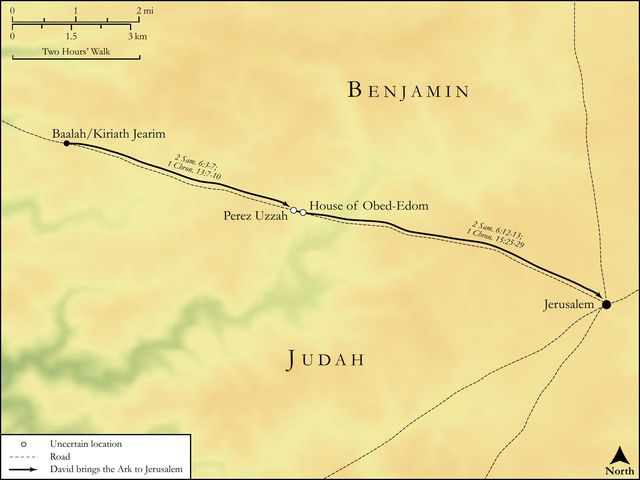
This verse serves as the climactic point of David's spirited defense against Michal's scorn, immediately following the triumphant return of the Ark of the Covenant to Jerusalem (2 Samuel 6). The narrative commences with the Ark's journey from Abinadab's house, tragically interrupted by the death of Uzzah (2 Samuel 6:6-7), an event that instilled a deep reverence and fear in David. After a three-month sojourn at Obed-Edom's house, where God's blessing was evident (2 Samuel 6:11-12), David joyfully brings the Ark into Jerusalem with a grand procession of sacrifices, shouts, and trumpet blasts. David, notably dressed in a simple linen ephod, dances with all his might before the Lord (2 Samuel 6:14). Michal, King Saul's daughter, witnesses this from a window and despises him in her heart (2 Samuel 6:16). Her direct confrontation in 2 Samuel 6:20 accuses David of debasing himself like a common person. David's immediate reply in 2 Samuel 6:21 emphasizes that his actions were "before the Lord," highlighting the divine audience for his worship. Verse 22 then extends this defense, solidifying his commitment to even greater self-abasement for God's glory, ultimately leading to Michal's barrenness as a consequence of her spiritual pride, as noted in 2 Samuel 6:23.
Historical & Cultural Context
The Ark of the Covenant represented the very presence of God among His people, serving as the most sacred object in Israel. Its return to Jerusalem was not merely a political maneuver but a profound theological event, establishing Jerusalem as the spiritual and political capital of the united kingdom. Kings in the ancient Near East were generally expected to maintain an aura of dignity and majesty, often seen as semi-divine figures. David's actions—donning a simple linen ephod (a garment associated with priests) instead of his royal robes, and dancing publicly with unreserved abandon—would have been perceived by many, particularly those adhering to traditional royal protocol like Michal, as a significant breach of decorum and an undignified display. Michal, as King Saul's daughter, may have harbored lingering resentment towards David for supplanting her father's dynasty, and her criticism could also reflect a desire to uphold a more conventional, stately image of kingship, perhaps reminiscent of her father's reign. David's response, however, transcends these human expectations, firmly rooting his identity and actions in his direct, personal relationship with Yahweh, the true King of Israel.
Key Themes
ShowHideThis passage powerfully illuminates several core themes. Humility in Worship is paramount, as David willingly sets aside his royal status to express unreserved devotion. His declaration to become "more vile" underscores that authentic worship prioritizes God's pleasure over human approval or perceived dignity. This stands in stark contrast to Michal's Spiritual Blindness and Pride, as her inability to appreciate David's genuine devotion stems from a focus on worldly appearances and a fundamental misunderstanding of the nature of God's relationship with His chosen king. The theme of God Exalting the Humble is also profoundly evident; David's willingness to be "base in mine own sight" for God's sake ultimately results in honor from those who truly understand divine worth, foreshadowing the New Testament principle that "whoever humbles himself will be exalted" (as seen in Luke 14:11). Finally, the narrative reinforces the distinction between Authentic Devotion versus External Performance, portraying David's worship as a heartfelt outpouring rather than a calculated display, a theme echoed in the New Testament's call to worship in spirit and truth (e.g., John 4:24). This entire episode highlights the profound difference between a heart fully surrendered to God and one constrained by human expectations and pride, a tension often explored throughout the books of 1 Samuel and 2 Samuel.
Exposition and Analysis
ShowHideKey Word Analysis
ShowHideThis Hebrew word (H7043) means "to be light," "to be trifling," "to be swift," or "to be despised." In this context, David's declaration "I will yet be more vile than thus" signifies his willingness to be even more devalued, despised, or insignificant in human estimation than he had already appeared to Michal. It is a radical statement of self-abasement, indicating a chosen posture of humility for the sake of God's honor.
The Hebrew term (H8217) means "depressed, literally or figuratively; base(-st), humble, low(-er, -ly)." When David states he "will be base in mine own sight," he emphasizes an internal willingness to diminish his own perceived status and importance. This signifies a deep-seated humility that transcends external appearances, where he is willing to become "lowly" or "unimportant" even in his own estimation when it comes to expressing worship and reverence for the Almighty.
This Hebrew word (H3513) carries the primary meaning of "to be heavy," "to be weighty," or "to be glorious." It signifies importance, respect, and dignity. David's assertion that he "shall be had in honour" by the maidservants stands in stark contrast to Michal's disdain. He understands that true honor—a "weighty" and lasting respect—comes not from maintaining a worldly image but from God and from those who recognize and value genuine devotion to Him.
Verse Breakdown
ShowHide"And I will yet be more vile than thus"
This clause serves as David's direct and defiant response to Michal's accusation of his debasing himself. He not only defends his actions but declares his intention to go even further in what she perceives as undignified behavior. His "vile" actions are not accidental but a deliberate and chosen posture of profound humility before God, indicating his readiness to endure even greater scorn for the sake of his unreserved devotion.
"and will be base in mine own sight"
This phrase accentuates the internal dimension of David's humility, moving beyond external perception to his self-perception. It signifies his willingness to diminish his own perceived status and importance, to become "lowly" or "unimportant" even in his own estimation, when it comes to expressing worship and reverence for the Almighty. This highlights a deep-seated, authentic humility that transcends outward appearances and human judgment.
"and of the maidservants which thou hast spoken of"
This directly references Michal's sarcastic remark in 2 Samuel 6:20, where she implied David had exposed himself "in the eyes of the handmaids of his servants." David cleverly turns her insult on its head, acknowledging these lower-status individuals but re-framing their potential perception. He implies that while Michal, a princess, despises him, those of humbler status might actually appreciate and understand his actions.
"of them shall I be had in honour"
This is the triumphant and paradoxical conclusion to David's defense. He asserts that despite Michal's aristocratic disdain, he will indeed receive honor, but it will come from the very people she looked down upon—the maidservants. This is not about seeking human praise, but about the spiritual principle that those who humble themselves before God will ultimately be exalted, often by those who share a similar heart for God, regardless of their social standing. It implies that the maidservants, unlike Michal, possess the spiritual discernment to recognize true devotion and honor it.
Literary Devices
ShowHideThe passage is rich with Contrast, primarily between David's uninhibited, God-focused worship and Michal's prideful, appearance-focused disdain. This stark contrast highlights the fundamental difference in their spiritual perspectives and priorities. There is also a strong element of Irony in David's statement: the king, who is expected to embody dignity and majesty, declares his willingness to become "more vile" to achieve true "honour" in the eyes of God and those who understand God's ways. This paradoxical statement underscores that God's economy of honor often inverts human standards, exalting the humble and humbling the proud. David's declaration "I will yet be more vile than thus" can also be seen as a form of Hyperbole, emphasizing the extreme extent of his commitment to humility before God, willing to go beyond mere acceptance of scorn to actively embracing a posture of self-abasement. The mention of "maidservants" functions as a Synecdoche or Metonymy, representing not just specific individuals but a broader category of people who, unlike Michal, possess spiritual discernment and a heart for God, and who will therefore grant David the honor that Michal withholds.
Theological and Thematic Connections
ShowHide2 Samuel 6:22 serves as a powerful theological statement on the nature of true worship and the character of God's chosen leaders. It dismantles the notion that spiritual devotion must conform to human standards of decorum or social status. David's radical humility demonstrates that genuine reverence for God often requires a willingness to shed self-consciousness and worldly pride, embracing a posture of vulnerability and unreserved adoration. This passage underscores that God values a humble and contrite heart above outward appearances or human accolades. It teaches that true honor is not conferred by human institutions or social standing, but by God Himself, who delights in those who humble themselves before Him. Michal's reaction, conversely, highlights the danger of spiritual pride and the inability to discern genuine faith when one is fixated on external propriety and human judgment.
Reflection and Application
ShowHideDavid's response to Michal is a profound challenge to our modern understanding of worship, leadership, and self-worth. In a world often driven by image, reputation, and social media validation, David's willingness to appear "vile" in human eyes for the sake of divine honor is deeply counter-cultural. It calls us to examine the authenticity of our own devotion: are we more concerned with how our faith is perceived by others, or with the pure, unadulterated pleasure of God? True worship is not a performance for an audience of humans, but an intimate, sometimes messy, outpouring of love and reverence before the Creator. This passage encourages us to cultivate a heart that values God's approval above all else, to be willing to shed our pride, self-consciousness, and fear of judgment when engaging with Him. It reminds us that humility is not weakness but a profound strength that opens the door to genuine connection with God and, paradoxically, to true honor in His sight.
Questions for Reflection
ShowHideFAQ
ShowHideWhy did Michal despise David's dancing, and why was her reaction so significant?
ShowHideMichal despised David's dancing because she viewed it as undignified and shameful for a king. As the daughter of King Saul, she likely held a traditional view of royal decorum, where a king maintained a stately and aloof image. David's uninhibited dancing, stripping off his royal robes to wear a simple linen ephod (a priestly garment), and mingling with the common people, would have seemed like a debasement of his royal status in her eyes. Her reaction is significant because it highlights a spiritual disconnect: she was focused on outward appearances and human dignity, while David was focused on genuine, unreserved worship of God. Her barrenness, mentioned in the very next verse (2 Samuel 6:23), is often interpreted as a divine judgment for her contempt of David's worship and her lack of understanding of God's heart.
What does David mean by "more vile than thus" and "base in mine own sight"?
ShowHideWhen David says he will be "more vile than thus," he is responding directly to Michal's accusation that he had "uncovered himself" and acted "shamelessly" (as in 2 Samuel 6:20). He is essentially saying, "What you saw as shameful, I am willing to go even further in that direction." He embraces the idea of appearing "insignificant" or "despised" in human eyes. To be "base in mine own sight" means he is willing to diminish his own perceived importance or status, even internally. It's a radical act of humility where he places God's honor and his unreserved devotion above any personal pride or royal dignity he might possess. It signifies a profound self-abasement before the Almighty, demonstrating a heart fully surrendered to God's pleasure.
Why does David mention the "maidservants" specifically?
ShowHideDavid mentions the "maidservants" because Michal had specifically used them in her scornful remark in 2 Samuel 6:20, implying that David had exposed himself "in the eyes of the handmaids of his servants." Michal's statement was meant to highlight how low David had stooped, even in the eyes of the lowest social class. David turns this insult on its head. He implies that while Michal, with her aristocratic pride, despises his worship, these humble maidservants, who likely have a simpler, more genuine faith, will actually honor him. This demonstrates that true honor comes from God and from those who recognize genuine devotion, not from those fixated on worldly status or appearances. It's a subtle rebuke to Michal's pride and a testament to the spiritual discernment of the humble, who understand the heart of worship better than the outwardly dignified.
Christ-Centered Fulfillment
ShowHideDavid's radical humility and willingness to be "vile" for the Lord's honor finds its ultimate and perfect fulfillment in the person and work of Jesus Christ. David, though a king, humbled himself to dance before the Ark; Christ, though God, "made himself nothing, taking the very nature of a servant, being made in human likeness" (Philippians 2:7). The King of Glory did not merely appear "vile" but truly became so in the eyes of the world, enduring the ultimate shame of the cross, where He was "despised and rejected by mankind, a man of suffering, and familiar with pain" (Isaiah 53:3). Like David, who received honor from the humble maidservants, Jesus was rejected by the religious elite and those who sought worldly power, but He was embraced by the lowly, the sinners, and the outcasts who recognized His divine authority and love. His entire earthly ministry was an embodiment of being "base in His own sight" for the sake of His Father's glory and humanity's salvation, culminating in His obedience "even to death on a cross!" (Philippians 2:8). Yet, it is precisely through this ultimate act of self-abasement that God "exalted him to the highest place and gave him the name that is above every name" (Philippians 2:9), demonstrating that true honor and exaltation flow from profound humility and perfect obedience to God. Jesus is the true King who, unlike Michal, perfectly understood and embodied the heart of worship, inviting all to come to Him, the "Lamb of God, who takes away the sin of the world!" (John 1:29).