


2 Samuel 3:13
Bible text: King James Version (1769 Blayney text) · Public domain
Bible text: King James Version with Strong's numbers · Public domain
Bible text: Berean Standard Bible · Public domain
Bible text: American Standard Version (1901) · Public domain
Bible text: World English Bible, Messianic edition · Public domain
Bible text: Geneva Bible (1599) · Public domain
Bible text: Young's Literal Translation · Public domain
- וַיֹּאמֶרvai·Yo·merand he saidH559Conj-w ¦ V-Qal-ConsecImperf-3msVerb Qal Consecutive Imperfect 3rd Singular Masculineוַandיֹּאמֶרhe said
- טוֹבTovgoodH2896Adj-msAdjective Singular Masculine Absolute
- אֲנִי'a·NiIH589Pro-1csPronoun Personal 1st Singular common gender
- אֶכְרֹת'ekh·RotI will makeH3772V-Qal-Imperf-1csVerb Qal Imperfect 1st Singular common gender
- אִתְּךָ'i·te·Khawith youH854Prep ¦ 2msPreposition Definiteאִתְּwithךָyou
- בְּרִיתbe·Rita covenantH1285N-fsNoun Singular Feminine Absolute
- אַךְ'akhonlyH389AdvAdverb
- דָּבָרda·Vara thingH1697N-msNoun Singular Masculine Absolute
- אֶחָד'e·ChadoneH259N-fsNoun Singular Feminine Absolute
- אָנֹכִי'a·no·KhiIH595Pro-1csPronoun Personal 1st Singular common gender
- שֹׁאֵלsho·'El[am] askingH7592V-Qal-Prtcpl-msVerb Qal Participle Singular Masculine Absolute
- מֵאִתְּךָme·'i·te·Khafrom with <the> youH854Prep-m ¦ Prep ¦ 2msPreposition Definiteמֵfromאִתְּwith <the>ךָyou
- לֵאמֹרle·Mor<to> sayingH559Prep-l ¦ V-Qal-InfVerb Qal Infinitive Constructלֵ<to>אמֹרsaying
- לֹאlo'notH3808NegParticle Negative
- תִרְאֶהtir·'Ehyou will seeH7200V-Qal-Imperf-2msVerb Qal Imperfect 2nd Singular Masculine
- אֶת'et<obj.>H853DirObjMParticle Object Indicator
- פָּנַיpa·Naimy faceH6440N-mpc ¦ 1csNoun Plural Masculine Constructפָּנַfaceיmy
- כִּיkiforH3588PrtParticle Conditional
- אִם'imexceptH518PrtParticle Conditional
- לִפְנֵיlif·Nei<to> beforeH6440Prep-l ¦ N-mpcNoun Plural Masculine Constructלִ<to>פְנֵיbefore
- הֱבִיאֲךָhe·vi·'a·Khabring youH935V-Hiphil-Perf-3ms ¦ 2msVerb Hiphil Perfect 3rd Singular Masculineהֱבִיאֲbringךָyou
- אֵת'et<obj.>H853DirObjMParticle Object Indicator
- מִיכַלmi·KhalMichalH4324N-proper-fNoun Proper Feminine
- בַּתbat[the] daughter ofH1323N-fscNoun Singular Feminine Construct
- שָׁאוּלsha·'UlSaulH7586N-proper-mNoun Proper Masculine
- בְּבֹאֲךָbe·vo·'a·Khawhen coming youH935Prep-b ¦ V-Qal-Inf ¦ 2msVerb Qal Infinitive Constructבְּwhenבֹאֲcomingךָyou
- לִרְאוֹתlir·'otto seeH7200Prep-l ¦ V-Qal-InfVerb Qal Infinitive Constructלִtoרְאוֹתsee
- אֶת'et<obj.>H853DirObjMParticle Object Indicator
- פָּנָיpa·Naimy faceH6440N-mpc ¦ 1csNoun Plural Masculine Constructפָּנָfaceיmy
English is a literal word-by-word gloss of the Hebrew, not the KJV's wording. Why?
This is the original text the KJV's translators worked from — each Hebrew word with its own literal English meaning in this verse, prepared by scholars at Tyndale House, Cambridge. The KJV translates whole sentences, not word by word, so its wording differs: one Hebrew word can become several English words, and the KJV may choose “the LORD” where the gloss reads “Yahweh”. Both are faithful — they answer different questions. For the KJV's own rendering, switch to the KJV text.
Details
See on the biblical-era maps
Study this verse
Public-domain commentary
Matthew Henry
From his Commentary on the Whole Bible. Henry comments on passages, not single verses — this entry covers 2 Samuel 3:7–21. His two-level outline is real structure in the source text, so it is rendered as structure.
Here, I. Abner breaks with Ish-bosheth, and deserts his interest, upon a little provocation which Ish-bosheth unadvisedly gave him. God can serve his own purposes by the sins and follies of men. 1. Ish-bosheth accused Abner of no less a crime than debauching one of his father's concubines, Sa2 3:7. Whether it was so or no does not appear, nor what ground he had for the suspicion: but, however it was, it would have been Ish-bosheth's prudence to be silent, considering how much it was his interest not to disoblige Abner. If the thing was false, and his jealousy groundless, it was very disingenuous and ungrateful to entertain unjust surmises of one who had ventured his all for him, and was certainly the best friend he had in the world. 2. Abner resented the charge very strongly. Whether he was guilty of the fault concerning this woman or no he does not say (Sa2 3:8), but we suspect he was guilty, for he does not expressly deny it; and, though he was, he lets Ish-bosheth know, (1.) That he scorned to be reproached with it by him, and would not take reproof at his hands. "What!" says Abner, "Am I a dog's head, a vile and contemptible animal, that thou exposest me thus? Sa2 3:8. Is this my recompence for the kindness I have shown to thee and thy father's house, and the good services I have done you?" He magnifies the service with this, that it was against Judah, the tribe on which the crown was settled, and which would certainly have it at last, so that, in supporting the house of Saul, he acted both against his conscience and against his interest, for which he deserved a better requital than this: and yet, perhaps, he would not have been so zealous for the house of Saul if he had not thereby gratified his own ambition and hoped to find his own account in it. Note, Proud men will not bear to be reproved, especially by those whom they think they have obliged. (2.) That he would certainly be revenged on him, Sa2 3:9, Sa2 3:10. With the utmost degree of arrogance and insolence he lets him know that, as he had raised him up, so he could pull him down again and would do it. He knew that God had sworn to David to give him the kingdom, and yet opposed it with all his might from a principle of ambition; but now he complies with it from a principle of revenge, under colour of some regard to the will of God, which was but a pretence. Those that are slaves to their lusts have many masters, which drive, some one way and some another, and, according as they make head, men are violently hurried into self-contradictions. Abner's ambition made him zealous for Ish-bosheth, and now his revenge made him as zealous for David. If he had sincerely regarded God's promise to David, and acted with an eye to that, he would have been steady and uniform in his counsels, and acted in consistency with himself. But, while Abner serves his own lusts, God by him serves his own purposes, makes even his wrath and revenge to praise him, and ordains strength to David by it. Lastly, See how Ish-bosheth was thunder-struck by Abner's insolence: He could not answer him again, Sa2 3:11. If Ish-bosheth had had the spirit of a man, especially of a prince, he might have answered him that his merits were the aggravation of his crimes, that he would not be served by so base a man, and doubted not but to do well enough without him. But he was conscious to himself of his own weakness, and therefore said not a word, lest he should make bad worse. His heart failed him, and he now became, as David had foretold concerning his enemies, like a bowing wall and a tottering fence, Psa 62:3.
II.Abner treats with David.
We must suppose that he began to grow weary of Ish-bosheth's cause, and sought an opportunity to desert it, or else, however he might threaten Ish-bosheth with it, for the quashing of the charge against himself, he would not have made good his angry words so soon as he did, Sa2 3:12. He sent messengers to David, to tell him that he was at his service. "Whose is the land? Is it not thine? For thou hast the best title to the government and the best interest in the people's affections." Note, God can find out ways to make those serviceable to the kingdom of Christ who yet have no sincere affection for it and who have vigorously set themselves against it. Enemies are sometimes made a footstool, not only to be trodden upon, but to ascend by. The earth helped the woman.
III.David enters into a treaty with Abner, but upon condition that he shall procure him the restitution of Michal his wife, Sa2 3:13. Hereby,
1.David showed the sincerity of his conjugal affection to his first and most rightful wife; neither her marrying another, nor his, had alienated him from her. Many waters could not quench that love.
2.He testified his respect to the house of Saul. So far was he from trampling upon it, now that it was fallen, that even in his elevation he valued himself not a little on his relation to it. He cannot be pleased with the honours of the throne unless he have Michal, Saul's daughter, to share with him in them, so far is he from bearing any malice to the family of his enemy. Abner sent him word that he must apply to Ish-bosheth, which he did (Sa2 3:14), pleading that he had purchased her at a dear rate, and she was wrongfully taken from him. Ish-bosheth durst not deny his demand, now that he had not Abner to stand by him, but took her from Phaltiel, to whom Saul had married her (Sa2 3:15), and Abner conducted her to David, not doubting but that then he should be doubly welcome when he brought him a wife in one hand and a crown in the other. Her latter husband was loth to part with her, and followed her weeping (Sa2 3:16), but there was no remedy: he must thank himself; for when he took her he knew that another had a right to her. Usurpers must expect to resign. Let no man therefore set his heart on that to which he is not entitled. If any disagreement has separated husband and wife, as they expect the blessing of God let them be reconciled, and come together again; let all former quarrels be forgotten, and let them live together in love, according to God's holy ordinance.
IV.Abner uses his interest with the elders of Israel to bring them over to David, knowing that whichever way they went the common people would follow of course. Now that it serves his own turn he can plead in David's behalf that he was, 1. Israel's choice (Sa2 3:17): "You sought for him in times past to be king over you, when he had signalized himself in so many engagements with the Philistines and done you so much good service; no man can pretend to greater personal merit than David nor to less than Ish-bosheth. You have tried them both, Detur digniori - Give the crown to him that best deserves it. Let David be your king." 2. God's choice (Sa2 3:18): "The Lord hath spoken of David. Compare Sa2 3:9. When God appointed Samuel to anoint him he did, in effect, promise that by his hand he would save Israel; for for that end he was made king. God having promised, by David's hand, to save Israel, it is both your duty, in compliance with God's will, and your interest, in order to your victories over your enemies, to submit to him; and it is the greatest folly in the world to oppose him." Who would have expected such reasonings as these out of Abner's mouth? But thus God will make the enemies of his people to know and own that he has loved them, Rev 3:9. He particularly applied to the men of Benjamin, those of his own tribe, on whom he had the greatest influence, and whom he had drawn in to appear for the house of Saul. He was the man that had deceived them, and therefore he was concerned to undeceive them. Thus the multitude are as they are managed.
V.David concludes the treaty with Abner; and he did wisely and well therein; for, whatever induced Abner to it, it was a good work to put an end to the war, and to settle the Lord's anointed on the throne; and it was as lawful for David to make use of his agency as it is for a poor man to receive alms from a Pharisee, who gives it in pride and hypocrisy. Abner reported to David the sense of the people and the success of his communications with them, Sa2 3:19. He came now, not as at first privately, but with a retinue of twenty men, and David entertained them with a feast (Sa2 3:20) in token of reconciliation and joy and as a pledge of the agreement between them: it was a feast upon a covenant, like that, Gen 26:30. If thy enemy hunger, feed him; but, if he submit, feast him. Abner, pleased with his entertainment, the prevention of his fall with Saul's house (which would have been inevitable if he had not taken this course), and much more with the prospect he had of preferment under David, undertakes in a little time to perfect the revolution, and to bring all Israel into obedience to David, Sa2 3:21. He tells David he shall reign over all that his heart desired. He knew David's elevation took rise from God's appointment, yet he insinuates that it sprang from his own ambition and desire of rule; thus (as bad men often do) he measured that good man by himself. However, David and he parted very good friends, and the affair between them was well settled. Thus it behoves all who fear God and keep his commandments to avoid strife, even with the wicked, to live at peace with all men, and to show the world that they are children of the light.
Continue studying 2 Samuel 3:13 across the web’s major study libraries — every link below opens this exact verse, chapter, or book on the destination site.
Read & Compare
 BibleGatewayThis verse in more than 200 translations and 70 languages.
 Bible.comThe YouVersion reader — hundreds of translations, reading plans, and highlights.
 ESV.orgCrossway's official English Standard Version reader.
 NET BibleThe NET translation with 60,000+ translators' notes on every rendering decision.
 STEP BibleTyndale House's free study tool — original text, vocabulary, and scholarly resources.
 BibliaLogos Bible Software's free web reader.
 USCCBThe New American Bible (Revised Edition) with the U.S. bishops' study notes.
Commentaries
 BibleHub CommentariesDozens of classic commentaries on this verse, gathered on one page.
 StudyLightMore than 100 commentary sets — the largest collection on the web.
 BibleRefPlain-English commentary on what this verse means, verse by verse.
 Enduring WordDavid Guzik's free commentary on this chapter, widely used by Bible teachers.
 Bible Study ToolsVerse commentary alongside Greek and Hebrew study aids.
Original Language & Research
- BibleHub InterlinearThe verse word by word — original language, transliteration, and English.
- BibleHub LexiconEvery word's original-language definition and Strong's entry.
 Blue Letter BibleDeep-study tools — Strong's numbers, concordance, and word studies.
 SefariaThe Hebrew text with Rashi and centuries of Jewish commentary.
Sermons, Hymns & Audio


TrulyRandomVerse is not affiliated with these sites and doesn’t control their content. They’re linked because they’re genuinely useful.
Summary
Second Samuel 3:13 captures a pivotal moment in David's consolidation of power, as he responds to Abner's offer of alliance with a non-negotiable condition: the return of Michal, Saul's daughter and David's first wife. This strategic demand was not merely a personal desire but a profound political maneuver, designed to solidify David's legitimate claim to the throne of all Israel by demonstrating continuity with the former royal house and asserting his divinely appointed authority over both Judah and the northern tribes.
Context
ShowHideLiterary Context
This verse is strategically placed within the unfolding narrative of the protracted civil war between the house of Saul, now nominally led by Ish-bosheth and militarily controlled by Abner, and the burgeoning house of David, reigning in Hebron over Judah. The preceding verses 2 Samuel 3:6-11 detail the escalating conflict between Abner and Ish-bosheth, culminating in Abner's decisive break from Saul's house. Abner, enraged by Ish-bosheth's accusation concerning Rizpah, pledges to transfer the entire kingdom from Saul's lineage to David, thereby fulfilling the divine promise previously revealed to David 2 Samuel 3:9-10. David's calculated response in 2 Samuel 3:13 serves as his immediate and foundational condition for accepting Abner's overtures, setting the stage for Michal's subsequent retrieval in 2 Samuel 3:14-16 and the broader negotiations for the unification of Israel under David's sole rule.
Historical & Cultural Context
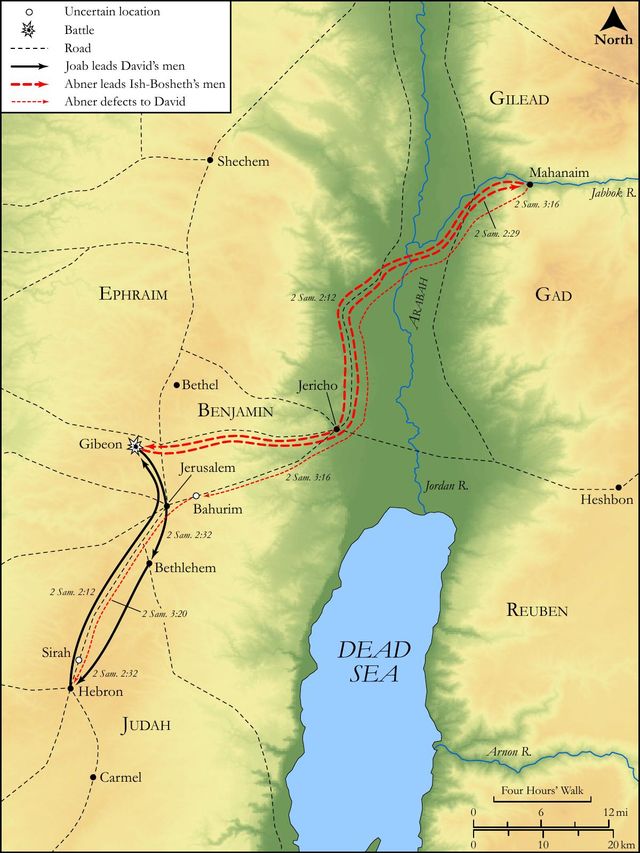
At this historical juncture, Israel was a deeply fractured kingdom. David had been anointed king over Judah and ruled from Hebron, while Ish-bosheth, Saul's surviving son, held nominal sway over the northern tribes from Mahanaim, largely sustained by Abner's formidable military leadership. The formation of alliances and treaties was a common and critical aspect of the political life of Israel and the nations round about, frequently involving specific conditions, exchanges, or symbolic acts. Marriage alliances, particularly those involving royal daughters, were paramount for establishing legitimacy, solidifying claims to succession, and forging political bonds. Michal had been given to David as a bride price for a perilous feat of valor—one hundred Philistine foreskins—thereby establishing David's bravery and his initial, legitimate connection to the royal family 1 Samuel 18:27. Later, Saul, in an act of political spite, had taken Michal from David and given her to Palti son of Laish 1 Samuel 25:44. David's demand for her return was therefore deeply rooted in both a personal grievance and the prevailing cultural understanding of royal legitimacy, marital rights, and the symbolic power of a royal wife.
Key Themes
ShowHideThis verse profoundly contributes to several overarching themes woven throughout the book of 2 Samuel. Firstly, it powerfully underscores the legitimacy of David's kingship, asserting his rightful claim not only through divine anointing but also through his established and rightful connection to the former royal house via Michal. Secondly, it highlights David's remarkable strategic wisdom and political acumen, demonstrating his astute ability to seize critical opportunities, leverage his position, and set the terms even when engaging with a powerful figure like Abner. His demand for Michal was a masterstroke of strategic diplomacy, asserting his authority and laying an undeniable foundational claim to the entire kingdom. Lastly, this act is a crucial and deliberate step towards the reunification of Israel under David's sole, divinely sanctioned rule, thereby fulfilling the prophetic promises concerning his reign, as seen in passages like 2 Samuel 5:3.
Exposition and Analysis
ShowHideKey Word Analysis
ShowHideDerived from a root meaning "to cut" (referencing the ancient practice of cutting animals and passing between the pieces to seal a covenant), this term signifies a solemn, binding compact, treaty, or formal agreement. It is far more profound and legally weighty than a casual promise, implying mutual obligations, sworn oaths, and severe consequences for breach. David's willingness to "make a league" with Abner indicates his readiness for a formal, lasting political agreement that would unite the kingdom, but crucially, only on terms he dictates.
This idiomatic expression, combining "to see" (râʼâh) and "face" (pânîym), denotes gaining an audience or formal reception with a superior, especially a king or ruler. It implies coming into the direct presence of authority to present a request, engage in negotiation, or seek favor. David's condition that Abner "shalt not see my face" until Michal is brought unequivocally establishes David as the sovereign authority. It signifies that Abner must fulfill this prerequisite before any official discussions about the kingdom's transfer can commence, thereby underscoring David's position of power and control in the negotiation.
Verse Breakdown
ShowHide"And he said, Well; I will make a league with thee:"
David's initial affirmative "Well" (Hebrew, ṭôwb) signals his acceptance of Abner's offer to facilitate the transfer of all Israel's allegiance to him. However, this immediate affirmation is swiftly qualified. The subsequent phrase, "I will make a league with thee," indicates David's readiness to enter into a formal covenant, acknowledging Abner's significant power and influence among the northern tribes, yet simultaneously asserting his own prerogative to dictate the terms of such a momentous agreement.
"but one thing I require of thee, that is, Thou shalt not see my face, except thou first bring Michal Saul's daughter,"
This constitutes David's absolute, non-negotiable condition. The demand for Michal's return is presented as an indispensable prerequisite for any formal audience or negotiation. By emphatically stating "Thou shalt not see my face," David establishes his superior position and the absolute necessity of this condition being met before he will even consider Abner's presence for further talks. Michal, as both Saul's daughter and David's first wife, represented a vital, legitimate link to the former royal house, making her return a profoundly symbolic and politically essential act.
"when thou comest to see my face."
This concluding phrase reiterates and reinforces the condition, emphasizing that the act of bringing Michal must unequivocally precede any formal meeting or audience. The repetition underscores David's unwavering authority and his firm determination to restore his rightful claim through Michal before any discussions concerning the kingdom's unification can proceed. It highlights the singularity and paramount importance of this demand in David's strategic vision.
Literary Devices
ShowHideThe most prominent literary device employed in 2 Samuel 3:13 is Symbolism. Michal, as Saul's daughter and David's first wife, transcends her individual identity to become a powerful symbol of the legitimate connection between David and the established house of Saul. Her demanded return is not merely a personal desire, though affection may have been a secondary factor, but a profound political statement. It signifies David's rightful and continuous claim to the throne of all Israel, demonstrating a seamless, legitimate succession from the former royal line and publicly validating his divine appointment. Her retrieval would serve as a visible and undeniable sign that David was not a mere usurper but the rightful heir, divinely chosen and now politically re-linked to the previous dynasty. This symbolic act was strategically crucial for gaining the allegiance and trust of the northern tribes, who had until this point remained loyal to Saul's lineage.
Theological and Thematic Connections
ShowHideDavid's insistence on Michal's return, while a shrewd and calculated political maneuver, simultaneously reflects deeper theological principles at play. It underscores God's unwavering sovereignty in establishing kingship and bringing about His divine purposes through the often complex and messy tapestry of human agency. David, though divinely chosen and anointed, was not passive; he actively navigated intricate political realities. His actions here demonstrate a profound reliance on both divine promise and practical, God-given wisdom. The restoration of Michal speaks to enduring themes of justice, rightful possession, and the rectification of wrongs, even within the turbulent context of a fractured kingdom. More broadly, this act foreshadows the ultimate reunification of God's people under a single, divinely appointed leader, a powerful theme that resonates throughout the entire biblical narrative, pointing towards the ultimate King.
Reflection and Application
ShowHideDavid's unwavering insistence on Michal's return before engaging in further negotiations with Abner reveals a leader who possessed a deep understanding of the importance of legitimacy, not only in the eyes of God but also in the perception of the people he sought to govern. He did not merely opportunistically seize an advantage but deliberately set a condition that powerfully reinforced his rightful claim and firmly established his authority. For believers today, this can serve as a potent reminder that true leadership, whether exercised within the church, family, community, or professional sphere, often necessitates a discerning blend of spiritual insight, strategic foresight, and an unyielding commitment to what is inherently right and just. It teaches us to prioritize foundational principles and to avoid compromising on matters of integrity, divine calling, or established rights, even when presented with seemingly advantageous shortcuts. Sometimes, the most effective and God-honoring path forward requires courageously addressing past injustices or reclaiming what was rightfully ours, not solely for personal gain, but for the greater good, the restoration of order, and the ultimate fulfillment of God's sovereign purposes.
Questions for Reflection
ShowHideFAQ
ShowHideWhy was Michal's return so important to David, beyond personal reasons?
ShowHideMichal's return was of paramount importance to David for several interconnected strategic, political, and symbolic reasons. Firstly, as Saul's daughter, her marriage to David 1 Samuel 18:27 had initially provided David with a legitimate, familial link to the reigning royal house. Her presence by his side would publicly demonstrate continuity between Saul's reign and David's, thereby lending crucial legitimacy to his claim over all Israel, not just Judah. Secondly, it was a profound matter of honor and legal right; Saul had unjustly taken Michal from David and given her to Palti 1 Samuel 25:44, an act that was a direct affront to David's status, his marital rights, and his royal dignity. Reclaiming her was an unequivocal assertion of his authority and a rectification of a significant past injustice. Lastly, and perhaps most importantly, it was a powerful symbolic act that would significantly aid in unifying the divided kingdom, signaling to the northern tribes that David was indeed the rightful and legitimate heir to the throne of all Israel, destined to rule over all twelve tribes, not merely a regional king of Judah.
Christ-Centered Fulfillment
ShowHideDavid's insistence on Michal's return as an absolute prerequisite for establishing his full kingship over all Israel profoundly foreshadows the ultimate Christ-centered fulfillment of God's grand redemptive plan. Just as David's legitimacy and complete reign were inextricably tied to his rightful bride, Christ's ultimate reign is eternally linked to His beloved bride, the Church, whom He redeems and restores to Himself. The New Covenant, established through the sacrificial shedding of Christ's blood, stands as the ultimate "league" or covenant by which God gathers His people from every tribe, tongue, and nation, bringing them into the very presence of the true and eternal King. Like Michal, who was unjustly taken away and alienated, humanity was tragically alienated from God through the pervasive power of sin. Yet, Christ, the greater David, came not merely to reclaim a bride, but to reclaim His own, making profound reconciliation possible through His perfect, atoning sacrifice Colossians 1:19-20. His "non-negotiable" requirement for us to "see His face"—to enter into His presence and kingdom—is genuine faith and repentance, by which we are brought into His glorious kingdom and become an integral part of His spotless, beloved bride Ephesians 5:25-27. The historical unification of Israel under David's righteous rule powerfully points to the ultimate spiritual unity of all believers in Christ, who reigns eternally as King of kings and Lord of lords, gathering His redeemed people into an everlasting covenant relationship, culminating in the joyous marriage supper of the Lamb Revelation 19:7.