


2 Samuel 3:12
Bible text: King James Version (1769 Blayney text) · Public domain
Bible text: King James Version with Strong's numbers · Public domain
Bible text: Berean Standard Bible · Public domain
Bible text: American Standard Version (1901) · Public domain
Bible text: World English Bible, Messianic edition · Public domain
Bible text: Geneva Bible (1599) · Public domain
Bible text: Young's Literal Translation · Public domain
- וַיִּשְׁלַחvai·yish·Lachand he sentH7971Conj-w ¦ V-Qal-ConsecImperf-3msVerb Qal Consecutive Imperfect 3rd Singular Masculineוַandיִּשְׁלַחhe sent
- אַבְנֵר'av·NerAbnerH74N-proper-mNoun Proper Masculine
- מַלְאָכִיםmal·'a·KhimmessengersH4397N-mpNoun Plural Masculine Absolute
- אֶל'eltoH413PrepPreposition
- דָּוִדda·VidDavidH1732N-proper-mNoun Proper Masculine
- תַּחְתָּיוta·cha·tovin place of himselfH8478N-msc ¦ 3msNoun Singular Masculine Constructתַּחְתָּיin place ofוhimself
- לֵאמֹרle·Mor<to> sayingH559Prep-l ¦ V-Qal-InfVerb Qal Infinitive Constructלֵ<to>אמֹרsaying
- לְמִיle·mi[belongs] to whom?H4310Prep-l ¦ InterrogPronoun Interrogativeלְ[belongs] toמִיwhom?
- אָרֶץ'A·retz[the] landH776N-fsNoun Singular Feminine Absolute
- לֵאמֹרle·Mor<to> sayingH559Prep-l ¦ V-Qal-InfVerb Qal Infinitive Constructלֵ<to>אמֹרsaying
- כָּרְתָהka·re·Tahmake !H3772V-Qal-Imp-2ms ¦ SfxVerb Qal Imperative 2nd Singular Masculineכָּרְתָmakeה!
- בְרִיתְךָve·ri·te·Khayour covenantH1285N-fsc ¦ 2msNoun Singular Feminine Constructבְרִיתְcovenantךָyour
- אִתִּי'i·Tiwith meH854Prep ¦ 1csPreposition Definiteאִתִּwithיme
- וְהִנֵּהve·hi·Nehand here!H2009Conj-w ¦ PrtParticle Interjectionוְandהִנֵּהhere!
- יָדִיya·Dimy handH3027N-csc ¦ 1csNoun Singular common gender Constructיָדִhandיmy
- עִמָּךְ'i·Makh[will be] with youH5973Prep ¦ 2msPreposition Definiteעִמָּ[will be] withךְyou
- לְהָסֵבle·ha·Sevto bring roundH5437Prep-l ¦ V-Hiphil-InfVerb Hiphil Infinitive Constructלְtoהָסֵבbring round
- אֵלֶיךָ'e·Lei·khato youH413Prep ¦ 2msPreposition Definiteאֵלֶיtoךָyou
- אֶת'et<obj.>H853DirObjMParticle Object Indicator
- כָּלkolallH3605N-mscNoun Singular Masculine Construct
- יִשְׂרָאֵלYis·ra·'ElIsraelH3478N-properNoun Proper Location
English is a literal word-by-word gloss of the Hebrew, not the KJV's wording. Why?
This is the original text the KJV's translators worked from — each Hebrew word with its own literal English meaning in this verse, prepared by scholars at Tyndale House, Cambridge. The KJV translates whole sentences, not word by word, so its wording differs: one Hebrew word can become several English words, and the KJV may choose “the LORD” where the gloss reads “Yahweh”. Both are faithful — they answer different questions. For the KJV's own rendering, switch to the KJV text.
Details
See on the biblical-era maps
Study this verse
Public-domain commentary
Matthew Henry
From his Commentary on the Whole Bible. Henry comments on passages, not single verses — this entry covers 2 Samuel 3:7–21. His two-level outline is real structure in the source text, so it is rendered as structure.
Here, I. Abner breaks with Ish-bosheth, and deserts his interest, upon a little provocation which Ish-bosheth unadvisedly gave him. God can serve his own purposes by the sins and follies of men. 1. Ish-bosheth accused Abner of no less a crime than debauching one of his father's concubines, Sa2 3:7. Whether it was so or no does not appear, nor what ground he had for the suspicion: but, however it was, it would have been Ish-bosheth's prudence to be silent, considering how much it was his interest not to disoblige Abner. If the thing was false, and his jealousy groundless, it was very disingenuous and ungrateful to entertain unjust surmises of one who had ventured his all for him, and was certainly the best friend he had in the world. 2. Abner resented the charge very strongly. Whether he was guilty of the fault concerning this woman or no he does not say (Sa2 3:8), but we suspect he was guilty, for he does not expressly deny it; and, though he was, he lets Ish-bosheth know, (1.) That he scorned to be reproached with it by him, and would not take reproof at his hands. "What!" says Abner, "Am I a dog's head, a vile and contemptible animal, that thou exposest me thus? Sa2 3:8. Is this my recompence for the kindness I have shown to thee and thy father's house, and the good services I have done you?" He magnifies the service with this, that it was against Judah, the tribe on which the crown was settled, and which would certainly have it at last, so that, in supporting the house of Saul, he acted both against his conscience and against his interest, for which he deserved a better requital than this: and yet, perhaps, he would not have been so zealous for the house of Saul if he had not thereby gratified his own ambition and hoped to find his own account in it. Note, Proud men will not bear to be reproved, especially by those whom they think they have obliged. (2.) That he would certainly be revenged on him, Sa2 3:9, Sa2 3:10. With the utmost degree of arrogance and insolence he lets him know that, as he had raised him up, so he could pull him down again and would do it. He knew that God had sworn to David to give him the kingdom, and yet opposed it with all his might from a principle of ambition; but now he complies with it from a principle of revenge, under colour of some regard to the will of God, which was but a pretence. Those that are slaves to their lusts have many masters, which drive, some one way and some another, and, according as they make head, men are violently hurried into self-contradictions. Abner's ambition made him zealous for Ish-bosheth, and now his revenge made him as zealous for David. If he had sincerely regarded God's promise to David, and acted with an eye to that, he would have been steady and uniform in his counsels, and acted in consistency with himself. But, while Abner serves his own lusts, God by him serves his own purposes, makes even his wrath and revenge to praise him, and ordains strength to David by it. Lastly, See how Ish-bosheth was thunder-struck by Abner's insolence: He could not answer him again, Sa2 3:11. If Ish-bosheth had had the spirit of a man, especially of a prince, he might have answered him that his merits were the aggravation of his crimes, that he would not be served by so base a man, and doubted not but to do well enough without him. But he was conscious to himself of his own weakness, and therefore said not a word, lest he should make bad worse. His heart failed him, and he now became, as David had foretold concerning his enemies, like a bowing wall and a tottering fence, Psa 62:3.
II.Abner treats with David.
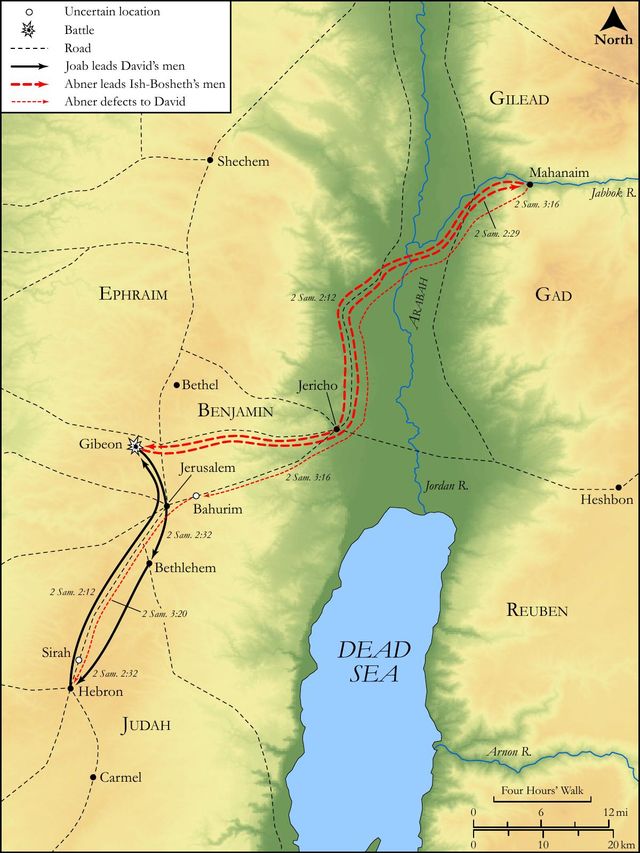
We must suppose that he began to grow weary of Ish-bosheth's cause, and sought an opportunity to desert it, or else, however he might threaten Ish-bosheth with it, for the quashing of the charge against himself, he would not have made good his angry words so soon as he did, Sa2 3:12. He sent messengers to David, to tell him that he was at his service. "Whose is the land? Is it not thine? For thou hast the best title to the government and the best interest in the people's affections." Note, God can find out ways to make those serviceable to the kingdom of Christ who yet have no sincere affection for it and who have vigorously set themselves against it. Enemies are sometimes made a footstool, not only to be trodden upon, but to ascend by. The earth helped the woman.
III.David enters into a treaty with Abner, but upon condition that he shall procure him the restitution of Michal his wife, Sa2 3:13. Hereby,
1.David showed the sincerity of his conjugal affection to his first and most rightful wife; neither her marrying another, nor his, had alienated him from her. Many waters could not quench that love.
2.He testified his respect to the house of Saul. So far was he from trampling upon it, now that it was fallen, that even in his elevation he valued himself not a little on his relation to it. He cannot be pleased with the honours of the throne unless he have Michal, Saul's daughter, to share with him in them, so far is he from bearing any malice to the family of his enemy. Abner sent him word that he must apply to Ish-bosheth, which he did (Sa2 3:14), pleading that he had purchased her at a dear rate, and she was wrongfully taken from him. Ish-bosheth durst not deny his demand, now that he had not Abner to stand by him, but took her from Phaltiel, to whom Saul had married her (Sa2 3:15), and Abner conducted her to David, not doubting but that then he should be doubly welcome when he brought him a wife in one hand and a crown in the other. Her latter husband was loth to part with her, and followed her weeping (Sa2 3:16), but there was no remedy: he must thank himself; for when he took her he knew that another had a right to her. Usurpers must expect to resign. Let no man therefore set his heart on that to which he is not entitled. If any disagreement has separated husband and wife, as they expect the blessing of God let them be reconciled, and come together again; let all former quarrels be forgotten, and let them live together in love, according to God's holy ordinance.
IV.Abner uses his interest with the elders of Israel to bring them over to David, knowing that whichever way they went the common people would follow of course. Now that it serves his own turn he can plead in David's behalf that he was, 1. Israel's choice (Sa2 3:17): "You sought for him in times past to be king over you, when he had signalized himself in so many engagements with the Philistines and done you so much good service; no man can pretend to greater personal merit than David nor to less than Ish-bosheth. You have tried them both, Detur digniori - Give the crown to him that best deserves it. Let David be your king." 2. God's choice (Sa2 3:18): "The Lord hath spoken of David. Compare Sa2 3:9. When God appointed Samuel to anoint him he did, in effect, promise that by his hand he would save Israel; for for that end he was made king. God having promised, by David's hand, to save Israel, it is both your duty, in compliance with God's will, and your interest, in order to your victories over your enemies, to submit to him; and it is the greatest folly in the world to oppose him." Who would have expected such reasonings as these out of Abner's mouth? But thus God will make the enemies of his people to know and own that he has loved them, Rev 3:9. He particularly applied to the men of Benjamin, those of his own tribe, on whom he had the greatest influence, and whom he had drawn in to appear for the house of Saul. He was the man that had deceived them, and therefore he was concerned to undeceive them. Thus the multitude are as they are managed.
V.David concludes the treaty with Abner; and he did wisely and well therein; for, whatever induced Abner to it, it was a good work to put an end to the war, and to settle the Lord's anointed on the throne; and it was as lawful for David to make use of his agency as it is for a poor man to receive alms from a Pharisee, who gives it in pride and hypocrisy. Abner reported to David the sense of the people and the success of his communications with them, Sa2 3:19. He came now, not as at first privately, but with a retinue of twenty men, and David entertained them with a feast (Sa2 3:20) in token of reconciliation and joy and as a pledge of the agreement between them: it was a feast upon a covenant, like that, Gen 26:30. If thy enemy hunger, feed him; but, if he submit, feast him. Abner, pleased with his entertainment, the prevention of his fall with Saul's house (which would have been inevitable if he had not taken this course), and much more with the prospect he had of preferment under David, undertakes in a little time to perfect the revolution, and to bring all Israel into obedience to David, Sa2 3:21. He tells David he shall reign over all that his heart desired. He knew David's elevation took rise from God's appointment, yet he insinuates that it sprang from his own ambition and desire of rule; thus (as bad men often do) he measured that good man by himself. However, David and he parted very good friends, and the affair between them was well settled. Thus it behoves all who fear God and keep his commandments to avoid strife, even with the wicked, to live at peace with all men, and to show the world that they are children of the light.
Continue studying 2 Samuel 3:12 across the web’s major study libraries — every link below opens this exact verse, chapter, or book on the destination site.
Read & Compare
 BibleGatewayThis verse in more than 200 translations and 70 languages.
 Bible.comThe YouVersion reader — hundreds of translations, reading plans, and highlights.
 ESV.orgCrossway's official English Standard Version reader.
 NET BibleThe NET translation with 60,000+ translators' notes on every rendering decision.
 STEP BibleTyndale House's free study tool — original text, vocabulary, and scholarly resources.
 BibliaLogos Bible Software's free web reader.
 USCCBThe New American Bible (Revised Edition) with the U.S. bishops' study notes.
Commentaries
 BibleHub CommentariesDozens of classic commentaries on this verse, gathered on one page.
 StudyLightMore than 100 commentary sets — the largest collection on the web.
 BibleRefPlain-English commentary on what this verse means, verse by verse.
 Enduring WordDavid Guzik's free commentary on this chapter, widely used by Bible teachers.
 Bible Study ToolsVerse commentary alongside Greek and Hebrew study aids.
Original Language & Research
- BibleHub InterlinearThe verse word by word — original language, transliteration, and English.
- BibleHub LexiconEvery word's original-language definition and Strong's entry.
 Blue Letter BibleDeep-study tools — Strong's numbers, concordance, and word studies.
 SefariaThe Hebrew text with Rashi and centuries of Jewish commentary.
Sermons, Hymns & Audio


TrulyRandomVerse is not affiliated with these sites and doesn’t control their content. They’re linked because they’re genuinely useful.
Summary
2 Samuel 3:12 records a pivotal moment in the protracted civil war between the house of Saul and the house of David, as Abner, the formidable commander of Saul's army and the de facto power behind Ish-bosheth's fragile reign, initiates contact with David. His message, framed as a rhetorical question about the rightful ownership of the land and an explicit offer of alliance, signals a dramatic and self-serving shift in allegiance. This strategic move, however, ultimately serves God's sovereign plan to unite all Israel under David's divinely appointed kingship, bringing an end to the prolonged conflict.
Context
ShowHideLiterary Context
This verse immediately follows a significant personal and political rupture between Abner and Ish-bosheth. Abner, angered by Ish-bosheth's accusation concerning his relationship with Rizpah, one of Saul's concubines (2 Samuel 3:7), had sworn to transfer the kingdom from the house of Saul to David (2 Samuel 3:9-10). The sending of messengers in 2 Samuel 3:12 is the direct fulfillment of that oath and sets the stage for the negotiations that will eventually bring the northern tribes under David's rule, culminating in the unification of Israel as described later in 2 Samuel 5. The preceding chapters detail the long and bitter war between the two houses, with Abner as the primary military leader for Saul's side (2 Samuel 2:17).
Historical & Cultural Context
The period described is one of transition and instability following King Saul's death. David had been anointed king by Samuel years prior (1 Samuel 16:13), but only reigned over Judah from Hebron. The northern tribes, under Abner's influence, had crowned Saul's son, Ish-bosheth, creating a divided kingdom. In Israel, a king's concubines were considered part of his royal inheritance, and their possession by another man could be interpreted as a claim to the throne. Abner's taking of Rizpah was thus a highly provocative act, and Ish-bosheth's challenge to it, though seemingly minor, was a direct affront to Abner's power and honor. The concept of a "league" or covenant (berit) was a formal and binding agreement, often with religious implications, crucial for political alliances and establishing legitimate rule.
Key Themes
ShowHideThis verse powerfully illustrates several key themes. Firstly, Shifting Allegiances and Political Pragmatism are evident in Abner's willingness to abandon his former loyalty to Saul's house. His rhetorical question, "Whose [is] the land?", underscores his recognition that the true power and divine mandate resided with David, while also asserting his own critical role in facilitating the transition. This is a clear move of political expediency, driven by personal slight and a realistic assessment of David's growing strength. Secondly, the theme of Divine Sovereignty Amidst Human Schemes is prominent. Though driven by personal ambition and political maneuvering, Abner's actions ultimately serve God's overarching plan to establish David as king over all Israel, as prophesied in 1 Samuel 15:28. The verse illustrates how even the self-serving choices of individuals can be orchestrated by divine providence to achieve His purposes. Finally, the Quest for Unity is central. Abner's offer to "bring about all Israel unto thee" signifies a crucial step towards ending the civil strife and uniting the divided kingdom under David's leadership, a move essential for the stability and future of the nation as it moved towards its golden age under David's reign (2 Samuel 5:1-5).
Exposition and Analysis
ShowHideKey Word Analysis
ShowHideIn the rhetorical question "Whose [is] the land?", 'erets' (H776) refers not merely to physical territory but to the entire kingdom, the rightful dominion. Abner's question is not a genuine inquiry but a loaded statement acknowledging David's legitimate claim to the throne of all Israel, implicitly recognizing God's choice and David's ascendant power. It is a declaration of the inevitable transfer of power and an invitation for David to accept Abner's assistance in this transition.
The term bᵉrîyth (H1285) signifies a compact, confederacy, or formal covenant. In Scripture, a bᵉrîyth was a solemn, binding agreement, often sealed with oaths and sacrifices, establishing a relationship between parties, whether individuals, tribes, or nations, as when Abraham and Abimelech made a covenant at Beersheba. Abner's proposal to "Make thy league with me" is an offer of a formal political alliance, positioning himself as a key broker in the transfer of power and seeking a secure position within David's future administration.
The phrase "my hand [shall be] with thee" is an idiom using yâd (H3027), signifying strong support, assistance, and active participation. Abner is pledging his considerable influence, military might, and political acumen to David's cause. Given Abner's standing as the commander of Saul's army and his sway over the northern tribes, this was a pledge of immense value, promising to deliver the entire kingdom to David through his means and power.
Verse Breakdown
ShowHide"And Abner sent messengers to David on his behalf"
This opening clause establishes Abner's initiative. He, not David, makes the first move, indicating his strategic foresight and perhaps his desperation or conviction that David's ultimate victory was inevitable. "On his behalf" suggests Abner is acting primarily in his own interest, seeking to secure his future and influence, rather than purely out of loyalty to David or God's will.
"saying, Whose [is] the land?"
This rhetorical question is the crux of Abner's message. It's a veiled acknowledgment of David's divine right to the throne of all Israel, a recognition that the kingdom (the "land") rightfully belongs to David, not Ish-bosheth. By posing it as a question, Abner invites David to affirm this unspoken truth and accept his assistance in making it a reality.
"saying [also], Make thy league with me"
This is Abner's explicit proposal for an alliance. He is offering a formal covenant, a binding agreement that would solidify his position and ensure his safety and influence under David's reign. This move highlights Abner's political astuteness and his desire to transition from being David's adversary to his powerful ally.
"and, behold, my hand [shall be] with thee"
This idiomatic expression is a strong pledge of active and powerful support. Abner promises to use his authority and influence to help David. It signifies a commitment to work alongside David, leveraging his established network and military control in the northern kingdom.
"to bring about all Israel unto thee"
This final clause states Abner's ultimate objective and the core of his offer: to unify the divided kingdom under David's rule. Abner, having been the architect of Ish-bosheth's kingship, now offers to dismantle it and deliver the allegiance of all the northern tribes to David, thereby fulfilling God's long-standing promise to David.
Literary Devices
ShowHideThe verse employs several significant literary devices. The most prominent is the Rhetorical Question, "Whose [is] the land?", which is not meant to elicit an answer but to make a forceful statement about the perceived rightful ownership of the kingdom. This question serves to subtly acknowledge David's legitimacy while positioning Abner as the indispensable agent for its realization. An Idiom is also present in "my hand [shall be] with thee," a common expression signifying active support and assistance. This vivid imagery conveys the strength and commitment of Abner's proposed alliance. Furthermore, there is a strong element of Irony in Abner's actions. The man who had previously established Ish-bosheth as king and fought fiercely against David now offers to bring all Israel to David. This turn of events highlights the unpredictable nature of human politics and the deeper, often unseen, hand of divine providence at work. Finally, the verse functions as a form of Foreshadowing, signaling the imminent unification of Israel under David's reign, a key event in the unfolding narrative of the Davidic kingdom.
Theological and Thematic Connections
ShowHideThis verse powerfully illustrates the intricate interplay between human agency and divine sovereignty. Abner's actions, driven by personal slight, political ambition, and a pragmatic assessment of power, are nevertheless instrumental in fulfilling God's long-standing promise to establish David as king over all Israel. It demonstrates that God's purposes are not thwarted by human machinations but can even be advanced through them, using the choices of individuals, whether noble or self-serving, to achieve His ultimate will. This passage reminds us that God's kingdom advances not always through straightforward, pious means, but often through the complex, messy realities of human history and politics, where even adversaries can become unwitting instruments of divine design. The "league" Abner proposes, while political, echoes the greater covenant God had made with David, ensuring his kingdom would be established.
Reflection and Application
ShowHideThe story of Abner's shift in allegiance offers profound lessons for believers today. It challenges us to look beyond immediate circumstances and the apparent chaos of human events to discern God's sovereign hand at work. Just as Abner's self-interested actions ultimately served God's plan for David, so too can God orchestrate events, even through unexpected or seemingly unrighteous means, to bring about His purposes in our lives and in the world. This calls for a posture of trust, recognizing that God is always at work, even when His methods are mysterious or involve flawed human actors. For leaders, it highlights the delicate balance between ambition and serving a greater purpose, and the importance of seeking unity rather than perpetuating division. It also reminds us that true authority and lasting power come from divine appointment, not merely human maneuvering. Ultimately, this passage reinforces the truth that God's chosen path will prevail, regardless of human obstacles or machinations, leading to the eventual establishment of His kingdom.
Questions for Reflection
ShowHideFAQ
ShowHideWhy did Abner, who had fought so hard for Saul's house, suddenly switch allegiance to David?
ShowHideAbner's shift was multifaceted. Primarily, it was triggered by a personal affront from Ish-bosheth, who accused him of sleeping with Rizpah, a concubine of Saul. In that culture, possessing a king's concubine could be seen as a claim to the throne, and Ish-bosheth's accusation was a direct challenge to Abner's authority and honor. This insult, combined with Abner's likely recognition of David's growing strength and divine favor (as seen in 2 Samuel 3:9-10), led him to pragmatically seek a new alliance. He saw the "writing on the wall" that David's kingship was inevitable and sought to secure his own position and influence within the new order.
What is the significance of Abner's rhetorical question, "Whose [is] the land?"
ShowHideThis question is not a literal inquiry but a powerful rhetorical device. Abner uses it to acknowledge David's legitimate claim to the entire kingdom of Israel, implicitly recognizing that the "land" (the kingdom) rightfully belongs to David, not Ish-bosheth. It's a way for Abner to signal his understanding of the divine mandate and the inevitable transfer of power, while simultaneously positioning himself as the key figure who can facilitate this transition and deliver the northern tribes to David. It's a statement of political reality and a strategic opening for negotiation.
How does this verse relate to God's overall plan for Israel?
ShowHideThis verse is crucial to God's plan because it marks a significant step towards the unification of Israel under David's divinely appointed kingship. God had chosen David and promised him an everlasting dynasty (2 Samuel 7:12-16). Abner's actions, though driven by human motives, become the very means by which the divided kingdom begins to coalesce. It illustrates God's sovereignty, demonstrating that He can use even the self-serving political maneuvers of individuals to accomplish His greater redemptive purposes for His people and the establishment of His chosen king.
Christ-Centered Fulfillment
ShowHideThe political maneuvering and eventual unification of Israel under David in 2 Samuel 3:12 offer a profound foreshadowing of the ultimate, eternal kingship of Jesus Christ. Just as Abner, a powerful figure in the earthly realm, recognized the inevitable transfer of power to David and sought to facilitate the establishment of his kingdom, so too does all earthly authority ultimately bow before the reign of Christ. The "land" or kingdom that Abner acknowledged as rightfully David's points to the universal dominion of the Son of David, Jesus, who is the true and eternal King. While David's kingdom was established through human alliances and military might, Christ's kingdom is not of this world (John 18:36) and is established through His sacrificial death and resurrection, conquering sin and death. He is the one to whom all authority in heaven and on earth has been given (Matthew 28:18). The bringing together of "all Israel" under David prefigures the gathering of all God's people—Jew and Gentile—into the one body of Christ, His Church, under His headship (Ephesians 1:22-23). Ultimately, Abner's pledge to "bring about all Israel unto thee" finds its perfect fulfillment in Christ, who draws all people to Himself (John 12:32) and whose kingdom will have no end (Luke 1:32-33). He is the true Lamb of God, who takes away the sin of the world, establishing a spiritual kingdom that transcends all earthly political boundaries and endures forever (Revelation 11:15).