


2 Samuel 5:2
Bible text: King James Version (1769 Blayney text) · Public domain
Bible text: King James Version with Strong's numbers · Public domain
Bible text: Berean Standard Bible · Public domain
Bible text: American Standard Version (1901) · Public domain
Bible text: World English Bible, Messianic edition · Public domain
Bible text: Geneva Bible (1599) · Public domain
Bible text: Young's Literal Translation · Public domain
- גַּםgambothH1571AdvAdverb
- אֶתְמוֹל'et·MolyesterdayH865N-msNoun Singular Masculine Absolute
- גַּםgamas well asH1571AdvAdverb
- שִׁלְשׁוֹםshil·Shomthree days agoH8032N-msNoun Singular Masculine Absolute
- בִּהְיוֹתbih·Yotwhen wasH1961Prep-b ¦ V-Qal-InfVerb Qal Infinitive Constructבִּwhenהְיוֹתwas
- שָׁאוּלsha·'UlSaulH7586N-proper-mNoun Proper Masculine
- מֶלֶךְMe·lekhkingH4428N-msNoun Singular Masculine Absolute
- עָלֵינוּ'a·Lei·nuover usH5921Prep ¦ 1cpPreposition Definiteעָלֵיoverנוּus
- אַתָּה'a·TahyouH859Pro-2msPronoun Personal 2nd Singular Masculine
- הָיִיתָha·yi·tahyou wereH1961V-Qal-Perf-2msVerb Qal Perfect 2nd Singular Masculine
- הַמּוֹצִיאha·mo·tzi'the [one who] led outH3318Art ¦ V-Hiphil-Prtcpl-msVerb Hiphil Participle Singular Masculine Absoluteהַtheמּוֹצִיא[one who] led out
- וְהַמֵּבִיאve·ha·me·vi'and the [one who] broughtH935Conj-w ¦ Art ¦ V-Hiphil-Prtcpl-msVerb Hiphil Participle Singular Masculine Absoluteוְandהַtheמֵּבִיא[one who] brought
- אֶת'et<obj.>H853DirObjMParticle Object Indicator
- יִשְׂרָאֵלYis·ra·'ElIsraelH3478N-properNoun Proper Location
- וַיֹּאמֶרvai·Yo·merand he saidH559Conj-w ¦ V-Qal-ConsecImperf-3msVerb Qal Consecutive Imperfect 3rd Singular Masculineוַandיֹּאמֶרhe said
- יְהוָהYah·wehYahwehH3068N-properNoun Proper Title
- לְךָle·Khato <the> youPrep-l ¦ 2msSuffix Personal 2nd Singular Masculineלְto <the>ךָyou
- אַתָּה'a·TahyouH859Pro-2msPronoun Personal 2nd Singular Masculine
- תִרְעֶהtir·'Ehyou will shepherdH7462V-Qal-Imperf-2msVerb Qal Imperfect 2nd Singular Masculine
- אֶת'et<obj.>H853DirObjMParticle Object Indicator
- עַמִּי'a·Mimy peopleH5971N-msc ¦ 1csNoun Singular Masculine Constructעַמִּpeopleיmy
- אֶת'et<obj.>H853DirObjMParticle Object Indicator
- יִשְׂרָאֵלYis·ra·'ElIsraelH3478N-properNoun Proper Location
- וְאַתָּהve·'a·Tahand youH859Conj-w ¦ Pro-2msPronoun Personal 2nd Singular Masculineוְandאַתָּהyou
- תִּהְיֶהtih·Yehyou will becomeH1961V-Qal-Imperf-2msVerb Qal Imperfect 2nd Singular Masculine
- לְנָגִידle·na·Gid<into> rulerH5057Prep-l ¦ N-msNoun Singular Masculine Absoluteלְ<into>נָגִידruler
- עַל'aloverH5921PrepPreposition
- יִשְׂרָאֵלYis·ra·'ElIsraelH3478N-properNoun Proper Location
English is a literal word-by-word gloss of the Hebrew, not the KJV's wording. Why?
This is the original text the KJV's translators worked from — each Hebrew word with its own literal English meaning in this verse, prepared by scholars at Tyndale House, Cambridge. The KJV translates whole sentences, not word by word, so its wording differs: one Hebrew word can become several English words, and the KJV may choose “the LORD” where the gloss reads “Yahweh”. Both are faithful — they answer different questions. For the KJV's own rendering, switch to the KJV text.
Details
See on the biblical-era maps
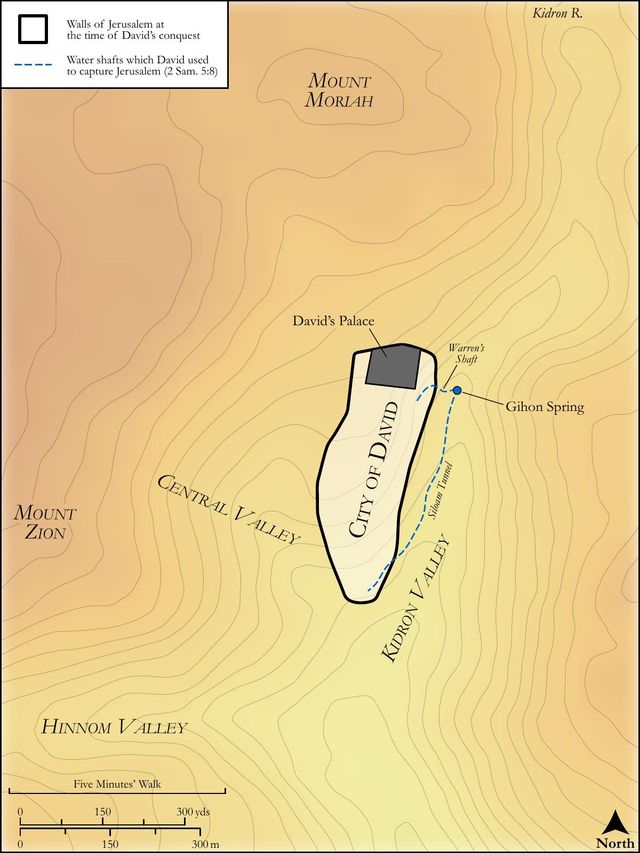
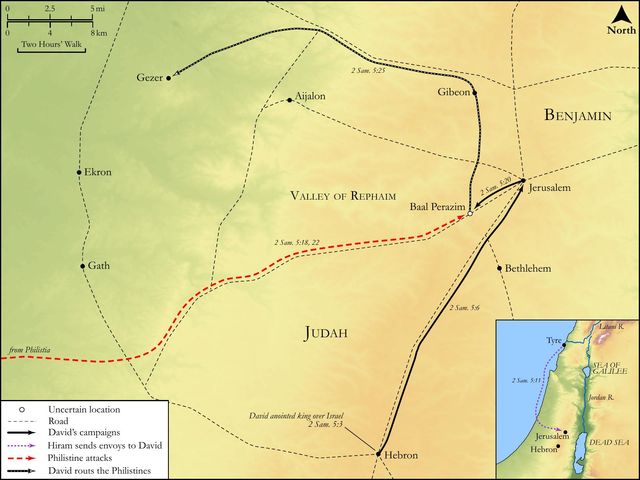
Study this verse
Public-domain commentary
Matthew Henry
From his Commentary on the Whole Bible. Henry comments on passages, not single verses — this entry covers 2 Samuel 5:1–5.
Here is, I. The humble address of all the tribes to David, beseeching him to take upon him the government (for they were now as sheep having no shepherd), and owning him for their king. Though David might by no means approve the murder of Ish-bosheth, yet he might improve the advantages he gained thereby, and accept the applications made to him thereupon. Judah had submitted to David as their king above seven years ago, and their ease and happiness, under his administration, encouraged the rest of the tribes to make their court to him. What numbers came from each tribe, with what zeal and sincerity they came, and how they were entertained for three days at Hebron, when they were all of one heart to make David king, we have a full account, 1 Chr. 12:23-40. Here we have only the heads of their address, containing the grounds they went upon in making David king. 1. Their relation to him was some inducement: "We are thy bone and thy flesh (Sa2 5:1), not only thou art our bone and our flesh, not a stranger, unqualified by the law to be king (Deu 17:15), but we are thine," that is, "we know that thou considerest us as thy bone and thy flesh, and hast as tender a concern for us as a man has for his own body, which Saul and his house had not. We are thy bone and thy flesh, and therefore thou wilt be as glad as we shall be to put an end to this long civil war; and thou wilt take pity on us, protect us, and do thy utmost for our welfare." Those who take Christ for their king may thus plead with him: "We are thy bone and thy flesh, thou hast made thyself in all things like unto thy brethren (Heb 2:17); therefore be thou our ruler, and let this ruin be under thy hand," Isa 3:6. 2. His former good services to the public were a further inducement (Sa2 5:2): "When Saul was king he was but the cypher, thou wast the figure, thou wast he that leddest out Israel to battle, and broughtest them in in triumph; and therefore who so fit now to fill the vacant throne?" He that is faithful in a little deserves to be entrusted with more. Former good offices done for us should be gratefully remembered by us when there is occasion. 3. The divine appointment was the greatest inducement of all: The Lord said, Thou shalt feed my people Israel, that is, thou shalt rule them; for princes are to feed their people as shepherds, in every thing consulting the subjects' benefit, feeding them and not fleecing them. "And thou shalt be not only a king to govern in peace, but a captain to preside in war, and be exposed to all the toils and perils of the camp." Since God has said so, now at length, when need drives them to it, they are persuaded to say so too.
II.The public and solemn inauguration of David, Sa2 5:3.
A convention of the states was called; all the elders of Israel came to him; the contract was settled, the pacta conventa - covenants, sworn to, and subscribed on both sides. He obliged himself to protect them as their judge in peace and captain in war; and they obliged themselves to obey him. He made a league with them to which God was a witness: it was before the Lord. Hereupon he was, for the third time, anointed king. His advances were gradual, that his faith might be tried and that he might gain experience. And thus his kingdom typified that of the Messiah, which was to come to its height by degrees; for we see not yet all things put under him (Heb 2:8), but we shall see it, Co1 15:25.
III.A general account of his reign and age.
He was thirty years old when he began to reign, upon the death of Saul, Sa2 5:4. At that age the Levites were at first appointed to begin their administration, Num 4:3. About that age the Son of David entered upon his public ministry, Luk 3:23. Then men come to their full maturity of strength and judgment. He reigned, in all, forty years and six months, of which seven years and a half in Hebron and thirty-three years in Jerusalem, Sa2 5:5. Hebron had been famous, Jos 14:15. It was a priest's city. But Jerusalem was to be more so, and to be the holy city. Great kings affected to raise cities of their own, Gen 10:11, 36, 32-35. David did so, and Jerusalem was the city of David. It is a name famous to the end of the Bible (Rev. 21), where we read of a new Jerusalem.
Continue studying 2 Samuel 5:2 across the web’s major study libraries — every link below opens this exact verse, chapter, or book on the destination site.
Read & Compare
 BibleGatewayThis verse in more than 200 translations and 70 languages.
 Bible.comThe YouVersion reader — hundreds of translations, reading plans, and highlights.
 ESV.orgCrossway's official English Standard Version reader.
 NET BibleThe NET translation with 60,000+ translators' notes on every rendering decision.
 STEP BibleTyndale House's free study tool — original text, vocabulary, and scholarly resources.
 BibliaLogos Bible Software's free web reader.
 USCCBThe New American Bible (Revised Edition) with the U.S. bishops' study notes.
Commentaries
 BibleHub CommentariesDozens of classic commentaries on this verse, gathered on one page.
 StudyLightMore than 100 commentary sets — the largest collection on the web.
 BibleRefPlain-English commentary on what this verse means, verse by verse.
 Enduring WordDavid Guzik's free commentary on this chapter, widely used by Bible teachers.
 Bible Study ToolsVerse commentary alongside Greek and Hebrew study aids.
Original Language & Research
- BibleHub InterlinearThe verse word by word — original language, transliteration, and English.
- BibleHub LexiconEvery word's original-language definition and Strong's entry.
 Blue Letter BibleDeep-study tools — Strong's numbers, concordance, and word studies.
 SefariaThe Hebrew text with Rashi and centuries of Jewish commentary.
Sermons, Hymns & Audio


TrulyRandomVerse is not affiliated with these sites and doesn’t control their content. They’re linked because they’re genuinely useful.
Summary
This verse records the pivotal moment when the elders of all Israel approach David in Hebron to anoint him king over the entire nation. Their declaration provides two compelling reasons for his ascension: his proven military and administrative leadership during Saul's reign, and, more significantly, the explicit divine mandate from the LORD that he would shepherd and lead God's people. This recognition marks the culmination of a long period of waiting for David and the establishment of a unified monarchy under God's chosen king, setting the stage for a new era in Israel's history.
Context
ShowHideLiterary Context
This verse is strategically placed within the narrative of David's rise to kingship, immediately following the unanimous decision of "all the tribes of Israel" to seek him out in Hebron, where he had already reigned over Judah for seven and a half years (2 Samuel 5:1). The elders' declaration in 2 Samuel 5:2 serves as the formal justification and divine endorsement for their choice, building upon their earlier acknowledgment of kinship ("Behold, we are your bone and your flesh"). This verse provides the specific arguments that solidify David's legitimacy in the eyes of the northern tribes, paving the way for the covenant David makes with them before the LORD and his anointing as king over all Israel (2 Samuel 5:3). The subsequent narrative details David's conquest of Jerusalem (2 Samuel 5:6-9) and its establishment as his capital, directly flowing from the unified monarchy solidified in this passage.
Historical & Cultural Context
Historically, Israel had been a divided kingdom for over seven years following Saul's death, with civil war raging between the house of Saul (under Ish-bosheth) and the house of David (2 Samuel 3:1). The elders' appeal to David signifies a profound desire for national unity, stability, and an end to the prolonged conflict. Culturally, the idiom "leddest out and broughtest in" was a widely understood expression for comprehensive leadership, particularly in military campaigns and daily governance. The imagery of a king "feeding" his people, likening him to a shepherd, was a powerful and common metaphor for kingship among the nations, signifying care, protection, and provision, often contrasting with the oppressive rule of other nations. Crucially, in a theocratic society like Israel, divine appointment ("the LORD said to thee") was paramount for a king's legitimacy, echoing God's earlier selection of Saul and now David, underscoring that true authority derived from God.
Key Themes
ShowHideThis verse powerfully reinforces the theme of Divine Sovereignty and Appointment, emphasizing that David's kingship was not merely a human political maneuver but a direct fulfillment of God's predetermined plan. The elders' explicit statement, "the LORD said to thee," underscores that David's rule was divinely mandated, a concept central to the Davidic Covenant later established in 2 Samuel 7. It also highlights Proven Leadership and Faithfulness, as the elders recall David's effective military and administrative guidance during Saul's reign, demonstrating his capacity to govern even in challenging circumstances. This past faithfulness prepared him for his greater role, a principle echoed in the New Testament regarding stewardship (e.g., Luke 16:10). Finally, the verse introduces the profound theme of the Shepherd-King, portraying leadership as nurturing and protective care rather than mere power. This imagery, central to the role of the Messiah as the Good Shepherd, defines a leadership model focused on the holistic well-being of the people.
Exposition and Analysis
ShowHideKey Word Analysis
ShowHideFrom הָיָה; (the) self-Existent or Eternal; Jehovah, Jewish national name of God. This term, used here, emphasizes that David's kingship is not merely a human political arrangement but a direct divine appointment. The covenantal God of Israel, the one who is eternally existent and faithful to His promises, is the ultimate source of David's authority and the one who has spoken concerning his rule.
A primitive root; to tend a flock; i.e. pasture it; intransitively, to graze (literally or figuratively); generally to rule; by extension, to associate with (as a friend). This verb is rich in meaning, encompassing "to shepherd," "to pasture," "to tend," "to graze," and by extension, "to govern" or "to rule." When applied to a king, it signifies a ruler responsible for the holistic well-being of his people, including their physical sustenance, security, justice, and spiritual flourishing. It contrasts sharply with predatory or neglectful leadership, emphasizing compassionate care.
From נָגַד; a commander (as occupying the front), civil, military or religious; generally (abstractly, plural), honorable themes. This term denotes a "leader," "prince," "ruler," or "commander." It signifies one who is appointed or set over others, often with a specific commission or authority, frequently in a military or governmental capacity. The combination of "feed" (shepherd) and "captain" (commander) beautifully encapsulates David's dual role: a compassionate caregiver and a decisive, authoritative leader.
Verse Breakdown
ShowHide"Also in time past, when Saul was king over us, thou wast he that leddest out and broughtest in Israel"
The elders begin by recalling David's established record of leadership and competence, even while he served under Saul's reign. The phrase "leddest out and broughtest in" is a well-known ancient idiom for comprehensive military and administrative leadership. It signifies one who successfully conducts the affairs of the nation, particularly in warfare (leading armies to battle and bringing them back victorious) and in daily governance (managing the people's movements and affairs). This acknowledges David's practical ability, proven experience, and capacity to protect and guide the people, even in challenging circumstances.
"and the LORD said to thee, Thou shalt feed my people Israel"
This clause reveals the divine mandate for David's kingship, a truth the elders were evidently aware of. The phrase "the LORD said to thee" points to a direct divine revelation or prophecy, most likely referring to Samuel's anointing of David (as recorded in 1 Samuel 16:12-13) or perhaps other prophetic words. The command "Thou shalt feed my people Israel" employs the powerful metaphor of a shepherd, emphasizing that David's rule is not for personal gain or power but for the nurturing, protection, and guidance of God's chosen people, reflecting God's own care for His flock.
"and thou shalt be a captain over Israel"
This second part of the divine mandate reinforces David's role as the authoritative leader. While "feed" speaks to the compassionate and caring aspect of kingship, "captain" highlights the executive, military, and governmental authority required to lead a nation effectively. It underscores his role as the appointed head, responsible for strategic direction, defense, and overall governance. Together, these two phrases define the nature of David's divinely appointed leadership: both nurturing and authoritative, a king who cares for his people as a shepherd and leads them decisively as a commander.
Literary Devices
ShowHideThe verse employs Metaphor extensively, particularly in the phrase "Thou shalt feed my people Israel," where David's role as king is likened to that of a shepherd. This metaphor is rich with connotations of care, protection, guidance, and provision, contrasting with the more aggressive or tyrannical models of leadership common among the kings of the nations. The idiom "leddest out and broughtest in" serves as a Merism, a literary device where two contrasting parts represent the whole, signifying comprehensive and total leadership in all aspects of national life, from military campaigns to daily administration. The elders' direct address to David, recalling his past deeds and God's decree, functions as Rhetorical Persuasion, building a compelling case for his immediate anointing as king over all Israel, uniting both human recognition and divine validation.
Theological and Thematic Connections
ShowHideThis verse is foundational to understanding the nature of biblical leadership, particularly kingship in Israel. It establishes that true authority derives not merely from human consensus or military prowess, but ultimately from divine appointment and a mandate to serve God's people. David's past faithfulness, even under Saul's hostile reign, served as a divine proving ground, demonstrating his character and competence. The emphasis on "feeding" God's people transforms the secular concept of a ruler into a sacred vocation, one of stewardship and sacrificial care, echoing God's own relationship with Israel as their Shepherd. This vision of leadership is profoundly theological, setting the stage for the Davidic Covenant and the expectation of a righteous king who governs according to God's heart.
Reflection and Application
ShowHideThe recognition of David as king over all Israel, as detailed in this verse, offers profound lessons for contemporary believers regarding leadership, divine timing, and personal calling. David's long journey from anointing to full kingship underscores the principle that God's plans unfold in His perfect timing, often requiring seasons of waiting, preparation, and faithfulness in obscurity or adversity. Our current circumstances, whether challenging or mundane, can be God's training ground for future responsibilities, shaping our character and competence. Furthermore, the dual imagery of "feeding" and being a "captain" challenges our understanding of leadership, urging us to embrace both compassionate care and decisive action. True leadership, whether in the church, family, or workplace, is fundamentally about service—nurturing, guiding, and protecting those entrusted to our care, always seeking their well-being above personal gain. This calls us to examine our own motives for influence and to cultivate a shepherd's heart in all our interactions, prioritizing the welfare of others.
Questions for Reflection
ShowHideFAQ
ShowHideWhat does "leddest out and broughtest in Israel" mean in practical terms?
ShowHideThis phrase is an ancient idiom signifying comprehensive and effective leadership, particularly in military and administrative contexts. It means that David was the one who successfully guided the people in all their affairs – leading them out to battle and bringing them back safely, managing their daily lives, and ensuring their security and prosperity. It speaks to his proven competence and ability to navigate the complexities of national governance and warfare, even under Saul's erratic rule. It's a testament to his practical, hands-on leadership that the elders recognized and valued.
Why was the "LORD said to thee" part so important for David's legitimacy?
ShowHideIn ancient Israel, a theocracy, divine endorsement was paramount for any leader's legitimacy. While human recognition and military success were important, the ultimate authority came from God. The elders' explicit mention of "the LORD said to thee" (referring to a divine oracle or prophecy, likely through Samuel's anointing in 1 Samuel 16:13) underscored that David's kingship was not merely a human political choice but a fulfillment of God's sovereign will. This divine mandate provided an unassailable foundation for his rule, uniting the tribes under a king chosen by God, ensuring stability and divine blessing for the unified monarchy.
What is the significance of the "shepherd" imagery for a king?
ShowHideThe imagery of a king as a "shepherd" ("feed my people Israel") was deeply significant among the nations and especially in Israel. It portrays the king not as an oppressive tyrant but as a caring, protective, and nurturing leader responsible for the well-being of his "flock" – the people. A good shepherd guides, protects from danger, provides food and water, and cares for the weak. This contrasts sharply with the self-serving rulers often depicted in the Old Testament (e.g., Ezekiel 34). For David, it meant his rule was to be characterized by compassion, justice, and devoted care for the nation, mirroring God's own role as the Shepherd of Israel (e.g., Psalm 23).
Christ-Centered Fulfillment
ShowHideThe anointing of David as king over all Israel, particularly with the divine mandate to "feed my people Israel" and be "a captain over Israel," finds its ultimate and perfect fulfillment in Jesus Christ. David, the shepherd-king, serves as a profound type of the Messiah. While David was a flawed human leader, Jesus is the perfect Good Shepherd who not only feeds His flock with spiritual nourishment – the bread of life (John 6:35) – but also lays down His life for them (John 10:15). He is the true "captain" or "prince" (often translated from words like archegos or nagid in the Septuagint) who leads His people to salvation (Hebrews 2:10) and establishes an eternal kingdom (Luke 1:32-33). The promise to David of an enduring dynasty (the Davidic Covenant in 2 Samuel 7) culminates in Christ, the Son of David, whose reign is eternal and whose care for His people is absolute and flawless, fulfilling all that David's earthly kingship foreshadowed.