


Genesis 43:3
Bible text: King James Version (1769 Blayney text) · Public domain
Bible text: Berean Standard Bible · Public domain
Bible text: American Standard Version (1901) · Public domain
Bible text: World English Bible, Messianic edition · Public domain
Bible text: Geneva Bible (1599) · Public domain
Bible text: Young's Literal Translation · Public domain
- וַיֹּאמֶרvai·Yo·merand he saidH559Conj-w ¦ V-Qal-ConsecImperf-3msVerb Qal Consecutive Imperfect 3rd Singular Masculineוַandיֹּאמֶרhe said
- אֵלָיו'e·Lavto himH413Prep ¦ 3msPrepositionאֵלָיtoוhim
- יְהוּדָהye·hu·DahJudahH3063N-proper-mNoun Proper Masculine
- לֵאמֹרle·Mor<to> sayingH559Prep-l ¦ V-Qal-InfVerb Qal Infinitive Constructלֵ<to>אמֹרsaying
- הָעֵדha·'Edcertainly <to warn>H5749V-Hiphil-InfAbsVerb Hiphil Infinitive Absolute
- הֵעִדhe·'Idhe warnedH5749V-Hiphil-Perf-3msVerb Hiphil Perfect 3rd Singular Masculine
- בָּנוּBa·nu<in> usPrep-b ¦ 1cpSuffix Personal 1st Plural common genderבָּ<in>נוּus
- הָאִישׁha·'Ishthe manH376Art ¦ N-msNoun Singular Masculine Absoluteהָtheאִישׁman
- לֵאמֹרle·Mor<to> sayingH559Prep-l ¦ V-Qal-InfVerb Qal Infinitive Constructלֵ<to>אמֹרsaying
- לֹאlo'notH3808NegParticle Negative
- תִרְאוּtir·'Uyou will seeH7200V-Qal-Imperf-2mpVerb Qal Imperfect 2nd Plural Masculine
- פָנַיfa·Naimy faceH6440N-mpc ¦ 1csNoun Plural Masculine Constructפָנַfaceיmy
- בִּלְתִּיbil·TiexceptH1115N-csNoun Singular common gender Absolute
- אֲחִיכֶם'a·chi·Khemyour brotherH251N-msc ¦ 2mpNoun Singular Masculine Constructאֲחִיbrotherכֶםyour
- אִתְּכֶם'i·te·Khem[is] with youH854Prep ¦ 2mpPrepositionאִתְּ[is] withכֶםyou
English is a literal word-by-word gloss of the Hebrew, not the KJV's wording. Why?
This is the original text the KJV's translators worked from — each Hebrew word with its own literal English meaning in this verse, prepared by scholars at Tyndale House, Cambridge. The KJV translates whole sentences, not word by word, so its wording differs: one Hebrew word can become several English words, and the KJV may choose “the LORD” where the gloss reads “Yahweh”. Both are faithful — they answer different questions. For the KJV's own rendering, switch to the KJV text.
Details
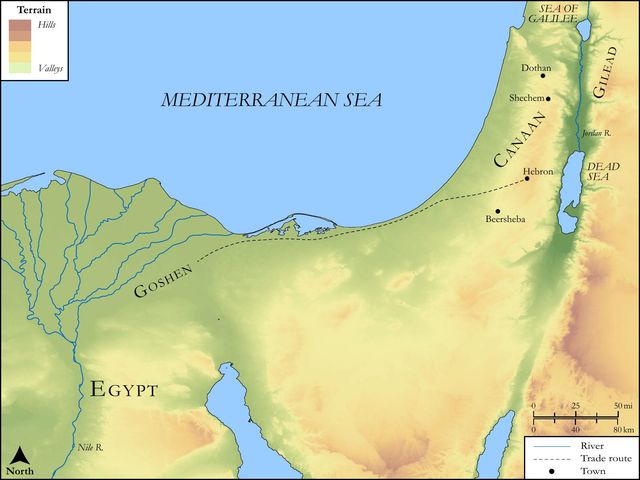
See on the biblical-era maps


Study this verse
Public-domain commentary
Matthew Henry
From his Commentary on the Whole Bible. Henry comments on passages, not single verses — this entry covers Genesis 43:1–10.
Here, 1. Jacob urges his sons to go and buy more corn in Egypt, Gen 43:1, Gen 43:2. The famine continued; and the corn they had bought was all spent, for it is meat that perisheth. Jacob, as a good master of a family, is in care to provide for those of his own house food convenient; and shall not God provide for his children, for the household of faith? Jacob bids them go again and buy a little food; now, in time of scarcity, a little must suffice, for nature is content with a little. 2. Judah urges him to consent that Benjamin should go down with them, how much soever it went against his feelings and previous determination. Note, It is not at all inconsistent with the honour and duty which children owe their parents humbly and modestly to advise them, and, as occasion is, to reason with them. Plead with your mother, plead, Hos 2:2. (1.) He insists upon the absolute necessity they were under of bringing Benjamin with them, of which he, who was a witness to all that had passed in Egypt, was a more competent judge than Jacob could be. Joseph's protestation (Gen 43:3) may be alluded to to show upon what terms we must draw nigh to God; unless we bring Christ along with us in the arms of our faith, we cannot see the face of God with comfort. (2.) He engages to take all possible care of him, and to do his utmost for his safety, Gen 43:8, Gen 43:9. Judah's conscience had lately smitten him for what he had done a great while ago against Joseph (Gen 42:21); and, as an evidence of the truth of his repentance, he is ready to undertake, as far as a man could do it, for Benjamin's security. He will not only not wrong him, but will do all he can to protect him. This is restitution, as far as the case will admit; when he knew not how he could restore Joseph, he would make some amends for the irreparable injury he had done him by doubling his care concerning Benjamin.
Continue studying Genesis 43:3 across the web’s major study libraries — every link below opens this exact verse, chapter, or book on the destination site.
Read & Compare
 BibleGatewayThis verse in more than 200 translations and 70 languages.
 Bible.comThe YouVersion reader — hundreds of translations, reading plans, and highlights.
 ESV.orgCrossway's official English Standard Version reader.
 NET BibleThe NET translation with 60,000+ translators' notes on every rendering decision.
 STEP BibleTyndale House's free study tool — original text, vocabulary, and scholarly resources.
 BibliaLogos Bible Software's free web reader.
 USCCBThe New American Bible (Revised Edition) with the U.S. bishops' study notes.
Commentaries
 BibleHub CommentariesDozens of classic commentaries on this verse, gathered on one page.
 StudyLightMore than 100 commentary sets — the largest collection on the web.
 BibleRefPlain-English commentary on what this verse means, verse by verse.
 Enduring WordDavid Guzik's free commentary on this chapter, widely used by Bible teachers.
 Bible Study ToolsVerse commentary alongside Greek and Hebrew study aids.
Original Language & Research
- BibleHub InterlinearThe verse word by word — original language, transliteration, and English.
- BibleHub LexiconEvery word's original-language definition and Strong's entry.
 Blue Letter BibleDeep-study tools — Strong's numbers, concordance, and word studies.
 SefariaThe Hebrew text with Rashi and centuries of Jewish commentary.
Sermons, Hymns & Audio


TrulyRandomVerse is not affiliated with these sites and doesn’t control their content. They’re linked because they’re genuinely useful.
Summary
Genesis 43:3 captures a critical moment in the ongoing famine narrative, depicting Judah's urgent and emphatic appeal to his father, Jacob. He reiterates the Egyptian governor's (Joseph's) non-negotiable demand: Jacob's sons would be denied further access to the governor's presence and thus to essential grain supplies unless their youngest brother, Benjamin, accompanied them back to Egypt. This verse underscores the family's desperate plight, forcing Jacob to confront the harsh reality of Joseph's terms and the existential threat posed by the famine, setting the stage for a pivotal journey.
Context
ShowHideLiterary Context
Genesis 43:3 is situated within the broader narrative of Jacob's family's second journey to Egypt for grain. In the preceding chapter, Joseph, unrecognized by his brothers, had accused them of being spies, demanding they bring their youngest brother, Benjamin, to prove their honesty. He held Simeon hostage as collateral. The immediate verses (Genesis 42:29-38) detail the brothers' return to Canaan, their recounting of the encounter with the Egyptian governor to Jacob, and Jacob's initial, vehement refusal to allow Benjamin to go, fearing further loss after Joseph's presumed death. Judah's words in Genesis 43:3 directly follow Jacob's despair, serving as a direct and urgent response to their father's reluctance, highlighting the impossibility of their situation without Benjamin. This sets up the dramatic tension leading to Judah's profound pledge in Genesis 43:8-9.
Historical & Cultural Context
The setting is Jacob's household, specifically during a severe, prolonged famine that gripped all the lands round about, as foretold by Joseph in Genesis 41:29-31. Famine was a recurring and devastating threat in this agrarian society, often leading to mass migration and desperate measures. Egypt, with its predictable Nile floods and advanced agricultural storage, was a traditional granary for the region. The cultural norms of the time placed immense value on family preservation and the protection of the youngest or most vulnerable, which explains Jacob's deep reluctance to part with Benjamin, his last son by Rachel. The concept of a "solemn protest" or oath carried immense weight, reflecting a legal and social understanding where such declarations were binding and had severe consequences if violated, often involving a curse or the loss of life/property.
Key Themes
ShowHideThis verse contributes significantly to several overarching themes in Genesis. It highlights Divine Providence and Sovereignty, as Joseph's actions, though seemingly harsh, are part of God's intricate plan to preserve Jacob's family and bring them to Egypt, ultimately fulfilling the Abrahamic covenant. It underscores the theme of Testing and Transformation, particularly for Jacob's sons, who are forced to confront their past actions (selling Joseph) and demonstrate genuine change and responsibility, especially concerning Benjamin. Judah's emerging leadership, a key theme in the latter chapters of Genesis, is powerfully evident here, foreshadowing his pivotal role in Israel's future. The severity of the famine also emphasizes Human Vulnerability and Dependence on God's Provision, as seen throughout the Joseph narrative.
Exposition and Analysis
ShowHideKey Word Analysis
ShowHideThis verb (H5749) conveys a strong, emphatic warning or testimony, often involving an oath or a serious, binding declaration. It implies a duplication or repetition, suggesting Joseph had made this demand not just once, but with such force and reiteration that it was undeniable. It's far more than a casual request; it's a binding, non-negotiable condition, implying severe consequences for non-compliance, such as imprisonment or death. Judah uses this word to impress upon Jacob the absolute gravity and finality of Joseph's terms.
The Hebrew word (H6440) for "face" is a plural noun used as a singular, often signifying presence, countenance, or even favor. To "see one's face" in this context means to gain access to their presence, to be received, and to be granted favor or an audience. Conversely, not seeing one's face means being denied access, favor, and ultimately, the ability to conduct business or receive provision. Joseph's demand was a complete block to their survival without Benjamin.
This primitive word (H251) denotes a literal brother but can also extend to wider kinship, affinity, or resemblance. In this context, it specifically refers to Benjamin, highlighting the familial bond and the profound emotional weight attached to him as Jacob's youngest and only remaining son from Rachel. The emphasis on "your brother" underscores the personal nature of Joseph's demand, targeting Jacob's deepest affections and testing the brothers' loyalty to their family.
Verse Breakdown
ShowHide"And Judah spake unto him, saying"
This opening clause highlights Judah's initiative and emerging leadership within the family. While Reuben had previously offered a desperate pledge, it is Judah who now steps forward with a pragmatic and forceful argument, addressing Jacob directly. This marks a significant shift, as Judah, who once suggested selling Joseph, now takes responsibility for the family's survival and Benjamin's safety.
"The man did solemnly protest unto us, saying"
Judah emphasizes the absolute nature of the Egyptian governor's (Joseph's) demand. The use of "solemnly protest" (from the Hebrew H5749, ʻûwd) signifies a strong, binding declaration, akin to an oath or a serious warning with severe consequences. Judah is not merely relaying a request but a non-negotiable condition, impressing upon Jacob the gravity and finality of Joseph's terms.
"Ye shall not see my face"
This clause conveys the core of Joseph's ultimatum. "Seeing one's face" (from the Hebrew H6440, pânîym) implies gaining access, favor, or an audience. Joseph's refusal to see them means he would deny them any further interaction, and crucially, any further grain, effectively condemning their families to starvation. It signifies a complete cessation of negotiation or provision without compliance.
"except your brother [be] with you"
This final, conditional clause explicitly states the single, non-negotiable term for their return and access to sustenance. The word "except" (from the Hebrew H1115, biltîy) functions as a strong negative particle, emphasizing that there is no alternative. Benjamin's presence is the sole condition for their survival, forcing Jacob to make an agonizing decision between his attachment to his youngest son and the survival of his entire household.
Literary Devices
ShowHideThe passage employs several potent literary devices. Dramatic Irony is paramount, as the reader knows "the man" is Joseph, while Jacob and his sons remain oblivious. This creates tension and suspense, as Joseph's seemingly harsh demands are understood by the reader as part of a larger, redemptive plan, contrasting with the characters' fear and desperation. Foreshadowing is evident in Judah's assertive role; his willingness to confront Jacob and later offer himself as surety for Benjamin (Genesis 43:9) foreshadows his future leadership and the eventual prominence of the tribe of Judah, from which kings and the Messiah would descend. The repeated emphasis on "seeing my face" functions as Symbolism, representing not just physical presence but also favor, access, and the very means of survival, highlighting the brothers' complete dependence on Joseph's will. The entire scenario also serves as a Test or crucible, designed by Joseph to assess his brothers' transformation and loyalty, particularly their care for Benjamin, in stark contrast to their past abandonment of Joseph.
Theological and Thematic Connections
ShowHideGenesis 43:3 powerfully illustrates the intricate workings of divine providence, where God orchestrates human decisions and difficult circumstances to fulfill His sovereign purposes. Joseph's stringent demand for Benjamin, though seemingly cruel to the family, was a crucial step in God's larger plan to bring Jacob's entire household to Egypt, preserve them during the severe famine, and ultimately prepare them for their future as a nation. This narrative underscores that even in moments of profound human distress and seemingly insurmountable obstacles, God is actively at work, weaving together events for redemptive ends, often through means that are initially perplexing or painful. It highlights the theme of testing, where the family's character and faith are refined through hardship, leading to repentance, reconciliation, and the demonstration of genuine change.
Reflection and Application
ShowHideThis verse offers profound lessons for believers today. Like Jacob and his sons, we often find ourselves in challenging circumstances where the path forward seems unclear, and the demands placed upon us appear impossible or unjust. This narrative reminds us that God is actively working behind the scenes, orchestrating events for a greater, redemptive purpose, even through seemingly harsh conditions or the difficult decisions of others. It calls us to trust in His unseen plan, even when we cannot discern the full picture, and to believe that He can use adversity to bring about good. Furthermore, Judah's willingness to step up, confront his father, and later offer himself as a guarantor for Benjamin demonstrates the importance of taking responsibility, acting with integrity, and showing sacrificial love, even when it involves personal risk or requires us to move beyond our comfort zones. Sometimes, difficult conditions, like the famine, serve as a divine crucible, forcing us to confront our fears, grow in faith, and take steps we might otherwise avoid, leading to unexpected growth, deeper reliance on God, and ultimately, His providential intervention.
Questions for Reflection
ShowHideFAQ
ShowHideWhy was Joseph so strict with his brothers, demanding Benjamin?
ShowHideJoseph's strictness was not born of malice but was a multi-faceted part of his divinely guided plan. Firstly, he aimed to test his brothers' character, particularly their care and responsibility for Benjamin, to see if they had truly changed from the callous individuals who sold him into slavery (Genesis 37:28). He wanted to ensure they would not abandon Benjamin as they had him. Secondly, by demanding Benjamin, Joseph created a scenario that would compel Jacob, his father, and the entire family to eventually come down to Egypt, thus fulfilling the dreams God had given him (Genesis 37:5-10) and ensuring their preservation during the severe famine.
What does "did solemnly protest" mean in this context?
ShowHideThe phrase "did solemnly protest" translates the Hebrew verb H5749 (ʻûwd), which signifies a strong, emphatic warning, a binding declaration, or a testimony given under solemn circumstances. It means Joseph's demand was absolute, non-negotiable, and carried severe consequences for non-compliance, akin to an oath or a sworn testimony. Judah was emphasizing to Jacob that this was not a mere suggestion or a casual request, but a critical, life-or-death condition that had been reiterated with utmost seriousness.
Christ-Centered Fulfillment
ShowHideThe narrative of Judah's emerging leadership and his willingness to stand as surety for Benjamin in this desperate situation profoundly foreshadows the person and work of Christ. Judah, from whose lineage the Messiah would ultimately come (Genesis 49:10), steps forward to mediate and offer himself as a substitute for Benjamin, much as Christ would later offer Himself as the ultimate surety and sacrifice for humanity. Just as Benjamin's life and the family's survival depended on Judah's pledge and subsequent intercession (Genesis 44:32-34), so too does humanity's salvation depend on Christ's atoning work on the cross, where He became our substitute and bore the consequences of our sin (2 Corinthians 5:21). Joseph's seemingly harsh demands, part of God's sovereign plan to bring His people to safety and reconciliation, also reflect how God's perfect justice and boundless mercy converge in Christ, who fulfills the law's demands and brings His people into a place of provision, reconciliation, and eternal life (Romans 3:23-26).