


Genesis 43:4
Bible text: King James Version (1769 Blayney text) · Public domain
Bible text: Berean Standard Bible · Public domain
Bible text: American Standard Version (1901) · Public domain
Bible text: World English Bible, Messianic edition · Public domain
Bible text: Geneva Bible (1599) · Public domain
Bible text: Young's Literal Translation · Public domain
- אִם'imifH518PrtParticle Conditional
- יֶשְׁךָyesh·Khathere youH3426Adj-csc ¦ 2msAdjective Numerical Singular common gender Constructיֶשְׁthereךָyou
- מְשַׁלֵּחַme·sha·Le·ach[are] sendingH7971V-Piel-Prtcpl-msVerb Piel Participle Singular Masculine Absolute
- אֶת'et<obj.>H853DirObjMParticle Object Indicator
- אָחִינוּ'a·Chi·nuour brotherH251N-msc ¦ 1cpNoun Singular Masculine Constructאָחִיbrotherנוּour
- אִתָּנוּ'i·Ta·nuwith usH854Prep ¦ 1cpPrepositionאִתָּwithנוּus
- נֵרְדָהne·re·Dahwe will go downH3381V-Qal-Imperf-1cpVerb Qal Imperfect 1st Plural common gender
- וְנִשְׁבְּרָהve·nish·be·Rahand we will buyH7666Conj-w ¦ V-Qal-Imperf-1cpVerb Qal Imperfect 1st Plural common genderוְandנִשְׁבְּרָהwe will buy
- לְךָle·Khafor youPrep-l ¦ 2msSuffix Personal 2nd Singular Masculineלְforךָyou
- אֹכֶל'O·khelfoodH400N-msNoun Singular Masculine Absolute
English is a literal word-by-word gloss of the Hebrew, not the KJV's wording. Why?
This is the original text the KJV's translators worked from — each Hebrew word with its own literal English meaning in this verse, prepared by scholars at Tyndale House, Cambridge. The KJV translates whole sentences, not word by word, so its wording differs: one Hebrew word can become several English words, and the KJV may choose “the LORD” where the gloss reads “Yahweh”. Both are faithful — they answer different questions. For the KJV's own rendering, switch to the KJV text.
Details
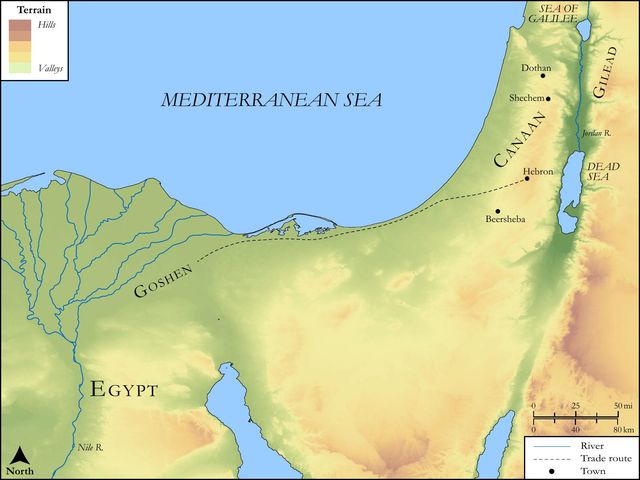
See on the biblical-era maps


Study this verse
Public-domain commentary
Matthew Henry
From his Commentary on the Whole Bible. Henry comments on passages, not single verses — this entry covers Genesis 43:1–10.
Here, 1. Jacob urges his sons to go and buy more corn in Egypt, Gen 43:1, Gen 43:2. The famine continued; and the corn they had bought was all spent, for it is meat that perisheth. Jacob, as a good master of a family, is in care to provide for those of his own house food convenient; and shall not God provide for his children, for the household of faith? Jacob bids them go again and buy a little food; now, in time of scarcity, a little must suffice, for nature is content with a little. 2. Judah urges him to consent that Benjamin should go down with them, how much soever it went against his feelings and previous determination. Note, It is not at all inconsistent with the honour and duty which children owe their parents humbly and modestly to advise them, and, as occasion is, to reason with them. Plead with your mother, plead, Hos 2:2. (1.) He insists upon the absolute necessity they were under of bringing Benjamin with them, of which he, who was a witness to all that had passed in Egypt, was a more competent judge than Jacob could be. Joseph's protestation (Gen 43:3) may be alluded to to show upon what terms we must draw nigh to God; unless we bring Christ along with us in the arms of our faith, we cannot see the face of God with comfort. (2.) He engages to take all possible care of him, and to do his utmost for his safety, Gen 43:8, Gen 43:9. Judah's conscience had lately smitten him for what he had done a great while ago against Joseph (Gen 42:21); and, as an evidence of the truth of his repentance, he is ready to undertake, as far as a man could do it, for Benjamin's security. He will not only not wrong him, but will do all he can to protect him. This is restitution, as far as the case will admit; when he knew not how he could restore Joseph, he would make some amends for the irreparable injury he had done him by doubling his care concerning Benjamin.
Continue studying Genesis 43:4 across the web’s major study libraries — every link below opens this exact verse, chapter, or book on the destination site.
Read & Compare
 BibleGatewayThis verse in more than 200 translations and 70 languages.
 Bible.comThe YouVersion reader — hundreds of translations, reading plans, and highlights.
 ESV.orgCrossway's official English Standard Version reader.
 NET BibleThe NET translation with 60,000+ translators' notes on every rendering decision.
 STEP BibleTyndale House's free study tool — original text, vocabulary, and scholarly resources.
 BibliaLogos Bible Software's free web reader.
 USCCBThe New American Bible (Revised Edition) with the U.S. bishops' study notes.
Commentaries
 BibleHub CommentariesDozens of classic commentaries on this verse, gathered on one page.
 StudyLightMore than 100 commentary sets — the largest collection on the web.
 BibleRefPlain-English commentary on what this verse means, verse by verse.
 Enduring WordDavid Guzik's free commentary on this chapter, widely used by Bible teachers.
 Bible Study ToolsVerse commentary alongside Greek and Hebrew study aids.
Original Language & Research
- BibleHub InterlinearThe verse word by word — original language, transliteration, and English.
- BibleHub LexiconEvery word's original-language definition and Strong's entry.
 Blue Letter BibleDeep-study tools — Strong's numbers, concordance, and word studies.
 SefariaThe Hebrew text with Rashi and centuries of Jewish commentary.
Sermons, Hymns & Audio


TrulyRandomVerse is not affiliated with these sites and doesn’t control their content. They’re linked because they’re genuinely useful.
Summary
Genesis 43:4 captures Judah's urgent and pivotal declaration to his father, Jacob, articulating the non-negotiable condition for their family's survival: the necessity of sending their youngest brother, Benjamin, to Egypt. This verse underscores the dire grip of the famine, Jacob's deep-seated reluctance to part with Benjamin, and the sons' desperate need to comply with the Egyptian governor's demand to secure vital provisions for their starving household.
Context
ShowHideLiterary Context
This verse is a critical turning point in the unfolding drama of Joseph and his brothers. It immediately follows Jacob's lament over the perceived loss of Joseph and Simeon, and his initial refusal to allow Benjamin to accompany his brothers to Egypt. Judah's statement in Genesis 43:4 is a direct response to Jacob's despair and the family's rapidly dwindling food supply, as highlighted in Genesis 43:2. It serves as the decisive argument that compels Jacob to finally agree, setting the stage for the brothers' return to Egypt and the dramatic revelation of Joseph's identity. This moment marks Judah's emergence as a leader and surety within the family, distinguishing him from his brothers and paving the way for his later significant role in the narrative.
Historical & Cultural Context
The setting is a severe, multi-year famine affecting both Canaan and Egypt, a common occurrence in Canaan and Egypt due to unpredictable rainfall and agricultural cycles. Egypt, with its Nile-fed agriculture and advanced storage capabilities, was often a refuge during such crises, making it a natural destination for grain. The cultural norm of a patriarch's absolute authority within the family is evident in Jacob's initial refusal and the sons' need to persuade him. Furthermore, the concept of a "surety" or "pledge" (as Judah offers in Genesis 43:9) was a recognized legal and social practice, underscoring the gravity of his commitment to Jacob. The journey from Canaan to Egypt involved significant travel, often by caravan, making the safety of family members, especially a beloved youngest son, a paramount concern.
Key Themes
ShowHideGenesis 43:4 contributes significantly to several overarching themes in the book of Genesis. It highlights the theme of Divine Providence, demonstrating how God orchestrates human circumstances, even famine and familial strife, to fulfill His covenant promises and preserve His chosen people. The verse also deepens the theme of Testing and Transformation, particularly for Jacob, who is forced to confront his fears and trust God amidst adversity, and for Judah, whose character is transformed from complicity in Joseph's sale to responsible leadership. Furthermore, it underscores the theme of Familial Reconciliation and Preservation, as the desperate need for food compels the brothers to revisit the very place where their past sins against Joseph are about to be confronted, ultimately leading to the preservation of Jacob's lineage, which is foundational to the future nation of Israel.
Exposition and Analysis
ShowHideGenesis 43:4 presents Judah's direct and urgent declaration, articulating the stark reality facing Jacob's household: "If thou wilt send our brother with us, we will go down and buy thee food." This statement underscores the non-negotiable condition set by the Egyptian governor for any further grain purchases, placing immense pressure on Jacob.
Key Word Analysis
ShowHideThis word (H7971) means "to send away, for, or out," encompassing a great variety of applications from dispatching to entrusting. In this context, it conveys the gravity of Jacob's decision to "release" or "entrust" his beloved son Benjamin into the care of his brothers for a perilous journey, highlighting the act of letting go and delegating authority.
This primitive word (H251) denotes a "brother" in the widest sense of literal relationship. Here, it specifically refers to Benjamin, the full brother of Joseph and Jacob's youngest and most cherished son. The emphasis on "our brother" appeals to Jacob's paternal bond and the shared familial responsibility among the sons, even as it highlights the unique position Benjamin holds in Jacob's heart.
This term (H7666) is denominative from a word meaning "grain," and specifically refers to "dealing in grain" or "buying/selling" it. The use of this particular verb pinpoints the precise and vital purpose of their proposed return to Egypt: to acquire the necessary grain to sustain their family, emphasizing the economic necessity driving their actions.
Verse Breakdown
ShowHide"If thou wilt send our brother with us"
This opening clause establishes the absolute condition for the brothers' return to Egypt. Judah presents it as a direct requirement from the Egyptian governor, effectively leaving Jacob with no alternative if the family is to survive. The phrase "our brother" subtly reminds Jacob of the familial bond and the shared responsibility for Benjamin's safety, while also acknowledging Jacob's personal attachment to his youngest son.
"we will go down"
This phrase signifies the physical journey from the elevated land of Canaan to the lower Nile Valley of Egypt. The verb "go down" (Hebrew: yârad) is consistently used in the Old Testament for this descent. It implies not just a physical change in elevation but also a journey into a foreign land, a place of potential danger and dependence, yet one that holds the key to their survival.
"and buy thee food"
This final clause states the ultimate purpose of their proposed journey and the direct benefit to Jacob. The "food" (Hebrew: ʼôkel) refers specifically to the grain needed to alleviate the famine. Judah's direct address "thee" underscores his commitment to providing for his father and the entire household, emphasizing the immediate and vital necessity of the mission.
Literary Devices
ShowHideGenesis 43:4, though brief, is rich in its literary impact. It functions as a powerful Plea, delivered by Judah, which carries the weight of the entire family's survival. The verse employs Conditionality ("If thou wilt send...") to highlight the stark choice facing Jacob, emphasizing the absolute necessity of Benjamin's presence for their mission's success. This conditional phrasing creates significant Dramatic Tension, as the reader understands Jacob's deep reluctance and the high stakes involved. Furthermore, Judah's emerging leadership and his willingness to take responsibility for Benjamin's safety in this moment serve as a subtle Foreshadowing of his later pivotal role in the narrative and his eventual position in the lineage of the Messiah. The simple, direct language conveys an undeniable Urgency, reflecting the desperate circumstances of the famine.
Theological and Thematic Connections
ShowHideGenesis 43:4, while a pragmatic statement, is deeply embedded in the larger narrative of God's sovereign plan for His people. It illustrates how divine providence often works through human desperation and difficult choices, compelling individuals to move in directions they would naturally resist. Jacob's struggle to release Benjamin mirrors the broader biblical theme of God testing the faith of His patriarchs, often requiring them to surrender what is most precious to them in order to experience a greater blessing or to fulfill a divine purpose. Judah's willingness to step forward and take responsibility for Benjamin also foreshadows the concept of intercession and the self-sacrificial leadership necessary for the well-being of God's people.
Reflection and Application
ShowHideGenesis 43:4 offers profound insights into human resilience and the complexities of faith when confronted with daunting challenges. In our own lives, we frequently encounter situations where difficult choices must be made for the greater good or for survival, whether physical, financial, or spiritual. This verse encourages us to recognize that dire necessity can be a powerful motivator for action, compelling us to move beyond fear or reluctance. Jacob's struggle to release Benjamin mirrors our own need to trust in a higher power or in circumstances beyond our control, even when our deepest fears are activated, reminding us to trust in the Lord with all your heart when the path ahead is unclear. Furthermore, the brothers' unified plea highlights the crucial importance of family and community support, demonstrating that leaning on and advocating for one another is vital for navigating life's most challenging seasons successfully. It challenges us to consider what "precious things" we might be holding onto that God is calling us to release for His greater purpose, trusting that His provision will ultimately outweigh our fears.
Questions for Reflection
ShowHideFAQ
ShowHideWhy was Benjamin's presence so crucial for the brothers to buy food?
ShowHideJoseph, disguised as the Egyptian governor, had accused his brothers of being spies during their first visit. To prove their honesty and to test their character, particularly regarding their treatment of a younger brother, he demanded they bring their youngest brother, Benjamin, to Egypt. This was Joseph's strategic way of discerning if his brothers had changed since their betrayal of him years earlier. Without Benjamin, they could not purchase more grain, as stated by Joseph in Genesis 42:20.
Why did Judah, specifically, step forward to make this plea?
ShowHideJudah's prominent role in this scene is highly significant. He had previously been instrumental in the decision to sell Joseph into slavery, though he had also advocated against killing him (Genesis 37:26-27). In Genesis 43, Judah demonstrates a profound transformation, taking responsibility and showing decisive leadership within the family. He offers to be surety for Benjamin, pledging his own life for Benjamin's safe return (Genesis 43:9). This act marks a pivotal shift in his character, highlighting his growth in integrity and willingness to sacrifice for his family's well-being, solidifying his emerging leadership.
What does "go down" signify in this context?
ShowHide"Go down" (Hebrew: yârad) is a consistent geographical and directional term in the Old Testament, referring to the descent from the higher elevation of the land of Canaan to the lower Nile Valley of Egypt. Beyond its literal meaning, it often carries theological implications, signifying a journey into a place of dependence, trial, or even spiritual testing. In this context, it signifies a necessary journey into a foreign land for survival, a journey that ultimately leads to the resolution of the family's conflict and the preservation of God's covenant people.
Christ-Centered Fulfillment
ShowHideGenesis 43:4, though a simple statement of necessity, profoundly points towards Christ-centered fulfillment through its themes of intercession, sacrifice, and the preservation of a chosen people. Judah's willingness to "send our brother" and his subsequent pledge to be surety for Benjamin (Genesis 43:9) profoundly foreshadow Christ's ultimate act of intercession and self-sacrifice. Just as Benjamin, the beloved son, had to be "sent" and risked for the salvation and sustenance of his family, so too was Christ, the beloved Son, "sent" by the Father into the perilous reality of human existence to secure spiritual sustenance and eternal salvation for humanity (John 3:16). Judah's taking responsibility for his brother's safe return prefigures Christ, our greater Brother and perfect Intercessor, who not only guarantees our eternal safety but also brings us into the presence of the Father, ensuring the preservation of God's spiritual family through His atoning work (Hebrews 7:25). The "food" they sought in Egypt ultimately points to Christ, the true Bread of Life, who satisfies our deepest spiritual hunger (John 6:35).