


2 Samuel 6:21
- וַיֹּאמֶרvai·Yo·merand he saidH559Conj-w ¦ V-Qal-ConsecImperf-3msVerb Qal Consecutive Imperfect 3rd Singular Masculineוַandיֹּאמֶרhe said
- דָּוִדda·VidDavidH1732N-proper-mNoun Proper Masculine
- אֶל'eltoH413PrepPreposition
- מִיכַלmi·KhalMichalH4324N-proper-fNoun Proper Feminine
- לִפְנֵיlif·Nei<to> beforeH6440Prep-l ¦ N-mpcNoun Plural Masculine Constructלִ<to>פְנֵיbefore
- יְהוָהYah·wehYahwehH3068N-properNoun Proper Title
- אֲשֶׁר'a·SherwhoH834RelParticle Relative
- בָּחַרba·charhe choseH977V-Qal-Perf-3msVerb Qal Perfect 3rd Singular Masculine
- בִּיbi<in> <the> mePrep-b ¦ 1csSuffix Personal 1st Singular common genderבִּ<in> <the>יme
- מֵאָבִיךְme·'a·viKhmore than your fatherH1Prep-m ¦ N-msc ¦ 2msNoun Singular Masculine Constructמֵmore thanאָבִיfatherךְyour
- וּמִכָּלu·mi·koland more than allH3605Conj-w ¦ Prep-m ¦ N-mscNoun Singular Masculine Constructוּandמִmore thanכָּלall
- בֵּיתוֹbei·Tohis householdH1004N-msc ¦ 3msNoun Singular Masculine Constructבֵּיתhouseholdוֹhis
- לְצַוֹּתle·tza·Votto appointH6680Prep-l ¦ V-Piel-InfVerb Piel Infinitive Constructלְtoצַוֹּתappoint
- אֹתִי'o·Ti<obj.> meH853DirObjM ¦ 1csParticle Object Indicatorאֹתִ<obj.>יme
- נָגִידna·GidrulerH5057N-msNoun Singular Masculine Absolute
- עַל'aloverH5921PrepPreposition
- עַם'am[the] people ofH5971N-mscNoun Singular Masculine Construct
- יְהוָהYah·wehYahwehH3068N-properNoun Proper Title
- עַל'aloverH5921PrepPreposition
- יִשְׂרָאֵלYis·ra·'ElIsraelH3478N-properNoun Proper Location
- וְשִׂחַקְתִּיve·si·chak·Tiand I will playH7832Conj-w ¦ V-Piel-ConsecPerf-1csVerb Piel Consecutive Perfect 1st Singular common genderוְandשִׂחַקְתִּיI will play
- לִפְנֵיlif·Nei<to> beforeH6440Prep-l ¦ N-mpcNoun Plural Masculine Constructלִ<to>פְנֵיbefore
- יְהוָהYah·wehYahwehH3068N-properNoun Proper Title
English is a literal word-by-word gloss of the Hebrew, not the KJV's wording. Why?
This is the original text the KJV's translators worked from — each Hebrew word with its own literal English meaning in this verse, prepared by scholars at Tyndale House, Cambridge. The KJV translates whole sentences, not word by word, so its wording differs: one Hebrew word can become several English words, and the KJV may choose “the LORD” where the gloss reads “Yahweh”. Both are faithful — they answer different questions. For the KJV's own rendering, switch to the KJV text.
Details
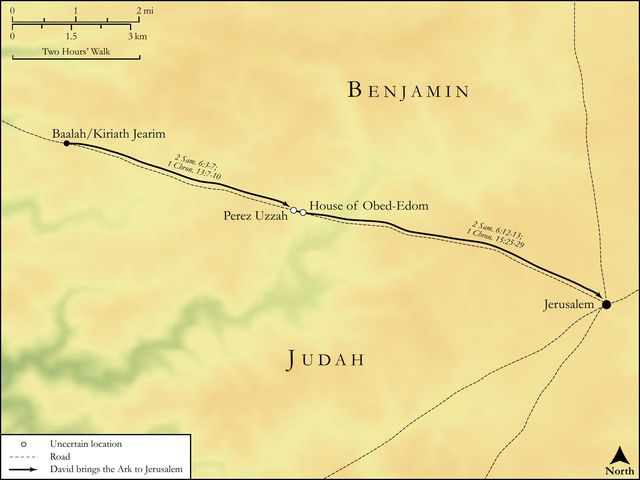
See on the biblical-era map

Study this verse
Public-domain commentary
Matthew Henry
From his Commentary on the Whole Bible. Henry comments on passages, not single verses — this entry covers 2 Samuel 6:20–23. His four-level outline is real structure in the source text, so it is rendered as structure.
David, having dismissed the congregation with a blessing, returned to bless his household (Sa2 6:20), that is, to pray with them and for them, and to offer up his family thanksgiving for this national mercy. Ministers must not think that their public performances will excuse them from their family-worship; but when they have, with their instructions and prayers, blessed the solemn assemblies, they must return in the same manner to bless their households, for with them they are in a particular manner charged. David, though he had prophets, and priests, and Levites, about him, to be his chaplains, yet did not devolve the work upon them, but himself blessed his household. It is angels' work to worship God, and therefore surely that can be no disparagement to the greatest of men.
Never did David return to his house with so much pleasure and satisfaction as he did now that he had got the ark into his neighbourhood; and yet even this joyful day concluded with some uneasiness, occasioned by the pride and peevishness of his wife. Even the palaces of princes are not exempt from domestic troubles. David had pleased all the multitude of Israel, but Michal was not pleased with his dancing before the ark. For this, when he was at a distance, she scorned him, and when he came home she scolded him. She was not displeased at his generosity to the people, nor did she grudge the entertainment he gave them; but she thought he degraded himself too much in dancing before the ark. It was not her covetousness, but her pride, that made her fret.
I.When she saw David in the street dancing before the Lord she despised him in her heart, Sa2 6:16.
She thought this mighty zeal of his for the ark of God, and the transport of joy he was in upon its coming home to him, was but a foolish thing, and unbecoming so great a soldier, and statesman, and monarch, as he was. It would have been enough for him to encourage the devotion of others, but she looked upon it as a thing below him to appear so very devout himself. "What a fool" (thinks she) "does my husband make of himself now! How fond is he of this ark, that might as well have lain still where it had lain for so many years! Much devotion has almost made him mad." Note, The exercises of religion appear very mean in the eyes of those that have little or no religion themselves.
II.When he came home in the very best disposition she began to upbraid him, and was so full of disdain and indignation that she could not contain till she had him in private, but went out to meet him with her reproaches. Observe,
1.How she taunted him (Sa2 6:20): "How glorious was the king of Israel today! What a figure didst thou make today in the midst of the mob! How unbecoming thy post and character!" Her contempt of him and his devotion began in the heart, but out of the abundance of that the mouth spoke. That which displeased her was his affection to the ark, which she wished he had no greater kindness for than she had: but she basely represents his conduct, in dancing before the ark, as lewd and immodest; and, while really she was displeased at it as a diminution to his honour, she pretended to dislike it as a reproach to his virtue, that he uncovered himself in the eyes of the maid-servants, as no man would have done but one of the vain fellows that cared not how much he shamed himself. We have no reason to think that this was true in fact. David, no doubt, observed decorum, and governed his zeal with discretion. But it is common for those that reproach religion thus to put false colours upon it and lay it under the most odious characters. To have abused any man thus for his pious zeal would have been very profane, but to abuse her own husband thus, whom she ought to have reverenced, and one whose prudence and virtue were above the reach of malice itself to disparage, one who had shown such affection for her that he would not accept a crown unless he might have her restored to him (Sa2 3:13), was a most base and wicked thing, and showed her to have more of Saul's daughter in her than of David's wife or Jonathan's sister.
2.How he replied to her reproach. He did not upbraid her with her treacherous departure from him to embrace the bosom of a stranger. He had forgiven that, and therefore had forgotten it, though, it may be, his own conscience, on this occasion, upbraided him with his folly in receiving her again (for that is said to pollute the land, Jer 3:1), but he justifies himself in what he did.
(1.)He designed thereby to honour God (Sa2 6:21): It was before the Lord, and with an eye to him. Whatever invidious construction she was pleased to put upon it, he had the testimony of his conscience for him that he sincerely aimed at the glory of God, for whom he thought he could never do enough. Here he reminds her indeed of the setting aside of her father's house, to make way for him to the throne, that she might not think herself the most proper judge of propriety: "God chose me before thy father, and appointed me to be ruler over Israel, and now I am the fountain of honour; and, if the expressions of a warm devotion to God were looked upon as mean and unfashionable in thy father's court, yet I will play before the Lord, and thereby bring them into reputation again. And, if this be to be vile (Sa2 6:22), I will be yet more vile." Note,
[1.]We should be afraid of censuring the devotion of others though it may not agree with our sentiments, because, for aught that we know, the heart may be upright in it, and who are we that we should despise those whom God has accepted?
[2.]If we can approve ourselves to God in what we do in religion, and do it as before the Lord, we need not value the censures and reproaches of men. If we appear right in God's eyes, no matter how mean we appear in the eyes of the world.
[3.]The more we are vilified for well-doing the more resolute we should be in it, and hold our religion the faster, and bind it the closer to us, for the endeavours of Satan's agents to shake us and to shame us out of it. I will be yet more vile.
(2.)He designed thereby to humble himself: "I will be base in my own sight, and will think nothing too mean to stoop to for the honour of God." In the throne of judgment, and in the field of battle, none shall do more to support the grandeur and authority of a prince than David shall; but in acts of devotion he lays aside the thought of majesty, humbles himself to the dust before the Lord, joins in with the meanest services done in honour of the ark, and thinks all this no diminution to him. The greatest of men is less than the least of the ordinances of Jesus Christ.
(3.)He doubted not but even this would turn to his reputation among those whose reproach Michal pretended to fear: Of the maid-servants shall I be had in honour. The common people would be so far from thinking the worse of him for these pious condescensions that they would esteem and honour him so much the more. Those that are truly pious are sometimes manifested in the consciences even of those that speak ill of them, Co2 5:11. Let us never be driven from our duty by the fear of reproach; for to be steady and resolute in it will perhaps turn to our reputation more than we think it will. Piety will have its praise. Let us not then be indifferent in it, nor afraid or ashamed to own it.
David was contented thus to justify himself, and did not any further animadvert upon Michal's insolence; but God punished her for it, writing her for ever childless from this time forward, Sa2 6:23. She unjustly reproached David for his devotion, and therefore God justly put her under the perpetual reproach of barrenness. Those that honour God he will honour; but those that despise him, and his servants and service, shall be lightly esteemed.
Historical interpretation
Two Centuries of Reception
2 surviving comments on this verse. Each one is dated, so this reads as a timeline rather than a list.
Select a marker to jump to its quote. Markers stagger vertically where authors wrote within a few decades of each other.
But the things which viewed corporeally are unseemly, when viewed in regard to holy religion become venerable, so that they who blame such things will involve their own souls in the net of blame. Thus Michal reproves David for his dancing and says to him, How glorious was the king of Israel to day, who uncovered himself to day in the eyes of his handmaids! And David answered her, It was before the Lord, which chose me before thy father, and before all his house to appoint me ruler over the people of the Lord, over Israel: therefore will I play before the Lord, and I will be yet more vile thus, and will be base in mine own sight, and of the maid-servants which thou hast spoken of, of them shall I be had in honour.
You will be blessed if you give thanks to God both in adversity and in prosperity and if you consider the prosperity of this life as smoke and vapor that immediately vanishes. David was a king, yet, in spite of having numerous treasures and ruling countless peoples with a strong hand, he sang of himself as humble and said, “I am afflicted in an agony from my youth.” And again, he said to the daughter of Saul, “I shall walk humbly, and I shall appear humbly before the Lord, who chose me rather than your father.” Likewise, he also said, “I am a wayfarer of earth and a pilgrim like all my fathers.”
Continue studying 2 Samuel 6:21 across the web’s major study libraries — every link below opens this exact verse, chapter, or book on the destination site.
Read & Compare
 BibleGatewayThis verse in more than 200 translations and 70 languages.
 Bible.comThe YouVersion reader — hundreds of translations, reading plans, and highlights.
 ESV.orgCrossway's official English Standard Version reader.
 NET BibleThe NET translation with 60,000+ translators' notes on every rendering decision.
 STEP BibleTyndale House's free study tool — original text, vocabulary, and scholarly resources.
 BibliaLogos Bible Software's free web reader.
 USCCBThe New American Bible (Revised Edition) with the U.S. bishops' study notes.
Commentaries
 BibleHub CommentariesDozens of classic commentaries on this verse, gathered on one page.
 StudyLightMore than 100 commentary sets — the largest collection on the web.
 BibleRefPlain-English commentary on what this verse means, verse by verse.
 Enduring WordDavid Guzik's free commentary on this chapter, widely used by Bible teachers.
 Bible Study ToolsVerse commentary alongside Greek and Hebrew study aids.
Original Language & Research
- BibleHub InterlinearThe verse word by word — original language, transliteration, and English.
- BibleHub LexiconEvery word's original-language definition and Strong's entry.
 Blue Letter BibleDeep-study tools — Strong's numbers, concordance, and word studies.
 SefariaThe Hebrew text with Rashi and centuries of Jewish commentary.
Sermons, Hymns & Audio


TrulyRandomVerse is not affiliated with these sites and doesn’t control their content. They’re linked because they’re genuinely useful.
Summary
In 2 Samuel 6:21, King David passionately defends his unreserved and undignified worship before the Lord to his wife, Michal, who had expressed contempt for his exuberant dancing as the Ark of the Covenant was brought into Jerusalem. David's response grounds his actions in God's sovereign election of him over Saul's house to rule Israel, asserting that his worship is primarily directed toward and for the pleasure of "the LORD," serving as a humble, joyful response to divine grace rather than adhering to human standards of royal decorum.
Context
ShowHideLiterary Context
This verse serves as the powerful climax of David's spirited defense against Michal's scorn, immediately following her public rebuke of his "uncovering himself" while dancing before the Lord as the Ark was processed into Jerusalem (2 Samuel 6:16). The broader narrative of 2 Samuel 6 meticulously details the triumphant, yet initially fraught, journey of the Ark of the Covenant from the house of Obed-Edom to Jerusalem, establishing Jerusalem as both the political and spiritual capital of Israel. David's ecstatic worship, which Michal views as demeaning for a king, contrasts sharply with the solemnity expected of royalty, setting up a poignant theological confrontation between human pride and divine honor. The chapter concludes with the severe consequence of Michal's contempt: her barrenness (see 2 Samuel 6:23), underscoring the gravity of her misjudgment of David's divinely-inspired devotion.
Historical & Cultural Context
The Ark of the Covenant represented the very presence of God among His people, serving as the tangible symbol of the covenant relationship between Yahweh and Israel. Its relocation to Jerusalem was a monumental event, signifying the spiritual consolidation of the kingdom under David. Kings in the ancient Near East were typically expected to maintain a dignified, even aloof, public image, embodying the power and majesty of their office. Michal, as the daughter of the former king, Saul, and a member of the royal household, likely held a strong adherence to these traditional notions of kingly decorum. David's actions, stripping himself of outer garments and dancing with abandon, would have been seen by some as a profound breach of royal protocol, particularly before "servant girls" (as Michal states in 2 Samuel 6:20). David's defense, however, powerfully reorients the focus from human expectations to divine election and the unique nature of Israel's kingship, which was ultimately subservient to God.
Key Themes
ShowHideDavid's declaration in this verse powerfully articulates several core themes found throughout the books of Samuel and the broader Old Testament. Firstly, it highlights Divine Election and Sovereignty, emphasizing that David's kingship was not a matter of human succession or merit but a direct, sovereign choice of God, who "chose me before thy father, and before all his house, to appoint me ruler over the people of the LORD, over Israel." This echoes God's earlier rejection of Saul and anointing of David (see 1 Samuel 16:1-13). Secondly, it underscores the theme of Authentic Worship and Humility. David's willingness to "play before the LORD" demonstrates a profound humility, prioritizing heartfelt devotion to God over maintaining a regal image or adhering to social norms. His worship is presented as being directed vertically, "before the LORD," rather than horizontally for human approval. This stands in stark contrast to Michal's Pride and Misunderstanding of Piety, which leads her to judge David's spiritual fervor through a lens of aristocratic disdain, ultimately resulting in her barrenness (as recorded in 2 Samuel 6:23).
Exposition and Analysis
ShowHideKey Word Analysis
ShowHideThis verb (H977) signifies a deliberate, sovereign act of selection, often implying a covenantal relationship or special favor. Here, it underscores God's active and decisive role in establishing David's kingship, contrasting sharply with the dynastic succession Michal might have expected or preferred from her father's house. David's authority and very identity as king are rooted in God's prior, unmerited choice, not in human lineage or popular acclaim.
This noun (H6440), often translated as "face" or "presence," is used here with a preposition to form the phrase "before the LORD." It denotes a direct, personal encounter or action performed in the divine presence, implying accountability and orientation toward God's approval rather than human observation or judgment. David's worship was not a performance for his subjects or Michal, but an offering made directly to the One whose presence was paramount.
While this verb (H7832) can sometimes mean to laugh, mock, or jest, in this context, it conveys a sense of joyful, unrestrained, and even spontaneous celebration or dancing. It suggests an exuberant, perhaps childlike, expression of delight and reverence that transcends formal ritual or dignified composure. David's use of this word emphasizes the uninhibited nature of his worship, which was born of profound joy and gratitude for God's election.
Verse Breakdown
ShowHide"And David said unto Michal"
This opening establishes the immediate context as a direct, personal confrontation, highlighting the marital and theological tension between David and Michal. It sets the stage for David's impassioned defense.
"[It was] before the LORD"
David immediately establishes the singular, divine audience for his actions. His worship was not directed at Michal, nor at his servants, but solely at God. This phrase fundamentally reorients the entire discussion from human perception and judgment to divine approval and presence.
"which chose me before thy father, and before all his house, to appoint me ruler over the people of the LORD, over Israel"
This clause forms the theological core of David's argument and the foundation for his worship. He asserts that his kingship is a direct result of God's sovereign and unmerited choice, bypassing Saul's lineage entirely. This divine election is the ultimate legitimization of his authority and the profound reason for his gratitude and unreserved worship. It also serves as a subtle but firm rebuke to Michal, whose pride in her royal lineage from Saul is implicitly challenged by God's rejection of her father's house.
"therefore will I play before the LORD"
This concluding clause functions as both a logical consequence and a firm declaration of intent. Because God chose him and appointed him to such a sacred office, David's response is one of unreserved, joyful worship, performed directly in God's presence. His actions are not an undignified display but a fitting, humble, and heartfelt response to the magnitude of God's grace and sovereignty in his life.
Literary Devices
ShowHideThe passage employs several potent literary devices to convey its profound message. Contrast is central, starkly juxtaposing David's humble, uninhibited devotion with Michal's aristocratic pride and concern for outward appearances. This highlights the differing understandings of true piety and kingship. The Repetition of the phrase "before the LORD" serves as an insistent theological refrain, emphasizing the vertical orientation of David's worship and his unwavering focus on God's approval rather than human judgment. David's speech itself functions as a powerful Argumentation or Defense, systematically dismantling Michal's criticism by appealing to divine authority and election. Furthermore, David's actions and Michal's reaction, particularly her contempt, can be seen as Foreshadowing the ultimate outcome for Michal, whose barrenness (2 Samuel 6:23) is implicitly linked to her disdain for the divinely chosen king and his authentic worship.
Theological and Thematic Connections
ShowHideDavid's bold declaration in 2 Samuel 6:21 is a profound statement on the nature of authentic worship and divine election. It teaches that true worship is not about human dignity, social decorum, or outward appearances, but about a humble, heartfelt response to God's sovereign grace. David, the anointed king, willingly sheds the outward trappings of royalty to express his devotion, recognizing that his position is entirely dependent on God's choice. His worship is a direct, personal interaction with the Lord, prioritizing God's pleasure above all human judgment. This passage challenges believers to examine their own motivations in worship, urging them to cultivate a spirit of genuine humility and unreserved adoration, focused solely on the One who has chosen and blessed them, regardless of how it may appear to others.
Reflection and Application
ShowHideDavid's response to Michal offers timeless lessons for believers navigating the tension between cultural expectations and authentic faith. His willingness to humble himself and express uninhibited joy "before the LORD" challenges us to consider where our ultimate allegiance lies. Do we prioritize human approval and societal norms, or are we willing to shed our own perceived dignity to offer God the worship He truly desires—a worship born of gratitude for His sovereign choice and grace? This passage calls us to cultivate a heart that is so overwhelmed by God's goodness and election that our expression of devotion becomes unconstrained, genuine, and focused entirely on His pleasure. It reminds us that our highest calling, regardless of our earthly status or role, is to live and worship "before the LORD," knowing that His gaze penetrates beyond outward appearances to the sincerity of our hearts.
Questions for Reflection
ShowHideFAQ
ShowHideWhy was Michal upset with David's dancing?
ShowHideMichal, as the daughter of King Saul, held a traditional view of royal dignity and decorum. She saw David's exuberant dancing, especially when he "uncovered himself" (likely meaning he removed his outer royal robes, revealing his priestly ephod or undergarments, and danced among the common people), as undignified and demeaning for a king. She believed he had humiliated himself before his servants, particularly the "handmaids of his servants" (see 2 Samuel 6:20). Her concern was for his public image and the perceived lowering of his royal status, rather than the spiritual fervor of his worship.
What is the significance of "before the LORD" in David's statement?
ShowHideThe phrase "before the LORD" is crucial to understanding David's motivation. It signifies that his actions were directed vertically, towards God, for His pleasure and honor, not for human display or approval. David was not performing for Michal or his subjects; he was worshipping the God who had chosen him. This highlights the essence of true worship: it is an act of devotion and submission to God, regardless of how it might be perceived by others. It underscores that God's approval is paramount, far outweighing human opinion or social conventions.
How does David's response relate to his kingship?
ShowHideDavid's response directly links his worship to the unique nature of his kingship. He asserts that his authority is not inherited or based on human lineage (like Saul's house), but is a direct result of God's sovereign choice and appointment. This divine election liberates him from the need to conform to human standards of royal dignity when worshipping God. Because he is God's chosen ruler "over the people of the LORD, over Israel," his primary allegiance and devotion are to God. His willingness to humble himself in worship is, paradoxically, an affirmation of his divinely ordained kingship, demonstrating that he serves God first and foremost.
Christ-Centered Fulfillment
ShowHideDavid's unreserved worship and his defense rooted in divine election powerfully foreshadow the person and work of Jesus Christ. Like David, Jesus was the divinely chosen King, not by human lineage alone, but by the direct will and appointment of God (see Isaiah 42:1 and Matthew 3:17). Yet, unlike earthly kings, Christ did not cling to dignity or status; instead, He "made himself nothing, taking the very nature of a servant, being made in human likeness" (Philippians 2:7). His entire life was an act of profound, humble worship "before the LORD," culminating in His ultimate obedience on the cross (see Philippians 2:8). David's "playing before the LORD" in joyful abandonment finds its ultimate expression in Christ, who, "for the joy set before him endured the cross, scorning its shame" (Hebrews 12:2). Jesus, the true Lamb of God, humbled Himself completely, not for His own glory, but for the glory of the Father and the salvation of His people, demonstrating the most authentic and unreserved worship possible. His self-abasement, perceived as weakness by the world, was in fact the greatest act of divine power and love, perfectly fulfilling the spirit of David's devotion.