


Numbers 10:33
Bible text: King James Version (1769 Blayney text) · Public domain
Bible text: King James Version with Strong's numbers · Public domain
Bible text: Berean Standard Bible · Public domain
Bible text: American Standard Version (1901) · Public domain
Bible text: World English Bible, Messianic edition · Public domain
Bible text: Geneva Bible (1599) · Public domain
Bible text: Young's Literal Translation · Public domain
- וַיִּסְעוּvai·yis·'Uand they set outH5265Conj-w ¦ V-Qal-ConsecImperf-3mpVerb Qal Consecutive Imperfect 3rd Plural Masculineוַandיִּסְעוּthey set out
- מֵהַרme·Harfrom [the] mountain ofH2022Prep-m ¦ N-mscNoun Singular Masculine Constructמֵfromהַר[the] mountain of
- יְהוָהYah·wehYahwehH3068N-properNoun Proper Title
- דֶּרֶךְDe·rekha journey ofH1870N-cscNoun Singular common gender Construct
- שְׁלֹשֶׁתshe·Lo·shetthreeH7969Adj-cscAdjective Numerical Singular common gender Construct
- יָמִיםya·MimdaysH3117N-mpNoun Plural Masculine Absolute
- וַאֲרוֹןva·'a·Ronand [the] ark ofH727Conj-w ¦ N-mscNoun Singular Masculine Constructוַandאֲרוֹן[the] ark of
- בְּרִיתbe·rit[the] covenant ofH1285N-fscNoun Singular Feminine Construct
- יְהוָהYah·wehYahwehH3068N-properNoun Proper Title
- נֹסֵעַno·Se·a'[was] setting outH5265V-Qal-Prtcpl-msVerb Qal Participle Singular Masculine Absolute
- לִפְנֵיהֶםlif·nei·Hem<to> before themH6440Prep-l ¦ N-mpc ¦ 3mpNoun Plural Masculine Constructלִ<to>פְנֵיbeforeהֶםthem
- דֶּרֶךְDe·rekha journey ofH1870N-cscNoun Singular common gender Construct
- שְׁלֹשֶׁתshe·Lo·shetthreeH7969Adj-cscAdjective Numerical Singular common gender Construct
- יָמִיםya·MimdaysH3117N-mpNoun Plural Masculine Absolute
- לָתוּרla·Turto seek outH8446Prep-l ¦ V-Qal-InfVerb Qal Infinitive Constructלָtoתוּרseek out
- לָהֶםla·Hemfor <the> themPrep-l ¦ 3mpSuffix Personal 3rd Plural Masculineלָfor <the>הֶםthem
- מְנוּחָהme·nu·Chaha resting placeH4496N-fsNoun Singular Feminine Absolute
English is a literal word-by-word gloss of the Hebrew, not the KJV's wording. Why?
This is the original text the KJV's translators worked from — each Hebrew word with its own literal English meaning in this verse, prepared by scholars at Tyndale House, Cambridge. The KJV translates whole sentences, not word by word, so its wording differs: one Hebrew word can become several English words, and the KJV may choose “the LORD” where the gloss reads “Yahweh”. Both are faithful — they answer different questions. For the KJV's own rendering, switch to the KJV text.
Details
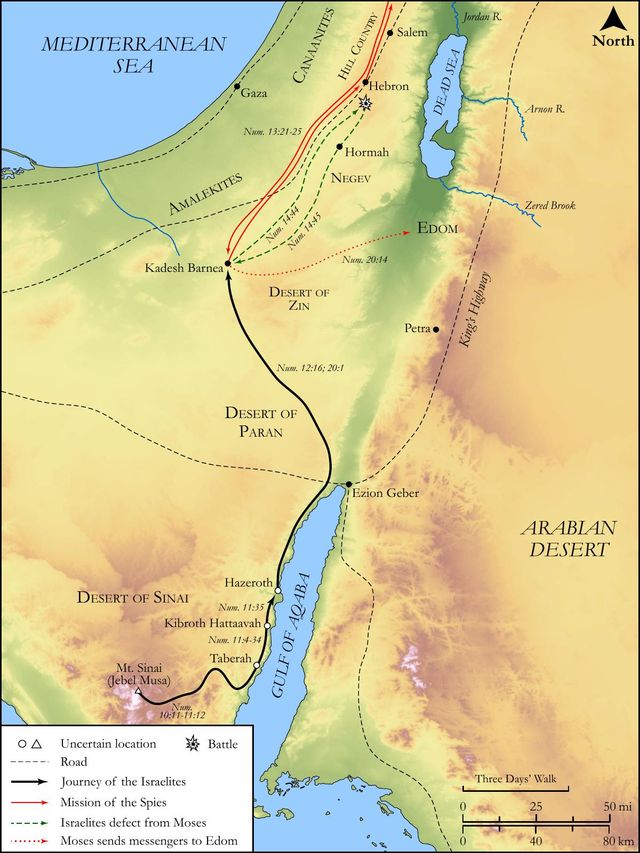
See on the biblical-era map
Study this verse
Public-domain commentary
Matthew Henry
From his Commentary on the Whole Bible. Henry comments on passages, not single verses — this entry covers Numbers 10:29–36. His four-level outline is real structure in the source text, so it is rendered as structure.
Here is, I. An account of what passed between Moses and Hobab, now upon this advance which the camp of Israel made towards Canaan. Some think that Hobab was the same with Jethro, Moses's father-in-law, and that the story, Ex. 18, should come in here; it seems more probable that Hobab was the son of Jethro, alias Reuel, or Raguel (Exo 2:18), and that when the father, being aged, went to his own land (Exo 18:27), he left his son Hobab with Moses, as Barzillai left Chimham with David; and the same word signifies both a father-in-law and a brother-in-law. Now this Hobab staid contentedly with Israel while they encamped at mount Sinai, near his own country; but, now that they were removing, he was for going back to his own country and kindred, and his father's house. Here is, 1. The kind invitation Moses gives him to go forward with them to Canaan, Num 10:29. He tempts him with a promise that they would certainly be kind to him, and puts God's word in for security: The Lord hath spoken good concerning Israel. As if he had said, "Come, cast in thy lot among us, and thou shalt fare as we fare; and we have the promise of God that we shall fare well." Note, Those that are bound for the heavenly Canaan should invite and encourage all their friends to go along with them, for we shall have never the less of the treasures of the covenant, and the joys of heaven, for others coming in to share with us. And what argument can be more powerful with us to take God's people for our people than this, that God hath spoken good concerning them? It is good having fellowship with those that have fellowship with God (Jo1 1:3), and going with those with whom God is, Zac 8:23. 2. Hobab's inclination, and present resolution, to go back to his own country, Num 10:30. One would have thought that he who had seen so much of the special presence of God with Israel, and such surprising tokens of his favour to them, would not have needed much invitation to embark with them. But his refusal must be imputed to the affection he had for his native air and soil, which was not overpowered, as it ought to have been, by a believing regard to the promise of God and a value for covenant blessings. He was indeed a son of Abraham's loins (for the Midianites descended from Abraham by Keturah), but not an heir of Abraham's faith (Heb 11:8), else he would not have given Moses this answer. Note, The things of this world, which are seen, draw strongly from the pursuit of the things of the other world, which are not seen. The magnetic virtue of this earth prevails with most people above the attractives of heaven itself. 3. The great importunity Moses used with him to alter his resolution, Num 10:31, Num 10:32. He urges, (1.) That he might be serviceable to them: "We are to encamp in the wilderness" (a country well known to Hobab), "and thou mayest be to us instead of eyes, not to show us where we must encamp, nor what way we must march" (which the cloud was to direct), "but to show us the conveniences and inconveniences of the place we march through and encamp in, that we may make the best use we can of the conveniences, and the best fence we can against the inconveniences." Note, It will very well consist with our trust in God's providence to make use of the help of our friends in those things wherein they are capable of being serviceable to us. Even those that were led by miracle must not slight the ordinary means of direction. Some think that Moses suggests this to Hobab, not because he expected much benefit from his information, but to please him with the thought of being some way useful to so great a body, and so to draw him on with them, by inspiring him with an ambition to obtain that honour. Calvin gives quite another sense of this place, very agreeably with the original, which yet I do not find taken notice of by any since. "Leave us not, I pray thee, but come along, to share with us in the promised land, for therefore hast thou known our encampment in the wilderness, and hast been to us instead of eyes; and we cannot make thee amends for sharing with us in our hardships, and doing us so many good offices, unless thou go with us to Canaan. Surely for this reason thou didst set out with us that thou mightest go on with us." Note, Those that have begun well should use that as a reason for their persevering, because otherwise they lose the benefit and recompence of all they have done and suffered. (2.) That they would be kind to him: What goodness the Lord shall do to us, the same we will do to thee, Num 10:32. Note, [1.] We can give only what we receive. We can do no more service and kindness to our friends than God is pleased to put it into the power of our hand to do. This is all we dare promise, to do good as God shall enable us. [2.] Those that share with God's Israel in their labours and hardships shall share with them in their comforts and honours. Those that are wiling to take their lot with them in the wilderness shall have their lot with them in Canaan; if we suffer with them we shall reign with them, Ti2 2:12; Luk 22:28, Luk 22:29.
We do not find any reply that Hobab here made to Moses, and therefore we hope that his silence gave consent, and he did not leave them, but that, when he perceived he might be useful, he preferred that before the gratifying of his own inclination; in this case he left us a good example. And we find (Jdg 1:16; Sa1 15:6) that his family was no loser by it.
II.An account of the communion between God and Israel in this removal.
They left the mount of the Lord (Num 10:33), that Mount Sinai where they had seen his glory and heard his voice, and had been taken into covenant with him (they must not expect that such appearances of God to them as they had there been blessed with should be constant); they departed from that celebrated mountain, which we never read of in scripture any more, unless with reference to these past stories; now farewell, Sinai; Zion is the mountain of which God has said. This is my rest for ever (Psa 132:14), and of which we must say so. But when they left the mount of the Lord they took with them the ark of the covenant of the Lord, by which their stated communion with God was to be kept up. For,
1.By it God did direct their paths. The ark of the covenant went before them, some think in place, at least in this removal; others think only in influence; though it was carried in the midst of the camp, yet the cloud that hovered over it directed all their motions. The ark (that is, the God of the ark) is said to search out a resting place for them; not that God's infinite wisdom and knowledge need to make searches, but every place they were directed to was as convenient for them as if the wisest man they had among them had been employed to go before them, and mark out their camp to the best advantage. thus Canaan is said to be a land which God spied out, Eze 20:6.
2.By it they did in all their ways acknowledge God, looking upon it as a token of God's presence; when that moved, or rested, they had their eye up unto God. Moses, as the mouth of the congregation, lifted up a prayer, both at the removing and at the resting of the ark; thus their going out and coming in were sanctified by prayer, and it is an example to us to begin and end every day's journey, and every day's work, with prayer.
(1.)Here is his prayer when the ark set forward: Rise up, Lord, and let thy enemies be scattered, Num 10:35. They were now in a desolate country, but they were marching towards an enemy's country, and their dependence was upon God for success and victory in their wars, as well as for direction and supply in the wilderness. David used this prayer long after (Psa 68:1), for he also fought the Lords' battles. Note,
[1.]There are those in the world that are enemies to God, and haters of him: secret and open enemies; enemies to his truths, his laws, his ordinances, his people.
[2.]The scattering and defeating of God's enemies is a thing to be earnestly desired, and believingly expected, by all the Lord's people. This prayer is a prophecy. Those that persist in rebellion against God are hasting towards their own ruin.
[3.]For the scattering and defeating of God's enemies, there needs no more but God's arising. When God arose to judgment, the work was soon done, Psa 76:8, Psa 76:9. "Rise, Lord, as the sun riseth to scatter the shadows of the night." Christ's rising from the dead scattered his enemies, Psa 68:18.
(2.)His prayer when the ark rested, Num 10:36.
[1.]That God would cause his people to rest. So some read it, "Return, O Lord, the many thousands of Israel, return them to their rest again after this fatigue." Thus it is said (Isa 63:14), The Spirit of the Lord caused him to rest. Thus he prays that God would give Israel success and victory abroad, and peace and tranquillity at home.
[2.]That God himself would take up his rest among them. So we read it: Return to the thousands of Israel, the ten thousand thousand, so the word is. Note, First, The church of God is a great body; there are many thousands belonging to God's Israel. Secondly, We ought in our prayers to concern ourselves for this body. Thirdly, The welfare and happiness of the Israel of God consist in the continual presence of God among them. Their safety consists not in their numbers, though they are thousands, many thousands, but in the favour of God, and his gracious return to them and residence with them. These thousands are cyphers; he is the figure: and upon this account, Happy art thou, O Israel! who is like unto thee, O people!
Continue studying Numbers 10:33 across the web’s major study libraries — every link below opens this exact verse, chapter, or book on the destination site.
Read & Compare
 BibleGatewayThis verse in more than 200 translations and 70 languages.
 Bible.comThe YouVersion reader — hundreds of translations, reading plans, and highlights.
 ESV.orgCrossway's official English Standard Version reader.
 NET BibleThe NET translation with 60,000+ translators' notes on every rendering decision.
 STEP BibleTyndale House's free study tool — original text, vocabulary, and scholarly resources.
 BibliaLogos Bible Software's free web reader.
 USCCBThe New American Bible (Revised Edition) with the U.S. bishops' study notes.
Commentaries
 BibleHub CommentariesDozens of classic commentaries on this verse, gathered on one page.
 StudyLightMore than 100 commentary sets — the largest collection on the web.
 BibleRefPlain-English commentary on what this verse means, verse by verse.
 Enduring WordDavid Guzik's free commentary on this chapter, widely used by Bible teachers.
 Bible Study ToolsVerse commentary alongside Greek and Hebrew study aids.
Original Language & Research
- BibleHub InterlinearThe verse word by word — original language, transliteration, and English.
- BibleHub LexiconEvery word's original-language definition and Strong's entry.
 Blue Letter BibleDeep-study tools — Strong's numbers, concordance, and word studies.
 SefariaThe Hebrew text with Rashi and centuries of Jewish commentary.
Sermons, Hymns & Audio


TrulyRandomVerse is not affiliated with these sites and doesn’t control their content. They’re linked because they’re genuinely useful.
Summary
Numbers 10:33 vividly narrates the pivotal departure of the Israelites from Mount Sinai, the "mount of the LORD," after a year of profound covenant establishment and divine instruction. This verse underscores God's active and intimate leadership of His people, revealing that the Ark of the Covenant, the tangible symbol of His presence, went ahead of them for a significant three-day journey. Its purpose was divinely ordained: to proactively scout and secure a suitable resting place for the entire congregation, thereby illustrating God's meticulous foresight and unwavering provision for their needs in the challenging wilderness.
Context
ShowHideLiterary Context
Numbers 10:33 marks a crucial transition in the book of Numbers, shifting from the meticulous preparations at Mount Sinai to the actual commencement of Israel's wilderness journey. The preceding chapters (Numbers 1-9) detail the census, the organization of the camp by tribes, the duties of the Levites, the dedication of the Tabernacle, and the divine cloud's guidance system. Specifically, Numbers 10:1-10 describes the use of silver trumpets to signal assembly and movement, while verses 11-28 meticulously outline the marching order of the tribes. Moses's invitation to Hobab (Numbers 10:29-32) highlights the human desire for guidance alongside the divine. Thus, verse 33 initiates the physical departure, transitioning from the structured life at Sinai to the dynamic, divinely-led pilgrimage, with the Ark of the Covenant taking the lead, signifying God's direct involvement in their itinerary.
Historical & Cultural Context
The "mount of the LORD" refers to Mount Sinai (also known as Horeb), where the Israelites had encamped for approximately a year after their exodus from Egypt (Exodus 19:1). This period was foundational for their identity as a nation, marked by the reception of the Mosaic Law, the establishment of the Tabernacle worship system, and the formalization of their covenant with Yahweh. Their departure signifies the end of this foundational phase and the beginning of their pilgrimage toward the Promised Land. The concept of a "three days' journey" was a common measure of distance in Israel, as in Moses' request that Pharaoh let the people go three days' journey into the wilderness, indicating a substantial distance that committed travelers to their journey, often implying a purposeful and significant leg of travel. The Ark of the Covenant was the most sacred object in Israel, representing God's throne and active presence among His people, particularly as the place where He communed with Moses (Exodus 25:22). Its vanguard position was a profound symbolic act of divine leadership.
Key Themes
ShowHideThis verse powerfully illustrates several core themes central to the wilderness narrative and broader biblical theology. Firstly, Divine Guidance and Presence is paramount, as the Ark, symbolizing God Himself, leads the way. This reinforces the consistent biblical portrayal of God as intimately involved in the daily movements and direction of His people, a theme evident throughout the wilderness narrative (e.g., Numbers 9:17-23). Secondly, God's Provident Care is clearly demonstrated in the Ark's mission "to search out a resting place for them." This highlights God's meticulous foresight and active provision, ensuring His people's well-being and security in an unfamiliar and often hostile environment. It speaks to God's unwavering commitment to His covenant promises to bring them to a land of rest. Thirdly, the verse initiates the Journey of Faith, where Israel is called to trust and follow God's leading into the unknown, a journey that would profoundly test their obedience and reliance on Yahweh, foreshadowing the spiritual pilgrimage of believers in all ages.
Exposition and Analysis
ShowHideKey Word Analysis
ShowHideThis term refers to a mountain or range of hills. In the context of "mount of the LORD," it specifically designates Mount Sinai (also called Horeb), the sacred peak where God manifested His presence, descended in fire and cloud, and delivered the Law to Israel, establishing His covenant with them (Exodus 19). The phrase emphasizes the divine authority and revelatory significance of this pivotal location.
The word ʼârôwn (H727) means "a box" or "chest," while bᵉrîyth (H1285) signifies "a compact," "covenant," or "league," often made by "cutting" (referring to ancient covenant rituals involving cutting animals). Combined, "Ark of the Covenant" refers to the most sacred object in the Tabernacle, housing the tablets of the Law and symbolizing God's throne and covenant presence among His people. Its leading position signifies God's personal, active, and covenantal leadership of the Israelite camp.
This primitive root implies an active, deliberate, and investigative exploration or reconnaissance. It suggests that God, through the Ark, was not passively moving but actively scouting ahead, discerning and preparing the most suitable and safe locations for the camp to settle. This highlights God's foresight, meticulous planning, and intimate care for the practical needs of His people, ensuring their provision and security.
Verse Breakdown
ShowHide"And they departed from the mount of the LORD three days' journey:"
This clause marks the physical commencement of Israel's journey from Sinai. The "three days' journey" indicates a specific, initial leg of their renewed expedition, emphasizing the immediate and purposeful nature of their movement from this significant, foundational location. It signifies the transition from a period of receiving divine instruction to one of active obedience and pilgrimage into the wilderness.
"and the ark of the covenant of the LORD went before them in the three days' journey,"
This highlights the pivotal role of the Ark. Its placement at the vanguard, preceding the entire camp, is profoundly symbolic. It signifies that God Himself, whose presence was uniquely associated with the Ark, was leading the way. This was not merely a human expedition but a divinely orchestrated movement, with God at its head, demonstrating His active involvement and supreme authority over their path.
"to search out a resting place for them."
This final phrase reveals the divine purpose behind the Ark's leading. God was not simply moving them but was actively and providentially preparing their way. The "resting place" (Hebrew, mᵉnûwchâh) implies not just a physical encampment but a place of security, provision, and respite. This underscores God's meticulous care and foresight, ensuring the well-being and comfort of His people throughout their arduous wilderness journey.
Literary Devices
ShowHideNumbers 10:33 employs several powerful literary devices to convey its profound theological message. Symbolism is paramount, with the "Ark of the Covenant" serving as the central symbol of God's tangible presence, active leadership, and unwavering covenant faithfulness. Its position at the front of the procession is a vivid visual representation of God going before His people, actively guiding and protecting them. The "mount of the LORD" is also highly symbolic, representing the sacred place of divine revelation and the foundational covenant between God and Israel. The phrase "three days' journey" functions as a form of Merism or a specific measurement, indicating a distinct and significant phase of travel rather than a literal, exact 72-hour period. This emphasizes the purposeful and committed nature of their initial movement. The entire verse also functions as a powerful instance of Narrative Foreshadowing, setting the stage for the challenges, divine provisions, and tests of faith that will characterize the remainder of Israel's wilderness wanderings, where God's guidance and provision will be continually tested and demonstrated.
Theological and Thematic Connections
ShowHideNumbers 10:33 is a profound statement about God's active and personal leadership of His people. It underscores the theological truth that God is not a passive observer but an intimate participant in the journey of faith. The Ark's leading position signifies that divine guidance is not merely intellectual or abstract, but a tangible, preceding presence that clears the path and prepares the way. This verse establishes a foundational pattern of God's providential care, where He goes ahead of His people to secure their future and provide for their every need, even in the most desolate circumstances. It calls for absolute trust in His foresight and sovereign orchestration of events, reminding believers that the ultimate "resting place" is found in following His lead, a rest that transcends physical location and speaks to spiritual security.
Reflection and Application
ShowHideNumbers 10:33 offers profound encouragement for the journey of faith in every age. Just as God, through the Ark, went before Israel to "search out a resting place," so too does He go before us in our lives. This verse reassures us that we are not navigating life's wilderness alone or blindly. God is intimately involved in orchestrating our paths, preparing our future, and providing for our needs, even when the way ahead seems uncertain or fraught with challenges. It invites us to relinquish control and trust in His divine foresight, knowing that His leading is always toward our ultimate good and His intended "resting place" for us, whether that be physical provision, spiritual peace, or eternal rest. Our call is to follow, to step out in faith when the divine signal moves, and to rest in the assurance that He has already gone ahead, having meticulously planned every step of our pilgrimage.
Questions for Reflection
ShowHideFAQ
ShowHideWhat is the significance of "three days' journey" in this verse?
ShowHideThe "three days' journey" in Numbers 10:33 likely refers to a significant, initial segment of their journey, rather than a precise literal duration. In Scripture, "three days' journey" often indicated a substantial distance, enough to separate travelers from their starting point and commit them to the journey. Theologically, it emphasizes the purposeful and immediate nature of their departure from Sinai. It signifies that they were not just moving a short distance, but embarking on a serious, divinely directed pilgrimage, with the Ark of the Covenant leading them into the unknown wilderness, actively "to search out a resting place for them." This initial leg set the tone for the entire wilderness experience, highlighting God's continuous guidance and Israel's commitment to following His lead, as seen in the subsequent narratives of their travels.
Why was the Ark of the Covenant so important for their journey?
ShowHideThe Ark of the Covenant was paramount because it symbolized God's very presence and throne among His people. It was the most sacred object in the Tabernacle, containing the tablets of the Law, a testament to God's covenant with Israel. Its leading position in the procession was not merely for practical navigation but was a profound theological statement. It demonstrated that God Himself was going before them, actively directing their path, protecting them, and providing for their needs. The Ark represented God's commitment to His covenant promises, serving as a visible assurance that the Lord was with them, leading them to the Promised Land. This divine leadership was crucial for their survival and success in the wilderness, as evidenced by its role in crossing the Jordan River (Joshua 3:6).
Christ-Centered Fulfillment
ShowHideNumbers 10:33, with its vivid portrayal of the Ark of the Covenant leading Israel to "search out a resting place," finds its ultimate and glorious fulfillment in Jesus Christ. The Ark, a symbol of God's tangible presence among His people, powerfully foreshadowed the incarnate Christ, who is God with us, Immanuel (Matthew 1:23). Just as the Ark went before Israel, clearing the way, scouting the path, and securing their rest, so Jesus, our ultimate leader, pioneer, and perfect High Priest, has gone before us. He is not merely one who shows us the way, but He is the Way itself, the Truth, and the Life, through whom we come to the Father (John 14:6). He has ascended to heaven to prepare a place for us, securing our eternal resting place in the Father's house, promising to return and take us to be with Him (John 14:2-3). Furthermore, Jesus is our true Sabbath rest, having accomplished the work of salvation that brings us into God's peace and spiritual repose, a rest that remains for the people of God (Hebrews 4:9-10). Thus, the divine foresight, active guidance, and meticulous provision depicted in Numbers 10:33 are perfectly and eternally realized in Christ, who is our infallible guide, our complete provision, and our everlasting rest.