


Joshua 3:2
Bible text: King James Version (1769 Blayney text) · Public domain
Bible text: Berean Standard Bible · Public domain
Bible text: American Standard Version (1901) · Public domain
Bible text: World English Bible, Messianic edition · Public domain
Bible text: Geneva Bible (1599) · Public domain
Bible text: Young's Literal Translation · Public domain
- וַיְהִיvay·Hiand it wasH1961Conj-w ¦ V-Qal-ConsecImperf-3msVerb Qal Consecutive Imperfect 3rd Singular Masculineוַandיְהִיit was
- מִקְצֵהmik·Tzehfrom [the] end ofH7097Prep-m ¦ N-mscNoun Singular Masculine Constructמִfromקְצֵה[the] end of
- שְׁלֹשֶׁתshe·Lo·shetthreeH7969Adj-cscAdjective Numerical Singular common gender Construct
- יָמִיםya·MimdaysH3117N-mpNoun Plural Masculine Absolute
- וַיַּעַבְרוּvai·ya·'av·Ruand they passedH5674Conj-w ¦ V-Qal-ConsecImperf-3mpVerb Qal Consecutive Imperfect 3rd Plural Masculineוַandיַּעַבְרוּthey passed
- הַשֹּׁטְרִיםha·sho·te·Rimthe officersH7860Art ¦ V-Qal-Prtcpl-mpVerb Qal Participle Plural Masculine Absoluteהַtheשֹּׁטְרִיםofficers
- בְּקֶרֶבbe·Ke·revin [the] midst ofH7130Prep-b ¦ N-mscNoun Singular Masculine Constructבְּinקֶרֶב[the] midst of
- הַמַּחֲנֶהHa·ma·cha·Nehthe campH4264Art ¦ N-fsNoun Singular Feminine Absoluteהַtheמַּחֲנֶהcamp
English is a literal word-by-word gloss of the Hebrew, not the KJV's wording. Why?
This is the original text the KJV's translators worked from — each Hebrew word with its own literal English meaning in this verse, prepared by scholars at Tyndale House, Cambridge. The KJV translates whole sentences, not word by word, so its wording differs: one Hebrew word can become several English words, and the KJV may choose “the LORD” where the gloss reads “Yahweh”. Both are faithful — they answer different questions. For the KJV's own rendering, switch to the KJV text.
Details
See on the biblical-era map
Study this verse
Public-domain commentary
Matthew Henry
From his Commentary on the Whole Bible. Henry comments on passages, not single verses — this entry covers Joshua 3:1–6. His three-level outline is real structure in the source text, so it is rendered as structure.
Rahab, in mentioning to the spies the drying up of the Red Sea (Jos 2:10), the report of which terrified the Canaanites more than anything else, intimates that those on that side the water expected that Jordan, that great defence of their country, would in like manner give way to them. Whether the Israelites had any expectation of it does not appear. God often did things for them which they looked not for, Isa 64:3. Now here we are told,
I.That they came to Jordan and lodged there, Jos 3:1.
Though they were not yet told how they should pass the river, and were unprovided for the passing of it in any ordinary way, yet they went forward in faith, having been told (Jos 1:11) that they should pass it. We must go on in the way of our duty though we foresee difficulties, trusting God to help us through them when we come to them. Let us proceed as far as we can, and depend on divine sufficiency for that which we find ourselves not sufficient for. In this march Joshua led them, and particular notice is taken of his early rising as there is afterwards upon other occasions (Jos 6:12; Jos 7:16; Jos 8:10), which intimates how little he loved his ease, how much he loved his business, and what care and pains he was willing to take in it. Those that would bring great tings to pass must rise early. Love not sleep, lest thou come to poverty. Joshua herein set a good example to the officers under him, and taught them to rise early, and to all that are in public stations especially to attend continually to the duty of their place.
II.That the people were directed to follow the ark.
Officers were appointed to go through the host to give these directions (v. 2), that every Israelite might know both what to do and what to depend upon.
1.They might depend upon the ark to lead them; that is, upon God himself, of whose presence the ark was an instituted sign and token. It seems, the pillar of cloud and fire was removed, else that would have led them, unless we suppose that it now hovered over the ark and so they had a double guide: honour was put upon the ark, and a defence upon that glory. It is called here the ark of the covenant of the Lord their God. What greater encouragement could they have than this, that the Lord was their God, a God in covenant with them? Here was the ark of the covenant; if God be ours, we need not fear any evil. He was nigh to them, present with them, went before them: what could come amiss to those that were thus guided, thus guarded? Formerly the ark was carried in the midst of the camp, but now it went before them to search out a resting-place for them (Num 10:33), and, as it were, to give them livery and seisin of the promised land, and put them in possession of it In the ark the tables of the law were, and over it the mercy-seat; for the divine law and grace reigning in the heart are the surest pledges of God's presence and favour, and those that would be led to the heavenly Canaan must take the law of God for their guide (if thou wilt enter into life keep the commandments) and have the great propitiation in their eye, looking for the mercy of our Lord Jesus Christ unto eternal life.
2.They might depend upon the priests and Levites, who were appointed for that purpose to carry the ark before them. The work of ministers is to hold forth the word of life, and to take care of the administration of those ordinances which are the tokens of God's presence and the instruments of his power and grace; and herein they must go before the people of God in their way to heaven.
3.The people must follow the ark: Remove from your place and go after it,
(1.)As those that are resolved never to forsake it. Wherever God's ordinances are, there we must be; if they flit, we must remove and go after them.
(2.)As those that are entirely satisfied in its guidance, that it will lead in the best way to the best end; and therefore, Lord, I will follow thee whithersoever thou goest. This must be all their car, to attend the motions of the ark, and follow it with an implicit faith. Thus must we walk after the rule of the word and the direction of the Spirit in every thing, so shall peace be upon us, as it now was upon the Israel of God. They must follow the priests as far as they carried the ark, but no further; so we must follow our ministers only as they follow Christ.
4.In following the ark, they must keep their distance, v. 4. They must none of them come within a thousand yards of the ark.
(1.)They must thus express their awful and reverent regard to that token of God's presence, lest its familiarity with them should breed contempt. This charge to them not to come near was agreeable to that dispensation of darkness, bondage, and terror: but we now through Christ have access with boldness.
(2.)Thus it was made to appear that the ark was able to protect itself, and needed not to be guarded by the men of war, but was itself a guard to them. With what a noble defiance of the enemy did it leave all it its friends half a mile behind except the unarmed priests that carried it as perfectly sufficient for its own safety and theirs that fallowed it!
(3.)Thus it was the better seen by those that were to be led by it: That you may know the way by which you must go, seeing it, as it were, chalked out or tracked by the ark. Had they been allowed to come near it, they would have surrounded it, and none would have had the sight of it but those that were close to it; but, as it was put at such a distance before them, they would all have the satisfaction of seeing it, and would be animated by the sight. And it was with good reason that this provision was made for their encouragement: For you have not passed this way heretofore. This had been the character of all their way through the wilderness, it was an untrodden path, but this especially through Jordan. While we are here we must expect and prepare for unusual events, to pass ways that we have not passed before, and much more when we go hence; our way through the valley of the shadow of death is a way we have not gone before, which makes it the more formidable. But, if we have the assurance of God's presence, we need not fear; that will furnish us with such strength as we never had when we come to do a work we never did.
III.They were commanded to sanctify themselves, that they might be prepared to attend the ark; and with good reason:
For tomorrow the Lord will do wonders among you, v. 5. See how magnificently he speaks of God's works: he doeth wonders, and is therefore to be adored, admired, and trusted in. See how intimately acquainted Joshua was with the divine counsels: he could tell before-hand what god would do, and when. See what preparation we must make to receive the discoveries of God's glory and the communications of his grace: we must sanctify ourselves. This we must do when we are to attend the ark, and God by it is about to do wonders among us; we must separate ourselves from all other cares, devote ourselves to God's honour, and cleanse ourselves from all filthiness of flesh and spirit. The people of Israel were now entering into the holy land, and therefore must sanctify themselves. God was about to give them uncommon instances of his favour, which by meditation and prayer they must compose their minds to a very careful observation of, that they might give God the glory, and take to themselves the comfort, of these appearances.
IV.The priests were ordered to take up the ark and carry it before the people, v.
6. It was the Levites' work ordinarily to carry the ark, Num 4:15. But on this great occasion the priests were ordered to do it. And they did as they were commanded, took up the ark, and did not think themselves disparaged, went before the people, and did not thing themselves exposed; the ark they carried was both their honour and their defence. And now we may suppose that prayer of Moses used, when the ark set forward (Num 10:35), Rise up, Lord and let they enemies be scattered. Magistrates are here instructed to stir up ministers to their work, and to make use of their authority for the furtherance of religion. Ministers must likewise learn to go before in the way of God, and not to shrink nor draw back when dangers are before them. They mus expect to be most struck at, but they know whom they have trusted.
Continue studying Joshua 3:2 across the web’s major study libraries — every link below opens this exact verse, chapter, or book on the destination site.
Read & Compare
 BibleGatewayThis verse in more than 200 translations and 70 languages.
 Bible.comThe YouVersion reader — hundreds of translations, reading plans, and highlights.
 ESV.orgCrossway's official English Standard Version reader.
 NET BibleThe NET translation with 60,000+ translators' notes on every rendering decision.
 STEP BibleTyndale House's free study tool — original text, vocabulary, and scholarly resources.
 BibliaLogos Bible Software's free web reader.
 USCCBThe New American Bible (Revised Edition) with the U.S. bishops' study notes.
Commentaries
 BibleHub CommentariesDozens of classic commentaries on this verse, gathered on one page.
 StudyLightMore than 100 commentary sets — the largest collection on the web.
 BibleRefPlain-English commentary on what this verse means, verse by verse.
 Enduring WordDavid Guzik's free commentary on this chapter, widely used by Bible teachers.
 Bible Study ToolsVerse commentary alongside Greek and Hebrew study aids.
Original Language & Research
- BibleHub InterlinearThe verse word by word — original language, transliteration, and English.
- BibleHub LexiconEvery word's original-language definition and Strong's entry.
 Blue Letter BibleDeep-study tools — Strong's numbers, concordance, and word studies.
 SefariaThe Hebrew text with Rashi and centuries of Jewish commentary.
Sermons, Hymns & Audio


TrulyRandomVerse is not affiliated with these sites and doesn’t control their content. They’re linked because they’re genuinely useful.
Summary
Joshua 3:2 marks a crucial administrative interlude in Israel's journey, detailing the organized preparations orchestrated by Joshua and his officers as the nation stood poised to cross the Jordan River into the Promised Land. This verse underscores a period of deliberate waiting and strategic organization, highlighting the disciplined readiness of the vast Israelite "host" under divinely appointed leadership, anticipating a momentous and miraculous act of God.
Context
ShowHideLiterary Context
This verse immediately follows the successful and encouraging return of the two spies from Jericho in Joshua 2, who reported the Canaanites' fear and demoralization. The "three days" mentioned here serve as a crucial interlude, a period of transition and final preparation between the reconnaissance mission and the miraculous crossing of the Jordan River. It builds upon Joshua's earlier command to the people in Joshua 1:11 to prepare provisions for the journey, indicating a time for final logistical arrangements and spiritual readiness. The narrative flow in Joshua 3 establishes a profound sense of suspense and anticipation, meticulously preparing the reader for the dramatic and divinely orchestrated events of the Jordan crossing that are about to unfold.
Historical & Cultural Context
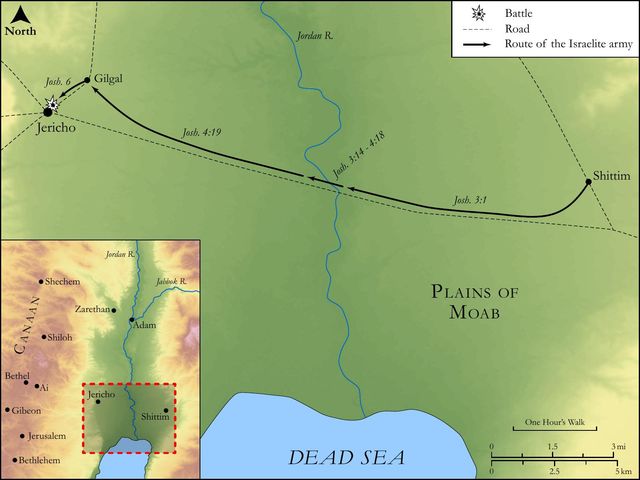
At this point, the Israelites were encamped at Shittim (also known as Abel-shittim), located on the plains of Moab, east of the Jordan River. This strategic location served as their final staging ground before their momentous entry into Canaan. The "officers" (Hebrew: shoterim) mentioned in the verse were not primarily military commanders but administrative officials, a vital role established during the Exodus period (e.g., Exodus 5:6 and Deuteronomy 1:15). Their essential function was to maintain order, communicate commands from the central leadership (Joshua), and ensure the logistical readiness of the vast Israelite population, which encompassed not only fighting men but also families, livestock, and all necessary supplies. This period of waiting was a common practice in ancient military campaigns, allowing for crucial final preparations, but in this biblical narrative, it also served a profound theological purpose, building anticipation for an imminent and powerful divine intervention.
Key Themes
ShowHideJoshua 3:2 powerfully reinforces the overarching theme of preparation and readiness for God's mighty and miraculous acts. The specific three-day period is presented not merely as a logistical pause but as a divinely ordained time for the people to physically organize, mentally prepare, and spiritually sanctify themselves for the miraculous. It also highlights the theme of organized and effective leadership under Joshua, demonstrating his administrative prowess in mobilizing and directing an entire nation. The officers' systematic movement through the camp signifies the disciplined structure and unity of Israel, a testament to God's desire for order and obedience even amidst the most extraordinary miraculous events. Furthermore, this waiting period subtly emphasizes the theme of divine timing and anticipation, building a profound sense of expectation for the Lord's imminent display of power, which would soon exalt Joshua in the eyes of all Israel, as explicitly promised in Joshua 3:7.
Exposition and Analysis
ShowHideKey Word Analysis
ShowHideFrom an unused root meaning "to be hot," this word refers to a day, either literally (from sunrise to sunset, or from one sunset to the next) or figuratively (a defined space of time). In the context of "three days," it signifies a specific, limited, and deliberate period of waiting and preparation. In biblical narrative, a three-day period often precedes a significant divine action, revelation, or a major transition, building suspense and emphasizing the purposeful nature of God's plans and the required human response of readiness.
This term denotes an official superintendent or magistrate, often functioning as a scribe or administrative official. These individuals were not primarily military commanders but rather key administrative personnel, likely drawn from tribal elders, whose role was to assist the primary leader (Joshua) in managing the logistical and organizational aspects of the vast Israelite community. Their function included conveying instructions, ensuring compliance, maintaining order, and overseeing the people's readiness for movement. Their presence underscores the structured and disciplined nature of the Israelite camp under Joshua's leadership, reflecting a divinely established order essential for such a large-scale undertaking.
Derived from a root meaning "to encamp," this word refers to an encampment of travelers or troops, and by extension, an army. However, in this context, it broadly encompasses the entire congregation or nation of Israel, including men, women, children, and their possessions. The term emphasizes the unified, organized movement of the entire community as they prepared to enter the Promised Land. It highlights that the upcoming event was not merely a military conquest but a national, covenantal undertaking, involving every member of God's people moving as one body under divine direction.
Verse Breakdown
ShowHide"And it came to pass after three days,"
This opening clause establishes a precise timeframe, indicating a period of waiting and deliberate preparation following previous commands and events, such as the spies' return. The mention of "three days" is a deliberate narrative pacing device, skillfully building anticipation for the profound divine action that is about to follow. It suggests a necessary interval for the people to gather their provisions, prepare themselves spiritually, and await further, specific instructions, demonstrating God's orderly and purposeful progression in His plan.
"that the officers went through the host;"
This clause details the specific administrative action undertaken during the waiting period. The "officers," acting as administrative leaders, systematically moved throughout the entire "host"—the vast Israelite encampment encompassing all people and their belongings. Their purpose was to convey vital instructions, ensure that everyone was aware of the impending movement, and confirm the nation's readiness. This action powerfully underscores Joshua's effective leadership and the disciplined, organized structure of the Israelite community, emphasizing that even miraculous divine intervention often requires human obedience, diligent preparation, and well-organized effort.
Literary Devices
ShowHideJoshua 3:2 employs several literary devices to enhance its meaning and impact, drawing the reader into the narrative's significance. Narrative Pacing is prominently displayed through the phrase "after three days," which deliberately creates a sense of anticipation and builds suspense for the impending miraculous crossing of the Jordan. This intentional pause allows the reader to fully grasp the weight of the moment and the critical importance of the preparations. The verse also utilizes Synecdoche when referring to the "host," where a part (the military aspect implied by the Hebrew machăneh) represents the whole (the entire nation of Israel, including non-combatants). This emphasizes the unified, purposeful movement of the entire community as a single entity. Furthermore, the action of the "officers" going "through the host" serves as a subtle yet powerful form of Foreshadowing, signaling that a significant, highly organized, and divinely orchestrated event is about to unfold, one that will require the active participation and collective readiness of every individual within the nation.
Theological and Thematic Connections
ShowHideJoshua 3:2 highlights the profound theological principle that divine action, while ultimately sovereign, often intersects with and requires human responsibility and preparation. The "three days" of waiting are not merely logistical; they serve as a crucial period for the people to internalize the divine commands, prepare their hearts spiritually, and build a corporate anticipation for God's mighty display of power. This preparation underscores the dynamic nature of the covenantal relationship: God acts faithfully, and His people are called to respond in active obedience and readiness. The systematic movement of the officers through the "host" signifies God's desire for order, discipline, and unity within His people, even when they are on the cusp of miraculous intervention. It teaches that genuine faith is not passive but involves diligent, obedient preparation for what God is about to do, demonstrating trust in His plan and timing.
Reflection and Application
ShowHideJoshua 3:2 offers a timeless and profound lesson about the essential interplay between divine sovereignty and human responsibility. Just as Israel was called to a period of patient waiting and diligent preparation before witnessing God's miraculous power at the Jordan River, so too are believers today often called to similar periods of patient anticipation and diligent readiness in their spiritual journeys. This verse powerfully reminds us that while God alone performs the miracles and orchestrates His divine plan, He frequently requires our active participation in preparing our hearts, minds, and circumstances. It encourages us to embrace spiritual discipline, to respect and follow godly leadership within the community of faith, and to ensure that our lives are aligned with God's revealed will, even when the path ahead is uncertain or demands a significant step of faith. We are prompted to ask ourselves: Are we truly ready for what God is preparing to do in our personal lives, in our families, or in our communities? Are we actively preparing, or are we merely passively waiting for divine intervention without our corresponding obedience?
Questions for Reflection
ShowHideFAQ
ShowHideWhy was there a "three days" waiting period mentioned in Joshua 3:2?
ShowHideThe "three days" serves multiple crucial purposes. Logistically, it provided the necessary time for the vast Israelite "host" to make final preparations, gather provisions, and organize themselves for the complex and unprecedented crossing of the Jordan River. Theologically, it created a period of intense anticipation and spiritual readiness, emphasizing the solemnity, significance, and divine nature of the impending miracle. In biblical narrative, a "three days" period often precedes a major divine act or revelation (e.g., Exodus 19:10-11 before the giving of the Law, or the resurrection of Christ after three days). It underscored that this was not a spontaneous human endeavor but a divinely orchestrated event requiring human obedience and sanctification.
Who were the "officers" mentioned, and what was their role?
ShowHideThe "officers" (Hebrew: shoterim) were administrative officials, distinct from military commanders or priests. Their role, established earlier under Moses (e.g., Deuteronomy 1:15), was to assist Joshua in managing the logistical and organizational aspects of the vast Israelite community. They were responsible for communicating commands from leadership, ensuring order, overseeing the distribution of provisions, and preparing the people for movement. Their systematic movement "through the host" in Joshua 3:2 highlights the disciplined and structured nature of the Israelite camp under Joshua's leadership, ensuring that the entire nation was ready for the divine command to cross.
What is the significance of the term "host" in this context?
ShowHideThe term "host" (Hebrew: machăneh) often refers to an army or military force, but in Joshua 3:2, it encompasses the entire nation of Israel—men, women, children, and their possessions. Its use emphasizes that the upcoming crossing of the Jordan was not merely a military campaign but a national, covenantal undertaking involving every single member of God's people. The entire community was united and moving as a single, organized body under God's command, demonstrating their collective identity as the "armies of the Lord" (Exodus 12:41).
Christ-Centered Fulfillment
ShowHideJoshua 3:2, with its profound emphasis on preparation, disciplined leadership, and the momentous crossing into the Promised Land, powerfully foreshadows the greater spiritual journey and the ultimate inheritance found in Christ. Just as Israel waited "three days" before entering their physical inheritance, believers today are called to a period of spiritual readiness and eager anticipation for the full realization of their spiritual inheritance in Christ. The miraculous crossing of the Jordan, a formidable barrier overcome by divine power, prefigures the new covenant inaugurated by Jesus Christ, who Himself is the ultimate "officer" and faithful Leader who guides His "host" (the Church) into God's eternal rest. The Promised Land, though a physical reality for ancient Israel, ultimately points to the heavenly realities and the spiritual rest that believers enter through saving faith in Christ (Hebrews 4:9-10). Jesus, the true Lamb of God, has already crossed the ultimate barrier of sin and death through His glorious resurrection "on the third day" (Luke 24:46), thereby opening the way for us to enter into a new life and a spiritual inheritance that is "imperishable, undefiled, and unfading, kept in heaven for you" (1 Peter 1:4). He is our greater Joshua, leading us not merely into a geographical land, but into the very presence and eternal kingdom of God.