


Numbers 10:34
Bible text: King James Version (1769 Blayney text) · Public domain
Bible text: Berean Standard Bible · Public domain
Bible text: American Standard Version (1901) · Public domain
Bible text: World English Bible, Messianic edition · Public domain
Bible text: Geneva Bible (1599) · Public domain
Bible text: Young's Literal Translation · Public domain
- וַעֲנַןva·'a·Nanand [the] cloud ofH6051Conj-w ¦ N-mscNoun Singular Masculine Constructוַandעֲנַן[the] cloud of
- יְהוָהYah·wehYahwehH3068N-properNoun Proper Title
- עֲלֵיהֶם'a·lei·Hem[was] over themH5921Prep ¦ 3mpPreposition Definiteעֲלֵי[was] overהֶםthem
- יוֹמָםyo·Mamby dayH3119AdvAdverb
- בְּנָסְעָםbe·na·se·'Amwhen they set outH5265Prep-b ¦ V-Qal-Inf ¦ 3mpVerb Qal Infinitive Constructבְּwhenנָסְעָset outםthey
- מִןminfromH4480PrepPreposition
- הַמַּחֲנֶהHa·ma·cha·Nehthe campH4264Art ¦ N-fsNoun Singular Feminine Absoluteהַtheמַּחֲנֶהcamp
English is a literal word-by-word gloss of the Hebrew, not the KJV's wording. Why?
This is the original text the KJV's translators worked from — each Hebrew word with its own literal English meaning in this verse, prepared by scholars at Tyndale House, Cambridge. The KJV translates whole sentences, not word by word, so its wording differs: one Hebrew word can become several English words, and the KJV may choose “the LORD” where the gloss reads “Yahweh”. Both are faithful — they answer different questions. For the KJV's own rendering, switch to the KJV text.
Details
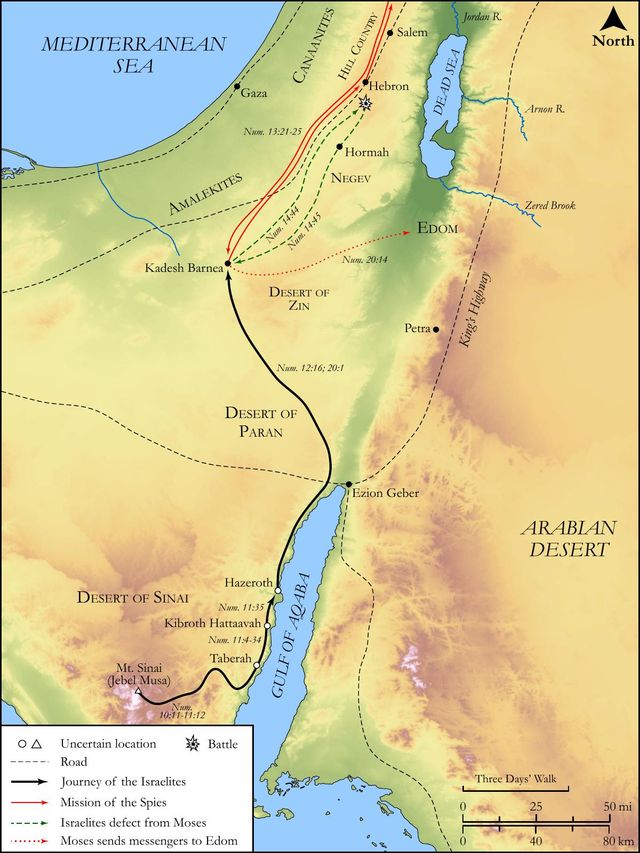
See on the biblical-era map
Study this verse
Public-domain commentary
Matthew Henry
From his Commentary on the Whole Bible. Henry comments on passages, not single verses — this entry covers Numbers 10:29–36. His four-level outline is real structure in the source text, so it is rendered as structure.
Here is, I. An account of what passed between Moses and Hobab, now upon this advance which the camp of Israel made towards Canaan. Some think that Hobab was the same with Jethro, Moses's father-in-law, and that the story, Ex. 18, should come in here; it seems more probable that Hobab was the son of Jethro, alias Reuel, or Raguel (Exo 2:18), and that when the father, being aged, went to his own land (Exo 18:27), he left his son Hobab with Moses, as Barzillai left Chimham with David; and the same word signifies both a father-in-law and a brother-in-law. Now this Hobab staid contentedly with Israel while they encamped at mount Sinai, near his own country; but, now that they were removing, he was for going back to his own country and kindred, and his father's house. Here is, 1. The kind invitation Moses gives him to go forward with them to Canaan, Num 10:29. He tempts him with a promise that they would certainly be kind to him, and puts God's word in for security: The Lord hath spoken good concerning Israel. As if he had said, "Come, cast in thy lot among us, and thou shalt fare as we fare; and we have the promise of God that we shall fare well." Note, Those that are bound for the heavenly Canaan should invite and encourage all their friends to go along with them, for we shall have never the less of the treasures of the covenant, and the joys of heaven, for others coming in to share with us. And what argument can be more powerful with us to take God's people for our people than this, that God hath spoken good concerning them? It is good having fellowship with those that have fellowship with God (Jo1 1:3), and going with those with whom God is, Zac 8:23. 2. Hobab's inclination, and present resolution, to go back to his own country, Num 10:30. One would have thought that he who had seen so much of the special presence of God with Israel, and such surprising tokens of his favour to them, would not have needed much invitation to embark with them. But his refusal must be imputed to the affection he had for his native air and soil, which was not overpowered, as it ought to have been, by a believing regard to the promise of God and a value for covenant blessings. He was indeed a son of Abraham's loins (for the Midianites descended from Abraham by Keturah), but not an heir of Abraham's faith (Heb 11:8), else he would not have given Moses this answer. Note, The things of this world, which are seen, draw strongly from the pursuit of the things of the other world, which are not seen. The magnetic virtue of this earth prevails with most people above the attractives of heaven itself. 3. The great importunity Moses used with him to alter his resolution, Num 10:31, Num 10:32. He urges, (1.) That he might be serviceable to them: "We are to encamp in the wilderness" (a country well known to Hobab), "and thou mayest be to us instead of eyes, not to show us where we must encamp, nor what way we must march" (which the cloud was to direct), "but to show us the conveniences and inconveniences of the place we march through and encamp in, that we may make the best use we can of the conveniences, and the best fence we can against the inconveniences." Note, It will very well consist with our trust in God's providence to make use of the help of our friends in those things wherein they are capable of being serviceable to us. Even those that were led by miracle must not slight the ordinary means of direction. Some think that Moses suggests this to Hobab, not because he expected much benefit from his information, but to please him with the thought of being some way useful to so great a body, and so to draw him on with them, by inspiring him with an ambition to obtain that honour. Calvin gives quite another sense of this place, very agreeably with the original, which yet I do not find taken notice of by any since. "Leave us not, I pray thee, but come along, to share with us in the promised land, for therefore hast thou known our encampment in the wilderness, and hast been to us instead of eyes; and we cannot make thee amends for sharing with us in our hardships, and doing us so many good offices, unless thou go with us to Canaan. Surely for this reason thou didst set out with us that thou mightest go on with us." Note, Those that have begun well should use that as a reason for their persevering, because otherwise they lose the benefit and recompence of all they have done and suffered. (2.) That they would be kind to him: What goodness the Lord shall do to us, the same we will do to thee, Num 10:32. Note, [1.] We can give only what we receive. We can do no more service and kindness to our friends than God is pleased to put it into the power of our hand to do. This is all we dare promise, to do good as God shall enable us. [2.] Those that share with God's Israel in their labours and hardships shall share with them in their comforts and honours. Those that are wiling to take their lot with them in the wilderness shall have their lot with them in Canaan; if we suffer with them we shall reign with them, Ti2 2:12; Luk 22:28, Luk 22:29.
We do not find any reply that Hobab here made to Moses, and therefore we hope that his silence gave consent, and he did not leave them, but that, when he perceived he might be useful, he preferred that before the gratifying of his own inclination; in this case he left us a good example. And we find (Jdg 1:16; Sa1 15:6) that his family was no loser by it.
II.An account of the communion between God and Israel in this removal.
They left the mount of the Lord (Num 10:33), that Mount Sinai where they had seen his glory and heard his voice, and had been taken into covenant with him (they must not expect that such appearances of God to them as they had there been blessed with should be constant); they departed from that celebrated mountain, which we never read of in scripture any more, unless with reference to these past stories; now farewell, Sinai; Zion is the mountain of which God has said. This is my rest for ever (Psa 132:14), and of which we must say so. But when they left the mount of the Lord they took with them the ark of the covenant of the Lord, by which their stated communion with God was to be kept up. For,
1.By it God did direct their paths. The ark of the covenant went before them, some think in place, at least in this removal; others think only in influence; though it was carried in the midst of the camp, yet the cloud that hovered over it directed all their motions. The ark (that is, the God of the ark) is said to search out a resting place for them; not that God's infinite wisdom and knowledge need to make searches, but every place they were directed to was as convenient for them as if the wisest man they had among them had been employed to go before them, and mark out their camp to the best advantage. thus Canaan is said to be a land which God spied out, Eze 20:6.
2.By it they did in all their ways acknowledge God, looking upon it as a token of God's presence; when that moved, or rested, they had their eye up unto God. Moses, as the mouth of the congregation, lifted up a prayer, both at the removing and at the resting of the ark; thus their going out and coming in were sanctified by prayer, and it is an example to us to begin and end every day's journey, and every day's work, with prayer.
(1.)Here is his prayer when the ark set forward: Rise up, Lord, and let thy enemies be scattered, Num 10:35. They were now in a desolate country, but they were marching towards an enemy's country, and their dependence was upon God for success and victory in their wars, as well as for direction and supply in the wilderness. David used this prayer long after (Psa 68:1), for he also fought the Lords' battles. Note,
[1.]There are those in the world that are enemies to God, and haters of him: secret and open enemies; enemies to his truths, his laws, his ordinances, his people.
[2.]The scattering and defeating of God's enemies is a thing to be earnestly desired, and believingly expected, by all the Lord's people. This prayer is a prophecy. Those that persist in rebellion against God are hasting towards their own ruin.
[3.]For the scattering and defeating of God's enemies, there needs no more but God's arising. When God arose to judgment, the work was soon done, Psa 76:8, Psa 76:9. "Rise, Lord, as the sun riseth to scatter the shadows of the night." Christ's rising from the dead scattered his enemies, Psa 68:18.
(2.)His prayer when the ark rested, Num 10:36.
[1.]That God would cause his people to rest. So some read it, "Return, O Lord, the many thousands of Israel, return them to their rest again after this fatigue." Thus it is said (Isa 63:14), The Spirit of the Lord caused him to rest. Thus he prays that God would give Israel success and victory abroad, and peace and tranquillity at home.
[2.]That God himself would take up his rest among them. So we read it: Return to the thousands of Israel, the ten thousand thousand, so the word is. Note, First, The church of God is a great body; there are many thousands belonging to God's Israel. Secondly, We ought in our prayers to concern ourselves for this body. Thirdly, The welfare and happiness of the Israel of God consist in the continual presence of God among them. Their safety consists not in their numbers, though they are thousands, many thousands, but in the favour of God, and his gracious return to them and residence with them. These thousands are cyphers; he is the figure: and upon this account, Happy art thou, O Israel! who is like unto thee, O people!
Continue studying Numbers 10:34 across the web’s major study libraries — every link below opens this exact verse, chapter, or book on the destination site.
Read & Compare
 BibleGatewayThis verse in more than 200 translations and 70 languages.
 Bible.comThe YouVersion reader — hundreds of translations, reading plans, and highlights.
 ESV.orgCrossway's official English Standard Version reader.
 NET BibleThe NET translation with 60,000+ translators' notes on every rendering decision.
 STEP BibleTyndale House's free study tool — original text, vocabulary, and scholarly resources.
 BibliaLogos Bible Software's free web reader.
 USCCBThe New American Bible (Revised Edition) with the U.S. bishops' study notes.
Commentaries
 BibleHub CommentariesDozens of classic commentaries on this verse, gathered on one page.
 StudyLightMore than 100 commentary sets — the largest collection on the web.
 BibleRefPlain-English commentary on what this verse means, verse by verse.
 Enduring WordDavid Guzik's free commentary on this chapter, widely used by Bible teachers.
 Bible Study ToolsVerse commentary alongside Greek and Hebrew study aids.
Original Language & Research
- BibleHub InterlinearThe verse word by word — original language, transliteration, and English.
- BibleHub LexiconEvery word's original-language definition and Strong's entry.
 Blue Letter BibleDeep-study tools — Strong's numbers, concordance, and word studies.
 SefariaThe Hebrew text with Rashi and centuries of Jewish commentary.
Sermons, Hymns & Audio


TrulyRandomVerse is not affiliated with these sites and doesn’t control their content. They’re linked because they’re genuinely useful.
Summary
Numbers 10:34 profoundly illustrates the tangible, unwavering presence and active guidance of the LORD over the Israelites as they embarked on their momentous journey from Mount Sinai into the vast wilderness. This verse encapsulates the immediate, visible, and constant nature of divine leading, serving as a powerful reminder of God's intimate involvement in the daily steps of His covenant people, ensuring their direction and protection as they moved according to His will.
Context
ShowHideLiterary Context
Numbers 10 marks a pivotal and dramatic transition in the narrative of Israel. After nearly a year encamped at the base of Mount Sinai, where they received the Law, established the covenant, and meticulously completed the Tabernacle, the nation is now commanded to break camp and proceed towards the Promised Land. The preceding verses (Numbers 10:1-33) meticulously detail the complex preparations for this departure: the blowing of the silver trumpets to signal movement, the precise order of march for each tribal division, and the sacred responsibility of carrying the Tabernacle components. This verse, Numbers 10:34, immediately follows Moses' fervent prayer for God's protective presence and blessing upon their journey (Numbers 10:35-36), confirming the divine response and the essential role of the cloud in orchestrating their every movement. It serves as a direct continuation and affirmation of the principles established in Numbers 9:15-23, which explicitly defined the cloud's function as the sole determinant of Israel's encampment and departure.
Historical & Cultural Context
The setting for Israel's journey was the vast, arid, and often hostile wilderness, a disorienting and dangerous environment for a multitude numbering in the millions. In such a landscape, reliable guidance, protection from the elements, and a tangible sense of divine presence were not merely comforts but absolute necessities for survival. While the nations claimed visible manifestations of their gods, the specific, consistent, and morally aligned presence of the LORD, Yahweh, through the cloud, set Israel's experience apart as uniquely covenantal. This manifestation powerfully echoed the pillar of cloud and fire that had guided them out of Egypt (e.g., Exodus 13:21-22), reinforcing the continuity of God's redemptive work and His unwavering commitment to His covenant people. Practically, the cloud provided crucial shade from the intense desert sun by day, a tangible expression of God's meticulous and providential care for His people's physical well-being.
Key Themes
ShowHideNumbers 10:34 powerfully reinforces several overarching themes central to the Pentateuch and the broader biblical narrative. Foremost is the theme of Divine Presence, showcasing God's immanence and His decision to dwell among His people, not just within the confines of the Tabernacle but actively guiding their every step in the open wilderness. This leads directly to the theme of Divine Guidance, where the cloud serves as the visible, unmistakable signal for Israel's movements, emphasizing God's sovereign control over their journey and destiny towards the Promised Land. The cloud's presence also profoundly signifies Divine Protection, shielding them from the harsh wilderness environment and symbolizing God's watchful care against unseen dangers and enemies. Furthermore, it underscores God's Faithfulness to His covenant promises, as His consistent presence was a daily reminder of His commitment to lead them to their inheritance, as detailed in the operational instructions for the cloud in Numbers 9:17-23. The Israelites' entire pilgrimage was predicated on their Obedience to this divine signal, requiring constant watchfulness and trust in God's timing and direction.
Exposition and Analysis
ShowHideKey Word Analysis
ShowHideThis term (H6051) refers to a visible atmospheric mass, but in biblical contexts, especially in the Pentateuch when associated with the LORD, it signifies a specific, supernatural manifestation of God's presence and glory. It is not merely a meteorological phenomenon but a tangible, miraculous sign of divine activity, often linked to the Shekinah glory, God's dwelling presence among His people. Its consistent appearance by day underscored its miraculous nature and its role as a divine beacon of guidance and protection.
This is the personal, covenant name of God (H3068), revealed to Moses at the burning bush (Exodus 3:14-15). Its use here emphasizes that the cloud is not a generic divine manifestation but specifically the presence of the God who made a covenant with Israel, redeemed them from slavery, and promised to lead them to their inheritance. It underscores the relational, faithful, and sovereign aspect of God's guidance, confirming that the cloud's movement was the direct will of their covenant God.
This adverb (H3119) specifies the time of the cloud's manifestation, highlighting its continuous presence during daylight hours. While the pillar of fire guided them by night, the cloud provided shade and direction during the day. This duality emphasizes God's unceasing, round-the-clock watchfulness and care for His people, ensuring their safety and guidance regardless of the hour or the harshness of the wilderness environment.
Verse Breakdown
ShowHide"And the cloud of the LORD [was] upon them by day"
This clause establishes the central subject – the "cloud of the LORD" – as the active agent of divine presence and guidance. The KJV's bracketed "was" correctly implies the continuous and enduring nature of this presence, signifying that God's manifestation was not intermittent but a consistent reality throughout their journey. The phrase "upon them" highlights the intimate and enveloping nature of this divine presence, indicating that God was not distant but intimately involved in their daily journey, providing both direction and covering. The specification "by day" distinguishes this manifestation from the pillar of fire by night, emphasizing God's continuous, round-the-clock guidance and protection.
"when they went out of the camp"
This phrase specifies the precise timing and context of the cloud's active and crucial role. It was particularly evident and essential during their movements, when they were most vulnerable, exposed, and most in need of clear direction. This underscores the practical and immediate nature of God's guidance, appearing precisely when His people needed to know where to go and when to move. It also implies a direct correlation between the cloud's movement and Israel's obedience, as their departure from encampment was contingent upon the cloud's lifting and leading.
Literary Devices
ShowHideNumbers 10:34 powerfully employs Symbolism, where the "cloud of the LORD" is not merely a meteorological phenomenon but a profound symbol of God's active, visible, and tangible presence among His people. It symbolizes divine guidance, protection, and faithfulness, a constant reminder of God's covenant loyalty. The cloud also functions as a Metonymy, where the visible cloud stands in for God Himself, indicating that God was literally "with them" in a manifest way. This direct association emphasizes God's immanence and active involvement in their daily lives. Furthermore, the verse participates in the broader Repetition of the cloud motif throughout the wilderness narratives (Exodus, Numbers), reinforcing its consistent role as the divine guide and a constant reminder of God's covenant loyalty. This repetition builds a sense of continuity and reliability in God's character and methods of leading, establishing a pattern of divine-human interaction.
Theological and Thematic Connections
ShowHideNumbers 10:34 stands as a profound testament to the doctrine of God's immanence and His unwavering covenant faithfulness. It illustrates that the God of Israel is not a distant, abstract deity, but one who actively dwells among His people, providing tangible guidance and protection. This visible manifestation of the "cloud of the LORD" serves as a powerful symbol of divine oversight, ensuring that Israel's journey through the treacherous wilderness was not left to chance but orchestrated by God Himself. It underscores the principle that God initiates, sustains, and directs the path of His chosen people, fulfilling His promises to lead them to their inheritance. This divine leading required Israel's absolute trust and obedience, setting a pattern for all who would follow God's path, demonstrating that true security and progress come from aligning with God's revealed will.
Reflection and Application
ShowHideNumbers 10:34 offers a timeless and deeply comforting truth for believers today: God's presence and guidance are constant, even when our path seems uncertain or fraught with challenges. While we no longer have a physical cloud to direct our steps, the enduring principle remains that God actively leads His people through every season of life. This verse calls us to cultivate a posture of profound dependence and humble trust, recognizing that God's wisdom and foresight far surpass our own limited understanding. It encourages us to seek His direction diligently through His inspired Word, to listen for the gentle promptings of His indwelling Holy Spirit, and to discern His sovereign hand in the circumstances and providences of our lives. Just as the cloud provided both clear direction and vital protection for Israel, God's abiding presence in our lives offers clarity in confusion and security in danger, reminding us that we are never alone on our journey of faith. Our task is to remain watchful, ready to obey, and confident in His unfailing leading, trusting that His path, though sometimes through the wilderness, ultimately leads to His promised blessings and His perfect will.
Questions for Reflection
ShowHideFAQ
ShowHideWhat was the significance of the "cloud of the LORD" for the Israelites?
ShowHideThe "cloud of the LORD" was the primary, visible manifestation of God's active and continuous presence among His people during their wilderness journey. Its significance was multi-faceted and deeply profound: it served as their divine guide, dictating precisely when and where they should move or encamp (as detailed in Numbers 9:15-23); it provided practical protection by day, offering crucial shade from the harsh desert sun (Psalm 105:39); and it was a constant, tangible reminder of God's covenant faithfulness and His unwavering commitment to lead them to the Promised Land. It symbolized God's intimate involvement in their daily lives, demonstrating that He was not a distant deity but one who literally "dwelt" among them. This cloud was also intrinsically linked to the glory of God, often referred to as the Shekinah, which filled the Tabernacle upon its completion (Exodus 40:34-38).
Christ-Centered Fulfillment
ShowHideThe physical cloud that guided Israel in the wilderness, a visible and tangible manifestation of God's presence, finds its ultimate and most profound fulfillment in the person of Jesus Christ. Just as the cloud was God "with them," Jesus is Immanuel, "God with us" (Matthew 1:23), fully embodying the divine presence in human flesh. Where the cloud was an external, temporary guide, Christ is the very embodiment of divine wisdom and direction, declaring Himself to be the Way, the Truth, and the Life (John 14:6), through whom all must come to the Father. The cloud provided shade and practical protection from the elements, but Jesus offers ultimate spiritual protection and eternal life, shielding His people from the judgment of sin and the power of death (Romans 8:1-2). Furthermore, the guiding presence of God, once symbolized by the cloud, is now extended to all believers through the indwelling Holy Spirit, whom Christ promised to send as another Helper, to guide us into all truth (John 16:13; John 14:16-18). Thus, the temporary, visible cloud foreshadowed the permanent, personal, and spiritual indwelling of God in Christ and through His Spirit, ensuring that God's people are never without His presence, guidance, and protection on their journey of faith toward the heavenly Promised Land.