


Exodus 13:22
Bible text: King James Version (1769 Blayney text) · Public domain
Bible text: Berean Standard Bible · Public domain
Bible text: American Standard Version (1901) · Public domain
Bible text: World English Bible, Messianic edition · Public domain
Bible text: Geneva Bible (1599) · Public domain
Bible text: Young's Literal Translation · Public domain
- לֹאlo'notH3808NegParticle Negative
- יָמִישׁya·Mishit departedH4185V-Qal-Imperf-3msVerb Qal Imperfect 3rd Singular Masculine
- עַמּוּד'a·Mud[the] pillar ofH5982N-mscNoun Singular Masculine Construct
- הֶעָנָןhe·'a·Nan<the> cloudH6051Art ¦ N-msNoun Singular Masculine Absoluteהֶ<the>עָנָןcloud
- יוֹמָםyo·Mamby dayH3119AdvAdverb
- וְעַמּוּדve·'a·Mudand [the] pillar ofH5982Conj-w ¦ N-mscNoun Singular Masculine Constructוְandעַמּוּד[the] pillar of
- הָאֵשׁha·'Esh<the> fireH784Art ¦ N-csNoun Singular common gender Absoluteהָ<the>אֵשׁfire
- לָיְלָהLa·ye·lahnightH3915N-msNoun Singular Masculine Absolute
- לִפְנֵיlif·Nei<to> beforeH6440Prep-l ¦ N-mpcNoun Plural Masculine Constructלִ<to>פְנֵיbefore
- הָעָםha·'Amthe peopleH5971Art ¦ N-msNoun Singular Masculine Absoluteהָtheעָםpeople
English is a literal word-by-word gloss of the Hebrew, not the KJV's wording. Why?
This is the original text the KJV's translators worked from — each Hebrew word with its own literal English meaning in this verse, prepared by scholars at Tyndale House, Cambridge. The KJV translates whole sentences, not word by word, so its wording differs: one Hebrew word can become several English words, and the KJV may choose “the LORD” where the gloss reads “Yahweh”. Both are faithful — they answer different questions. For the KJV's own rendering, switch to the KJV text.
Details
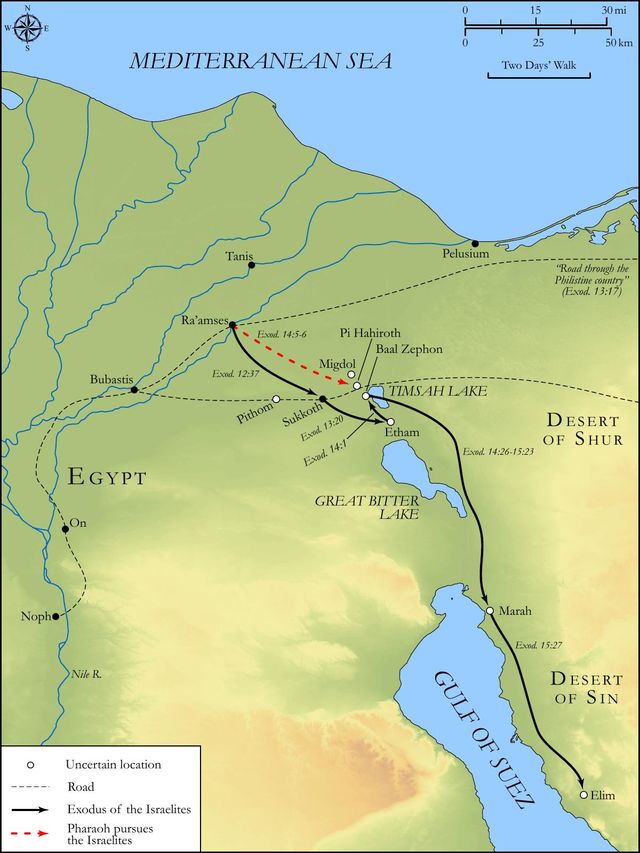
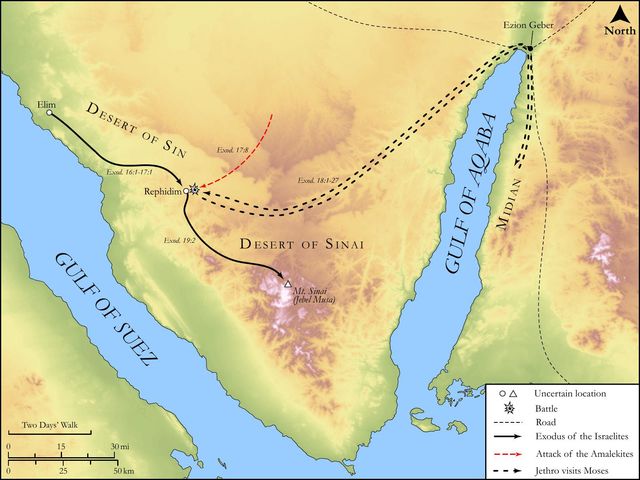
See on the biblical-era maps

Study this verse
Public-domain commentary
Matthew Henry
From his Commentary on the Whole Bible. Henry comments on passages, not single verses — this entry covers Exodus 13:17–22. His three-level outline is real structure in the source text, so it is rendered as structure.
Here is, I. The choice God made of their way, Exo 13:17, Exo 13:18. He was their guide. Moses gave them direction but as he received it from the Lord. Note, The way of man is not in himself, Jer 10:23. He may devise his way, and design it; but, after all, it is God that directs his steps, Pro 16:9. Man proposes, but God disposes, and in his disposal we must acquiesce, and set ourselves to follow providence. There were two ways from Egypt to Canaan. One was a short cut from the north of Egypt to the south of Canaan, perhaps about four or five days' journey; the other was much further about, through the wilderness, and that was the way in which God chose to lead his people Israel, Exo 13:18. 1. There were many reasons why God led them through the way of the wilderness of the Red Sea. The Egyptians were to be drowned in the Red Sea. The Israelites were to be humbled and proved in the wilderness, Deu 8:2. God had given it to Moses for a sign (Exo 3:12), You shall serve God in this mountain. They had again and again told Pharaoh that they must go three days' journey into the wilderness to do sacrifice, and therefore it was requisite that they should bend their march that way, else they would justly have been exclaimed against as notorious dissemblers. Before they entered the lists with their enemies, matters must be settled between them and their God, laws must be given, ordinances instituted, covenants sealed, and the original contract ratified, for the doing of which it was necessary that they should retire into the solitudes of a wilderness, the only closet for such a crowd; the high road would be no proper place for these transactions. It is said (Deu 32:10), He led them about, some hundreds of miles about, and yet (Psa 107:7), He led them forth by the right way. God's way is the right way, though it seem about. If we think he leads not his people the nearest way, yet we may be sure he leads them the best way, and so it will appear when we come to our journey's end. Judge nothing before the time. 2. There was one reason why God did not lead them the nearest way, which would have brought them after a few days' march to the land of the Philistines (for it was that part of Canaan that lay next to Egypt), namely, because they were not as yet fit for war, much less for war with the Philistines, Exo 13:17. Their spirits were broken with slavery; it was not easy for them to turn their hands of a sudden from the trowel to the sword. The Philistines were formidable enemies, too fierce to be encountered by raw recruits; it was more suitable that they should begin with the Amalekites, and be prepared for the wars of Canaan by experiencing the difficulties of the wilderness. Note, God proportions his people's trials to their strength, and will not suffer them to be tempted above what they are able, Co1 10:13. That promise, if compared with the foregoing verses, will seem to refer to this event, as an instance of it. God knows our frame, and considers our weakness and faintheartedness, and by less trials will prepare us for greater. God is said to bring Israel out of Egypt as the eagle brings up her young ones (Deu 32:11), teaching them by degrees to fly. Orders being thus given which way they should go, we are told, (1.) That they went up themselves, not as a confused rout, but in good order, rank and file: they went up harnessed, Exo 13:18. They went up by five in a rank (so some), in five squadrons, so others. They marched like an army with banners, which added much to their strength and honour. (2.) That they took the bones of Joseph along with them (Exo 13:19), and probably the bones of the rest of Jacob's sons, unless (as some think) they had been privately carried to Canaan (Act 7:16), severally as they died. Joseph had particularly appointed that his bones should be carried up when God should visit the (Gen 50:25, Gen 50:26), so that their carrying up his bones was not only a performance of the oath their fathers had sworn to Joseph, but an acknowledgment of the performance of God's promise to them by Joseph that he would visit them and bring them out of the land of Egypt, and an encouragement to their faith and hope that he would fulfil the other part of the promise, which was to bring them to Canaan, in expectation of which they carried these bones with them while they wandered in the desert. They might think, "Joseph's bones must rest at last, and then we shall." Moses is said to take these bones with him. Moses was now a very great man; so had Joseph been in his day, yet he was now but a box full of dry bones; this was all that remained of him in this world, which might serve for a monitor to Moses to remember his mortality. I have said, You are gods; it was said so to Moses expressly (Exo 7:1); but you shall die like men.
II.Here is the guidance they were blessed with in the way:
The Lord went before them in a pillar, Exo 13:21, Exo 13:22. In the first two stages it was enough that God directed Moses whither to march: he knew the country and the road well enough; but now that they had come to the edge of the wilderness (Exo 13:20) they would have occasion for a guide; and a very good guide they had, one that was infinitely wise, kind, and faithful: The Lord went before them, the shechinah (or appearance of the divine Majesty, which was typical of Christ) or a previous manifestation of the eternal Word, which, in the fulness of time, was to be made flesh, and dwell among us. Christ was with the church in the wilderness, Co1 10:9. Now their King passed before them, even the Lord on the head of them, Mic 2:13. Note, Those whom God brings into a wilderness he will not leave nor lose there, but will take care to lead them through it; we may well think it was a very great satisfaction to Moses and the pious Israelites to be sure that they were under divine guidance. Those needed not to fear missing their way who were thus led, nor being lost who were thus directed; those needed not to fear being benighted who were thus illuminated, nor being robbed who were thus protected. Those who make the glory of God their end, and the word of God their rule, the Spirit of God the guide of their affections, and the providence of God the guide of their affairs, may be confident that the Lord goes before them, as truly as he went before Israel in the wilderness, though not so sensibly; we must live by faith.
1.They had sensible evidences of God's going before them. They all saw an appearance from heaven of a pillar, which in the bright day appeared cloudy, and in the dark night appeared fiery. We commonly see that that which is a flame in the night is a smoke in the day; so was this. God gave them this ocular demonstration of his presence, in compassion to the infirmity of their faith, and in compliance with that infant state of the church, which needed to be thus lisped to in their own language; but blessed are those that have not seen and yet have believed God's gracious presence with them, according to his promise.
2.They had sensible effects of God's going before them in this pillar. For,
(1.)It led the way in that vast howling wilderness, in which there was no road, no track, no way-mark, of which they had no maps, through which they had no guides. When they marched, this pillar went before them, at the rate that they could follow, and appointed the place of their encampment, as Infinite Wisdom saw fit, which both eased them from care, and secured them from danger, both in moving and in resting.
(2.)It sheltered them by day from the heat, which, at some times of the year, was extreme.
(3.)It gave them light by night when they had occasion for it, and at all times made their camp pleasant and the wilderness they were in less frightful.
III.These were constant standing miracles (Exo 13:22):
He took not away the pillar of cloud; no, not when they seemed to have less occasion for it, travelling through inhabited countries, no, not when they murmured and were provoking; it never left them, till it brought them to the borders of Canaan. It was a cloud which the wind could not scatter. This favour is acknowledged with thankfulness long afterwards, Neh 9:19; Psa 78:14. There was something spiritual in this pillar of cloud and fire.
1.The children of Israel were baptized unto Moses in this cloud, which, some think, distilled dew upon them, Co1 10:2. By coming under this cloud, they signified their putting themselves under the divine guidance and command by the ministry of Moses. Protection draws allegiance; this cloud was the badge of God's protection, and so became the bond of their allegiance. Thus they were initiated, and admitted under that government, now when they were entering upon the wilderness.
2.Some make this cloud a type f Christ. The cloud of his human nature was a veil to the light and fire of his divine nature; we find him (Rev 10:1) clothed with a cloud, and his feet as pillars of fire. Christ is our way, the light of our way and the guide of it.
3.It signified the special guidance and protection which the church of Christ is under in this world. God himself is the keeper of Israel, and he neither slumbers nor sleeps, Psa 121:4; Isa 27:3. There is a defence created, not only on Sion's assemblies, but on every dwelling-place in Sion. See Isa 4:5, Isa 4:6. Nay, every Israelite indeed is hidden under the shadow of God's wings (Psa 17:8); angels, whose ministry was made use of in this cloud, are employed for their good, and pitch their tents about them. Happy art thou, O Israel! who is like unto thee, O people?
Continue studying Exodus 13:22 across the web’s major study libraries — every link below opens this exact verse, chapter, or book on the destination site.
Read & Compare
 BibleGatewayThis verse in more than 200 translations and 70 languages.
 Bible.comThe YouVersion reader — hundreds of translations, reading plans, and highlights.
 ESV.orgCrossway's official English Standard Version reader.
 NET BibleThe NET translation with 60,000+ translators' notes on every rendering decision.
 STEP BibleTyndale House's free study tool — original text, vocabulary, and scholarly resources.
 BibliaLogos Bible Software's free web reader.
 USCCBThe New American Bible (Revised Edition) with the U.S. bishops' study notes.
Commentaries
 BibleHub CommentariesDozens of classic commentaries on this verse, gathered on one page.
 StudyLightMore than 100 commentary sets — the largest collection on the web.
 BibleRefPlain-English commentary on what this verse means, verse by verse.
 Enduring WordDavid Guzik's free commentary on this chapter, widely used by Bible teachers.
 Bible Study ToolsVerse commentary alongside Greek and Hebrew study aids.
Original Language & Research
- BibleHub InterlinearThe verse word by word — original language, transliteration, and English.
- BibleHub LexiconEvery word's original-language definition and Strong's entry.
 Blue Letter BibleDeep-study tools — Strong's numbers, concordance, and word studies.
 SefariaThe Hebrew text with Rashi and centuries of Jewish commentary.
Sermons, Hymns & Audio


TrulyRandomVerse is not affiliated with these sites and doesn’t control their content. They’re linked because they’re genuinely useful.
Summary
Exodus 13:22 powerfully affirms God's unwavering commitment to His people, Israel, by emphasizing the continuous, visible presence of the pillar of cloud by day and the pillar of fire by night. This verse concludes a pivotal section detailing Israel's initial exodus, serving as a profound testament to the Lord's steadfast guidance, protection, and faithfulness throughout their perilous wilderness journey, ensuring they were never left without His divine direction.
Context
ShowHideLiterary Context
Exodus 13:22 serves as the emphatic conclusion to a passage detailing the Lord's direct leadership of Israel out of Egypt. The preceding verses establish the initial stages of the Exodus, including the institution of the Passover and the consecration of the firstborn. Specifically, Exodus 13:17-18 explains God's strategic decision to lead Israel by a longer, safer route, avoiding immediate conflict with the Philistines and preventing the people from becoming discouraged and returning to Egypt. This divine foresight highlights God's protective care. Exodus 13:21 then introduces the miraculous pillars of cloud and fire as the tangible manifestation of God's presence and guidance, leading the way for the vast multitude. Verse 22 then powerfully reinforces the absolute continuity and reliability of this divine leadership, stressing that these visible signs were never withdrawn from the people, providing crucial assurance as they ventured into the vast, unknown desert.
Historical & Cultural Context
The ancient Israelites, newly freed slaves, faced an immense and terrifying journey through a harsh, desolate wilderness. Such a journey required clear, consistent leadership, provision, and protection from the elements and potential threats. Among the nations, kings and gods were often depicted as leading their people or armies, sometimes with visible signs or omens. However, the continuous, palpable presence of Yahweh through the pillars was unique and unprecedented. It addressed critical needs: the cloud provided essential shade from the scorching desert sun by day, and the fire offered light, warmth, and protection from dangers and predators during the cold, dark nights. This visible manifestation of God's presence also served as a constant reminder of His covenant with them, distinguishing Him from the pagan deities of the surrounding nations and fostering dependence and trust in a people prone to fear and doubt.
Key Themes
ShowHideExodus 13:22 contributes significantly to several major theological and narrative themes within the book of Exodus and the broader Pentateuch. Foremost among these is the theme of Divine Presence and Guidance. The pillars are the tangible embodiment of God "going before" His people, a theme introduced earlier in Exodus 3:12 and reiterated throughout their journey. This verse also underscores God's Faithfulness and Covenant Loyalty, demonstrating His unwavering commitment to His promises despite the people's future grumbling and rebellion, as seen in passages like Exodus 16. It highlights God's Sovereignty and Providence, showing Him actively orchestrating every step of their liberation and journey, providing for their physical needs and protecting them from harm. Finally, it reinforces the theme of Israel's Dependence on God, as they are utterly reliant on His visible leading for their survival and direction in the wilderness, a lesson often revisited in the wilderness narratives, such as the giving of the Law at Mount Sinai.
Exposition and Analysis
ShowHideExodus 13:22 states, "He took not away the pillar of the cloud by day, nor the pillar of fire by night, from before the people." This short verse is packed with theological significance regarding God's character and relationship with Israel.
Key Word Analysis
ShowHideThis primitive root (H4185) signifies "to withdraw (both literally and figuratively, whether intransitive or transitive); cease, depart, go back, remove, take away." The negation "not" (לֹא, lo) preceding this verb emphatically conveys the idea of an unwavering, continuous, and permanent presence. It highlights God's steadfast commitment and reliability, emphasizing that His guidance was not temporary or conditional but an enduring aspect of their journey, reflecting His unchanging character.
Derived from the root meaning "to stand," this noun (H5982) refers to "a column (as standing); also a stand, i.e. platform." In this context, it denotes a visible, tangible, and upright manifestation of God's presence and leadership. The term emphasizes the stability, prominence, and supportive nature of this divine sign, serving as a constant point of reference and direction for the vast Israelite multitude.
This noun (H6051) refers to "a cloud (as covering the sky), i.e. the nimbus or thunder-cloud." Here, it specifically denotes the daytime manifestation of God's presence, providing shade and guidance. The cloud's natural properties (covering, obscuring) are transformed into a supernatural sign of divine protection and leading, signifying God's ability to use natural phenomena for His supernatural purposes.
Verse Breakdown
ShowHide"He took not away"
This opening clause immediately establishes the central theme: God's unwavering commitment. The active verb "took away" (from mûwsh') negated by "not" (לֹא, lo) underscores the intentional and continuous nature of God's provision. It wasn't a temporary measure that might be withdrawn based on Israel's behavior, but a permanent fixture of their wilderness experience, highlighting God's enduring faithfulness and covenant loyalty.
"the pillar of the cloud by day, nor the pillar of fire by night"
This specifies the two distinct yet complementary manifestations of God's presence. The "pillar of cloud" provided shade and direction during the day, while the "pillar of fire" offered light, warmth, and protection at night. This parallelism highlights the comprehensive nature of God's care, adapting to the specific needs of day and night, ensuring constant guidance, comfort, and security regardless of the time or circumstance.
"from before the people"
This phrase emphasizes the visibility, accessibility, and directness of God's presence. The pillars were not distant or hidden but were directly "before" them, leading the way. This ensured that every Israelite, from the front to the rear of the vast multitude, could see God's leading and follow Him. It was a public, undeniable sign of His active involvement in their lives, fostering trust and obedience.
Literary Devices
ShowHideThe verse effectively employs parallelism by presenting two complementary manifestations of God's presence—"the pillar of the cloud by day, nor the pillar of fire by night"—to emphasize the continuous, comprehensive, and adaptive nature of God's guidance. The metaphor of the "pillar" makes an abstract divine presence tangible and relatable, providing a concrete image for God's leading that the Israelites could physically observe and follow. Furthermore, the use of a negative assertion ("He took not away") powerfully conveys a positive truth: God's enduring, unwavering faithfulness and commitment to His people. This rhetorical choice underscores the reliability and permanence of His divine care.
Theological and Thematic Connections
ShowHideExodus 13:22 reveals several profound theological truths about God and His relationship with His people. Primarily, it underscores God's unwavering faithfulness and constant presence. He is not a distant deity but one who actively engages with and leads His covenant people, adapting His provision to their specific needs (shade by day, light/warmth by night). This verse highlights His omnipresence and omniscience, as He is aware of and provides for their needs both day and night, demonstrating His meticulous care. It speaks powerfully to His covenant loyalty, demonstrating that despite Israel's future failures and rebellions, God remains true to His promise to guide and protect them. This continuous, visible guidance was foundational to their identity as God's chosen nation.
This theme of divine guidance and presence is woven throughout the biblical narrative, extending far beyond the wilderness. God's leading hand is evident from His guidance of Abraham in his journey of faith, to His provision for Israel in the wilderness, and ultimately to His ongoing direction for His people today. The pillars foreshadow the indwelling Holy Spirit, who guides believers in the New Covenant.
Reflection and Application
ShowHideWhile we no longer see visible pillars of cloud or fire, Exodus 13:22 remains profoundly relevant for believers today. It assures us that God's promise of constant presence and guidance endures. In our own "wilderness journeys" of life—whether navigating career changes, relational challenges, health crises, spiritual doubts, or periods of uncertainty—we can trust that the Lord will not abandon us. His Spirit, the Holy Spirit, now serves as our internal guide and Comforter, illuminating our path through His Word (Psalm 119:105) and prayer. This verse encourages us to look to God for direction, knowing that His faithfulness is unwavering, and He will always lead His people. It reminds us that even when our circumstances seem dark or uncertain, God is actively present, providing light, protection, and direction, adapting His guidance to our specific needs, just as He did for Israel. Our responsibility is to remain attentive to His leading and trust in His steadfast love.
Questions for Reflection
ShowHideFAQ
ShowHideWere the pillars of cloud and fire literal or symbolic?
ShowHideThe biblical text presents them as literal, tangible manifestations of God's presence. They provided real shade from the scorching sun during the day and real light and warmth at night, addressing the practical needs of the vast multitude in the harsh desert environment. While they were profoundly symbolic of God's guidance, protection, and constant presence, their physical reality was crucial for the Israelites' survival and their perception of God's active involvement in their daily lives. They were not merely visions but physical phenomena.
How did the pillars guide such a large number of people?
ShowHideThe pillars were immense and visible from a great distance, allowing the entire multitude, estimated to be over two million people, to see them. When the cloud lifted from the Tabernacle (later in the journey) or simply moved, the people knew it was time to break camp and move; when it settled, they knew it was time to encamp. This simple, clear signal ensured that the entire community, though vast and diverse, could follow God's direction in unity, preventing chaos and ensuring everyone remained under His direct leadership, as described in Numbers 9:17-23.
Why did God use such visible signs? Couldn't He have guided them in other ways?
ShowHideGod chose this highly visible and tangible method to meet the specific needs of a newly liberated, unorganized, and often fearful people. Visible signs provided constant reassurance, built trust in a God they were just beginning to know deeply, demonstrated His unique power over nature, and distinguished Him unequivocally from all other pagan gods. It was a tangible, undeniable proof of His covenant faithfulness and sovereign leadership, essential for a people embarking on a journey of faith and forming their identity as His chosen nation. This direct, undeniable manifestation of His presence was a foundational element in establishing their relationship with Yahweh.
Christ-Centered Fulfillment
ShowHideExodus 13:22, with its emphasis on God's constant, visible presence and unwavering guidance for His people, finds its ultimate fulfillment and amplification in the person and work of Jesus Christ. Just as the pillars were "God with them" in the wilderness, Jesus is Immanuel, "God with us" (Matthew 1:23), the ultimate manifestation of God's presence. He is not merely a visible sign, but God incarnate, dwelling among humanity (John 1:14), making the invisible God fully known.
Jesus declares Himself to be "the light of the world" (John 8:12), fulfilling the role of the pillar of fire by night, illuminating the path, dispelling spiritual darkness, and guiding humanity out of sin's shadows into God's marvelous light. He is also "the way, the truth, and the life" (John 14:6), embodying the perfect guidance provided by the pillar of cloud by day. He is the one who leads His people through the wilderness of this fallen world to the promised land of eternal life, offering not just direction but the very means to reach the destination.
Furthermore, after His ascension, Jesus sent the Holy Spirit (John 16:13), who now indwells believers, serving as our internal guide, comforter, and constant presence. The Spirit illuminates God's Word, convicts of sin, empowers us to live according to God's will, and intercedes for us (Romans 8:26-27), ensuring that God's people are never left without His divine direction, just as Israel was never left without the pillars. The unbroken presence of the pillars in Exodus 13:22 powerfully foreshadows the unbroken, eternal presence of Christ with His church until the end of the age (Matthew 28:20), a promise made possible through His finished work and the gift of His Spirit.