


Isaiah 28:12
Bible text: King James Version (1769 Blayney text) · Public domain
Bible text: Berean Standard Bible · Public domain
Bible text: American Standard Version (1901) · Public domain
Bible text: World English Bible, Messianic edition · Public domain
Bible text: Geneva Bible (1599) · Public domain
Bible text: Young's Literal Translation · Public domain
- אֲשֶׁר'a·SherwhomH834RelParticle Relative
- אָמַר'a·Marhe saidH559V-Qal-Perf-3msVerb Qal Perfect 3rd Singular Masculine
- אֲלֵיהֶם'a·lei·Hemto themH413Prep ¦ 3mpPrepositionאֲלֵיtoהֶםthem
- זֹאתzotthisH2063PrtParticle Demonstrative
- הַמְּנוּחָהha·me·nu·Chah[is] the resting placeH4496Art ¦ N-fsNoun Singular Feminine Absoluteהַ[is] theמְּנוּחָהresting place
- הָנִיחוּha·Ni·chugive restH5117V-Hiphil-Imp-2mpVerb Hiphil Imperative 2nd Plural Masculine
- לֶעָיֵףle·'a·Yefto the wearyH5889Prep-l ¦ Adj-msAdjective Singular Masculine Absoluteלֶto theעָיֵףweary
- וְזֹאתve·Zotand thisH2063Conj-w ¦ PrtParticle Demonstrativeוְandזֹאתthis
- הַמַּרְגֵּעָהha·mar·ge·'Ah[is] the place of restH4774Art ¦ N-fsNoun Singular Feminine Absoluteהַ[is] theמַּרְגֵּעָהplace of rest
- וְלֹאve·Lo'and notH3808Conj-w ¦ NegParticle Negativeוְandלֹאnot
- אָבוּא'a·Vu'they were willingH14V-Qal-Perf-3cpVerb Qal Perfect 3rd Plural common gender
- שְׁמוֹעַshe·Mo·a'to listenH8085V-Qal-InfVerb Qal Infinitive Construct
English is a literal word-by-word gloss of the Hebrew, not the KJV's wording. Why?
This is the original text the KJV's translators worked from — each Hebrew word with its own literal English meaning in this verse, prepared by scholars at Tyndale House, Cambridge. The KJV translates whole sentences, not word by word, so its wording differs: one Hebrew word can become several English words, and the KJV may choose “the LORD” where the gloss reads “Yahweh”. Both are faithful — they answer different questions. For the KJV's own rendering, switch to the KJV text.
Details
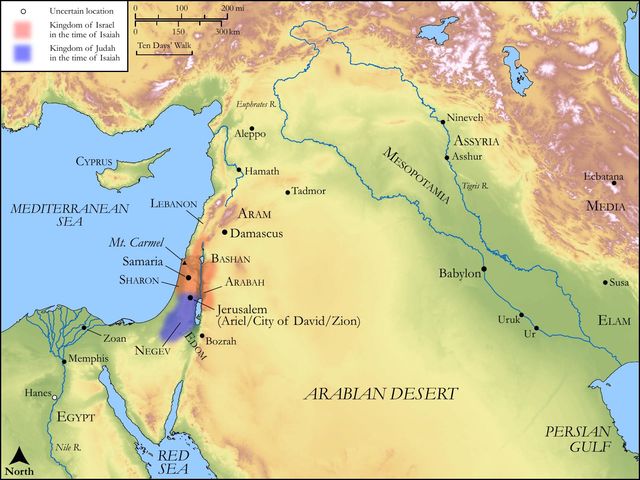
See on the biblical-era map
Study this verse
Public-domain commentary
Matthew Henry
From his Commentary on the Whole Bible. Henry comments on passages, not single verses — this entry covers Isaiah 28:9–13. His two-level outline is real structure in the source text, so it is rendered as structure.
The prophet here complains of the wretched stupidity of this people, that they were unteachable and made no improvement of the means of grace which they possessed; they still continued as they were, their mistakes not rectified, their hearts not renewed, nor their lives reformed. Observe,
I.What it was that their prophets and ministers designed and aimed at.
It was to teach them knowledge, the knowledge of God and his will, and to make them understand doctrine, Isa 28:9. This is God's way of dealing with men, to enlighten men's minds first with the knowledge of his truth, and thus to gain their affections, and bring their wills into a compliance with his laws; thus he enters in by the door, whereas the thief and the robber climb up another way.
II.What method they took, in pursuance of this design.
They left no means untried to do them good, but taught them as children are taught, little children that are beginning to learn, that are taken from the breast to the book (Isa 28:9), for among the Jews it was common for mothers to nurse their children till they were three years old, and almost ready to go to school. And it is good to begin betimes with children, to teach them, as they are capable, the good knowledge of the Lord, and to instruct them even when they are but newly weaned from the milk. The prophets taught them as children are taught; for,
1.They were constant and industrious in teaching them. They took great pains with them, and with great prudence, teaching them as they needed it and were able to bear it (Isa 28:10): Precept upon precept. It must be so, or (as some read) it has been so. They have been taught, as children are taught to read, by precept upon precept, and taught to write by line upon line, a little here and a little there, a little of one thing and a little of another, that the variety of instructions might be pleasing and inviting, - a little at one time and a little at another, that they might not have their memories overcharged, - a little from one prophet and a little from another, that every one might be pleased with his friend and him whom he admired. Note, For our instruction in the things of God it is requisite that we have precept upon precept and line upon line, that one precept and line should be followed, and so enforced by another; the precept of justice must be upon the precept of piety, and the precept of charity upon that of justice. Nay, it is necessary that the same precept and the same line should be often repeated and inculcated upon us, that we may the better understand them and the more easily recollect them when we have occasion for them. Teachers should accommodate themselves to the capacity of the learners, give them what they most need and can best bear, and a little at a time, Deu 6:6, Deu 6:7.
2.They courted and persuaded them to learn, Isa 28:12. God, by his prophets, said to them, "This way that we are directing you to, and directing you in, is the rest, the only rest, wherewith you may cause the weary to rest; and this will be the refreshing of your own souls, and will bring rest to your country from the wars and other calamities with which it has been long harassed." Note, God by his word calls us to nothing but what is really for our advantage; for the service of God is the only true rest for those that are weary of the service of sin and there is no refreshing but under the easy yoke of the Lord Jesus.
III.What little effect all this had upon the people.
They were as unapt to learn as young children newly weaned from the milk, and it was as impossible to fasten any thing upon them (Isa 28:9): nay, one would choose rather to teach a child of two years old than undertake to teach them; for they have not only (like such a child) no capacity to receive what is taught them, but they are prejudiced against it. As children, they have need of milk, and cannot bear strong meat, Heb 5:12.
1.They would not hear (Isa 28:12), no, not that which would be rest and refreshing to them. They had no mind to hear it. The word of God commanded their serious attention, but could not gain it; they were where it was preached, but they turned a deaf ear to it, or as it came in at one ear it went out at the other.
2.They would not heed. It was unto them precept upon precept, and line upon line (Isa 28:13); they went on in a road of external performances; they kept up the old custom of attending upon the prophet's preaching and it was continually sounding in their ears, but that was all; it made no impression upon them; they had the letter of the precept, but no experience of the power and spirit of it; it was continually beating upon them, but it beat nothing into them. Nay,
3.It should seem, they ridiculed the prophet's preaching, and bantered it. The word of the Lord was unto them Tsau latsau, kau lakau; in the original it is in rhyme; they made a song of the prophet's words, and sang it when they were merry over their wine. David was the song of the drunkards. It is great impiety, and a high affront to God, thus to make a jest of sacred things, to speak of that vainly which should make us serious.
IV.How severely God would reckon with them for this.
1.He would deprive them of the privilege of plain preaching, and speak to them with stammering lips and another tongue, Isa 28:11. Those that will not understand what is plain and level to their capacity, but despise it as mean and trifling, are justly amused with that which is above them. Or God will send foreign armies among them, whose language they understand not, to lay their country waste. Those that will not hear the comfortable voice of God's word shall be made to hear the dreadful voice of his rod. Or these words may be taken as denoting God's gracious condescension to their capacity in his dealing with them; he lisped to them in their own language, as nurses do to their children, with stammering lips, to humor them; he changed his voice, tried first one way and then another; the apostle quotes it as a favour (Co1 14:21), applying it to the gift of tongues, and complaining that yet for all this they would not hear.
2.He would bring utter ruin upon them. By their profane contempt of God and his word they are but hastening on their own ruin, and ripening themselves for it; it is that they may go and fall backward, may grow worse and worse, may depart further and further from God, and proceed from one sin to another, till they be quite broken, and snared, and taken, and ruined, Isa 28:13. They have here a little and there a little of the word of God; they think it too much, and say to the seers, See not; but it proves too little to convert them, and will prove enough to condemn them. If it be not a savour of life unto life, it will be a savour of death unto death.
Historical interpretation
Four Centuries of Reception
2 surviving comments on this verse. Each one is dated, so this reads as a timeline rather than a list.
Select a marker to jump to its quote. Markers stagger vertically where authors wrote within a few decades of each other.
Follow after charity, and desire spiritual gifts, but rather that ye may prophesy. For he that speaketh in an unknown tongue speaketh not unto men, but unto God: for no man understandeth him; howbeit in the spirit he speaketh mysteries. But he that prophesieth speaketh unto men to edification, and exhortation, and comfort. He that speaketh in an unknown tongue edifieth himself; but he that prophesieth edifieth the church. I would that ye all spake with tongues, but rather that ye prophesied: for greater is he that prophesieth than he that speaketh with tongues, except he interpret, that the church may receive edifying. Now, brethren, if I come unto you speaking with tongues, what shall I profit you, except I shall speak to you either by revelation, or by knowledge, or by prophesying, or by doctrine? And even things without life giving sound, whether pipe or harp, except they give a distinction in the sounds, how shall it be known what is piped or harped? For if the trumpet give an uncertain sound, who shall prepare himself to the battle? So likewise ye, except ye utter by the tongue words easy to be understood, how shall it be known what is spoken? for ye shall speak into the air. There are, it may be, so many kinds of voices in the world, and none of them is without signification. Therefore if I know not the meaning of the voice, I shall be unto him that speaketh a barbarian, and he that speaketh shall be a barbarian unto me. Even so ye, forasmuch as ye are zealous of spiritual gifts, seek that ye may excel to the edifying of the church. Wherefore let him that speaketh in an unknown tongue pray that he may interpret. For if I pray in an unknown tongue, my spirit prayeth, but my understanding is unfruitful. What is it then? I will pray with the spirit, and I will pray with the understanding also: I will sing with the spirit, and I will sing with the understanding also. Else when thou shalt bless with the spirit, how shall he that occupieth the room of the unlearned say Amen at thy giving of thanks, seeing he understandeth not what thou sayest? For thou verily givest thanks well, but the other is not edified. I thank my God, I speak with tongues more than ye all: Yet in the church I had rather speak five words with my understanding, that by my voice I might teach others also, than ten thousand words in an unknown tongue. Brethren, be not children in understanding: howbeit in malice be ye children, but in understanding be men. In the law it is written, With men of other tongues and other lips will I speak unto this people; and yet for all that will they not hear me, saith the Lord. [Isaiah 28:11-12] Wherefore tongues are for a sign, not to them that believe, but to them that believe not: but prophesying serveth not for them that believe not, but for them which believe. If therefore the whole church be come together into one place, and all speak with tongues, and there come in those that are unlearned, or unbelievers, will they not say that ye are mad? But if all prophesy, and there come in one that believeth not, or one unlearned, he is convinced of all, he is judged of all: And thus are the secrets of his heart made manifest; and so falling down on his face he will worship God, and report that God is in you of a truth.
(Vers. 10 seqq.) Who will teach knowledge, and who will make understanding? Weaned from milk, pulled from the breasts: command, re-command; command, re-command; wait, re-wait; wait, re-wait; a little here, a little there. For with stammering lips and another tongue He will speak to this people, to whom He said, 'This is the rest, give rest to the weary,' and 'This is the refreshing,' but they would not hear. And the word of the Lord will be to them, command, re-command; command, re-command; wait, re-wait; wait, re-wait; a little here, a little there, that they may go and fall backward, and be broken, snared, and caught. LXX: To whom shall we announce evil, and to whom shall we announce good news? Those who have been weaned from milk, those who have been taken away from the breast. Expect tribulation upon tribulation; wait for hope upon hope; still little, still little: because of the mockery of lips, because of the other tongue with which they will speak to this people, saying to them: This is the rest for the hungry, and this is the crushing, and they did not want to hear. The word of the Lord will come upon them: Tribulation upon tribulation: wait, wait; hope upon hope: still little, still little; so that they may go and fall backward, and be crushed, and be endangered, and be captured. Who, he says, is worthy of the teaching of the Lord, to whom are the words of the Savior saying: 'He who has ears to hear, let him hear' (Matthew 12:15), so that what he has heard with his ears, he may understand with his heart? The following verse shows who they are: 'Weaned from milk, drawn from the breast, who are not nourished with milk in infancy, but are fed with solid food; who were drawn from the breast with Isaac: for the joy of this, Abraham made a great feast' (Genesis 22); they deserve to hear the mysteries of the Lord, and to understand what the priest and prophet do not know, intoxicated and absorbed by wine, who wandered and did not know the one who sees, because all their tables are filled with vomit and filth, who, when the prophets announce the future and threaten torments unless they did what was commanded, used to say scoffing: 'Command, re-command; command, re-command,' that is, 'order, order, command what we should do.' And when they abused the patience of God, who delays his anger in order to show mercy; who used to say even this in jest through the mouths of the prophets: Wait a little longer, wait a little while, the things that we have prophesied will come. But all of these things they spoke to the people, because they did not believe the words of God; and immediately the prophet brings this in: By no means will God speak to you with these words, in order to give you a commandment of what you should do, and to wait for the things that are to come, but he will speak to you in present fury, who had previously said to the people: This is my rest, revive the weary, I have labored for a long time, I have found no rest in anything. Foxes have dens, and birds of the sky have nests; but the Son of Man has nowhere to lay his head (Matthew 8; Luke 9). And this is my refreshment, that I may find rest in you at times. Those who did not want to listen and despised my warnings; therefore, they say to the prophets what they used to say when they were playing: Command, re-command; command, re-command; wait, re-wait; wait, re-wait; a little here, a little there, and they mock my patience, thinking that I am threatening things that I will never do: let them experience the fulfillment of their desires, so that they may go to destruction and fall back incurably; and may they never make progress and be unable to say with the Apostle: Forgetting the past, we stretch out to what is ahead (Philippians 3:13); but may they be broken and ensnared, and captured by either the Babylonian or the Roman army. For that which we have said: Command, re-command; command, re-command; expect, re-expect; expect, re-expect; a little here, a little there, in Hebrew it is written thus: Sau Lasau, Sau Lasau; Cau Lacau, Cau Lacau: Zer Sam, Zer Sam; and with these words the most impure heresy is accustomed to deceive and terrify the simple ones, in order to make them fear the novelty of the words, so that whoever knows these words and remembers them during their intercourse, without any doubt, will pass on to the kingdom of heaven. We read in the Apostle: 'In other tongues and with other lips I will speak to this people, and even then they will not listen to me,' says the Lord (1 Corinthians 14:21). This seems to me to be taken from the present chapter according to the Hebrew, and we observed this in the Old Testament (except for a few testimonies, which only Luke abuses by having more knowledge of the Greek language). Wherever something is said from the Old Testament, we do not follow the Septuagint, but the Hebrew, not following any interpretation, but translating the Hebrew sense into our own language. Symmachus, Theodotion, and the Septuagint had different opinions on this passage, and since it is long to speak about all of them, let us briefly pass over the Septuagint interpreters who are read in the Churches. I reject the Jewish people, the Priests and the Prophets, who have become drunk with wine, and have strayed and their plan, which they entered into because of greed, has been consumed by a curse. Will we announce future tribulations for the sake of Christ to them? To whom will evil be prepared as the crown of virtues? Surely it signifies the apostles, those who have been weaned from milk, those who have been torn away from the breast: Expect tribulation upon tribulation. But it speaks to the choir of the apostles and of all believers, that they should prepare themselves not for one, but for many tribulations, so that when they are troubled and oppressed, they may hope again, and have hope upon hope. And if the things that are promised are delayed a little, let them not be unbelieving: for indeed, it is a small and little delay, and the things that are promised will come. Indeed, tribulation works patience; patience, probation: probation, hope; and hope does not disappoint. (Rom. V, 3, 4, 5). And this same tribulation will be multiplied by the detraction of lips and the blasphemies of persecutors, with which they rage against the people of God with a rabid mouth. Moreover, the apostles and apostolic men will speak to the Jewish people, saying: This is the rest for the hungry for justice, and this is the contrition and anguish that leads to life. When these things were preached, the wicked refused to listen. Therefore, what was said to the people of God: Endure tribulation, endure tribulation; wait for hope, wait for hope: a little longer, a little longer, will be turned into punishment for those who refused to hear the word of the Lord, so that they may fall and go backwards, and fall into the danger of siege and death, and be captured without any end to their misery. But the Hebrew word Dea, which everyone translates as 'knowledge', was only interpreted poorly by the Seventy, a clear error. For the first letter is distinguished either as Daleth or Res with a small apex. Therefore, if it is read as Dea (), it means 'knowledge'; if Rea (), it means 'malice'; not from evil, which is contrary to good, but from constraint.
Continue studying Isaiah 28:12 across the web’s major study libraries — every link below opens this exact verse, chapter, or book on the destination site.
Read & Compare
 BibleGatewayThis verse in more than 200 translations and 70 languages.
 Bible.comThe YouVersion reader — hundreds of translations, reading plans, and highlights.
 ESV.orgCrossway's official English Standard Version reader.
 NET BibleThe NET translation with 60,000+ translators' notes on every rendering decision.
 STEP BibleTyndale House's free study tool — original text, vocabulary, and scholarly resources.
 BibliaLogos Bible Software's free web reader.
 USCCBThe New American Bible (Revised Edition) with the U.S. bishops' study notes.
Commentaries
 BibleHub CommentariesDozens of classic commentaries on this verse, gathered on one page.
 StudyLightMore than 100 commentary sets — the largest collection on the web.
 BibleRefPlain-English commentary on what this verse means, verse by verse.
 Enduring WordDavid Guzik's free commentary on this chapter, widely used by Bible teachers.
 Bible Study ToolsVerse commentary alongside Greek and Hebrew study aids.
Original Language & Research
- BibleHub InterlinearThe verse word by word — original language, transliteration, and English.
- BibleHub LexiconEvery word's original-language definition and Strong's entry.
 Blue Letter BibleDeep-study tools — Strong's numbers, concordance, and word studies.
 SefariaThe Hebrew text with Rashi and centuries of Jewish commentary.
Sermons, Hymns & Audio


TrulyRandomVerse is not affiliated with these sites and doesn’t control their content. They’re linked because they’re genuinely useful.
Summary
Isaiah 28:12 powerfully articulates God's gracious and compassionate offer of profound spiritual and national rest and refreshing to the weary and rebellious people of Judah, particularly their scoffing leaders. Despite the impending judgment resulting from their reliance on human wisdom and misguided alliances, God reveals His provision as the sole source of genuine peace and restoration. This divine tranquility was intended not only for their own holistic well-being but also to empower them to bring solace to others. Tragically, in their stubbornness and spiritual deafness, the people actively refused to heed this tender divine invitation, choosing instead to pursue their own destructive paths.
Context
ShowHideLiterary Context
Isaiah 28 initiates a new cycle of "Woes" (chapters 28-33), shifting the prophetic focus from the northern kingdom of Israel (Ephraim) to the southern kingdom of Judah, specifically its complacent and corrupt leaders in Jerusalem. The preceding verses (Isaiah 28:1-6) pronounce a severe judgment upon Ephraim for its pride, spiritual drunkenness, and impending fall. Isaiah 28:7-13 then directly addresses Judah's similar spiritual blindness and moral decay, vividly portraying its priests and prophets as staggering from wine and scoffing at God's simple, repetitive instruction, which they dismiss as "precept upon precept, line upon line" (see Isaiah 28:10). Verse 12 stands as a poignant divine interjection, a merciful and tender offer of true solace and security amidst the condemnation of their false confidence. It immediately precedes the leaders' defiant boast of having made a "covenant with death" (see Isaiah 28:15) and God's subsequent promise of a "tried stone" as a sure foundation (see Isaiah 28:16). This verse profoundly highlights God's persistent grace and unwavering compassion even in the face of profound human rebellion and impending judgment.
Historical & Cultural Context
The historical backdrop for Isaiah 28 is the tumultuous 8th century BCE, a period dominated by the relentless rise of the Assyrian Empire. The northern kingdom of Israel was already on the brink of collapse, eventually falling to Assyria in 722 BCE. Judah, the southern kingdom, faced immense geopolitical pressure and was caught between the existential Assyrian threat and the temptation to forge deceptive alliances with Egypt or other regional powers for security. The leaders in Jerusalem, rather than placing their trust in Yahweh, were deeply entrenched in political maneuvering, moral corruption, and spiritual apathy. The prophet Isaiah consistently condemned their reliance on human strength, their revelry, and their blatant rejection of God's covenant. The "rest" and "refreshing" offered by God in this verse stand in stark contrast to the false sense of security and fleeting pleasures that these leaders sought in their drunkenness and misguided political strategies, which were ultimately leading them to exhaustion, ruin, and divine judgment.
Key Themes
ShowHideThis verse encapsulates several major theological and narrative themes prevalent throughout the book of Isaiah and the broader prophetic literature. First, it underscores the theme of Divine Grace and Invitation, demonstrating God's enduring compassion and persistent desire to offer a path to genuine peace and security, even to a rebellious people despite their profound sin. Second, it highlights the profound contrast between True vs. False Security, where God's provision of "rest" and "refreshing" stands in stark opposition to the deceptive and ultimately destructive "covenant with death" (see Isaiah 28:15) that Judah's leaders had foolishly forged. Third, the tragic phrase "yet they would not hear" powerfully conveys the theme of Human Rebellion and Stubbornness, a recurring motif throughout the Old Testament where God's people repeatedly reject His wisdom and counsel, leading inevitably to their downfall (e.g., Jeremiah 7:24). Finally, the verse subtly touches on the theme of Prophetic Warning and Hope, as Isaiah, through divine inspiration, delivers both a stern rebuke and a tender invitation, foreshadowing the ultimate, Christ-centered source of true rest.
Exposition and Analysis
ShowHideKey Word Analysis
ShowHideThis term signifies more than a mere cessation from labor; it conveys a profound sense of settled repose, deep tranquility, security, and a comfortable dwelling place. In this context, it refers to the holistic spiritual and national peace that God desired for His people, a state of secure well-being derived from trusting and obeying Him. It stands in sharp contrast to the turmoil and instability of their self-reliant ways.
This word describes a state of being languid, faint, or thirsty. It paints a vivid picture of exhaustion, not just physically but spiritually and emotionally, reflecting the condition of those burdened by sin, false hopes, and the futility of their own efforts, whom God intended to refresh and revitalize.
This is a crucial word that means "to hear intelligently," often implying attention, understanding, and obedience. The phrase "yet they would not hear" (which also incorporates H14, ʼâbâh, meaning "to be willing" or "consent") indicates that their failure was not a passive inability to perceive or comprehend, but an active, deliberate unwillingness to listen, understand, and, most critically, obey God's clear and gracious instruction.
Verse Breakdown
ShowHide"To whom he said"
This opening clause unequivocally establishes God as the divine speaker, addressing His people—specifically the leaders and inhabitants of Judah—through the prophetic voice of Isaiah. It underscores the divine origin and authoritative nature of the message, emphasizing that this is a direct communication from the Sovereign Lord, not merely human counsel.
"This is the rest wherewith ye may cause the weary to rest"
God identifies His divine instruction, His covenant, and His ways as the exclusive source of true mᵉnûwchâh (rest). This rest is presented as not merely for their personal benefit but as so abundant and transformative that it would enable them to become conduits of solace and genuine peace to others who are ʻâyêph (weary, languid, faint). This points to a holistic well-being that flows outward, impacting and restoring the community.
"and this is the refreshing"
Parallel to the concept of "rest," this clause introduces margêʻâh (refreshing), signifying renewed strength, comfort, and restoration. It powerfully underscores the revitalizing and comforting effect of God's presence and guidance, offering a complete and perfect antidote to the spiritual, emotional, and national exhaustion experienced by His people.
"yet they would not hear"
This tragic and poignant conclusion reveals the people's stubborn and deliberate rebellion. Despite the clarity, compassion, and profound benefit of God's offer, they actively chose not to shâmaʻ (hear intelligently and obey). Their unwillingness to consent to God's path of peace and trust ultimately sealed their fate, leading them away from the very source of their desired security and well-being.
Literary Devices
ShowHideIsaiah 28:12 masterfully employs several literary devices to convey its profound and poignant message. Parallelism is prominently evident in the balanced phrasing, "This is the rest... and this is the refreshing," which effectively emphasizes the dual and comprehensive nature of God's provision for His people's holistic well-being. A stark Contrast is powerfully drawn between God's gracious and life-giving offer of peace and the people's stubborn, self-destructive rejection, highlighting the tragic consequences of human rebellion against divine wisdom. The terms "rest" and "refreshing" function as rich Metaphors for a state of profound spiritual, national, and personal security, tranquility, and renewal that only God can provide, standing in direct opposition to the "weariness" which metaphorically represents the spiritual, moral, and emotional exhaustion resulting from their sin and misguided pursuits. There is also a profound element of Irony in the fact that the people, exhausted by their own futile efforts and false alliances, defiantly reject the very source of true rest and revitalization that God freely and compassionately offers.
Theological and Thematic Connections
ShowHideIsaiah 28:12 profoundly reveals God's consistent character as a gracious provider of rest and solace, a theme deeply woven throughout biblical history. From the foundational creation Sabbath (see Genesis 2:2-3) to the promise of the land of Canaan as a place of rest for Israel (see Deuteronomy 12:9-10), God continually offers His people a secure dwelling and spiritual tranquility rooted in His presence and covenant. The tragedy of this verse lies in the people's repeated failure to enter into this divine rest due to their persistent disobedience and hardened hearts, a pattern seen consistently throughout Israel's history. God's rest is not merely a passive cessation from activity but an active state of trusting reliance on Him, leading to holistic well-being and the capacity to extend that peace and comfort to others. Their refusal to hear underscores the critical importance of attentive obedience to God's voice as the indispensable prerequisite for experiencing His promised rest.
Reflection and Application
ShowHideIsaiah 28:12 serves as a timeless mirror, reflecting the perennial human tendency to seek rest and security in fleeting, self-devised solutions rather than in God's unchanging truth and wisdom. In our modern world, we often find ourselves profoundly weary from the relentless pursuit of success, material possessions, social validation, or even spiritual performance, only to discover that these avenues lead to deeper exhaustion and dissatisfaction. God's compassionate invitation to "rest" and "refreshing" remains wide open, urging us to lay down the heavy burdens of self-reliance, crippling anxiety, and endless striving. True spiritual vitality and inner peace are found only when we cease from our own works and wholeheartedly heed God's voice, trusting implicitly in His sovereign provision and perfect wisdom. Furthermore, the verse challenges us to honestly consider if we, like ancient Judah, are "unwilling to hear" God's gentle call, perhaps preferring the familiar chaos of our own making to the transformative peace and profound rest He offers. Embracing God's rest not only renews and revitalizes us personally but also empowers us to become authentic agents of His peace, capable of ministering genuine solace and hope to others who are weary and burdened in a world desperately searching for true rest.
Questions for Reflection
ShowHideFAQ
ShowHideWhat does "the rest wherewith ye may cause the weary to rest" mean?
ShowHideThis phrase highlights the overflowing and generative nature of God's provision. It implies that the "rest" God offers is not merely a personal solace or a cessation of individual striving, but a profound, holistic well-being that empowers those who receive it to become channels of peace and restoration to others. When God's people genuinely enter into His rest through faith and obedience, they are not only renewed themselves but are also equipped to minister to the "weary" around them—those burdened by sin, anxiety, the futility of life without God, or the exhaustion of their own efforts. It speaks to a transformative power that extends beyond individual experience to impact the community and the world with divine peace.
Why did they "not hear" God's gracious offer?
ShowHideTheir refusal was not a passive inability to understand or comprehend, but an active and deliberate unwillingness to listen, internalize, and obey. This spiritual deafness stemmed from a complex interplay of factors: profound spiritual pride, a deep-seated self-sufficiency, and a preference for human wisdom and political alliances over divine counsel. They had hardened their hearts through persistent sin, idolatry, and a rejection of God's covenant, making them unreceptive to the simple yet demanding path of trust and obedience that God offered. This stubborn rebellion is a recurring and tragic theme throughout the prophetic books, demonstrating humanity's persistent tendency to reject God's life-giving truth (e.g., Jeremiah 7:24).
Christ-Centered Fulfillment
ShowHideIsaiah 28:12 finds its ultimate and glorious fulfillment in the person and work of Jesus Christ. The "rest" and "refreshing" that ancient Israel tragically rejected are perfectly embodied and freely offered in Him. While the Old Testament pointed to a Sabbath rest and a physical land of promise, these were but shadows and types of the true spiritual and eternal rest found exclusively in Christ. He is the "tried stone" and "precious cornerstone" prophesied later in Isaiah 28:16, the sure and unshakeable foundation upon whom all who believe can build their lives and find absolute security. Jesus Himself extends the very invitation that Israel refused, declaring, "Come unto me, all ye that labour and are heavy laden, and I will give you rest" (Matthew 11:28). He provides rest from the crushing burden of sin and the demands of the law, from the futility of self-righteousness, and from the anxieties of a fallen world. Through His finished work on the cross, He became our Sabbath, our ultimate source of peace and profound spiritual renewal. By faith in Him, we enter into God's promised rest, as powerfully articulated in Hebrews 4, where the author urges believers to strive to enter that rest, lest they fall after the example of Israel's disobedience. Jesus is the one who truly causes the weary to rest, offering not just a temporary reprieve but an eternal, soul-deep refreshing that transforms us and enables us to extend His peace to a weary world.