


Isaiah 28:13
- וְהָיָהve·ha·Yahand it will beH1961Conj-w ¦ V-Qal-ConsecPerf-3msVerb Qal Consecutive Perfect 3rd Singular Masculineוְandהָיָהit will be
- לָהֶםla·Hemto themPrep-l ¦ 3mpSuffix Personal 3rd Plural Masculineלָtoהֶםthem
- דְּבַרde·var[the] word ofH1697N-mscNoun Singular Masculine Construct
- יְהוָהYah·wehYahwehH3068N-properNoun Proper Title
- צַוtzavcommandH6673N-msNoun Singular Masculine Absolute
- לָצָוla·Tzavto [the] commandH6673Prep-l ¦ N-msNoun Singular Masculine Absoluteלָtoצָו[the] command
- צַוtzavcommandH6673N-msNoun Singular Masculine Absolute
- לָצָוla·Tzavto [the] commandH6673Prep-l ¦ N-msNoun Singular Masculine Absoluteלָtoצָו[the] command
- קַוkavlineH6957N-msNoun Singular Masculine Absolute
- לָקָוla·Kavto [the] lineH6957Prep-l ¦ N-msNoun Singular Masculine Absoluteלָtoקָו[the] line
- קַוkavlineH6957N-msNoun Singular Masculine Absolute
- לָקָוla·Kavto [the] lineH6957Prep-l ¦ N-msNoun Singular Masculine Absoluteלָtoקָו[the] line
- זְעֵירze·'Eira littleH2191N-msNoun Singular Masculine Absolute
- שָׁםshamthereH8033AdvAdverb
- זְעֵירze·'Eira littleH2191N-msNoun Singular Masculine Absolute
- שָׁםShamthereH8033AdvAdverb
- לְמַעַןle·Ma·'anso thatH4616PrtParticle Conditional
- יֵלְכוּye·le·Khuthey may goH1980V-Qal-Imperf-3mpVerb Qal Imperfect 3rd Plural Masculine
- וְכָשְׁלוּve·kha·she·Luand they will stumbleH3782Conj-w ¦ V-Qal-ConsecPerf-3cpVerb Qal Consecutive Perfect 3rd Plural common genderוְandכָשְׁלוּthey will stumble
- אָחוֹר'a·chOrbackwardsH268N-msNoun Singular Masculine Absolute
- וְנִשְׁבָּרוּve·nish·Ba·ruand they will be brokenH7665Conj-w ¦ V-Niphal-ConsecPerf-3cpVerb Niphal Consecutive Perfect 3rd Plural common genderוְandנִשְׁבָּרוּthey will be broken
- וְנוֹקְשׁוּve·nok·Shuand they will be ensnaredH3369Conj-w ¦ V-Niphal-ConsecPerf-3cpVerb Niphal Consecutive Perfect 3rd Plural common genderוְandנוֹקְשׁוּthey will be ensnared
- וְנִלְכָּדוּve·nil·Ka·duand they will be capturedH3920Conj-w ¦ V-Niphal-ConsecPerf-3cpVerb Niphal Consecutive Perfect 3rd Plural common genderוְandנִלְכָּדוּthey will be captured
English is a literal word-by-word gloss of the Hebrew, not the KJV's wording. Why?
This is the original text the KJV's translators worked from — each Hebrew word with its own literal English meaning in this verse, prepared by scholars at Tyndale House, Cambridge. The KJV translates whole sentences, not word by word, so its wording differs: one Hebrew word can become several English words, and the KJV may choose “the LORD” where the gloss reads “Yahweh”. Both are faithful — they answer different questions. For the KJV's own rendering, switch to the KJV text.
Details
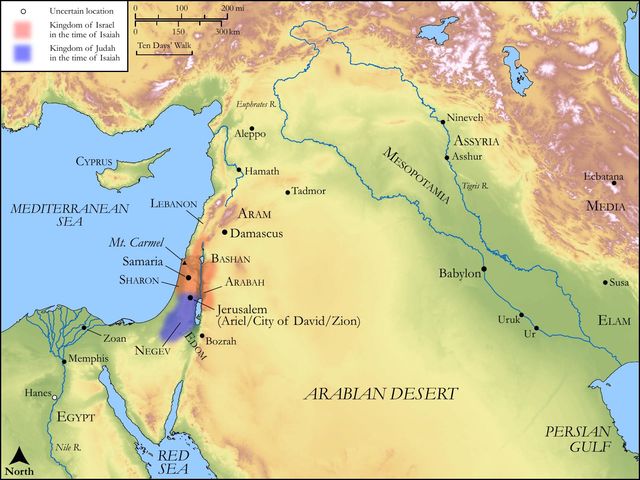
See on the biblical-era map
Study this verse
Public-domain commentary
Matthew Henry
From his Commentary on the Whole Bible. Henry comments on passages, not single verses — this entry covers Isaiah 28:9–13. His two-level outline is real structure in the source text, so it is rendered as structure.
The prophet here complains of the wretched stupidity of this people, that they were unteachable and made no improvement of the means of grace which they possessed; they still continued as they were, their mistakes not rectified, their hearts not renewed, nor their lives reformed. Observe,
I.What it was that their prophets and ministers designed and aimed at.
It was to teach them knowledge, the knowledge of God and his will, and to make them understand doctrine, Isa 28:9. This is God's way of dealing with men, to enlighten men's minds first with the knowledge of his truth, and thus to gain their affections, and bring their wills into a compliance with his laws; thus he enters in by the door, whereas the thief and the robber climb up another way.
II.What method they took, in pursuance of this design.
They left no means untried to do them good, but taught them as children are taught, little children that are beginning to learn, that are taken from the breast to the book (Isa 28:9), for among the Jews it was common for mothers to nurse their children till they were three years old, and almost ready to go to school. And it is good to begin betimes with children, to teach them, as they are capable, the good knowledge of the Lord, and to instruct them even when they are but newly weaned from the milk. The prophets taught them as children are taught; for,
1.They were constant and industrious in teaching them. They took great pains with them, and with great prudence, teaching them as they needed it and were able to bear it (Isa 28:10): Precept upon precept. It must be so, or (as some read) it has been so. They have been taught, as children are taught to read, by precept upon precept, and taught to write by line upon line, a little here and a little there, a little of one thing and a little of another, that the variety of instructions might be pleasing and inviting, - a little at one time and a little at another, that they might not have their memories overcharged, - a little from one prophet and a little from another, that every one might be pleased with his friend and him whom he admired. Note, For our instruction in the things of God it is requisite that we have precept upon precept and line upon line, that one precept and line should be followed, and so enforced by another; the precept of justice must be upon the precept of piety, and the precept of charity upon that of justice. Nay, it is necessary that the same precept and the same line should be often repeated and inculcated upon us, that we may the better understand them and the more easily recollect them when we have occasion for them. Teachers should accommodate themselves to the capacity of the learners, give them what they most need and can best bear, and a little at a time, Deu 6:6, Deu 6:7.
2.They courted and persuaded them to learn, Isa 28:12. God, by his prophets, said to them, "This way that we are directing you to, and directing you in, is the rest, the only rest, wherewith you may cause the weary to rest; and this will be the refreshing of your own souls, and will bring rest to your country from the wars and other calamities with which it has been long harassed." Note, God by his word calls us to nothing but what is really for our advantage; for the service of God is the only true rest for those that are weary of the service of sin and there is no refreshing but under the easy yoke of the Lord Jesus.
III.What little effect all this had upon the people.
They were as unapt to learn as young children newly weaned from the milk, and it was as impossible to fasten any thing upon them (Isa 28:9): nay, one would choose rather to teach a child of two years old than undertake to teach them; for they have not only (like such a child) no capacity to receive what is taught them, but they are prejudiced against it. As children, they have need of milk, and cannot bear strong meat, Heb 5:12.
1.They would not hear (Isa 28:12), no, not that which would be rest and refreshing to them. They had no mind to hear it. The word of God commanded their serious attention, but could not gain it; they were where it was preached, but they turned a deaf ear to it, or as it came in at one ear it went out at the other.
2.They would not heed. It was unto them precept upon precept, and line upon line (Isa 28:13); they went on in a road of external performances; they kept up the old custom of attending upon the prophet's preaching and it was continually sounding in their ears, but that was all; it made no impression upon them; they had the letter of the precept, but no experience of the power and spirit of it; it was continually beating upon them, but it beat nothing into them. Nay,
3.It should seem, they ridiculed the prophet's preaching, and bantered it. The word of the Lord was unto them Tsau latsau, kau lakau; in the original it is in rhyme; they made a song of the prophet's words, and sang it when they were merry over their wine. David was the song of the drunkards. It is great impiety, and a high affront to God, thus to make a jest of sacred things, to speak of that vainly which should make us serious.
IV.How severely God would reckon with them for this.
1.He would deprive them of the privilege of plain preaching, and speak to them with stammering lips and another tongue, Isa 28:11. Those that will not understand what is plain and level to their capacity, but despise it as mean and trifling, are justly amused with that which is above them. Or God will send foreign armies among them, whose language they understand not, to lay their country waste. Those that will not hear the comfortable voice of God's word shall be made to hear the dreadful voice of his rod. Or these words may be taken as denoting God's gracious condescension to their capacity in his dealing with them; he lisped to them in their own language, as nurses do to their children, with stammering lips, to humor them; he changed his voice, tried first one way and then another; the apostle quotes it as a favour (Co1 14:21), applying it to the gift of tongues, and complaining that yet for all this they would not hear.
2.He would bring utter ruin upon them. By their profane contempt of God and his word they are but hastening on their own ruin, and ripening themselves for it; it is that they may go and fall backward, may grow worse and worse, may depart further and further from God, and proceed from one sin to another, till they be quite broken, and snared, and taken, and ruined, Isa 28:13. They have here a little and there a little of the word of God; they think it too much, and say to the seers, See not; but it proves too little to convert them, and will prove enough to condemn them. If it be not a savour of life unto life, it will be a savour of death unto death.
Historical interpretation
Historical reception
1 surviving comment on this verse from the historical church.
(Vers. 10 seqq.) Who will teach knowledge, and who will make understanding? Weaned from milk, pulled from the breasts: command, re-command; command, re-command; wait, re-wait; wait, re-wait; a little here, a little there. For with stammering lips and another tongue He will speak to this people, to whom He said, 'This is the rest, give rest to the weary,' and 'This is the refreshing,' but they would not hear. And the word of the Lord will be to them, command, re-command; command, re-command; wait, re-wait; wait, re-wait; a little here, a little there, that they may go and fall backward, and be broken, snared, and caught. LXX: To whom shall we announce evil, and to whom shall we announce good news? Those who have been weaned from milk, those who have been taken away from the breast. Expect tribulation upon tribulation; wait for hope upon hope; still little, still little: because of the mockery of lips, because of the other tongue with which they will speak to this people, saying to them: This is the rest for the hungry, and this is the crushing, and they did not want to hear. The word of the Lord will come upon them: Tribulation upon tribulation: wait, wait; hope upon hope: still little, still little; so that they may go and fall backward, and be crushed, and be endangered, and be captured. Who, he says, is worthy of the teaching of the Lord, to whom are the words of the Savior saying: 'He who has ears to hear, let him hear' (Matthew 12:15), so that what he has heard with his ears, he may understand with his heart? The following verse shows who they are: 'Weaned from milk, drawn from the breast, who are not nourished with milk in infancy, but are fed with solid food; who were drawn from the breast with Isaac: for the joy of this, Abraham made a great feast' (Genesis 22); they deserve to hear the mysteries of the Lord, and to understand what the priest and prophet do not know, intoxicated and absorbed by wine, who wandered and did not know the one who sees, because all their tables are filled with vomit and filth, who, when the prophets announce the future and threaten torments unless they did what was commanded, used to say scoffing: 'Command, re-command; command, re-command,' that is, 'order, order, command what we should do.' And when they abused the patience of God, who delays his anger in order to show mercy; who used to say even this in jest through the mouths of the prophets: Wait a little longer, wait a little while, the things that we have prophesied will come. But all of these things they spoke to the people, because they did not believe the words of God; and immediately the prophet brings this in: By no means will God speak to you with these words, in order to give you a commandment of what you should do, and to wait for the things that are to come, but he will speak to you in present fury, who had previously said to the people: This is my rest, revive the weary, I have labored for a long time, I have found no rest in anything. Foxes have dens, and birds of the sky have nests; but the Son of Man has nowhere to lay his head (Matthew 8; Luke 9). And this is my refreshment, that I may find rest in you at times. Those who did not want to listen and despised my warnings; therefore, they say to the prophets what they used to say when they were playing: Command, re-command; command, re-command; wait, re-wait; wait, re-wait; a little here, a little there, and they mock my patience, thinking that I am threatening things that I will never do: let them experience the fulfillment of their desires, so that they may go to destruction and fall back incurably; and may they never make progress and be unable to say with the Apostle: Forgetting the past, we stretch out to what is ahead (Philippians 3:13); but may they be broken and ensnared, and captured by either the Babylonian or the Roman army. For that which we have said: Command, re-command; command, re-command; expect, re-expect; expect, re-expect; a little here, a little there, in Hebrew it is written thus: Sau Lasau, Sau Lasau; Cau Lacau, Cau Lacau: Zer Sam, Zer Sam; and with these words the most impure heresy is accustomed to deceive and terrify the simple ones, in order to make them fear the novelty of the words, so that whoever knows these words and remembers them during their intercourse, without any doubt, will pass on to the kingdom of heaven. We read in the Apostle: 'In other tongues and with other lips I will speak to this people, and even then they will not listen to me,' says the Lord (1 Corinthians 14:21). This seems to me to be taken from the present chapter according to the Hebrew, and we observed this in the Old Testament (except for a few testimonies, which only Luke abuses by having more knowledge of the Greek language). Wherever something is said from the Old Testament, we do not follow the Septuagint, but the Hebrew, not following any interpretation, but translating the Hebrew sense into our own language. Symmachus, Theodotion, and the Septuagint had different opinions on this passage, and since it is long to speak about all of them, let us briefly pass over the Septuagint interpreters who are read in the Churches. I reject the Jewish people, the Priests and the Prophets, who have become drunk with wine, and have strayed and their plan, which they entered into because of greed, has been consumed by a curse. Will we announce future tribulations for the sake of Christ to them? To whom will evil be prepared as the crown of virtues? Surely it signifies the apostles, those who have been weaned from milk, those who have been torn away from the breast: Expect tribulation upon tribulation. But it speaks to the choir of the apostles and of all believers, that they should prepare themselves not for one, but for many tribulations, so that when they are troubled and oppressed, they may hope again, and have hope upon hope. And if the things that are promised are delayed a little, let them not be unbelieving: for indeed, it is a small and little delay, and the things that are promised will come. Indeed, tribulation works patience; patience, probation: probation, hope; and hope does not disappoint. (Rom. V, 3, 4, 5). And this same tribulation will be multiplied by the detraction of lips and the blasphemies of persecutors, with which they rage against the people of God with a rabid mouth. Moreover, the apostles and apostolic men will speak to the Jewish people, saying: This is the rest for the hungry for justice, and this is the contrition and anguish that leads to life. When these things were preached, the wicked refused to listen. Therefore, what was said to the people of God: Endure tribulation, endure tribulation; wait for hope, wait for hope: a little longer, a little longer, will be turned into punishment for those who refused to hear the word of the Lord, so that they may fall and go backwards, and fall into the danger of siege and death, and be captured without any end to their misery. But the Hebrew word Dea, which everyone translates as 'knowledge', was only interpreted poorly by the Seventy, a clear error. For the first letter is distinguished either as Daleth or Res with a small apex. Therefore, if it is read as Dea (), it means 'knowledge'; if Rea (), it means 'malice'; not from evil, which is contrary to good, but from constraint.
Continue studying Isaiah 28:13 across the web’s major study libraries — every link below opens this exact verse, chapter, or book on the destination site.
Read & Compare
 BibleGatewayThis verse in more than 200 translations and 70 languages.
 Bible.comThe YouVersion reader — hundreds of translations, reading plans, and highlights.
 ESV.orgCrossway's official English Standard Version reader.
 NET BibleThe NET translation with 60,000+ translators' notes on every rendering decision.
 STEP BibleTyndale House's free study tool — original text, vocabulary, and scholarly resources.
 BibliaLogos Bible Software's free web reader.
 USCCBThe New American Bible (Revised Edition) with the U.S. bishops' study notes.
Commentaries
 BibleHub CommentariesDozens of classic commentaries on this verse, gathered on one page.
 StudyLightMore than 100 commentary sets — the largest collection on the web.
 BibleRefPlain-English commentary on what this verse means, verse by verse.
 Enduring WordDavid Guzik's free commentary on this chapter, widely used by Bible teachers.
 Bible Study ToolsVerse commentary alongside Greek and Hebrew study aids.
Original Language & Research
- BibleHub InterlinearThe verse word by word — original language, transliteration, and English.
- BibleHub LexiconEvery word's original-language definition and Strong's entry.
 Blue Letter BibleDeep-study tools — Strong's numbers, concordance, and word studies.
 SefariaThe Hebrew text with Rashi and centuries of Jewish commentary.
Sermons, Hymns & Audio


TrulyRandomVerse is not affiliated with these sites and doesn’t control their content. They’re linked because they’re genuinely useful.
Summary
Isaiah 28:13 delivers a scathing divine indictment against the spiritually complacent and arrogant leaders and people of Judah. Despite the Lord's patient, consistent, and incremental instruction, delivered "precept upon precept, line upon line," they scorned His word as infantile babble. This verse declares the tragic, ironic consequence of their rejection: because they refused to heed God's clear and accessible truth, their very path of rebellion would lead them to stumble backward, be broken, snared, and ultimately taken captive, illustrating the severe judgment that awaits those who despise divine wisdom.
Context
ShowHideLiterary Context
Isaiah 28:13 is a pivotal and climactic statement within a broader oracle (Isaiah 28:1-29) primarily addressing the spiritual decay and impending judgment upon both the northern kingdom of Israel (Ephraim) and, by extension, the southern kingdom of Judah. The preceding verses (Isaiah 28:7-12) vividly portray the moral and spiritual bankruptcy of Judah's religious and political leadership, who are depicted as "staggering from wine and reeling from beer," rendering them utterly incapable of discerning or delivering God's message. In their drunken stupor and spiritual arrogance, they scorn the prophet Isaiah's patient and repetitive teaching, mockingly mimicking his words, "For it is precept upon precept, precept upon precept, line upon line, line upon line; here a little, there a little" Isaiah 28:10. This mockery implies that God's instruction is too simplistic, fit only for infants. Verse 13 serves as God's direct, ironic, and severe response: precisely because they found His clear, foundational teaching contemptible, He would indeed speak to them in a "foreign tongue" (through the invading Assyrian army), and their rejection of His word would lead directly to their catastrophic downfall, fulfilling the very judgment they scoffed at.
Historical & Cultural Context
The prophecy in Isaiah 28 is situated during a tumultuous and perilous period in Israel's history, likely during the latter half of the 8th century BC, specifically under the reigns of Kings Ahaz and Hezekiah in Judah. This era was dominated by the rising power of the Assyrian Empire, which had already severely impacted the northern kingdom of Israel, leading to its eventual collapse and exile in 722 BC. Judah, the southern kingdom, faced similar existential threats and was constantly tempted to form political alliances with foreign powers (like Egypt or Assyria itself) rather than trusting in the Lord for deliverance. Culturally, the leaders and people had become deeply entrenched in self-sufficiency, pride, and spiritual apathy. They preferred the perceived sophistication of political maneuvering and the allure of syncretistic religious practices over the seemingly straightforward, yet profoundly demanding, covenant obligations to Yahweh. Their disdain for Isaiah's "simple" teaching reflects a widespread spiritual dullness and a dangerous rejection of the foundational truths that had historically sustained Israel, leading them to misinterpret God's patient instruction as weakness or foolishness.
Key Themes
ShowHideIsaiah 28:13 powerfully contributes to several overarching themes prevalent throughout the book of Isaiah and the broader prophetic corpus. A primary theme is Divine Instruction and Human Rebellion. God, in His unwavering faithfulness and love, consistently provides clear, accessible, and incremental guidance to His people. Yet, humanity, driven by pride and spiritual blindness, frequently rejects or distorts this divine revelation. The "precept upon precept" motif highlights God's methodical, building-block approach to truth, which is tragically met with scorn and spiritual arrogance, echoing the dire warnings against despising wisdom found in Proverbs 1:24-33. This leads directly to the theme of Consequence and Judgment. The latter half of the verse meticulously details the inevitable and severe outcome of rejecting divine truth: spiritual and physical stumbling, brokenness, and ultimately, captivity. This serves as a potent reminder that God's patience is not limitless, and persistent rebellion against His word incurs righteous divine judgment. Finally, the passage powerfully employs the theme of Divine Irony, where God utilizes the very thing the people despised—what they perceived as simple, foreign-sounding instruction—as the precise means of their judgment, turning their mockery back upon them. This is consistent with God's sovereign use of foreign nations to discipline His covenant people, as seen in passages like Isaiah 10:5-6.
Exposition and Analysis
ShowHideKey Word Analysis
ShowHideIn "the word of the LORD," dâbâr is far more comprehensive than a mere utterance. It signifies an authoritative communication, a matter, an affair, a decree, or even a deed. Here, it refers to the active, revealed will and instruction of God—His authoritative pronouncements and commands. The use of dâbâr emphasizes that what the people scorned was not merely human speech or advice, but the very authoritative utterance and command of the self-existent God, Yahweh.
Derived from the root meaning "to command" or "to enjoin," tsav specifically denotes an injunction, a command, or a rule. Its repetition, "precept upon precept," underscores the methodical, incremental, and foundational nature of God's teaching. It suggests a patient, building-block approach to spiritual understanding, where essential truths are laid down repeatedly and consistently, forming the basis for all further knowledge and obedience.
This primitive root means "to totter or waver (through weakness of the legs, especially the ankle); by implication, to falter, stumble, faint or fall." In Isaiah 28:13, it vividly describes the physical and spiritual collapse that befalls those who reject God's word. It signifies a loss of stability, a moral and societal deterioration, and ultimately, a comprehensive defeat that directly stems from their refusal to walk in God's prescribed path.
Verse Breakdown
ShowHide"But the word of the LORD was unto them precept upon precept, precept upon precept; line upon line, line upon line; here a little, and there a little"
This opening clause describes God's persistent, patient, and consistent method of instructing His people. The emphatic repetition of "precept upon precept" (tsaw latsaw) and "line upon line" (qaw laqaw) highlights the continuous, foundational, and perhaps even elementary nature of God's teaching. It illustrates that God provided His truth in a clear, accessible, and repeated manner, much like a diligent teacher patiently instructs a child, building knowledge incrementally ("here a little, and there a little"). This was God's gracious provision, designed for their spiritual growth, stability, and well-being.
"that they might go, and fall backward, and be broken, and snared, and taken"
This clause reveals the tragic, ironic, and divinely ordained consequence of their stubborn rejection. The conjunction "that" (לְמַעַן, lema'an) here indicates a resultant purpose or consequence. Because they scorned God's simple, clear instruction, the very path they chose—the path of rebellion, self-reliance, and alliance with foreign powers—would lead them not to progress but to catastrophic regression ("fall backward"). This backward fall would result in their being "broken" (shattered, utterly defeated), "snared" (caught unexpectedly in a trap, like prey), and "taken" (captured, led into exile). This is God's righteous judgment, where their own choices and contempt for His word become the direct instruments of their downfall, fulfilling the very fate they sought to avoid by rejecting God's way.
Literary Devices
ShowHideIsaiah 28:13 is powerfully constructed through several prominent literary devices that amplify its message of divine instruction and impending judgment. The most striking is Repetition, evident in the phrases "precept upon precept" and "line upon line," each repeated twice, followed by "here a little, and there a little." This repetition not only underscores the persistent, incremental nature of God's teaching but also, in the context of the preceding verses, satirically mimics the people's scornful perception of it as tedious, simplistic, and fit only for infants. This satirical effect is further enhanced by Onomatopoeia, as the Hebrew phrases tsaw latsaw, tsaw latsaw; qaw laqaw, qaw laqaw are widely believed to mimic the sounds of babbling or rudimentary, repetitive instruction, reinforcing the mockery from the perspective of the unrepentant leaders. The verse also employs profound Irony: God's patient, clear, and foundational instruction, intended for their salvation, stability, and flourishing, becomes the very means by which they stumble and are destroyed, precisely because of their proud and contemptuous rejection. What they deemed foolish or beneath them ultimately becomes their undoing. Finally, there is a strong sense of Parallelism and escalating consequences in the latter part of the verse ("fall backward, and be broken, and snared, and taken"), creating a rhythmic progression that emphasizes the comprehensive and inescapable nature of their impending doom.
Theological and Thematic Connections
ShowHideIsaiah 28:13 profoundly illustrates the critical importance of humility and attentiveness to God's revealed word. It underscores that divine truth, even when presented in seemingly simple or repetitive forms, is absolutely foundational for spiritual life, stability, and flourishing. The people's scorn for God's "precept upon precept" teaching demonstrates a dangerous spiritual arrogance that prefers human wisdom, political maneuvering, or self-sufficiency over divine guidance. The tragic outcome—stumbling, brokenness, and captivity—serves as a timeless and severe warning that rejecting God's clear instruction inevitably leads to ruin. This passage reveals God as a patient Teacher who consistently provides truth in an accessible manner, but also as a righteous Judge who allows those who despise His grace to experience the natural, yet divinely ordained, consequences of their persistent rebellion. It highlights the profound theological principle that true wisdom and genuine security begin with reverent submission to God's word, regardless of how basic or profound its individual components may seem.
Reflection and Application
ShowHideIsaiah 28:13 offers a powerful and convicting mirror for contemporary believers and communities, challenging us to deeply examine our own attitudes toward God's word. Do we approach Scripture with genuine humility, eager to receive "precept upon precept," even the seemingly simple or repetitive truths that form the bedrock of our faith? Or do we, like the ancient Israelites, grow weary of foundational teachings, constantly seeking novel insights, complex intellectual stimulation, or dramatic revelations while neglecting the consistent, daily discipline of building upon the basics of faith and obedience? This verse serves as a stark reminder that true spiritual maturity and stability are not found in despising simplicity or seeking to bypass fundamental truths, but rather in diligently and humbly building upon the consistent, incremental revelation of God. Our spiritual stability, moral integrity, and flourishing depend entirely on our willingness to submit to God's clear commands and patient instruction, even when they challenge our pride, expose our weaknesses, or seem inconvenient. To scorn the "precept upon precept" is to invite spiritual stumbling, moral brokenness, and ultimately, a profound disconnect from the life-giving presence of God, whereas embracing it leads to a life firmly established and secure in His unchanging truth.
Questions for Reflection
ShowHideFAQ
ShowHideWhat does "precept upon precept, line upon line" mean in this context?
ShowHideThis phrase describes God's patient, consistent, and methodical way of instructing His people. "Precept" (Hebrew tsav) refers to a command or injunction, while "line" (Hebrew qav) refers to a measuring line or rule, signifying order and standard. Together, they depict God giving His truth incrementally, building knowledge block by block, much like a diligent teacher patiently instructs a child or an architect lays out a precise blueprint. However, in Isaiah 28:13, the phrase also carries a strong sarcastic undertone, mimicking the mocking words of the unrepentant Israelites who found God's clear, repetitive teaching tedious and childish, likening it to babbling or rudimentary instruction given to infants, as seen in Isaiah 28:10.
Why did God allow them to "fall backward, and be broken, and snared, and taken"?
ShowHideThe latter part of the verse describes the severe divine judgment that resulted directly from the people's stubborn rebellion and their scornful rejection of God's clear and patient instruction. Because they refused to walk in the light of God's truth, choosing instead to rely on their own flawed wisdom, political alliances, and pagan practices, God allowed them to experience the natural, yet divinely ordained, consequences of their choices. Their "falling backward" signifies a profound spiritual and national collapse, leading to military defeat ("broken"), entrapment by their enemies ("snared"), and ultimately, exile ("taken") by foreign powers, particularly the Assyrians. This outcome was not arbitrary but a direct and just consequence of their persistent disobedience and contempt for the Lord's word, fulfilling the warnings of covenant curses found in passages like Deuteronomy 28:15-68.
Christ-Centered Fulfillment
ShowHideIsaiah 28:13 finds profound and multi-faceted Christ-centered fulfillment. First, Jesus Himself is the ultimate "Word of the LORD" John 1:1, the perfect embodiment of God's instruction, revelation, and active will. Just as God patiently gave "precept upon precept" in the Old Testament, Jesus taught with unparalleled divine authority and profound simplicity, often using parables and straightforward commands that were accessible to all, yet inexhaustibly deep in their wisdom. Tragically, just as the Israelites scorned God's "simple" word, many in Jesus' day, particularly the religious elite, rejected His plain teaching and divine claims, finding them too basic, too challenging, or beneath their sophisticated theological frameworks Matthew 11:25. This pervasive rejection of God's incarnate Word ultimately led to their spiritual stumbling and judgment.
Furthermore, Jesus is prophetically presented as the "precious cornerstone" laid in Zion in the very next verse, Isaiah 28:16, a prophecy directly applied to Christ in the New Testament 1 Peter 2:6-8. For all who believe and build their lives upon Him, He is the sure and unshakable foundation; but for those who reject Him, He becomes "a stone of stumbling and a rock of offense." The dire consequences described in Isaiah 28:13—"falling backward, and being broken, and snared, and taken"—vividly prefigure the spiritual and eternal consequences for all who refuse to submit to the clear, simple, and life-giving truth of the Gospel of Jesus Christ. His teachings, though seemingly basic, are the very path to eternal life and true freedom John 8:31-32, and to despise them is to choose a path that inevitably leads to spiritual ruin, brokenness, and eternal separation from God, fulfilling the judgment pronounced upon all who reject God's patient and ultimate instruction.