


Judges 20:18
Bible text: King James Version (1769 Blayney text) · Public domain
Bible text: King James Version with Strong's numbers · Public domain
Bible text: Berean Standard Bible · Public domain
Bible text: American Standard Version (1901) · Public domain
Bible text: World English Bible, Messianic edition · Public domain
Bible text: Geneva Bible (1599) · Public domain
Bible text: Young's Literal Translation · Public domain
- וַיָּקֻמוּvai·ya·Ku·muand they aroseH6965Conj-w ¦ V-Qal-ConsecImperf-3mpVerb Qal Consecutive Imperfect 3rd Plural Masculineוַandיָּקֻמוּthey arose
- וַיַּעֲלוּvai·ya·'a·Luand they went upH5927Conj-w ¦ V-Qal-ConsecImperf-3mpVerb Qal Consecutive Imperfect 3rd Plural Masculineוַandיַּעֲלוּthey went up
- בֵיתveitBeth-H1008N-properNoun Proper Location
- אֵל'el-elH1008N-properNoun Proper Location
- וַיִּשְׁאֲלוּvai·yish·'a·Luand they askedH7592Conj-w ¦ V-Qal-ConsecImperf-3mpVerb Qal Consecutive Imperfect 3rd Plural Masculineוַandיִּשְׁאֲלוּthey asked
- בֵאלֹהִיםve·lo·Himby GodH430Prep-b ¦ N-mpNoun Plural Masculine AbsoluteבֵbyאלֹהִיםGod
- וַיֹּאמְרוּvai·yo·me·Ruand they saidH559Conj-w ¦ V-Qal-ConsecImperf-3mpVerb Qal Consecutive Imperfect 3rd Plural Masculineוַandיֹּאמְרוּthey said
- בְּנֵיbe·Nei[the] people ofH1121N-mpcNoun Plural Masculine Construct
- יִשְׂרָאֵלYis·ra·'ElIsraelH3478N-properNoun Proper Location
- מִיmiwho?H4310InterrogPronoun Interrogative
- יַעֲלֶהya·'a·lehwill he go upH5927V-Qal-Imperf-3msVerb Qal Imperfect 3rd Singular Masculine
- לָּנוּLa·nufor <the> usPrep-l ¦ 1cpSuffix Personal 1st Plural common genderלָּfor <the>נוּus
- בַתְּחִלָּהva·te·chi·Lahat the firstH8462Prep-b ¦ N-fsNoun Singular Feminine Absoluteבַat theתְּחִלָּהfirst
- לַמִּלְחָמָהla·mil·cha·Mahto the battleH4421Prep-l ¦ N-fsNoun Singular Feminine Absoluteלַto theמִּלְחָמָהbattle
- עִם'imwithH5973PrepPreposition
- בְּנֵיbe·Nei[the] descendants ofH1121N-mpcNoun Plural Masculine Construct
- בִנְיָמִןvin·ya·MinBenjaminH1144N-proper-mNoun Proper Masculine
- וַיֹּאמֶרvai·Yo·merand he saidH559Conj-w ¦ V-Qal-ConsecImperf-3msVerb Qal Consecutive Imperfect 3rd Singular Masculineוַandיֹּאמֶרhe said
- יְהוָהYah·wehYahwehH3068N-properNoun Proper Title
- יְהוּדָהye·hu·DahJudahH3063N-properNoun Proper Location
- בַתְּחִלָּהva·te·chi·Lah[will be] at the firstH8462Prep-b ¦ N-fsNoun Singular Feminine Absoluteבַ[will be] at theתְּחִלָּהfirst
English is a literal word-by-word gloss of the Hebrew, not the KJV's wording. Why?
This is the original text the KJV's translators worked from — each Hebrew word with its own literal English meaning in this verse, prepared by scholars at Tyndale House, Cambridge. The KJV translates whole sentences, not word by word, so its wording differs: one Hebrew word can become several English words, and the KJV may choose “the LORD” where the gloss reads “Yahweh”. Both are faithful — they answer different questions. For the KJV's own rendering, switch to the KJV text.
Details
See on the biblical-era maps
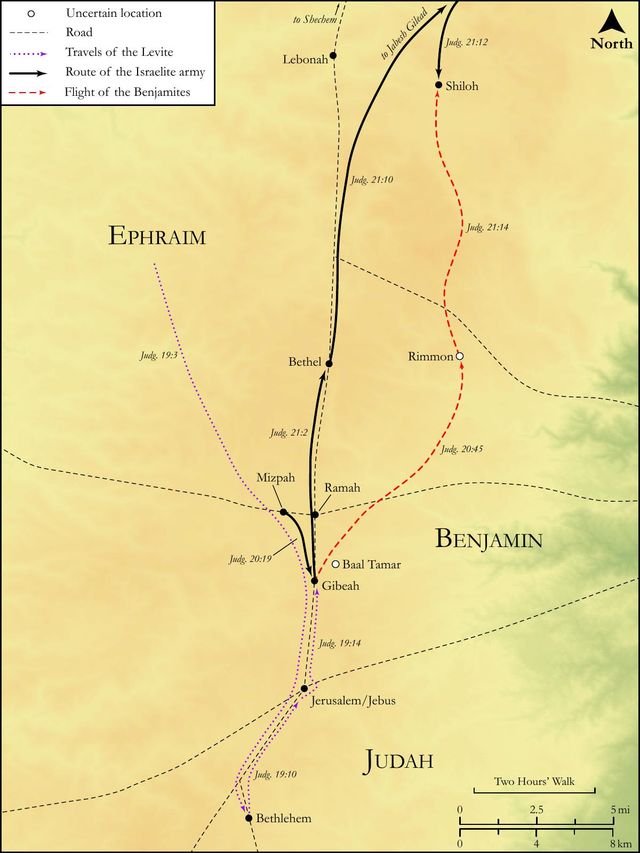
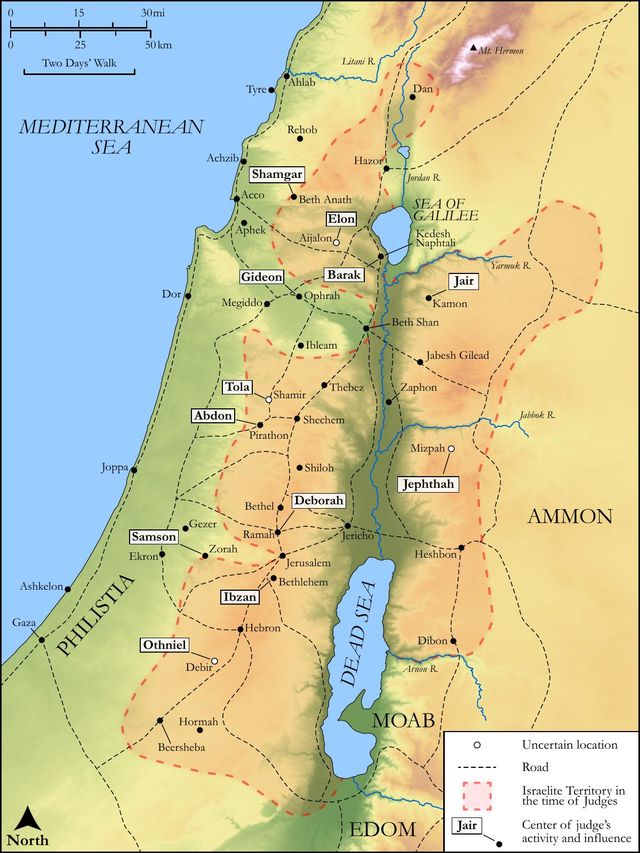
Study this verse
Public-domain commentary
Matthew Henry
From his Commentary on the Whole Bible. Henry comments on passages, not single verses — this entry covers Judges 20:18–25. His two-level outline is real structure in the source text, so it is rendered as structure.
We have here the defeat of the men of Israel in their first and second battle with the Benjamites.
I.Before their first engagement they asked counsel of God concerning the order of their battle and were directed, and yet they were sorely beaten. They did not think it was proper to ask of God whether they should go up at all against Benjamin (the case was plain enough, the men of Gibeah must be punished for their wickedness, and Israel must inflict the punishment or it will not be done), but "Who shall go first?" (Jdg 20:18), that is, "Who shall be general of our army?" for, which soever tribe was appointed to go first, the prince of that tribe must be looked upon as commander-in-chief of the whole body. For, if they had meant it of the order of their march only, it would have been proper to ask, "Who shall go next?" and then, "Who next?" But, if they know that Judah must go first, they know they must all observe the orders of the prince of that tribe. This honour was done to Judah because our Lord Jesus was to spring from that tribe, who was in all things to have the pre-eminence. The tribe that went up first had the most honourable post, but withal the most dangerous, and probably lost most in the engagement. Who would strive for precedency that sees the peril of it? Yet though Judah, that strong and valiant tribe, goes up first, and all the tribes of Israel attend them, little Benjamin (so he is called, Psa 68:27), is too hard for them all. The whole army lays siege to Gibeah, Jdg 20:19. The Benjamites advance to raise the siege, and the army prepares to give them a warm reception (Jdg 20:20). But between the Benjamites that attacked them in the front with incredible fury, and the men of Gibeah that sallied out upon their rear, they were put into confusion and lost 22,000 men, Jdg 20:21. Here were no prisoners taken, for there was no quarter given, but all put to the sword.
II.Before their second engagement they again asked counsel of God, and more solemnly than before; for they wept before the Lord until evening (Jdg 20:23), lamenting the loss of so many brave men, especially as it was a token of God's displeasure and would give occasion to the Benjamites to triumph in the success of their wickedness. Also at this time they did not ask who should go up first, but whether they should go up at all. The intimate a reason why they should scruple to do it, especially now that Providence had frowned upon them, because Benjamin was their brother, and a readiness to lay down their arms if God should so order them. God bade them go up; he allowed the attempt, for, though Benjamin was their brother, he was a gangrened member of their body and must be cut off. Upon this they encouraged themselves, perhaps more in their own strength than in the divine commission, and made a second attempt upon the forces of the rebels, in the same place where the former battle was fought (Jdg 20:22), with the hope of retrieving their credit upon the same spot of ground where they had lost it, which they would not superstitiously change, as if there were any thing unlucky in the place. But they were this second time repulsed, with the loss of 18,000 men, Jdg 20:25. The former day's loss and this amounted to 40,000, which was just a tenth part of the whole army, and the same number that they had drawn out by lot to fetch victuals, Jdg 20:10. They decimated themselves for that service, and now God again decimated them for the slaughter. But what shall we say to these things, that so just and honourable a cause should thus be put to the worst once and again? Were they not fighting God's battle against sin? Had they not his commission? What, and yet miscarry thus!
1.God's judgments are a great deep, and his way is in the sea. Clouds and darkness are often round about him, but judgment and justice are always the habitation of his throne. We may be sure of the righteousness, when we cannot see the reasons, of God's proceedings.
2.God would hereby show them, and us in them, that the race is not to the swift nor the battle to the strong, that we are not to confide in numbers, which perhaps the Israelites did with too much assurance. We must never lay the weight on an arm of flesh, which only the Rock of ages will bear.
3.God designed hereby to correct Israel for their sins. They did well to show such a zeal against the wickedness of Gibeah: but were there not with them, even with them, sins against the Lord their God? Those must be made to know their own iniquity that are forward in condemning the iniquity of others. Some think it was a rebuke to them for not witnessing against the idolatry of Micah and the Danites, by which their religion was corrupted, as they now did against the lewdness of Gibeah and the Benjamites, by which the public peace was disturbed, though God had particularly ordered them to levy war upon idolaters, Deu 13:12, etc.
4.God would hereby teach us not to think it strange if a good cause should suffer defeat fore a while, nor to judge of the merits of it by the success of it. The interest of grace in the heart, and of religion in the world, may be foiled, and suffer great loss, and seem to be quite run down, but judgment will be brought forth to victory at last. Vincimur in praelio, sed non in bello - We are foiled in a battle, but not in the whole campaign. Right may fall, but it shall arise.
Continue studying Judges 20:18 across the web’s major study libraries — every link below opens this exact verse, chapter, or book on the destination site.
Read & Compare
 BibleGatewayThis verse in more than 200 translations and 70 languages.
 Bible.comThe YouVersion reader — hundreds of translations, reading plans, and highlights.
 ESV.orgCrossway's official English Standard Version reader.
 NET BibleThe NET translation with 60,000+ translators' notes on every rendering decision.
 STEP BibleTyndale House's free study tool — original text, vocabulary, and scholarly resources.
 BibliaLogos Bible Software's free web reader.
 USCCBThe New American Bible (Revised Edition) with the U.S. bishops' study notes.
Commentaries
 BibleHub CommentariesDozens of classic commentaries on this verse, gathered on one page.
 StudyLightMore than 100 commentary sets — the largest collection on the web.
 BibleRefPlain-English commentary on what this verse means, verse by verse.
 Enduring WordDavid Guzik's free commentary on this chapter, widely used by Bible teachers.
 Bible Study ToolsVerse commentary alongside Greek and Hebrew study aids.
Original Language & Research
- BibleHub InterlinearThe verse word by word — original language, transliteration, and English.
- BibleHub LexiconEvery word's original-language definition and Strong's entry.
 Blue Letter BibleDeep-study tools — Strong's numbers, concordance, and word studies.
 SefariaThe Hebrew text with Rashi and centuries of Jewish commentary.
Sermons, Hymns & Audio


TrulyRandomVerse is not affiliated with these sites and doesn’t control their content. They’re linked because they’re genuinely useful.
Summary
Judges 20:18 chronicles a critical juncture in the inter-tribal conflict against Benjamin, portraying the unified tribes of Israel ascending to a sacred site to seek divine guidance before engaging in battle. This verse underscores the Israelites' persistent, albeit often inconsistent, acknowledgment of God's supreme authority and their reliance on His direction, even amidst the profound moral decline and internal strife characteristic of the Judges period, as the LORD directly responds to their inquiry by designating Judah to lead the initial assault.
Context
ShowHideLiterary Context
Judges 20:18 is embedded within the climactic civil war narrative against the tribe of Benjamin, which spans Judges 19 through Judges 21. The preceding chapter, Judges 19, vividly recounts the horrific crime committed by Benjamites in Gibeah against a Levite's concubine—an act of extreme depravity that elicits outrage across Israel. The Levite's gruesome act of dismembering her body and distributing its pieces to all the tribes serves as a shocking catalyst, uniting the other eleven tribes in righteous indignation and a demand for justice. Judges 20 opens with the assembly of these tribes at Mizpah, where they recount the atrocity and resolve to punish the perpetrators. Verse 18 marks their transition from strategic planning to seeking divine counsel for the impending conflict, highlighting their understanding that even in a war of retribution, God's approval and direction were paramount.
Historical & Cultural Context
The Book of Judges portrays a tumultuous and decentralized era in Israelite history, following the conquest of Canaan but preceding the establishment of the monarchy. This period is famously encapsulated by the recurring refrain: "In those days there was no king in Israel; everyone did what was right in his own eyes" (e.g., Judges 17:6 and Judges 21:25). This pervasive moral and political anarchy forms the backdrop for the Gibeah incident and the subsequent civil war. The phrase "went up to the house of God" most likely refers to Bethel (meaning "house of God"), a significant sanctuary and place of worship with deep historical roots (e.g., Jacob's dream in Genesis 28), or potentially Shiloh, where the tabernacle was located. It served as a central location for the tribes to assemble and seek divine counsel, often through the high priest consulting God via the Urim and Thummim. This practice underscores the Israelite belief that divine guidance was indispensable for major undertakings, particularly warfare, even when the cause appeared self-evidently just.
Key Themes
ShowHideThis verse contributes to several foundational themes within Judges and broader Israelite theology. Firstly, it emphasizes the necessity of seeking divine counsel, even amidst human depravity and the complexities of civil war. Despite their moral failings, the Israelites still recognized God as the ultimate authority, demonstrating a foundational principle of seeking God's direction in all significant endeavors, a theme echoed in Proverbs 3:5-6. Secondly, it affirms God's active involvement and sovereignty in the nation's affairs. The LORD's direct and immediate answer, "Judah [shall go up] first," underscores His dominion over the outcomes of battles and the leadership roles within the tribes, reflecting His sovereign control over history. Thirdly, the selection of Judah's leadership role is profoundly significant; this tribe was consistently at the forefront of Israel's military endeavors, as seen in Judges 1:1-2, and was destined for a prominent role in Israel's history, including the lineage of King David and, ultimately, the Messiah. Finally, the verse is set within a narrative of the Israelites pursuing justice and retribution for a grave injustice, though the tragic and complex outcomes of this war, detailed in Judges 21, reveal the profound cost of sin and the limits of human justice without true spiritual revival.
Exposition and Analysis
ShowHideKey Word Analysis
ShowHideThe Hebrew phrase בֵּית־אֵל ( Bêyth-ʼÊl ), derived from H1004 (bayith, "house") and H430 (ʼĕlôhîym, "God"), literally means "house of God." While it can refer to any sanctuary, in this context, it specifically designates the city of Bethel, a significant cultic site with a long history in Israel, known for Jacob's dream (Genesis 28:10-22). Its mention here underscores the tribes' intention to seek legitimate divine guidance from a recognized sacred place, highlighting the formal and religious nature of their inquiry.
The verb שָׁאַל ( shâʼal ) (H7592) means "to inquire, consult, ask." This term is frequently used in the Old Testament for seeking an oracle or divine guidance, often through the high priest using the Urim and Thummim. The act of "asking counsel of God" indicates a formal, ritualized inquiry, demonstrating the Israelites' belief that God could and would provide direct answers to their questions regarding military strategy and leadership.
The tribe of יְהוּדָה ( Yᵉhûwdâh ) (H3063), meaning "celebrated," is consistently portrayed as a leading tribe in Israelite history. Its selection here to lead the battle echoes its initial leadership role in the conquest of Canaan (Judges 1:1-2) and profoundly foreshadows its future prominence as the tribe from which King David and ultimately the Messiah would descend. God's designation of Judah affirms its divinely appointed preeminence, even in a period of chaos and moral decline.
Verse Breakdown
ShowHide"And the children of Israel arose, and went up to the house of God"
This clause emphasizes the unified, collective action of the other eleven tribes. Their "arising" signifies a decisive movement, and "going up" implies a journey to a higher, sacred place, indicating the solemnity and religious significance of their assembly. The "house of God" (Bethel) serves as the designated place for divine consultation, reinforcing the idea that this was not merely a human strategic meeting but a spiritual inquiry, demonstrating their continued, albeit imperfect, adherence to seeking divine will.
"and asked counsel of God, and said, Which of us shall go up first to the battle against the children of Benjamin?"
This segment highlights the specific nature of their inquiry. They are not asking if they should go to battle (that decision has already been made in response to the atrocity), but how they should proceed, specifically concerning leadership and strategy. This demonstrates their recognition of God's sovereignty over military endeavors and their desire for divine strategy, even in a conflict against a fellow Israelite tribe, showing a residual understanding of God's authority.
"And the LORD said, Judah [shall go up] first."
This concise and direct response from God underscores His active involvement in Israel's affairs. The divine oracle is unambiguous, immediately identifying Judah as the lead tribe. This divine directive sets the stage for the subsequent battles, demonstrating God's sovereign hand in directing the course of events, even when the human participants are morally compromised and the situation is fraught with internal conflict.
Literary Devices
ShowHideJudges 20:18 employs several literary devices to convey its profound message. Direct Discourse is prominently featured, as the Israelites' specific question and the LORD's immediate, unequivocal answer are presented verbatim. This technique lends immediacy and undeniable authority to the divine pronouncement, underscoring God's direct and active involvement in the nation's affairs. The verse also utilizes Foreshadowing, as God's selection of Judah to lead the charge anticipates the tribe's enduring prominence throughout Israelite history, culminating in the Davidic monarchy and the lineage of the Messiah. There is also a powerful element of Irony present; despite the horrific moral decay and spiritual apostasy described in the preceding chapters, the Israelites still instinctively turn to God for guidance in their military endeavors. This highlights the complex spiritual state of the nation during the Judges period—a people who had largely abandoned God's laws yet still acknowledged His power and authority in specific, often self-serving, instances.
Theological and Thematic Connections
ShowHideJudges 20:18 profoundly illustrates the tension between human depravity and divine sovereignty. Even in a period marked by moral anarchy ("everyone did what was right in his own eyes"), the Israelites retained a fundamental understanding of the need to consult God, particularly before significant undertakings like warfare. This act of seeking counsel, despite the flawed context of a civil war born of horrific sin, reveals God's enduring willingness to engage with His people, even when they are far from perfect. It underscores that God's authority and involvement transcend human chaos and sin. His direct answer signifies His active governance over the affairs of humanity, even in their conflicts, and His sovereign choice in designating leadership. The verse implicitly teaches that while human actions have consequences, God remains the ultimate arbiter of outcomes, and seeking His will is always the proper posture for His people.
Reflection and Application
ShowHideJudges 20:18 offers a timeless lesson on the critical importance of seeking God's counsel in all aspects of life, regardless of the circumstances. Even when faced with daunting challenges, complex decisions, or morally ambiguous situations, believers are called to consult God through prayer, diligent study of His Word, and seeking wise, godly counsel from the community of faith. The Israelites, despite their profound spiritual and moral decline, still instinctively turned to God before engaging in a civil war. This should challenge us: if they, in their brokenness, sought God's guidance, how much more should we, who live under a better covenant, earnestly and consistently seek the Lord's will? It reminds us that God is willing to provide direction when we earnestly seek Him, even if His answers are not always what we expect or are easy to follow. Our reliance on Him demonstrates our trust in His sovereignty and wisdom, acknowledging that His ways are higher than our ways and that true wisdom begins with Him.
Questions for Reflection
ShowHideFAQ
ShowHideWhere exactly was the "house of God" mentioned in this verse?
ShowHideWhile the exact location is not explicitly stated in Judges 20:18, biblical scholars generally agree it refers to Bethel (meaning "house of God"), a significant sanctuary and cultic site located north of Jerusalem. Bethel had a long history as a place of divine encounter, dating back to Jacob's dream in Genesis 28. It served as a central gathering place for the tribes of Israel during this period. Some scholars also suggest Shiloh, where the tabernacle was located, but the narrative flow in Judges 20 seems to favor Bethel, which is mentioned again in Judges 20:26.
Why did God choose Judah to go first?
ShowHideGod's selection of Judah to lead the charge is significant for several reasons. Firstly, Judah was already a prominent and powerful tribe, having previously been designated to lead the initial conquests of Canaan in Judges 1:1-2. This established a precedent for their military leadership. Secondly, this choice profoundly foreshadows Judah's enduring preeminence in Israel's history. From Judah would come the lineage of King David, the greatest king of Israel, and ultimately, the Messiah. God's designation here underscores His sovereign plan for Judah's pivotal role in the unfolding narrative of salvation history.
Does God always approve of war when He gives counsel for it?
ShowHideNot necessarily. In Judges 20:18, God's counsel is a direct response to Israel's specific inquiry about who should lead the battle, not an endorsement of the war itself or the tragic circumstances that led to it. The Book of Judges consistently highlights Israel's moral failures, and this civil war is a direct consequence of the depravity described in Judges 19. God, in His sovereignty, can guide and direct events even within the context of human sin and conflict, without necessarily sanctioning the sin itself. His response here acknowledges their inquiry and provides a strategic directive, demonstrating His active involvement in the affairs of His people, even when those affairs are marred by their own disobedience and violence.
Christ-Centered Fulfillment
ShowHideJudges 20:18, with its depiction of a flawed people seeking divine counsel for a civil war, finds its ultimate fulfillment in Jesus Christ. While the Israelites sought a leader from Judah for a physical battle against a human enemy, Christ, the true Lion of the tribe of Judah (Revelation 5:5), is the ultimate leader of God's people in a spiritual warfare against sin, death, and the powers of darkness (Ephesians 6:10-18). Unlike the temporary and often tragic outcomes of human conflicts in Judges, Jesus is the "Wonderful Counselor" (Isaiah 9:6) who perfectly embodies God's wisdom and provides the definitive solution to humanity's deepest moral failures. The chaotic period of Judges, where "everyone did what was right in his own eyes," starkly contrasts with the reign of Christ, who brings true order, justice, and peace through His perfect obedience and atoning sacrifice. He is the Lamb of God who takes away the sin of the world (John 1:29), offering reconciliation and a new covenant that transcends the cycles of sin and judgment seen in Judges. In Him, we find not just counsel for a battle, but the very embodiment of God's will and the ultimate victory over all darkness.