


Judges 20:17
Bible text: King James Version (1769 Blayney text) · Public domain
Bible text: Berean Standard Bible · Public domain
Bible text: American Standard Version (1901) · Public domain
Bible text: World English Bible, Messianic edition · Public domain
Bible text: Geneva Bible (1599) · Public domain
Bible text: Young's Literal Translation · Public domain
- וְאִישׁve·'Ishand [the] man ofH376Conj-w ¦ N-mscNoun Singular Masculine Constructוְandאִישׁ[the] man of
- יִשְׂרָאֵלYis·ra·'ElIsraelH3478N-properNoun Proper Location
- הִתְפָּקְדוּhit·pa·ke·Duthey were musteredH6485V-Hithpael-Perf-3cpVerb Hithpael Perfect 3rd Plural common gender
- לְבַדle·Vad<to> apartH905Prep-l ¦ N-mscNoun Singular Masculine Constructלְ<to>בַדapart
- מִבִּנְיָמִןmi·bin·ya·Minfrom BenjaminH1144Prep-m ¦ N-proper-mNoun Proper MasculineמִfromבִּנְיָמִןBenjamin
- אַרְבַּע'ar·Ba'fourH702N-cscNoun Singular common gender Construct
- מֵאוֹתme·'othundred<s>H3967N-fpNoun Plural Feminine Absolute
- אֶלֶף'E·lefthousandH505N-cscNoun Singular common gender Construct
- אִישׁ'ishmanH376N-msNoun Singular Masculine Absolute
- שֹׁלֵףSho·lef[who] drewH8025V-Qal-Prtcpl-msVerb Qal Participle Singular Masculine Absolute
- חָרֶבCha·reva swordH2719N-fsNoun Singular Feminine Absolute
- כָּלkolallH3605N-mscNoun Singular Masculine Construct
- זֶהzehthisH2088PrtParticle Demonstrative
- אִישׁ'ish[was] man ofH376N-mscNoun Singular Masculine Construct
- מִלְחָמָהmil·cha·MahwarH4421N-fsNoun Singular Feminine Absolute
English is a literal word-by-word gloss of the Hebrew, not the KJV's wording. Why?
This is the original text the KJV's translators worked from — each Hebrew word with its own literal English meaning in this verse, prepared by scholars at Tyndale House, Cambridge. The KJV translates whole sentences, not word by word, so its wording differs: one Hebrew word can become several English words, and the KJV may choose “the LORD” where the gloss reads “Yahweh”. Both are faithful — they answer different questions. For the KJV's own rendering, switch to the KJV text.
Details
See on the biblical-era maps
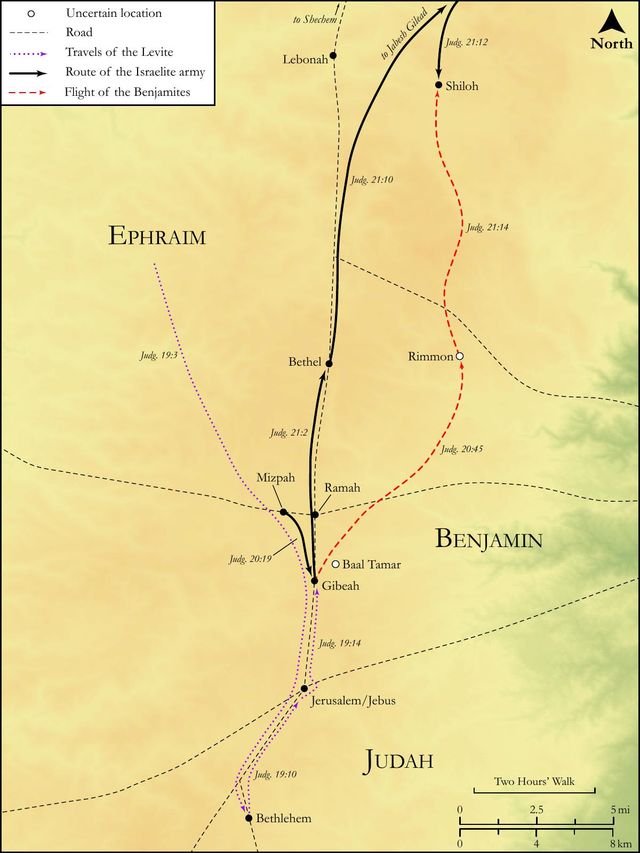
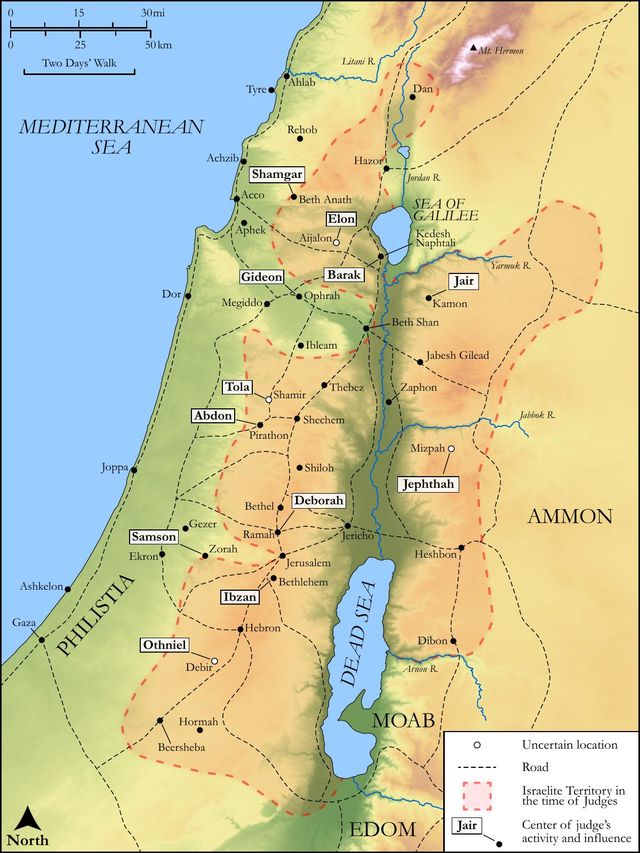
Study this verse
Public-domain commentary
Matthew Henry
From his Commentary on the Whole Bible. Henry comments on passages, not single verses — this entry covers Judges 20:12–17. His three-level outline is real structure in the source text, so it is rendered as structure.
Here is, I. The fair and just demand which the tribes of Israel, now encamped, sent to the tribe of Benjamin, to deliver up the malefactors of Gibeah to justice, Jdg 20:12, Jdg 20:13. If the tribe of Benjamin had come up, as they ought to have done, to the assembly, and agreed with them in their resolution, there would have been none to deal with but the men of Gibeah only, but they, by their absence, taking part with the criminals, application must be made to them all. The Israelites were zealous against the wickedness that was committed, yet they were discreet in their zeal, and did not think it would justify them in falling upon the whole tribe of Benjamin unless they, by refusing to give up the criminals, and protecting them against justice, should make themselves guilty, ex post facto - as accessaries after the fact. They desire them to consider how great the wickedness was that was committed (Jdg 20:12), and that it was done among them: and how necessary it was therefore that they should either punish the malefactors with death themselves, according to the law of Moses, or deliver them up to the general assembly, to be so much the more publicly and solemnly punished, that evil might be put away from Israel, the national guilt removed, the infection stopped by cutting off the gangrened part, and national judgments prevented; for the sin was so very like that of the Sodomites that they might justly fear, if they did not punish it, God would rain hail from heaven upon them, as he did, not only upon Sodom, but the neighbouring cities. If the Israelites had not made this reasonable demand, they would have had much more reason to lament the following desolations of Benjamin. All methods of accommodation must be used before we go to war or go to law. The demand was like that of Joab's to Abel, Sa2 20:20, Sa2 20:21. "Only deliver up the traitor, and we will lay down our arms." On these terms, and no other, God will be at peace with us, that we part with our sins, that we mortify and crucify our lusts, and then all shall be well; his anger will be turned away.
II.The wretched obstinacy and perverseness of the men of Benjamin, who seem to have been as unanimous and zealous in their resolutions to stand by the criminals as the rest of the tribes were to punish them, so little sense had they of their honour, duty, and interest. 1. They were so prodigiously vile as to patronise the wickedness that was committed: They would not hearken to the voice of their brethren (Jdg 20:13), either because those of that tribe were generally more vicious and debauched at this time than the rest of the tribes, and therefore would not bear to have that punished in others of which they knew themselves guilty (some of the most fruitful and pleasant parts of Canaan fell to the lot of this tribe; their land, like that of Sodom, was as the garden of the Lord, which perhaps helped to make the inhabitants, like the men of Sodom, wicked, and sinners before the Lord exceedingly, Gen 13:10, Gen 13:13), or because (as bishop Patrick suggests) they took it ill that the other tribes should meddle with their concerns; they would not do that which they knew was their duty because they were reminded of it by their brethren, by whom they scorned to be taught and controlled. If there were any wise men among them that would have complied with the demand made, yet they were overpowered by the majority, who thus made the crime of the men of Gibeah their own. Thus we have fellowship with the unfruitful works of darkness if we say A confederacy with those that have, and make ourselves guilty of other men's sins by countenancing and defending them. It seems there is no cause so bad but it will find some patrons, some advocates, to appear for it; but woe be to those by whom such offences come. Those will have a great deal to answer for that obstruct the course of necessary justice, and strengthen the hands of the wicked, by saying, O wicked man! thou shalt not die.
2.They were so prodigiously vain and presumptuous as to make head against the united force of all Israel. Never, surely, were men so wretchedly infatuated as they were when they took up arms in opposition,
(1.)To so good a cause as Israel had. How could they expect to prosper when they fought against justice, and consequently against the just God himself, against those that had the high priest and the divine oracle on their side, and so acted in downright rebellion against the sacred and supreme authority of the nation.
(2.)To so great a force as Israel had. The disproportion of their numbers was much greater than that, Luk 14:31, Luk 14:32, where he that had but 10,000 durst not meet him that came against him with 20,000, and therefore desired conditions of peace. There the enemy was but two to one, here above fifteen to one; yet they despised conditions of peace. All the forces they could bring into the field were but 26,000 men, besides 700 men of Gibeah (Jdg 20:15); yet with these they will dare to face 400,000 men of Israel, Jdg 20:17. Thus sinners are infatuated to their own ruin, and provoke him to jealousy who is infinitely stronger than they, Co1 10:22. But it should seem they depended upon the skill of their men to make up what was wanting in numbers, especially a regiment of slingers, 700 men, who, though left-handed, were so dexterous at slinging stones that they would not be a hair's breadth beside their mark, Jdg 20:16. But these good marksmen were very much out in their aim when they espoused this bad cause. Benjamin signifies the son of the right hand, yet we find his posterity left-handed.
Continue studying Judges 20:17 across the web’s major study libraries — every link below opens this exact verse, chapter, or book on the destination site.
Read & Compare
 BibleGatewayThis verse in more than 200 translations and 70 languages.
 Bible.comThe YouVersion reader — hundreds of translations, reading plans, and highlights.
 ESV.orgCrossway's official English Standard Version reader.
 NET BibleThe NET translation with 60,000+ translators' notes on every rendering decision.
 STEP BibleTyndale House's free study tool — original text, vocabulary, and scholarly resources.
 BibliaLogos Bible Software's free web reader.
 USCCBThe New American Bible (Revised Edition) with the U.S. bishops' study notes.
Commentaries
 BibleHub CommentariesDozens of classic commentaries on this verse, gathered on one page.
 StudyLightMore than 100 commentary sets — the largest collection on the web.
 BibleRefPlain-English commentary on what this verse means, verse by verse.
 Enduring WordDavid Guzik's free commentary on this chapter, widely used by Bible teachers.
 Bible Study ToolsVerse commentary alongside Greek and Hebrew study aids.
Original Language & Research
- BibleHub InterlinearThe verse word by word — original language, transliteration, and English.
- BibleHub LexiconEvery word's original-language definition and Strong's entry.
 Blue Letter BibleDeep-study tools — Strong's numbers, concordance, and word studies.
 SefariaThe Hebrew text with Rashi and centuries of Jewish commentary.
Sermons, Hymns & Audio


TrulyRandomVerse is not affiliated with these sites and doesn’t control their content. They’re linked because they’re genuinely useful.
Summary
Judges 20:17 precisely enumerates the formidable military strength of the combined Israelite tribes, excluding Benjamin, as they prepare for a devastating civil war. This count of "four hundred thousand men that drew sword" reveals the immense scale of the impending conflict, underscoring the gravity of the tribes' resolve to confront the profound moral decay and unaddressed sin within Israel, specifically the heinous crime committed in Gibeah of Benjamin. The verse serves as a chilling prelude to one of the most tragic and fratricidal episodes in Israel's history, highlighting the dire consequences of a nation without righteous leadership and a collective commitment to covenant fidelity.
Context
ShowHideLiterary Context
Judges 20:17 is situated within the harrowing appendix of the Book of Judges (Judges 19-21), a section designed to illustrate the depths of Israel's spiritual and moral decline in the absence of a king. The preceding chapter, Judges 19, details the horrific abuse, murder, and dismemberment of a Levite's concubine by Benjaminites in Gibeah. This gruesome act served as a shocking indictment and a desperate call for justice, igniting national outrage. Following this, Judges 20:1-16 describes the assembly of the other eleven tribes at Mizpah, their demand for the perpetrators to be surrendered, and Benjamin's defiant refusal to comply. Verse 17, therefore, marks a critical juncture, quantifying the overwhelming military might arrayed against Benjamin, setting the stage for the bloody and tragic civil war that ensues, a stark illustration of a nation where "every man did that which was right in his own eyes" (Judges 17:6).
Historical & Cultural Context
The period of the Judges was characterized by a cyclical pattern of apostasy, oppression, and deliverance, marked by the absence of a central, divinely appointed king. This era was one of significant moral and spiritual decline, as evidenced by pervasive idolatry, oppression, and the breakdown of covenant faithfulness. The events of Judges 19-21, culminating in this civil war, reflect the nadir of this period, demonstrating the internal chaos that resulted from a lack of unified, righteous leadership and a disregard for God's law. Militarily, the tribes of Israel would typically muster a levy of fighting men when threatened or when called to collective action, often from their various clans and families. The figure of 400,000 men represents an exceptionally large mobilization, indicating a profound sense of communal outrage and a determination to enforce justice, even if it meant internecine conflict. Such a large force would have been a significant logistical undertaking, underscoring the depth of the crisis and the perceived necessity of intervention.
Key Themes
ShowHideJudges 20:17 contributes to several overarching themes within the Book of Judges and the broader biblical narrative. Firstly, it highlights the overwhelming military mobilization as a direct response to profound moral decay, demonstrating the tribes' collective outrage and their resolve to address the heinous crime committed. Secondly, the explicit exclusion of Benjamin ("beside Benjamin") underscores the tragedy of inter-tribal conflict and the devastating consequences of internal strife within God's chosen people, a stark contrast to the ideal of unity found in passages like Psalm 133:1. This fratricidal war serves as a somber warning about the failure to uphold righteous standards and the breakdown of communal responsibility. Finally, while the outcome was tragic, the initial gathering of such a massive force was driven by a desperate call for justice against an abomination, revealing a lingering, albeit flawed, sense of communal responsibility for moral order, even in a period marked by significant spiritual decline and the absence of a king (Judges 21:25).
Exposition and Analysis
ShowHideKey Word Analysis
ShowHideThis name signifies "son of (the) right hand" and refers to the youngest son of Jacob, as well as the tribe descended from him. In Judges 20:17, the explicit exclusion "beside Benjamin" is crucial. It immediately signals the nature of the conflict as an internal, fratricidal war rather than a conventional battle against an external enemy. The tribe of Benjamin stands isolated, defying the collective will of the other tribes, setting the stage for their near annihilation.
This term refers to a cutting instrument, specifically a sword, but can also denote other sharp implements like a knife or axe. In the phrase "drew sword," it signifies the primary weapon of a warrior. Its presence here emphasizes the combat-ready nature of the enumerated men, indicating that they were not merely able-bodied individuals but trained and equipped soldiers prepared for lethal engagement. The sword, typically a tool for defense or conquest against foreign foes, is tragically turned inward against fellow Israelites.
This word denotes a battle or, more broadly, warfare. When combined with "men" (Hebrew, ʼîysh), the phrase "men of war" (H376, H4421) describes seasoned soldiers, individuals whose profession or primary function is military combat. The repetition and emphasis on "men of war" in the verse underscore the professional and formidable nature of the assembled Israelite force. It highlights that the nation was mobilizing for a serious, large-scale military engagement, not a mere skirmish, tragically against its own kin.
Verse Breakdown
ShowHide"And the men of Israel, beside Benjamin, were numbered"
This opening clause establishes the scope of the census, specifying that all tribes of Israel except Benjamin were included. This exclusion is critically important, immediately highlighting the unprecedented and tragic nature of this conflict as an internal, fratricidal war within God's covenant people. It sets the stage for the profound division and sorrow that will characterize the ensuing chapters, emphasizing Benjamin's isolation and defiance.
"four hundred thousand men that drew sword"
This phrase quantifies the immense military strength of the united eleven tribes. The number signifies an overwhelming force, emphasizing the seriousness of their resolve and the perceived necessity of such a massive mobilization. "Men that drew sword" clarifies that these were not just able-bodied males, but trained and equipped warriors, ready for active engagement in battle. This detail underscores the gravity of the situation and the commitment of the tribes to a military solution.
"all these [were] men of war"
This concluding affirmation reinforces the professional and combat-ready nature of the enumerated force. It underlines that every man counted was a skilled soldier, possessing the necessary training, equipment, and mindset for military engagement. This detail amplifies the tragic irony of the situation: such a formidable army, typically intended for external threats, was now poised to engage in a devastating conflict against their own brethren, highlighting the depth of Israel's internal breakdown and moral decay.
Literary Devices
ShowHideJudges 20:17 employs several potent literary devices that amplify its impact and foreshadow the ensuing tragedy. The sheer numerical figure of "four hundred thousand" functions as Hyperbole or Exaggeration, serving to underscore the overwhelming force assembled, even if the number is meant to convey vastness rather than a precise literal count. This emphasizes the gravity of the situation and the determination of the tribes. The explicit exclusion of Benjamin ("beside Benjamin") creates a stark Contrast, highlighting the profound internal division within Israel, a people meant to be unified under God. This contrast sets the stage for the fratricidal nature of the conflict. Furthermore, the enumeration of such a massive, combat-ready army functions as powerful Foreshadowing, ominously predicting the devastating scale of the impending civil war and the immense loss of life that will follow. There is also a profound Irony in the fact that such a formidable force, gathered to uphold justice, ultimately brings about immense self-destruction and suffering within the very nation it seeks to purify.
Theological and Thematic Connections
ShowHideJudges 20:17, by detailing the immense military mobilization against a fellow Israelite tribe, profoundly illustrates the devastating consequences of unaddressed sin and the breakdown of covenant community. The numerical strength, while impressive, underscores the tragic reality that sheer power cannot compensate for a lack of spiritual integrity and righteous leadership. This verse highlights the deep moral decay that had permeated Israel, leading to internal strife and bloodshed rather than unity and peace. It serves as a stark reminder that when a people forsakes God's law and "every man does what is right in his own eyes," the very fabric of society unravels, leading to devastating self-inflicted wounds. The pursuit of justice, though initially righteous, became tainted by the absence of wisdom, mercy, and a true understanding of covenant brotherhood, resulting in a conflict that brought Israel to the brink of annihilation.
Reflection and Application
ShowHideJudges 20:17, though a historical military census, carries profound and sobering lessons for contemporary communities, churches, and nations. It stands as a stark testament to how unchecked moral decay and a failure to address sin decisively can escalate into devastating internal conflict. The immense strength of the Israelite army, intended to bring justice, ultimately led to widespread suffering and near-annihilation for one of its own tribes, demonstrating that power without wisdom, humility, and a commitment to reconciliation can be self-destructive. For us today, this verse underscores the critical importance of confronting sin and injustice within our own spheres, yet always pursuing unity and peace, even in the face of deep disagreements. It cautions against allowing internal divisions to fester to the point of catastrophic breakdown, reminding us that true strength lies not merely in numbers or might, but in spiritual integrity, a commitment to God's ways, and a willingness to seek reconciliation and forgiveness, embodying the wisdom that "a house divided against itself cannot stand."
Questions for Reflection
ShowHideFAQ
ShowHideWhy was such a large army needed to confront the tribe of Benjamin?
ShowHideThe immense size of the army (400,000 men) reflects the extreme gravity with which the other Israelite tribes viewed the atrocity committed in Gibeah (Judges 19). It was not just a crime, but a profound violation of covenant law and social order, an "abomination" (Judges 20:6) that demanded a national response. The sheer number underscores the collective outrage and determination to purge evil from Israel. Furthermore, Benjamin's defiant refusal to surrender the perpetrators, despite repeated appeals (Judges 20:12-13), escalated the situation from a judicial matter to a full-scale military confrontation. The large force was intended to overwhelm Benjamin and enforce justice, though the tragic outcome demonstrates that even overwhelming power can lead to immense suffering when wisdom and true unity are lacking.
Christ-Centered Fulfillment
ShowHideJudges 20:17, with its depiction of a massive army poised for fratricidal conflict, profoundly highlights the tragic consequences of Israel's moral decay and its desperate need for a true and righteous king. The failure of human leadership and the breakdown of unity, where "every man did that which was right in his own eyes" (Judges 21:25), ultimately led to internal bloodshed. This chaos points forward to Jesus Christ, the ultimate and perfect King, who brings true justice and peace not through the sword against His own people, but through His sacrificial death and reconciling work. Unlike the Israelite tribes who fought against each other, Christ unites His people, breaking down walls of hostility and creating one new humanity in Himself (Ephesians 2:14-16). He is the true "man of war" in a spiritual sense, conquering sin, death, and the powers of darkness through His cross and resurrection, establishing a kingdom that is not of this world (John 18:36), a kingdom marked by righteousness, peace, and joy in the Holy Spirit (Romans 14:17). The tragic disunity and self-destruction in Judges underscore the profound necessity of Christ's perfect reign, which alone can bring true healing, unity, and lasting peace to God's people.