


1 Samuel 6:21
- וַיִּשְׁלְחוּvai·yish·le·Chuand they sentH7971Conj-w ¦ V-Qal-ConsecImperf-3mpVerb Qal Consecutive Imperfect 3rd Plural Masculineוַandיִּשְׁלְחוּthey sent
- מַלְאָכִיםmal·'a·KhimmessengersH4397N-mpNoun Plural Masculine Absolute
- אֶל'eltoH413PrepPreposition
- יוֹשְׁבֵיyo·she·Vei[the] inhabitants ofH3427V-Qal-Prtcpl-mpVerb Qal Participle Plural Masculine Construct
- קִרְיַתkir·yatKiriathH7157N-properNoun Proper Location
- יְעָרִיםye·'a·RimJearimH7157N-properNoun Proper Location
- לֵאמֹרle·Mor<to> sayingH559Prep-l ¦ V-Qal-InfVerb Qal Infinitive Constructלֵ<to>אמֹרsaying
- הֵשִׁבוּhe·Shi·vuthey have brought backH7725V-Hiphil-Perf-3cpVerb Hiphil Perfect 3rd Plural common gender
- פְלִשְׁתִּיםfe·lish·Tim[the] PhilistinesH6430N-mpNoun Gentilic Plural Masculine Absolute
- אֶת'et<obj.>H853DirObjMParticle Object Indicator
- אֲרוֹן'a·Ron[the] ark ofH727N-mscNoun Singular Masculine Construct
- יְהוָהYah·wehYahwehH3068N-properNoun Proper Title
- רְדוּre·Ducome downH3381V-Qal-Imp-2mpVerb Qal Imperative 2nd Plural Masculine
- הַעֲלוּha·'a·Lutake upH5927V-Hiphil-Imp-2mpVerb Hiphil Imperative 2nd Plural Masculine
- אֹתוֹ'o·To<obj.> itH853DirObjM ¦ 3msParticle Object Indicatorאֹת<obj.>וֹit
- אֲלֵיכֶם'a·lei·Khemto youH413Prep ¦ 2mpPreposition Definiteאֲלֵיtoכֶםyou
English is a literal word-by-word gloss of the Hebrew, not the KJV's wording. Why?
This is the original text the KJV's translators worked from — each Hebrew word with its own literal English meaning in this verse, prepared by scholars at Tyndale House, Cambridge. The KJV translates whole sentences, not word by word, so its wording differs: one Hebrew word can become several English words, and the KJV may choose “the LORD” where the gloss reads “Yahweh”. Both are faithful — they answer different questions. For the KJV's own rendering, switch to the KJV text.
Details
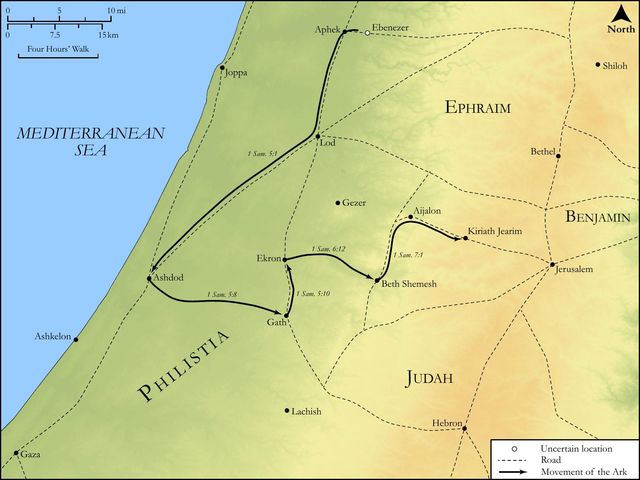
See on the biblical-era map
Study this verse
Public-domain commentary
Matthew Henry
From his Commentary on the Whole Bible. Henry comments on passages, not single verses — this entry covers 1 Samuel 6:19–21.
Here is, 1. The sin of the men of Beth-shemesh: They looked into the ark of the Lord, Sa1 6:19. Every Israelite had heard great talk of the ark, and had been possessed with a profound veneration for it; but they had been told that it was lodged within a veil, and even the high priest himself might not look upon it but once a year, and then through a cloud of incense. Perhaps this made many say (as we are apt to covet that which is forbidden) what a great deal they would give for a sight of it. Some of these Beth-shemites, we may suppose, for that reason, rejoiced to see the ark (Sa1 6:13) more than for the sake of the public. Yet this did not content them; they might see it, but they would go further, they would take off the covering, which it is likely was nailed or screwed on, and look into it, under pretence of seeing whether the Philistines had not taken the two tables out of it or some way damaged them, but really to gratify a sinful curiosity of their own, which intruded into those things that God had thought fit to conceal from them. Note, It is a great affront to God for vain men to pry into and meddle with the secret things which belong not to them, Deu 29:29; Col 2:18. We were all ruined by an ambition of forbidden knowledge. That which made this looking into the ark a great sin was that it proceeded from a very low and mean opinion of the ark. The familiarity they had with it upon this occasion bred contempt and irreverence. Perhaps they presumed upon their being priests; but the dignity of the ministerial office will be so far from excusing that it will aggravate a careless and irreverent treatment of holy things. They should, by their example, have taught others to keep their distance and look upon the ark with a holy awe. Perhaps they presumed upon the kind entertainment they had given the ark, and the sacrifices they had now offered to welcome it home with, for which they thought the ark was indebted to them, and they might be allowed to repay themselves with the satisfaction of looking into it. But let no man think that his service done for God will justify him in any instance of disrespect or irreverence towards the things of God. Or it may be they presumed upon the present mean circumstances the ark was in, newly come out of captivity, and unsettled; now that it stood upon a cold stone, they thought they might make free with it; they should never have such another opportunity of being familiar with it. It is an offence to God if we think meanly of his ordinances because of the meanness of the manner of their administration. Had they looked with an understanding eye upon the ark, and not judged purely by outward appearance, they would have thought that the ark never shone with greater majesty than it did not. It had triumphed over the Philistines, and come out of its house of bondage (like Christ out of the grave) by its own power; had they considered this, they would not have looked into it thus, as a common chest. 2. Their punishment for this sin: He smote the men of Beth-shemesh, many of them, with a great slaughter. How jealous is God for the honour of his ark! He will not suffer it to be profaned. Be not deceived, God is not mocked. Those that will not fear his goodness, and reverently use the tokens of his grace, shall be made to feel his justice, and sink under the tokens of his displeasure. Those that pry into what is forbidden, and come too near to holy fire, will find it is at their peril. He smote 50,070 men. This account of the numbers smitten is expressed in a very unusual manner in the original, which, besides the improbability that there should be so many guilty and so many slain, occasions many learned men to question whether we take the matter aright. In the original it is, He smote in (or among) the people three score and ten men, fifty thousand men. The Syriac and Arabic read it, five thousand and seventy men. The Chaldee reads it, seventy men of the elders, and fifty thousand of the common people. Seventy men as valuable as 50,000, so some, because they were priests. Some think the seventy men were the Beth-shemites that were slain for looking into the ark, and the 50,000 were those that were slain by the ark, in the land of the Philistines. He smote seventy men, that is, fifty out of a thousand, which was one in twenty, a half decimation; so some understand it. The Septuagint read it much as we do, he smote seventy men, and fifty thousand men. Josephus says only seventy were smitten. 3. The terror that was struck upon the men of Beth-shemesh by this severe stroke. They said, as well they might, Who is able to stand before this holy Lord God? Sa1 6:20. Some think this expresses their murmuring against God, as if he had dealt hardly and unjustly with them. Instead of quarrelling with themselves and their own sins, they quarrelled with God and his judgments; as David was displeased, in a case not much dissimilar, Sa2 6:8, Sa2 6:9. I rather think it intimates their awful and reverent adoration of God, as the Lord God, as a holy Lord God, and as a God before whom none is able to stand. This they infer from that tremendous judgment, "Who is able to stand before the God of the ark?" To stand before God to worship him (blessed be his name) is not impossible; we are through Christ invited, encouraged, and enabled to do it, but to stand before God to contend with him we are not able. Who is able to stand before the throne of his immediate glory, and look full upon it? Ti1 6:16. Who is able to stand before the tribunal of his enflexible justice, and make his part good there? Psa 130:3; Psa 143:2. Who is able to stand before the arm of his provoked power, and either resist or bear the strokes of it? Psa 76:7. 4. Their desire, hereupon, to be rid of the ark. They asked, To whom shall he go up from us? Sa1 6:20. They should rather have asked, "How may we make our peace with him, and recover his favour?" Mic 6:6, Mic 6:7. But they begin to be as weary of the ark as the Philistines had been, whereas, if they had treated it with due reverence, who knows but it might have taken up its residence among them, and they had all been blessed for the ark's sake? But thus, when the word of God works with terror on sinners' consciences, they, instead of taking the blame and shame to themselves, quarrel with the word, and put it from them, Jer 6:10. They sent messengers to the elders of Kirjath-jearim, a strong city further up in the country, and begged of them to come and fetch the ark up thither, Sa1 6:21. They durst not touch it to bring it thither themselves, but stood aloof from it as a dangerous thing. Thus do foolish men run from one extreme to the other, from presumptuous boldness to slavish shyness. Kirjath-jearim, that is, the city of woods, belonged to Judah, Jos 15:9, Jos 15:60. It lay in the way from Beth-shemesh to Shiloh, so that when they sent to them to fetch it, we may suppose, they intended that the elders of Shiloh should fetch it thence, but God intended otherwise. Thus was it sent from town to town, and no care taken of it by the public, a sign that there was no king in Israel.
Continue studying 1 Samuel 6:21 across the web’s major study libraries — every link below opens this exact verse, chapter, or book on the destination site.
Read & Compare
 BibleGatewayThis verse in more than 200 translations and 70 languages.
 Bible.comThe YouVersion reader — hundreds of translations, reading plans, and highlights.
 ESV.orgCrossway's official English Standard Version reader.
 NET BibleThe NET translation with 60,000+ translators' notes on every rendering decision.
 STEP BibleTyndale House's free study tool — original text, vocabulary, and scholarly resources.
 BibliaLogos Bible Software's free web reader.
 USCCBThe New American Bible (Revised Edition) with the U.S. bishops' study notes.
Commentaries
 BibleHub CommentariesDozens of classic commentaries on this verse, gathered on one page.
 StudyLightMore than 100 commentary sets — the largest collection on the web.
 BibleRefPlain-English commentary on what this verse means, verse by verse.
 Enduring WordDavid Guzik's free commentary on this chapter, widely used by Bible teachers.
 Bible Study ToolsVerse commentary alongside Greek and Hebrew study aids.
Original Language & Research
- BibleHub InterlinearThe verse word by word — original language, transliteration, and English.
- BibleHub LexiconEvery word's original-language definition and Strong's entry.
 Blue Letter BibleDeep-study tools — Strong's numbers, concordance, and word studies.
 SefariaThe Hebrew text with Rashi and centuries of Jewish commentary.
Sermons, Hymns & Audio


TrulyRandomVerse is not affiliated with these sites and doesn’t control their content. They’re linked because they’re genuinely useful.
Summary
Following the catastrophic divine judgment upon the people of Beth-shemesh for their irreverent handling of the Ark of the LORD, the terrified survivors, overwhelmed by its sacred and perilous presence, dispatched messengers to the inhabitants of Kirjath-jearim. Their urgent plea was for Kirjath-jearim to assume custody of the Ark, signaling their profound desire to rid themselves of a responsibility they could not bear, and thus initiating the next significant phase of the Ark's journey back into Israelite territory.
Context
ShowHideLiterary Context
This verse serves as the concluding action in a dramatic and somber sequence concerning the Ark of the LORD. It immediately follows the devastating judgment at Beth-shemesh, where 70 (or 50,070, depending on textual tradition) men died for presumptuously looking into the Ark, an act of sacrilege against God's holiness (compare with 1 Samuel 6:19). Prior to this, the Ark had been captured by the Philistines in battle (1 Samuel 4:11), leading to a series of plagues and the humiliation of their god Dagon across Philistine cities (1 Samuel 5:1-12). The Philistines, recognizing God's hand, returned the Ark to Israelite territory on a new cart drawn by cows, which miraculously brought it directly to Beth-shemesh (1 Samuel 6:1-12). The Beth-shemeshites' urgent invitation to Kirjath-jearim in 1 Samuel 6:21 is a direct consequence of their recent trauma and sets the stage for the Ark's long, quiet stay in Kirjath-jearim, as detailed in 1 Samuel 7:1-2.
Historical & Cultural Context
The events of 1 Samuel unfold during a pivotal transitional period in Israel's history, moving from the decentralized era of the Judges to the establishment of the monarchy. This was a time characterized by spiritual decline, intermittent Philistine oppression, and a general lack of consistent adherence to the Mosaic covenant. The Ark of the LORD was not merely a religious artifact; it was the preeminent symbol of Yahweh's presence, His throne, and the very heart of Israel's covenant relationship with Him. Its proper handling was meticulously prescribed in the Law, requiring specific priestly families (Kohathites) to carry it on poles (e.g., Numbers 4:15), and strictly forbidding anyone from looking inside. Both the Philistines' suffering and the Beth-shemeshites' deaths underscore the severe consequences of treating God's holiness casually, whether from ignorance or presumptuous disregard. Kirjath-jearim, meaning "city of forests," was a Gibeonite city (Joshua 9:17) located on the border of Judah and Benjamin. Its likely elevated position explains the phrase "fetch it up," and its relative isolation may have made it a pragmatic, albeit temporary, resting place for the Ark.
Key Themes
ShowHideThe overarching narrative surrounding the Ark's journey, culminating in the events of this verse, powerfully highlights several profound theological themes. First, the absolute holiness and sovereignty of God are undeniably demonstrated. Even when captured by enemies, God proves His inherent power over foreign gods and nations, and His holiness demands profound reverence from His own people. Second, the theme of reverence and obedience is paramount; the tragic deaths at Beth-shemesh serve as a stark warning against treating God's sacred commands and His manifest presence lightly. Third, the narrative reveals the burden and responsibility of God's presence. While the Ark was a symbol of divine blessing, guidance, and victory for Israel, its presence also carried immense responsibility and potential danger for those who failed to approach it according to God's prescribed ways. Finally, the divine providence is clearly evident, as God orchestrates the Ark's return to Israelite territory despite human failures and Philistine intentions, ensuring His sovereign purposes are ultimately fulfilled, even when His people are in spiritual disarray.
Exposition and Analysis
ShowHideKey Word Analysis
ShowHideA primitive root meaning "to send away, for, or out." In this context, it signifies a deliberate dispatch of messengers, indicating the Beth-shemeshites' urgent and intentional act of divesting themselves of the Ark. Their sending of messengers, rather than moving the Ark themselves, underscores their fear and their desire to transfer the responsibility and peril associated with its presence.
A term referring to a "box" or "chest," specifically the "Ark of the Covenant" or "Ark of the Testimony." This sacred chest contained the tablets of the Law, Aaron's rod, and a pot of manna, but more significantly, it was the symbolic throne of God, the place where He met with Israel (Exodus 25:22). The consistent use of "the ark of the LORD" throughout this narrative emphasizes its divine ownership and the inherent holiness associated with Yahweh Himself, underscoring why its mishandling brought such severe consequences.
A primitive root meaning "to ascend" or "to bring up." This verb implies an upward movement or ascent, indicating that Kirjath-jearim was situated at a higher elevation than Beth-shemesh. This detail subtly reinforces the idea that taking custody of the Ark was a weighty, "uphill" task, both literally and metaphorically, signifying the immense responsibility being transferred to the inhabitants of Kirjath-jearim.
Verse Breakdown
ShowHide"And they sent messengers to the inhabitants of Kirjathjearim, saying"
This clause identifies the agents of action as the surviving people of Beth-shemesh. Their decision to send messengers rather than transport the Ark themselves highlights their profound fear and desperation to divest themselves of this dangerous holy object. It signifies a crucial shift in responsibility, as they actively seek another community to bear the burden and perceived danger of the Ark's presence, demonstrating their inability or unwillingness to properly care for it.
"The Philistines have brought again the ark of the LORD"
This statement serves as a factual report, acknowledging the Ark's return from Philistine captivity. However, it also subtly shifts the immediate blame or responsibility for the Ark's presence away from themselves, as if to say, "It's not our fault it's here; the Philistines returned it, and now it's causing us trouble." This phrasing reflects their desire to present the situation as a matter of divine providence that has now become an unbearable problem for them, necessitating its transfer.
"come ye down, [and] fetch it up to you"
This is the core of their urgent plea, an invitation for the people of Kirjath-jearim to take the Ark. "Come ye down" suggests Kirjath-jearim was at a higher elevation, requiring a descent to Beth-shemesh. "Fetch it up to you" then implies the subsequent ascent with the Ark to Kirjath-jearim. This command encapsulates the transfer of a sacred, yet perilous, responsibility from one terrified community to another, driven by fear and the desperate desire for relief from the divine judgment they had experienced.
Literary Devices
ShowHideThe passage employs several potent literary devices to convey its profound meaning. There is a strong sense of irony present: the Ark, which was meant to be Israel's strength, their battle standard, and the symbol of God's protective presence, has ironically become a source of terror and death for both the pagan Philistines and the Israelites of Beth-shemesh. This highlights the double-edged nature of God's holiness – a blessing to those who obey and approach Him on His terms, but a consuming fire to those who disregard His commands. The narrative also uses contrast effectively, juxtaposing the Philistines' eventual cautious and respectful handling of the Ark (motivated by self-preservation and fear of Yahweh's power) with the Israelites of Beth-shemesh's catastrophic irreverence and presumption. Furthermore, the very act of sending messengers and the plea to "fetch it up" serves as a form of foreshadowing, hinting at the long period of spiritual neglect and dormancy that the Ark would experience in Kirjath-jearim, where it would remain for two decades, largely forgotten and unvisited until King David's later efforts to bring it to Jerusalem.
Theological and Thematic Connections
ShowHideThis verse, situated at the culmination of a series of divine judgments related to the Ark, powerfully underscores the unchanging holiness of God and the absolute necessity of approaching Him on His terms. The Ark, as the tangible representation of God's presence, was not a mere object to be handled casually or exploited for human gain. Its sacredness demanded meticulous adherence to divine commands, and any deviation, whether by Philistine ignorance or Israelite presumption, resulted in severe consequences. This narrative serves as a timeless reminder that God's majesty cannot be trifled with; His presence, while a source of blessing and covenant promise, is also a consuming fire to those who disregard His revealed will. The Beth-shemeshites' desperate plea to Kirjath-jearim reveals a people more concerned with escaping the effects of God's holiness than with cultivating a proper reverence for Him, highlighting a spiritual immaturity that plagued Israel during this period.
Reflection and Application
ShowHideThe profound fear that gripped Beth-shemesh after the judgment of the LORD is a stark reminder that God's holiness is not to be taken lightly. While we no longer have a physical Ark, the principles of reverence, obedience, and the awe-inspiring nature of God remain foundational to our relationship with Him. His presence is now manifested through His inspired Word, the indwelling Holy Spirit within believers, and in the gathered community of the church. This passage challenges us to examine how we approach God in our daily lives: Do we treat His Word with the profound respect and diligent study it deserves? Do we approach prayer and corporate worship with a deep sense of awe for His majesty, or with a casual familiarity that borders on irreverence? Just as the Ark was a weighty responsibility, so too is the stewardship of God's truth and His manifest presence entrusted to us as believers. We are called to bear His name and His Spirit in the world with utmost care and faithfulness, understanding that genuine reverence leads to life and spiritual flourishing, while presumption can lead to spiritual barrenness or even judgment.
Questions for Reflection
ShowHideFAQ
ShowHideWhy were the people of Beth-shemesh so eager to get rid of the Ark?
ShowHideThe people of Beth-shemesh were eager to get rid of the Ark because they had experienced a severe and terrifying divine judgment. After the Ark was returned by the Philistines, some Beth-shemeshites looked inside it, violating God's explicit commands regarding the Ark's sacredness and the proper way to approach it (Numbers 4:20). This act of irreverence resulted in the death of many, instilling profound fear and a desperate desire to distance themselves from an object that, to them, had become a source of death and dread rather than blessing. They perceived the Ark not as a symbol of God's covenant presence to be cherished and revered, but as a dangerous and unbearable burden.
What was the significance of Kirjath-jearim in this narrative?
ShowHideKirjath-jearim, meaning "city of forests," was a Gibeonite city that later became part of Judah's territory. Its significance in this narrative is primarily as the next, and importantly, long-term resting place for the Ark of the LORD. The Beth-shemeshites, overwhelmed by the Ark's presence and the judgment it brought, urgently appealed to Kirjath-jearim to take custody of it. The Ark remained in Kirjath-jearim, specifically at the house of Abinadab, for a significant period of twenty years (1 Samuel 7:1-2) until King David later orchestrated its transfer to Jerusalem (2 Samuel 6:1-19). Its elevated location, implied by the command to "fetch it up," and perhaps its relative obscurity, made it a suitable, albeit temporary and somewhat neglected, solution for the Ark's housing during a period of spiritual decline and instability in Israel.
Christ-Centered Fulfillment
ShowHideThe Ark of the LORD, a central and potent symbol in the Old Testament, represented the very presence of God dwelling among His people, yet it was a veiled and dangerous presence, accessible to all but a select few under incredibly strict conditions. The fear and judgment associated with its mishandling, as powerfully illustrated in the events of 1 Samuel 6:19-21, vividly demonstrate humanity's inherent inability to stand in the unmediated presence of a perfectly holy God without incurring His righteous wrath. However, this narrative finds its ultimate and glorious fulfillment in the person and work of Jesus Christ. He is the true and perfect "Ark" of God's presence, for in Him "the whole fullness of deity dwells bodily" (Colossians 2:9). Unlike the physical Ark, which brought death to those who approached it improperly, Jesus, through His perfect life, atoning death on the cross, and triumphant resurrection, has become the ultimate "mercy seat" (Romans 3:25; Hebrews 9:5) through whom we can now boldly approach God's throne of grace without fear of judgment, finding grace and help in time of need (Hebrews 4:16). He is the one who "fetches us up," not to a temporary dwelling place in Kirjath-jearim, but into eternal fellowship with God, making us, through the indwelling Holy Spirit, living temples where God's presence safely and intimately resides (1 Corinthians 6:19-20; Ephesians 2:21-22). The fear of the Ark's consuming presence is transformed into the joy and peace of God's indwelling presence through Christ, who has perfectly fulfilled all the requirements of God's holiness on our behalf, bridging the chasm between a holy God and sinful humanity.