


1 Samuel 6:20
- וַיֹּאמְרוּvai·yo·me·Ruand they saidH559Conj-w ¦ V-Qal-ConsecImperf-3mpVerb Qal Consecutive Imperfect 3rd Plural Masculineוַandיֹּאמְרוּthey said
- אַנְשֵׁי'an·Shei[the] people ofH582N-mpcNoun Plural Masculine Construct
- בֵיתveitBethH1053N-properNoun Proper Location
- שֶׁמֶשׁShe·meshShemeshH1053N-properNoun Proper Location
- מִיmiwho?H4310InterrogPronoun Interrogative
- יוּכַלyu·Khalis he ableH3201V-Qal-Imperf-3msVerb Qal Imperfect 3rd Singular Masculine
- לַעֲמֹדla·'a·Modto standH5975Prep-l ¦ V-Qal-InfVerb Qal Infinitive Constructלַtoעֲמֹדstand
- לִפְנֵיlif·Nei<to> beforeH6440Prep-l ¦ N-mpcNoun Plural Masculine Constructלִ<to>פְנֵיbefore
- יְהוָהYah·wehYahwehH3068N-properNoun Proper Title
- הָאֱלֹהִיםha·'E·lo·Himthe GodH430Art ¦ N-mpNoun Plural Masculine AbsoluteהָtheאֱלֹהִיםGod
- הַקָּדוֹשׁha·ka·Do·osh<the> holyH6918Art ¦ Adj-msAdjective Singular Masculine Absoluteהַ<the>קָּדוֹשׁholy
- הַזֶּהha·Zeh<the> thisH2088Art ¦ PrtParticle Demonstrativeהַ<the>זֶּהthis
- וְאֶלve·'eland toH413Conj-w ¦ PrepPrepositionוְandאֶלto
- מִיmiwhom?H4310InterrogPronoun Interrogative
- יַעֲלֶהya·'a·Lehwill it go upH5927V-Qal-Imperf-3msVerb Qal Imperfect 3rd Singular Masculine
- מֵעָלֵינוּme·'a·Lei·nufrom with <the> usH5921Prep-m ¦ Prep ¦ 1cpPreposition Definiteמֵfromעָלֵיwith <the>נוּus
English is a literal word-by-word gloss of the Hebrew, not the KJV's wording. Why?
This is the original text the KJV's translators worked from — each Hebrew word with its own literal English meaning in this verse, prepared by scholars at Tyndale House, Cambridge. The KJV translates whole sentences, not word by word, so its wording differs: one Hebrew word can become several English words, and the KJV may choose “the LORD” where the gloss reads “Yahweh”. Both are faithful — they answer different questions. For the KJV's own rendering, switch to the KJV text.
Details
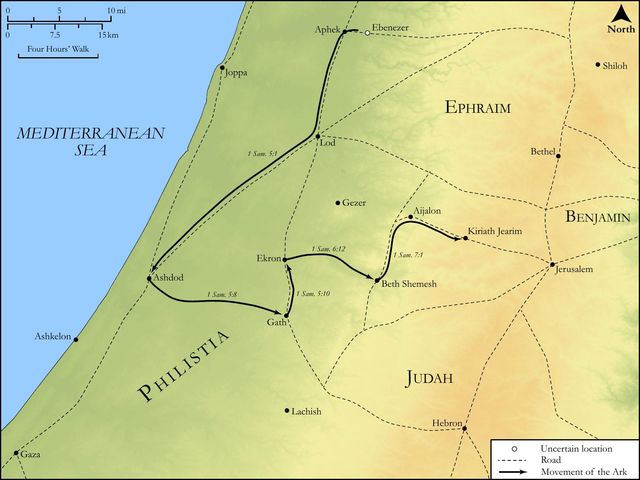
See on the biblical-era map
Study this verse
Public-domain commentary
Matthew Henry
From his Commentary on the Whole Bible. Henry comments on passages, not single verses — this entry covers 1 Samuel 6:19–21.
Here is, 1. The sin of the men of Beth-shemesh: They looked into the ark of the Lord, Sa1 6:19. Every Israelite had heard great talk of the ark, and had been possessed with a profound veneration for it; but they had been told that it was lodged within a veil, and even the high priest himself might not look upon it but once a year, and then through a cloud of incense. Perhaps this made many say (as we are apt to covet that which is forbidden) what a great deal they would give for a sight of it. Some of these Beth-shemites, we may suppose, for that reason, rejoiced to see the ark (Sa1 6:13) more than for the sake of the public. Yet this did not content them; they might see it, but they would go further, they would take off the covering, which it is likely was nailed or screwed on, and look into it, under pretence of seeing whether the Philistines had not taken the two tables out of it or some way damaged them, but really to gratify a sinful curiosity of their own, which intruded into those things that God had thought fit to conceal from them. Note, It is a great affront to God for vain men to pry into and meddle with the secret things which belong not to them, Deu 29:29; Col 2:18. We were all ruined by an ambition of forbidden knowledge. That which made this looking into the ark a great sin was that it proceeded from a very low and mean opinion of the ark. The familiarity they had with it upon this occasion bred contempt and irreverence. Perhaps they presumed upon their being priests; but the dignity of the ministerial office will be so far from excusing that it will aggravate a careless and irreverent treatment of holy things. They should, by their example, have taught others to keep their distance and look upon the ark with a holy awe. Perhaps they presumed upon the kind entertainment they had given the ark, and the sacrifices they had now offered to welcome it home with, for which they thought the ark was indebted to them, and they might be allowed to repay themselves with the satisfaction of looking into it. But let no man think that his service done for God will justify him in any instance of disrespect or irreverence towards the things of God. Or it may be they presumed upon the present mean circumstances the ark was in, newly come out of captivity, and unsettled; now that it stood upon a cold stone, they thought they might make free with it; they should never have such another opportunity of being familiar with it. It is an offence to God if we think meanly of his ordinances because of the meanness of the manner of their administration. Had they looked with an understanding eye upon the ark, and not judged purely by outward appearance, they would have thought that the ark never shone with greater majesty than it did not. It had triumphed over the Philistines, and come out of its house of bondage (like Christ out of the grave) by its own power; had they considered this, they would not have looked into it thus, as a common chest. 2. Their punishment for this sin: He smote the men of Beth-shemesh, many of them, with a great slaughter. How jealous is God for the honour of his ark! He will not suffer it to be profaned. Be not deceived, God is not mocked. Those that will not fear his goodness, and reverently use the tokens of his grace, shall be made to feel his justice, and sink under the tokens of his displeasure. Those that pry into what is forbidden, and come too near to holy fire, will find it is at their peril. He smote 50,070 men. This account of the numbers smitten is expressed in a very unusual manner in the original, which, besides the improbability that there should be so many guilty and so many slain, occasions many learned men to question whether we take the matter aright. In the original it is, He smote in (or among) the people three score and ten men, fifty thousand men. The Syriac and Arabic read it, five thousand and seventy men. The Chaldee reads it, seventy men of the elders, and fifty thousand of the common people. Seventy men as valuable as 50,000, so some, because they were priests. Some think the seventy men were the Beth-shemites that were slain for looking into the ark, and the 50,000 were those that were slain by the ark, in the land of the Philistines. He smote seventy men, that is, fifty out of a thousand, which was one in twenty, a half decimation; so some understand it. The Septuagint read it much as we do, he smote seventy men, and fifty thousand men. Josephus says only seventy were smitten. 3. The terror that was struck upon the men of Beth-shemesh by this severe stroke. They said, as well they might, Who is able to stand before this holy Lord God? Sa1 6:20. Some think this expresses their murmuring against God, as if he had dealt hardly and unjustly with them. Instead of quarrelling with themselves and their own sins, they quarrelled with God and his judgments; as David was displeased, in a case not much dissimilar, Sa2 6:8, Sa2 6:9. I rather think it intimates their awful and reverent adoration of God, as the Lord God, as a holy Lord God, and as a God before whom none is able to stand. This they infer from that tremendous judgment, "Who is able to stand before the God of the ark?" To stand before God to worship him (blessed be his name) is not impossible; we are through Christ invited, encouraged, and enabled to do it, but to stand before God to contend with him we are not able. Who is able to stand before the throne of his immediate glory, and look full upon it? Ti1 6:16. Who is able to stand before the tribunal of his enflexible justice, and make his part good there? Psa 130:3; Psa 143:2. Who is able to stand before the arm of his provoked power, and either resist or bear the strokes of it? Psa 76:7. 4. Their desire, hereupon, to be rid of the ark. They asked, To whom shall he go up from us? Sa1 6:20. They should rather have asked, "How may we make our peace with him, and recover his favour?" Mic 6:6, Mic 6:7. But they begin to be as weary of the ark as the Philistines had been, whereas, if they had treated it with due reverence, who knows but it might have taken up its residence among them, and they had all been blessed for the ark's sake? But thus, when the word of God works with terror on sinners' consciences, they, instead of taking the blame and shame to themselves, quarrel with the word, and put it from them, Jer 6:10. They sent messengers to the elders of Kirjath-jearim, a strong city further up in the country, and begged of them to come and fetch the ark up thither, Sa1 6:21. They durst not touch it to bring it thither themselves, but stood aloof from it as a dangerous thing. Thus do foolish men run from one extreme to the other, from presumptuous boldness to slavish shyness. Kirjath-jearim, that is, the city of woods, belonged to Judah, Jos 15:9, Jos 15:60. It lay in the way from Beth-shemesh to Shiloh, so that when they sent to them to fetch it, we may suppose, they intended that the elders of Shiloh should fetch it thence, but God intended otherwise. Thus was it sent from town to town, and no care taken of it by the public, a sign that there was no king in Israel.
Historical interpretation
Historical reception
2 surviving comments on this verse. Each one is dated, so this reads as a timeline rather than a list.
And the men of Beth-shemesh said: Who can stand, etc. The men of the house of the sun, that is, the citizens of the heavenly homeland, wandering on earth; and if they taste even a little, and that by snatching, of the eternal light which they thirst for, they immediately realize how much they are nothing of their own, rightly fearing they say: For no living being will be justified in your sight (Psalm 142). Because even if someone seems to stand by human judgment, yet in the sight of the Divine Majesty, they are proven to be lying low; and with modest and kind advice, after that sublime ardor of love known only to themselves and to God, they impart to their lesser neighbors the gifts of spiritual knowledge that are sufficient for them. As the great citizen of Beth-shemesh said: For whether we are out of our mind, it is for God; if we are of sound mind, it is for you (2 Corinthians 5). And this is what follows, with the men of Beth-shemesh speaking about the ark of the Lord:
And to whom will it ascend from us? etc. Cariathiarim, indeed, which is called the city of forests, signifies the great perfection of life, but certainly less than Bethsames, that is, the house of the sun. For this, namely, signifies the sublimity of contemplation, because the pure in heart will see God (Matt. 5); that one shows the community of active conversation, by which also all the trees of the forests bearing their fruits will rejoice before the face of the Lord, because He comes, and makes His abode with them. And from Bethsamis the ark is sent to Cariathiarim, because divine grace now kindles the hearts of the great, so that they contemplate the summit through faith, now helps the humble hearts of beginners, so that they, like fruits, produce varieties of good works.
Continue studying 1 Samuel 6:20 across the web’s major study libraries — every link below opens this exact verse, chapter, or book on the destination site.
Read & Compare
 BibleGatewayThis verse in more than 200 translations and 70 languages.
 Bible.comThe YouVersion reader — hundreds of translations, reading plans, and highlights.
 ESV.orgCrossway's official English Standard Version reader.
 NET BibleThe NET translation with 60,000+ translators' notes on every rendering decision.
 STEP BibleTyndale House's free study tool — original text, vocabulary, and scholarly resources.
 BibliaLogos Bible Software's free web reader.
 USCCBThe New American Bible (Revised Edition) with the U.S. bishops' study notes.
Commentaries
 BibleHub CommentariesDozens of classic commentaries on this verse, gathered on one page.
 StudyLightMore than 100 commentary sets — the largest collection on the web.
 BibleRefPlain-English commentary on what this verse means, verse by verse.
 Enduring WordDavid Guzik's free commentary on this chapter, widely used by Bible teachers.
 Bible Study ToolsVerse commentary alongside Greek and Hebrew study aids.
Original Language & Research
- BibleHub InterlinearThe verse word by word — original language, transliteration, and English.
- BibleHub LexiconEvery word's original-language definition and Strong's entry.
 Blue Letter BibleDeep-study tools — Strong's numbers, concordance, and word studies.
 SefariaThe Hebrew text with Rashi and centuries of Jewish commentary.
Sermons, Hymns & Audio


TrulyRandomVerse is not affiliated with these sites and doesn’t control their content. They’re linked because they’re genuinely useful.
Summary
Following the catastrophic judgment upon the men of Bethshemesh for their irreverent gaze into the Ark of the Covenant, 1 Samuel 6:20 encapsulates their profound terror and desperation. Overwhelmed by the raw, unmediated display of divine holiness and the devastating consequences of their sacrilege, the survivors articulate a fearful, rhetorical question: who can possibly endure in the immediate presence of such a holy God, and how can they rid themselves of this terrifying, burdensome sacred object? This verse starkly highlights the immense chasm between humanity's inherent sinfulness and God's absolute purity, underscoring the perilous nature of approaching the sacred without proper reverence, obedience, and divine mediation.
Context
ShowHideLiterary Context
This verse serves as the climactic expression of fear and desperation immediately following a tragic incident in Bethshemesh, detailed in 1 Samuel 6:13-19. The Ark of the Covenant, after seven months of afflicting the Philistines, had just been miraculously returned to Israelite territory by a divinely guided cart. The people of Bethshemesh, including Levitical priests, received the Ark with initial rejoicing and sacrifice. However, in their misguided zeal or presumptuous curiosity, some of them looked directly into the Ark, an act explicitly forbidden by Mosaic Law for all but specific Levites, and even then, only under strict conditions of covering (Numbers 4:15). This profound sacrilege provoked a severe divine judgment, resulting in the death of seventy men (or 50,070 in some textual traditions, though seventy is widely preferred by scholars as more consistent with the narrative's scale). The verse immediately precedes the Bethshemeshites' appeal to the inhabitants of Kiriath-jearim to take the Ark from them, setting the stage for its long stay there (1 Samuel 7:1), demonstrating their desperate desire to be rid of the terrifying divine presence.
Historical & Cultural Context
The Ark of the Covenant was the preeminent sacred object in ancient Israel, symbolizing God's throne, His covenant presence, and His very glory among His people. Its design, construction, and handling were meticulously prescribed in the Mosaic Law (e.g., Exodus 25:10-22). Only the Levites of the Kohathite clan were permitted to carry it, and it was to be covered before transport; even they were forbidden from touching or looking directly at its sacred contents, "lest they die" (Numbers 4:15-20). The Bethshemeshites, though residents of a Levitical city, evidently disregarded these strictures, perhaps due to ignorance, presumption, or a misguided sense of familiarity. The concept of divine holiness in ancient Near Eastern cultures, including Israel, often involved a sense of inherent danger and separateness associated with the sacred. Unsanctioned contact with holy objects or spaces was believed to invite divine wrath, as seen in other biblical accounts like Nadab and Abihu's death for offering "strange fire" before the LORD (Leviticus 10:1-2). The incident at Bethshemesh underscores the absolute necessity of approaching God on His terms, not human ones, and the severe consequences of failing to do so.
Key Themes
ShowHideThis verse powerfully articulates several core themes central to the book of Samuel and broader biblical theology. Firstly, it highlights God's Unapproachable Holiness and Sovereignty. The desperate question "Who is able to stand before this holy LORD God?" underscores the vast, unbridgeable chasm between the infinitely pure, transcendent Creator and finite, sinful humanity. God's holiness is not merely a moral attribute but an intrinsic aspect of His being that demands absolute reverence, sets Him apart from all creation, and renders Him dangerous to the unholy. Secondly, the verse illustrates the Consequences of Disobedience and Sacrilege. The swift and severe divine judgment at Bethshemesh serves as a stark warning against treating sacred things casually or violating God's explicit commands regarding His presence. This theme reappears later in the narrative with Uzzah's death for touching the Ark (2 Samuel 6:6-7), reinforcing the consistent divine demand for reverent obedience. Finally, the second part of the Bethshemeshites' cry, "and to whom shall he go up from us?", reveals the Burden of God's Presence When Improperly Approached. Rather than a source of blessing, protection, and joy, God's presence, when disrespected, became a terrifying liability, prompting a desperate desire for its removal. This contrasts sharply with the joy and security experienced when God's presence is welcomed with humble obedience and proper worship, as seen in David's later bringing of the Ark to Jerusalem (2 Samuel 6:12-15).
Exposition and Analysis
ShowHideKey Word Analysis
ShowHideFrom the root qadash, meaning "to be set apart," "consecrated," or "distinct." When applied to God, it describes His absolute moral purity, His transcendence, and His majestic separation from all that is common, profane, or sinful. It denotes His awe-inspiring nature that demands reverence and respect. The Bethshemeshites' use of this word indicates a sudden, terrifying realization of God's utterly unique and dangerous purity in contrast to their own defilement and the commonness of their actions.
"LORD" (יְהוָה, Yᵉhôvâh, often rendered Yahweh) is God's personal, covenant name, emphasizing His active, relational presence and His faithfulness to His promises, particularly to Israel. "God" (אֱלֹהִים, ʼĕlôhîym) is a more general term for deity, but here it refers to the supreme Creator and Sovereign, the one true God. The combination underscores that the God who is personally present among them in the Ark is also the ultimate, transcendent, and holy Ruler of all. The Bethshemeshites are encountering the full, terrifying weight of the covenant-keeping, sovereign God who demands absolute obedience and reverence.
A primitive root meaning "to stand," implying enduring, surviving, or maintaining one's position in the face of an overwhelming force. In this context, it powerfully conveys the utter inability of sinful humanity to remain in the immediate, unmediated presence of a holy God without perishing. It speaks to their utter vulnerability, inadequacy, and the impossibility of their continued existence in the face of such divine purity and power.
Verse Breakdown
ShowHide"And the men of Bethshemesh said"
This opening phrase indicates a communal, unified response of profound fear, horror, and desperation from the survivors of the divine judgment. Their words are not a casual remark but an outcry born of terror and a sudden, painful, and deeply unsettling awareness of God's unapproachable power and His righteous judgment against irreverence.
"Who is able to stand before this holy LORD God?"
This rhetorical question expresses their overwhelming sense of human inadequacy, vulnerability, and utter helplessness in the face of God's absolute holiness. Having witnessed the swift and deadly consequences of their irreverence, they realize that no one, in their sinful state, can safely endure in the unmediated presence of such a pure, powerful, and demanding God. It highlights the vast, unbridgeable chasm between divine perfection and human impurity, emphasizing that the very presence of the Holy One is perilous to the unholy.
"and to whom shall he go up from us?"
This second rhetorical question reveals their desperate desire for the Ark, and thus God's immediate, terrifying presence, to be removed from their midst. "Go up" likely refers to the Ark being carried away, perhaps "going up" to a higher place or another city. They perceive God's presence not as a blessing or a source of protection, but as an unbearable, life-threatening burden and a source of judgment. Their concern is no longer about reverence or obedience, but about self-preservation and escape from the terrifying proximity of the Holy One.
Literary Devices
ShowHideThe verse primarily employs a Rhetorical Question ("Who is able to stand before this holy LORD God? and to whom shall he go up from us?"). These questions are not posed to elicit information but to express the profound terror, helplessness, and desperation of the Bethshemeshites. They underscore the overwhelming nature of God's holiness and the human inability to withstand it, functioning as an outcry of despair. There is also an element of Hyperbole in their cry, reflecting the extreme emotional state of the people who have just witnessed a devastating divine judgment. Their questions, while genuine expressions of fear, are exaggerated to convey the utter impossibility of their situation and their perceived inability to survive. Furthermore, a poignant Irony is present: the Ark, which was Israel's greatest treasure and the very symbol of God's protective presence, becomes a terrifying burden that they desperately wish to be rid of, precisely because of their own sin and irreverence in its presence.
Theological and Thematic Connections
ShowHideThe incident at Bethshemesh and the desperate cry of its survivors encapsulate a foundational theological truth: God is utterly holy, and sinful humanity cannot approach Him on its own terms without dire consequences. This truth pervades the Old Testament, emphasizing the necessity of mediation, atonement, and strict adherence to divine commands when encountering the sacred. The Ark, as the physical representation of God's presence, served as a tangible reminder of this divine attribute. The Bethshemeshites' experience underscores that God's holiness is not merely an abstract concept but a powerful, active force that demands reverence and separates the clean from the unclean, the sacred from the profane. Their question, "Who is able to stand before this holy LORD God?", echoes the universal human predicament in the face of divine purity, setting the stage for the revelation of God's gracious provision for reconciliation through a divinely appointed mediator.
Reflection and Application
ShowHideThe chilling cry of the Bethshemeshites serves as a timeless and sobering reminder of the profound reverence due to God. In an age often characterized by casual approaches to spirituality and a diminished sense of divine transcendence, this verse calls us back to a deep understanding of God's absolute holiness, His justice, and the serious implications of treating His presence or His commands lightly. While the Old Covenant emphasized the awe-inspiring distance between a holy God and sinful humanity, it also foreshadowed the ultimate solution. For us today, the question "Who is able to stand before this holy LORD God?" finds its ultimate answer not in our own merit or ability to perfectly adhere to ceremonial law, but in the gracious provision of Jesus Christ. We are called to worship God with profound reverence and awe, recognizing His unchanging nature and His consuming holiness, even as we approach Him with confidence through the new and living way opened by Christ's perfect sacrifice. This essential balance of reverent fear and confident access is crucial for a healthy spiritual life, preventing both dangerous presumption and paralyzing despair.
Questions for Reflection
ShowHideFAQ
ShowHideWhy were the men of Bethshemesh punished for looking into the Ark?
ShowHideThe punishment was not arbitrary but a direct and severe consequence of violating God's explicit commands regarding the Ark of the Covenant, which represented His holy presence. According to Mosaic Law, specifically Numbers 4:15-20, only specific Levites (Kohathites) were permitted to handle the Ark, and even then, only after it had been covered by the priests. No one, not even the Levites, was permitted to look directly at the sacred contents of the Ark, "lest they die." The Ark was the earthly throne of God, and unauthorized access or irreverent curiosity was considered a profound sacrilege, a direct affront to God's holiness and sovereignty. The severity of the judgment underscored the absolute necessity of approaching God on His terms, not human ones, and the inherent danger of treating the sacred as common. This event served as a stark lesson that God's holiness demands strict adherence to His revealed will.
What does "to whom shall he go up from us?" mean?
ShowHideThis phrase expresses the desperate desire of the Bethshemeshites for the Ark, and thus God's immediate, terrifying presence, to be removed from their midst. The verb "go up" (Hebrew ʻâlâh) in this context likely refers to the Ark being carried away, perhaps "going up" to a higher place, a more secure location, or simply being transferred to another city. Having witnessed the devastating judgment that accompanied its presence, they no longer perceived God's presence as a blessing or a source of protection, but as an overwhelming, dangerous burden that brought death and destruction. Their question is a desperate plea for someone else to take on the perilous responsibility of hosting the Ark, as they felt utterly incapable of enduring its holy presence any longer without further calamity.
Is God still "unapproachable" today, as implied by this verse?
ShowHideIn His essential nature, God remains absolutely holy, transcendent, and separate from all sin, making Him inherently "unapproachable" to sinful humanity on our own terms. Hebrews 12:29 reminds us that "our God is a consuming fire," indicating His righteous judgment against sin. However, the New Testament reveals that the chasm between a holy God and sinful humanity has been miraculously bridged through the atoning work of Jesus Christ. While God's holiness has not diminished, His grace has provided a new and living way for us to approach Him. Through Christ, we can now "draw near with confidence to the throne of grace" (Hebrews 4:16), not because we are less sinful, but because Christ's perfect righteousness covers us (2 Corinthians 5:21). So, while God remains awesome and holy, He is now graciously accessible to those who come through faith in His Son, though always with profound reverence and awe for His majestic being.
Christ-Centered Fulfillment
ShowHideThe desperate cry of the Bethshemeshites in 1 Samuel 6:20 – "Who is able to stand before this holy LORD God?" – powerfully articulates the universal human predicament under the Old Covenant. It reveals humanity's utter inability to endure in the unmediated presence of a perfectly holy God due to sin. The Ark, representing God's fearsome presence, became a source of terror and judgment, highlighting the profound need for a perfect mediator and a new way of access. This profound Old Testament tension finds its glorious and complete fulfillment in Jesus Christ. He is the ultimate answer to the Bethshemeshites' question, for He alone is able to stand before the holy LORD God, not only as fully God but also as fully human, perfectly righteous, and utterly without sin (Hebrews 4:15). Through His sacrificial death on the cross, Christ became the propitiation for our sins, satisfying God's righteous wrath and bridging the chasm that separated humanity from God (Romans 3:25). He is our great High Priest, who has entered the true heavenly sanctuary, not with the blood of animals, but with His own precious blood, securing an eternal redemption for all who believe (Hebrews 9:11-14). Therefore, while the Bethshemeshites cried out for the Ark to "go up from us," we, through faith in Christ, are now invited to "draw near with confidence to the throne of grace, that we may receive mercy and find grace to help in time of need" (Hebrews 4:16). Jesus transforms the terrifying burden of God's presence into a source of life, peace, and confident communion, making the Holy One approachable for all who believe, not through their own merit, but solely through His finished work.