


1 Samuel 1:15
Bible text: King James Version (1769 Blayney text) · Public domain
Bible text: King James Version with Strong's numbers · Public domain
Bible text: Berean Standard Bible · Public domain
Bible text: American Standard Version (1901) · Public domain
Bible text: World English Bible, Messianic edition · Public domain
Bible text: Geneva Bible (1599) · Public domain
Bible text: Young's Literal Translation · Public domain
- וַתַּעַןva·Ta·'anand she answeredH6030Conj-w ¦ V-Qal-ConsecImperf-3fsVerb Qal Consecutive Imperfect 3rd Singular Feminineוַandתַּעַןshe answered
- חַנָּהcha·NahHannahH2584N-proper-fNoun Proper Feminine
- וַתֹּאמֶרva·To·merand she saidH559Conj-w ¦ V-Qal-ConsecImperf-3fsVerb Qal Consecutive Imperfect 3rd Singular Feminineוַandתֹּאמֶרshe said
- לֹאlo'noH3808NegParticle Negative
- אֲדֹנִי'a·do·Nimy O lordH113N-msc ¦ 1csNoun Singular Masculine ConstructאֲדֹנִO lordיmy
- אִשָּׁה'i·Shah[am] a womanH802N-fsNoun Singular Feminine Absolute
- קְשַׁתke·shathard ofH7186Adj-fscAdjective Singular Feminine Construct
- רוּחַRu·achspiritH7307N-fsNoun Singular Feminine Absolute
- אָנֹכִי'a·No·khiIH595Pro-1csPronoun Personal 1st Singular common gender
- וְיַיִןve·Ya·yinand wineH3196Conj-w ¦ N-msNoun Singular Masculine Absoluteוְandיַיִןwine
- וְשֵׁכָרve·she·Kharand strong drinkH7941Conj-w ¦ N-msNoun Singular Masculine Absoluteוְandשֵׁכָרstrong drink
- לֹאlo'notH3808NegParticle Negative
- שָׁתִיתִיsha·Ti·tiI have drunkH8354V-Qal-Perf-1csVerb Qal Perfect 1st Singular common gender
- וָאֶשְׁפֹּךְva·'esh·Pokhand I have poured outH8210Conj-w ¦ V-Qal-ConsecImperf-1csVerb Qal Consecutive Imperfect 1st Singular common genderוָandאֶשְׁפֹּךְI have poured out
- אֶת'et<obj.>H853DirObjMParticle Object Indicator
- נַפְשִׁיnaf·Shimy soulH5315N-fsc ¦ 1csNoun Singular Feminine Constructנַפְשִׁsoulיmy
- לִפְנֵיlif·Nei<to> beforeH6440Prep-l ¦ N-mpcNoun Plural Masculine Constructלִ<to>פְנֵיbefore
- יְהוָהYah·wehYahwehH3068N-properNoun Proper Title
English is a literal word-by-word gloss of the Hebrew, not the KJV's wording. Why?
This is the original text the KJV's translators worked from — each Hebrew word with its own literal English meaning in this verse, prepared by scholars at Tyndale House, Cambridge. The KJV translates whole sentences, not word by word, so its wording differs: one Hebrew word can become several English words, and the KJV may choose “the LORD” where the gloss reads “Yahweh”. Both are faithful — they answer different questions. For the KJV's own rendering, switch to the KJV text.
Details
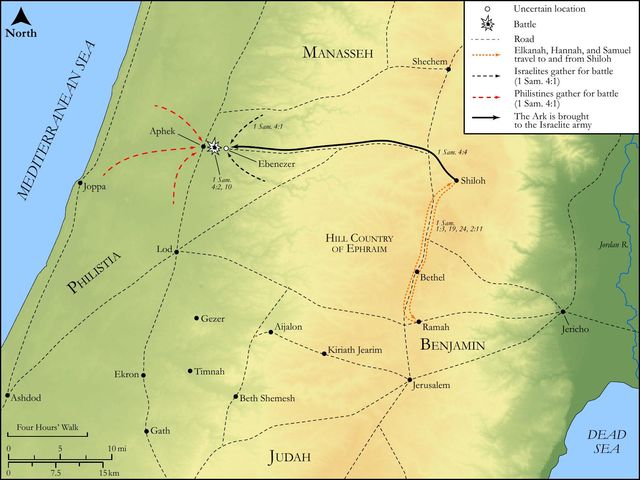
See on the biblical-era map
Study this verse
Public-domain commentary
Matthew Henry
From his Commentary on the Whole Bible. Henry comments on passages, not single verses — this entry covers 1 Samuel 1:9–18. His three-level outline is real structure in the source text, so it is rendered as structure.
Elkanah had gently reproved Hannah for her inordinate grief, and here we find the good effect of the reproof.
I.It brought her to her meat.
She ate and drank, Sa1 1:9. She did not harden herself in sorrow, nor grow sullen when she was reproved for it; but, when she perceived her husband uneasy that she did not come and eat with them, she cheered up her own spirits as well as she could, and came to table. it is as great a piece of self-denial to control our passions as it is to control our appetites.
II.It brought her to her prayers.
It put her upon considering, "Do I well to be angry? Do I well to fret? What good does it do me? Instead of binding the burden thus upon my shoulders, had I not better easy myself of it, and cast it upon the Lord by prayer?" Elkanah had said, Am not I better to thee than ten sons? which perhaps occasioned her to think within herself, "Whether he be so or no, God is, and therefore to him will I apply, and before him will I pour out my complaint, and try what relief that will give me." If ever she will make a more solemn address than ordinary to the throne of grace upon this errand, now is the time. They are at Shiloh, at the door of the tabernacle, where God had promised to meet his people, and which was the house of prayer. They had recently offered their peace-offerings, to obtain the favour of God and all good and in token of their communion with him; and, taking the comfort of their being accepted of him, they had feasted upon the sacrifice; and now it was proper to put up her prayer in virtue of that sacrifice, for the peace-offerings, for by it not only atonement is made for sin, but the audience and acceptance of our prayers and an answer of peace to them are obtained for us: to that sacrifice, in all our supplications, we must have an eye. Now concerning Hannah's prayer we may observe,
1.The warm and lively devotion there was in it, which appeared in several instances, for our direction in prayer.
(1.)She improved the present grief and trouble of her spirit for the exciting and quickening of her pious affections in prayer: Being in bitterness of soul, she prayed, Sa1 1:10. This good use we should make of our afflictions, they should make us the more lively in our addresses to God. Our blessed Saviour himself, being in an agony, prayed more earnestly, Luk 22:44.
(2.)She mingled tears with her prayers. It was not a dry prayer: she wept sore. Like a true Israelite, she wept and made supplication (Hos 12:4), with an eye to the tender mercy of our God, who knows the troubled soul. The prayer came from her heart, as the tears from her eyes.
(3.)She was very particular, and yet very modest, in her petition. She begged a child, a man-child, that it might be fit to serve in the tabernacle. God gives us leave, in prayer, not only to ask good things in general, but to mention that special good thing which we most need and desire. Yet she says not, as Rachel, Give me children, Gen 30:1. She will be very thankful for one.
(4.)She made a solemn vow, or promise, that if God would give her a son she would give him up to God, Sa1 1:11. He would be by birth a Levite, and so devoted to the service of God, but he should be by her vow a Nazarite, and his very childhood should be sacred. It is probable she had acquainted Elkanah with her purpose before, and had had his consent and approbation. Note, Parents have a right to dedicate their children to God, as living sacrifices and spiritual priests; and an obligation is thereby laid upon them to serve God faithfully all the days of their life. Note further, It is very proper, when we are in pursuit of any mercy, to bind our own souls with a bond, that, if God give it us, we will devote it to his honour and cheerfully use it in his service. Not that hereby we can pretend to merit the gift, but thus we are qualified for it and for the comfort of it. In hope of mercy, let us promise duty.
(5.)She spoke all this so softly that none could hear her. Her lips moved, but her voice was not heard, Sa1 1:13. Hereby she testified her belief of God's knowledge of the heart and its desires. Thoughts are words to him, nor is he one of those gods that must be cried aloud to, Kg1 18:27. It was likewise an instance of her humility and holy shamefacedness in her approach to God. She was none of those that made her voice to be heard on high, Isa 58:4. It was a secret prayer, and therefore, though made in a public place, yet was thus made secretly, and not, as the Pharisees prayed, to be seen of men. It is true prayer is not a thing we have reason to be ashamed of, but we must avoid all appearances of ostentation. Let what passes between God and our souls be kept to ourselves.
2.The hard censure she fell under for it. Eli was now high priest, and judge in Israel; he sat upon a seat in the temple, to oversee what was done there, Sa1 1:9. The tabernacle is here called the temple, because it was now fixed, and served all the purposes of a temple. There Eli sat to receive addresses and give direction, and somewhere (it is probable in a private corner) he espied Hannah at her prayers, and by her unusual manner fancied she was drunken, and spoke to her accordingly (Sa1 1:14): How long wilt thou be drunken? - the very imputation that Peter and the apostles fell under when the Holy Ghost gave them utterance, Act 2:13. Perhaps in this degenerate age it was no strange thing to see drunken women at the door of the tabernacle; for otherwise, one would think, the vile lust of Hophni and Phinehas could not have found so easy a prey there, Sa1 2:22. Eli took Hannah for one of these. It is one bad effect of the abounding of iniquity, and its becoming fashionable, that it often gives occasion to suspect the innocent. When a disease is epidemical every one is suspected to be tainted with it. Now,
(1.)This was Eli's fault; and a great fault it was to pass so severe a censure without better observation or information. If his own eyes had already become dim, he should have employed those about him to enquire. Drunkards are commonly noisy and turbulent, but this poor woman was silent and composed. His fault was the worse that he was the priest of the Lord, who should have had compassion on the ignorant, Heb 5:2. Note, It ill becomes us to be rash and hasty in our censures of others, and to be forward to believe people guilty of bad things, while either the matter of fact on which the censure is grounded is doubtful and unproved or is capable of a good construction. Charity commands us to hope the best concerning all, and forbids censoriousness. Paul had very good information when he did but partly believe (Co1 11:18), hoping it was not so. Especially we ought to be cautious how we censure the devotions of others, lest we call that hypocrisy, enthusiasm, or superstition, which is really the fruit of an honest zeal, and it is accepted of God.
(2.)It was Hannah's affliction; and a great affliction it was, added to all the rest, vinegar to the wounds of her spirit. She had been reproved by Elkanah because she would not eat and drink, and now to be reproached by Eli as if she had eaten and drunk too much was very hard. Note, It is no new thing for those that do well to be ill thought of, and we must not think it strange if at any time it be our lot.
3.Hannah's humble vindication of herself from this crime with which she was charged. She bore it admirably well. She did not retort the charge and upbraid him with the debauchery of his own sons, did not bid him look at home and restrain them, did not tell him how ill it became one in his place thus to abuse a poor sorrowful worshipper at the throne of grace. When we are at any time unjustly censured we have need to set a double watch before the door of our lips, that we do not recriminate, and return censure for censure. Hannah thought it enough to vindicate herself, and so must we, Sa1 1:15, Sa1 1:16.
(1.)In justice to herself, she expressly denies the charge, speaks to him with all possible respect, calls him, My lord, intimates how very desirous she was to stand right in his opinion and how loth to lie under his censure. "No, my lord, it is not as you suspect; I have drunk neither wine nor strong drink, not any at all" (though it was proper enough to be given to one of such a heavy heart, Pro 31:6), "much less to any excess; therefore count not thy handmaid for a daughter of Belial." Note, Drunkards are children of Belial (women-drunkards, particularly), children of the wicked one, children of disobedience, children that will not endure the yoke (else they would not be drunk), more especially when they are actually drunk. Those that cannot govern themselves will not bear that any one else should. Hannah owns that the crime would have been very great if she had indeed been guilty of it, and he might justly have shut her out of the courts of God's house; but the very manner of her speaking in her own defence was sufficient to demonstrate that she was not drunk.
(2.)In justice to him, she gives an account of her present behaviour, which had given occasion to his suspicion: "I am a woman of a sorrowful spirit, dejected and discomposed, and that is the reason I do not look as other people; the eyes are red, not with wine, but with weeping. And at this time I have not been talking to myself, as drunkards and fools do, but I have been pouring out my soul before the Lord, who hears and understands the language of the heart, and this out of the abundance of my complaint and grief." She had been more than ordinarily fervent in prayer to God, and this, she tells him, was the true reason of the transport and disorder she seemed to be in. Note, When we are unjustly censured we should endeavour, not only to clear ourselves, but to satisfy our brethren, by giving them a just and true account of that which they misapprehended.
4.The atonement Eli made for his rash unfriendly censure, by a kind and fatherly benediction, Sa1 1:17. He did not (as many are apt to do in such a case) take it for an affront to have his mistake rectified and to be convinced of his error, nor did it put him out of humour. But, on the contrary, he now encouraged Hannah's devotions as much as before he had discountenanced them; not only intimated that he was satisfied of her innocency by those words, Go in peace, but, being high priest, as one having authority he blessed her in the name of the Lord, and, though he knew not what the particular blessing was that she had been praying for, yet he puts his Amen to it, so good an opinion had he now conceived of her prudence and piety: The God of Israel grant thee thy petition, whatever it is, that thou hast asked of him. Note, By our meek and humble carriage towards those that reproach us because they do not know us, we may perhaps make them our friends, and turn their censures of us into prayers for us.
5.The great satisfaction of mind with which Hannah now went away, Sa1 1:18. She begged the continuance of Eli's good opinion of her and his good prayers for her, and then she went her way and did eat of what remained of the peace-offerings (none of which was to be left until the morning), and her countenance was no more sad, no more as it had been, giving marks of inward trouble and discomposure; but she looked pleasant and cheerful, and all was well. Why, what had happened? Whence came this sudden happy change? She had by prayer committed her case to God and left it with him, and now she was no more perplexed about it. She had prayed for herself, and Eli had prayed for her; and she believed that God would either give her the mercy she had prayed for or make up the want of it to her some other way. Note, Prayer is heart's-ease to a gracious soul; the seed of Jacob have often found it so, being confident that God will never say unto them, Seek you me in vain, see Phi 4:6, Phi 4:7. Prayer will smooth the countenance; it should do so.
Continue studying 1 Samuel 1:15 across the web’s major study libraries — every link below opens this exact verse, chapter, or book on the destination site.
Read & Compare
 BibleGatewayThis verse in more than 200 translations and 70 languages.
 Bible.comThe YouVersion reader — hundreds of translations, reading plans, and highlights.
 ESV.orgCrossway's official English Standard Version reader.
 NET BibleThe NET translation with 60,000+ translators' notes on every rendering decision.
 STEP BibleTyndale House's free study tool — original text, vocabulary, and scholarly resources.
 BibliaLogos Bible Software's free web reader.
 USCCBThe New American Bible (Revised Edition) with the U.S. bishops' study notes.
Commentaries
 BibleHub CommentariesDozens of classic commentaries on this verse, gathered on one page.
 StudyLightMore than 100 commentary sets — the largest collection on the web.
 BibleRefPlain-English commentary on what this verse means, verse by verse.
 Enduring WordDavid Guzik's free commentary on this chapter, widely used by Bible teachers.
 Bible Study ToolsVerse commentary alongside Greek and Hebrew study aids.
Original Language & Research
- BibleHub InterlinearThe verse word by word — original language, transliteration, and English.
- BibleHub LexiconEvery word's original-language definition and Strong's entry.
 Blue Letter BibleDeep-study tools — Strong's numbers, concordance, and word studies.
 SefariaThe Hebrew text with Rashi and centuries of Jewish commentary.
Sermons, Hymns & Audio


TrulyRandomVerse is not affiliated with these sites and doesn’t control their content. They’re linked because they’re genuinely useful.
Summary
1 Samuel 1:15 profoundly captures Hannah's poignant and dignified response to Eli, the High Priest, who mistakenly accuses her of drunkenness. Far from being intoxicated, Hannah reveals the profound depth of her spiritual anguish, declaring herself "a woman of a sorrowful spirit" who has, in fact, been engaged in a desperate and unreserved act of prayer, "pouring out her soul before the LORD." This verse serves as a powerful testament to the authenticity and intensity of true supplication, highlighting the stark contrast between superficial judgment and genuine spiritual devotion.
Context
ShowHideLiterary Context
The book of 1 Samuel opens by introducing Elkanah and his two wives, Peninnah and Hannah. The narrative immediately establishes Hannah's barrenness, a source of immense personal sorrow and societal shame in ancient Israel, as seen in 1 Samuel 1:2. Peninnah, who has children, frequently provokes Hannah, especially during their annual pilgrimage to Shiloh to worship the LORD. This persistent grief culminates in Hannah's deep distress, leading her to weep bitterly and pray silently at the tabernacle, as detailed in 1 Samuel 1:10. Eli, observing her lips moving but hearing no sound, misinterprets her fervent prayer as intoxication and rebukes her, as recorded in 1 Samuel 1:12-14. Verse 15 is Hannah's eloquent and sorrowful reply, clarifying the true nature of her profound spiritual engagement and setting the stage for her vow and the subsequent birth of Samuel.
Historical & Cultural Context
In ancient Israelite society, barrenness was often perceived as a divine curse and brought significant social stigma, as evidenced by the rivalry between Hannah and Peninnah. The annual pilgrimage to Shiloh was a central religious event, as it housed the Tabernacle and the Ark of the Covenant before the construction of the Temple in Jerusalem. This made Shiloh the primary place for national worship and personal vows. The role of the High Priest, Eli, was crucial for spiritual discernment and guidance, yet his misjudgment of Hannah underscores a broader theme of spiritual decline within the priesthood, a theme that becomes more pronounced later in 1 Samuel 2. Hannah's public display of intense, silent prayer, while unusual, was a desperate act within the accepted framework of seeking divine intervention in a culture where communal and individual supplication was common.
Key Themes
ShowHideThis verse contributes significantly to several key themes within 1 Samuel 1 and the broader biblical narrative. Firstly, it highlights the theme of Heartfelt Supplication, demonstrating that genuine prayer is an unreserved pouring out of one's deepest self before God, regardless of outward appearance or social convention. Hannah's example provides a model for how believers can truly "pour out their heart before Him," as exhorted in Psalm 62:8. Secondly, it underscores the theme of Misjudgment and Discernment, as Eli, the spiritual leader, fails to discern the true nature of Hannah's spiritual agony, offering a cautionary tale against superficial condemnation. Thirdly, the verse emphasizes Authenticity in Prayer, revealing Hannah's spiritual integrity and her focus on direct communication with God rather than human perception. Finally, it powerfully illustrates the theme of God's Attentiveness to the Afflicted, showing that even in profound "sorrowful spirit," faith leads one to seek and find solace in the LORD, who is "near to the brokenhearted," as promised in Psalm 34:18.
Exposition and Analysis
ShowHideKey Word Analysis
ShowHideThis phrase, translated as "sorrowful spirit," literally means "hard of spirit" or "bitter of soul." The Hebrew word qâsheh (H7186) denotes hardness, severity, or difficulty, while rûwach (H7307) refers to spirit, breath, or wind. Thus, "qâsheh rûwach" conveys a deep-seated, intense anguish and oppression of the inner being, far beyond mere sadness. It describes a spirit that is burdened, afflicted, and weighed down by profound suffering, reflecting Hannah's chronic and debilitating grief over her barrenness and Peninnah's taunts.
This powerful idiom signifies a complete and unreserved emptying of one's innermost self before God. The verb shâphak (H8210) means "to pour out" or "to shed," and nephesh (H5315) refers to the soul, life, or inner being. When Hannah states she "poured out her soul," she is describing an act of profound, earnest, and unreserved prayer where she held nothing back, exposing her deepest pains, desires, and vulnerabilities to the LORD. It implies a total surrender of her emotional and spiritual burden into God's hands.
Verse Breakdown
ShowHide"And Hannah answered and said, No, my lord, I [am] a woman of a sorrowful spirit:"
Hannah's response is characterized by both dignity and directness. She respectfully addresses Eli as "my lord" but firmly refutes his accusation. Her self-description as "a woman of a sorrowful spirit" immediately corrects Eli's misjudgment by revealing the true, profound nature of her inner state. This declaration is not an excuse but an honest articulation of her deep, persistent anguish, inviting empathy and understanding rather than condemnation.
"I have drunk neither wine nor strong drink,"
This clause serves as a clear and unequivocal denial of Eli's accusation of intoxication. By explicitly stating her sobriety, Hannah underscores the clarity of her mind and the intentionality of her actions. This refutation is crucial for establishing her spiritual integrity and differentiating her fervent spiritual exercise from worldly excess, thereby highlighting Eli's failure in discernment.
"but have poured out my soul before the LORD."
This is the climax of Hannah's explanation, revealing the true essence of her behavior. It defines her unusual actions not as a sign of drunkenness but as an intense, unreserved act of prayer and communion with God. The phrase "before the LORD" emphasizes the direct, personal, and sacred nature of her supplication, indicating that her focus was entirely on God, not on human observers or their perceptions. It is a declaration of profound spiritual devotion and absolute trust in God as the sole recipient of her deepest burdens.
Literary Devices
ShowHideThe passage in 1 Samuel 1:15 is rich with literary devices that amplify its meaning and impact. A primary device is Contrast, starkly evident between Eli's worldly misjudgment and Hannah's profound spiritual devotion. Eli, the High Priest, represents a failing spiritual leadership that cannot discern genuine piety, while Hannah embodies authentic, desperate faith. This creates Irony, as the one tasked with spiritual oversight completely misunderstands a moment of intense spiritual communion. Furthermore, Hannah's declaration, "I have poured out my soul before the LORD," employs a powerful Metaphor or Idiom. This vivid imagery of "pouring out" transforms an abstract concept of emotional release into a tangible, visceral action, emphasizing the completeness and unreserved nature of her prayer. The entire exchange also serves as Foreshadowing, hinting at the spiritual decline within Eli's household and the coming shift in leadership from a corrupt priesthood to a prophet (Samuel), born out of this very prayer.
Theological and Thematic Connections
ShowHideHannah's experience in 1 Samuel 1:15 offers profound theological insights into the nature of prayer, God's character, and human discernment. It teaches us that authentic prayer is not about eloquent words or composed demeanor, but about the raw, honest outpouring of the heart to God. God values sincerity and desperation over outward appearances, hearing the cry of the afflicted even when others misinterpret it. This passage affirms God's attentiveness to the suffering and His willingness to engage with humanity's deepest pains. It also serves as a crucial reminder for believers to exercise humility and compassion, avoiding hasty judgments based on superficial observations, and instead seeking to understand the underlying spiritual realities of others.
Reflection and Application
ShowHideHannah's profound vulnerability and unwavering focus on God in 1 Samuel 1:15 provide a timeless model for our own spiritual lives. In a world often preoccupied with appearances and quick judgments, Hannah reminds us that true devotion is an internal posture of the heart, laid bare before the Almighty. Her example encourages us to bring our most agonizing sorrows, our deepest anxieties, and our most desperate longings directly to God, holding nothing back. We are invited to "pour out our souls" in prayer, trusting that God sees beyond our outward expressions and hears the silent cries of our hearts. Furthermore, Hannah's encounter with Eli serves as a powerful cautionary tale, urging us to cultivate discernment and empathy rather than quick condemnation. It challenges us to look beyond unusual behaviors or outward appearances and seek to understand the underlying spiritual or emotional realities of those around us, responding with compassion and grace instead of superficial judgment.
Questions for Reflection
ShowHideFAQ
ShowHideWhy did Eli think Hannah was drunk?
ShowHideEli observed Hannah praying silently, with her lips moving but no sound coming forth. This unusual, intense, and seemingly uncontrolled behavior, combined with her deep emotional distress, led him to mistakenly conclude that she was intoxicated. In ancient Israel, public displays of fervent emotion could sometimes be associated with drunkenness, especially if they were outside the typical, more reserved forms of prayer.
What does the phrase "poured out my soul before the LORD" signify?
ShowHideThis is a powerful Hebrew idiom that signifies an act of deep, unreserved, and honest prayer. It means to fully unburden one's innermost self, including all anxieties, sorrows, desires, and vulnerabilities, directly before God. Hannah was holding nothing back, completely emptying her heart and spirit to the LORD, trusting Him with her deepest pain and longing. It speaks to a profound level of intimacy and trust in God's presence and attentiveness.
What is the significance of Shiloh in this narrative?
ShowHideShiloh was the central place of Israelite worship before the construction of the Temple in Jerusalem. It housed the Tabernacle, which contained the Ark of the Covenant, making it the primary sanctuary where Israelites would come to offer sacrifices, make vows, and seek the LORD's presence. Hannah's annual pilgrimage to Shiloh underscores the importance of this sacred site for national and personal devotion, and it was the designated place where she could bring her deepest spiritual burdens directly to God.
Christ-Centered Fulfillment
ShowHideHannah's fervent prayer and the subsequent birth of Samuel, a prophet who would bridge the gap between judges and kings, profoundly foreshadow the coming of Christ. Hannah's "sorrowful spirit" and her unreserved "pouring out of her soul" before the LORD find their ultimate echo and answer in Jesus. He is the ultimate High Priest, not like Eli, but one who truly understands our weaknesses and sorrows, having been "tempted in every way, just as we are—yet without sin," as affirmed in Hebrews 4:15. Jesus himself, in the Garden of Gethsemane, "poured out his soul" in anguish, praying with such intensity that His sweat was like drops of blood, as recorded in Luke 22:44, demonstrating the perfect model of unreserved supplication. Hannah's longing for a son who would be dedicated to the LORD points to the ultimate Son, Jesus, who was perfectly dedicated to His Father's will, even unto death on the cross. Through Christ, we have direct access to God, not needing to rely on fallible human priests, for He is our perfect intercessor, who "is at the right hand of God and is also interceding for us," as declared in Romans 8:34. Hannah's answered prayer for a deliverer finds its ultimate and eternal fulfillment in the salvation brought by Jesus, the true Lamb of God who takes away the sin of the world.