


Judges 7:11
Bible text: King James Version (1769 Blayney text) · Public domain
Bible text: King James Version with Strong's numbers · Public domain
Bible text: Berean Standard Bible · Public domain
Bible text: American Standard Version (1901) · Public domain
Bible text: World English Bible, Messianic edition · Public domain
Bible text: Geneva Bible (1599) · Public domain
Bible text: Young's Literal Translation · Public domain
- וְשָׁמַעְתָּve·sha·ma'·Taand you will hearH8085Conj-w ¦ V-Qal-ConsecPerf-2msVerb Qal Consecutive Perfect 2nd Singular Masculineוְandשָׁמַעְתָּyou will hear
- מַהmahwhat?H4100InterrogPronoun Interrogative
- יְדַבֵּרוּye·da·Be·ruwill they speakH1696V-Piel-Imperf-3mpVerb Piel Imperfect 3rd Plural Masculine
- וְאַחַרve·'a·Charand afterH310Conj-w ¦ Adj-msAdjective Numerical Singular Masculine Absoluteוְandאַחַרafter
- תֶּחֱזַקְנָהte·che·Zak·nahthey will be strongH2388V-Qal-Imperf-3fpVerb Qal Imperfect 3rd Plural Feminine
- יָדֶיךָya·Dei·khayour handsH3027N-cdc ¦ 2msNoun Dual common gender Constructיָדֶיhandsךָyour
- וְיָרַדְתָּve·ya·rad·Taand you will go downH3381Conj-w ¦ V-Qal-ConsecPerf-2msVerb Qal Consecutive Perfect 2nd Singular Masculineוְandיָרַדְתָּyou will go down
- בַּמַּחֲנֶהba·ma·cha·Nehin the campH4264Prep-b ¦ N-fsNoun Singular Feminine Absoluteבַּin theמַּחֲנֶהcamp
- וַיֵּרֶדvai·Ye·redand he went downH3381Conj-w ¦ V-Qal-ConsecImperf-3msVerb Qal Consecutive Imperfect 3rd Singular Masculineוַandיֵּרֶדhe went down
- הוּאhu'heH1931Pro-3msPronoun Personal 3rd Singular Masculine
- וּפֻרָהu·fu·Rahand PurahH6513Conj-w ¦ N-proper-mNoun Proper MasculineוּandפֻרָהPurah
- נַעֲרוֹna·'a·Rohis servantH5288N-msc ¦ 3msNoun Singular Masculine Constructנַעֲרservantוֹhis
- אֶל'eltoH413PrepPreposition
- קְצֵהke·Tzeh[the] edge ofH7097N-mscNoun Singular Masculine Construct
- הַחֲמֻשִׁיםha·cha·mu·Shimthose arrayed for battleH2571Art ¦ V-Qal-PassPrtcpl-mpVerb Qal Participle Passive Plural Masculine Absoluteהַthoseחֲמֻשִׁיםarrayed for battle
- אֲשֶׁר'a·SherwhoH834RelParticle Relative
- בַּמַּחֲנֶהBa·ma·cha·Neh[were] in the campH4264Prep-b ¦ N-fsNoun Singular Feminine Absoluteבַּ[were] in theמַּחֲנֶהcamp
English is a literal word-by-word gloss of the Hebrew, not the KJV's wording. Why?
This is the original text the KJV's translators worked from — each Hebrew word with its own literal English meaning in this verse, prepared by scholars at Tyndale House, Cambridge. The KJV translates whole sentences, not word by word, so its wording differs: one Hebrew word can become several English words, and the KJV may choose “the LORD” where the gloss reads “Yahweh”. Both are faithful — they answer different questions. For the KJV's own rendering, switch to the KJV text.
Details
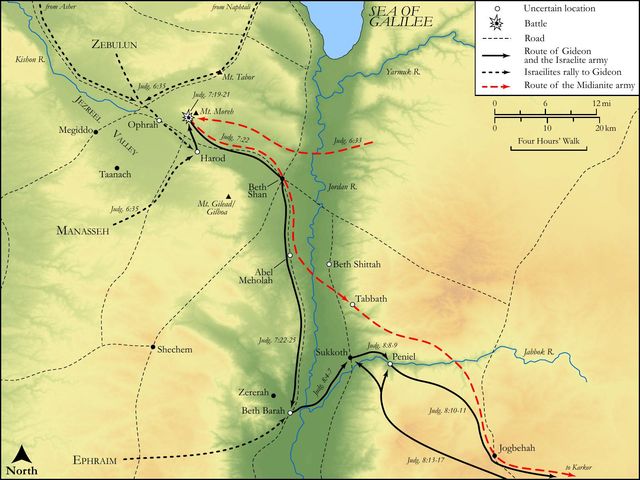
See on the biblical-era maps

Study this verse
Public-domain commentary
Matthew Henry
From his Commentary on the Whole Bible. Henry comments on passages, not single verses — this entry covers Judges 7:9–15. His three-level outline is real structure in the source text, so it is rendered as structure.
Gideon's army being diminished as we have found it was, he must either fight by faith or not at all; God therefore here provides recruits for his faith, instead of recruits for his forces.
I.He furnishes him with a good foundation to build his faith upon.
Nothing but a word from God will be a footing for faith. He has this as full and express as he can desire, Jdg 7:9.
1.A word of command to warrant the action, which otherwise seemed rash and indiscreet, and unbecoming a wise general: Arise, get thee down with this handful of men unto the host.
2.A word of promise to assure him of the success, which otherwise seemed very improbable: I have delivered it into thy hand; it is all thy own. This word of the Lord came to him the same night, when he was (we may suppose) greatly agitated and full of care how he should come off; in the multitude of his thoughts within him these comforts did delight his soul. Divine consolations are given in to believers not only strongly but seasonably.
II.He furnishes him with a good prop to support his faith with.
1.He orders him to be his own spy, and now in the dead of the night to go down privately into the host of Midian, and see what intelligence he could gain: "If thou fear to go down to fight, go first only with thy own servant (Jdg 7:10) and hear what they say" (Jdg 7:11); and it is intimated to him that he should hear that which would greatly strengthen his faith. God knows the infirmities of his people, and what great encouragement they may sometimes take from a small matter; and therefore, knowing beforehand what would occur to Gideon, in that very part of the camp to which he would go down, he orders him to go down and hearken to what they said, that he might the more firmly believe what God said. He must take with him Phurah his servant, one that he could confide in, probably one of the ten that had helped him to break down the altar of Baal. He must take him and no one else with him, must take him with him to be a witness of what he should hear the Midianites say, that out of the mouth of these two witnesses, when the matter came to be reported to Israel, the word might be established. He must take his servant with him, because two are better than one and a little help is better than none.
2.Being so, he orders him the sight of something that was discouraging. It was enough to frighten him to discern, perhaps by moon-light, the vast numbers of the enemy (Jdg 7:12), the men like grasshoppers for multitude, and they proved no better than grasshoppers for strength and courage; the camels one could not count, any more than the sand. But,
3.He causes him to hear that which was to him a very good omen; and when he had heard it he went back again immediately, supposing he now had what he was sent thither for. He overheard two soldiers of the enemy, that were comrades, talking; probably they were in bed together, waking in the night.
(1.)One of them tells his dream, and as our dreams generally are, and therefore not worth telling again, it is a very foolish one. He dreamed that he saw a barley-cake come rolling down the hill into the camp of the Midianites, and "methought," says he (for so we speak in telling our dreams), "this rolling cake struck one of our tents" (perhaps one of the chief of their tents) "and with such violence that" (would you think it?) "it overturned the tent, forced down the stakes, and broke the cords at one blow, so that the tent lay along and buried its inhabitants," Jdg 7:13. In multitudes of dreams there are divers vanities, says Solomon, Ecc 5:7. One would wonder what odd incoherent things are often put together by a ludicrous fancy in our dreams.
(2.)The other, it may be between sleeping and waking, undertakes to interpret this dream, and the interpretation is very far-fetched: This is nothing else save the sword of Gideon, Jdg 7:14. Our expositors now can tell us how apt the resemblance was, that Gideon, who had threshed corn for his family, and made cakes for his friend (Jdg 6:11-19), was fitly represented by a cake, - that he and his army were as inconsiderable as a cake made of a little flour, as contemptible as a barley-cake, hastily got together as a cake suddenly baked upon the coals, and as unlikely to conquer this great army as a cake to overthrow a tent. But, after all, do not interpretations belong to God? He put it into the head of the one to dream and into the mouth of the other to give the sense of it; if Gideon had heard the dream only, and he and his servant had been left to interpret it themselves, it had so little significancy in it that it would have done him little service; but, having the interpretation from the mouth of an enemy, it not only appeared to come from God, who has all men's hearts and tongues in his hand, but it was likewise an evidence that the enemy was quite dispirited, and that the name of Gideon had become so formidable to them that it disturbed their sleep. The victory would easily be won which was already so tamely yielded: Into his hand hath God delivered Midian. Those were not likely to fight who saw God fighting against them.
Lastly, Gideon, observing the finger of God pointing him to this very place, at this very time, to hear this dream and the interpretation of it, was exceedingly encouraged by it against the melancholy apprehensions he had upon the reducing of his army. He was very well pleased to hear himself compared to a barley-cake, when it proved to effect such great things. Being hereby animated, we are told (Jdg 7:15), 1. How he gave God the glory of it; he worshipped immediately, bowed his head, or, it may be, lifted up his eyes and hands, and in a short ejaculation thanked God for the victory he was now sure of, and for this encouragement to expect it. Wherever we are, we may speak to God, and worship him, and find a way open heavenward. God must have the praise of that which is encouraging to our faith, and his providence must be acknowledged in those events which, though minute and seemingly accidental, prove serviceable to us. 2. How he gave his friends a share in the encouragements he had received: Arise, prepare to march presently; the Lord has delivered Midian into your hand.
Continue studying Judges 7:11 across the web’s major study libraries — every link below opens this exact verse, chapter, or book on the destination site.
Read & Compare
 BibleGatewayThis verse in more than 200 translations and 70 languages.
 Bible.comThe YouVersion reader — hundreds of translations, reading plans, and highlights.
 ESV.orgCrossway's official English Standard Version reader.
 NET BibleThe NET translation with 60,000+ translators' notes on every rendering decision.
 STEP BibleTyndale House's free study tool — original text, vocabulary, and scholarly resources.
 BibliaLogos Bible Software's free web reader.
 USCCBThe New American Bible (Revised Edition) with the U.S. bishops' study notes.
Commentaries
 BibleHub CommentariesDozens of classic commentaries on this verse, gathered on one page.
 StudyLightMore than 100 commentary sets — the largest collection on the web.
 BibleRefPlain-English commentary on what this verse means, verse by verse.
 Enduring WordDavid Guzik's free commentary on this chapter, widely used by Bible teachers.
 Bible Study ToolsVerse commentary alongside Greek and Hebrew study aids.
Original Language & Research
- BibleHub InterlinearThe verse word by word — original language, transliteration, and English.
- BibleHub LexiconEvery word's original-language definition and Strong's entry.
 Blue Letter BibleDeep-study tools — Strong's numbers, concordance, and word studies.
 SefariaThe Hebrew text with Rashi and centuries of Jewish commentary.
Sermons, Hymns & Audio


TrulyRandomVerse is not affiliated with these sites and doesn’t control their content. They’re linked because they’re genuinely useful.
Summary
Judges 7:11 serves as a pivotal moment in Gideon's campaign, illustrating God's compassionate accommodation to Gideon's lingering apprehension despite the dramatic reduction of his army. God instructs Gideon to take his servant, Phurah, and stealthily approach the Midianite camp to overhear their conversations. This divine directive is not primarily for tactical intelligence but functions as a direct, tangible act of grace designed to bolster Gideon's courage and solidify his faith, thereby empowering him to lead Israel's small force against the overwhelming Midianite host.
Context
ShowHideLiterary Context
Judges 7:11 is strategically placed immediately after God's drastic and counter-intuitive reduction of Gideon's army from 32,000 to a mere 300 men, a measure detailed in Judges 7:2-7. This severe reduction was designed to ensure that Israel would attribute victory solely to God, preventing any boasting in human strength. Despite having received clear divine commands and witnessed miraculous signs, such as the dew on the fleece in Judges 6:36-40, Gideon still harbored understandable fear when confronted with the vast Midianite and Amalekite forces. The preceding verse, Judges 7:10, explicitly reveals God's tender awareness of Gideon's human weakness: "But if thou fear to go down, go thou with Phurah thy servant down to the host." Verse 11 then describes Gideon's immediate obedience to this specific, personalized command, setting the stage for the crucial overheard conversation in Judges 7:13-14, which directly confirms God's plan and decisively strengthens Gideon's resolve.
Historical & Cultural Context
The period of the Judges, roughly spanning the 12th to 11th centuries BC, was marked by a cyclical pattern of Israel's apostasy, divine judgment through foreign oppression, and subsequent deliverance by divinely raised judges, as comprehensively outlined throughout the Book of Judges. At this time, Israel was under severe oppression from the Midianites and Amalekites, nomadic desert tribes renowned for their devastating raids that left the land barren and impoverished, as vividly depicted in Judges 6:3-6. The Midianite army, described as "like grasshoppers for multitude" in Judges 7:12, represented an overwhelming and existential threat. In the warfare of that day, the psychological factors of fear and morale were paramount. Dreams and omens were widely regarded as potent conveyors of divine messages or portents, and their interpretation held significant sway over a soldier's or army's resolve. God's strategic use of a Midianite soldier's dream to bolster Gideon's faith is a brilliant demonstration of His sovereignty, extending even to the beliefs and fears within the enemy's camp.
Key Themes
ShowHideThis verse powerfully encapsulates several key themes central to the narrative of Gideon and the broader theological message of the Book of Judges. Firstly, it profoundly illustrates Divine Compassion and Accommodation, as God, despite His omnipotence and unwavering purpose, condescends to meet Gideon precisely in his moment of fear, providing a personalized and tangible sign of assurance. Secondly, it powerfully underscores the theme of God's Sovereignty over Human Weakness. Gideon's fear is not dismissed but acknowledged, and God's plan is not derailed; instead, God works through and strengthens Gideon's weakness, demonstrating the timeless truth that "the battle is the Lord's," as declared in 1 Samuel 17:47. Thirdly, the passage emphasizes Obedience as a Prerequisite for Divine Empowerment. Gideon's willingness to obey the unusual and potentially perilous command to stealthily approach the enemy camp in the dark is foundational to his reception of the promised strengthening. Finally, it showcases God's Strategic Providence, utilizing seemingly small, indirect means—such as an overheard conversation—to achieve His mighty purposes and confirm His word, a pattern evident throughout the entire narrative of Gideon's miraculous victory.
Exposition and Analysis
ShowHideKey Word Analysis
ShowHideA primitive root, meaning "to arrange," but primarily used figuratively (of words) "to speak." It encompasses expressing thoughts, commanding, declaring, or telling. In this context, "what they say" refers to the specific words spoken by the Midianite soldiers. God's instruction for Gideon to "hear what they say" highlights the divine orchestration of a conversation that would directly address Gideon's apprehension, demonstrating God's meticulous control over even the seemingly mundane interactions within the enemy's camp.
A primitive root meaning "to fasten upon; hence, to seize, be strong (figuratively, courageous, causatively strengthen, cure, help, repair, fortify), obstinate; to bind, restrain, conquer." In the phrase "shall thine hands be strengthened," this verb signifies far more than mere physical might. It refers to a profound inner fortification, a renewal of courage, resolve, and confidence. This is a divine infusion of morale and conviction, enabling Gideon to overcome his pervasive fear and decisively lead the small Israelite force against an overwhelming enemy. The strengthening is primarily spiritual and psychological, leading to practical, bold action.
From the root chanah, meaning "to encamp." This noun refers to an encampment (of travelers or troops), and by extension, an army. In Judges 7:11, machăneh emphasizes the immense size and formidable nature of the combined Midianite and Amalekite forces. The phrase "unto the outside of the armed men that [were] in the host" vividly portrays Gideon's perilous proximity to the very heart of the enemy's strength, underscoring the extreme danger of his reconnaissance mission and the courage divinely imparted to undertake it.
Verse Breakdown
ShowHide"And thou shalt hear what they say;"
This initial clause presents God's precise and purposeful instruction to Gideon. The divine objective is not for Gideon to gather conventional military intelligence, but for him to personally witness and hear something specific that will directly address his deep-seated fear. It implies a divinely orchestrated encounter, where God has already prepared the exact conversation Gideon is about to overhear, showcasing His meticulous sovereignty over all circumstances, even the seemingly casual chatter within an enemy encampment.
"and afterward shall thine hands be strengthened to go down unto the host."
This is the explicit divine promise and the core purpose of the reconnaissance mission. The act of hearing the predetermined conversation will serve as the direct catalyst for Gideon's inner fortification. "Thine hands be strengthened" idiomatically signifies the bolstering of his resolve, courage, and confidence, preparing him psychologically and spiritually to initiate the attack. The phrase "to go down unto the host" highlights the imminent and direct confrontation, emphasizing the crucial transition from apprehension and hesitation to decisive, faith-filled action.
"Then went he down with Phurah his servant unto the outside of the armed men that [were] in the host."
This clause describes Gideon's immediate and courageous obedience to God's specific command. Phurah, identified as Gideon's servant, accompanies him, providing a trusted companion and perhaps a measure of comfort and a witness in this perilous undertaking. The precise detail "unto the outside of the armed men" underscores the stealth and extreme danger involved in approaching the very perimeter of the enemy's armed forces. This act of obedience, despite the inherent vulnerability, serves as a testament to Gideon's growing faith and his willingness to trust God's unconventional plan.
Literary Devices
ShowHideJudges 7:11 masterfully employs several potent literary devices. Divine Irony is strikingly evident in God's strategic use of the enemy's own words and fears to strengthen Gideon; the very adversaries Israel fears become unwitting instruments of God's encouragement and confirmation. This highlights God's absolute sovereign control over all things, extending even to the internal thoughts and casual conversations of His adversaries. There is also a strong element of Foreshadowing, as Gideon's act of listening directly precedes the dramatic revelation of the Midianite soldier's dream and its interpretation in Judges 7:13-14, which serves as a divine confirmation of Israel's impending victory. The narrative skillfully uses Contrast between Gideon's initial, palpable fear and the promised, divinely imparted strengthening, thereby emphasizing the transformative power of God's personal assurance. Finally, the vivid detail of Gideon "going down" stealthily into the enemy camp, despite the inherent danger, functions as Symbolism for the necessary step of vulnerable faith and obedience required to receive and experience God's empowering grace.
Theological and Thematic Connections
ShowHideJudges 7:11 profoundly illustrates God's intimate knowledge of and compassionate response to human weakness, even in His chosen leaders. It teaches that God does not merely issue commands, but also graciously equips and reassures, often providing tangible, personalized signs to bolster faith when fear threatens to paralyze. This divine condescension, meeting Gideon precisely in his specific need for reassurance, powerfully demonstrates God's personal involvement in the lives of His servants and His unwavering commitment to seeing His purposes fulfilled, not through overwhelming human might or strategic brilliance, but through His own power made perfect in weakness. The verse underscores the profound theological truth that true strength for God's service comes not from inherent human ability, impressive numbers, or self-confidence, but from a divinely imparted courage rooted in absolute trust and obedient reliance upon God alone.
Reflection and Application
ShowHideJudges 7:11 offers profound and timeless encouragement for believers navigating their own "battles" and moments of fear, doubt, or overwhelming circumstances. Just as God provided a specific, personalized sign to strengthen Gideon's hands and heart, He continues to offer reassurance and empowerment to us when we feel overwhelmed by daunting challenges, whether they be spiritual, relational, professional, or deeply personal. This divine strengthening often manifests not through a direct, thunderous miracle, but through unexpected confirmations, through the profound wisdom found in God's Word, through the timely encouragement of fellow believers, or even through seemingly ordinary circumstances that unmistakably reveal God's providential hand at work. The lesson is clear: when we are weak, God is undeniably strong, and our willingness to obey, even in small, fearful steps, positions us to receive His empowering grace. We are called to trust that God understands our deepest anxieties and will provide exactly what we need to fulfill His purposes, equipping us perfectly for the challenges that lie ahead.
Questions for Reflection
ShowHideFAQ
ShowHideWhy did God need Gideon to overhear a conversation to strengthen him? Couldn't God just tell him directly?
ShowHideWhile God certainly possesses the power to directly speak to Gideon and instantly instill courage, His chosen method here demonstrates His profound understanding of human psychology and His compassionate accommodation to Gideon's specific need for tangible assurance. Gideon had already received direct commands and witnessed miraculous signs, such as the fleece in Judges 6:36-40. However, facing an overwhelmingly superior enemy force after his own army had been drastically reduced, his fear was deeply human and entirely understandable. Overhearing the Midianite soldier's dream and its interpretation, as precisely described in Judges 7:13-14, provided an external, undeniable, and highly culturally relevant confirmation directly from the enemy's own camp. This was a powerful, undeniable sign that God was indeed with him and was actively working on his behalf, even within the enemy's ranks. It wasn't about God's inability to speak directly, but about His divine wisdom in providing the most effective and impactful form of reassurance for Gideon's specific state of mind and the cultural context of the time.
What does it mean for Gideon's "hands to be strengthened"?
ShowHideThe phrase "thine hands be strengthened" is a powerful Hebrew idiom that extends far beyond mere physical ability. It refers to a profound bolstering of Gideon's inner resolve, courage, and confidence. In ancient Hebrew thought, the "hands" often symbolized one's capacity for action, power, and effectiveness. Therefore, for his hands to be "strengthened" means that his spirit would be emboldened, his fear would dissipate, and he would be empowered with the necessary conviction and unwavering resolve to lead the charge against the Midianite army. It signifies a spiritual and psychological strengthening that directly translates into practical, decisive leadership, enabling him to fulfill God's command to "go down unto the host." This divine empowerment is absolutely crucial because, humanly speaking, Gideon's situation was utterly hopeless, as starkly highlighted by the vast disparity in numbers between his 300 men and the "multitude" of the Midianites, described in Judges 7:12.
Who was Phurah, and why was he mentioned?
ShowHidePhurah is identified simply as Gideon's servant. While the biblical text provides no further biographical details about him, his inclusion in this verse is highly significant. Firstly, his presence underscores the very real danger and gravity of Gideon's mission; Gideon did not go alone but took a trusted companion, perhaps for moral support in a terrifying situation or as an independent witness to the events. Secondly, Phurah's role as a servant highlights Gideon's established position as a leader, even in his moments of profound fear and vulnerability. Thirdly, and perhaps most importantly, Phurah's presence ensures that there was an independent witness to the remarkable event of Gideon overhearing the Midianite soldier's dream and its interpretation. This adds crucial credibility and weight to the narrative, confirming the divine orchestration of the event. His name, though not elaborated upon, serves to ground the story in a specific, historical context, emphasizing the personal and intimate nature of God's interaction with Gideon.
Christ-Centered Fulfillment
ShowHideJudges 7:11, with its profound emphasis on divine strengthening in the face of overwhelming odds, finds its ultimate and most profound fulfillment in the person and work of Jesus Christ. Gideon's desperate need for reassurance and empowering courage before facing a physical enemy powerfully foreshadows humanity's universal and desperate need for spiritual strength to overcome the far greater spiritual enemies of sin, death, and the devil. Where Gideon received a temporary strengthening for a specific, earthly battle, Christ offers a permanent, indwelling power and courage to all who believe. The "overheard conversation" that bolstered Gideon's faith points to the ultimate "Word" of God, Jesus Christ Himself, through whom God has spoken definitively and fully to humanity, as declared in Hebrews 1:1-2. In Christ, believers are not merely strengthened for a single battle, but are given the Holy Spirit, who empowers them for all of life's challenges, enabling them to "be strong in the Lord, and in the power of his might" (Ephesians 6:10). Jesus, as the Lamb of God who takes away the sin of the world (John 1:29), faced the ultimate "host" of spiritual darkness, not with 300 men, but alone on the cross. Through His sacrificial death and glorious resurrection, He secured the definitive and eternal victory, offering true and lasting peace, courage, and overcoming power to all who trust in Him, enabling them to overcome the world, for He has overcome the world (John 16:33).