


1 Samuel 26:5
Bible text: King James Version (1769 Blayney text) · Public domain
Bible text: King James Version with Strong's numbers · Public domain
Bible text: Berean Standard Bible · Public domain
Bible text: American Standard Version (1901) · Public domain
Bible text: World English Bible, Messianic edition · Public domain
Bible text: Geneva Bible (1599) · Public domain
Bible text: Young's Literal Translation · Public domain
- וַיָּקָםvai·Ya·komand he aroseH6965Conj-w ¦ V-Qal-ConsecImperf-3msVerb Qal Consecutive Imperfect 3rd Singular Masculineוַandיָּקָםhe arose
- דָּוִדda·VidDavidH1732N-proper-mNoun Proper Masculine
- וַיָּבֹאvai·ya·Vo'and he wentH935Conj-w ¦ V-Qal-ConsecImperf-3msVerb Qal Consecutive Imperfect 3rd Singular Masculineוַandיָּבֹאhe went
- אֶל'eltoH413PrepPreposition
- הַמָּקוֹםha·ma·kOmthe placeH4725Art ¦ N-msNoun Singular Masculine Absoluteהַtheמָּקוֹםplace
- אֲשֶׁר'a·SherwhereH834RelParticle Relative
- חָנָהcha·nahhe had encampedH2583V-Qal-Perf-3msVerb Qal Perfect 3rd Singular Masculine
- שָׁםshamthereH8033AdvAdverb
- שָׁאוּלsha·'UlSaulH7586N-proper-mNoun Proper Masculine
- וַיַּרְאvai·Yar'and he sawH7200Conj-w ¦ V-Qal-ConsecImperf-3msVerb Qal Consecutive Imperfect 3rd Singular Masculineוַandיַּרְאhe saw
- דָּוִדda·VidDavidH1732N-proper-mNoun Proper Masculine
- אֶת'et<obj.>H853DirObjMParticle Object Indicator
- הַמָּקוֹםha·ma·kOmthe placeH4725Art ¦ N-msNoun Singular Masculine Absoluteהַtheמָּקוֹםplace
- אֲשֶׁר'a·SherwhereH834RelParticle Relative
- שָׁכַבsha·khavhe layH7901V-Qal-Perf-3msVerb Qal Perfect 3rd Singular Masculine
- שָׁםshamthereH8033AdvAdverb
- שָׁאוּלsha·'UlSaulH7586N-proper-mNoun Proper Masculine
- וְאַבְנֵרve·'av·Nerand AbnerH74Conj-w ¦ N-proper-mNoun Proper MasculineוְandאַבְנֵרAbner
- בֶּןben[the] son ofH1121N-mscNoun Singular Masculine Construct
- נֵרnerNerH5369N-proper-mNoun Proper Masculine
- שַׂרsar[the] commander ofH8269N-mscNoun Singular Masculine Construct
- צְבָאוֹtze·va·'Ohis armyH6635N-msc ¦ 3msNoun Singular Masculine Constructצְבָאarmyוֹhis
- וְשָׁאוּלve·sha·'Uland SaulH7586Conj-w ¦ N-proper-mNoun Proper MasculineוְandשָׁאוּלSaul
- שֹׁכֵבsho·Khev[was] lyingH7901V-Qal-Prtcpl-msVerb Qal Participle Singular Masculine Absolute
- בַּמַּעְגָּלba·ma'·Galin the campH4570Prep-b ¦ N-msNoun Singular Masculine Absoluteבַּin theמַּעְגָּלcamp
- וְהָעָםve·ha·'Amand the peopleH5971Conj-w ¦ Art ¦ N-msNoun Singular Masculine Absoluteוְandהָtheעָםpeople
- חֹנִיםcho·Nim[was] encampedH2583V-Qal-Prtcpl-mpVerb Qal Participle Plural Masculine Absolute
- סְבִיבֹתָיוse·vi·vo·tovaround himH5439N-cpc ¦ 3msNoun Plural common gender Constructסְבִיבֹתָיaroundוhim
English is a literal word-by-word gloss of the Hebrew, not the KJV's wording. Why?
This is the original text the KJV's translators worked from — each Hebrew word with its own literal English meaning in this verse, prepared by scholars at Tyndale House, Cambridge. The KJV translates whole sentences, not word by word, so its wording differs: one Hebrew word can become several English words, and the KJV may choose “the LORD” where the gloss reads “Yahweh”. Both are faithful — they answer different questions. For the KJV's own rendering, switch to the KJV text.
Details
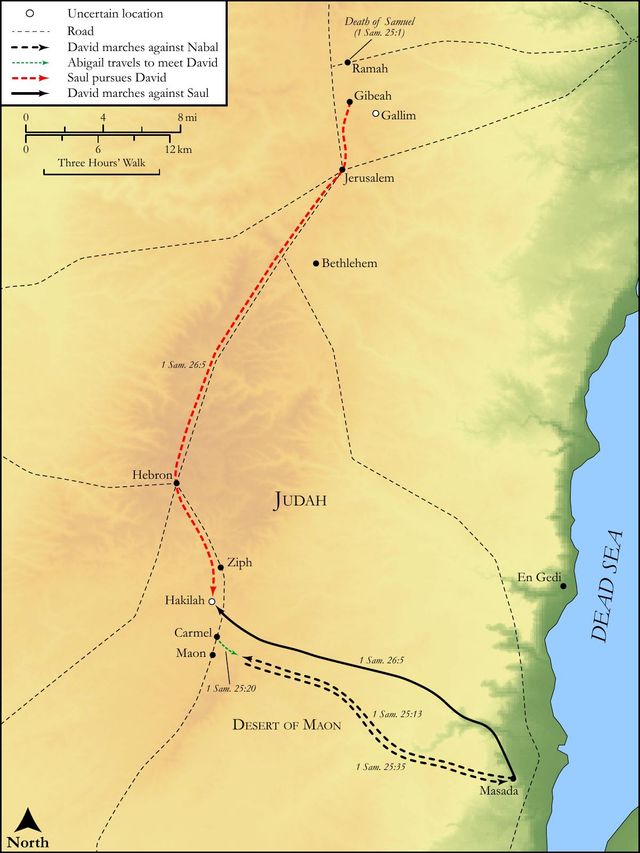
See on the biblical-era map
Study this verse
Public-domain commentary
Matthew Henry
From his Commentary on the Whole Bible. Henry comments on passages, not single verses — this entry covers 1 Samuel 26:1–5. His three-level outline is real structure in the source text, so it is rendered as structure.
Here, 1. Saul gets information of David's movements and acts offensively. The Ziphites came to him and told him where David now was, in the same place where he was when they formerly betrayed him, Sa1 23:19. Perhaps (though it is not mentioned) Saul had given them intimation, under-hand, that he continued his design against David, and would be glad of their assistance. If not, they were very officious to Saul, aware of what would please him, and very malicious against David, to whom they despaired of ever reconciling themselves, and therefore they stirred up Saul (who needed no such spur) against him, Sa1 26:1. For aught we know, Saul would have continued in the same good mind that he was in (Sa1 24:17), and would not have given David this fresh trouble, if the Ziphites had not put him on. See what need we have to pray to God that, since we have so much of the tinner of corruption in our own hearts, the sparks of temptation may be kept far from us, lest, if they come together, we be set on fire of hell. Saul readily caught at the information, and went down with an army of 3000 men to the place where David hid himself, Sa1 26:2. How soon do unsanctified hearts lose the good impressions which their convictions have made upon them and return with the dog to their vomit!
2.David gets information of Saul's movements and acts defensively. He did not march out to meet and fight him; he sought only his own safety, not Saul's ruin; therefore he abode in the wilderness (Sa1 26:3), putting thereby a great force upon himself, and curbing the bravery of his own spirit by a silent retirement, showing more true valour than he could have done by an irregular resistance.
(1.)He had spies who informed him of Saul's descent, that he had come in very deed (Sa1 26:4.); for he would not believe that Saul would deal so basely with him till he had the utmost evidence of it.
(2.)He observed with his own eyes how Saul was encamped, Sa1 26:5. He came towards the place where Saul and his men had pitched their tents, so near as to be able, undiscovered, to take a view of their entrenchments, probably in the dusk of the evening.
Historical interpretation
Historical reception
1 surviving comment on this verse from the historical church.
And David arose and came to the place where Saul was. When the Jews were persecuting Him, the Lord did not leave the province, did not withhold the benefits dispensed, but always taught in the synagogue and in the temple, where everyone gathered, and healed their sick (John 10).
Continue studying 1 Samuel 26:5 across the web’s major study libraries — every link below opens this exact verse, chapter, or book on the destination site.
Read & Compare
 BibleGatewayThis verse in more than 200 translations and 70 languages.
 Bible.comThe YouVersion reader — hundreds of translations, reading plans, and highlights.
 ESV.orgCrossway's official English Standard Version reader.
 NET BibleThe NET translation with 60,000+ translators' notes on every rendering decision.
 STEP BibleTyndale House's free study tool — original text, vocabulary, and scholarly resources.
 BibliaLogos Bible Software's free web reader.
 USCCBThe New American Bible (Revised Edition) with the U.S. bishops' study notes.
Commentaries
 BibleHub CommentariesDozens of classic commentaries on this verse, gathered on one page.
 StudyLightMore than 100 commentary sets — the largest collection on the web.
 BibleRefPlain-English commentary on what this verse means, verse by verse.
 Enduring WordDavid Guzik's free commentary on this chapter, widely used by Bible teachers.
 Bible Study ToolsVerse commentary alongside Greek and Hebrew study aids.
Original Language & Research
- BibleHub InterlinearThe verse word by word — original language, transliteration, and English.
- BibleHub LexiconEvery word's original-language definition and Strong's entry.
 Blue Letter BibleDeep-study tools — Strong's numbers, concordance, and word studies.
 SefariaThe Hebrew text with Rashi and centuries of Jewish commentary.
Sermons, Hymns & Audio


TrulyRandomVerse is not affiliated with these sites and doesn’t control their content. They’re linked because they’re genuinely useful.
Summary
1 Samuel 26:5 meticulously details David's audacious and divinely protected infiltration of King Saul's encampment in the desolate wilderness of Ziph. This pivotal scene sets the stage for David's second opportunity to take the life of his persecutor, an act he steadfastly refuses, thereby demonstrating his unwavering trust in God's sovereign timing and his profound reverence for the Lord's anointed. The verse highlights Saul's unexpected vulnerability despite being surrounded by his formidable army and chief commander, powerfully underscoring God's providential hand protecting David even in the face of extreme danger.
Context
ShowHideLiterary Context
This verse immediately follows the Ziphites' betrayal of David to Saul, prompting Saul's renewed pursuit. It serves as a striking parallel to the earlier encounter in the cave of En-gedi, where David similarly had Saul's life in his hands but chose mercy. The repetition of this scenario in 1 Samuel 26 is crucial for reinforcing David's character as a man of integrity and faith, committed to God's will rather than personal ambition or vengeance. The detailed description of Saul's camp, Abner's position, and David's undetected entry heightens the narrative tension, emphasizing the miraculous nature of David's access. This entire episode stands in stark contrast to Saul's increasingly paranoid, vengeful, and ungodly behavior, further validating David's divine appointment to the kingship over Saul's failed reign.
Historical & Cultural Context
The setting, the wilderness of Ziph, was a rugged and desolate region in the Judean hills, providing natural hiding places for David and his loyal followers. Saul's relentless pursuit of David was characteristic of the political instability and personal paranoia that plagued his reign, fueled by jealousy and his rejection by God. The presence of "Abner the son of Ner, the captain of his host," is highly significant. Abner, Saul's cousin and a formidable military leader, was responsible for the king's personal security and the army's strategic deployment. His proximity to Saul underscored the presumed impregnability of the royal encampment. In ancient Israel, the concept of "the Lord's anointed" (מְשִׁיחַ יְהוָה, māšīaḥ YHWH) conferred a sacred, inviolable status upon the king, regardless of his personal conduct. David's profound respect for this divine appointment, even when Saul actively sought his life, was not merely a personal choice but a deep theological statement, demonstrating his understanding of God's sovereignty over human institutions.
Key Themes
ShowHide1 Samuel 26:5 introduces and reinforces several critical themes permeating the book of Samuel. Firstly, it powerfully illustrates Divine Protection and Providence. David's ability to navigate a highly dangerous situation and penetrate a heavily guarded camp without detection clearly indicates God's protective hand over His chosen one, echoing promises of divine safeguarding found in passages like Psalm 121:7-8. Secondly, it highlights David's Righteous Character and Trust in God's Sovereignty, contrasting his patience and reliance on God's timing with Saul's impulsive and vengeful actions. David's refusal to harm Saul, even when given the perfect opportunity, underscores his profound Respect for God's Anointed, a principle central to the covenant relationship between God and His king, as seen in David's earlier declaration in 1 Samuel 24:6. Finally, the scene implicitly points to Saul's Vulnerability and God's Judgment, as the king, despite his military might, is exposed and helpless before the very man he seeks to destroy, a testament to God's ultimate control over human affairs and His ability to humble the proud.
Exposition and Analysis
ShowHideKey Word Analysis
ShowHideThis verb (H2583) means "to incline; by implication, to decline (of the slanting rays of evening); specifically, to pitch a tent; gen. to encamp (for abode or siege)." In 1 Samuel 26:5, its repeated use ("Saul had pitched" and "the people pitched round about him") describes the established, organized military camp of Saul and his army. It emphasizes the deliberate and presumably secure arrangement of their defensive posture, making David's infiltration all the more remarkable.
This noun (H4725) means "properly, a standing, i.e. a spot; but used widely of a locality (general or specific); also (figuratively) of a condition (of body or mind)." In this verse, "the place where Saul had pitched" and "the place where Saul lay" refers to the specific physical location of the king's encampment and his sleeping quarters within it. It underscores David's precise objective in his reconnaissance, not merely to find the camp, but to pinpoint Saul's exact position.
This noun (H4570) refers to "a track (literally or figuratively); also a rampart (as circular)." While the KJV translates it as "trench," the Hebrew maʻgâl more accurately denotes a circular encampment, a wagon-fort, or a defensive perimeter formed by wagons or shields. It suggests a central, protected area within the camp where Saul would have been sleeping, implying a measure of security. This detail highlights the apparent impregnability of Saul's position, making David's infiltration even more astonishing and indicative of divine intervention.
Verse Breakdown
ShowHide"And David arose, and came to the place where Saul had pitched"
This opening clause immediately establishes David's initiative, courage, and strategic daring. He doesn't passively wait but actively seeks out the enemy's position, indicating a deliberate and determined decision to confront the danger head-on. The act of "arising" suggests a purposeful and decisive movement.
"and David beheld the place where Saul lay"
This phrase emphasizes David's direct observation and precise intelligence gathering. He isn't merely approaching the general encampment; he is specifically locating Saul himself, indicating a focused objective for his reconnaissance and confirming the king's vulnerable position.
"and Abner the son of Ner, the captain of his host"
The inclusion of Abner's full name and title highlights the formidable opposition and the king's chief protector. Abner, as the commander of Saul's army, was responsible for the king's safety. His presence near Saul signifies the highest level of security, making David's undetected presence all the more remarkable and setting the stage for Abner's later rebuke for his failure to guard the king.
"and Saul lay in the trench"
This crucial detail specifies Saul's sleeping location within the defensive perimeter (the maʻgâl or circular encampment). It suggests a place of supposed safety and centrality within the camp, ironically underscoring his extreme vulnerability despite being surrounded by his loyal forces.
"and the people pitched round about him."
This final clause completes the vivid picture of a heavily guarded camp, with the entire army arrayed in a protective circle around the king. It reinforces the perceived impossibility of David's infiltration and magnifies the divine protection that allowed him to move freely and unseen within such a secure environment.
Literary Devices
ShowHide1 Samuel 26:5 employs several potent literary devices to enhance its impact. Irony is strikingly present, as Saul, the powerful king with a vast army and his chief commander, lies vulnerable and unaware in the very center of his "secure" encampment, while David, the hunted fugitive, moves freely and unseen. This starkly contrasts Saul's perceived strength with his actual helplessness, highlighting God's reversal of human expectations. Suspense is masterfully built through the meticulous description of David's stealthy approach and observation of the sleeping king and his guard, creating palpable tension about David's impending actions. The detailed Imagery of Saul "in the trench" and "the people pitched round about him" creates a vivid mental picture, immersing the reader in the scene and emphasizing the apparent impregnability of the camp. Furthermore, the narrative uses Contrast to differentiate David's strategic acumen and spiritual discernment from Saul's spiritual blindness and physical vulnerability. The entire scene also serves as Foreshadowing, subtly hinting at God's continued protection over David and His ultimate plan to establish David as king, despite Saul's persistent efforts to thwart it.
Theological and Thematic Connections
ShowHide1 Samuel 26:5 is more than a mere descriptive verse; it is foundational to understanding David's character and God's providential care. It underscores the profound theological principle that God's chosen instruments are protected and empowered by His Spirit, even when facing overwhelming human opposition. David's ability to penetrate Saul's heavily guarded camp is not merely a testament to his courage or military skill, but a clear demonstration of divine enablement. This event powerfully illustrates David's profound respect for God's anointing, refusing to take matters into his own hands and trusting God to remove Saul in His perfect timing. This commitment to divine sovereignty, even when personal vengeance seems justified, sets David apart as a "man after God's own heart" and provides a powerful example of faith in action, reminding believers to wait patiently for the Lord's vindication rather than seeking immediate retribution.
Reflection and Application
ShowHideThis verse, and the narrative it introduces, offers profound and enduring lessons for contemporary believers. David's audacious yet divinely protected infiltration of Saul's camp reminds us that God is actively involved in the lives of His people, providing protection and opening doors even in the most perilous circumstances. It challenges us to cultivate a deep and unwavering trust in God's sovereignty, especially when we face formidable adversaries or feel unjustly persecuted. David's subsequent decision not to harm Saul, despite having the perfect opportunity, is a powerful call to exercise patience, humility, and profound respect for authority, even when that authority is flawed, ungodly, or actively hostile. It teaches us to resist the urge for personal vengeance and to wait for God to work out His purposes, trusting that He will ultimately bring justice and vindication in His perfect timing. In our own lives, this translates to choosing forgiveness over bitterness, prayer over retaliation, and trusting God's timing over our own impatience. It encourages us to maintain integrity and a godly character even when others act unjustly towards us, knowing that our ultimate vindication comes from the Lord.
Questions for Reflection
ShowHideFAQ
ShowHideWhy did David go into Saul's camp alone, knowing the danger?
ShowHideDavid's decision to enter Saul's camp, as described in 1 Samuel 26:5, was a testament to both his strategic acumen and his profound faith. Militarily, he sought to confirm Saul's precise presence and position. More importantly, it was an act of audacious trust in God's protection and providence. David had experienced God delivering Saul into his hand before (1 Samuel 24:4), and he likely felt led by the Spirit to confront the situation directly. This bold step was not recklessness, but a demonstration of his reliance on divine guidance and a setup for another powerful display of his character and God's sovereignty.
What does "Saul lay in the trench" mean in this context?
ShowHideThe KJV translation "trench" for the Hebrew word maʻgâl (מַעְגָּל) can be somewhat misleading. As detailed in 1 Samuel 26:5, maʻgâl more accurately refers to a circular encampment, a wagon-fort, or a defensive perimeter. It implies a central, presumably secure, position within the camp where Saul would have been sleeping, surrounded by his forces and their protective formation. This detail emphasizes the apparent impregnability of Saul's position, making David's undetected infiltration even more remarkable and highlighting the divine hand at work in providing David access.
Who was Abner, and why is his presence significant in this verse?
ShowHideAbner was Saul's cousin and, crucially, the commander-in-chief ("captain of his host") of Saul's army, as noted in 1 Samuel 26:5. His presence next to Saul signifies the king's most trusted and formidable protector, responsible for his personal safety and the overall security of the camp. The fact that David could approach Saul undetected, despite Abner's close proximity and grave responsibility, underscores the depth of Saul's vulnerability and the miraculous nature of David's access. It also sets up Abner's later public humiliation when David calls out his egregious failure to guard the king's life (1 Samuel 26:14-16).
Christ-Centered Fulfillment
ShowHideThe narrative of David sparing Saul in 1 Samuel 26, initiated by David's daring reconnaissance in 1 Samuel 26:5, profoundly foreshadows the character and redemptive mission of Jesus Christ. David, the rightful king, unjustly pursued and persecuted, yet refusing to take vengeance or seize the throne by force, serves as a powerful type of Christ. Just as David trusted God's timing for his enthronement and honored the Lord's anointed, even in his fallen state, so Jesus, the true and eternal King, perfectly submitted to the Father's will. He refused to call down legions of angels to defend Himself (Matthew 26:53) or to retaliate against His persecutors, instead entrusting Himself to Him who judges justly (1 Peter 2:23). Christ, though possessing all power and authority, willingly subjected Himself to unjust suffering and death, trusting His Father for vindication and ultimate enthronement (Philippians 2:8-11). David's respect for the flawed king, Saul, points to Christ's perfect obedience to God's plan, even when it meant enduring the sin and rebellion of humanity. Jesus, the ultimate Lamb of God who takes away the sin of the world (John 1:29), did not come to destroy but to save, patiently enduring the cross to secure the kingdom not through human might or violence, but through divine love and sacrificial atonement, ultimately fulfilling all righteousness and establishing His eternal reign.