


1 Samuel 26:4
Bible text: King James Version (1769 Blayney text) · Public domain
Bible text: Berean Standard Bible · Public domain
Bible text: American Standard Version (1901) · Public domain
Bible text: World English Bible, Messianic edition · Public domain
Bible text: Geneva Bible (1599) · Public domain
Bible text: Young's Literal Translation · Public domain
- וַיִּשְׁלַחvai·yish·Lachand he sentH7971Conj-w ¦ V-Qal-ConsecImperf-3msVerb Qal Consecutive Imperfect 3rd Singular Masculineוַandיִּשְׁלַחhe sent
- דָּוִדda·VidDavidH1732N-proper-mNoun Proper Masculine
- מְרַגְּלִיםme·ra·ge·LimspiesH7270V-Piel-Prtcpl-mpVerb Piel Participle Plural Masculine Absolute
- וַיֵּדַעvai·Ye·da'and he knewH3045Conj-w ¦ V-Qal-ConsecImperf-3msVerb Qal Consecutive Imperfect 3rd Singular Masculineוַandיֵּדַעhe knew
- כִּיkithatH3588PrtParticle Conditional
- בָאva'he had comeH935V-Qal-Perf-3msVerb Qal Perfect 3rd Singular Masculine
- שָׁאוּלsha·'UlSaulH7586N-proper-mNoun Proper Masculine
- אֶל'eltoH413PrepPreposition
- נָכוֹןna·Khona certain [thing]H3559V-Niphal-Prtcpl-msVerb Niphal Participle Singular Masculine Absolute
English is a literal word-by-word gloss of the Hebrew, not the KJV's wording. Why?
This is the original text the KJV's translators worked from — each Hebrew word with its own literal English meaning in this verse, prepared by scholars at Tyndale House, Cambridge. The KJV translates whole sentences, not word by word, so its wording differs: one Hebrew word can become several English words, and the KJV may choose “the LORD” where the gloss reads “Yahweh”. Both are faithful — they answer different questions. For the KJV's own rendering, switch to the KJV text.
Details
See on the biblical-era map
Study this verse
Public-domain commentary
Matthew Henry
From his Commentary on the Whole Bible. Henry comments on passages, not single verses — this entry covers 1 Samuel 26:1–5. His three-level outline is real structure in the source text, so it is rendered as structure.
Here, 1. Saul gets information of David's movements and acts offensively. The Ziphites came to him and told him where David now was, in the same place where he was when they formerly betrayed him, Sa1 23:19. Perhaps (though it is not mentioned) Saul had given them intimation, under-hand, that he continued his design against David, and would be glad of their assistance. If not, they were very officious to Saul, aware of what would please him, and very malicious against David, to whom they despaired of ever reconciling themselves, and therefore they stirred up Saul (who needed no such spur) against him, Sa1 26:1. For aught we know, Saul would have continued in the same good mind that he was in (Sa1 24:17), and would not have given David this fresh trouble, if the Ziphites had not put him on. See what need we have to pray to God that, since we have so much of the tinner of corruption in our own hearts, the sparks of temptation may be kept far from us, lest, if they come together, we be set on fire of hell. Saul readily caught at the information, and went down with an army of 3000 men to the place where David hid himself, Sa1 26:2. How soon do unsanctified hearts lose the good impressions which their convictions have made upon them and return with the dog to their vomit!
2.David gets information of Saul's movements and acts defensively. He did not march out to meet and fight him; he sought only his own safety, not Saul's ruin; therefore he abode in the wilderness (Sa1 26:3), putting thereby a great force upon himself, and curbing the bravery of his own spirit by a silent retirement, showing more true valour than he could have done by an irregular resistance.
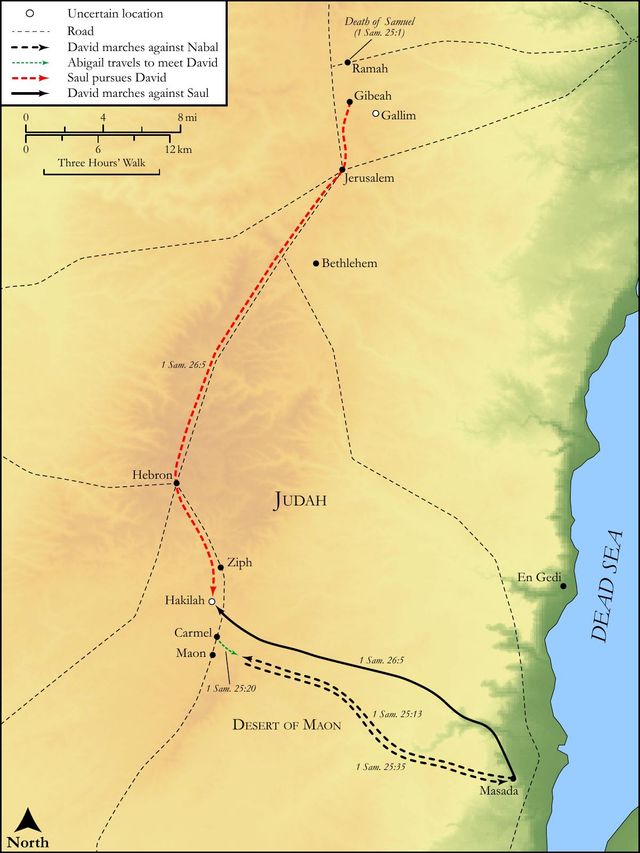
(1.)He had spies who informed him of Saul's descent, that he had come in very deed (Sa1 26:4.); for he would not believe that Saul would deal so basely with him till he had the utmost evidence of it.
(2.)He observed with his own eyes how Saul was encamped, Sa1 26:5. He came towards the place where Saul and his men had pitched their tents, so near as to be able, undiscovered, to take a view of their entrenchments, probably in the dusk of the evening.
Continue studying 1 Samuel 26:4 across the web’s major study libraries — every link below opens this exact verse, chapter, or book on the destination site.
Read & Compare
 BibleGatewayThis verse in more than 200 translations and 70 languages.
 Bible.comThe YouVersion reader — hundreds of translations, reading plans, and highlights.
 ESV.orgCrossway's official English Standard Version reader.
 NET BibleThe NET translation with 60,000+ translators' notes on every rendering decision.
 STEP BibleTyndale House's free study tool — original text, vocabulary, and scholarly resources.
 BibliaLogos Bible Software's free web reader.
 USCCBThe New American Bible (Revised Edition) with the U.S. bishops' study notes.
Commentaries
 BibleHub CommentariesDozens of classic commentaries on this verse, gathered on one page.
 StudyLightMore than 100 commentary sets — the largest collection on the web.
 BibleRefPlain-English commentary on what this verse means, verse by verse.
 Enduring WordDavid Guzik's free commentary on this chapter, widely used by Bible teachers.
 Bible Study ToolsVerse commentary alongside Greek and Hebrew study aids.
Original Language & Research
- BibleHub InterlinearThe verse word by word — original language, transliteration, and English.
- BibleHub LexiconEvery word's original-language definition and Strong's entry.
 Blue Letter BibleDeep-study tools — Strong's numbers, concordance, and word studies.
 SefariaThe Hebrew text with Rashi and centuries of Jewish commentary.
Sermons, Hymns & Audio


TrulyRandomVerse is not affiliated with these sites and doesn’t control their content. They’re linked because they’re genuinely useful.
Summary
This verse highlights David's judicious and strategic response to the renewed threat from King Saul. After receiving intelligence of a second betrayal by the Ziphites, David, rather than acting impulsively, employs reconnaissance to verify Saul's confirmed presence in the wilderness of Ziph. This action underscores David's reliance on both divine guidance and practical wisdom in navigating relentless persecution, setting the stage for his subsequent daring encounter.
Context
ShowHideLiterary Context
This verse is strategically placed immediately following the Ziphites' second betrayal of David to Saul, as detailed in 1 Samuel 26:1. This incident intentionally echoes a similar earlier betrayal in 1 Samuel 23:19-24, emphasizing the recurring danger David faced from Saul's relentless pursuit and the opportunistic nature of those seeking favor with the reigning king. David's decision to send out spies in 1 Samuel 26:4 is a direct, calculated response to this intelligence, preparing the ground for his audacious nocturnal infiltration of Saul's camp, described in 1 Samuel 26:5-12, and his second opportunity to spare Saul's life. The immediate narrative flow underscores David's strategic foresight and his reliance on verified information before taking decisive action, standing in stark contrast to Saul's often impulsive and ill-considered pursuits.
Historical & Cultural Context
The wilderness of Ziph, situated within the rugged Judean desert, was a desolate and challenging region characterized by its numerous caves, deep wadis, and sparse vegetation. This terrain offered ideal concealment for fugitives like David but also presented significant logistical challenges for travel and made surveillance a perilous necessity. The Ziphites, a local clan, likely felt a strong allegiance to King Saul or sought to curry favor by informing on David, whom the established monarchy regarded as a rebel. The practice of dispatching "spies" (מְרַגְּלִים, meraglim) was a standard military procedure in Israel and among the nations round about. It was crucial for gathering vital intelligence on enemy movements, assessing troop strength, and understanding the terrain, much like Moses sent spies to reconnoiter Canaan in Numbers 13. David's action in this verse reflects the harsh realities of survival in a hostile environment, where accurate and verified information was paramount for ensuring safety and gaining a strategic advantage.
Key Themes
ShowHideThis verse significantly contributes to several overarching themes woven throughout the Book of 1 Samuel. Firstly, it powerfully illustrates the theme of divine providence working through human prudence; while David employs human wisdom and strategy, God's protective hand is demonstrably guiding and preserving him. Secondly, it highlights David's consistent prudence and discernment, showcasing that unwavering faith in God does not negate the essential need for practical wisdom and careful planning, a characteristic that consistently distinguishes him from Saul. Thirdly, the verse exemplifies the relentless and increasingly irrational nature of Saul's pursuit of David, portraying Saul as consumed by jealousy and fear, seemingly incapable of learning from past encounters or acts of mercy, such as David sparing his life at En-gedi. Finally, it reinforces the theme of David's righteous character and his reliance on verified intelligence, contrasting sharply with Saul's impulsiveness and his tendency to act on rumor or suspicion.
Exposition and Analysis
ShowHideKey Word Analysis
ShowHideA primitive root meaning "to send away, for, or out." In this context, it denotes a deliberate act of dispatching individuals with a specific purpose. David's use of this verb emphasizes his proactive and intentional decision to gather intelligence, rather than passively awaiting further developments. It signifies a calculated move to gain control over a dangerous situation by initiating a mission to acquire critical information.
Derived from a root meaning "to walk along," but specifically used for "to reconnoiter" or "to spy out." This term refers to individuals tasked with covert observation and information gathering, often with military or strategic objectives. David's deployment of ragal indicates a meticulous and disciplined effort to obtain precise and reliable intelligence, demonstrating his strategic acumen and his commitment to verified facts over hearsay or assumptions.
A primitive root meaning "to know," "to perceive," or "to ascertain by seeing." This verb signifies the acquisition of knowledge through direct experience, observation, or thorough investigation, leading to confirmed certainty. David didn't merely hear a report; he knew with certainty, indicating the successful and reliable outcome of his reconnaissance mission. This transition from potential rumor to verified fact was crucial for his subsequent actions.
A primitive root meaning "to be erect" or "to stand perpendicular," and causatively, "to set up," "establish," "fix," or "render sure." As an idiom, "in very deed" conveys absolute certainty and confirmation. It emphasizes that Saul's presence was not merely a possibility or a rumor but a firmly established and undeniable reality. This level of verification provided David with the solid intelligence needed to formulate his precise and confident plans, enabling him to act with strategic precision rather than doubt.
Verse Breakdown
ShowHide"David therefore sent out spies"
This initial clause reveals David's immediate, calculated, and strategic response to the intelligence received from the Ziphites. Instead of reacting with panic or an immediate flight, David demonstrates remarkable prudence and foresight by initiating a reconnaissance mission. This action highlights his exceptional leadership qualities and his unwavering commitment to making informed decisions, even when under extreme pressure and facing imminent danger. It showcases a proactive approach to understanding and neutralizing the threat before making any further moves.
"and understood that Saul was come in very deed"
This second clause signifies the successful and conclusive outcome of David's intelligence-gathering operation. The spies confirmed the Ziphites' report, providing David with undeniable and absolute verification of Saul's actual presence and close proximity. The emphatic phrase "in very deed" underscores the certainty and truthfulness of the intelligence, moving David beyond mere rumor or suspicion to a confirmed, undeniable reality. This certainty was critically important for David to accurately assess the immediate danger, evaluate the terrain, and meticulously plan his next audacious move, which ultimately led to his daring night raid on Saul's camp.
Literary Devices
ShowHideThe verse primarily employs Foreshadowing and Contrast. David's meticulous act of sending out spies foreshadows the dramatic and daring night infiltration of Saul's camp that immediately follows in the narrative, signaling that David is not merely reacting defensively but is strategically preparing for a decisive encounter. This careful preparation highlights David's disciplined and measured approach, which stands in stark Contrast to Saul's often impulsive, emotionally driven, and frequently irrational actions throughout the entire book. The verse also subtly incorporates Irony; despite Saul's overwhelming military advantage and relentless pursuit, David, the hunted fugitive, maintains a strategic upper hand through his superior intelligence and wisdom, ultimately leading to Saul's vulnerability and David's moral triumph.
Theological and Thematic Connections
ShowHideThis verse, while appearing to be a straightforward report of military intelligence, carries profound theological implications. It powerfully illustrates the biblical principle that divine providence, God's sovereign care and guidance, does not negate human responsibility or the diligent exercise of wisdom. David, consistently described as a man after God's own heart, demonstrates a profound trust in God's ultimate deliverance, yet he never abandons practical prudence or strategic planning. His decisive action of sending spies reflects a mature faith that understands God often works through human means and careful preparation. This essential balance between faith and action is a recurring theme throughout Scripture, emphasizing that while God is absolutely sovereign, believers are simultaneously called to exercise discernment, gather accurate information, and act wisely and responsibly in the face of adversity. It underscores that spiritual reliance on God should inform and empower, rather than replace, strategic thinking and responsible decision-making.
Reflection and Application
ShowHideDavid's strategic prudence in 1 Samuel 26:4 offers a timeless and invaluable model for navigating the complexities and challenges of life. In a world frequently characterized by misinformation, impulsive reactions, and overwhelming pressures, David's example calls us to cultivate a spirit of careful discernment and intentionality. Before making significant decisions, especially when confronting opposition, uncertainty, or potential danger, it is profoundly wise to diligently gather reliable information, verify facts, and seek sound counsel. This approach does not imply a lack of faith in God, but rather a responsible stewardship of the wisdom and resources God graciously provides. Just as David sought to understand the undeniable reality of Saul's pursuit, we are encouraged to assess our circumstances realistically, combining prayerful reliance on God with practical, well-considered steps. This vital balance allows us to act with confidence, clarity, and effectiveness, avoiding the pitfalls of rashness or naive inaction, and ultimately honoring God through our thoughtful and discerning engagement with the world around us.
Questions for Reflection
ShowHideFAQ
ShowHideWhy did David send spies if he trusted God for protection?
ShowHideDavid's decision to send spies demonstrates a profound and mature understanding of how divine providence often works in conjunction with human responsibility and wisdom. Trusting God for protection does not imply abandoning common sense, strategic intelligence, or prudent action. Throughout Scripture, faithful individuals are consistently shown to act with foresight and make informed decisions while simultaneously relying on God's sovereign hand (for example, Nehemiah's balanced approach of prayer and watchfulness against his enemies in Nehemiah 4:9). David's action in 1 Samuel 26:4 is a prime example of "faith in action"—he trusts God to deliver him, but he also takes responsible, intelligent steps to understand his situation, assess the threat, and protect himself and his men, thereby allowing God's protection to manifest through his wise and discerning choices. It highlights that true faith is not passive resignation but active, discerning engagement with reality.
What does "in very deed" mean in this context?
ShowHideThe phrase "in very deed" (derived from the Hebrew root kûwn, H3559) emphasizes the absolute certainty, confirmation, and undeniable truthfulness of the intelligence David received. It means that the report of Saul's arrival was not merely a rumor, a suspicion, or a fleeting possibility, but a firmly established, verified, and undeniable fact. The spies' mission was successful in confirming Saul's presence beyond any shadow of a doubt. This level of certainty was critically important for David, as it allowed him to transition from a state of uncertainty to one of confirmed knowledge, enabling him to make precise and confident strategic decisions, such as his subsequent infiltration of Saul's camp, knowing exactly where Saul and his forces were located and the precise nature of the threat. It underscores the reliability and accuracy of the information David obtained.
How does David's prudence here compare to Saul's actions?
ShowHideDavid's strategic prudence and careful discernment in 1 Samuel 26:4 stand in stark contrast to King Saul's often impulsive, emotionally driven, and frequently irrational actions throughout the narrative of the Book of 1 Samuel. While David meticulously gathers intelligence, verifies facts, and acts based on confirmed information, Saul frequently reacts to rumors, personal insecurities, fits of rage, or unverified reports (for instance, his rash vow in 1 Samuel 14:24 or his unprovoked, paranoid attacks on David). David's calculated and measured approach demonstrates profound wisdom, self-control, and strategic foresight—qualities that are essential for effective and righteous leadership. In contrast, Saul's impulsiveness consistently leads to poor judgment, moral failings, and ultimately, his tragic downfall. This stark contrast highlights a key theological and narrative theme in the book: the fundamental difference between a leader chosen and blessed by God who walks in wisdom and discernment, and one who relies on his own flawed judgment and unchecked emotions.
Christ-Centered Fulfillment
ShowHideWhile 1 Samuel 26:4 describes David's strategic prudence in the face of an earthly adversary, it subtly points to the ultimate Prudence and divine Wisdom perfectly embodied in Jesus Christ. David, the hunted king-in-waiting, takes calculated steps to understand his enemy's movements, a necessary act for his survival and eventual ascent to the throne. This foreshadows Christ, the true King, who, though fully divine, walked in perfect wisdom, discernment, and strategic purpose during His earthly ministry. Jesus consistently "knew what was in man" (John 2:25), understood the malicious schemes of His adversaries (Matthew 22:18), and strategically navigated the profound opposition of religious and political powers, always fulfilling His Father's precise will. Unlike David, who sent spies to protect his own life, Christ intentionally and sovereignly laid down His life, demonstrating ultimate wisdom, obedience, and self-sacrificial love in His crucifixion, thereby securing the definitive victory over sin, death, and the powers of darkness (Philippians 2:8). His "reconnaissance" was not for self-preservation but for the eternal salvation of humanity, culminating in His triumph over the ultimate enemy, Satan, and the establishment of His everlasting kingdom (Colossians 2:15).