


1 Samuel 26:3
Bible text: King James Version (1769 Blayney text) · Public domain
Bible text: King James Version with Strong's numbers · Public domain
Bible text: Berean Standard Bible · Public domain
Bible text: American Standard Version (1901) · Public domain
Bible text: World English Bible, Messianic edition · Public domain
Bible text: Geneva Bible (1599) · Public domain
Bible text: Young's Literal Translation · Public domain
- וַיִּחַןvai·Yi·chanand he encampedH2583Conj-w ¦ V-Qal-ConsecImperf-3msVerb Qal Consecutive Imperfect 3rd Singular Masculineוַandיִּחַןhe encamped
- שָׁאוּלsha·'UlSaulH7586N-proper-mNoun Proper Masculine
- בְּגִבְעַתbe·giv·'Aton [the] hill ofH1389Prep-b ¦ N-fscNoun Singular Feminine Constructבְּonגִבְעַת[the] hill of
- הַחֲכִילָהha·cha·khi·Lah<the> HakilahH2444Art ¦ N-properNoun Proper Locationהַ<the>חֲכִילָהHakilah
- אֲשֶׁר'a·SherwhichH834RelParticle Relative
- עַל'al[was] onH5921PrepPreposition
- פְּנֵיpe·Nei[the] face ofH6440N-mpcNoun Plural Masculine Construct
- הַיְשִׁימֹןhay·shi·Mon<the> JeshimonH3452Art ¦ N-properNoun Proper Locationהַ<the>יְשִׁימֹןJeshimon
- עַל'alonH5921PrepPreposition
- הַדָּרֶךְha·Da·rekhthe wayH1870Art ¦ N-csNoun Singular common gender Absoluteהַtheדָּרֶךְway
- וְדָוִדve·da·Vidand DavidH1732Conj-w ¦ N-proper-mNoun Proper MasculineוְandדָוִדDavid
- יֹשֵׁבyo·Shev[was] dwellingH3427V-Qal-Prtcpl-msVerb Qal Participle Singular Masculine Absolute
- בַּמִּדְבָּרba·mid·Barin the wildernessH4057Prep-b ¦ N-msNoun Singular Masculine Absoluteבַּin theמִּדְבָּרwilderness
- וַיַּרְאvai·Yar'and he sawH7200Conj-w ¦ V-Qal-ConsecImperf-3msVerb Qal Consecutive Imperfect 3rd Singular Masculineוַandיַּרְאhe saw
- כִּיkithatH3588PrtParticle Conditional
- בָאva'he had comeH935V-Qal-Perf-3msVerb Qal Perfect 3rd Singular Masculine
- שָׁאוּלsha·'UlSaulH7586N-proper-mNoun Proper Masculine
- אַחֲרָיו'a·cha·Ravafter himH310Adj-mpc ¦ 3msAdjective Numerical Plural Masculine Constructאַחֲרָיafterוhim
- הַמִּדְבָּרָהha·mid·Ba·rahthe wilderness towardsH4057Art ¦ N-ms ¦ SfxNoun Singular Masculine Absoluteהַtheמִּדְבָּרָwildernessהtowards
English is a literal word-by-word gloss of the Hebrew, not the KJV's wording. Why?
This is the original text the KJV's translators worked from — each Hebrew word with its own literal English meaning in this verse, prepared by scholars at Tyndale House, Cambridge. The KJV translates whole sentences, not word by word, so its wording differs: one Hebrew word can become several English words, and the KJV may choose “the LORD” where the gloss reads “Yahweh”. Both are faithful — they answer different questions. For the KJV's own rendering, switch to the KJV text.
Details
See on the biblical-era map
Study this verse
Public-domain commentary
Matthew Henry
From his Commentary on the Whole Bible. Henry comments on passages, not single verses — this entry covers 1 Samuel 26:1–5. His three-level outline is real structure in the source text, so it is rendered as structure.
Here, 1. Saul gets information of David's movements and acts offensively. The Ziphites came to him and told him where David now was, in the same place where he was when they formerly betrayed him, Sa1 23:19. Perhaps (though it is not mentioned) Saul had given them intimation, under-hand, that he continued his design against David, and would be glad of their assistance. If not, they were very officious to Saul, aware of what would please him, and very malicious against David, to whom they despaired of ever reconciling themselves, and therefore they stirred up Saul (who needed no such spur) against him, Sa1 26:1. For aught we know, Saul would have continued in the same good mind that he was in (Sa1 24:17), and would not have given David this fresh trouble, if the Ziphites had not put him on. See what need we have to pray to God that, since we have so much of the tinner of corruption in our own hearts, the sparks of temptation may be kept far from us, lest, if they come together, we be set on fire of hell. Saul readily caught at the information, and went down with an army of 3000 men to the place where David hid himself, Sa1 26:2. How soon do unsanctified hearts lose the good impressions which their convictions have made upon them and return with the dog to their vomit!
2.David gets information of Saul's movements and acts defensively. He did not march out to meet and fight him; he sought only his own safety, not Saul's ruin; therefore he abode in the wilderness (Sa1 26:3), putting thereby a great force upon himself, and curbing the bravery of his own spirit by a silent retirement, showing more true valour than he could have done by an irregular resistance.
(1.)He had spies who informed him of Saul's descent, that he had come in very deed (Sa1 26:4.); for he would not believe that Saul would deal so basely with him till he had the utmost evidence of it.
(2.)He observed with his own eyes how Saul was encamped, Sa1 26:5. He came towards the place where Saul and his men had pitched their tents, so near as to be able, undiscovered, to take a view of their entrenchments, probably in the dusk of the evening.
Continue studying 1 Samuel 26:3 across the web’s major study libraries — every link below opens this exact verse, chapter, or book on the destination site.
Read & Compare
 BibleGatewayThis verse in more than 200 translations and 70 languages.
 Bible.comThe YouVersion reader — hundreds of translations, reading plans, and highlights.
 ESV.orgCrossway's official English Standard Version reader.
 NET BibleThe NET translation with 60,000+ translators' notes on every rendering decision.
 STEP BibleTyndale House's free study tool — original text, vocabulary, and scholarly resources.
 BibliaLogos Bible Software's free web reader.
 USCCBThe New American Bible (Revised Edition) with the U.S. bishops' study notes.
Commentaries
 BibleHub CommentariesDozens of classic commentaries on this verse, gathered on one page.
 StudyLightMore than 100 commentary sets — the largest collection on the web.
 BibleRefPlain-English commentary on what this verse means, verse by verse.
 Enduring WordDavid Guzik's free commentary on this chapter, widely used by Bible teachers.
 Bible Study ToolsVerse commentary alongside Greek and Hebrew study aids.
Original Language & Research
- BibleHub InterlinearThe verse word by word — original language, transliteration, and English.
- BibleHub LexiconEvery word's original-language definition and Strong's entry.
 Blue Letter BibleDeep-study tools — Strong's numbers, concordance, and word studies.
 SefariaThe Hebrew text with Rashi and centuries of Jewish commentary.
Sermons, Hymns & Audio


TrulyRandomVerse is not affiliated with these sites and doesn’t control their content. They’re linked because they’re genuinely useful.
Summary
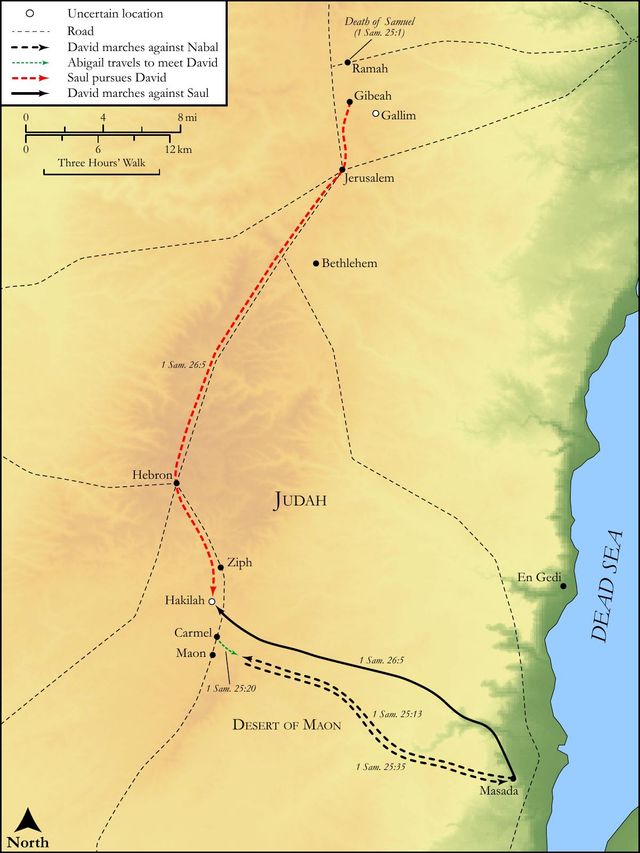
1 Samuel 26:3 powerfully depicts the escalating and obsessive pursuit of David by King Saul, who, consumed by jealousy and paranoia, strategically establishes his military camp on the hill of Hachilah, a prominent landmark before Jeshimon. Simultaneously, David, the divinely anointed but currently fugitive future king, remains hidden in the desolate wilderness, acutely aware of Saul's determined and relentless advance. This verse masterfully sets the stage for a critical confrontation, highlighting the stark contrast between Saul's desperate and misguided efforts to eliminate his perceived rival and David's precarious existence, marked by constant flight, unwavering integrity, and profound reliance on divine protection.
Context
ShowHideLiterary Context
This verse immediately plunges the reader back into the heart of the conflict between Saul and David, following a brief respite and a significant demonstration of David's character. In 1 Samuel 24, David had a clear opportunity to kill Saul in the cave of En Gedi but chose instead to spare his life, affirming his profound respect for God's anointed king and his trust in divine timing. Saul even appeared to acknowledge David's righteousness and future kingship, confessing, "You are more righteous than I" (1 Samuel 24:17). However, this apparent repentance proved fleeting. Chapter 25 narrates the death of Samuel and David's encounters with Nabal and Abigail, showcasing David's developing leadership and wisdom. Chapter 26 opens with the Ziphites, once again, betraying David's location to Saul, echoing their earlier treachery in 1 Samuel 23:19-24, which also featured the hill of Hachilah. Thus, 1 Samuel 26:3 re-establishes the core tension, underscoring Saul's persistent malice and setting the stage for another profound test of David's faith, patience, and commitment to God's will.
Historical & Cultural Context
The narrative unfolds within the nascent period of the Israelite monarchy, a turbulent era transitioning from a decentralized tribal system to a centralized kingdom. Saul, as Israel's first king, was initially chosen by God but subsequently rejected due to his disobedience and spiritual rebellion (1 Samuel 15:23). David, in contrast, had been secretly anointed by Samuel as Saul's successor (1 Samuel 16:13), representing God's chosen future for Israel. The "wilderness" (Hebrew: midbār) of Judah, particularly the region around Jeshimon (meaning "desolation" or "wasteland"), was a notoriously rugged, arid, and sparsely populated area characterized by deep wadis, steep hills, and numerous caves. This harsh environment served as an ideal natural fortress for fugitives like David but also presented immense challenges for survival. Saul's action of "pitching" a military camp (Hebrew: ḥā·nāh) signifies a formal, organized military operation, demonstrating his kingly authority and the significant resources he was willing to deploy in his personal vendetta. A crucial cultural norm of the time was the profound reverence for the "Lord's anointed" (the king), which explains David's repeated refusal to raise his hand against Saul, despite ample opportunity.
Key Themes
ShowHide1 Samuel 26:3 powerfully contributes to several overarching themes woven throughout the book of 1 Samuel. Firstly, it vividly illustrates the theme of relentless persecution and the destructive nature of unchecked jealousy and paranoia, as seen in Saul's obsessive pursuit of David despite previous opportunities for reconciliation and even his own prior acknowledgment of David's innocence. Secondly, the verse highlights David's unwavering dependence on God and his steadfast commitment to trusting divine timing, as he remains a fugitive, refusing to seize the throne through violent means or personal vengeance. His "abode in the wilderness" signifies a prolonged period of refining and testing, a spiritual crucible preparing him for the weighty responsibilities of kingship. Thirdly, the narrative implicitly reinforces the profound theme of divine providence and protection. Despite Saul's determined efforts, superior military resources, and the apparent vulnerability of David, God consistently safeguards His chosen one, demonstrating His faithfulness to His covenant and His sovereign plan. This divine oversight is a recurring motif in David's life, echoing sentiments found in passages like Psalm 34:7. The precise geographical details of Hachilah and Jeshimon emphasize the harsh realities of David's existence, making God's sustained protection all the more remarkable.
Exposition and Analysis
ShowHideKey Word Analysis
ShowHideThis verb (H2583) signifies "to encamp," "to pitch a tent," or "to set up a military camp." When applied to Saul, it conveys a deliberate, organized, and aggressive military maneuver. Saul is not merely searching; he is establishing a fortified position, indicating a serious and sustained intent to trap and eliminate David. It underscores the king's authority and resources being deployed against a single, unarmed individual, highlighting the imbalance of power and Saul's obsession.
This verb (H3427) means "to sit down," "to dwell," "to remain," or "to inhabit." In David's context, it suggests a more settled, though still precarious, existence in his hiding place. Unlike Saul's temporary military encampment, David is "dwelling" in the wilderness, emphasizing his prolonged state of being a fugitive and his adaptation to the harsh environment. It starkly contrasts Saul's aggressive movement with David's defensive, hidden posture, underscoring David's patient endurance.
This term (H4057) refers to a desolate, uncultivated, and often arid region, distinct from fertile land. In biblical narratives, the wilderness is frequently a place of testing, refuge, and divine encounter. For David, it is a place of forced exile and extreme hardship, yet also a sanctuary where he relies entirely on God for sustenance and protection. Its mention twice in the verse emphasizes the harsh reality of David's life and the extreme lengths Saul was willing to go to pursue him, highlighting the physical and spiritual crucible David endured.
Verse Breakdown
ShowHide"And Saul pitched in the hill of Hachilah, which [is] before Jeshimon, by the way."
This clause meticulously details Saul's strategic positioning. The verb "pitched" (Hebrew: ḥā·nāh) implies a formal military encampment, signifying Saul's organized and aggressive intent to hunt David down. The "hill of Hachilah" and "Jeshimon" are precise geographical markers within the rugged wilderness of Judah, known for their desolate and challenging terrain. This geographical specificity highlights the intensity and calculated nature of Saul's pursuit, indicating his intimate knowledge of David's likely hiding places and his determination to corner him.
"But David abode in the wilderness,"
This clause immediately draws a stark contrast between David's situation and Saul's. The verb "abode" (Hebrew: yā·šaḇ) suggests David's more settled, yet profoundly precarious, existence as a fugitive. He is not merely passing through but living and enduring in the wilderness, emphasizing his prolonged state of hiding, hardship, and reliance on divine provision. The implicit "but" (though not explicitly in the Hebrew conjunction) underscores the different circumstances and mindsets of the two men: one actively pursuing with power, the other patiently enduring in vulnerability.
"and he saw that Saul came after him into the wilderness."
This final clause underscores David's acute awareness and vigilance regarding the ongoing threat. He is not caught unawares or surprised; he is keenly observant and fully cognizant of Saul's relentless and determined advance. This critical awareness sets the stage for the dramatic events that follow, where David, despite his vulnerable position, once again has the opportunity to demonstrate his extraordinary character, faith, and restraint in the face of extreme provocation.
Literary Devices
ShowHideThe verse employs several effective literary devices to convey its profound meaning. Contrast is highly prominent, juxtaposing Saul's aggressive, organized "pitching" (a military action) in a specific, known location with David's precarious "abode" (a state of dwelling) in the vast, desolate "wilderness." This highlights the stark power dynamic and the differing spiritual states of the two men: one driven by earthly power and unholy obsession, the other by patient endurance and divine trust. There is also a subtle irony in the king of Israel, God's first anointed, being consumed by a destructive obsession to hunt down God's chosen future king in the wilderness—a place often associated with divine testing, preparation, and encounter with God. The repeated mention of the "wilderness" functions as powerful symbolism, representing not only a physical place of refuge and hardship but also a spiritual crucible where David's faith, character, and leadership are refined under immense duress. The precise geographical details like "Hachilah" and "Jeshimon" lend a strong sense of realism and immediacy to the narrative, grounding the intense spiritual and personal conflict in a tangible, rugged landscape.
Theological and Thematic Connections
ShowHide1 Samuel 26:3 serves as a powerful illustration of the persistent nature of unrighteous opposition and the unwavering divine protection afforded to God's chosen. Saul's relentless pursuit, driven by a heart consumed by jealousy, fear, and a tragic spiritual decline, stands in stark contrast to David's patient endurance and profound trust in God's sovereign plan. Theologically, this passage reinforces the truth that even when God's people face intense persecution and seem to be at their most vulnerable, His hand of protection remains steadfast. It challenges believers to respond to hostility not with retaliation or despair, but with a steadfast reliance on God's justice and perfect timing, understanding that ultimate vengeance belongs to the Lord (Romans 12:19). David's experience in the wilderness, though fraught with danger and hardship, was also a period of profound spiritual growth and preparation for his future role as king, demonstrating God's ability to use adversity for His redemptive purposes and to shape His servants for greater responsibilities.
Reflection and Application
ShowHideThis verse offers profound insights into how we navigate periods of intense opposition, unjust persecution, or challenging circumstances in our own lives. Like David, we may find ourselves in "wilderness" seasons—periods of isolation, vulnerability, or relentless pressure from adversaries or overwhelming situations. The narrative encourages us to cultivate a spirit of patient endurance, trusting that God is sovereign even when circumstances seem chaotic, threatening, and deeply unfair. Rather than succumbing to fear, bitterness, or the temptation to retaliate and take matters into our own hands, David's example calls us to remain steadfast in our integrity, to continue doing what is right, and to wait for God's perfect deliverance and vindication. It also serves as a sobering warning against allowing envy, insecurity, or a lust for control to consume our hearts, as these destructive emotions can lead us down a path of spiritual ruin, much like Saul's tragic trajectory. Ultimately, the verse reminds us that our true security is not found in our ability to outmaneuver our enemies or control our circumstances, but in the unwavering faithfulness and protective hand of God, who is our ultimate refuge and strength in every season of life.
Questions for Reflection
ShowHideFAQ
ShowHideWhy did Saul pursue David so relentlessly, even after David had spared his life?
ShowHideSaul's relentless pursuit of David, despite David's repeated acts of loyalty and mercy (e.g., 1 Samuel 24:1-7), stemmed primarily from a complex combination of deep-seated jealousy, paranoia, and a profound spiritual decline. Saul recognized David as a formidable threat to his throne, especially after David's anointing by Samuel (1 Samuel 16:13) and his immense popularity following the defeat of Goliath (1 Samuel 18:7-8). Saul's fear was compounded by his own rejection by God as king (1 Samuel 15:23) and the torment of an evil spirit that afflicted him (1 Samuel 16:14). His actions were not rational but driven by an unchecked obsession to eliminate his perceived rival, even at the cost of his own integrity, the well-being of his kingdom, and the very principles of justice. This relentless pursuit highlights the tragic consequences of a heart hardened against God's will.
Christ-Centered Fulfillment
ShowHide1 Samuel 26:3, with its poignant depiction of David as the unjustly pursued and hidden king, serves as a profound foreshadowing of Christ. David, the anointed one (Hebrew: mashiach), is relentlessly hunted by the reigning but rejected king, forced to dwell in the desolate wilderness, yet miraculously preserved by divine protection. This narrative arc powerfully mirrors the life of Jesus, the true Anointed King, who was born into humble circumstances and faced relentless persecution from the established religious and political authorities. From attempts on His life in infancy (Matthew 2:13-18) to the constant plots throughout His public ministry (John 7:1), Jesus was often a fugitive in His own land. Like David, Jesus frequently withdrew to desolate places for prayer and solitude (Mark 1:35) and was ultimately betrayed and hunted down by those in power. However, unlike David, who still had moments of human weakness, Jesus perfectly embodied righteousness, patience, and unwavering trust in His Father's will, even in the face of extreme suffering and death (Philippians 2:8). His "abode" on earth was one of humility and self-emptying, culminating in His ultimate sacrifice as the Lamb of God who takes away the sin of the world (John 1:29). Thus, David's wilderness experience, marked by divine preservation amidst relentless pursuit, points to the greater reality of Christ's perfect suffering, His perfect obedience, and His ultimate vindication and enthronement as the King of kings, whose kingdom is not of this world (John 18:36), a kingdom that will endure forever.