


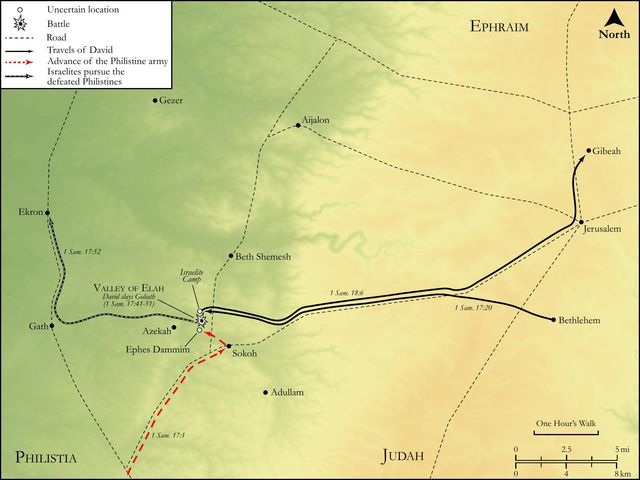
1 Samuel 17:20
Bible text: King James Version (1769 Blayney text) · Public domain
Bible text: King James Version with Strong's numbers · Public domain
Bible text: Berean Standard Bible · Public domain
Bible text: American Standard Version (1901) · Public domain
Bible text: World English Bible, Messianic edition · Public domain
Bible text: Geneva Bible (1599) · Public domain
Bible text: Young's Literal Translation · Public domain
- וַיַּשְׁכֵּםvai·yash·Kemand he rose earlyH7925Conj-w ¦ V-Hiphil-ConsecImperf-3msVerb Hiphil Consecutive Imperfect 3rd Singular Masculineוַandיַּשְׁכֵּםhe rose early
- דָּוִדda·VidDavidH1732N-proper-mNoun Proper Masculine
- בַּבֹּקֶרba·Bo·kerin the morningH1242Prep-b ¦ N-msNoun Singular Masculine Absoluteבַּin theבֹּקֶרmorning
- וַיִּטֹּשׁvai·yi·Toshand he leftH5203Conj-w ¦ V-Qal-ConsecImperf-3msVerb Qal Consecutive Imperfect 3rd Singular Masculineוַandיִּטֹּשׁhe left
- אֶת'et<obj.>H853DirObjMParticle Object Indicator
- הַצֹּאןha·tzoNthe flockH6629Art ¦ N-csNoun Singular common gender Absoluteהַtheצֹּאןflock
- עַל'alwithH5921PrepPreposition
- שֹׁמֵרsho·Mera watchmanH8104V-Qal-Prtcpl-msVerb Qal Participle Singular Masculine Absolute
- וַיִּשָּׂאvai·yi·Sa'and he lifted upH5375Conj-w ¦ V-Qal-ConsecImperf-3msVerb Qal Consecutive Imperfect 3rd Singular Masculineוַandיִּשָּׂאhe lifted up
- וַיֵּלֶךְvai·Ye·lekhand he wentH1980Conj-w ¦ V-Qal-ConsecImperf-3msVerb Qal Consecutive Imperfect 3rd Singular Masculineוַandיֵּלֶךְhe went
- כַּאֲשֶׁרka·'a·Sherjust asH834Prep-k ¦ RelParticle Relativeכַּjustאֲשֶׁרas
- צִוָּהוּtzi·Va·huhe had commanded himH6680V-Piel-Perf-3ms ¦ 3msVerb Piel Perfect 3rd Singular Masculineצִוָּhe had commandedהוּhim
- יִשָׁיyi·ShaiJesseH3448N-proper-mNoun Proper Masculine
- וַיָּבֹאvai·ya·Vo'and he cameH935Conj-w ¦ V-Qal-ConsecImperf-3msVerb Qal Consecutive Imperfect 3rd Singular Masculineוַandיָּבֹאhe came
- הַמַּעְגָּלָהha·ma'·Ga·lahthe camp towardsH4570Art ¦ N-ms ¦ SfxNoun Singular Masculine Absoluteהַtheמַּעְגָּלָcampהtowards
- וְהַחַיִלve·ha·Cha·yiland the armyH2428Conj-w ¦ Art ¦ N-msNoun Singular Masculine Absoluteוְandהַtheחַיִלarmy
- הַיֹּצֵאhai·yo·Tze'which was going outH3318Art ¦ V-Qal-Prtcpl-msVerb Qal Participle Singular Masculine Absoluteהַwhichיֹּצֵאwas going out
- אֶל'eltoH413PrepPreposition
- הַמַּעֲרָכָהha·Ma·'a·ra·Khahthe battle lineH4634Art ¦ N-fsNoun Singular Feminine Absoluteהַtheמַּעֲרָכָהbattle line
- וְהֵרֵעוּve·he·Re·'uand they shouted a war cryH7321Conj-w ¦ V-Hiphil-ConsecPerf-3cpVerb Hiphil Consecutive Perfect 3rd Plural common genderוְandהֵרֵעוּthey shouted a war cry
- בַּמִּלְחָמָהba·mil·cha·Mahin the battleH4421Prep-b ¦ N-fsNoun Singular Feminine Absoluteבַּin theמִּלְחָמָהbattle
English is a literal word-by-word gloss of the Hebrew, not the KJV's wording. Why?
This is the original text the KJV's translators worked from — each Hebrew word with its own literal English meaning in this verse, prepared by scholars at Tyndale House, Cambridge. The KJV translates whole sentences, not word by word, so its wording differs: one Hebrew word can become several English words, and the KJV may choose “the LORD” where the gloss reads “Yahweh”. Both are faithful — they answer different questions. For the KJV's own rendering, switch to the KJV text.
Details
See on the biblical-era map
Study this verse
Public-domain commentary
Matthew Henry
From his Commentary on the Whole Bible. Henry comments on passages, not single verses — this entry covers 1 Samuel 17:12–30. His four-level outline is real structure in the source text, so it is rendered as structure.
Forty days the two armies lay encamped facing one another, each advantageously posted, but neither forward to engage. Either they were parleying and treating of an accommodation or they were waiting for recruits; and perhaps there were frequent skirmishes between small detached parties. All this while, twice a day, morning and evening, did the insulting champion appear in the field and repeat his challenge, his own heart growing more and more proud for his not being answered and the people of Israel more and more timorous, while God designed hereby to ripen him for destruction and to make Israel's deliverance the more illustrious. All this while David is keeping his father's sheep, but at the end of forty days Providence brings him to the field to win and wear the laurel which no other Israelite dares venture for. We have in these verses,
I.The present state of his family.
His father was old (Sa1 17:12): He went among men for an old man, was taken notice of for his great age, above what was usual at that time, and therefore was excused from pubic services, and went not in person to the wars, but sent his sons; he had the honours paid him that were due his age, his hoary head was a crown of glory to him. David's three elder brethren, who perhaps envied his place at the court, got their father to send for him home, and let them go to the camp, where they hoped to signalize themselves and eclipse him (Sa1 17:13, Sa1 17:14), while David himself was so far from being proud of the services he had done his prince, or ambitious of further preferment, that he not only returned from court to the obscurity of his father's house, but to care, and toil, and (as it proved, Sa1 17:34) the peril, of keeping his father's sheep. It was the praise of this humility that it came after he had the honour of a courtier, and the reward of it that it came before the honour of a conqueror. Before honour is humility. Now he had that opportunity of mediation and prayer, and other acts of devotion, which fitted him for what he was destined to more than all the military exercises of that inglorious camp could do.
II.The orders his father gave him to go and visit his brethren in the camp.
He did not himself ask leave to go, to satisfy his curiosity, or to gain experience and make observations; but his father sent him on a mean and homely errand, on which any of his servants might have gone. He must carry some bread and cheese to his brethren, ten loaves with some parched corn for themselves (Sa1 17:17) and ten cheeses (which, it seems, he thought too good for them) for a present to their colonel, Sa1 17:18. David must still be the drudge of the family, though he was to be the greatest ornament of it. He had not so much as an ass at command to carry his load, but must take it on his back, and yet run to the camp. Jesse, we thought, was privy to his being anointed, and yet industriously kept him thus mean and obscure, probably to hide him from the eye of suspicion and envy, knowing that he was anointed to a crown in reversion. He must observe how his brethren fared, whether they were not reduced to short allowance, now that the encampment continued so long, that, if need were, he might send them more provisions. And he must take their pledge, that is, if they had pawned any thing, he must redeem it; take notice of their company, so some observe, whom they associate with, and what sort of life they lead. Perhaps David, like Joseph, had formerly brought to his father their evil report, and now he sends him to enquire concerning their manners. See the care the pious parents about their children when they are abroad from them, especially in places of temptation; they are solicitous how they conduct themselves, and particularly what company they keep. Let children think of this, and conduct themselves accordingly, remembering that, when they are from under their parents' eye, they are still under God's eye.
III.David's dutiful obedience to his father's command.
His prudence and care made him be up early (Sa1 17:20), and yet not to leave his sheep without a keeper, so faithful was he in a few things and therefore the fitter to be made ruler over many things, and so well had he learnt to obey before he pretended to command. God's providence brought him to the camp very seasonably, when both sides had set the battle in array, and, as it should seem, were more likely to come to an engagement than they had yet been during all the forty days, Sa1 17:21. Both sides were now preparing to fight. Jesse little thought of sending his son to the army just at that critical juncture, but the wise God orders the time and all the circumstances of actions and affairs so as to serve his designs of securing the interests of Israel and advancing the men after his own heart. Now observe here,
1.How brisk and lively David was, Sa1 17:22. What articles he brought he honestly took care of, and left them with those that had the charge of the bag and baggage; but, though he had come a long journey with a great load, he ran into the army, to see what was doing there, and to pay his respects to his brethren. Seest thou a man thus diligent in his business, he is in the way of preferment, he shall stand before kings.
2.How bold and daring the Philistine was, Sa1 17:23. Now that the armies were drawn out into a line of battle he appeared first to renew his challenge, vainly imagining that he was in the eager chase of his own glory and triumph, whereas really he was but courting his own destruction.
3.How timorous and faint-hearted the men of Israel were. Though they had, for forty days together, been used to his haughty looks and threatening language, and, having seen no execution done by either, might have learned to despise both, yet, upon his approach, they fled from him and were greatly afraid, Sa1 17:24. One Philistine could never thus have chased 1000 Israelites, and put 10,000 to flight, unless their Rock, being treacherously forsaken by them, had justly sold them, and shut them up, Deu 32:30.
4.How high Saul bid for a champion. Though he was the tallest of all the men of Israel, and, if he had not been so, while he kept close to God might himself have safely taken up the gauntlet which this insolent Philistine threw down, yet, the Spirit of the Lord having departed from him, he durst not do it, nor press Jonathan to do it; but whoever will do it shall have as good preferment as he can give him, Sa1 17:25. If the hope of wealth and honour will prevail with any man to expose himself so far, it is proclaimed that the bold adventurer, if he come off, shall marry the king's daughter and have a good portion with her; but, as it should seem, whether he come off or no, his father's house shall be free in Israel, from all toll, tribute, custom, and services to the crown, or shall be ennobled and advanced to the peerage.
5.How much concerned David was to assert the honour of God and Israel against the impudent challenges of this champion. He asked what reward was promised to him that should slay this Philistine (Sa1 17:26), though he knew already, not because he was ambitious of the honour, but because he would have it taken notice of, and reported to Saul, how much he resented the indignity hereby done to Israel and Israel's God. He might have presumed so far upon his acquaintance and interest at court as to go himself to Saul to offer his service; but his modesty would not let him do this. It was one of his own rules, before it was one of his son's proverbs, Put not forth thyself in the presence of the king, and stand not in the place of great men (Pro 25:6); yet his zeal put him upon that method which he hoped would bring him into this great engagement. Two considerations, it seems, fired David with a holy indignation: - (1.) That the challenger was one that was uncircumcised, a stranger to God and out of covenant with him. (2.) That the challenged were the armies of the living God, devoted to him, employed by him and for him, so that the affronts offered to them reflected upon the living God himself, and that he could not bear. When therefore some had told him what was the reward proposed for killing the Philistine (Sa1 17:27) he asked others (Sa1 17:30), with the same resentment, which he expected would at length come to Saul's ear.
6.How he was brow-beaten and discouraged by his eldest brother Eliab, who, taking notice of his forwardness, fell into a passion upon it, and gave David very abusive language, Sa1 17:28. Consider this,
(1.)As the fruit of Eliab's jealousy. He was the eldest brother, and David the youngest, and perhaps it had been customary with him (as it is with too many elder brothers) to trample upon him and take every occasion to chide him. But those who thus exalt themselves over their juniors may perhaps live to see themselves, by a righteous providence, abased, and those to whom they are abusive exalted. Time may come when the elder may serve the younger. But Eliab was now vexed that his younger brother should speak those bold words against the Philistine which he himself durst not say. He knew what honour David had already had in the court, and, if he should now get honour in the camp (from which he thought he had found means effectually to seclude him, Sa1 17:15), the glory of his elder brethren would be eclipsed and stained; and therefore (such is the nature of jealousy) he would rather that Goliath should triumph over Israel than that David should be the man that should triumph over him. Wrath is cruel and anger is outrageous, but who can stand before envy, especially the envy of a brother, the keenness of which Jacob, and Joseph, and David experienced? See Pro 18:19. It is very ill-favoured language that Eliab here gives him; not only unjust and unkind, but, at this time, basely ungrateful; for David was now sent by his father, as Joseph by his, on a kind of visit to his brethren. Eliab intended, in what he said, not only to grieve and discourage David himself, and quench that noble fire which he perceived glowing in his breast, but to represent him to those about him as an idle proud lad, not fit to be taken notice of. He gives them to understand that his business was only to keep sheep, and falsely insinuates that he was a careless unfaithful shepherd; though he had left his charge in good hands (Sa1 17:20), yet he must tauntingly be asked, With whom hast thou left those few sheep? Though he came down now to the camp in disobedience to his father and kindness to his brethren, and Eliab knew this, yet his coming is turned to his reproach: "Thou hast come down, not to do any service, but to gratify thy own curiosity, and only to look about thee;" and thence he will infer the pride and naughtiness of his heart, and pretends to know it as certainly as if he were in his bosom. David could appeal to God concerning his humility and sincerity (Psa 17:3; Psa 131:1) and at this time gave proofs of both, and yet could not escape this hard character from his own brother. See the folly, absurdity, and wickedness, of a proud and envious passion; how groundless its jealousies are, how unjust its censures, how unfair its representations, how bitter its invectives, and how indecent its language. God, by his grace, keep us from such a spirit!
(2.)As a trial of David's meekness, patience and constancy. A short trial it was, and he approved himself well in it; for,
[1.]He bore the provocation with admirable temper (Sa1 17:29): "What have I now done? What fault have I committed, for which I should thus be chidden? Is there not a cause for my coming to the camp, when my father sent me? Is there not a cause for my resenting the injury done to Israel's honour by Goliath's challenges?" He had right and reason on his side, and knew it, and therefore did not render railing for railing, but with a soft answer turned away his brother's wrath. This conquest of his own passion was in some respects more honourable than his conquest of Goliath. He that hath rule over his own spirit is better than the mighty. It was no time for David to quarrel with his brother when the Philistines were upon them. The more threatening the church's enemies are the more forbearing her friends should be with one another.
[2.]He broke through the discouragement with admirable resolution. He would not be driven off from his thoughts of engaging the Philistine by the ill-will of his brother. Those that undertake great and public services must not think it strange if they be discountenanced and opposed by those from whom they had reason to expect support and assistance; but must humbly go on with their work, in the face not only of their enemies' threats, but of their friends' slights and suspicions.
Historical interpretation
Two Centuries of Reception
3 surviving comments on this verse. Each one is dated, so this reads as a timeline rather than a list.
Select a marker to jump to its quote. Markers stagger vertically where authors wrote within a few decades of each other.
As David came, he found the Jewish people located in the valley of Terebinth in order to fight against the Philistines, because Christ the true David was to come in order to lift up the human race from the valley of sins and tears. They stood in a valley facing the Philistines. They were in a valley, because the weight of their sins had pressed them down. However, they were standing but did not dare to fight against their adversaries. Why did they not dare to do so? Because David who typified Christ had not yet arrived. It is true, dearly beloved. Who was able to fight against the devil before Christ our Lord freed the human race from his power? Now the word David is interpreted as strong in hand; and what is stronger, brothers, than he who conquered the whole world, armed with a cross but not a sword? Furthermore, the children of Israel stood against their adversaries for forty days. Because of the four seasons and the four parts of the world, those forty days signify the present life in which the Christian people do not cease to fight against Goliath and his army, that is, the devil and his angels. Moreover, it would be impossible to conquer, if Christ the true David had not come down with his staff which is the mystery of the cross. Truly, the devil was free before the advent of Christ, dearly beloved; but at his coming Christ did to him what is recorded in the Gospel: “No one can enter the strong man’s house, and plunder his goods, unless he first binds the strong man.” For this reason Christ came and bound the devil.
So David rose early, etc. The shadow of the law receded, truth arose from the earth; that is, the Lord in the flesh, who would minister the light of the Gospel to the world, appeared; whereby He did not abandon the ninety-nine elect sheep divinely in heaven, even when, made man, He sought the one erring sheep in the world. But He came full of grace and truth, and from His fullness we have all received, grace upon grace (John 1); the kind whom all the pious expected to come, believed in, preached, and loved.
And He came to the place of Magala, etc. The Lord appearing in the flesh found both the saints struggling for faith and the unclean spirits plotting to destroy the fortresses of faith. Such was the state of the world when the Lord was born, such it persists until the end of this age.
Continue studying 1 Samuel 17:20 across the web’s major study libraries — every link below opens this exact verse, chapter, or book on the destination site.
Read & Compare
 BibleGatewayThis verse in more than 200 translations and 70 languages.
 Bible.comThe YouVersion reader — hundreds of translations, reading plans, and highlights.
 ESV.orgCrossway's official English Standard Version reader.
 NET BibleThe NET translation with 60,000+ translators' notes on every rendering decision.
 STEP BibleTyndale House's free study tool — original text, vocabulary, and scholarly resources.
 BibliaLogos Bible Software's free web reader.
 USCCBThe New American Bible (Revised Edition) with the U.S. bishops' study notes.
Commentaries
 BibleHub CommentariesDozens of classic commentaries on this verse, gathered on one page.
 StudyLightMore than 100 commentary sets — the largest collection on the web.
 BibleRefPlain-English commentary on what this verse means, verse by verse.
 Enduring WordDavid Guzik's free commentary on this chapter, widely used by Bible teachers.
 Bible Study ToolsVerse commentary alongside Greek and Hebrew study aids.
Original Language & Research
- BibleHub InterlinearThe verse word by word — original language, transliteration, and English.
- BibleHub LexiconEvery word's original-language definition and Strong's entry.
 Blue Letter BibleDeep-study tools — Strong's numbers, concordance, and word studies.
 SefariaThe Hebrew text with Rashi and centuries of Jewish commentary.
Sermons, Hymns & Audio


TrulyRandomVerse is not affiliated with these sites and doesn’t control their content. They’re linked because they’re genuinely useful.
Summary
1 Samuel 17:20 serves as a pivotal narrative hinge, meticulously detailing David's diligent and obedient departure from his pastoral duties. He ensures the responsible care of his flock before embarking on a mission for his father, Jesse. His journey culminates in a divinely orchestrated arrival at the Israelite encampment, coinciding precisely with the army's preparation for battle. This moment thrusts David into the heart of the impending conflict with the Philistine champion, Goliath. The verse subtly yet powerfully underscores David's faithful character and God's sovereign timing, setting the stage for a transformative encounter that will profoundly alter the course of Israelite history and David's destiny.
Context
ShowHideLiterary Context
This verse is a crucial pivot point within the broader narrative of 1 Samuel 17, which recounts the dramatic confrontation between David and Goliath. The preceding verses establish a tense stalemate in the Valley of Elah, where the Philistine and Israelite armies are arrayed against each other. For forty days, Goliath, the formidable Philistine champion, has issued a daily challenge to single combat, instilling fear and demoralizing King Saul and the entire Israelite army (1 Samuel 17:1-11). David, still a young shepherd, is introduced as the youngest son of Jesse, whose three eldest brothers are already serving in Saul's army (1 Samuel 17:12-13). Jesse's instruction to David in 1 Samuel 17:17-18—to bring provisions to his brothers and their commander, and to check on their welfare—serves as the immediate catalyst for David's journey. Verse 20 marks David's faithful execution of this command, leading him directly into the unfolding crisis at the precise moment of its escalation.
Historical & Cultural Context
The setting, the Valley of Elah, was a strategically vital corridor between the Philistine plain and the Judean hills, making it a frequent point of contention between Israel and Philistia. The practice of champion warfare, where a single warrior from each side fought to decide the outcome, was a recognized method among the nations of that day, often employed to minimize casualties in large-scale military engagements. The "trench" (Hebrew: ma'agal) likely refers to a defensive perimeter, possibly a wagon fort, a circular encampment, or a prepared battle line where soldiers would gather before engaging the enemy. David's role as a shepherd, though seemingly humble, was a common and respected occupation in ancient Israel, often requiring significant responsibility, courage, and vigilance in protecting flocks from predators and thieves. His diligence in leaving the sheep "with a keeper" highlights his responsible character and adherence to good stewardship, a highly valued trait in their agrarian society. The phrase "shouted for the battle" refers to the traditional battle cry (Hebrew: rua'), a psychological weapon used to intimidate the enemy and rally one's own troops, signaling the imminent commencement of hostilities.
Key Themes
ShowHideThis verse powerfully contributes to several overarching themes in the book of 1 Samuel. Obedience and Diligence are prominently displayed in David's immediate and responsible response to his father's command. His careful stewardship of the sheep and prompt departure underscore a character trait that would serve him well as a future king, demonstrating faithfulness in "small" tasks which often precede larger callings. Divine Providence and Sovereign Timing are central; David's arrival "as the host was going forth to the fight" is far from coincidental. It highlights God's meticulous orchestration of events, positioning David at the precise moment and place where he would be needed to fulfill God's purposes, setting the stage for his confrontation with Goliath and his subsequent rise to prominence. This verse also marks a subtle but significant Transition and Preparation for David, moving him from the quiet solitude of the shepherd's field to the public arena of warfare, where his faith, courage, and leadership would be tested and revealed, foreshadowing his future anointing as king of Israel as described in 1 Samuel 16.
Exposition and Analysis
ShowHideKey Word Analysis
ShowHideThis word properly refers to "dawn" as the break of day, and generally to "morning." David's early rising signifies his eagerness, diligence, and promptness in fulfilling his father's command. It indicates a disciplined and responsible approach to his duties, setting the tone for his character throughout the narrative.
The King James Version's translation "trench" for the Hebrew word מַעֲגָל (ma'agal) can be misleading in modern English. While it can denote a circular entrenchment or a defensive line, in this context, it more broadly refers to the "camp" or "wagon fort" where the army was arrayed, or the "place of the wagons." It suggests a fortified perimeter or the specific location where the troops formed up for battle. David arrived at the very edge of the Israelite encampment, at the point of action, rather than an isolated ditch, emphasizing his direct entry into the military sphere.
The phrase "shouted for the battle" translates a form of the Hebrew verb רוּעַ (ruwa'), which signifies a loud shout, a battle cry, or a trumpet blast. It indicates the war cry raised by the soldiers as they prepared to engage the enemy. This was a common practice in ancient warfare, serving both to intimidate the opposing force and to rally one's own troops. David's arrival precisely at the moment this cry went up signifies the immediate and intense atmosphere of impending conflict, plunging him directly into the thick of the action.
Verse Breakdown
ShowHide"And David rose up early in the morning"
This clause emphasizes David's promptness, diligence, and readiness to fulfill his responsibilities without delay. His early rising indicates a strong work ethic and a disciplined character, traits that would mark his future leadership.
"and left the sheep with a keeper"
This detail highlights David's responsibility and good stewardship. He did not abandon his duties but ensured his flock was properly cared for before embarking on his new mission, demonstrating faithfulness in his current, humble role as a shepherd. This act underscores his reliability and foresight.
"and took, and went, as Jesse had commanded him"
This phrase underscores David's immediate and unquestioning obedience to his father's instructions. His actions are a direct fulfillment of Jesse's command, showing respect for parental authority and a diligent spirit. This obedience is a key aspect of his character, preparing him for God's greater call.
"and he came to the trench, as the host was going forth to the fight"
This is the pivotal moment of divine timing and orchestration. David's arrival at the camp's defensive line or staging area (ma'agal) coincides precisely with the Israelite army moving out to engage the Philistines. This "as...so" construction emphasizes the perfect synchronization of David's journey with the unfolding crisis, powerfully suggesting God's sovereign hand in orchestrating his presence at this critical juncture.
"and shouted for the battle"
This final phrase vividly describes the intense atmosphere David walked into. The "shout" is the war cry, signaling the immediate commencement of hostilities. David is not merely observing from a distance but is plunged directly into the sounds and sights of an army preparing for imminent combat, setting the stage for his unexpected and providential involvement.
Literary Devices
ShowHideThe narrative in 1 Samuel 17:20 masterfully employs several literary devices to heighten its impact and foreshadow future events. There is clear Narrative Pacing, as the verse quickly transitions David from the quiet, domestic sphere of shepherding to the tumultuous edge of battle, accelerating the plot towards the inevitable confrontation with Goliath. The precise timing of David's arrival, "as the host was going forth to the fight," exemplifies powerful Divine Irony and Foreshadowing. It is ironic that David, sent on a mundane errand to deliver provisions, arrives at the exact moment of crisis, providentially positioned to resolve the stalemate. This timing also foreshadows his crucial role as Israel's deliverer. The Juxtaposition of David's humble, pastoral duties with the grandeur and terror of an army preparing for war highlights his sudden transition and the divine hand guiding his steps. Furthermore, the detailed description of David's diligence in leaving the sheep with a keeper serves as effective Characterization, subtly revealing his responsible, faithful, and trustworthy nature, which is a prerequisite for the heroic actions he is about to undertake and for his future leadership of Israel.
Theological and Thematic Connections
ShowHide1 Samuel 17:20 profoundly illustrates the principle of divine sovereignty working through human obedience and diligence. David's faithfulness in seemingly small, mundane tasks—caring for sheep and obeying his father—positions him precisely where God intends for him to be for a momentous purpose. His early rising and diligent care for his flock are not random details but underscore a character prepared for greater responsibilities. The "coincidence" of his arrival at the very moment the armies are shouting for battle is a powerful testament to God's meticulous orchestration of events, demonstrating that even our ordinary acts of obedience can be woven into God's extraordinary plans. This verse teaches us that God often prepares us in the hidden places of faithfulness for the public arenas of His calling, and His timing is always perfect, even when it appears to us as mere happenstance. It reassures us that God is actively involved in the details of our lives, guiding our steps toward His ultimate purposes.
Reflection and Application
ShowHideDavid's journey in 1 Samuel 17:20 offers profound lessons for believers today, reminding us that God often uses our faithfulness in the ordinary to prepare us for the extraordinary. His diligence in caring for his sheep, his prompt obedience to his father, and his responsible delegation of duties all speak to a character that is ready to be used by God. We are called to cultivate a similar spirit of faithfulness in our daily lives, trusting that even seemingly insignificant tasks contribute to God's larger purposes. This means approaching our daily work, family responsibilities, and community engagements with the same care and commitment David showed for his flock. Furthermore, David's arrival at the battlefield at the precise moment the armies were preparing for war highlights the concept of divine timing. It encourages us to be present, observant, and responsive to God's leading, understanding that He orchestrates circumstances to bring us to the right place at the right time. Our readiness and obedience allow us to step into the opportunities God has prepared, even when we don't fully understand the grand design, trusting that His plan is unfolding perfectly.
Questions for Reflection
ShowHideFAQ
ShowHideWhat is the significance of David leaving the sheep "with a keeper"?
ShowHideThis detail is highly significant because it highlights David's profound sense of responsibility and diligence. As a shepherd, his primary duty was the welfare of his flock. By ensuring the sheep were left with a "keeper" (a trusted person or another capable shepherd), David demonstrated that he did not abandon his existing responsibilities carelessly, even when embarking on a new mission. This act of good stewardship reveals a foundational aspect of his character: faithfulness in the small things, which is often a prerequisite for being entrusted with greater responsibilities. It also suggests that David's departure was not impulsive but a well-considered act of obedience, reflecting his thoughtful and reliable nature.
Was David's arrival at the battlefield truly a coincidence?
ShowHideFrom a purely human perspective, David's arrival "as the host was going forth to the fight" might appear coincidental. However, from a theological standpoint, the biblical narrative strongly suggests divine orchestration. The consistent theme throughout 1 Samuel is God's sovereign hand guiding events and raising up leaders according to His will. David's journey, his obedience to Jesse, and his precise timing of arrival are presented as evidence of God's providence, positioning him exactly where he needed to be to confront Goliath and begin his rise to prominence. It underscores that God works through seemingly ordinary circumstances to accomplish His extraordinary purposes, a pattern seen throughout the biblical narrative, from Joseph's story to Esther's strategic placement.
How does David's obedience in this verse relate to his later kingship?
ShowHideDavid's prompt and responsible obedience in 1 Samuel 17:20 is foundational to his character and profoundly foreshadows his fitness for kingship. His faithfulness in caring for his father's sheep (a small "kingdom") and his immediate obedience to Jesse's command demonstrate the essential qualities of a good leader: responsibility, diligence, integrity, and respect for authority. These are the very attributes God seeks in those He raises up for leadership. His willingness to serve diligently in humble tasks, coupled with his deep trust in God (which will be vividly evident in his confrontation with Goliath), prepared him for the immense responsibilities of leading the entire nation of Israel. This verse shows David's character being shaped and tested in the "school of obedience" before he steps onto the national stage as God's chosen king.
Christ-Centered Fulfillment
ShowHide1 Samuel 17:20, with David's humble obedience and divinely orchestrated arrival at the battlefield, beautifully foreshadows the ultimate work of Christ, the greater David. Like David, who "rose up early" and obediently went as commanded by his earthly father, Jesus perfectly fulfilled the will of His heavenly Father, embodying absolute obedience even unto death on the cross (Philippians 2:8). Just as David, the shepherd, left his sheep with a keeper before embarking on his mission, Jesus, the Good Shepherd, entrusted His flock to the care of His disciples and the Holy Spirit before embarking on His ultimate mission to the cross, ensuring their protection even as He faced the ultimate battle (John 10:11-15 and John 17:11-12). Most profoundly, David's arrival at the battlefield precisely "as the host was going forth to the fight" speaks to Christ's perfect divine timing. He came into the world "in the fullness of time" (Galatians 4:4), at the very moment humanity was arrayed against the formidable, seemingly unconquerable foes of sin, death, and the devil. Jesus, the true Champion, entered the fray not merely to observe but to conquer, achieving a decisive and eternal victory over these spiritual giants that no human champion could defeat (Colossians 2:15). David's journey from shepherd to warrior, prompted by obedience and guided by providence, points to the greater Shepherd-King who, through His perfect obedience and timely sacrifice, secured eternal victory and salvation for His people (Hebrews 2:14-15).