


1 Samuel 17:55
Bible text: King James Version (1769 Blayney text) · Public domain
Bible text: King James Version with Strong's numbers · Public domain
Bible text: Berean Standard Bible · Public domain
Bible text: American Standard Version (1901) · Public domain
Bible text: World English Bible, Messianic edition · Public domain
Bible text: Geneva Bible (1599) · Public domain
Bible text: Young's Literal Translation · Public domain
- וְכִרְאוֹתve·khir·'otand just as sawH7200Conj-w ¦ Prep-k ¦ V-Qal-InfVerb Qal Infinitive Constructוְandכִjust asרְאוֹתsaw
- שָׁאוּלsha·'UlSaulH7586N-proper-mNoun Proper Masculine
- אֶת'et<obj.>H853DirObjMParticle Object Indicator
- דָּוִדda·VidDavidH1732N-proper-mNoun Proper Masculine
- יֹצֵאyo·Tze'going outH3318V-Qal-Prtcpl-msVerb Qal Participle Singular Masculine Absolute
- לִקְרַאתlik·Ratto meetH7122Prep-l ¦ V-Qal-InfVerb Qal Infinitive Constructלִtoקְרַאתmeet
- הַפְּלִשְׁתִּיha·pe·lish·Tithe PhilistineH6430Art ¦ N-msNoun Gentilic Singular Masculine AbsoluteהַtheפְּלִשְׁתִּיPhilistine
- אָמַר'a·Marhe saidH559V-Qal-Perf-3msVerb Qal Perfect 3rd Singular Masculine
- אֶל'eltoH413PrepPreposition
- אַבְנֵר'av·NerAbnerH74N-proper-mNoun Proper Masculine
- שַׂרsar[the] commander ofH8269N-mscNoun Singular Masculine Construct
- הַצָּבָאha·tza·Va'the armyH6635Art ¦ N-msNoun Singular Masculine Absoluteהַtheצָּבָאarmy
- בֶּןbenson ofH1121N-mscNoun Singular Masculine Construct
- מִיmiwhom?H4310InterrogPronoun Interrogative
- זֶהzehthisH2088PrtParticle Demonstrative
- הַנַּעַרha·Na·'ar[is] the youthH5288Art ¦ N-msNoun Singular Masculine Absoluteהַ[is] theנַּעַרyouth
- אַבְנֵר'av·NerO AbnerH74N-proper-mNoun Proper Masculine
- וַיֹּאמֶרvai·Yo·merand he saidH559Conj-w ¦ V-Qal-ConsecImperf-3msVerb Qal Consecutive Imperfect 3rd Singular Masculineוַandיֹּאמֶרhe said
- אַבְנֵר'av·NerAbnerH74N-proper-mNoun Proper Masculine
- חֵיchei[by] [the] life ofH2416Adj-mscAdjective Singular Masculine Construct
- נַפְשְׁךָnaf·she·Khayour selfH5315N-fsc ¦ 2msNoun Singular Feminine Constructנַפְשְׁselfךָyour
- הַמֶּלֶךְha·Me·lekhO kingH4428Art ¦ N-msNoun Singular Masculine AbsoluteהַOמֶּלֶךְking
- אִם'imifH518PrtParticle Conditional
- יָדָעְתִּיya·Da·'e·tiI knewH3045V-Qal-Perf-1csVerb Qal Perfect 1st Singular common gender
English is a literal word-by-word gloss of the Hebrew, not the KJV's wording. Why?
This is the original text the KJV's translators worked from — each Hebrew word with its own literal English meaning in this verse, prepared by scholars at Tyndale House, Cambridge. The KJV translates whole sentences, not word by word, so its wording differs: one Hebrew word can become several English words, and the KJV may choose “the LORD” where the gloss reads “Yahweh”. Both are faithful — they answer different questions. For the KJV's own rendering, switch to the KJV text.
Details
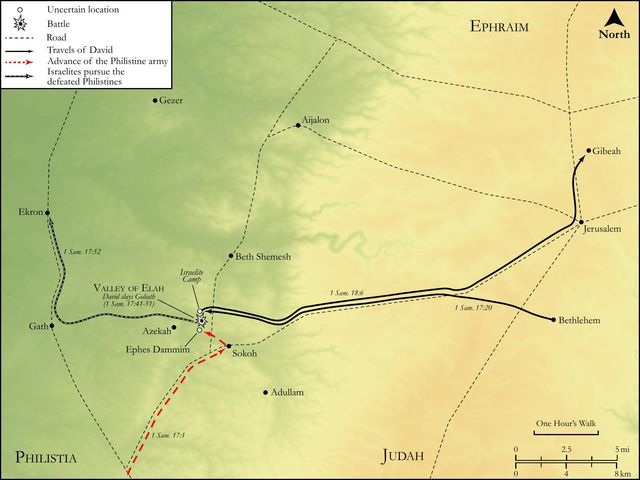
See on the biblical-era map
Study this verse
Public-domain commentary
Matthew Henry
From his Commentary on the Whole Bible. Henry comments on passages, not single verses — this entry covers 1 Samuel 17:48–58.
Here is 1. The engagement between the two champions, Sa1 17:48. To this engagement the Philistine advanced with a great deal of state and gravity; if he must encounter a pigmy, yet it shall be with the magnificence of a giant and a grandee. This is intimated in the manner of expression: He arose, and came, and drew nigh, like a stalking mountain, overlaid with brass and iron, to meet David. David advanced with no less activity and cheerfulness, as one that aimed more to do execution than to make a figure: He hasted, and ran, being lightly clad, to meet the Philistine. We may imagine with what tenderness and compassion the Israelites saw such a pleasing youth as this throwing himself into the mouth of destruction, but he knew whom he had believed and for whom he acted. 2. The fall of Goliath in this engagement. He was in no haste, because in no fear, but confident that he should soon at one stroke cleave his adversary's head; but, while he was preparing to do it solemnly, David did his business effectually, without any parade: he slang a stone which hit him in the forehead, and, in the twinkling of an eye, fetched him to the ground, Sa1 17:49. Goliath knew there were famous slingers in Israel (Jdg 20:16), yet was either so forgetful or presumptuous as to go with the beaver of his helmet open, and thither, to the only part left exposed, not so much David's art as God's providence directed the stone, and brought it with such force that it sunk into his head, notwithstanding the impudence with which his forehead was brazened. See how frail and uncertain life is, even when it thinks itself best fortified, and how quickly, how easily, and with how small a matter, the passage may be opened for life to go out and death to enter. Goliath himself has not power over the spirit to retain the spirit, Ecc 8:8. Let not the strong man glory in his strength, nor the armed man in his armour. See how God resists the proud and pours contempt upon those that bid defiance to him and his people. None ever hardened his heart against God and prospered. One of the Rabbin thinks that when Goliath said to David, Come, and I will give thy flesh to the fowls of the air, he threw up his head so hastily that his helmet fell off, and so left his broad forehead a fair mark for David. To complete the execution, David drew Goliath's own sword, a two-handed weapon for David, and with it cut off his head, Sa1 17:51. What need had David to take a sword of his own? his enemy's sword shall serve his purpose, when he has occasion for one. God is greatly glorified when his proud enemies are cut off with their own sword and he makes their own tongues to fall upon them, Psa 64:8. David's victory over Goliath was typical of the triumphs of the son of David over Satan and all the powers of darkness, whom he spoiled, and made a show of them openly (Col 2:15), and we through him are more than conquerors. 3. The defeat of the Philistines' army hereupon. They relied wholly upon the strength of their champion, and therefore, when they saw him slain, they did not, as Goliath had offered, throw down their arms and surrender themselves servants to Israel (Sa1 17:9), but took to their heels, being wholly dispirited, and thinking it to no purpose to oppose one before whom such a mighty man had fallen: They fled (Sa1 17:51), and this put life into the Israelites, who shouted and pursued them (David, it is probable, leading them on in the pursuit) even to the gates of their own cities, Sa1 17:52. In their return from the chase they seized all the baggage, plundered the tents (Sa1 17:53), and enriched themselves with the spoil. 4. David's disposal of his trophies, Sa1 17:54. He brought the head of the Philistine to Jerusalem, to be a terror to the Jebusites, who held the strong-hold of Sion: it is probable that he carried it in triumph to other cities. His armour he laid up in his tent; only the sword was preserved behind the ephod in the tabernacle, as consecrated to God, and a memorial of the victory to his honour, Sa1 21:9. 5. The notice that was taken of David. Though he had been at court formerly, yet, having been for some time absent (Sa1 17:15), Saul had forgotten him, being melancholy and mindless, and little thinking that his musician would have spirit enough to be his champion; and therefore, as if he had never seen him before, he asked whose son he was. Abner was a stranger to him, but brought him to Saul (Sa1 17:57), and he gave a modest account of himself, Sa1 17:58. And now he was introduced to the court with much greater advantages than before, in which he owned God's hand performing all things for him.
Continue studying 1 Samuel 17:55 across the web’s major study libraries — every link below opens this exact verse, chapter, or book on the destination site.
Read & Compare
 BibleGatewayThis verse in more than 200 translations and 70 languages.
 Bible.comThe YouVersion reader — hundreds of translations, reading plans, and highlights.
 ESV.orgCrossway's official English Standard Version reader.
 NET BibleThe NET translation with 60,000+ translators' notes on every rendering decision.
 STEP BibleTyndale House's free study tool — original text, vocabulary, and scholarly resources.
 BibliaLogos Bible Software's free web reader.
 USCCBThe New American Bible (Revised Edition) with the U.S. bishops' study notes.
Commentaries
 BibleHub CommentariesDozens of classic commentaries on this verse, gathered on one page.
 StudyLightMore than 100 commentary sets — the largest collection on the web.
 BibleRefPlain-English commentary on what this verse means, verse by verse.
 Enduring WordDavid Guzik's free commentary on this chapter, widely used by Bible teachers.
 Bible Study ToolsVerse commentary alongside Greek and Hebrew study aids.
Original Language & Research
- BibleHub InterlinearThe verse word by word — original language, transliteration, and English.
- BibleHub LexiconEvery word's original-language definition and Strong's entry.
 Blue Letter BibleDeep-study tools — Strong's numbers, concordance, and word studies.
 SefariaThe Hebrew text with Rashi and centuries of Jewish commentary.
Sermons, Hymns & Audio


TrulyRandomVerse is not affiliated with these sites and doesn’t control their content. They’re linked because they’re genuinely useful.
Summary
1 Samuel 17:55 captures a moment of profound dramatic irony and foreshadowing as King Saul, on the cusp of David's legendary confrontation with Goliath, asks his military commander Abner about the identity of the young man. This inquiry, coupled with Abner's frank admission of ignorance, starkly highlights David's humble and overlooked status within the royal court, setting the stage for his sudden and divinely orchestrated emergence from obscurity into national prominence through an act of extraordinary faith and courage.
Context
ShowHideLiterary Context
This verse is strategically placed at the climax of the narrative leading up to David's confrontation with Goliath. Immediately preceding it, David has arrived at the battlefield, heard Goliath's taunts, and expressed his indignation, offering to fight the giant after Saul and the entire Israelite army have been paralyzed by fear for forty days, as detailed in 1 Samuel 17:1-11. David's brothers, particularly Eliab, had initially scorned him, accusing him of pride, as recorded in 1 Samuel 17:28-29. Saul himself had initially dismissed David due to his youth, as seen in 1 Samuel 17:33. Yet, David's unwavering faith and testimony of God's past deliverance against lions and bears convinced Saul to allow him to face the Philistine champion. Saul's question in this verse, just as David steps out, underscores the king's profound lack of recognition and memory regarding David, despite David having previously served him as a skilled musician and armor-bearer, a fact established in 1 Samuel 16:19-23. This lapse emphasizes the unexpected nature of David's challenge and the divine hand at work, elevating an unknown shepherd boy.
Historical & Cultural Context
In ancient Israel, lineage and family background were paramount to one's identity, social standing, and eligibility for various roles, especially within the military or royal court. Knowing "whose son" someone was provided crucial information about their clan, tribe, and reputation. Saul's question to Abner, the commander of his army, reflects this cultural emphasis on pedigree, as he seeks to understand the background of this surprisingly courageous youth who is about to undertake a task no seasoned warrior dared. The Philistines were a formidable enemy, technologically superior with iron weaponry and militarily organized, posing an existential threat to Israel. The practice of champion warfare, where a single warrior from each side fought to decide the outcome, was a known, albeit risky, strategy to minimize casualties. Abner's ignorance of David's father, Jesse, highlights David's genuinely humble and unremarkable origins from Bethlehem, a small town in Judah, reinforcing that he was not a figure of renown within the established military or political circles.
Key Themes
ShowHideThis verse powerfully contributes to several overarching themes in the book of 1 Samuel. Firstly, it highlights Saul's spiritual and physical decline, manifested in his inability to recall or recognize David, God's chosen successor. Despite David's prior service and divine anointing, as described in 1 Samuel 16:13, Saul's focus is on human appearance and military might, rather than divine anointing or spiritual discernment, a stark contrast to God's own perspective, which looks at the heart rather than outward appearance (1 Samuel 16:7). Secondly, it underscores God's pattern of choosing the humble and overlooked to accomplish His mighty purposes. David, a mere shepherd boy, is elevated by God's sovereign hand, demonstrating that divine empowerment is not contingent upon human status or recognition. This theme resonates throughout biblical history, from Abraham to the apostles. Finally, this moment serves as a pivotal point of revelation and transition for David. His courageous act against Goliath, prompted by faith in the living God, transforms him from an obscure youth into a national hero, marking the true beginning of his public rise and paving the way for his eventual kingship over Israel.
Exposition and Analysis
ShowHideKey Word Analysis
ShowHideThis term refers to a boy or young man, typically from infancy to adolescence, implying active energy. By implication, it can also refer to a servant. Its use here emphasizes David's tender age and lack of conventional military experience, making his challenge to Goliath even more astonishing. It highlights the disparity between David's physical appearance and the immense spiritual courage he possesses, underscoring that God's power is made perfect in weakness.
This word denotes a son, derived from the idea of building the family name. In ancient Israelite culture, knowing someone's "son" (i.e., their father and lineage) was fundamental to establishing their identity, social standing, and tribal affiliation. Saul's question, "whose son [is] this youth?", is not merely casual curiosity but a deep inquiry into David's background, seeking to understand his social and familial credentials, which would typically determine his suitability for such a perilous task or his potential for future reward.
This primitive root means "to know," often implying ascertainment by seeing, and used in a wide variety of senses including observation, care, recognition, and instruction. Abner's declaration, "I cannot tell," using this verb, signifies a complete lack of knowledge or recognition of David's lineage. This is not merely a forgotten detail but a profound ignorance from the highest military commander, reinforcing David's humble and previously unremarkable status within the royal and military echelons.
Verse Breakdown
ShowHide"And when Saul saw David go forth against the Philistine"
This clause vividly sets the scene, capturing the king's immediate attention at the precise moment David, having shed Saul's ill-fitting armor, steps onto the battlefield. David is armed only with his shepherd's staff, sling, and five smooth stones, a stark contrast to the heavily armed Goliath. Saul's observation is direct and striking, indicating a sudden, profound impression made by David's audacious and unexpected move.
"he said unto Abner, the captain of the host, Abner, whose son [is] this youth?"
Saul's direct address to Abner, his chief military officer (H8269, sar ha-tsabaʼ), highlights his surprise and the urgency of his inquiry. The question "whose son [is] this youth?" reveals Saul's astonishing lack of recognition, despite David having served him previously. It indicates a profound disconnect or perhaps a troubled mind, unable to recall the young man who had ministered to him with his harp and carried his armor. This question is driven by a desire to understand the background and credentials of this unexpectedly courageous individual.
"And Abner said, [As] thy soul liveth, O king, I cannot tell."
Abner's response is a solemn oath, "As thy soul liveth" (H5315, nephesh + H2416, chay), a common and weighty affirmation in ancient Israel, indicating the truthfulness and sincerity of his statement. His declaration, "I cannot tell" (H518, ʼim + H3045, yâdaʻ), confirms that David's family and background were not known within the royal or military circles, reinforcing David's humble and previously unremarkable status. This mutual ignorance from the highest echelons of Israelite leadership underscores the divine nature of David's rise, as human wisdom and recognition were absent.
Literary Devices
ShowHideThe passage employs several potent literary devices. Irony is prominent, as Saul, the king, is utterly unaware of the identity of the very individual God has anointed to succeed him, despite David having already served in his court. This dramatic irony is amplified by the reader's knowledge from 1 Samuel 16 that David is God's chosen. Foreshadowing is also at play; Saul's inquiry about David's lineage subtly sets the stage for the establishment of David's royal dynasty, which will be central to Israel's future. The contrast between Saul's fear and David's faith, and between Saul's towering stature and David's youthful appearance, is starkly highlighted, emphasizing that God's ways are not man's ways. Furthermore, the dialogue between Saul and Abner serves to underscore David's humble origins and the unexpected nature of his emergence, making his subsequent victory even more miraculous and clearly attributable to divine intervention rather than human prowess or pedigree.
Theological and Thematic Connections
ShowHideThis verse powerfully illustrates the theological principle that God often chooses the humble, the overlooked, and the seemingly unqualified to accomplish His greatest purposes, thereby demonstrating His own power and wisdom, rather than relying on human strength or status. Saul's blindness to David's identity, despite David's prior service and divine anointing, serves as a poignant commentary on Saul's spiritual decline and his inability to discern God's hand at work. It highlights a recurring biblical theme: God's perspective on leadership and worth differs radically from human standards. While humans look at outward appearance and credentials, God looks at the heart and raises up those who are faithful to Him, regardless of their worldly standing. This divine pattern ensures that all glory redounds to Him alone, as He elevates the lowly and brings down the proud.
Reflection and Application
ShowHide1 Samuel 17:55 offers profound lessons for contemporary believers. It reminds us that God's call and preparation often occur in obscurity, far from the spotlight of human recognition. David's time as a shepherd, honing his skills and developing his faith, was his divine training ground, unseen by the king or the army. This narrative encourages us to embrace seasons of apparent insignificance, trusting that God is at work, shaping our character and equipping us for His purposes, even when we feel overlooked or undervalued by others. It challenges us to cultivate a heart that seeks God's approval above human applause, knowing that true elevation comes from Him alone. Furthermore, it serves as a caution to those in positions of leadership: to remain humble, discerning, and open to how God might be raising up unexpected individuals, lest we, like Saul, miss or forget those whom God is preparing for significant roles in His kingdom. Our worth and potential are not defined by human accolades but by God's sovereign design and empowering presence.
Questions for Reflection
ShowHideFAQ
ShowHideWhy did Saul not recognize David, even though David had served him previously?
ShowHideSaul's failure to recognize David, despite David having previously served him as a skilled musician and armor-bearer (1 Samuel 16:19-23), can be attributed to several factors. Firstly, David's prior service was likely more personal and less public; he was a court musician and a personal attendant, not a prominent military figure. Kings had many servants, and it's plausible that in the chaos and stress of war, Saul's memory was clouded. Secondly, Saul was in a state of spiritual and mental decline, tormented by an evil spirit (1 Samuel 16:14). This troubled state could have impaired his memory and discernment. Thirdly, David's appearance on the battlefield, offering to fight Goliath, was so radically different from his previous role that it might have made him seem like a completely new person in Saul's eyes. This dramatic shift from a soothing musician to a courageous warrior could have genuinely surprised the king, leading him to inquire about David's background in this new context. It also serves as a subtle theological point: Saul, who consistently failed to trust God, was increasingly blind to God's chosen instruments, whereas the Lord was clearly with David (1 Samuel 18:12).
What is the significance of Abner's oath, "As thy soul liveth"?
ShowHideAbner's phrase, "[As] thy soul liveth, O king," is a common and very strong oath in ancient Hebrew culture. It means, "By your very life, O king, what I am about to say is absolutely true." It functions as a solemn affirmation, emphasizing the sincerity and certainty of the speaker's statement. In this context, Abner's use of the oath underscores his genuine ignorance of David's lineage. He is not merely saying "I don't know," but rather, "I swear by your life, O king, that I truly have no knowledge of this youth's father." This adds weight to the fact that David was indeed an unknown figure within the royal and military establishment, making his subsequent victory even more remarkable.
Does this verse imply David was completely unknown before this moment?
ShowHideNot entirely, but it certainly emphasizes his lack of prominence or recognition in the royal court and military hierarchy. David was known to Saul personally as a musician and armor-bearer (1 Samuel 16:19-23), and he was known in his hometown of Bethlehem as Jesse's son. However, he was not a figure of national renown, a military commander, or from a prominent family that would be immediately recognized by the king or his chief general. This verse highlights that his public identity and reputation were about to be radically transformed by his encounter with Goliath. It signifies the moment he steps from personal service into public, divinely appointed leadership.
Christ-Centered Fulfillment
ShowHide1 Samuel 17:55, with Saul's profound ignorance of David's identity despite his prior service, beautifully foreshadows the Christ who came in humble obscurity, largely unrecognized by the very people He came to save. Just as David, the shepherd boy from Bethlehem, was God's anointed king-in-waiting, so too was Jesus, the Son of God, born in the humble town of Bethlehem, growing up in Nazareth, a place from which "nothing good" was expected (John 1:46). He was the true Lamb of God, who takes away the sin of the world, yet He had "no form or majesty that we should look at him, and no beauty that we should desire him" (Isaiah 53:2). Many of His own people, including their religious leaders, failed to recognize Him as the Messiah, even though He performed miracles and taught with unparalleled authority (John 1:10-11). God consistently chooses what is "foolish in the world to shame the wise; God chose what is weak in the world to shame the strong" (1 Corinthians 1:27), a principle perfectly exemplified in both David's and Christ's humble beginnings. David's victory over Goliath, the seemingly invincible foe, prefigures Christ's ultimate and decisive victory over the greater enemies of sin, death, and the devil, achieved not through worldly power but through self-sacrificial love on the cross (Colossians 2:15). Just as David, the shepherd, became king, Jesus, the Good Shepherd, is the King of Kings and Lord of Lords, whose true identity and divine authority are revealed to those with eyes of faith.