


1 Samuel 16:22
Bible text: King James Version (1769 Blayney text) · Public domain
Bible text: Berean Standard Bible · Public domain
Bible text: American Standard Version (1901) · Public domain
Bible text: World English Bible, Messianic edition · Public domain
Bible text: Geneva Bible (1599) · Public domain
Bible text: Young's Literal Translation · Public domain
- וַיִּשְׁלַחvai·yish·Lachand he sentH7971Conj-w ¦ V-Qal-ConsecImperf-3msVerb Qal Consecutive Imperfect 3rd Singular Masculineוַandיִּשְׁלַחhe sent
- שָׁאוּלsha·'UlSaulH7586N-proper-mNoun Proper Masculine
- אֶל'eltoH413PrepPreposition
- יִשַׁיyi·ShaiJesseH3448N-proper-mNoun Proper Masculine
- לֵאמֹרle·Mor<to> sayingH559Prep-l ¦ V-Qal-InfVerb Qal Infinitive Constructלֵ<to>אמֹרsaying
- יַעֲמָדya·'a·modlet him standH5975V-Qal-Imperf-3msVerb Qal Imperfect 3rd Singular Masculine
- נָאna'pleaseH4994PrtParticle Interjection
- דָוִדda·VidDavidH1732N-proper-mNoun Proper Masculine
- לְפָנַיle·fa·Nai<to> before meH6440Prep-l ¦ N-mpc ¦ 1csNoun Plural Masculine Constructלְ<to>פָנַbeforeיme
- כִּיkiforH3588PrtParticle Conditional
- מָצָאMa·tza'he has foundH4672V-Qal-Perf-3msVerb Qal Perfect 3rd Singular Masculine
- חֵןchenfavorH2580N-msNoun Singular Masculine Absolute
- בְּעֵינָיbe·'ei·Naiin my viewH5869Prep-b ¦ N-fdc ¦ 1csNoun Dual Feminine Constructבְּinעֵינָviewיmy
English is a literal word-by-word gloss of the Hebrew, not the KJV's wording. Why?
This is the original text the KJV's translators worked from — each Hebrew word with its own literal English meaning in this verse, prepared by scholars at Tyndale House, Cambridge. The KJV translates whole sentences, not word by word, so its wording differs: one Hebrew word can become several English words, and the KJV may choose “the LORD” where the gloss reads “Yahweh”. Both are faithful — they answer different questions. For the KJV's own rendering, switch to the KJV text.
Details
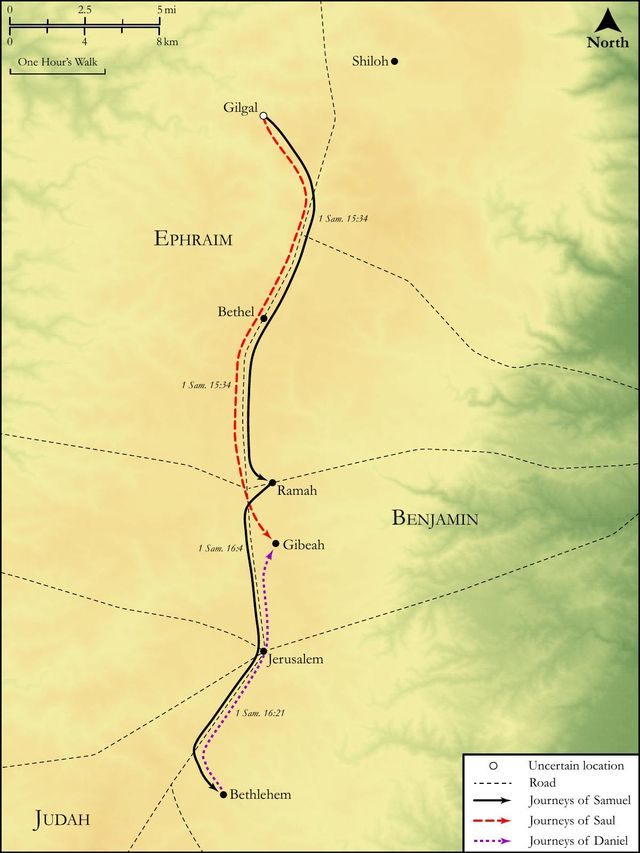
See on the biblical-era map
Study this verse
Public-domain commentary
Matthew Henry
From his Commentary on the Whole Bible. Henry comments on passages, not single verses — this entry covers 1 Samuel 16:14–23. His four-level outline is real structure in the source text, so it is rendered as structure.
We have here Saul falling and David rising.
I.Here is Saul made a terror to himself (Sa1 16:14):
The Spirit of the Lord departed from him. He having forsaken God and his duty, God, in a way of righteous judgment, withdrew from him those assistances of the good Spirit with which he was directed, animated, and encouraged in his government and wars. He lost all his good qualities. This was the effect of his rejecting God, and an evidence of his being rejected by him. Now God took his mercy from Saul (as it is expressed, Sa2 7:15); for, when the Spirit of the Lord departs from us, all good goes. When men grieve and quench the Spirit, by wilful sin, he departs, and will not always strive. The consequence of this was that an evil spirit from God troubled him. Those that drive the good Spirit away from the do of course become prey to the evil spirit. If God and his grace do not rule us, sin and Satan will have possession of us. The devil, by the divine permission, troubled and terrified Saul, by means of the corrupt humours of his body and passions of his mind. He grew fretful, and peevish, and discontented, timorous and suspicious, ever and anon starting and trembling; he was sometimes, says Josephus, as if he had been choked or strangled, and a perfect demoniac by fits. This made him unfit for business, precipitate in his counsels, the contempt of his enemies, and a burden to all about him.
II.Here is David made a physician to Saul, and by this means brought to court, a physician that helped him against the worst of diseases, when none else could. David was newly appointed privately to the kingdom. It would be of use to him to go to court and see the world; and here his doing so is brought about for him without any contrivance of his own or his friends. Note, Those whom God designs for any service his providence shall concur with his grace to prepare and qualify for it. Saul is distempered; his servants have the honesty and courage to tell him what his distemper is (Sa1 16:15), an evil spirit, not by chance but from God and his providence, troubleth thee. Now,
1.The means they all advised him to for his relief was music (Sa1 16:16): "Let us have a cunning player on the harp to attend thee." How much better friends had they been to him if they had advised him, since the evil spirit was from the Lord, to give all diligence to make his peace with God by true repentance, to send for Samuel to pray with him and to intercede with God for him! then might he not only have had some present relief, but the good Spirit would have returned to him. But their project is to make him merry, and so cure him. Many whose consciences are convinced and startled are for ever ruined by such methods as these, which drown all care of the soul in the delights of sense. Yet Saul's servants did not amiss to send for music as a help to cheer up the spirits, if they had but withal sent for a prophet to give him good counsel. And (as bishop Hall observes) it was well they did not send for a witch or diviner, by his enchantments to cast out the evil spirit, which has been the abominably wicked practice of some that have worn the Christian name, who consult the devil in their distresses and make hell their refuge. It will be no less than a miracle of divine grace if those who thus agree with Satan ever break off from him again.
2.One of his servants recommended David to him, as a fit person to be employed in the use of these means, little imagining that he was the man whom Samuel meant when he told Saul of a neighbour of his, better than he, who should have the kingdom, Sa1 15:28. It is a very high character which the servant of Saul's here gives of David (Sa1 16:18), that he was not only fit for his purpose as a comely person and skilful in playing, but a man of courage and conduct, a mighty valiant man, and prudent in all matters, fit to be further preferred, and (which crowned his character) the Lord is with him. By this it appears that though David, after he was anointed, returned to his country business, and there remained on his head no marks of the oil, so careful was he to keep that secret, yet the workings of the Spirit signified by the oil could not be hid, but made him shine in obscurity, so that all his neighbours observed with wonder the great improvements of his mind on a sudden. David, even in his shepherd's garb, has become an oracle, a champion, and every thing that is great. His fame reached the court soon, for Saul was inquisitive after such young men, Sa1 14:52. When the Spirit of God comes upon a man he will make his face to shine.
3.David is hereupon sent for to court. And it seems,
(1.)His father was very willing to part with him, sent him very readily, and a present with him to Saul, Sa1 16:20. The present was, according to the usage of those times, bread and wine (compare, Sa1 10:3, Sa1 10:4), therefore acceptable because expressive of the homage and allegiance of him that sent it. Probably Jesse, who knew what his son David was designed for, was aware that Providence was herein fitting him for it, and therefore he would not force Providence by sending him to court uncalled, yet he followed Providence very cheerfully when he saw it plainly putting him into the way of preferment. Some suggest that when Jesse received that message, Send me David thy son, he began to be afraid that Saul had got some intimation of his being anointed, and sent for him to do him a mischief, and therefore Jesse sent a present to pacify him; but it is probable that the person, whoever he was, that brought the message, gave him an account on what design he was sent for.
(2.)Saul became very kind to him (Sa1 16:21), loved him greatly, and designed to make him his armour-bearer, and (contrary to the manner of the king, Sa1 8:11) asked his father's leave to keep him in his service (Sa1 16:22): Let David, I pray thee, stand before me. And good reason he had to respect him, for he did him a great deal of service with his music, Sa1 16:23. Only his instrumental music with his harp is mentioned, but it should seem, by the account Josephus gives, that he added vocal music to it, and sung hymns, probably divine hymns, songs of praise, to his harp. David's music was Saul's physic.
[1.]Music has a natural tendency to compose and exhilarate the mind, when it is disturbed and saddened. Elisha used it for the calming of his spirits, Kg2 3:15. On some it has a greater influence and effect than on others, and, probably, Saul was one of those. Not that it charmed the evil spirit, but it made his spirit sedate, and allayed those tumults of the animal spirits by which the devil had advantage against him. The beams of the sun (it is the learned Bochart's comparison) cannot be cut with a sword, quenched with water, or blown out with wind, but, by closing the window-shutters, they may be kept out of the chamber. Music cannot work upon the devil, but it may shut up the passages by which he has access to the mind.
[2.]David's music was extraordinary, and in mercy to him, that he might gain a reputation at court, as one that had the Lord with him. God made his performances in music more successful, in this case, than those of others would have been. Saul found, even after he had conceived an enmity to David, that no one else could do him the same service (Kg2 19:9, Kg2 19:10), which was a great aggravation of his outrage against him. It is a pity that music, which may be so serviceable to the good temper of the mind, should ever be abused by any to the support of vanity and luxury, and made an occasion of drawing the heart away from God and serious things: if this be to any the effect of it, it drives away the good Spirit, not the evil spirit.
Continue studying 1 Samuel 16:22 across the web’s major study libraries — every link below opens this exact verse, chapter, or book on the destination site.
Read & Compare
 BibleGatewayThis verse in more than 200 translations and 70 languages.
 Bible.comThe YouVersion reader — hundreds of translations, reading plans, and highlights.
 ESV.orgCrossway's official English Standard Version reader.
 NET BibleThe NET translation with 60,000+ translators' notes on every rendering decision.
 STEP BibleTyndale House's free study tool — original text, vocabulary, and scholarly resources.
 BibliaLogos Bible Software's free web reader.
 USCCBThe New American Bible (Revised Edition) with the U.S. bishops' study notes.
Commentaries
 BibleHub CommentariesDozens of classic commentaries on this verse, gathered on one page.
 StudyLightMore than 100 commentary sets — the largest collection on the web.
 BibleRefPlain-English commentary on what this verse means, verse by verse.
 Enduring WordDavid Guzik's free commentary on this chapter, widely used by Bible teachers.
 Bible Study ToolsVerse commentary alongside Greek and Hebrew study aids.
Original Language & Research
- BibleHub InterlinearThe verse word by word — original language, transliteration, and English.
- BibleHub LexiconEvery word's original-language definition and Strong's entry.
 Blue Letter BibleDeep-study tools — Strong's numbers, concordance, and word studies.
 SefariaThe Hebrew text with Rashi and centuries of Jewish commentary.
Sermons, Hymns & Audio


TrulyRandomVerse is not affiliated with these sites and doesn’t control their content. They’re linked because they’re genuinely useful.
Summary
1 Samuel 16:22 marks a pivotal moment in the unfolding narrative of God's sovereign plan, formally integrating David into King Saul's royal court. This verse solidifies David's position from a temporary visitor, brought in to alleviate Saul's torment, to a permanent fixture in the king's service, all under the guise of Saul's personal preference and the unexpected favor David found in his sight. It is a crucial step in God's orchestration of David's ascent to the throne, positioning the chosen king within the very heart of the existing monarchy.
Context
ShowHideLiterary Context
This verse is a direct continuation of the narrative established in 1 Samuel 16. Earlier in the chapter, the prophet Samuel, under divine instruction, had secretly anointed David as the future king of Israel, a fact unknown to Saul or the public. Simultaneously, King Saul was being tormented by an evil spirit from the Lord, leading his servants to seek a skilled harpist to soothe him. David, described as a courageous warrior, prudent in speech, a handsome person, and one with whom the Lord was, was recommended and subsequently brought to Saul. David's musical ability proved effective in alleviating Saul's distress, as noted in 1 Samuel 16:21, leading to the king's growing affection and reliance on him. This verse represents Saul's formal request to Jesse to allow David to remain permanently, signifying David's transition from a temporary relief worker to a regular member of the king's retinue. It sets the stage for David's continued presence in the court, his later military exploits, and the eventual conflict with Saul.
Historical & Cultural Context
Among the kings of that day, the king's court was the center of power, administration, and cultural life. Individuals who "stood before" the king (a common idiom for H5975 and H6440) were typically trusted advisors, servants, or officials, indicating a position of significant access and influence. Such a position was highly sought after and often involved a complex system of patronage and loyalty. The concept of "favor" (H2580, chên) was crucial in these hierarchical societies, signifying acceptance, approval, and often, the granting of privileges or positions. For a young man like David, a shepherd from Bethlehem, to gain such favor and a permanent place in the king's court was an extraordinary elevation, indicative of a divine hand at work. Music also played a significant role in ancient courts, not just for entertainment but also for therapeutic purposes, as seen in Saul's case, and sometimes even for prophetic inspiration (2 Kings 3:15).
Key Themes
ShowHideThis verse powerfully illustrates several overarching themes within 1 Samuel and the broader biblical narrative. Firstly, it highlights Divine Orchestration and Sovereignty. Unbeknownst to Saul, God was sovereignly guiding events to bring David, the divinely chosen king, into the very heart of the existing monarchy. Saul's affliction and his subsequent "favor" for David were not accidental but part of God's larger, unseen plan to prepare David for leadership and ultimately replace Saul. This is a testament to God's ability to work through human circumstances and even human weakness to achieve His purposes, as seen throughout the book of Samuel, where God raises up and casts down kings according to His will (1 Samuel 2:7-8). Secondly, the theme of Unexpected Favor is prominent. David's elevation was not through political maneuvering or military conquest at this stage, but through a combination of his God-given talents (music, courage, wisdom, as described in 1 Samuel 16:18) and the surprising favor he found in Saul's eyes. This underscores how God can open doors in unexpected ways, even through the needs and desires of those who might later become adversaries. Finally, it speaks to Preparation for Leadership. By serving in Saul's court, David gained invaluable, on-the-job experience in royal protocol, military affairs, and understanding the complexities of governing. This period of service, though often challenging, was crucial for his development and maturation, equipping him for his future role as king of Israel.
Exposition and Analysis
ShowHideKey Word Analysis
ShowHideThis word signifies graciousness, kindness, acceptance, or goodwill. In this context, it implies that David was pleasing or agreeable to Saul, not necessarily out of deep, personal affection but because his presence and skills brought relief and benefit to the king. It denotes a practical approval and a sense of delight in David's company, laying the groundwork for David's continued service and integration into the court. This "favor" is a human expression, but the narrative subtly implies a divine hand in orchestrating it.
This primitive root means "to stand" in various relations, including to abide, be present, or serve. When combined with "before me" (from H6440, pânîym), it forms an idiom common in Scripture, denoting a position of service, attendance, or official duty in the presence of a superior, especially a king. For David, it signifies his formal integration into the royal household, moving beyond a temporary assignment to a recognized, permanent role within Saul's inner circle. It underscores the king's desire for David's continuous presence and service.
Verse Breakdown
ShowHide"And Saul sent to Jesse, saying,"
This initial clause emphasizes the king's initiative and authority. Saul, as the reigning monarch, issues a formal communication to Jesse, David's father. This act underscores the gravity of the request and David's newfound importance in the king's eyes. It's not a casual suggestion but a royal decree, indicating Saul's growing reliance on David.
"Let David, I pray thee, stand before me;"
This is the core of Saul's request. The phrase "I pray thee" (Hebrew: נָא, naʾ) adds a polite but firm tone, indicating a strong desire. "Stand before me" signifies David's official appointment to a permanent position in Saul's service. This was a position of proximity and access to the king, granting David invaluable exposure to court life, governance, and military affairs, all crucial for his future role as king.
"for he hath found favour in my sight."
This concluding clause provides the justification for Saul's request. The "favor" David found was primarily due to his ability to soothe Saul's tormented spirit through his harp playing (1 Samuel 16:21) and his overall commendable character (1 Samuel 16:18). This human favor, however, is presented within the broader divine narrative where God is actively working to elevate David, even through the seemingly mundane or personal preferences of the king.
Literary Devices
ShowHideThe verse employs several significant literary devices. Irony is powerfully present, as Saul, the king rejected by God, unknowingly brings his divinely appointed successor into his most intimate circle. Saul seeks relief from his torment, and in doing so, he embraces the very individual who will eventually replace him on the throne. This dramatic irony underscores God's sovereign control over human events. Furthermore, the narrative is imbued with Divine Providence, though not explicitly stated in this verse. The reader is aware, from earlier in the chapter, that God has already chosen and anointed David (1 Samuel 16:1-13). Saul's "favor" for David is thus not merely a human preference but a divinely orchestrated step in the unfolding of God's plan for David and for Israel. This subtle yet pervasive sense of God's unseen hand guiding events serves as a form of Foreshadowing, hinting at David's future ascent to kingship, as his presence in the court provides him with the necessary training and exposure for his eventual reign.
Theological and Thematic Connections
ShowHideThis verse beautifully illustrates the intricate ways in which God works behind the scenes to accomplish His purposes, often using human choices and circumstances that appear entirely natural. Saul's "favor" for David, while seemingly a personal preference, is deeply embedded within God's sovereign plan to elevate David to the throne. It highlights that God does not always operate through dramatic miracles but frequently through the mundane, the relational, and the seemingly coincidental. David's gifts and character made him suitable for Saul's court, but it was God's unseen hand that positioned him there, preparing him for a greater calling. This speaks to the broader theological truth that God often prepares His chosen vessels through periods of service and seemingly ordinary tasks, equipping them with the necessary experience and character for future, more significant roles. It reminds us that our present circumstances, even those that seem challenging or insignificant, can be part of God's grand design for our lives and for His kingdom.
Reflection and Application
ShowHide1 Samuel 16:22 offers profound insights into God's methods of preparing and positioning His people. For us today, it serves as a powerful reminder that our gifts and talents, when submitted to God, can open doors to unexpected opportunities and places of influence. David was simply using his skill to serve the king, yet this seemingly ordinary act was a crucial step in his divine appointment. We may find ourselves in roles or environments we never anticipated, serving people who may not even acknowledge God's hand in our presence. Yet, these very experiences can be vital for our growth, character development, and preparation for future callings. This verse encourages us to faithfully steward our abilities, to be diligent in whatever task is before us, and to trust that God is always working behind the scenes, orchestrating circumstances for His perfect will, even when the path seems unclear or the immediate purpose is simply to bring relief to another. Our "favor" in the eyes of others, or the opportunities that arise, are often God's means of positioning us for His greater purposes, shaping us into the individuals He intends to be.
Questions for Reflection
ShowHideFAQ
ShowHideWas Saul aware that David had been anointed king by Samuel?
ShowHideNo, the biblical text strongly indicates that Saul was unaware of David's anointing. The anointing by Samuel in 1 Samuel 16:1-13 was a private, prophetic act, known only to Samuel, David, and perhaps David's immediate family. Saul's request for David to "stand before me" in 1 Samuel 16:22 is based purely on David's ability to soothe him and the favor he found in David's presence. The dramatic irony of the narrative lies precisely in Saul unknowingly bringing his divinely appointed successor into his closest circle, a testament to God's sovereign and often hidden ways of working.
Why was David chosen to play the harp for Saul, and what was the significance of music?
ShowHideDavid was chosen to play the harp for Saul because Saul was being tormented by an evil spirit from the Lord, which caused him distress and fits of rage. His servants suggested finding a skilled musician to soothe him. David was recommended by one of Saul's servants, who described him as "skillful in playing, a mighty valiant man, a man of war, prudent in matters, and a comely person, and the Lord is with him" (1 Samuel 16:18). Music in ancient Israel was believed to have therapeutic and spiritual power. It could calm agitated spirits, induce prophetic states, or simply provide comfort. For Saul, David's music, empowered by the presence of the Lord with David, brought him relief from his torment (1 Samuel 16:21).
Christ-Centered Fulfillment
ShowHideThe narrative of David's entry into Saul's court, marked by divine favor and unseen orchestration, profoundly foreshadows the person and work of Jesus Christ. Just as David, the shepherd, was chosen and anointed by God to be king, so too Jesus is the ultimate Shepherd-King, the Anointed One (Christ) chosen by God from eternity past. David found "favor" in Saul's sight, a human favor that served God's divine purpose; similarly, Jesus, the Son of God, found ultimate "favor" with God the Father, as declared at His baptism ("This is my beloved Son, in whom I am well pleased" - Matthew 3:17) and transfiguration (Matthew 17:5). Furthermore, Jesus, like David, entered into the "court" of humanity, not as a political figure seeking power, but as a humble servant, bringing healing and peace to those tormented by sin and spiritual darkness. He is the true "Lamb of God, who takes away the sin of the world" (John 1:29), whose presence brings ultimate relief and reconciliation. David's preparation for kingship through service in Saul's court points to Christ's own earthly ministry, where He humbled Himself, "taking the form of a servant" (Philippians 2:7), before ascending to His rightful throne as King of kings and Lord of lords (Revelation 19:16). Ultimately, David's story is a shadow of the greater King, Jesus, who not only found favor but is the very embodiment of God's grace and favor toward humanity.