


1 Samuel 16:23
Bible text: King James Version (1769 Blayney text) · Public domain
Bible text: King James Version with Strong's numbers · Public domain
Bible text: Berean Standard Bible · Public domain
Bible text: American Standard Version (1901) · Public domain
Bible text: World English Bible, Messianic edition · Public domain
Bible text: Geneva Bible (1599) · Public domain
Bible text: Young's Literal Translation · Public domain
- וְהָיָהve·ha·Yahand it wasH1961Conj-w ¦ V-Qal-ConsecPerf-3msVerb Qal Consecutive Perfect 3rd Singular Masculineוְandהָיָהit was
- בִּהְיוֹתbih·Yotwhen wasH1961Prep-b ¦ V-Qal-InfVerb Qal Infinitive Constructבִּwhenהְיוֹתwas
- רוּחַRu·acha spirit ofH7307N-fscNoun Singular Feminine Construct
- אֱלֹהִים'E·lo·HimGodH430N-mpNoun Plural Masculine Absolute
- אֶל'eltoH413PrepPreposition
- שָׁאוּלsha·'UlSaulH7586N-proper-mNoun Proper Masculine
- וְלָקַחve·la·Kachand he tookH3947Conj-w ¦ V-Qal-ConsecPerf-3msVerb Qal Consecutive Perfect 3rd Singular Masculineוְandלָקַחhe took
- דָּוִדda·VidDavidH1732N-proper-mNoun Proper Masculine
- אֶת'et<obj.>H853DirObjMParticle Object Indicator
- הַכִּנּוֹרha·ki·Northe harpH3658Art ¦ N-msNoun Singular Masculine Absoluteהַtheכִּנּוֹרharp
- וְנִגֵּןve·ni·Genand he playedH5059Conj-w ¦ V-Piel-ConsecPerf-3msVerb Piel Consecutive Perfect 3rd Singular Masculineוְandנִגֵּןhe played
- בְּיָדוֹbe·ya·Dowith his handH3027Prep-b ¦ N-csc ¦ 3msNoun Singular common gender Constructבְּwithיָדhandוֹhis
- וְרָוַחve·ra·Vachand it was reliefH7304Conj-w ¦ V-Qal-ConsecPerf-3msVerb Qal Consecutive Perfect 3rd Singular Masculineוְandרָוַחit was relief
- לְשָׁאוּלle·sha·'Ulto SaulH7586Prep-l ¦ N-proper-mNoun Proper MasculineלְtoשָׁאוּלSaul
- וְטוֹבve·Tovand goodH2896Conj-w ¦ Adj-msAdjective Singular Masculine Absoluteוְandטוֹבgood
- לוֹlo[belonged] to <the> himPrep-l ¦ 3msSuffix Personal 3rd Singular Masculineל[belonged] to <the>וֹhim
- וְסָרָהve·Sa·rahand it departedH5493Conj-w ¦ V-Qal-ConsecPerf-3fsVerb Qal Consecutive Perfect 3rd Singular Feminineוְandסָרָהit departed
- מֵעָלָיוme·'a·Lavfrom on <the> himH5921Prep-m ¦ Prep ¦ 3msPreposition Definiteמֵfromעָלָיon <the>וhim
- רוּחַRu·ach[the] spirit ofH7307N-fscNoun Singular Feminine Construct
- הָרָעָהha·ra·'Ah<the> evilH7451Art ¦ Adj-fsAdjective Singular Feminine Absoluteהָ<the>רָעָהevil
English is a literal word-by-word gloss of the Hebrew, not the KJV's wording. Why?
This is the original text the KJV's translators worked from — each Hebrew word with its own literal English meaning in this verse, prepared by scholars at Tyndale House, Cambridge. The KJV translates whole sentences, not word by word, so its wording differs: one Hebrew word can become several English words, and the KJV may choose “the LORD” where the gloss reads “Yahweh”. Both are faithful — they answer different questions. For the KJV's own rendering, switch to the KJV text.
Details
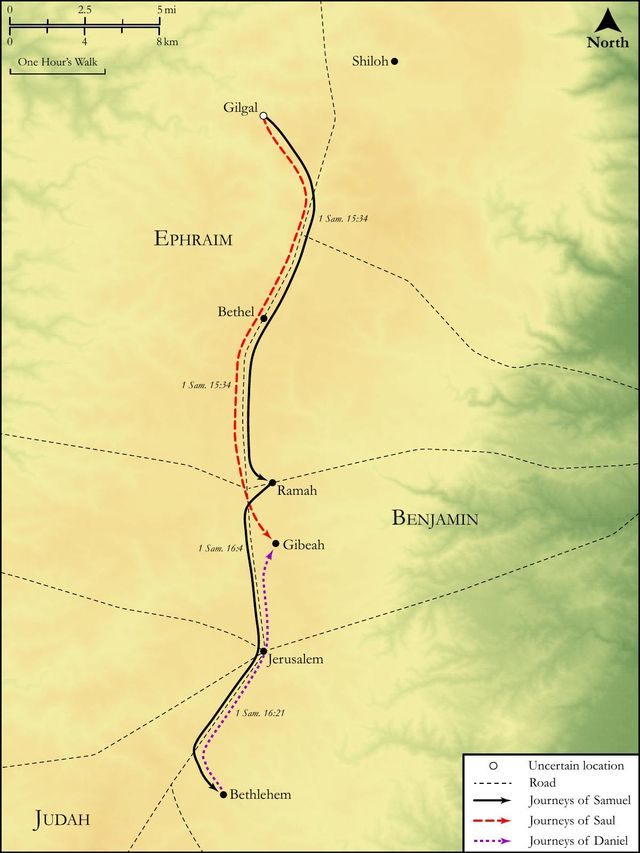
See on the biblical-era map
Study this verse
Public-domain commentary
Matthew Henry
From his Commentary on the Whole Bible. Henry comments on passages, not single verses — this entry covers 1 Samuel 16:14–23. His four-level outline is real structure in the source text, so it is rendered as structure.
We have here Saul falling and David rising.
I.Here is Saul made a terror to himself (Sa1 16:14):
The Spirit of the Lord departed from him. He having forsaken God and his duty, God, in a way of righteous judgment, withdrew from him those assistances of the good Spirit with which he was directed, animated, and encouraged in his government and wars. He lost all his good qualities. This was the effect of his rejecting God, and an evidence of his being rejected by him. Now God took his mercy from Saul (as it is expressed, Sa2 7:15); for, when the Spirit of the Lord departs from us, all good goes. When men grieve and quench the Spirit, by wilful sin, he departs, and will not always strive. The consequence of this was that an evil spirit from God troubled him. Those that drive the good Spirit away from the do of course become prey to the evil spirit. If God and his grace do not rule us, sin and Satan will have possession of us. The devil, by the divine permission, troubled and terrified Saul, by means of the corrupt humours of his body and passions of his mind. He grew fretful, and peevish, and discontented, timorous and suspicious, ever and anon starting and trembling; he was sometimes, says Josephus, as if he had been choked or strangled, and a perfect demoniac by fits. This made him unfit for business, precipitate in his counsels, the contempt of his enemies, and a burden to all about him.
II.Here is David made a physician to Saul, and by this means brought to court, a physician that helped him against the worst of diseases, when none else could. David was newly appointed privately to the kingdom. It would be of use to him to go to court and see the world; and here his doing so is brought about for him without any contrivance of his own or his friends. Note, Those whom God designs for any service his providence shall concur with his grace to prepare and qualify for it. Saul is distempered; his servants have the honesty and courage to tell him what his distemper is (Sa1 16:15), an evil spirit, not by chance but from God and his providence, troubleth thee. Now,
1.The means they all advised him to for his relief was music (Sa1 16:16): "Let us have a cunning player on the harp to attend thee." How much better friends had they been to him if they had advised him, since the evil spirit was from the Lord, to give all diligence to make his peace with God by true repentance, to send for Samuel to pray with him and to intercede with God for him! then might he not only have had some present relief, but the good Spirit would have returned to him. But their project is to make him merry, and so cure him. Many whose consciences are convinced and startled are for ever ruined by such methods as these, which drown all care of the soul in the delights of sense. Yet Saul's servants did not amiss to send for music as a help to cheer up the spirits, if they had but withal sent for a prophet to give him good counsel. And (as bishop Hall observes) it was well they did not send for a witch or diviner, by his enchantments to cast out the evil spirit, which has been the abominably wicked practice of some that have worn the Christian name, who consult the devil in their distresses and make hell their refuge. It will be no less than a miracle of divine grace if those who thus agree with Satan ever break off from him again.
2.One of his servants recommended David to him, as a fit person to be employed in the use of these means, little imagining that he was the man whom Samuel meant when he told Saul of a neighbour of his, better than he, who should have the kingdom, Sa1 15:28. It is a very high character which the servant of Saul's here gives of David (Sa1 16:18), that he was not only fit for his purpose as a comely person and skilful in playing, but a man of courage and conduct, a mighty valiant man, and prudent in all matters, fit to be further preferred, and (which crowned his character) the Lord is with him. By this it appears that though David, after he was anointed, returned to his country business, and there remained on his head no marks of the oil, so careful was he to keep that secret, yet the workings of the Spirit signified by the oil could not be hid, but made him shine in obscurity, so that all his neighbours observed with wonder the great improvements of his mind on a sudden. David, even in his shepherd's garb, has become an oracle, a champion, and every thing that is great. His fame reached the court soon, for Saul was inquisitive after such young men, Sa1 14:52. When the Spirit of God comes upon a man he will make his face to shine.
3.David is hereupon sent for to court. And it seems,
(1.)His father was very willing to part with him, sent him very readily, and a present with him to Saul, Sa1 16:20. The present was, according to the usage of those times, bread and wine (compare, Sa1 10:3, Sa1 10:4), therefore acceptable because expressive of the homage and allegiance of him that sent it. Probably Jesse, who knew what his son David was designed for, was aware that Providence was herein fitting him for it, and therefore he would not force Providence by sending him to court uncalled, yet he followed Providence very cheerfully when he saw it plainly putting him into the way of preferment. Some suggest that when Jesse received that message, Send me David thy son, he began to be afraid that Saul had got some intimation of his being anointed, and sent for him to do him a mischief, and therefore Jesse sent a present to pacify him; but it is probable that the person, whoever he was, that brought the message, gave him an account on what design he was sent for.
(2.)Saul became very kind to him (Sa1 16:21), loved him greatly, and designed to make him his armour-bearer, and (contrary to the manner of the king, Sa1 8:11) asked his father's leave to keep him in his service (Sa1 16:22): Let David, I pray thee, stand before me. And good reason he had to respect him, for he did him a great deal of service with his music, Sa1 16:23. Only his instrumental music with his harp is mentioned, but it should seem, by the account Josephus gives, that he added vocal music to it, and sung hymns, probably divine hymns, songs of praise, to his harp. David's music was Saul's physic.
[1.]Music has a natural tendency to compose and exhilarate the mind, when it is disturbed and saddened. Elisha used it for the calming of his spirits, Kg2 3:15. On some it has a greater influence and effect than on others, and, probably, Saul was one of those. Not that it charmed the evil spirit, but it made his spirit sedate, and allayed those tumults of the animal spirits by which the devil had advantage against him. The beams of the sun (it is the learned Bochart's comparison) cannot be cut with a sword, quenched with water, or blown out with wind, but, by closing the window-shutters, they may be kept out of the chamber. Music cannot work upon the devil, but it may shut up the passages by which he has access to the mind.
[2.]David's music was extraordinary, and in mercy to him, that he might gain a reputation at court, as one that had the Lord with him. God made his performances in music more successful, in this case, than those of others would have been. Saul found, even after he had conceived an enmity to David, that no one else could do him the same service (Kg2 19:9, Kg2 19:10), which was a great aggravation of his outrage against him. It is a pity that music, which may be so serviceable to the good temper of the mind, should ever be abused by any to the support of vanity and luxury, and made an occasion of drawing the heart away from God and serious things: if this be to any the effect of it, it drives away the good Spirit, not the evil spirit.
Historical interpretation
Fourteen Centuries of Reception
7 surviving comments on this verse. Each one is dated, so this reads as a timeline rather than a list.
Select a marker to jump to its quote. Markers stagger vertically where authors wrote within a few decades of each other.
Once when he came to Saul, who was frenzied and out of his right mind, he healed him by soothing his passions with song, so that Saul’s understanding returned to him again in accordance with nature. The goal, then, of the symbolism of the singing is clear from these words. It recommends that we achieve the subjugation of those passions which arise in us in various ways from the circumstances of life.
After this, you will find plenty of men and women, filled with a divine spirit, who sang of the mysteries of God. Among these was David. As a boy, he was given a special call to this office, and by God’s grace he became the prince of singers and left us a treasury of song. He was still a boy when his sweet, strong song with his harp subdued the evil spirit working in Saul. Not that there was any kind of power in the harp, but, with its wooden frame and the strings stretched across, it was a symbol of the cross of Christ. It was the passion that was being sung, and it was this which subdued the spirit of the devil.
You, a man of the church, ought to be better instructed by the music of the church than by Pythagoras. Think what David’s lyre did for Saul, who was harassed by an evil spirit but recovered from this disturbance when the holy man played his lyre; beware of thinking the concupiscence of the flesh is a good merely because it is sometimes checked by musical sounds.
The discipline of music incorporates great power and knowledge which brings delight; teachers of secular literature, through the generosity of God who grants all that is useful, have made it possible through theoretical texts to ascertain what was earlier regarded as hidden from view in the nature of the world. The first division of this discipline, then, is into harmonics, rhythmics and metrics. The second division, that of musical instruments, is between percussion, strings and wind. The third division is into six harmonies, the fourth into fifteen tones. In this way the virtue of this most beautiful discipline is unfolded by such distinctions drawn by people of old. We read in secular works that many miracles were brought forth by these measures. But we need say nothing of this fabulous material; we read that by means of David’s tuneful harp the demon was expelled from Saul. The divine reading attests that the walls of Jericho at once collapsed at the din of trumpets. So there is no doubt that sounds of music, at the Lord’s command or with his permission, have unleashed great forces.
Indeed, we should not disregard the fact that whenever the evil spirit possessed Saul, David took his harp and soothed his madness. What is symbolized by Saul but the pride of the mighty and what by David but the lowly life of the saints? As often, therefore, as Saul was possessed by the unclean spirit, his madness was soothed by David’s singing. So, too, whenever the disposition of people in power is turned to raving anger by pride, it is proper that we should recall them to a healthy frame of mind by gentle words, sweet tones of the harp, as it were.
Therefore whenever the evil spirit of God seized Saul, etc. The sense is clear from the preceding, and it is suitable not only to the faithful Jews but also to us. For it must be that whenever any temptation of the evil spirit seizes our mind and turns it away from the tranquility of its state, whoever of the spiritual brothers is present should bring to our memory the humility of the Lord's passion, earnestly exhorting us; because He who was innocent and just sustained the punishment of the cross for us voluntarily, leaving indeed an example that following His steps, we may act innocently in prosperity and patiently in adversity. Thus it will come to be that, refreshed by brotherly consolation as if by David's playing of the harp, we may bear it more lightly. For David always signifies our Redeemer, but sometimes in himself, sometimes in his members: and with the departure of the dire spirit's influence, immediately the grace of the Holy Spirit succeeding will enlighten us. But if it moves anyone why the Spirit is called both of God and evil; let him know that it is called of God indeed because of His most just permission, but evil because of the most wicked will of that spirit. For God uses even evil spirits for the testing of some, for punishment or correction, or even for the maintenance of good things. For testing, indeed, as the Lord tested blessed Job by allowing Satan; for punishment, as the lying spirit deceived King Ahab to perish in battle because of his preceding crimes by the Lord's permission; for correction, as the Apostle handed over the sinner in Corinth to Satan (I Cor. V), that his spirit might be saved in the day of the Lord Jesus. Furthermore, for the preservation of virtues, as the same Apostle, lest he be exalted by the greatness of revelations, received an angel of Satan to buffet him (II Cor. XII). Josephus mentions this passage in his history of Antiquities: "And Saul was suddenly seized by certain passions and demons, bringing him suffocations and distress;" and a little later: "They ordered, he says, that when demons attacked and disturbed him, standing over his head, he should play the harp and sing hymns." For it is not to be thought that that harp, however sweetly sounding, could have had such great power as to drive away evil spirits; but the figure of the holy cross, and the very passion of the Lord which was sung, already then was breaking the audacity of the devil; just as the destroying angel of Egypt did not pass by because of the virtue of the blood placed on the doorposts (Exod. XII), but because that blood was a type: the place of the middle lintel, and of each doorpost, where it was anointed, expressed the very figure of the salutary cross. The angel passed by the houses of the Hebrews, seeing them marked, unharmed, by the divine foreknowledge, indicating the coming of Him in the flesh who would by His blood through the cross free us from eternal death.
Departed from him: Chased away by David's devotion.
Continue studying 1 Samuel 16:23 across the web’s major study libraries — every link below opens this exact verse, chapter, or book on the destination site.
Read & Compare
 BibleGatewayThis verse in more than 200 translations and 70 languages.
 Bible.comThe YouVersion reader — hundreds of translations, reading plans, and highlights.
 ESV.orgCrossway's official English Standard Version reader.
 NET BibleThe NET translation with 60,000+ translators' notes on every rendering decision.
 STEP BibleTyndale House's free study tool — original text, vocabulary, and scholarly resources.
 BibliaLogos Bible Software's free web reader.
 USCCBThe New American Bible (Revised Edition) with the U.S. bishops' study notes.
Commentaries
 BibleHub CommentariesDozens of classic commentaries on this verse, gathered on one page.
 StudyLightMore than 100 commentary sets — the largest collection on the web.
 BibleRefPlain-English commentary on what this verse means, verse by verse.
 Enduring WordDavid Guzik's free commentary on this chapter, widely used by Bible teachers.
 Bible Study ToolsVerse commentary alongside Greek and Hebrew study aids.
Original Language & Research
- BibleHub InterlinearThe verse word by word — original language, transliteration, and English.
- BibleHub LexiconEvery word's original-language definition and Strong's entry.
 Blue Letter BibleDeep-study tools — Strong's numbers, concordance, and word studies.
 SefariaThe Hebrew text with Rashi and centuries of Jewish commentary.
Sermons, Hymns & Audio


TrulyRandomVerse is not affiliated with these sites and doesn’t control their content. They’re linked because they’re genuinely useful.
Summary
1 Samuel 16:23 masterfully depicts the providential convergence of divine judgment and sovereign grace, as the young David, God's chosen and anointed servant, enters King Saul's court. Through his divinely-empowered musical gift, David provides temporary solace to the king, who is tormented by an afflicting spirit permitted by God, thereby demonstrating God's meticulous orchestration of events to position His anointed for future leadership and revealing the profound spiritual impact of God-ordained gifts.
Context
ShowHideLiterary Context
This verse serves as the climactic and pivotal moment in a divinely orchestrated narrative that sets the stage for the transition of Israel's monarchy. It immediately follows the Lord's definitive rejection of Saul as king due to his persistent disobedience, a rejection vividly detailed in 1 Samuel 15. In stark contrast, God sovereignly chooses and anoints David through the prophet Samuel, an event recounted in 1 Samuel 16:1-13. The departure of the Spirit of the Lord from Saul and the subsequent torment by an "evil spirit from the Lord" (as described in 1 Samuel 16:14) creates the desperate need for relief that leads to David's introduction. Saul's servants, seeking a remedy for their afflicted king, recommend a skilled musician, leading directly to David's recruitment and the description of his impressive qualities in 1 Samuel 16:18. This entire sequence meticulously reveals God's active hand in bringing His chosen king into the royal court, preparing him for the throne and the fulfillment of His covenant purposes.
Historical & Cultural Context
In the days of Israel's kings, particularly within royal courts, the presence of musicians, poets, and wise advisors was a common and integral feature. Music, beyond mere entertainment, often carried significant spiritual, therapeutic, and even magical connotations. It was believed to influence moods, evoke divine presence, and, in some contexts, ward off malevolent influences. The concept of spirits, both benevolent and malevolent, was deeply embedded in the worldview of the time. While the text states an "evil spirit from God" afflicted Saul, this does not imply that God is the author of evil. Rather, it underscores His ultimate sovereignty over all spiritual forces, even permitting or sending afflictions as a consequence of sin or for His divine purposes. Saul's condition, whether interpreted as a severe psychological affliction (such as deep depression, paranoia, or fits of rage) or a literal demonic oppression, was understood within this framework as a divinely permitted judgment, a consequence of his spiritual rebellion and God's withdrawal of His favor.
Key Themes
ShowHideThis passage is rich with converging theological and narrative themes. Divine Sovereignty stands paramount, as God meticulously orchestrates every detail, from Saul's rejection to David's anointing and his strategic placement in the king's court. This highlights that even human suffering, political shifts, and seemingly random events are under God's ultimate control and serve His overarching plan. The Consequences of Disobedience are starkly illustrated in Saul's torment, which serves as a poignant contrast to David, who is filled with the Spirit of the Lord. The Power of Music is also a significant theme, demonstrating its profound capacity to bring solace, peace, and even temporary spiritual relief, especially when wielded by one attuned to God's Spirit. Finally, David's Character is subtly but powerfully revealed; despite being divinely anointed for kingship, he humbly serves, using his gift to alleviate the suffering of his predecessor, showcasing a servant-leader heart that would profoundly define his future reign and resonate with the qualities of the ideal king.
Exposition and Analysis
ShowHideKey Word Analysis
ShowHideThis word (H7451) signifies something "bad" or "evil" in a natural or moral sense. In this context, it describes the quality of the spirit afflicting Saul, indicating its harmful, distressing, and undesirable effect upon him. It denotes the negative impact on Saul's well-being, leading to his fits of madness and torment.
The term (H7307) fundamentally means "wind" or "breath," but figuratively extends to "spirit," especially of a rational being, encompassing its expression and functions. Here, it refers to an intelligent, influencing entity that possesses Saul, causing his distress. The phrase "spirit from God" emphasizes that this spiritual influence, though evil in its effect, operates under God's ultimate permission and sovereignty.
This verb (H7304) literally means "to breathe freely" or "to have ample room," and by implication, "to revive" or "be refreshed." It describes the immediate, positive effect David's music had on Saul, bringing him a sense of calm, relief, and temporary alleviation from the torment, allowing him to regain composure and peace.
Verse Breakdown
ShowHide"And it came to pass, when the [evil] spirit from God was upon Saul"
This clause establishes the recurring nature of Saul's affliction, emphasizing its divine origin as a consequence of God's judgment on Saul's disobedience. It sets the stage for the narrative's resolution by highlighting the king's desperate need for intervention.
"that David took a harp, and played with his hand"
This describes David's direct, personal action. The "harp" (כִּנּוֹר, kinnor) was a common stringed instrument, and David's "playing with his hand" signifies his personal skill, dedication, and direct engagement in ministering to Saul. This was not merely a performance but an act of service, implicitly empowered by God's Spirit upon David.
"so Saul was refreshed, and was well, and the evil spirit departed from him"
This tripartite outcome highlights the immediate, positive, and temporary effect of David's music. Saul experienced "refreshment" (relief from distress), "was well" (regained composure or mental clarity), and the "evil spirit departed" (the tormenting influence ceased for that period). This demonstrates the spiritual power at work through David's music, bringing a cessation of the spiritual oppression and providing a glimpse of the peace David would ultimately bring to Israel.
Literary Devices
ShowHideThe passage employs several potent literary devices to convey its profound theological message. Juxtaposition is starkly evident in the contrast between Saul's tormented state, marked by the "evil spirit from God," and David's serene, Spirit-filled presence, manifested through his music. This highlights the spiritual decline of the disobedient king versus the divine favor upon the anointed, humble shepherd. Symbolism is also at play, with the harp serving as a conduit for divine peace and a tangible representation of David's anointing and God's presence with him. Music itself symbolizes harmony, order, and healing, powerfully contrasting with the disharmony and chaos that afflicted Saul's inner world. Furthermore, this episode serves as a powerful foreshadowing of David's future role. Just as he brings temporary relief and order to Saul's chaotic inner world, he will eventually bring order, stability, and righteous rule to the chaotic kingdom of Israel as its rightful king, demonstrating his capacity as a divinely appointed deliverer and a man after God's own heart.
Theological and Thematic Connections
ShowHideThis passage profoundly illustrates God's absolute sovereignty, extending even over human suffering and spiritual affliction. The description of an "evil spirit from God" underscores that nothing, not even malevolent spiritual forces, operates outside of God's ultimate permission and divine purpose. God uses Saul's torment as a divine instrument to bring David, His chosen king, into the royal court, thereby advancing His redemptive plan for Israel. This highlights that God's ways are often mysterious and complex, employing diverse means—even difficult circumstances—to achieve His sovereign will. Moreover, it affirms the spiritual power of God-given gifts, demonstrating how talents like music, when consecrated to the Lord and wielded by those filled with His Spirit, can be conduits of divine peace and healing, bringing temporary relief to those in spiritual or emotional distress.
Reflection and Application
ShowHide1 Samuel 16:23 offers a compelling narrative for profound reflection on God's active involvement in our lives, even amidst perplexing and challenging circumstances. It challenges us to recognize that God can use unexpected means, seemingly humble talents, and unlikely individuals to fulfill His grand purposes. For those experiencing spiritual or emotional distress, it offers a glimpse into the potential for God-given gifts, like music, to bring solace and temporary relief, reminding us of the holistic nature of our well-being and God's capacity to minister through various channels. David's humble service, despite his anointing as the next king, calls us to steward our own talents—whatever they may be—to serve others, bringing comfort, peace, or healing where we can, trusting that God will use our faithfulness for His greater glory. It also reminds us that while God may permit trials or afflictions, He always remains sovereign, orchestrating events for the good of His people and the advancement of His kingdom, often in ways we cannot immediately discern.
Questions for Reflection
ShowHideFAQ
ShowHideWas the "evil spirit from God" a demon, or a psychological affliction?
ShowHideThe text uses the phrase "evil spirit from God" (Hebrew: ruach ra'ah me'et Yahweh), which has led to various interpretations. It does not necessarily mean God created evil, but that He sovereignly permitted or sent an afflicting spirit as a consequence of Saul's disobedience and the departure of the Holy Spirit (1 Samuel 16:14). This could refer to a literal demonic entity that God allowed to torment Saul, or it could be a severe psychological affliction (such as deep depression, paranoia, or fits of rage) that was understood in Saul's day as having a spiritual origin and was divinely permitted. The key theological point is God's ultimate sovereignty over all spiritual and human circumstances, using even what appears to be negative for His divine purposes. The effect on Saul was clearly debilitating, regardless of the precise nature of the spirit.
How could music heal a spiritual affliction?
ShowHideDavid's music did not "heal" Saul's spiritual affliction in a permanent sense, but it brought temporary relief and solace. The text states Saul "was refreshed, and was well, and the evil spirit departed from him" for a time. This highlights the profound connection between the spiritual, emotional, and physical aspects of human existence. Music, particularly when played by someone filled with the Spirit of God, can have a powerful calming and uplifting effect on the human soul. In this instance, it was a divinely empowered means through which God provided respite to Saul. It demonstrates that God can use various channels, including artistic expression, to minister to individuals, even in the context of spiritual warfare or psychological distress. This is a testament to the holistic nature of God's care and the power of God-given gifts.
Christ-Centered Fulfillment
ShowHide1 Samuel 16:23, while detailing David's temporary relief of Saul, powerfully foreshadows the ultimate, permanent deliverance found in Jesus Christ. David, the anointed one, brings solace through his music, a prefigurement of Christ, the true Anointed One (Messiah), who brings ultimate peace and healing to a world tormented by sin and spiritual oppression. Just as the "evil spirit from God" departed from Saul at David's playing, so too do all evil spirits and the power of sin flee at the authority of Jesus. The Gospels repeatedly show Jesus casting out demons with a mere word, demonstrating His absolute dominion over all spiritual forces (e.g., Mark 1:27). Where David offered temporary respite, Christ offers eternal rest and true spiritual freedom from the bondage of sin and the dominion of darkness (Colossians 1:13-14). He is the true "Son of David" who brings not just momentary refreshment but everlasting peace and reconciliation with God, fulfilling the deep longing for deliverance that Saul's torment represents (see John 14:27 and Romans 5:1).