


1 Samuel 16:18
Bible text: King James Version (1769 Blayney text) · Public domain
Bible text: King James Version with Strong's numbers · Public domain
Bible text: Berean Standard Bible · Public domain
Bible text: American Standard Version (1901) · Public domain
Bible text: World English Bible, Messianic edition · Public domain
Bible text: Geneva Bible (1599) · Public domain
Bible text: Young's Literal Translation · Public domain
- וַיַּעַןvai·ya·'Anand he answeredH6030Conj-w ¦ V-Qal-ConsecImperf-3msVerb Qal Consecutive Imperfect 3rd Singular Masculineוַandיַּעַןhe answered
- אֶחָד'e·ChadoneH259N-fsNoun Singular Feminine Absolute
- מֵהַנְּעָרִיםme·ha·ne·'a·Rimfrom the young menH5288Prep-m ¦ Art ¦ N-mpNoun Plural Masculine Absoluteמֵfromהַtheנְּעָרִיםyoung men
- וַיֹּאמֶרvai·Yo·merand he saidH559Conj-w ¦ V-Qal-ConsecImperf-3msVerb Qal Consecutive Imperfect 3rd Singular Masculineוַandיֹּאמֶרhe said
- הִנֵּהhi·Nehhere!H2009PrtParticle Interjection
- רָאִיתִיra·'I·tiI have seenH7200V-Qal-Perf-1csVerb Qal Perfect 1st Singular common gender
- בֵּןbena sonH1121N-msNoun Singular Masculine Absolute
- לְיִשַׁיle·yi·Shaiof JesseH3448Prep-l ¦ N-proper-mNoun Proper MasculineלְofיִשַׁיJesse
- בֵּיתbeit[the] Beth-H1022N-mscNoun Singular Masculine Construct
- הַלַּחְמִיha·lach·Mi<the> -lehemiteH1022Art ¦ N-msNoun Gentilic Singular Masculine Absoluteהַ<the>לַּחְמִי-lehemite
- יֹדֵעַyo·De·a'[who] knowsH3045V-Qal-Prtcpl-msVerb Qal Participle Singular Masculine Absolute
- נַגֵּןNa·gento playH5059V-Piel-InfVerb Piel Infinitive Construct
- וְגִבּוֹרve·gi·Borand a mighty [man] ofH1368Conj-w ¦ N-mscNoun Singular Masculine Constructוְandגִבּוֹרa mighty [man] of
- חַיִלCha·yilstrengthH2428N-msNoun Singular Masculine Absolute
- וְאִישׁve·'Ishand a man ofH376Conj-w ¦ N-mscNoun Singular Masculine Constructוְandאִישׁa man of
- מִלְחָמָהmil·cha·MahwarH4421N-fsNoun Singular Feminine Absolute
- וּנְבוֹןu·ne·Vonand [one] discerning ofH995Conj-w ¦ V-Niphal-Prtcpl-msVerb Niphal Participle Singular Masculine Constructוּandנְבוֹן[one] discerning of
- דָּבָרda·VarwordH1697N-msNoun Singular Masculine Absolute
- וְאִישׁve·'Ishand a man ofH376Conj-w ¦ N-mscNoun Singular Masculine Constructוְandאִישׁa man of
- תֹּאַרTo·'arformH8389N-msNoun Singular Masculine Absolute
- וַיהוָהva·Yah·wehand YahwehH3068Conj-w ¦ N-properNoun Proper TitleוַandיהוָהYahweh
- עִמּוֹi·Mo[is] with himH5973Prep ¦ 3msPreposition Definiteעִמּ[is] withוֹhim
English is a literal word-by-word gloss of the Hebrew, not the KJV's wording. Why?
This is the original text the KJV's translators worked from — each Hebrew word with its own literal English meaning in this verse, prepared by scholars at Tyndale House, Cambridge. The KJV translates whole sentences, not word by word, so its wording differs: one Hebrew word can become several English words, and the KJV may choose “the LORD” where the gloss reads “Yahweh”. Both are faithful — they answer different questions. For the KJV's own rendering, switch to the KJV text.
Details
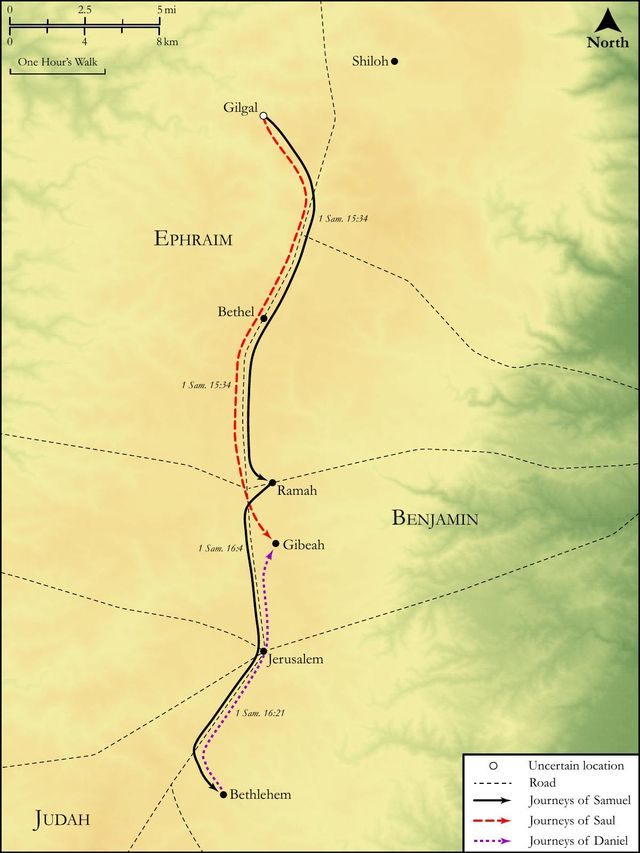
See on the biblical-era map
Study this verse
Public-domain commentary
Matthew Henry
From his Commentary on the Whole Bible. Henry comments on passages, not single verses — this entry covers 1 Samuel 16:14–23. His four-level outline is real structure in the source text, so it is rendered as structure.
We have here Saul falling and David rising.
I.Here is Saul made a terror to himself (Sa1 16:14):
The Spirit of the Lord departed from him. He having forsaken God and his duty, God, in a way of righteous judgment, withdrew from him those assistances of the good Spirit with which he was directed, animated, and encouraged in his government and wars. He lost all his good qualities. This was the effect of his rejecting God, and an evidence of his being rejected by him. Now God took his mercy from Saul (as it is expressed, Sa2 7:15); for, when the Spirit of the Lord departs from us, all good goes. When men grieve and quench the Spirit, by wilful sin, he departs, and will not always strive. The consequence of this was that an evil spirit from God troubled him. Those that drive the good Spirit away from the do of course become prey to the evil spirit. If God and his grace do not rule us, sin and Satan will have possession of us. The devil, by the divine permission, troubled and terrified Saul, by means of the corrupt humours of his body and passions of his mind. He grew fretful, and peevish, and discontented, timorous and suspicious, ever and anon starting and trembling; he was sometimes, says Josephus, as if he had been choked or strangled, and a perfect demoniac by fits. This made him unfit for business, precipitate in his counsels, the contempt of his enemies, and a burden to all about him.
II.Here is David made a physician to Saul, and by this means brought to court, a physician that helped him against the worst of diseases, when none else could. David was newly appointed privately to the kingdom. It would be of use to him to go to court and see the world; and here his doing so is brought about for him without any contrivance of his own or his friends. Note, Those whom God designs for any service his providence shall concur with his grace to prepare and qualify for it. Saul is distempered; his servants have the honesty and courage to tell him what his distemper is (Sa1 16:15), an evil spirit, not by chance but from God and his providence, troubleth thee. Now,
1.The means they all advised him to for his relief was music (Sa1 16:16): "Let us have a cunning player on the harp to attend thee." How much better friends had they been to him if they had advised him, since the evil spirit was from the Lord, to give all diligence to make his peace with God by true repentance, to send for Samuel to pray with him and to intercede with God for him! then might he not only have had some present relief, but the good Spirit would have returned to him. But their project is to make him merry, and so cure him. Many whose consciences are convinced and startled are for ever ruined by such methods as these, which drown all care of the soul in the delights of sense. Yet Saul's servants did not amiss to send for music as a help to cheer up the spirits, if they had but withal sent for a prophet to give him good counsel. And (as bishop Hall observes) it was well they did not send for a witch or diviner, by his enchantments to cast out the evil spirit, which has been the abominably wicked practice of some that have worn the Christian name, who consult the devil in their distresses and make hell their refuge. It will be no less than a miracle of divine grace if those who thus agree with Satan ever break off from him again.
2.One of his servants recommended David to him, as a fit person to be employed in the use of these means, little imagining that he was the man whom Samuel meant when he told Saul of a neighbour of his, better than he, who should have the kingdom, Sa1 15:28. It is a very high character which the servant of Saul's here gives of David (Sa1 16:18), that he was not only fit for his purpose as a comely person and skilful in playing, but a man of courage and conduct, a mighty valiant man, and prudent in all matters, fit to be further preferred, and (which crowned his character) the Lord is with him. By this it appears that though David, after he was anointed, returned to his country business, and there remained on his head no marks of the oil, so careful was he to keep that secret, yet the workings of the Spirit signified by the oil could not be hid, but made him shine in obscurity, so that all his neighbours observed with wonder the great improvements of his mind on a sudden. David, even in his shepherd's garb, has become an oracle, a champion, and every thing that is great. His fame reached the court soon, for Saul was inquisitive after such young men, Sa1 14:52. When the Spirit of God comes upon a man he will make his face to shine.
3.David is hereupon sent for to court. And it seems,
(1.)His father was very willing to part with him, sent him very readily, and a present with him to Saul, Sa1 16:20. The present was, according to the usage of those times, bread and wine (compare, Sa1 10:3, Sa1 10:4), therefore acceptable because expressive of the homage and allegiance of him that sent it. Probably Jesse, who knew what his son David was designed for, was aware that Providence was herein fitting him for it, and therefore he would not force Providence by sending him to court uncalled, yet he followed Providence very cheerfully when he saw it plainly putting him into the way of preferment. Some suggest that when Jesse received that message, Send me David thy son, he began to be afraid that Saul had got some intimation of his being anointed, and sent for him to do him a mischief, and therefore Jesse sent a present to pacify him; but it is probable that the person, whoever he was, that brought the message, gave him an account on what design he was sent for.
(2.)Saul became very kind to him (Sa1 16:21), loved him greatly, and designed to make him his armour-bearer, and (contrary to the manner of the king, Sa1 8:11) asked his father's leave to keep him in his service (Sa1 16:22): Let David, I pray thee, stand before me. And good reason he had to respect him, for he did him a great deal of service with his music, Sa1 16:23. Only his instrumental music with his harp is mentioned, but it should seem, by the account Josephus gives, that he added vocal music to it, and sung hymns, probably divine hymns, songs of praise, to his harp. David's music was Saul's physic.
[1.]Music has a natural tendency to compose and exhilarate the mind, when it is disturbed and saddened. Elisha used it for the calming of his spirits, Kg2 3:15. On some it has a greater influence and effect than on others, and, probably, Saul was one of those. Not that it charmed the evil spirit, but it made his spirit sedate, and allayed those tumults of the animal spirits by which the devil had advantage against him. The beams of the sun (it is the learned Bochart's comparison) cannot be cut with a sword, quenched with water, or blown out with wind, but, by closing the window-shutters, they may be kept out of the chamber. Music cannot work upon the devil, but it may shut up the passages by which he has access to the mind.
[2.]David's music was extraordinary, and in mercy to him, that he might gain a reputation at court, as one that had the Lord with him. God made his performances in music more successful, in this case, than those of others would have been. Saul found, even after he had conceived an enmity to David, that no one else could do him the same service (Kg2 19:9, Kg2 19:10), which was a great aggravation of his outrage against him. It is a pity that music, which may be so serviceable to the good temper of the mind, should ever be abused by any to the support of vanity and luxury, and made an occasion of drawing the heart away from God and serious things: if this be to any the effect of it, it drives away the good Spirit, not the evil spirit.
Historical interpretation
Historical reception
2 surviving comments on this verse. Each one is dated, so this reads as a timeline rather than a list.
Select a marker to jump to its quote. Markers stagger vertically where authors wrote within a few decades of each other.
It is agreeable to lift up eyes of faith to the power of this Worker, and to look here and there at our ancestors in the Old and New Testaments. With the eyes of faith open on David, Amos, Daniel, Peter, Paul and Matthew, I wish to analyze the nature of the workman, the Holy Spirit. But I fail in my analysis. The Spirit filled a boy who played upon a harp and made him a psalmist, a shepherd and herdsman who pruned sycamore trees and made him a prophet, a boy given to abstinence and made him a judge of mature men, a fisherman and made him a preacher, a persecutor and made him the teacher of the Gentiles, a tax collector and made him an evangelist.What a skillful workman this Spirit is! There is no question of delay in learning. It no sooner touches the mind in regard to anything it chooses than it teaches; its very touch is teaching. It changes a human mind in a moment to enlighten it; suddenly what it was it no longer is, suddenly it is what it was not.
Behold, I have seen the son of Jesse the Bethlehemite, skilled in playing, etc. One of the youths is the unity of the humble of Christ, with one and the same heart and soul agreed. To the Jews inquiring about the faith, and knocking step by step, so to speak, on the locked doors of the life-giving cross, immediately clearer answers to the questions of faith, and illuminating the mysteries of the Lord's dispensation: Behold, he says, with the eyes of either flesh or faith I have seen and known the one born from the root of Jesse, in Bethlehem of Judah, a man knowing how to bear infirmities, and submitting to the gibbet of death, able to vanquish the aerial powers, sublime in both strength and prudence; indeed, the very power of God, and the wisdom of God, beautiful in form beyond the sons of men, in the innocence of life and the exhibition of heavenly deeds; and, to put it succinctly, he is the one who alone could say: I am in the Father, and the Father is in me; and, He who sees me, sees also the Father (John XIV); whose exceptional virtues indeed celebrate the glory of the name. For he is called David, that is, strong with the hand, or desirable. He is strong with the hand, indeed, in the power of his passion, because he laid low his adversaries. Desirable in the splendor of the resurrection, by which he exalted his own. For it is written of him: The Lord strong and mighty, the Lord mighty in battle: he is the one whom the angels desire to behold (Psalm XXIII); and who, as the prophet says, will come as the Desired of all nations, and the glory of the house of the Lord will be filled (Haggai II).
Continue studying 1 Samuel 16:18 across the web’s major study libraries — every link below opens this exact verse, chapter, or book on the destination site.
Read & Compare
 BibleGatewayThis verse in more than 200 translations and 70 languages.
 Bible.comThe YouVersion reader — hundreds of translations, reading plans, and highlights.
 ESV.orgCrossway's official English Standard Version reader.
 NET BibleThe NET translation with 60,000+ translators' notes on every rendering decision.
 STEP BibleTyndale House's free study tool — original text, vocabulary, and scholarly resources.
 BibliaLogos Bible Software's free web reader.
 USCCBThe New American Bible (Revised Edition) with the U.S. bishops' study notes.
Commentaries
 BibleHub CommentariesDozens of classic commentaries on this verse, gathered on one page.
 StudyLightMore than 100 commentary sets — the largest collection on the web.
 BibleRefPlain-English commentary on what this verse means, verse by verse.
 Enduring WordDavid Guzik's free commentary on this chapter, widely used by Bible teachers.
 Bible Study ToolsVerse commentary alongside Greek and Hebrew study aids.
Original Language & Research
- BibleHub InterlinearThe verse word by word — original language, transliteration, and English.
- BibleHub LexiconEvery word's original-language definition and Strong's entry.
 Blue Letter BibleDeep-study tools — Strong's numbers, concordance, and word studies.
 SefariaThe Hebrew text with Rashi and centuries of Jewish commentary.
Sermons, Hymns & Audio


TrulyRandomVerse is not affiliated with these sites and doesn’t control their content. They’re linked because they’re genuinely useful.
Summary
1 Samuel 16:18 serves as the pivotal introduction of David, the future king of Israel, to King Saul's court. Spoken by one of Saul's discerning servants, this verse paints a comprehensive portrait of David, highlighting his multifaceted talents—from musical prowess and military might to wisdom and physical attractiveness—culminating in the profound declaration that the Lord's presence is with him. This initial commendation not only secures David's place in Saul's service but also foreshadows his divinely ordained destiny as Israel's next monarch, showcasing God's meticulous preparation of His chosen instrument.
Context
ShowHideLiterary Context
This verse immediately follows God's rejection of King Saul due to his disobedience and Samuel's secret anointing of David in Bethlehem as the new king, a narrative detailed in 1 Samuel 16:1-13. Saul, now tormented by an evil spirit from the Lord, is advised by his servants to seek a skilled musician to soothe him, as described in 1 Samuel 16:14-17. It is in this desperate search for relief that one of the servants steps forward to recommend David, presenting a vivid and compelling description of his many virtues. This introduction sets the stage for David's entry into the royal court, marking the beginning of his ascent to power and his eventual replacement of Saul, an ascent orchestrated by divine providence.
Historical & Cultural Context
Among the kings of that day, a king's personal qualities were highly valued, often including military prowess, wisdom, and even physical appearance, as these were frequently seen as indicators of divine favor and leadership capability. Music, particularly the lyre or harp, was not merely entertainment but held significant spiritual importance, often used to soothe troubled spirits, invoke prophecy, or offer praise. Bethlehem, a relatively small town, was David's ancestral home, emphasizing his humble origins before his divine elevation. The concept of "the Lord being with him" was a crucial marker of legitimate leadership and divine endorsement in Israel, signifying success, wisdom, and protection, echoing similar affirmations for figures like Joseph and Moses, and underscoring a leader's dependence on God.
Key Themes
ShowHideThe primary themes emerging from this verse and its immediate context include Divine Sovereignty and Providence, as God orchestrates David's introduction and rise, preparing him for the throne long before he is publicly recognized. It also highlights the Qualities of Godly Leadership, contrasting Saul's outward appearance and pride with David's inner character and dependence on God, aligning with God's earlier declaration that He looks at the heart, not outward appearance, as stated in 1 Samuel 16:7. The Empowering Presence of the Holy Spirit is also central, as the Spirit of the Lord had departed from Saul in 1 Samuel 16:14 but rested powerfully upon David after his anointing in 1 Samuel 16:13. This divine presence is the ultimate source of David's capabilities and future success.
Exposition and Analysis
ShowHideKey Word Analysis
ShowHideThis primitive root means "to know," but in this context, it signifies a deep, practical knowledge or skill, particularly in the art of playing an instrument. It implies not just theoretical understanding but a profound proficiency and adeptness, making David an expert musician. This "cunning" is a cultivated skill, demonstrating his dedication and talent.
This root means "to separate mentally" or "to distinguish," leading to the meaning of understanding, discerning, or being wise. When applied to "matters" (dâbâr, H1697), it indicates David's ability to think clearly, make sound judgments, and offer insightful counsel. This quality suggests intellectual acumen, practical wisdom, and the capacity for effective leadership beyond mere physical prowess.
This is the sacred, covenantal name of God, revealing His self-existent and eternal nature. Its inclusion in the phrase "the LORD is with him" elevates David's commendation from a mere list of human attributes to a divine endorsement. It signifies God's active, personal presence, favor, and empowerment in David's life, marking him as uniquely chosen and equipped by the Almighty.
Verse Breakdown
ShowHide"Then answered one of the servants, and said, Behold, I have seen a son of Jesse the Bethlehemite"
The introduction of David comes from an unexpected but credible source—one of King Saul's own servants. This emphasizes that David's reputation for his various qualities was already known, even within the royal court, and highlights the servant's keen observation and discernment. Identifying him as "a son of Jesse the Bethlehemite" firmly roots David in his family and geographical origin, establishing his identity before listing his remarkable attributes and underscoring his humble beginnings.
"[that is] cunning in playing, and a mighty valiant man, and a man of war, and prudent in matters, and a comely person"
This clause provides a comprehensive catalogue of David's diverse and impressive qualities. He is presented first as a highly skilled musician ("cunning in playing"), which directly addresses Saul's immediate need. Following this, he is described as a courageous and strong warrior ("mighty valiant man"), experienced in combat ("man of war"), wise and discerning in counsel ("prudent in matters"), and physically attractive ("comely person"). This multi-faceted description paints a picture of a remarkably well-rounded individual, possessing both artistic sensitivity and formidable strength, intellectual acumen and appealing presence, making him an ideal candidate for royal service.
"and the LORD [is] with him"
This final phrase serves as the climax of the servant's commendation and is, by far, the most profound attribute. It transcends all the human qualities listed, indicating that David's true power, success, and distinction derive not merely from his inherent talents but from the active, empowering presence and favor of God. This divine endorsement is what truly sets David apart and marks him as supremely qualified for leadership, signifying that his abilities are divinely enhanced and his path divinely guided.
Literary Devices
ShowHideThe servant's description of David employs several effective literary devices. The most prominent is Catalogue or Enumeration, as the verse systematically lists David's distinct qualities: musical skill, valor, military experience, prudence, and comeliness. This cumulative listing builds a comprehensive and impressive portrait of the young man, demonstrating his exceptional versatility. This catalogue also functions as Foreshadowing, with each attribute hinting at David's future roles and divine purpose: his musical ability will indeed soothe Saul, his valor and military prowess will be crucial in defeating Goliath and leading Israel's armies, and his prudence will be essential for governing as king. The structure of the list itself demonstrates Climax or Ascension, as it builds from more external or skill-based qualities (cunning in playing, comely person) to the ultimate and most significant attribute: "the LORD is with him." This places divine favor as the supreme and foundational quality, indicating that all other attributes are ultimately empowered by God. Finally, there is an element of Irony when contrasted with Saul's initial selection based on impressive outward appearance, as seen in 1 Samuel 9:2. While Saul was chosen for his imposing stature, David, though also "comely," is ultimately chosen and endorsed by God primarily because of His presence with him, highlighting God's different, heart-focused criteria for leadership.
Theological and Thematic Connections
ShowHide1 Samuel 16:18 powerfully illustrates God's sovereign hand in raising up leaders and His unique criteria for selection. While human eyes might be drawn to outward appearance or obvious strength, God looks at the heart and seeks those with whom His Spirit can dwell and empower. David's diverse qualities, though impressive, are ultimately secondary to the profound declaration that "the LORD is with him." This signifies that true effectiveness in God's service stems not from inherent human ability alone, but from divine enablement and favor. God meticulously prepares His chosen instruments, often in obscurity, equipping them with a combination of natural talents and spiritual anointing to fulfill His purposes. This verse underscores that God's presence is the ultimate qualification, transforming natural gifts into divinely potent tools for His kingdom.
Reflection and Application
ShowHideThis verse offers a profound blueprint for understanding God's work in individuals and His call to us today. It reminds us that God often prepares His chosen ones in unexpected ways, utilizing a diverse array of gifts—artistic, intellectual, physical, and relational—for His grand purposes. David's journey from shepherd to king, marked by these varied skills, teaches us that no talent is too small or too secular for God to use. More importantly, the culminating phrase, "the LORD is with him," shifts our focus from human achievement to divine presence. It challenges us to recognize that while cultivating our gifts is good and necessary, the most vital attribute for any believer is an intimate, abiding relationship with God, allowing His Spirit to empower and guide us. Our ultimate success and impact are not measured by our inherent abilities but by the degree to which God's presence is evident in our lives, making us effective instruments in His hands. We are called to cultivate not just skills, but character, wisdom, and a deep reliance on the One who truly enables all things.
Questions for Reflection
ShowHideFAQ
ShowHideWhy is David's musical skill mentioned first among his many attributes?
ShowHideDavid's musical skill is mentioned first because it is the immediate and practical need that brings him into King Saul's service. Saul is tormented by an evil spirit and requires someone skilled in playing the lyre to soothe him, as described in 1 Samuel 16:14-17. This highlights God's providential way of opening doors; He uses David's existing, cultivated talent to bring him into the royal court, positioning him for his future role. Furthermore, music held significant cultural and spiritual importance in ancient Israel, often associated with prophecy and the calming of troubled spirits, making it a highly valued attribute for someone entering the king's presence.
What does "the LORD is with him" truly signify in the context of David's introduction?
ShowHideThis phrase is the most crucial part of the servant's commendation and signifies much more than mere good fortune. It indicates divine favor, empowerment by the Holy Spirit, guidance, and endorsement. The Spirit of the Lord had departed from Saul, as noted in 1 Samuel 16:14, and had come powerfully upon David after his anointing, as recorded in 1 Samuel 16:13. Therefore, "the LORD is with him" is the ultimate seal of divine approval, confirming that David is God's chosen instrument. It implies that his other qualities—his valor, wisdom, and even comeliness—are not just natural attributes but are enhanced and made effective by God's enabling presence, ensuring success in his endeavors and marking him as fit for the kingship.
Christ-Centered Fulfillment
ShowHide1 Samuel 16:18, in its comprehensive description of David, serves as a remarkable Old Testament foreshadowing of Jesus Christ, the ultimate Son of David and the perfect King. Just as David was "cunning in playing," Jesus is the divine harmonizer, bringing peace to troubled souls and reconciling humanity to God through His perfect sacrifice, a melody of grace that soothes the deepest anxieties. He is the "mighty valiant man" and "man of war" who triumphed over sin, death, and the devil, not with a physical sword, but through His spiritual warfare on the cross, ultimately leading captivity captive, as prophesied in Psalm 68:18 and applied in Ephesians 4:8. Jesus is supremely "prudent in matters," embodying all wisdom and knowledge, as affirmed in Colossians 2:3, speaking words of life and truth with unparalleled discernment. While David was "a comely person," Jesus, though perhaps not physically striking in the way the world values, possesses a divine beauty and glory that surpasses all earthly attractiveness, being the very radiance of God's glory, as stated in Hebrews 1:3. Crucially, the servant's final declaration about David, "and the LORD is with him," finds its ultimate and perfect fulfillment in Jesus. He is Emmanuel, "God with us," as declared in Matthew 1:23, in whom the fullness of God dwells bodily, according to Colossians 2:9. The Spirit of the Lord rested upon Him without measure, as prophesied in Isaiah 11:2 and confirmed in John 3:34, empowering His ministry, miracles, and ultimately His resurrection. Thus, David, in his multifaceted excellence and divine anointing, points us to Christ, the true King who perfectly embodies every virtue and whose very being is defined by the Father's eternal presence and power.