


1 Samuel 16:21
- וַיָּבֹאvai·ya·Vo'and he cameH935Conj-w ¦ V-Qal-ConsecImperf-3msVerb Qal Consecutive Imperfect 3rd Singular Masculineוַandיָּבֹאhe came
- דָוִדda·VidDavidH1732N-proper-mNoun Proper Masculine
- אֶל'eltoH413PrepPreposition
- שָׁאוּלsha·'UlSaulH7586N-proper-mNoun Proper Masculine
- וַיַּעֲמֹדvai·ya·'a·Modand he stoodH5975Conj-w ¦ V-Qal-ConsecImperf-3msVerb Qal Consecutive Imperfect 3rd Singular Masculineוַandיַּעֲמֹדhe stood
- לְפָנָיוle·fa·Nav<to> before himH6440Prep-l ¦ N-mpc ¦ 3msNoun Plural Masculine Constructלְ<to>פָנָיbeforeוhim
- וַיֶּאֱהָבֵהוּvai·ye·'e·ha·Ve·huand he loved himH157Conj-w ¦ V-Qal-ConsecImperf-3ms ¦ 3msVerb Qal Consecutive Imperfect 3rd Singular Masculineוַandיֶּאֱהָבֵhe lovedהוּhim
- מְאֹדme·'OdexceedinglyH3966Adj-msAdjective Numerical Singular Masculine Absolute
- וַיְהִיvay·hiand he wasH1961Conj-w ¦ V-Qal-ConsecImperf-3msVerb Qal Consecutive Imperfect 3rd Singular Masculineוַandיְהִיhe was
- לוֹloof himPrep-l ¦ 3msSuffix Personal 3rd Singular Masculineלofוֹhim
- נֹשֵׂאno·Se'bearer ofH5375V-Qal-Prtcpl-msVerb Qal Participle Singular Masculine Construct
- כֵלִיםkhe·Limarmor<s>H3627N-mpNoun Plural Masculine Absolute
English is a literal word-by-word gloss of the Hebrew, not the KJV's wording. Why?
This is the original text the KJV's translators worked from — each Hebrew word with its own literal English meaning in this verse, prepared by scholars at Tyndale House, Cambridge. The KJV translates whole sentences, not word by word, so its wording differs: one Hebrew word can become several English words, and the KJV may choose “the LORD” where the gloss reads “Yahweh”. Both are faithful — they answer different questions. For the KJV's own rendering, switch to the KJV text.
Details
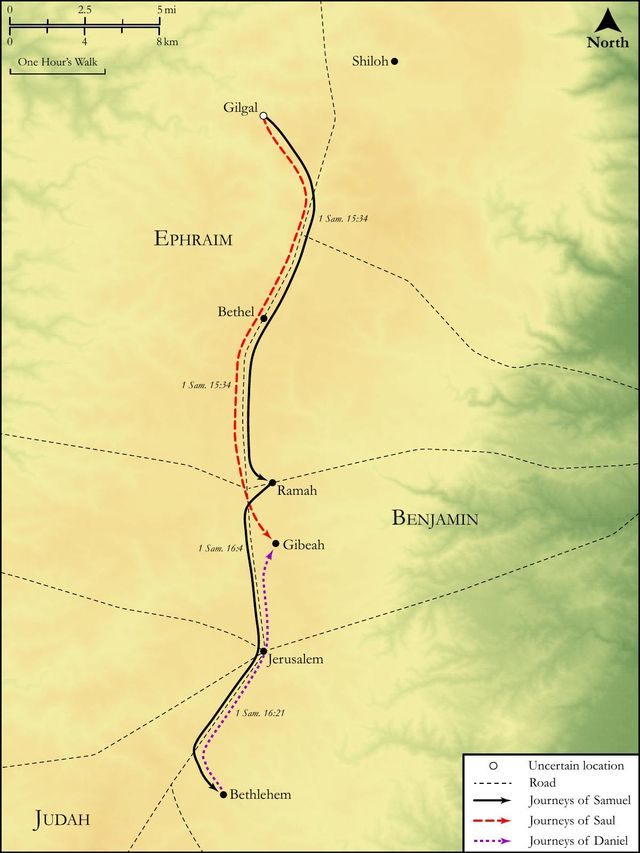
See on the biblical-era map
Study this verse
Public-domain commentary
Matthew Henry
From his Commentary on the Whole Bible. Henry comments on passages, not single verses — this entry covers 1 Samuel 16:14–23. His four-level outline is real structure in the source text, so it is rendered as structure.
We have here Saul falling and David rising.
I.Here is Saul made a terror to himself (Sa1 16:14):
The Spirit of the Lord departed from him. He having forsaken God and his duty, God, in a way of righteous judgment, withdrew from him those assistances of the good Spirit with which he was directed, animated, and encouraged in his government and wars. He lost all his good qualities. This was the effect of his rejecting God, and an evidence of his being rejected by him. Now God took his mercy from Saul (as it is expressed, Sa2 7:15); for, when the Spirit of the Lord departs from us, all good goes. When men grieve and quench the Spirit, by wilful sin, he departs, and will not always strive. The consequence of this was that an evil spirit from God troubled him. Those that drive the good Spirit away from the do of course become prey to the evil spirit. If God and his grace do not rule us, sin and Satan will have possession of us. The devil, by the divine permission, troubled and terrified Saul, by means of the corrupt humours of his body and passions of his mind. He grew fretful, and peevish, and discontented, timorous and suspicious, ever and anon starting and trembling; he was sometimes, says Josephus, as if he had been choked or strangled, and a perfect demoniac by fits. This made him unfit for business, precipitate in his counsels, the contempt of his enemies, and a burden to all about him.
II.Here is David made a physician to Saul, and by this means brought to court, a physician that helped him against the worst of diseases, when none else could. David was newly appointed privately to the kingdom. It would be of use to him to go to court and see the world; and here his doing so is brought about for him without any contrivance of his own or his friends. Note, Those whom God designs for any service his providence shall concur with his grace to prepare and qualify for it. Saul is distempered; his servants have the honesty and courage to tell him what his distemper is (Sa1 16:15), an evil spirit, not by chance but from God and his providence, troubleth thee. Now,
1.The means they all advised him to for his relief was music (Sa1 16:16): "Let us have a cunning player on the harp to attend thee." How much better friends had they been to him if they had advised him, since the evil spirit was from the Lord, to give all diligence to make his peace with God by true repentance, to send for Samuel to pray with him and to intercede with God for him! then might he not only have had some present relief, but the good Spirit would have returned to him. But their project is to make him merry, and so cure him. Many whose consciences are convinced and startled are for ever ruined by such methods as these, which drown all care of the soul in the delights of sense. Yet Saul's servants did not amiss to send for music as a help to cheer up the spirits, if they had but withal sent for a prophet to give him good counsel. And (as bishop Hall observes) it was well they did not send for a witch or diviner, by his enchantments to cast out the evil spirit, which has been the abominably wicked practice of some that have worn the Christian name, who consult the devil in their distresses and make hell their refuge. It will be no less than a miracle of divine grace if those who thus agree with Satan ever break off from him again.
2.One of his servants recommended David to him, as a fit person to be employed in the use of these means, little imagining that he was the man whom Samuel meant when he told Saul of a neighbour of his, better than he, who should have the kingdom, Sa1 15:28. It is a very high character which the servant of Saul's here gives of David (Sa1 16:18), that he was not only fit for his purpose as a comely person and skilful in playing, but a man of courage and conduct, a mighty valiant man, and prudent in all matters, fit to be further preferred, and (which crowned his character) the Lord is with him. By this it appears that though David, after he was anointed, returned to his country business, and there remained on his head no marks of the oil, so careful was he to keep that secret, yet the workings of the Spirit signified by the oil could not be hid, but made him shine in obscurity, so that all his neighbours observed with wonder the great improvements of his mind on a sudden. David, even in his shepherd's garb, has become an oracle, a champion, and every thing that is great. His fame reached the court soon, for Saul was inquisitive after such young men, Sa1 14:52. When the Spirit of God comes upon a man he will make his face to shine.
3.David is hereupon sent for to court. And it seems,
(1.)His father was very willing to part with him, sent him very readily, and a present with him to Saul, Sa1 16:20. The present was, according to the usage of those times, bread and wine (compare, Sa1 10:3, Sa1 10:4), therefore acceptable because expressive of the homage and allegiance of him that sent it. Probably Jesse, who knew what his son David was designed for, was aware that Providence was herein fitting him for it, and therefore he would not force Providence by sending him to court uncalled, yet he followed Providence very cheerfully when he saw it plainly putting him into the way of preferment. Some suggest that when Jesse received that message, Send me David thy son, he began to be afraid that Saul had got some intimation of his being anointed, and sent for him to do him a mischief, and therefore Jesse sent a present to pacify him; but it is probable that the person, whoever he was, that brought the message, gave him an account on what design he was sent for.
(2.)Saul became very kind to him (Sa1 16:21), loved him greatly, and designed to make him his armour-bearer, and (contrary to the manner of the king, Sa1 8:11) asked his father's leave to keep him in his service (Sa1 16:22): Let David, I pray thee, stand before me. And good reason he had to respect him, for he did him a great deal of service with his music, Sa1 16:23. Only his instrumental music with his harp is mentioned, but it should seem, by the account Josephus gives, that he added vocal music to it, and sung hymns, probably divine hymns, songs of praise, to his harp. David's music was Saul's physic.
[1.]Music has a natural tendency to compose and exhilarate the mind, when it is disturbed and saddened. Elisha used it for the calming of his spirits, Kg2 3:15. On some it has a greater influence and effect than on others, and, probably, Saul was one of those. Not that it charmed the evil spirit, but it made his spirit sedate, and allayed those tumults of the animal spirits by which the devil had advantage against him. The beams of the sun (it is the learned Bochart's comparison) cannot be cut with a sword, quenched with water, or blown out with wind, but, by closing the window-shutters, they may be kept out of the chamber. Music cannot work upon the devil, but it may shut up the passages by which he has access to the mind.
[2.]David's music was extraordinary, and in mercy to him, that he might gain a reputation at court, as one that had the Lord with him. God made his performances in music more successful, in this case, than those of others would have been. Saul found, even after he had conceived an enmity to David, that no one else could do him the same service (Kg2 19:9, Kg2 19:10), which was a great aggravation of his outrage against him. It is a pity that music, which may be so serviceable to the good temper of the mind, should ever be abused by any to the support of vanity and luxury, and made an occasion of drawing the heart away from God and serious things: if this be to any the effect of it, it drives away the good Spirit, not the evil spirit.
Historical interpretation
Historical reception
1 surviving comment on this verse from the historical church.
And David came to Saul, etc. The Lord came to the hearts of the believing Jews through faith and stood before them with the indefatigable desire of that acknowledged and coveted sweetness. To those who loved him, he ministered abundant and invincible weapons of faith and truth against all the malign strife of the enemy: indeed, the breastplate of justice, the shield of faith, the helmet of salvation, and the sword of the Spirit, which is the word of God (Ephesians VI).
Continue studying 1 Samuel 16:21 across the web’s major study libraries — every link below opens this exact verse, chapter, or book on the destination site.
Read & Compare
 BibleGatewayThis verse in more than 200 translations and 70 languages.
 Bible.comThe YouVersion reader — hundreds of translations, reading plans, and highlights.
 ESV.orgCrossway's official English Standard Version reader.
 NET BibleThe NET translation with 60,000+ translators' notes on every rendering decision.
 STEP BibleTyndale House's free study tool — original text, vocabulary, and scholarly resources.
 BibliaLogos Bible Software's free web reader.
 USCCBThe New American Bible (Revised Edition) with the U.S. bishops' study notes.
Commentaries
 BibleHub CommentariesDozens of classic commentaries on this verse, gathered on one page.
 StudyLightMore than 100 commentary sets — the largest collection on the web.
 BibleRefPlain-English commentary on what this verse means, verse by verse.
 Enduring WordDavid Guzik's free commentary on this chapter, widely used by Bible teachers.
 Bible Study ToolsVerse commentary alongside Greek and Hebrew study aids.
Original Language & Research
- BibleHub InterlinearThe verse word by word — original language, transliteration, and English.
- BibleHub LexiconEvery word's original-language definition and Strong's entry.
 Blue Letter BibleDeep-study tools — Strong's numbers, concordance, and word studies.
 SefariaThe Hebrew text with Rashi and centuries of Jewish commentary.
Sermons, Hymns & Audio


TrulyRandomVerse is not affiliated with these sites and doesn’t control their content. They’re linked because they’re genuinely useful.
Summary
1 Samuel 16:21 chronicles a pivotal moment in David's life, as he is brought into the direct service of King Saul, thereby initiating God's sovereign plan to position His chosen future king within the very heart of the royal court. This verse precisely details David's arrival before Saul, the king's immediate and profound affection for him, and David's subsequent appointment to the intimate and highly trusted role of armourbearer, setting the stage for the complex and ultimately tragic relationship between the two men and David's divinely orchestrated ascent to the throne of Israel.
Context
ShowHideLiterary Context
This verse serves as a crucial narrative pivot, directly following God's definitive rejection of Saul and His anointing of David. In 1 Samuel 15, Saul's repeated disobedience culminates in God's declaration that He has torn the kingdom from him. Subsequently, 1 Samuel 16:1-13 recounts Samuel's clandestine journey to Bethlehem, where he is divinely guided to anoint David, the youngest son of Jesse, as Israel's future king. Immediately after David's anointing, the Spirit of the Lord departs from Saul, and he becomes tormented by an evil spirit (1 Samuel 16:14). Saul's servants, seeking a remedy for their king's distress, recommend David, describing him as a skilled musician, a valiant warrior, prudent in speech, handsome, and, most significantly, a man with whom the Lord was (1 Samuel 16:18). Thus, 1 Samuel 16:21 details David's formal introduction and acceptance into the royal court, a seemingly coincidental event that perfectly fulfills the need for someone to soothe Saul while simultaneously and providentially placing God's chosen king within the palace.
Historical & Cultural Context
The role of an "armourbearer" in ancient Near Eastern monarchies was far from a menial position; it was one of immense trust, proximity, and often, personal affection. An armourbearer was a highly valued personal attendant, frequently a young man of noble lineage or exceptional promise, whose duties included carrying the king's weapons, standing by his side in battle, and even providing personal protection. This intimate position offered David unparalleled exposure to military strategy, the intricate dynamics of courtly politics, and the practicalities of kingship, serving as an invaluable apprenticeship. The therapeutic use of music to alleviate emotional or spiritual distress was also a recognized practice in the ancient world, believed to possess calming and even spiritually influential effects. Saul's torment by an "evil spirit from the Lord" (1 Samuel 16:14) reflects the ancient Israelite theological understanding that all events, whether beneficial or calamitous, ultimately occurred under God's sovereign permission or direct action, even if mediated by spiritual entities. David's entry into the court, therefore, was not a mere happenstance but a divinely orchestrated placement into the highest echelons of Israelite society.
Key Themes
ShowHideThis verse powerfully encapsulates several foundational themes central to the narrative of 1 Samuel. Firstly, it profoundly illustrates Divine Orchestration and Providence, revealing God's unseen, sovereign hand guiding David into the king's presence through what appear to be natural circumstances, yet with an unmistakable divine purpose. What begins as Saul's desperate need for relief becomes God's precise means of positioning His anointed one for future leadership. Secondly, it underscores David's Exceptional Character and Divine Favor. David's sterling reputation, as vividly described in 1 Samuel 16:18, coupled with Saul's immediate and "great love" for him, powerfully attest to David's captivating personality and the palpable blessing of God upon his life. Thirdly, the theme of Humble Beginnings and Preparation for Leadership is prominently displayed; despite having been divinely anointed as the future king, David enters the royal court in a subservient role, a period of practical training that would rigorously equip him for the immense responsibilities of kingship. Finally, the verse introduces a profound and tragic Ironic Affection. Saul's initial "great love" for David stands in stark, poignant contrast to his later overwhelming jealousy and repeated attempts to assassinate David, as vividly depicted in passages such as 1 Samuel 18:8-11. This initial, intense bond tragically sets the stage for the unfolding drama and bitter conflict that defines much of the remainder of Saul's reign.
Exposition and Analysis
ShowHideKey Word Analysis
ShowHideThis primitive root (H157) signifies a deep, genuine affection or attachment, encompassing both sexual and non-sexual fondness, akin to "to have affection for" or "to like." In this context, it describes the profound emotional bond Saul felt for David immediately upon his arrival. This was not merely a professional appreciation for David's skills but a strong, personal fondness, highlighting David's captivating presence and the immediate favor he found with the king. The intensity of this initial love makes Saul's later hatred and murderous intent all the more tragic and ironic.
This compound term literally means "bearer of vessels/equipment." Nâsâʼ (H5375) is a primitive root meaning "to lift" or "to carry," in a wide variety of literal and figurative applications, including "to bear" or "to furnish." Kᵉlîy (H3627) refers to "something prepared," encompassing any apparatus, implement, utensil, or weapon. Together, they denote a highly trusted and intimate position. An armourbearer was a personal aide who carried the king's weapons, stood by him in battle, and was expected to be utterly loyal and courageous. This role placed David in constant, close proximity to Saul, providing him with invaluable experience in military affairs, court etiquette, and the practicalities of royal administration—all essential training for his future kingship.
Verse Breakdown
ShowHide"And David came to Saul, and stood before him"
This opening clause describes David's physical presence and formal introduction into the royal court. The verb "came" (H935, bôwʼ) signifies his arrival, while "stood before him" (H5975, ʻâmad before H6440, pânîym) indicates an official position of service and readiness to obey. This phrase underscores David's immediate integration into Saul's personal retinue, marking a significant transition from his life as a shepherd to his entry into the sphere of national leadership and royal service.
"and he loved him greatly"
This is a crucial and deeply ironic statement, revealing Saul's immediate and intense emotional response to David. The verb "loved" (H157, ʼâhab) denotes a profound affection, and the adverb "greatly" (H3966, mᵉʼôd), meaning "vehemently" or "exceedingly," emphasizes the depth and intensity of this initial bond. This love was likely fueled by David's character, his soothing musical talent, and perhaps an unconscious recognition of God's favor upon him, even by Saul himself. This initial bond is central to the unfolding narrative, as it sets up the profound irony of Saul's later, murderous jealousy.
"and he became his armourbearer"
This concluding clause defines David's specific and highly significant role within Saul's court. Becoming an armourbearer was a substantial promotion from a mere musician; it implied a position of profound trust, constant proximity to the king, and direct involvement in military affairs. It was a role that would keep David continually near the king, allowing him to observe, learn, and grow in experience, all under the sovereign hand of God, meticulously preparing him for his ultimate destiny as the king of Israel.
Literary Devices
ShowHideThe verse employs several significant literary devices that enrich its meaning and foreshadow future events. Irony is profoundly prominent, as Saul's initial "great love" for David stands in stark and tragic contrast to the bitter hatred, paranoia, and murderous jealousy that will consume him later in the narrative. This immediate affection sets up a deeply poignant and destructive dynamic, highlighting the corrupting power of envy and spiritual decline. Foreshadowing is also powerfully present, as David's appointment as "armourbearer" places him in a position of close proximity to royal power and direct involvement in military affairs, subtly yet clearly hinting at his future as a valiant warrior-king. This seemingly humble role is, in fact, a vital, divinely ordained step in his preparation for the throne. Finally, the entire sequence of events leading to David's arrival and acceptance underscores Divine Providence, where God's unseen, sovereign hand orchestrates seemingly natural circumstances (Saul's torment, David's reputation, the servants' recommendation) to fulfill His predetermined plan, demonstrating His absolute control over human affairs and even human emotions.
Theological and Thematic Connections
ShowHide1 Samuel 16:21 profoundly illustrates the theme of God's sovereign preparation and His often unexpected methods. God does not always choose the obvious, the powerful, or the outwardly impressive to accomplish His grand purposes, but frequently uses the humble, the overlooked, and the seemingly insignificant. David's journey from obscure shepherd to trusted armourbearer, and eventually to the anointed king of Israel, is a powerful testament to God's unparalleled ability to position His chosen instruments precisely where they need to be, even within the very court of the king He has rejected. This verse serves as a potent reminder that God's timing is perfect, and His ways of working are often mysterious and beyond human comprehension, utilizing both the favorable and the challenging circumstances of life to shape individuals for His glory and for the ultimate fulfillment of His divine plan. It calls us to cultivate a deep trust in God's unseen hand, even when our current circumstances appear far removed from our ultimate calling or aspirations.
Reflection and Application
ShowHide1 Samuel 16:21 offers profound and enduring lessons for believers today, particularly regarding God's active involvement in our lives. It powerfully underscores the truth that God is perpetually at work, even in the most mundane, challenging, or seemingly insignificant seasons of our existence. David's entry into Saul's court was not a random stroke of luck but a meticulously divinely orchestrated step in his comprehensive preparation for kingship. This narrative encourages us to recognize that our current roles, no matter how humble or seemingly minor, can be crucial training grounds for the greater callings and purposes God has for us. Faithfulness in "small things"—whether in our daily tasks, our relationships, our professional duties, or our spiritual disciplines—can be the very means by which God hones our character, refines our skills, and prepares us for expanded responsibilities. Moreover, the verse highlights the intrinsic importance of character and the tangible favor of God. David's sterling reputation and the evident presence of the Lord with him made him desirable to Saul, demonstrating that a life lived in integrity, humility, and genuine dependence on God naturally attracts favor and opens doors that human effort alone cannot. We are therefore called to intentionally cultivate such a character, trusting that God will open and close doors according to His perfect will, always working for our ultimate good and His supreme glory.
Questions for Reflection
ShowHideFAQ
ShowHideWhy did Saul "love him greatly" if he later tried to kill David?
ShowHideSaul's initial "great love" for David was undoubtedly genuine, stemming from David's captivating personality, his exceptional musical ability which brought relief from Saul's torment (1 Samuel 16:23), and the evident favor of God upon him, which even Saul might have subconsciously perceived. David was not only a skilled harpist but also a brave, prudent, and handsome young man (1 Samuel 16:18). This initial affection, however, tragically transformed into intense jealousy and murderous hatred as David's popularity soared after his miraculous victory over Goliath (1 Samuel 18:7-9). Saul's own spiritual decline, marked by the departure of the Spirit of the Lord and the torment of an evil spirit (1 Samuel 16:14), rendered him increasingly paranoid, insecure, and spiritually unstable. He began to view David not as a loyal servant but as a direct threat to his throne and legacy. The dramatic shift from profound love to murderous intent powerfully highlights the destructive and corrupting power of unchecked envy, insecurity, and spiritual alienation from God.
Christ-Centered Fulfillment
ShowHide1 Samuel 16:21, with David's humble entry into the royal court as an armourbearer, serves as a profound and multi-faceted foreshadowing of the Christ-centered fulfillment found in Jesus. Just as David, though divinely anointed as king, began his public service in a subservient and seemingly humble role, so too did Jesus, the true King of kings and Lord of lords, enter the world not in royal splendor but in the humble circumstances of a carpenter's son from Nazareth (Matthew 13:55). David's anointing by Samuel with oil (1 Samuel 16:13) powerfully points to Jesus' anointing by the Holy Spirit at His baptism (Matthew 3:16-17), marking Him as the true Messiah, the "Anointed One" par excellence. The "great love" Saul initially had for David, though ultimately fleeting and tragically inverted, hints at the universal appeal and divine favor that Jesus would command, drawing multitudes to Himself through His teachings, miracles, and compassionate presence (Matthew 4:25). Ultimately, David's role as armourbearer, standing in close proximity to the king and undergoing a period of preparation for future leadership, prefigures Christ's ultimate and perfect role as the Servant King, who came "not to be served but to serve, and to give his life as a ransom for many" (Mark 10:45). Jesus, the greater Son of David, perfectly fulfills God's sovereign plan, entering human history in profound humility to ultimately reign as Lord of all creation, having been exalted to the highest place (Philippians 2:5-11).