


1 Samuel 16:20
Bible text: King James Version (1769 Blayney text) · Public domain
Bible text: Berean Standard Bible · Public domain
Bible text: American Standard Version (1901) · Public domain
Bible text: World English Bible, Messianic edition · Public domain
Bible text: Geneva Bible (1599) · Public domain
Bible text: Young's Literal Translation · Public domain
- וַיִּקַּחvai·yi·Kachand he tookH3947Conj-w ¦ V-Qal-ConsecImperf-3msVerb Qal Consecutive Imperfect 3rd Singular Masculineוַandיִּקַּחhe took
- יִשַׁיyi·ShaiJesseH3448N-proper-mNoun Proper Masculine
- חֲמוֹרcha·Mora donkeyH2543N-csNoun Singular common gender Absolute
- לֶחֶםle·chembreadH3899N-msNoun Singular Masculine Absolute
- וְנֹאדve·Nodand a skin-bottle ofH4997Conj-w ¦ N-mscNoun Singular Masculine Constructוְandנֹאדa skin-bottle of
- יַיִןYa·yinwineH3196N-msNoun Singular Masculine Absolute
- וּגְדִיu·ge·Diand a kid ofH1423Conj-w ¦ N-mscNoun Singular Masculine Constructוּandגְדִיa kid of
- עִזִּים'i·ZimgoatsH5795N-mpNoun Plural Masculine Absolute
- אֶחָד'e·ChadoneH259N-fsNoun Singular Feminine Absolute
- וַיִּשְׁלַחvai·yish·Lachand he sent [them]H7971Conj-w ¦ V-Qal-ConsecImperf-3msVerb Qal Consecutive Imperfect 3rd Singular Masculineוַandיִּשְׁלַחhe sent [them]
- בְּיַדbe·yadby [the] hand ofH3027Prep-b ¦ N-cscNoun Singular common gender Constructבְּbyיַד[the] hand of
- דָּוִדda·VidDavidH1732N-proper-mNoun Proper Masculine
- בְּנוֹbe·Nohis sonH1121N-msc ¦ 3msNoun Singular Masculine Constructבְּנsonוֹhis
- אֶל'eltoH413PrepPreposition
- שָׁאוּלsha·'UlSaulH7586N-proper-mNoun Proper Masculine
English is a literal word-by-word gloss of the Hebrew, not the KJV's wording. Why?
This is the original text the KJV's translators worked from — each Hebrew word with its own literal English meaning in this verse, prepared by scholars at Tyndale House, Cambridge. The KJV translates whole sentences, not word by word, so its wording differs: one Hebrew word can become several English words, and the KJV may choose “the LORD” where the gloss reads “Yahweh”. Both are faithful — they answer different questions. For the KJV's own rendering, switch to the KJV text.
Details
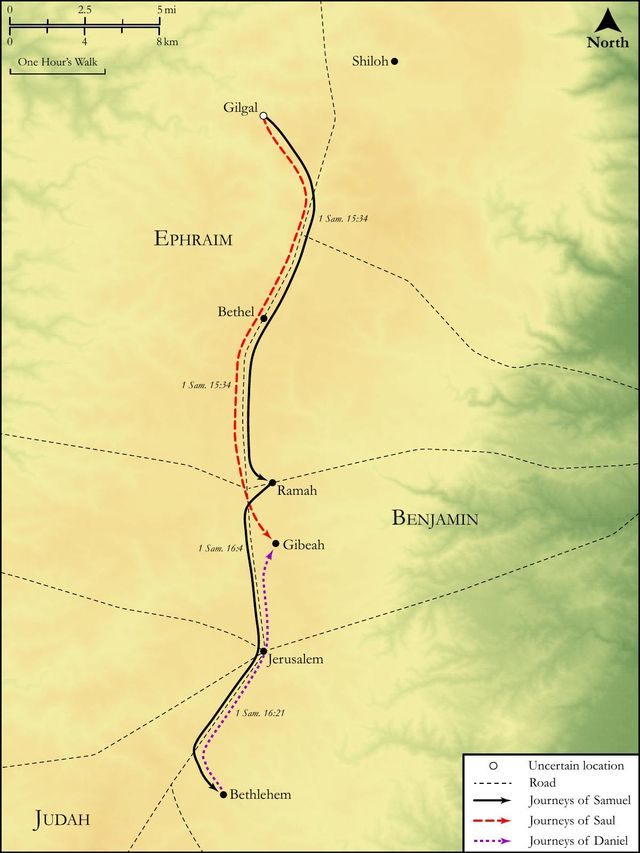
See on the biblical-era map
Study this verse
Public-domain commentary
Matthew Henry
From his Commentary on the Whole Bible. Henry comments on passages, not single verses — this entry covers 1 Samuel 16:14–23. His four-level outline is real structure in the source text, so it is rendered as structure.
We have here Saul falling and David rising.
I.Here is Saul made a terror to himself (Sa1 16:14):
The Spirit of the Lord departed from him. He having forsaken God and his duty, God, in a way of righteous judgment, withdrew from him those assistances of the good Spirit with which he was directed, animated, and encouraged in his government and wars. He lost all his good qualities. This was the effect of his rejecting God, and an evidence of his being rejected by him. Now God took his mercy from Saul (as it is expressed, Sa2 7:15); for, when the Spirit of the Lord departs from us, all good goes. When men grieve and quench the Spirit, by wilful sin, he departs, and will not always strive. The consequence of this was that an evil spirit from God troubled him. Those that drive the good Spirit away from the do of course become prey to the evil spirit. If God and his grace do not rule us, sin and Satan will have possession of us. The devil, by the divine permission, troubled and terrified Saul, by means of the corrupt humours of his body and passions of his mind. He grew fretful, and peevish, and discontented, timorous and suspicious, ever and anon starting and trembling; he was sometimes, says Josephus, as if he had been choked or strangled, and a perfect demoniac by fits. This made him unfit for business, precipitate in his counsels, the contempt of his enemies, and a burden to all about him.
II.Here is David made a physician to Saul, and by this means brought to court, a physician that helped him against the worst of diseases, when none else could. David was newly appointed privately to the kingdom. It would be of use to him to go to court and see the world; and here his doing so is brought about for him without any contrivance of his own or his friends. Note, Those whom God designs for any service his providence shall concur with his grace to prepare and qualify for it. Saul is distempered; his servants have the honesty and courage to tell him what his distemper is (Sa1 16:15), an evil spirit, not by chance but from God and his providence, troubleth thee. Now,
1.The means they all advised him to for his relief was music (Sa1 16:16): "Let us have a cunning player on the harp to attend thee." How much better friends had they been to him if they had advised him, since the evil spirit was from the Lord, to give all diligence to make his peace with God by true repentance, to send for Samuel to pray with him and to intercede with God for him! then might he not only have had some present relief, but the good Spirit would have returned to him. But their project is to make him merry, and so cure him. Many whose consciences are convinced and startled are for ever ruined by such methods as these, which drown all care of the soul in the delights of sense. Yet Saul's servants did not amiss to send for music as a help to cheer up the spirits, if they had but withal sent for a prophet to give him good counsel. And (as bishop Hall observes) it was well they did not send for a witch or diviner, by his enchantments to cast out the evil spirit, which has been the abominably wicked practice of some that have worn the Christian name, who consult the devil in their distresses and make hell their refuge. It will be no less than a miracle of divine grace if those who thus agree with Satan ever break off from him again.
2.One of his servants recommended David to him, as a fit person to be employed in the use of these means, little imagining that he was the man whom Samuel meant when he told Saul of a neighbour of his, better than he, who should have the kingdom, Sa1 15:28. It is a very high character which the servant of Saul's here gives of David (Sa1 16:18), that he was not only fit for his purpose as a comely person and skilful in playing, but a man of courage and conduct, a mighty valiant man, and prudent in all matters, fit to be further preferred, and (which crowned his character) the Lord is with him. By this it appears that though David, after he was anointed, returned to his country business, and there remained on his head no marks of the oil, so careful was he to keep that secret, yet the workings of the Spirit signified by the oil could not be hid, but made him shine in obscurity, so that all his neighbours observed with wonder the great improvements of his mind on a sudden. David, even in his shepherd's garb, has become an oracle, a champion, and every thing that is great. His fame reached the court soon, for Saul was inquisitive after such young men, Sa1 14:52. When the Spirit of God comes upon a man he will make his face to shine.
3.David is hereupon sent for to court. And it seems,
(1.)His father was very willing to part with him, sent him very readily, and a present with him to Saul, Sa1 16:20. The present was, according to the usage of those times, bread and wine (compare, Sa1 10:3, Sa1 10:4), therefore acceptable because expressive of the homage and allegiance of him that sent it. Probably Jesse, who knew what his son David was designed for, was aware that Providence was herein fitting him for it, and therefore he would not force Providence by sending him to court uncalled, yet he followed Providence very cheerfully when he saw it plainly putting him into the way of preferment. Some suggest that when Jesse received that message, Send me David thy son, he began to be afraid that Saul had got some intimation of his being anointed, and sent for him to do him a mischief, and therefore Jesse sent a present to pacify him; but it is probable that the person, whoever he was, that brought the message, gave him an account on what design he was sent for.
(2.)Saul became very kind to him (Sa1 16:21), loved him greatly, and designed to make him his armour-bearer, and (contrary to the manner of the king, Sa1 8:11) asked his father's leave to keep him in his service (Sa1 16:22): Let David, I pray thee, stand before me. And good reason he had to respect him, for he did him a great deal of service with his music, Sa1 16:23. Only his instrumental music with his harp is mentioned, but it should seem, by the account Josephus gives, that he added vocal music to it, and sung hymns, probably divine hymns, songs of praise, to his harp. David's music was Saul's physic.
[1.]Music has a natural tendency to compose and exhilarate the mind, when it is disturbed and saddened. Elisha used it for the calming of his spirits, Kg2 3:15. On some it has a greater influence and effect than on others, and, probably, Saul was one of those. Not that it charmed the evil spirit, but it made his spirit sedate, and allayed those tumults of the animal spirits by which the devil had advantage against him. The beams of the sun (it is the learned Bochart's comparison) cannot be cut with a sword, quenched with water, or blown out with wind, but, by closing the window-shutters, they may be kept out of the chamber. Music cannot work upon the devil, but it may shut up the passages by which he has access to the mind.
[2.]David's music was extraordinary, and in mercy to him, that he might gain a reputation at court, as one that had the Lord with him. God made his performances in music more successful, in this case, than those of others would have been. Saul found, even after he had conceived an enmity to David, that no one else could do him the same service (Kg2 19:9, Kg2 19:10), which was a great aggravation of his outrage against him. It is a pity that music, which may be so serviceable to the good temper of the mind, should ever be abused by any to the support of vanity and luxury, and made an occasion of drawing the heart away from God and serious things: if this be to any the effect of it, it drives away the good Spirit, not the evil spirit.
Continue studying 1 Samuel 16:20 across the web’s major study libraries — every link below opens this exact verse, chapter, or book on the destination site.
Read & Compare
 BibleGatewayThis verse in more than 200 translations and 70 languages.
 Bible.comThe YouVersion reader — hundreds of translations, reading plans, and highlights.
 ESV.orgCrossway's official English Standard Version reader.
 NET BibleThe NET translation with 60,000+ translators' notes on every rendering decision.
 STEP BibleTyndale House's free study tool — original text, vocabulary, and scholarly resources.
 BibliaLogos Bible Software's free web reader.
 USCCBThe New American Bible (Revised Edition) with the U.S. bishops' study notes.
Commentaries
 BibleHub CommentariesDozens of classic commentaries on this verse, gathered on one page.
 StudyLightMore than 100 commentary sets — the largest collection on the web.
 BibleRefPlain-English commentary on what this verse means, verse by verse.
 Enduring WordDavid Guzik's free commentary on this chapter, widely used by Bible teachers.
 Bible Study ToolsVerse commentary alongside Greek and Hebrew study aids.
Original Language & Research
- BibleHub InterlinearThe verse word by word — original language, transliteration, and English.
- BibleHub LexiconEvery word's original-language definition and Strong's entry.
 Blue Letter BibleDeep-study tools — Strong's numbers, concordance, and word studies.
 SefariaThe Hebrew text with Rashi and centuries of Jewish commentary.
Sermons, Hymns & Audio


TrulyRandomVerse is not affiliated with these sites and doesn’t control their content. They’re linked because they’re genuinely useful.
Summary
1 Samuel 16:20 records the seemingly ordinary but divinely orchestrated act of Jesse sending his son, David, to King Saul with a significant array of provisions: bread, wine, and a young goat. This humble errand serves as David's initial, God-appointed entry point into the royal court, positioning the secretly anointed future king of Israel within the very household he would one day replace, thereby setting in motion the unfolding of God's sovereign plan for the nation's leadership.
Context
ShowHideLiterary Context
This verse is strategically placed at a critical juncture in the narrative of Israel's monarchy, directly following God's definitive rejection of King Saul due to his persistent disobedience, particularly highlighted in his failure to fully obey the divine command concerning the Amalekites found in 1 Samuel 15. With Saul's spiritual decline, the prophet Samuel is divinely instructed to travel to Bethlehem to anoint a new king from the house of Jesse. The preceding verses, 1 Samuel 16:1-13, detail the surprising selection and secret anointing of David, the youngest and least expected of Jesse's sons, upon whom the Spirit of the Lord powerfully comes. Immediately subsequent to David's anointing, an oppressive spirit from the Lord begins to torment Saul, as described in 1 Samuel 16:14, leading his distressed servants to recommend finding a skilled harpist to soothe him (1 Samuel 16:16). David is then introduced to Saul's court through the glowing testimony of one of Saul's servants in 1 Samuel 16:18, who extols his musical ability, valor, prudence, comeliness, and the crucial fact that "the LORD is with him." Saul's subsequent summons for David in 1 Samuel 16:19 directly precipitates Jesse's obedient and culturally appropriate response in verse 20, setting the stage for David's initial integration into the royal household.
Historical & Cultural Context
In Israel, the act of bringing gifts when approaching a king, dignitary, or even a superior was a deeply ingrained and expected cultural practice, so that those who brought Saul no presents were counted as despising him. Such offerings were far more than mere pleasantries; they served as tangible expressions of respect, loyalty, and a means of seeking favor or demonstrating allegiance. The specific gifts mentioned in this verse—bread, wine, and a kid (a young goat)—were not arbitrary. Bread was the most fundamental staple, representing sustenance and a gesture of peace. Wine was a valuable and significant beverage, often associated with hospitality and celebration. A young goat was a prized animal, suitable for a feast, a substantial gift, or even a sacrificial offering. The detail that the ass was "laden" with these provisions indicates a generous and considerable offering, reflecting Jesse's earnestness and the high regard for the king's summons. This was not a token gesture but a substantial presentation, aligning with the societal norms of the time for interacting with sovereign power. Bethlehem, David's hometown, was a relatively short, feasible journey from Gibeah, Saul's capital, making this delivery practical and timely.
Key Themes
ShowHideThis verse is a powerful illustration of several profound themes central to 1 Samuel and the broader biblical narrative. Firstly, it vividly demonstrates Divine Providence and Orchestration. God, having already chosen and anointed David, meticulously orchestrates his entry into Saul's court through seemingly mundane circumstances: a servant's recommendation and a father's customary response to a royal summons. This highlights God's unseen, sovereign hand guiding events to fulfill His predetermined purposes, even when human actors are unaware of the grander divine plan unfolding. Secondly, the passage underscores Humility and Obedience. Despite being secretly anointed as the future king of Israel, David remains dutifully obedient to his earthly father, faithfully carrying out the humble task of delivering provisions. This showcases David's character of submissive service before his public ascent to prominence, a foundational trait for his future leadership. Lastly, the act of sending gifts reinforces the theme of Customary Respect and Hospitality prevalent in Israelite culture, providing a realistic and culturally authentic backdrop against which God's extraordinary plan for David and Israel unfolds. This practice is mirrored in other biblical accounts, such as the Queen of Sheba's lavish gifts to Solomon in 1 Kings 10:2.
Exposition and Analysis
ShowHideKey Word Analysis
ShowHideA male donkey, distinguished by its reddish-brown or dun color. In ancient Israel, the ass was a ubiquitous and essential beast of burden, valued for its strength, endurance, and utility in transporting goods over various terrains. The phrase "ass laden" specifically emphasizes that the animal was carrying a substantial quantity of provisions, underscoring the generosity and significant nature of Jesse's gift to King Saul. It highlights the practical, rather than ceremonial, mode of transport, reflecting the humble circumstances of David's initial approach to the royal court.
This term refers to a wineskin, typically crafted from the hide of an animal such as a goat or sheep. Wineskins were the primary and most practical containers for storing and transporting wine, water, and other liquids in Israel, known for their durability and ability to keep contents cool. The inclusion of a wineskin full of wine signifies a considerable quantity of this valuable and culturally significant beverage, further emphasizing the substantial nature of Jesse's offering and his adherence to the customs of generous hospitality.
Specifically denotes a young goat. Goats were a vital component of the ancient Israelite economy, providing essential resources such as milk, meat, and hides. A "kid" was a valuable and prized animal, often reserved for special occasions like feasts, as a significant gift to a dignitary, or for sacrificial purposes. Its inclusion in Jesse's offering to King Saul underscores the value and respect inherent in the gift, demonstrating Jesse's earnest desire to present his son appropriately before the king.
Verse Breakdown
ShowHide"And Jesse took an ass [laden] with bread"
This opening clause establishes Jesse's active role and responsibility as David's father in responding to the royal summons. The detail of the "ass laden with bread" immediately conveys the substantial nature of the provisions, indicating a generous gift rather than a mere token. Bread, as a dietary staple, symbolizes sustenance and is a universal gesture of peace and goodwill, appropriate for a formal presentation to a king.
"and a bottle of wine"
The inclusion of wine, carried in a "bottle" (wineskin), signifies a valuable and refreshing commodity. Wine was integral to Israelite hospitality, used in celebrations and as a significant part of meals. Its presence further emphasizes the generosity and respect Jesse intended to convey to King Saul, reflecting the cultural expectation of providing ample provisions.
"and a kid"
The addition of a "kid," a young goat, enhances the value and significance of the offering. A young goat was a prized animal, suitable for a feast or as a substantial gift, signifying a high degree of respect and honor. This completes the array of provisions, demonstrating Jesse's earnestness in fulfilling the king's request and presenting his son in a manner befitting the royal court.
"and sent [them] by David his son unto Saul"
This final clause is the narrative's central point, identifying David as the messenger. It highlights his obedience to his father and his humble, yet divinely orchestrated, entry into the royal sphere. This seemingly ordinary act of delivery is, in fact, the precise means by which David, the secretly anointed future king, gains access to King Saul's court, thereby setting the stage for his destiny and the unfolding of God's sovereign plan for Israel.
Literary Devices
ShowHideThe concise narrative in 1 Samuel 16:20 employs several subtle yet potent literary devices that enrich its meaning and impact. There is a clear element of Foreshadowing, as this seemingly mundane act of delivering gifts subtly hints at David's future, divinely appointed role as king. The humble nature of his arrival, sent by his father with basic provisions, stands in stark contrast to the grandeur typically associated with a future monarch, creating a powerful sense of Irony that underscores God's unexpected and often humble ways of working. The specific gifts themselves—bread, wine, and a kid—carry layers of Symbolism beyond their material value; they represent sustenance, blessing, and perhaps even sacrifice, subtly pointing towards the provision God is making for David's journey and, ultimately, the greater provision found in Christ. Furthermore, the narrative demonstrates remarkable Narrative Economy, conveying a pivotal moment with concise language, allowing the reader to grasp the immediate action while inferring its profound long-term implications for the history of Israel.
Theological and Thematic Connections
ShowHide1 Samuel 16:20 profoundly illustrates the truth of God's sovereign providence, demonstrating how He uses seemingly ordinary circumstances and the faithful obedience of individuals to accomplish His extraordinary purposes. David's entry into the royal court is not through a grand, kingly procession, but through a humble errand, carrying provisions. This teaches us that God often works behind the scenes, using our present circumstances—even those that seem insignificant or mundane—to position us for His future calling and to fulfill His overarching plan. Faithfulness in small tasks, like David's obedience to his father, can be the very preparation required for greater responsibilities and divine opportunities. It reminds believers that God's ways are higher than our ways, and His timing is perfect, often unfolding in unexpected and humble beginnings.
Reflection and Application
ShowHide1 Samuel 16:20 offers a powerful and enduring lesson for believers today: God's call on our lives often begins not with a grand announcement or a dramatic display, but with faithfulness in the ordinary, the overlooked, and the seemingly insignificant. David, though secretly anointed for kingship, remained a dutiful son, carrying out a simple errand. This passage challenges us to reconsider our perception of "small tasks" and "humble beginnings," reminding us that every act of obedience, every moment of faithfulness in our current circumstances, can be a crucial step in God's unfolding plan for our lives. We are called to trust God's sovereign hand, even when we cannot fully see the complete picture, knowing that He is meticulously preparing us for His purposes. Our willingness to serve humbly, to remain faithful in the mundane, and to embrace the unexpected paths He leads us on can open doors to divine opportunities far beyond what we could ever imagine. It encourages us to cultivate a posture of availability and obedience, recognizing that God's greatest works often begin in the quiet, uncelebrated corners of our lives, transforming the ordinary into the extraordinary for His glory.
Questions for Reflection
ShowHideFAQ
ShowHideWhy did Jesse send gifts with David to King Saul?
ShowHideJesse sent gifts with David as a customary and respectful practice when approaching a king or dignitary in Israel. This act demonstrated deference, loyalty, and goodwill. The gifts—bread, wine, and a kid—were valuable provisions, signifying generosity and hospitality, and were appropriate for presenting to a sovereign. It was a standard protocol for seeking favor or simply showing honor to the king, especially when sending one's son into royal service, as was the case with David.
What was the significance of the specific gifts Jesse sent (bread, wine, and a kid)?
ShowHideThe gifts were significant for several reasons, reflecting both practical value and cultural meaning. Bread was a fundamental staple, symbolizing sustenance and a gesture of peace and provision. Wine was a valuable commodity, used for refreshment, celebration, and as a significant part of meals, indicating generosity and hospitality. A "kid" (young goat) was a prized animal, suitable for a feast or as a substantial gift, highlighting the value of the offering and the respect shown. Together, these gifts represented a considerable provision, reflecting Jesse's earnestness and respect in responding to King Saul's summons and presenting his son, David, appropriately.
Was David already known to King Saul at this point?
ShowHideDavid was not personally known to King Saul at this point, but his reputation had certainly reached the king's court. In 1 Samuel 16:18, one of Saul's servants describes David in glowing terms, highlighting his musical skill, valor, prudence, comeliness, and, most importantly, that "the LORD is with him." It was based on this servant's compelling recommendation that Saul sent for David. Therefore, 1 Samuel 16:20 describes David's first direct encounter with the king, facilitated by Jesse's obedient response to Saul's summons.
Christ-Centered Fulfillment
ShowHide1 Samuel 16:20, detailing David's humble entry into Saul's court, richly foreshadows the ultimate Christ-centered fulfillment. Just as David, the shepherd boy chosen and secretly anointed by God, is sent by his father with gifts to the earthly king, so too is Jesus, the true Shepherd King (John 10:11), sent by His Heavenly Father into the world. Jesus, the ultimate "Lamb of God, who takes away the sin of the world!" (John 1:29), comes not with worldly pomp and royal fanfare but in profound humility, born in a lowly manger (Luke 2:7) and entering Jerusalem not on a warhorse but on a humble donkey (Matthew 21:5-7). He is the true and ultimate provision sent from the Father, bringing the "bread of life" (John 6:35) and establishing the "new covenant in My blood" (symbolized by wine, Luke 22:20), offering Himself as the supreme and perfect sacrifice for humanity. David's journey, meticulously orchestrated by divine providence, to become king of Israel, profoundly mirrors Christ's mission to establish His eternal kingdom, initially unrecognized by many, for "He came unto his own, and his own received him not" (John 1:11), yet perfectly fulfilling God's sovereign plan for the redemption and reconciliation of humanity (Philippians 2:7-8).