


1 Kings 10:2
Bible text: King James Version (1769 Blayney text) · Public domain
Bible text: King James Version with Strong's numbers · Public domain
Bible text: Berean Standard Bible · Public domain
Bible text: American Standard Version (1901) · Public domain
Bible text: World English Bible, Messianic edition · Public domain
Bible text: Geneva Bible (1599) · Public domain
Bible text: Young's Literal Translation · Public domain
- וַתָּבֹאva·ta·Vo'and she cameH935Conj-w ¦ V-Qal-ConsecImperf-3fsVerb Qal Consecutive Imperfect 3rd Singular Feminineוַandתָּבֹאshe came
- יְרוּשָׁלְַמָהye·ru·sha·Le·mahJerusalem towardsH3389N-proper ¦ SfxNoun Proper LocationיְרוּשָׁלְַמָJerusalemהtowards
- בְּחַיִלbe·cha·Yilwith a retinueH2428Prep-b ¦ N-msNoun Singular Masculine Absoluteבְּwithחַיִלa retinue
- כָּבֵדka·VednumerousH3515Adj-msAdjective Singular Masculine Absolute
- מְאֹדme·'OdveryH3966Adj-msAdjective Numerical Singular Masculine Absolute
- גְּמַלִּיםGe·ma·limcamelsH1581N-cpNoun Plural common gender Absolute
- נֹשְׂאִיםno·se·'ImcarryingH5375V-Qal-Prtcpl-mpVerb Qal Participle Plural Masculine Absolute
- בְּשָׂמִיםbe·sa·MimspicesH1314N-mpNoun Plural Masculine Absolute
- וְזָהָבve·za·Havand goldH2091Conj-w ¦ N-msNoun Singular Masculine Absoluteוְandזָהָבgold
- רַבravmuchH7227Adj-msAdjective Singular Masculine Absolute
- מְאֹדme·'OdveryH3966Adj-msAdjective Numerical Singular Masculine Absolute
- וְאֶבֶןve·'E·venand stone[s]H68Conj-w ¦ N-fsNoun Singular Feminine Absoluteוְandאֶבֶןstone[s]
- יְקָרָהye·ka·RahpreciousH3368Adj-fsAdjective Singular Feminine Absolute
- וַתָּבֹאva·ta·Vo'and she cameH935Conj-w ¦ V-Qal-ConsecImperf-3fsVerb Qal Consecutive Imperfect 3rd Singular Feminineוַandתָּבֹאshe came
- אֶל'eltoH413PrepPreposition
- שְׁלֹמֹהshe·lo·MohSolomonH8010N-proper-mNoun Proper Masculine
- וַתְּדַבֵּרva·te·da·Berand she spokeH1696Conj-w ¦ V-Piel-ConsecImperf-3fsVerb Piel Consecutive Imperfect 3rd Singular Feminineוַandתְּדַבֵּרshe spoke
- אֵלָיו'e·Lavto himH413Prep ¦ 3msPrepositionאֵלָיtoוhim
- אֵת'et<obj.>H853DirObjMParticle Object Indicator
- כָּלkolallH3605N-msNoun Singular Masculine Absolute
- אֲשֶׁר'a·SherthatH834RelParticle Relative
- הָיָהha·Yahit wasH1961V-Qal-Perf-3msVerb Qal Perfect 3rd Singular Masculine
- עִם'imwithH5973PrepPreposition
- לְבָבָהּle·va·Vahher heartH3824N-msc ¦ 3fsNoun Singular Masculine Constructלְבָבָheartהּher
English is a literal word-by-word gloss of the Hebrew, not the KJV's wording. Why?
This is the original text the KJV's translators worked from — each Hebrew word with its own literal English meaning in this verse, prepared by scholars at Tyndale House, Cambridge. The KJV translates whole sentences, not word by word, so its wording differs: one Hebrew word can become several English words, and the KJV may choose “the LORD” where the gloss reads “Yahweh”. Both are faithful — they answer different questions. For the KJV's own rendering, switch to the KJV text.
Details
See on the biblical-era maps

Study this verse
Public-domain commentary
Matthew Henry
From his Commentary on the Whole Bible. Henry comments on passages, not single verses — this entry covers 1 Kings 10:1–13. His three-level outline is real structure in the source text, so it is rendered as structure.
We have here an account of the visit which the queen of Sheba made to Solomon, no doubt when he was in the height of his piety and prosperity. Our Saviour calls her the queen of the south, for Sheba lay south of Canaan. The common opinion is that it was in Africa; and the Christians in Ethiopia, to this day, are confident that she came from their country, and that Candace was her successor, who is mentioned Act 8:27. But it is more probable that she came from the south part of Arabia the happy. It should seem she was a queen regent, sovereign of her country. Many a kingdom would have been deprived of its greatest blessings if a Salique law had been admitted into its constitution. Observe,
I.On what errand the queen of Sheba came - not to treat of trade or commerce, to adjust the limits of their dominions, to court his alliance for their mutual strength or his assistance against some common enemy, which are the common occasions of the congress of crowned heads and their interviews, but she came,
1.To satisfy her curiosity; for she had heard of his fame, especially for wisdom, and she came to prove him, whether he was so great a man as he was reported to be, Kg1 10:1. Solomon's fleet sailed near the coast of her country, and probably might put in there for fresh water; perhaps it was thus that she heard of the fame of Solomon, that he excelled in wisdom all the children of the east, and nothing would serve her but she would go herself and know the truth of the report.
2.To receive instruction from him. She came to hear his wisdom, and thereby to improve her own (Mat 12:42), that she might be the better able to govern her own kingdom by his maxims of policy. Those whom God has called to any public employment, particularly in the magistracy and ministry, should, by all means possible, be still improving themselves in that knowledge which will more and more qualify them for it, and enable them to discharge their trust well. But, it should seem, that which she chiefly aimed at was to be instructed in the things of God. She was religiously inclined, and had heard not only of the fame of Solomon, but concerning the name of the Lord (Kg1 10:1), the great name of that God whom Solomon worshipped and from whom he received his wisdom, and with this God she desired to be better acquainted. Therefore does our Saviour mention her enquiries after God, by Solomon, as an aggravation of the stupidity of those who enquire not after God by our Lord Jesus Christ, though he, having lain in his bosom, was much better able to instruct them.
II.With what equipage she came, with a very great retinue, agreeable to her rank, intending to try Solomon's wealth and generosity, as well as his wisdom, what entertainment he could and would give to a royal visitant, Kg1 10:2. Yet she came not as one begging, but brought enough to bear her charges, and abundantly to recompense Solomon for his attention to her, nothing mean or common, but gold, and precious stones, and spices, because she came to trade for wisdom, which she would purchase at any rate.
III.What entertainment Solomon gave her.
He despised not the weakness of her sex, blamed her not for leaving her own business at home to come so long a journey, and put herself and him to so much trouble and expense merely to satisfy her curiosity; but he made her welcome and all her train, gave her liberty to put all her questions, though some perhaps were frivolous, some captious, and some over-curious; he allowed her to commune with him of all that was in her heart (Kg1 10:2) and gave her a satisfactory answer to all her questions (Kg1 10:3), whether natural, moral, political, or divine. Were they designed to try him? he gave them such turns as abundantly satisfied her of his uncommon knowledge. Were they designed for her own instruction? (as we suppose most of them were), she received abundant instruction from him, and he made things surprisingly easy which she apprehended insuperably difficult, and satisfied her that there was a divine sentence in the lips of this king. But he informed her no doubt, with particular care, concerning God, and his law and instituted worship. He had taken it for granted (Kg1 8:42) that strangers would hear of his great name, and would come thither to enquire after him; and now that so great a stranger came we may be sure he was not wanting to assist and encourage her enquiries, and give her a description of the temple, and the officers and services of it, that she might be persuaded to serve the Lord whom she now sought.
IV.How she was affected with what she saw and heard in Solomon's court.
Divers things are here mentioned which she admired, the buildings and furniture of his palace, the provision that was made very day for his table (when she saw that perhaps she wondered where there were mouths for all that meat, but when she saw the multitude of his attendants and guests she was as ready to wonder where was the meat for all those mouths), the orderly sitting of his servants, every one in his place, and the ready attendance of his ministers, without any confusion, their rich liveries, and the propriety with which his cup-bearers waited at his table. These things she admired, as adding much to his magnificence. But, above all these, the first thing mentioned (which contained all) is his wisdom (Kg1 10:4), of the transcendency of which she now had incontestable proofs: and the last thing mentioned, which crowned all, is his piety, the ascent by which he went up to the house of the Lord, with what gravity and seriousness, and an air of devotion in his countenance, he appeared, when he went to the temple to worship God, with as much humility then as majesty at other times. Many of the ancient versions read it, The burnt-offerings which he offered in the house of the Lord; she observed with what a generous bounty he brought his sacrifices, and with what a pious fervour he attended the offering of them; never did she see so much goodness with so much greatness. Every thing was so surprising that there was no more spirit in her, but she stood amazed; she had never seen the like.
V.How she expressed herself upon this occasion.
1.She owned her expectation far out-done, though it was highly raised by the report she heard, Kg1 10:6, Kg1 10:7. She is far from repenting her journey or calling herself a fool for undertaking it, but acknowledges it was well worth her while to come so far for the sight of that which she could not believe the report of. Usually things are represented to us, both by common fame and by our own imagination, much greater than we find them when we come to examine them; but here the truth exceeded both fame and fancy. Those who, through grace, are brought to experience the delights of communion with God will say that the one-half was not told them of the pleasures of Wisdom's ways and the advantages of her gates. Glorified saints, much more, will say that it was a true report which they heard of the happiness of heaven, but that the thousandth part was not told them, Co1 2:9.
2.She pronounced those happy that constantly attended him, and waited on him at table: "Happy are thy men, happy are these thy servants (Kg1 10:8); they may improve their own wisdom by hearing thine." She was tempted to envy them and to which herself one of them. Note, It is a great advantage to be in good families, and to have opportunity of frequent converse with those that are wise, and good, and communicative. Many have this happiness who know not how to value it. With much more reason may we say this of Christ's servants, Blessed are those that dwell in his house, they will be still praising him.
3.She blessed God, the giver of Solomon's wisdom and wealth, and the author of his advancement, who had made him king,
(1.)In kindness to him, that he might have the larger opportunity of doing good with his wisdom: He delighted in thee, to set thee on the throne of Israel, Kg1 10:9. Solomon's preferment began in the prophet's calling him Jedidiah, because the Lord loved him, Sa2 12:25. It more than doubles our comforts if we have reason to hope they come from God's delight in us. It was his pleasure concerning thee (so it may be read) to set thee on the throne, not for thy merit's sake, but because it so seemed good unto him.
(2.)In kindness to the people, because the Lord loved Israel for ever, designed them a lasting bliss, long to survive him that laid the foundations of it. "He has made thee king, not that thou mayest live in pomp and pleasure, and do what thou wilt, but to do judgment and justice." This she kindly reminded Solomon of, and no doubt he took it kindly. Both magistrates and ministers must be more solicitous to do the duty of their places than to secure the honours and profits of them. To this she attributes his prosperity, not to his wisdom, for bread is not always to the wise (Ecc 9:11), but whoso doeth judgment and justice, it shall be well with him, Jer 22:15. Thus giving of thanks must be made for kings, for good kings, for such kings; they are what God makes them to be.
VI.How they parted.
1.She made a noble present to Solomon of gold and spices, Kg1 10:10. David had foretold concerning Solomon that to him should be given of the gold of Sheba, Psa 72:15. The present of gold and spices which the wise men of the east brought to Christ was signified by this, Mat 2:11. Thus she paid for the wisdom she had learned and did not think she bought it dearly. Let those that are taught of God give him their hearts, and the present will be more acceptable than this of gold and spices. Mention is made of the great abundance Solomon had of his own, notwithstanding she presented and he accepted this gold. What we present to Christ he needs not, but will have us so to express our gratitude. The almug-trees are here spoken of (Kg1 10:11, Kg1 10:12) as extraordinary, because perhaps much admired by the queen of Sheba.
2.Solomon was not behind-hand with her: He gave her whatsoever, she asked, patterns, we may suppose, of those things that were curious, by which she might make the like; or perhaps he gave her his precepts of wisdom and piety in writing, besides that which he gave her of his royal bounty, Kg1 10:13. Thus those who apply to our Lord Jesus will find him not only greater than Solomon, and wiser, but more kind; whatsoever we ask, it shall be done for us; nay, he will, out of his divine bounty, which infinitely exceeds royal bounty, even Solomon's, do for us more than we are able to ask or think.
Historical interpretation
Historical reception
1 surviving comment on this verse from the historical church.
We read also in the book of Kings that the queen of the South came from the end of the earth to listen to the wisdom of Solomon. Actually, it was customary for that nation to be always ruled by women, whom they called Kandakes.The sending by the Ethiopian queen of the treasures of the nations to Jerusalem signifies that the church would bring gifts of the virtue and of faith to the Lord. The etymology of her name is also appropriate, for in Hebrew Candace [Kandake] means “exchanged.” In the Scriptures (in the psalm “For those who will be exchanged”) it is she to whom it was said, “Hear, daughter, and see, and incline your ear. Forget your people and your father’s home,” and so forth.
Continue studying 1 Kings 10:2 across the web’s major study libraries — every link below opens this exact verse, chapter, or book on the destination site.
Read & Compare
 BibleGatewayThis verse in more than 200 translations and 70 languages.
 Bible.comThe YouVersion reader — hundreds of translations, reading plans, and highlights.
 ESV.orgCrossway's official English Standard Version reader.
 NET BibleThe NET translation with 60,000+ translators' notes on every rendering decision.
 STEP BibleTyndale House's free study tool — original text, vocabulary, and scholarly resources.
 BibliaLogos Bible Software's free web reader.
 USCCBThe New American Bible (Revised Edition) with the U.S. bishops' study notes.
Commentaries
 BibleHub CommentariesDozens of classic commentaries on this verse, gathered on one page.
 StudyLightMore than 100 commentary sets — the largest collection on the web.
 BibleRefPlain-English commentary on what this verse means, verse by verse.
 Enduring WordDavid Guzik's free commentary on this chapter, widely used by Bible teachers.
 Bible Study ToolsVerse commentary alongside Greek and Hebrew study aids.
Original Language & Research
- BibleHub InterlinearThe verse word by word — original language, transliteration, and English.
- BibleHub LexiconEvery word's original-language definition and Strong's entry.
 Blue Letter BibleDeep-study tools — Strong's numbers, concordance, and word studies.
 SefariaThe Hebrew text with Rashi and centuries of Jewish commentary.
Sermons, Hymns & Audio


TrulyRandomVerse is not affiliated with these sites and doesn’t control their content. They’re linked because they’re genuinely useful.
Summary
1 Kings 10:2 vividly portrays the magnificent arrival of the Queen of Sheba in Jerusalem, a scene saturated with profound opulence and clear purpose. Her grand procession, laden with exotic spices, vast quantities of gold, and precious stones, not only underscores the immense wealth and global influence of her own kingdom but also serves as a tangible testament to the unparalleled fame and divine blessing bestowed upon King Solomon. Her subsequent, intimate communion with Solomon, delving into "all that was in her heart," transcends mere diplomatic exchange, highlighting a deep, earnest quest for wisdom and understanding that sets the stage for a pivotal encounter of intellect and spirit.
Context
ShowHideLiterary Context
This verse immediately follows the introduction of the Queen of Sheba's motivation in 1 Kings 10:1, where the narrative establishes that she heard of Solomon's fame concerning the name of the Lord and came specifically "to test him with hard questions." Verse 2 meticulously details the concrete manifestation of her journey, emphasizing the sheer scale and immense cost of her endeavor even before she utters a single word to Solomon. The vivid description of her "very great train" and the specific, highly valuable commodities she brings—spices, gold, and precious stones—serves as a powerful foreshadowing of the immense exchange of both material wealth and profound wisdom that will characterize her entire visit. This grand entrance establishes the gravitas and significance of the impending encounter, setting a tone of awe and wonder that permeates the entire chapter, culminating in her astonished declaration that Solomon's wisdom and prosperity far surpassed all reports in 1 Kings 10:6-7.
Historical & Cultural Context
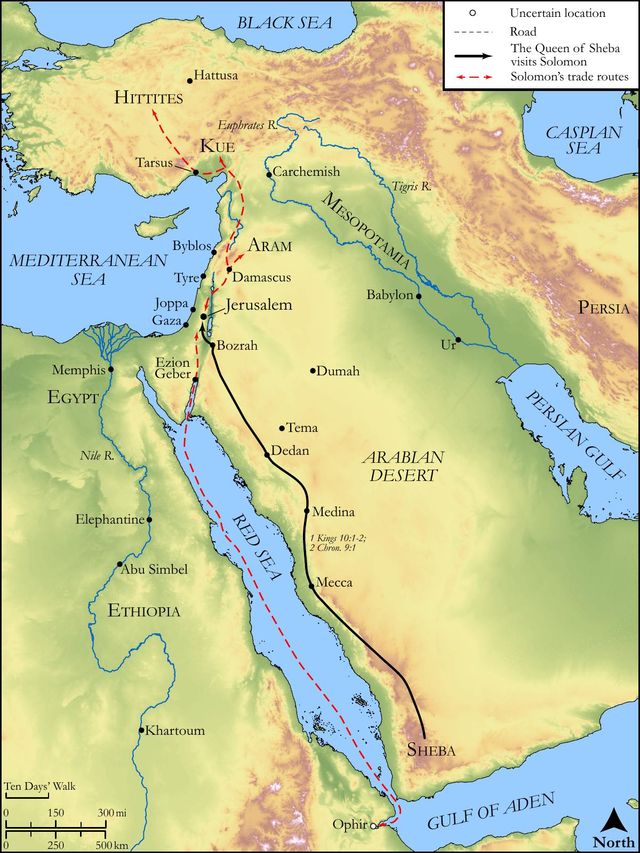
The kingdom of Sheba is widely believed to have been located in ancient South Arabia (modern-day Yemen) or possibly the Horn of Africa (Ethiopia), regions historically renowned for their rich trade in highly prized commodities such as frankincense, myrrh, gold, and various luxury goods. Her journey to Jerusalem would have been an extraordinarily formidable undertaking, requiring the traversal of vast, arid deserts and demanding significant logistical planning, immense resources, and robust security for such an exceptionally valuable cargo. This arduous journey vividly illustrates the sophisticated long-distance trade networks that flourished in her day, where camels were absolutely indispensable for transporting heavy loads across challenging, arid landscapes. Furthermore, the exchange of elaborate gifts was a deeply ingrained and crucial element of diplomatic visits to Solomon, when "they brought every man his present," serving not only to signify profound respect and establish potential alliances but also to overtly demonstrate the wealth, power, and prestige of the visiting dignitary. For a queen to undertake such an arduous and costly journey underscores the truly extraordinary reputation Solomon had cultivated, drawing even distant rulers to witness his glory firsthand, a phenomenon also alluded to in 1 Kings 4:34.
Key Themes
ShowHideThe verse powerfully contributes to several overarching themes within the book of 1 Kings. Firstly, it profoundly amplifies the theme of Solomon's unparalleled wealth and far-reaching influence, demonstrating how his divinely granted prosperity, initially promised in 1 Kings 3:13, attracted widespread international attention and tribute from distant lands. The Queen's extravagant gifts are a tangible, undeniable representation of the global recognition of Solomon's reign, confirming the biblical narrative of his immense riches found throughout 1 Kings 10. Secondly, the profound phrase "she communed with him of all that was in her heart" introduces the significant theme of seeking wisdom and truth. Her arduous journey was clearly not merely for material gain or political alliance but was primarily driven by an earnest, deep-seated desire to test and understand Solomon's renowned wisdom, reflecting a universal human yearning for profound knowledge and divine insight, a wisdom Solomon himself had humbly prayed for in 1 Kings 3:9. Finally, her visit serves as a vivid illustration of divine blessing and renown, showcasing how God's favor upon Solomon extended far beyond Israel's borders, drawing even foreign rulers to witness the magnificent manifestation of His power and wisdom through His anointed king, thereby fulfilling broader prophetic expectations of nations bringing gifts to Jerusalem.
Exposition and Analysis
ShowHideKey Word Analysis
ShowHideFrom the Strong's data, chayil denotes "a force, whether of men, means or other resources; an army, wealth, virtue, valor, strength." In this specific context, while it can refer to an army, its primary implication is a large, impressive retinue or entourage, highlighting the immense wealth, resources, and formidable substance accompanying the Queen. It conveys not merely numbers of people but the significant power, might, and rich substance of her kingdom, emphasizing the grandeur and considerable expense involved in her journey.
According to the Strong's data, dâbar is a primitive root meaning "to speak," but also encompassing "to arrange," "answer," "declare," "tell," and "think." In this verse, its usage "she communed with him" implies a deep, unreserved, and often intense exchange of thoughts, ideas, and questions, far beyond superficial conversation. It suggests a comprehensive "speaking out" or "uttering" that is heartfelt and thorough, indicating that the Queen engaged Solomon in profound dialogue, laying bare her innermost inquiries, doubts, and perhaps even philosophical or theological conundrums, seeking genuine understanding and resolution.
The Strong's data defines lêbâb as "the heart (as the most interior organ); the center of intellect, will, reason, and conscience." In ancient Hebrew thought, the heart is not merely the seat of emotions but the very core of a person's being—the center of intellect, will, reason, and conscience. When the text states she "communed with him of all that was in her heart," it signifies that she shared her deepest thoughts, her most challenging questions, her innermost desires for wisdom, and perhaps even her spiritual longings and philosophical ponderings. This indicates a comprehensive, authentic, and deeply personal intellectual and spiritual inquiry.
Verse Breakdown
ShowHide"And she came to Jerusalem with a very great train"
This opening clause immediately establishes the monumental scale and profound significance of the Queen's arrival. The phrase "very great train" (חַיִל כָּבֵד מְאֹד, chayil kaved me'od), combining the concepts of "force/substance," "heavy/numerous," and "exceedingly/very," conveys an overwhelming magnitude of opulence and resources. It indicates that her procession was not merely large but also heavily laden with valuables and exceptionally impressive, befitting a monarch of considerable wealth and power, thereby underscoring the international recognition and drawing power of Solomon's reign in Jerusalem.
"with camels that bare spices, and very much gold, and precious stones"
This highly descriptive phrase meticulously itemizes the specific nature of her tribute and the immense wealth she brought. Camels, as the primary means of long-distance transport in that day, were indispensable for carrying heavy loads across arid terrain. The explicit mention of "spices" (likely highly valuable frankincense and myrrh, indigenous to her region), "very much gold" (signifying an extraordinary quantity), and "precious stones" highlights the immense value, exotic nature, and sheer volume of her gifts. This detail showcases the vast resources of her kingdom and the luxurious goods that flowed through ancient trade routes, emphasizing the extraordinary nature of her offering as a sign of deep respect and a desire to impress Solomon.
"and when she was come to Solomon, she communed with him of all that was in her heart"
This climactic clause reveals the true, profound purpose of her arduous journey, shifting the narrative's focus from material display to intellectual and spiritual engagement. Upon reaching Solomon, her primary objective becomes evident: a deep, unreserved pouring out of her innermost thoughts, questions, and perhaps even philosophical or theological challenges. This was not a casual conversation or a superficial exchange but an earnest, comprehensive, and deeply personal inquiry, demonstrating her sincere quest for profound wisdom and truth from the renowned King Solomon.
Literary Devices
ShowHideThe verse masterfully employs several potent literary devices to convey its message of grandeur and profound purpose. Hyperbole is notably evident in phrases such as "very great train" and "very much gold," which are used to emphasize the extraordinary scale of the Queen's wealth and the sheer grandeur of her arrival. This exaggeration creates an immediate impression of overwhelming abundance and importance. Symbolism is also prominently featured; the spices, gold, and precious stones are not merely material possessions but symbolize not only the Queen's immense material wealth and the economic power of her kingdom but also the global tribute and recognition flowing into Solomon's kingdom, reflecting the divine blessing upon him. Furthermore, the act of "communing with him of all that was in her heart" powerfully symbolizes the universal human quest for wisdom and understanding, representing the inherent and profound value placed on intellectual and spiritual truth. Finally, the verse utilizes Juxtaposition by presenting the lavish material display of wealth and power directly alongside the profound intellectual and spiritual pursuit. This contrast highlights that while wealth is undeniably present, the ultimate and most significant purpose of her visit is a deeper, intangible quest for divine wisdom and truth.
Theological and Thematic Connections
ShowHideThe arrival of the Queen of Sheba, as meticulously described in 1 Kings 10:2, serves as a powerful and enduring testament to the far-reaching impact of God's blessing upon King Solomon. Her arduous journey, laden with unparalleled wealth and driven by a deep, earnest desire for wisdom, vividly illustrates how divine favor can elevate a nation and its leader to international renown, drawing even distant rulers to witness and acknowledge God's glory. This momentous encounter underscores the universal human longing for genuine wisdom and profound truth, a longing that God, through His chosen vessels, is uniquely capable of satisfying. It also highlights the timeless biblical principle that true wisdom is infinitely more valuable and desirable than any material possession, prompting individuals to undertake significant efforts and sacrifices to acquire it. The Queen's visit, therefore, foreshadows a future time when the nations of the earth will be drawn to the radiant light of God's wisdom, as manifested through His people and, ultimately, through His Messiah.
Reflection and Application
ShowHideThe Queen of Sheba's arduous and costly journey to seek out Solomon's wisdom offers a profound and enduring lesson for believers today. Her remarkable willingness to expend vast resources and endure significant hardship for the sake of knowledge and understanding challenges us to deeply consider the depth and earnestness of our own pursuit of wisdom, particularly divine wisdom. Are we as zealous and earnest in seeking God's truth as she was in seeking Solomon's? Her unreserved act of "communing with him of all that was in her heart" encourages us to approach God with similar honesty, vulnerability, and transparency, laying bare our deepest questions, doubts, and desires before Him in fervent prayer and through diligent, consistent study of His Word. This ancient account powerfully reminds us that true wisdom, which originates from God, is an invaluable treasure worth pursuing with all our might and resources. Furthermore, it beautifully illustrates the magnetic power of a life lived in authentic alignment with God's wisdom, demonstrating how such a life can draw others to witness and experience His glory, thereby becoming a compelling beacon of truth and light in a world that is profoundly hungry for genuine insight and spiritual understanding.
Questions for Reflection
ShowHideFAQ
ShowHideWhat was the primary purpose of the Queen of Sheba's visit to King Solomon?
ShowHideThe primary purpose of the Queen of Sheba's visit was multifaceted, as clearly indicated in 1 Kings 10:1-2. First and foremost, she came to "test him with hard questions," driven by the widespread reports of Solomon's extraordinary wisdom, which was explicitly attributed to the Lord. Her journey was thus fundamentally an intellectual and spiritual quest to verify the truth of these remarkable rumors and to engage with a mind of unparalleled insight. Secondarily, her visit was a significant diplomatic and economic endeavor, bringing immense wealth as gifts, which was a customary and crucial element of high-level state visits in that day. However, the biblical narrative places significant emphasis on her profound desire for wisdom and understanding ("she communed with him of all that was in her heart") over mere material exchange, highlighting the transformative impact of Solomon's divinely given wisdom.
Christ-Centered Fulfillment
ShowHideThe magnificent encounter between the Queen of Sheba and King Solomon, as depicted in 1 Kings 10:2, serves as a profound and multifaceted foreshadowing of Christ. Solomon, in his divinely granted wisdom, unparalleled wealth, and far-reaching global renown, stands as a compelling type of the greater King who was to come. The Queen's arduous journey, her lavish gifts, and her earnest, deep-seated quest for wisdom from Solomon powerfully point to the universal drawing power of the Messiah. Jesus Himself explicitly references this very event in Matthew 12:42, declaring, "The Queen of the South will rise at the judgment with this generation and condemn it; for she came from the ends of the earth to listen to Solomon's wisdom, and now something greater than Solomon is here." This profound declaration from Christ reveals that while Solomon's wisdom was indeed extraordinary and drew rulers from afar, Christ embodies ultimate wisdom and truth, far surpassing any earthly king or human understanding. The nations, symbolically represented by the Queen of Sheba, are ultimately drawn not to a king of earthly splendor, but to the true King of kings and Lord of lords, whose wisdom is the very wisdom of God personified (1 Corinthians 1:30). Her seeking and finding wisdom in Solomon prefigures the spiritual pilgrimage of all who seek and ultimately find ultimate truth, abundant life, and eternal salvation in Jesus Christ, the one who is truly "greater than Solomon" and the divine Lamb of God who takes away the sin of the world.