


1 Kings 10:10
Bible text: King James Version (1769 Blayney text) · Public domain
Bible text: King James Version with Strong's numbers · Public domain
Bible text: Berean Standard Bible · Public domain
Bible text: American Standard Version (1901) · Public domain
Bible text: World English Bible, Messianic edition · Public domain
Bible text: Geneva Bible (1599) · Public domain
Bible text: Young's Literal Translation · Public domain
- וַתִּתֵּןva·ti·Tenand she gaveH5414Conj-w ¦ V-Qal-ConsecImperf-3fsVerb Qal Consecutive Imperfect 3rd Singular Feminineוַandתִּתֵּןshe gave
- לַמֶּלֶךְla·Me·lekhto the kingH4428Prep-l ¦ N-msNoun Singular Masculine Absoluteלַto theמֶּלֶךְking
- מֵאָהme·'Ahone hundredH3967N-fsNoun Singular Feminine Absolute
- וְעֶשְׂרִיםve·'es·Rimand twentyH6242Conj-w ¦ N-mpNoun Plural Masculine Absoluteוְandעֶשְׂרִיםtwenty
- כִּכַּרki·Kartalent[s] ofH3603N-fscNoun Singular Feminine Construct
- זָהָבza·HavgoldH2091N-msNoun Singular Masculine Absolute
- וּבְשָׂמִיםu·ve·sa·Mimand spicesH1314Conj-w ¦ N-mpNoun Plural Masculine Absoluteוּandבְשָׂמִיםspices
- הַרְבֵּהhar·BehmuchH7235V-Hiphil-InfAbsVerb Hiphil Infinitive Absolute
- מְאֹדme·'OdveryH3966Adj-msAdjective Numerical Singular Masculine Absolute
- וְאֶבֶןve·'E·venand stone[s]H68Conj-w ¦ N-fsNoun Singular Feminine Absoluteוְandאֶבֶןstone[s]
- יְקָרָהye·ka·RahpreciousH3368Adj-fsAdjective Singular Feminine Absolute
- לֹאlo'notH3808NegParticle Negative
- בָאva'it has comeH935V-Qal-Perf-3msVerb Qal Perfect 3rd Singular Masculine
- כַבֹּשֶׂםkha·Bo·semlike the spiceH1314Prep-k ¦ N-msNoun Singular Masculine Absoluteכַlike theבֹּשֶׂםspice
- הַהוּאha·Hu'<the> thatH1931Art ¦ Pro-3msPronoun Personal 3rd Singular Masculineהַ<the>הוּאthat
- עוֹד'OdagainH5750Adj-msAdjective Numerical Singular Masculine Absolute
- לָרֹבla·Roto abundanceH7230Prep-l ¦ N-msNoun Singular Masculine Absoluteלָtoרֹבabundance
- אֲשֶׁר'a·SherwhichH834RelParticle Relative
- נָתְנָהna·te·Nahshe gaveH5414V-Qal-Perf-3fsVerb Qal Perfect 3rd Singular Feminine
- מַלְכַּתmal·kat[the] queen ofH4436N-fscNoun Title Singular Feminine Construct
- שְׁבָאshe·Va'ShebaH7614N-properNoun Proper Location
- לַמֶּלֶךְla·Me·lekhto the kingH4428Prep-l ¦ N-msNoun Singular Masculine Absoluteלַto theמֶּלֶךְking
- שְׁלֹמֹהshe·lo·MohSolomonH8010N-proper-mNoun Proper Masculine
English is a literal word-by-word gloss of the Hebrew, not the KJV's wording. Why?
This is the original text the KJV's translators worked from — each Hebrew word with its own literal English meaning in this verse, prepared by scholars at Tyndale House, Cambridge. The KJV translates whole sentences, not word by word, so its wording differs: one Hebrew word can become several English words, and the KJV may choose “the LORD” where the gloss reads “Yahweh”. Both are faithful — they answer different questions. For the KJV's own rendering, switch to the KJV text.
Details
See on the biblical-era maps

Study this verse
Public-domain commentary
Matthew Henry
From his Commentary on the Whole Bible. Henry comments on passages, not single verses — this entry covers 1 Kings 10:1–13. His three-level outline is real structure in the source text, so it is rendered as structure.
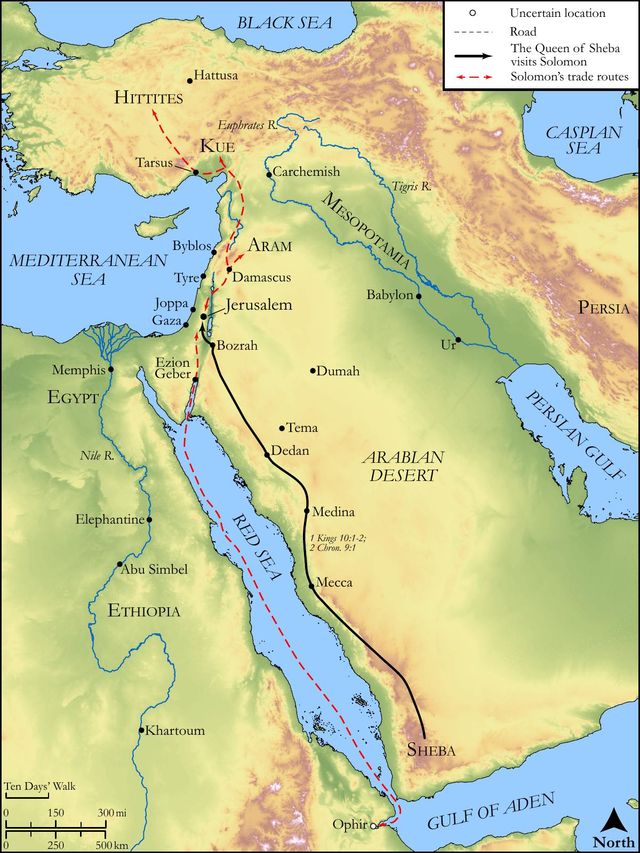
We have here an account of the visit which the queen of Sheba made to Solomon, no doubt when he was in the height of his piety and prosperity. Our Saviour calls her the queen of the south, for Sheba lay south of Canaan. The common opinion is that it was in Africa; and the Christians in Ethiopia, to this day, are confident that she came from their country, and that Candace was her successor, who is mentioned Act 8:27. But it is more probable that she came from the south part of Arabia the happy. It should seem she was a queen regent, sovereign of her country. Many a kingdom would have been deprived of its greatest blessings if a Salique law had been admitted into its constitution. Observe,
I.On what errand the queen of Sheba came - not to treat of trade or commerce, to adjust the limits of their dominions, to court his alliance for their mutual strength or his assistance against some common enemy, which are the common occasions of the congress of crowned heads and their interviews, but she came,
1.To satisfy her curiosity; for she had heard of his fame, especially for wisdom, and she came to prove him, whether he was so great a man as he was reported to be, Kg1 10:1. Solomon's fleet sailed near the coast of her country, and probably might put in there for fresh water; perhaps it was thus that she heard of the fame of Solomon, that he excelled in wisdom all the children of the east, and nothing would serve her but she would go herself and know the truth of the report.
2.To receive instruction from him. She came to hear his wisdom, and thereby to improve her own (Mat 12:42), that she might be the better able to govern her own kingdom by his maxims of policy. Those whom God has called to any public employment, particularly in the magistracy and ministry, should, by all means possible, be still improving themselves in that knowledge which will more and more qualify them for it, and enable them to discharge their trust well. But, it should seem, that which she chiefly aimed at was to be instructed in the things of God. She was religiously inclined, and had heard not only of the fame of Solomon, but concerning the name of the Lord (Kg1 10:1), the great name of that God whom Solomon worshipped and from whom he received his wisdom, and with this God she desired to be better acquainted. Therefore does our Saviour mention her enquiries after God, by Solomon, as an aggravation of the stupidity of those who enquire not after God by our Lord Jesus Christ, though he, having lain in his bosom, was much better able to instruct them.
II.With what equipage she came, with a very great retinue, agreeable to her rank, intending to try Solomon's wealth and generosity, as well as his wisdom, what entertainment he could and would give to a royal visitant, Kg1 10:2. Yet she came not as one begging, but brought enough to bear her charges, and abundantly to recompense Solomon for his attention to her, nothing mean or common, but gold, and precious stones, and spices, because she came to trade for wisdom, which she would purchase at any rate.
III.What entertainment Solomon gave her.
He despised not the weakness of her sex, blamed her not for leaving her own business at home to come so long a journey, and put herself and him to so much trouble and expense merely to satisfy her curiosity; but he made her welcome and all her train, gave her liberty to put all her questions, though some perhaps were frivolous, some captious, and some over-curious; he allowed her to commune with him of all that was in her heart (Kg1 10:2) and gave her a satisfactory answer to all her questions (Kg1 10:3), whether natural, moral, political, or divine. Were they designed to try him? he gave them such turns as abundantly satisfied her of his uncommon knowledge. Were they designed for her own instruction? (as we suppose most of them were), she received abundant instruction from him, and he made things surprisingly easy which she apprehended insuperably difficult, and satisfied her that there was a divine sentence in the lips of this king. But he informed her no doubt, with particular care, concerning God, and his law and instituted worship. He had taken it for granted (Kg1 8:42) that strangers would hear of his great name, and would come thither to enquire after him; and now that so great a stranger came we may be sure he was not wanting to assist and encourage her enquiries, and give her a description of the temple, and the officers and services of it, that she might be persuaded to serve the Lord whom she now sought.
IV.How she was affected with what she saw and heard in Solomon's court.
Divers things are here mentioned which she admired, the buildings and furniture of his palace, the provision that was made very day for his table (when she saw that perhaps she wondered where there were mouths for all that meat, but when she saw the multitude of his attendants and guests she was as ready to wonder where was the meat for all those mouths), the orderly sitting of his servants, every one in his place, and the ready attendance of his ministers, without any confusion, their rich liveries, and the propriety with which his cup-bearers waited at his table. These things she admired, as adding much to his magnificence. But, above all these, the first thing mentioned (which contained all) is his wisdom (Kg1 10:4), of the transcendency of which she now had incontestable proofs: and the last thing mentioned, which crowned all, is his piety, the ascent by which he went up to the house of the Lord, with what gravity and seriousness, and an air of devotion in his countenance, he appeared, when he went to the temple to worship God, with as much humility then as majesty at other times. Many of the ancient versions read it, The burnt-offerings which he offered in the house of the Lord; she observed with what a generous bounty he brought his sacrifices, and with what a pious fervour he attended the offering of them; never did she see so much goodness with so much greatness. Every thing was so surprising that there was no more spirit in her, but she stood amazed; she had never seen the like.
V.How she expressed herself upon this occasion.
1.She owned her expectation far out-done, though it was highly raised by the report she heard, Kg1 10:6, Kg1 10:7. She is far from repenting her journey or calling herself a fool for undertaking it, but acknowledges it was well worth her while to come so far for the sight of that which she could not believe the report of. Usually things are represented to us, both by common fame and by our own imagination, much greater than we find them when we come to examine them; but here the truth exceeded both fame and fancy. Those who, through grace, are brought to experience the delights of communion with God will say that the one-half was not told them of the pleasures of Wisdom's ways and the advantages of her gates. Glorified saints, much more, will say that it was a true report which they heard of the happiness of heaven, but that the thousandth part was not told them, Co1 2:9.
2.She pronounced those happy that constantly attended him, and waited on him at table: "Happy are thy men, happy are these thy servants (Kg1 10:8); they may improve their own wisdom by hearing thine." She was tempted to envy them and to which herself one of them. Note, It is a great advantage to be in good families, and to have opportunity of frequent converse with those that are wise, and good, and communicative. Many have this happiness who know not how to value it. With much more reason may we say this of Christ's servants, Blessed are those that dwell in his house, they will be still praising him.
3.She blessed God, the giver of Solomon's wisdom and wealth, and the author of his advancement, who had made him king,
(1.)In kindness to him, that he might have the larger opportunity of doing good with his wisdom: He delighted in thee, to set thee on the throne of Israel, Kg1 10:9. Solomon's preferment began in the prophet's calling him Jedidiah, because the Lord loved him, Sa2 12:25. It more than doubles our comforts if we have reason to hope they come from God's delight in us. It was his pleasure concerning thee (so it may be read) to set thee on the throne, not for thy merit's sake, but because it so seemed good unto him.
(2.)In kindness to the people, because the Lord loved Israel for ever, designed them a lasting bliss, long to survive him that laid the foundations of it. "He has made thee king, not that thou mayest live in pomp and pleasure, and do what thou wilt, but to do judgment and justice." This she kindly reminded Solomon of, and no doubt he took it kindly. Both magistrates and ministers must be more solicitous to do the duty of their places than to secure the honours and profits of them. To this she attributes his prosperity, not to his wisdom, for bread is not always to the wise (Ecc 9:11), but whoso doeth judgment and justice, it shall be well with him, Jer 22:15. Thus giving of thanks must be made for kings, for good kings, for such kings; they are what God makes them to be.
VI.How they parted.
1.She made a noble present to Solomon of gold and spices, Kg1 10:10. David had foretold concerning Solomon that to him should be given of the gold of Sheba, Psa 72:15. The present of gold and spices which the wise men of the east brought to Christ was signified by this, Mat 2:11. Thus she paid for the wisdom she had learned and did not think she bought it dearly. Let those that are taught of God give him their hearts, and the present will be more acceptable than this of gold and spices. Mention is made of the great abundance Solomon had of his own, notwithstanding she presented and he accepted this gold. What we present to Christ he needs not, but will have us so to express our gratitude. The almug-trees are here spoken of (Kg1 10:11, Kg1 10:12) as extraordinary, because perhaps much admired by the queen of Sheba.
2.Solomon was not behind-hand with her: He gave her whatsoever, she asked, patterns, we may suppose, of those things that were curious, by which she might make the like; or perhaps he gave her his precepts of wisdom and piety in writing, besides that which he gave her of his royal bounty, Kg1 10:13. Thus those who apply to our Lord Jesus will find him not only greater than Solomon, and wiser, but more kind; whatsoever we ask, it shall be done for us; nay, he will, out of his divine bounty, which infinitely exceeds royal bounty, even Solomon's, do for us more than we are able to ask or think.
Historical interpretation
Historical reception
1 surviving comment on this verse from the historical church.
The queen of Sheba was a type of our church. She came from her distant land to king Solomon, the church came together from the four regions of the world to Christ. What [the queen] ignored, she learned from Solomon, and she went back to her land with many gifts. Here the mystery which had remained hidden for centuries and generations was finally revealed: after she had been taught to despise earthly possessions, she was made a participant and dispenser of the heavenly treasure. Why do not we imitate the queen of the South, whom our mother [the church] emulated, by offering gold, precious stones and spices to Christ? The transaction is that we lose worthless things, so that we may get great ones, which we search for and lack in the highest degree.
Continue studying 1 Kings 10:10 across the web’s major study libraries — every link below opens this exact verse, chapter, or book on the destination site.
Read & Compare
 BibleGatewayThis verse in more than 200 translations and 70 languages.
 Bible.comThe YouVersion reader — hundreds of translations, reading plans, and highlights.
 ESV.orgCrossway's official English Standard Version reader.
 NET BibleThe NET translation with 60,000+ translators' notes on every rendering decision.
 STEP BibleTyndale House's free study tool — original text, vocabulary, and scholarly resources.
 BibliaLogos Bible Software's free web reader.
 USCCBThe New American Bible (Revised Edition) with the U.S. bishops' study notes.
Commentaries
 BibleHub CommentariesDozens of classic commentaries on this verse, gathered on one page.
 StudyLightMore than 100 commentary sets — the largest collection on the web.
 BibleRefPlain-English commentary on what this verse means, verse by verse.
 Enduring WordDavid Guzik's free commentary on this chapter, widely used by Bible teachers.
 Bible Study ToolsVerse commentary alongside Greek and Hebrew study aids.
Original Language & Research
- BibleHub InterlinearThe verse word by word — original language, transliteration, and English.
- BibleHub LexiconEvery word's original-language definition and Strong's entry.
 Blue Letter BibleDeep-study tools — Strong's numbers, concordance, and word studies.
 SefariaThe Hebrew text with Rashi and centuries of Jewish commentary.
Sermons, Hymns & Audio


TrulyRandomVerse is not affiliated with these sites and doesn’t control their content. They’re linked because they’re genuinely useful.
Summary
1 Kings 10:10 meticulously records the lavish tribute presented by the Queen of Sheba to King Solomon, marking a pinnacle of diplomatic exchange and material wealth during his reign. This verse highlights the astounding quantity of gold, an unprecedented store of spices, and precious stones, underscoring the Queen's profound awe at Solomon's divinely granted wisdom and the unparalleled splendor of his kingdom. It serves as a testament to the international recognition of Solomon's prosperity, which was a direct fulfillment of God's promises.
Context
ShowHideLiterary Context
This verse is situated at the climax of the Queen of Sheba's visit to Jerusalem, as recounted in 1 Kings 10. Having heard of Solomon's legendary wisdom and prosperity, she traveled from her distant kingdom to test him with "hard questions" as stated in 1 Kings 10:1. After witnessing his wisdom, the grandeur of his court, the order of his administration, and the opulence of his temple and palace, she was utterly overwhelmed, declaring that "the half was not told me" in 1 Kings 10:7. Her magnificent gifts, detailed in this verse, are a direct response to her profound astonishment and serve as a formal expression of honor and tribute, preceding her departure from Jerusalem. The narrative then shifts to Solomon's reciprocal gifts and the immense wealth that continued to flow into his kingdom.
Historical & Cultural Context
The kings of that day maintained intricate diplomatic relations, often cemented through elaborate gift-giving. Such exchanges were not merely commercial transactions but symbolic acts affirming alliances, respect, and submission. The Queen of Sheba's journey from a kingdom likely located in modern-day Yemen or Ethiopia underscores the vast reach of Solomon's reputation and the extensive trade networks of the era. Spices, gold, and precious stones were highly valued commodities, serving as currency, luxury goods, and essential components in religious rituals and medicinal practices. The "talents of gold" refer to a significant unit of weight, indicating a staggering amount of wealth. This exchange reflects a period of unprecedented peace and prosperity for Israel, positioning Solomon as a global power whose influence extended far beyond his immediate borders, drawing admiration and tribute from distant lands.
Key Themes
ShowHide1 Kings 10:10 powerfully reinforces several overarching themes within the book of Kings and the broader biblical narrative. Firstly, it highlights God's Unparalleled Blessing and Fulfillment of Promise. Solomon's immense wealth and international renown are direct manifestations of God's promise to him in 1 Kings 3:13, where God granted him "both riches, and honour" because he chose wisdom. Secondly, the verse emphasizes Solomon's God-Given Wisdom as the Source of Prosperity. The Queen's visit was prompted by reports of his wisdom, and her gifts were a response to witnessing it firsthand, demonstrating how divine wisdom leads to practical success and material abundance. Thirdly, it showcases International Recognition of God's Work. The Queen's awe and tribute are not merely for Solomon but implicitly for the God of Israel, whose blessing is evident in Solomon's reign. Finally, the verse underscores the theme of Generosity and Reciprocity, as the Queen's extraordinary giving is met with Solomon's own generosity, reflecting the nature of diplomatic and personal relationships between kings.
Exposition and Analysis
ShowHideKey Word Analysis
ShowHideThis Hebrew term (H3603) refers to a unit of weight, often associated with a "large [round] coin" or a "circle." In this context, it signifies a substantial measure of gold, typically about 75 pounds (or approximately 34 kilograms). The mention of "an hundred and twenty talents of gold" signifies an astronomical sum, equating to roughly 9,000 pounds (over 4,000 kilograms) of gold. This massive quantity underscores the immense wealth of the Queen of Sheba and the unprecedented nature of her gift, far exceeding what would be considered customary tribute. It highlights the extraordinary value placed on Solomon's wisdom and kingdom.
This word (H1314) denotes "fragrance" or "spicery," by implication, the "balsam plant." It refers to aromatic substances, often derived from plants, used for incense, perfumes, medicinal purposes, and culinary flavorings. In Scripture, spices like frankincense and myrrh were highly prized, rare, and extremely valuable, often transported over long distances via trade routes. The phrase "very great store" and the emphatic declaration that "there came no more such abundance of spices" emphasize the unparalleled quantity and quality of these exotic commodities, making this gift of spices uniquely significant.
This Hebrew noun (H7230) signifies a "great quantity, multitude, or superabundance" in any respect. Its use in the phrase "no more such abundance of spices" serves as an emphatic superlative, indicating that this particular delivery of spices was unmatched in Israel's history, setting a benchmark for generosity and wealth. It highlights the extraordinary and unprecedented nature of the Queen's offering, emphasizing the peak of Solomon's prosperity and the lavishness of the tribute he received.
Verse Breakdown
ShowHide"And she gave the king an hundred and twenty talents of gold,"
This clause immediately establishes the immense material value of the Queen of Sheba's gift. The "hundred and twenty talents of gold" represents an extraordinary amount, far beyond a typical diplomatic offering, signifying profound respect and acknowledgment of Solomon's status and wealth. This detail highlights the opulence of the era and the Queen's own vast resources, demonstrating the depth of her impression.
"and of spices very great store, and precious stones:"
This part of the verse expands on the diversity and richness of the Queen's tribute. The "very great store" of spices emphasizes their unprecedented quantity, indicating a supply far exceeding any previous imports. Coupled with "precious stones," these items further underscore the exotic nature and immense value of the gifts, reflecting the Queen's desire to honor Solomon with the finest and most valuable commodities from her kingdom, symbolizing her profound admiration.
"there came no more such abundance of spices as these which the queen of Sheba gave to king Solomon."
This concluding statement serves as a powerful hyperbole, emphasizing the unique and unparalleled nature of the spice offering. It acts as a superlative, declaring that this specific gift of spices was a historical record, never to be surpassed. This final clause not only highlights the Queen's extraordinary generosity but also implicitly underscores the peak of Solomon's wealth and the divine favor bestowed upon him, which attracted such magnificent tributes, solidifying his international renown.
Literary Devices
ShowHideThe verse employs several literary devices to underscore the significance of the Queen of Sheba's gifts. Enumeration is evident in the precise listing of the specific types of gifts: gold, spices, and precious stones, which provides a concrete sense of the immense wealth exchanged and the variety of valuable commodities. Hyperbole is powerfully used in the statement, "there came no more such abundance of spices as these," which emphasizes the unprecedented and unmatched quantity of the spices. This is not necessarily a literal claim that no more spices ever came, but rather an emphatic declaration of the extraordinary nature of this specific gift, setting it apart as a benchmark of lavishness. Additionally, the repetition of "spices" and the emphasis on "abundance" create emphasis, drawing the reader's attention to this particular commodity as a highlight of the Queen's tribute and a testament to her unparalleled generosity. These devices collectively serve to magnify the Queen's generosity and, by extension, the unparalleled prosperity and international renown of King Solomon.
Theological and Thematic Connections
ShowHide1 Kings 10:10 stands as a vivid testament to God's faithfulness in fulfilling His promises and His capacity to bless beyond measure. The immense wealth and international acclaim Solomon received were not merely a result of his shrewd leadership but a direct consequence of God's divine favor, granted after Solomon chose wisdom over riches or a long life, as recorded in 1 Kings 3:13. The Queen of Sheba's lavish gifts, particularly the unprecedented quantity of spices, symbolize the global recognition of God's blessing upon Israel through its king. This passage highlights that true wisdom, divinely bestowed, leads to a prosperity that draws even distant nations to acknowledge the greatness of God. It also underscores the principle that generosity often flows from a heart overwhelmed by genuine awe and respect, mirroring how God's abundant blessings can inspire lavish worship and giving from His people.
Reflection and Application
ShowHideThe narrative of the Queen of Sheba's visit and her extraordinary gifts to Solomon offers profound insights for contemporary believers. It reminds us that God is the ultimate source of all wisdom, wealth, and honor. While few will experience material prosperity on Solomon's scale, the principle remains: seeking God's wisdom and His kingdom first can lead to blessings, both material and spiritual, that exceed our expectations. The Queen's response of lavish giving, prompted by her astonishment at Solomon's wisdom and the splendor of his kingdom, challenges us to consider our own generosity. What moves us to give? Is it a response to the overwhelming goodness and wisdom of God in our lives? This passage encourages us to cultivate a heart of awe and gratitude, recognizing God's abundant provision and responding with open-handed generosity in our worship and service. It also prompts us to consider how our lives, marked by God's wisdom and blessing, might draw others to inquire about the source of our hope and joy.
Questions for Reflection
ShowHideFAQ
ShowHideWhat was the significance of the "talents of gold" mentioned in this verse?
ShowHideThe "talents of gold" refer to a substantial unit of weight and value in Israel. One talent typically weighed about 75 pounds (approximately 34 kilograms). Therefore, 120 talents of gold amounted to roughly 9,000 pounds (over 4,000 kilograms) of gold. This was an astronomical sum, representing an immense transfer of wealth. Its significance lies not only in the sheer monetary value but also in what it symbolized: the Queen of Sheba's vast resources, her profound respect and awe for King Solomon's divinely granted wisdom and prosperity, and the unparalleled diplomatic exchange that marked the zenith of Solomon's reign. This gift underscored the international recognition of Solomon's kingdom as a preeminent power, blessed by God.
Why were "spices" so valuable in Solomon's day, and what kind of spices might these have been?
ShowHideSpices were incredibly valuable in Solomon's day for several reasons. They were used for perfumes, incense in religious rituals, medicinal purposes, and as culinary flavorings. Many spices, like frankincense and myrrh, were rare, difficult to cultivate, and had to be transported over long and dangerous trade routes from distant lands, making them luxury commodities. The "very great store" of spices given by the Queen of Sheba likely included these highly prized resins, which were indigenous to regions like the Arabian Peninsula (where Sheba is thought to have been located). The emphasis on "no more such abundance" highlights the extraordinary quantity and quality of this particular gift, underscoring its unique value and the Queen's exceptional generosity.
Where did the Queen of Sheba come from, and what was the purpose of her visit?
ShowHideThe Queen of Sheba's kingdom is generally believed to have been located in the region of modern-day Yemen or Ethiopia, in the Arabian Peninsula. Her purpose in visiting King Solomon was primarily to test his legendary wisdom and to witness the splendor of his kingdom for herself, as she had heard "the fame of Solomon concerning the name of the Lord" as recounted in 1 Kings 10:1. She came with "hard questions" to challenge his intellect. Upon witnessing his wisdom, the order of his court, and the magnificence of his enterprises, she was utterly overwhelmed, concluding that the half had not been told her, as stated in 1 Kings 10:7. Her visit was a diplomatic mission that validated Solomon's international renown and underscored the divine favor upon his reign.
Christ-Centered Fulfillment
ShowHideThe unparalleled wisdom and wealth of Solomon, culminating in the lavish tribute from the Queen of Sheba, serve as a profound foreshadowing of Jesus Christ. Solomon's reign, marked by peace and prosperity, was a type of the messianic kingdom, and his wisdom, though great, was finite. Jesus, however, is the embodiment of divine wisdom, "in whom are hid all the treasures of wisdom and knowledge," as declared in Colossians 2:3. The Queen of Sheba's journey from the ends of the earth to hear Solomon's wisdom and offer him gifts anticipates the nations coming to Christ, the true King of kings, to worship Him and offer their lives as spiritual sacrifices, echoing the prophecies of Isaiah 60:6. Jesus Himself declared, "The Queen of the South will rise up at the judgment with this generation and condemn it, for she came from the ends of the earth to hear the wisdom of Solomon, and behold, something greater than Solomon is here," as recorded in Matthew 12:42. The gold, spices, and precious stones given to Solomon find their ultimate spiritual fulfillment in the immeasurable spiritual riches found in Christ, who offers eternal life, true peace, and wisdom that surpasses all understanding, as highlighted in Ephesians 3:8. The lavish gifts to Solomon point to the worship and devotion due to Christ, who is worthy of all honor, glory, and praise from every nation and tribe, as described in Revelation 5:12.