


1 Samuel 23:11
Bible text: King James Version (1769 Blayney text) · Public domain
Bible text: King James Version with Strong's numbers · Public domain
Bible text: Berean Standard Bible · Public domain
Bible text: American Standard Version (1901) · Public domain
Bible text: World English Bible, Messianic edition · Public domain
Bible text: Geneva Bible (1599) · Public domain
Bible text: Young's Literal Translation · Public domain
- הֲיַסְגִּרֻנִיha·yas·gi·Ru·ni¿ will they deliver up meH5462Interrog ¦ V-Hiphil-Imperf-3mp ¦ 1csVerb Hiphil Imperfect 3rd Plural Masculineהֲ¿יַסְגִּרֻwill they deliver upנִיme
- בַעֲלֵיva·'a·Lei[the] citizens ofH1167N-mpcNoun Plural Masculine Construct
- קְעִילָהke·'i·LahKeilahH7084N-properNoun Proper Location
- בְיָדוֹve·ya·Doin his handH3027Prep-b ¦ N-csc ¦ 3msNoun Singular common gender Constructבְinיָדhandוֹhis
- הֲיֵרֵדha·ye·Red¿ will he come downH3381Interrog ¦ V-Qal-Imperf-3msVerb Qal Imperfect 3rd Singular Masculineהֲ¿יֵרֵדwill he come down
- שָׁאוּלsha·'UlSaulH7586N-proper-mNoun Proper Masculine
- כַּאֲשֶׁרka·'a·Sherjust asH834Prep-k ¦ RelParticle Relativeכַּjustאֲשֶׁרas
- שָׁמַעsha·Ma'he has heardH8085V-Qal-Perf-3msVerb Qal Perfect 3rd Singular Masculine
- עַבְדֶּךָ'av·De·khayour servantH5650N-msc ¦ 2msNoun Singular Masculine Constructעַבְדֶּservantךָyour
- יְהוָהYah·wehO YahwehH3068N-properNoun Proper Title
- אֱלֹהֵי'e·lo·Hei[the] God ofH430N-mpcNoun Plural Masculine Construct
- יִשְׂרָאֵלYis·ra·'ElIsraelH3478N-properNoun Proper Location
- הַגֶּדha·gedtellH5046V-Hiphil-Imp-2msVerb Hiphil Imperative 2nd Singular Masculine
- נָאna'pleaseH4994PrtParticle Interjection
- לְעַבְדֶּךָle·'av·De·khato your servantH5650Prep-l ¦ N-msc ¦ 2msNoun Singular Masculine Constructלְtoעַבְדֶּservantךָyour
- וַיֹּאמֶרvai·Yo·merand he saidH559Conj-w ¦ V-Qal-ConsecImperf-3msVerb Qal Consecutive Imperfect 3rd Singular Masculineוַandיֹּאמֶרhe said
- יְהוָהYah·wehYahwehH3068N-properNoun Proper Title
- יֵרֵדye·Redhe will come downH3381V-Qal-Imperf-3msVerb Qal Imperfect 3rd Singular Masculine
English is a literal word-by-word gloss of the Hebrew, not the KJV's wording. Why?
This is the original text the KJV's translators worked from — each Hebrew word with its own literal English meaning in this verse, prepared by scholars at Tyndale House, Cambridge. The KJV translates whole sentences, not word by word, so its wording differs: one Hebrew word can become several English words, and the KJV may choose “the LORD” where the gloss reads “Yahweh”. Both are faithful — they answer different questions. For the KJV's own rendering, switch to the KJV text.
Details
See on the biblical-era map
Study this verse
Public-domain commentary
Matthew Henry
From his Commentary on the Whole Bible. Henry comments on passages, not single verses — this entry covers 1 Samuel 23:7–13. His four-level outline is real structure in the source text, so it is rendered as structure.
Here is, I. Saul contriving within himself the destruction of David (Sa1 23:7, Sa1 23:8): He heard that he had come to Keilah; and did he not hear what brought him thither? Was it not told him that he had bravely relieved Keilah and delivered it out of the hands of the Philistines? This, one would think, should have put Saul upon considering what honour and dignity should be done to David for this. But, instead of that, he catches at it as an opportunity of doing David a mischief. An ungrateful wretch he was, and for ever unworthy to have any service or kindness done him. Well might David complain of his enemies that they rewarded him evil for good, and that for his love they ere his adversaries, Psa 35:12; Psa 109:4. Christ was used thus basely, Joh 10:32. Now observe, 1. How Saul abused the God of Israel, in making his providence to patronise and give countenance to his malicious designs, and thence promising himself success in them: God hath delivered him into my hand; as if he who was rejected of God were in this instance owned and favoured by him, and David infatuated. He vainly triumphs before the victory, forgetting how often he had had fairer advantages against David than he had now and had yet missed his aim. He impiously connects God with his cause, because he thought he had gained one point. Therefore David prays (Psa 140:8), Grant not, O Lord! the desires of the wicked; further not his wicked device, lest they exalt themselves. We must not think that one smiling providence either justifies an unrighteous cause or secures its success. 2. How Saul abused the Israel of God, in making them the servants of his malice against David. He called all the people together to war, and they must with all speed march to Keilah, pretending to oppose the Philistines, but intending to besiege David and his men, though concealing that design; for it is said (Sa1 23:9) that he secretly practised mischief against him. Miserable is that people whose prince is a tyrant, for, while some are sufferers by his tyranny, others (which is worse) are made servants to it and instruments of it.
II.David consulting with God concerning his own preservation.
He knew by the information bought him that Saul was plotting his ruin (Sa1 23:9) and therefore applied to his great protector for direction. No sooner is the ephod brought to him than he makes use of it: Bring hither the ephod. We have the scriptures, those lively oracles, in our hands; let us take advice from them in doubtful cases. "Bring hither the Bible."
1.David's address to God upon this occasion is,
(1.)Very solemn and reverent. Twice he calls God the Lord God of Israel, and thrice calls himself his servant, Sa1 23:10, Sa1 23:11. Those that address God must know their distance, and who they are speaking to.
(2.)Very particular and express. His representation of the case is so (Sa1 23:10): "Thy servant has certainly heard on good authority" (for he would not call for the ephod upon every idle rumour) "that Saul has a design upon Keilah;" he does not say, "to destroy me," but, "to destroy the city" (as he had lately done the city of Nob) "for my sake." He seems more solicitous for their safety than for his own, and will expose himself any where rather than they shall be brought into trouble by his being among them. Generous souls are thus minded. His queries upon the case are likewise very particular. God allows us to be so in our addresses to him: "Lord, direct me in this matter, about which I am now at a loss." He does indeed invert the due order of his queries, but God in his answer puts him into method. That question should have been put first, and was first answered, "Will Saul come down, as thy servant has heard?" "Yea," says the oracle, "he will come down; he has resolved it, is preparing for it, and will do it, unless he hear that thou hast quitted the town." "Well, but if he do come down will the men of Keilah stand by me in holding the city against him, or will they open to him the gates, and deliver me into his hand?" If he had asked the men (the magistrates or elders) of Keilah themselves what they would do in that case, they could not have told him, not knowing their own minds, nor what they should do when it came to the trial, much less which way the superior vote of their council would carry it; or they might have told him they would protect him, and yet afterwards have betrayed him; but God could tell him infallibly: "When Saul besieges their city, and demands of them that they surrender thee into his hands, how fond soever they now seem of thee, as their saviour, they will deliver thee up rather than stand the shock of Saul's fury." Note,
[1.]God knows all men better than they know themselves, knows their length, their strength, what is in them, and what they will do if they come into such and such circumstances.
[2.]He therefore knows not only what will be, but what would be if it were not prevented; and therefore knows how to deliver the godly out of temptation, and how to render to every man according to his works.
2.David, having thus far notice given him of his danger, quitted Keilah, Sa1 23:13. His followers had now increased in number to 600; with these he went out, not knowing whither he went, but resolving to follow Providence and put himself under its protection. This broke Saul's measures. He thought God had delivered David into his hand, but it proved that God delivered him out of his hand, as a bird out of the snare of the fowler. When Saul heard that David had escaped from Keilah, he forbore to go forth with the body of the army, as he intended (Sa1 23:8), and resolved to take only his own guards, and go in quest of his people's enemies and turn their counsels head-long.
Continue studying 1 Samuel 23:11 across the web’s major study libraries — every link below opens this exact verse, chapter, or book on the destination site.
Read & Compare
 BibleGatewayThis verse in more than 200 translations and 70 languages.
 Bible.comThe YouVersion reader — hundreds of translations, reading plans, and highlights.
 ESV.orgCrossway's official English Standard Version reader.
 NET BibleThe NET translation with 60,000+ translators' notes on every rendering decision.
 STEP BibleTyndale House's free study tool — original text, vocabulary, and scholarly resources.
 BibliaLogos Bible Software's free web reader.
 USCCBThe New American Bible (Revised Edition) with the U.S. bishops' study notes.
Commentaries
 BibleHub CommentariesDozens of classic commentaries on this verse, gathered on one page.
 StudyLightMore than 100 commentary sets — the largest collection on the web.
 BibleRefPlain-English commentary on what this verse means, verse by verse.
 Enduring WordDavid Guzik's free commentary on this chapter, widely used by Bible teachers.
 Bible Study ToolsVerse commentary alongside Greek and Hebrew study aids.
Original Language & Research
- BibleHub InterlinearThe verse word by word — original language, transliteration, and English.
- BibleHub LexiconEvery word's original-language definition and Strong's entry.
 Blue Letter BibleDeep-study tools — Strong's numbers, concordance, and word studies.
 SefariaThe Hebrew text with Rashi and centuries of Jewish commentary.
Sermons, Hymns & Audio


TrulyRandomVerse is not affiliated with these sites and doesn’t control their content. They’re linked because they’re genuinely useful.
Summary
1 Samuel 23:11 captures a critical juncture in David's life, revealing his profound dependence on God amidst intense vulnerability and imminent danger. Having recently delivered the city of Keilah from Philistine oppression, David receives intelligence that King Saul plans to besiege the city to capture him. Faced with the potential betrayal by the very people he had just saved, David turns to the Lord, seeking direct divine counsel on two specific questions: whether the men of Keilah would surrender him into Saul's hand, and if Saul would indeed come down as reported. The Lord's immediate and unequivocal response, "He will come down," confirms the accuracy of David's intelligence and underscores God's active involvement in the affairs of His servants, providing precise guidance in moments of dire uncertainty and setting the stage for the subsequent revelation of Keilah's treachery.
Context
ShowHideLiterary Context
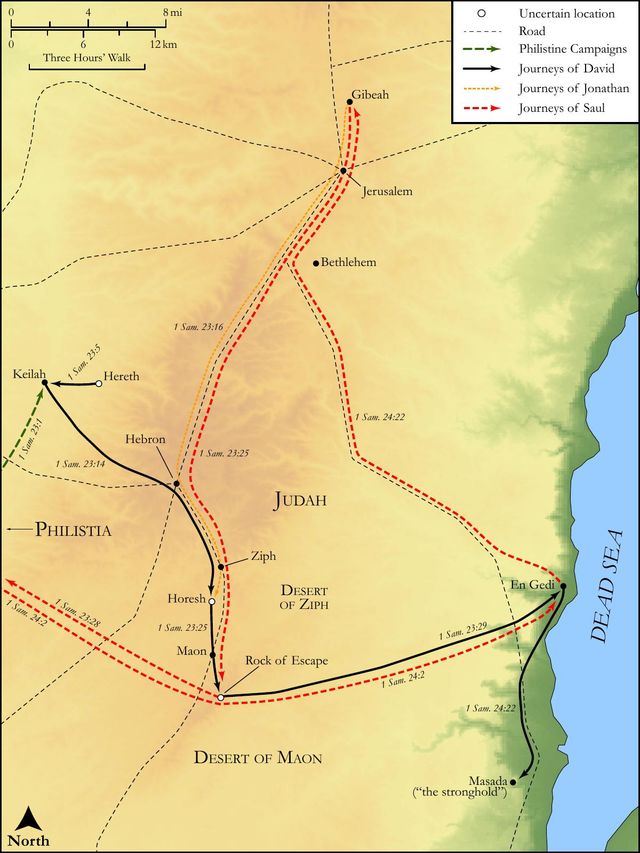
This verse is strategically placed within a dramatic and extended narrative detailing David's relentless flight from King Saul, who has succumbed to a consuming jealousy and a murderous obsession. Immediately preceding this passage, David, after inquiring of the Lord, bravely led his small band of men to rescue the Philistine-besieged city of Keilah, saving its inhabitants and their livestock from certain destruction (1 Samuel 23:1-5). The arrival of Abiathar the priest, bringing the ephod, a vital instrument for divine consultation, further facilitated David's ability to seek God's will directly (1 Samuel 23:6). Upon hearing that David was in Keilah, Saul, believing God had "delivered him into my hand," devised a plan to trap him within the fortified city (1 Samuel 23:7-8). It is against this backdrop of recent deliverance and impending treachery that David, acutely aware of Saul's malicious intent, turns to God in this verse, seeking specific information about the loyalty of Keilah's citizens and Saul's approach, which then sets the stage for God's subsequent, more detailed revelation in 1 Samuel 23:12 that confirms the potential betrayal.
Historical & Cultural Context
The period of Saul's reign and David's subsequent rise was a tumultuous and transitional era in ancient Israel. Kingship was a relatively new institution, and the tension between divine appointment (David) and human selection (Saul) was a central theme. The city of Keilah, situated in the Shephelah—the lowlands between the Judean hills and the Philistine plain—was strategically important and highly vulnerable to Philistine raids due to its location. David's act of deliverance would have been seen as a significant act of tribal loyalty and military prowess, establishing him as a protector. The use of the ephod for divine consultation was a legitimate and established practice in Israelite worship, signifying direct communication with God through the high priest. This practice highlights the theocratic nature of Israel, where God was ultimately the supreme ruler and source of wisdom, even amidst the establishment of human kingship. The concept of "delivering up" or betrayal was a grave concern in a society where tribal and familial loyalties were paramount, and the threat of such an act by those just saved would have been deeply unsettling and morally reprehensible.
Key Themes
ShowHideThis verse powerfully illustrates several enduring themes within 1 Samuel and the broader biblical narrative. Firstly, it highlights Divine Guidance and Dependence, showcasing David's consistent and profound reliance on God for every strategic decision, even when his own military acumen might suggest a course of action. Unlike Saul, who increasingly acted independently or sought illicit guidance, David continually "inquired of the Lord," demonstrating a model of faithful leadership and trust in God's sovereignty, as seen throughout his flight in passages like 1 Samuel 23:2. Secondly, the Lord's immediate and unambiguous answer, "He will come down," underscores God's Responsive Nature and His willingness to communicate specifically with His servants when they earnestly seek His will, offering practical, actionable information. Thirdly, David's fear of betrayal and God's subsequent confirmation (in the following verse) speak to the harsh reality of Human Fickleness and Self-Preservation, where gratitude can be quickly overshadowed by fear or self-interest, a theme echoed in other accounts of human unfaithfulness, such as the Israelites' grumbling in the wilderness despite God's provisions (Exodus 16). Finally, the verse reinforces Saul's Obsessive and Irrational Pursuit of David, driven by jealousy and a deepening spiritual decline, a motif that dominates the latter part of 1 Samuel, exemplified by Saul's relentless hunt detailed in 1 Samuel 23:14.
Exposition and Analysis
ShowHideKey Word Analysis
ShowHideThe Hebrew verb סָגַר (çâgar) means "to shut up; figuratively, to surrender; close up, deliver (up), give over (up)." In this context, David's question, "Will the men of Keilah deliver me up into his hand?", uses çâgar to express the specific fear of being "handed over" or "surrendered" to Saul. It implies a deliberate act of betrayal, where the inhabitants, despite David's recent heroic rescue, would choose to enclose him and give him directly into the custody of his enemy. This word emphasizes the active, treacherous role of the Keilahites in such a potential betrayal.
The Hebrew verb נָגַד (nâgad) means "to front, i.e. stand boldly out opposite; by implication (causatively), to manifest; figuratively, to announce (always by word of mouth to one present); specifically, to expose, predict, explain." David's plea, "I beseech thee, tell thy servant," conveys a humble yet earnest and persistent seeking of divine revelation. It is not a casual inquiry but a fervent request for direct, specific, and authoritative guidance from God in a life-threatening situation. This word highlights David's posture of desperate dependence and his recognition of God as the ultimate source of truth and direction, capable of revealing hidden things.
The Hebrew verb יָרַד (yârad) means "to descend (literally, to go downwards; or conventionally to a lower region, as the shore, a boundary, the enemy, etc.; or figuratively, to fall); causatively, to bring down." Saul's intended action is described as "coming down" to Keilah. This term is geographically accurate, as Keilah was in the lowlands (Shephelah) relative to Saul's likely position in the hill country. The Lord's simple, direct affirmation, "He will come down," uses the same verb, confirming the precise nature of Saul's impending movement and validating David's intelligence. It is a factual, unambiguous confirmation of the enemy's plan.
Verse Breakdown
ShowHide"Will the men of Keilah deliver me up into his hand?"
This is David's first, urgent question, revealing his deep concern about the loyalty of the very people he had just rescued. The phrase "into his hand" signifies being completely at Saul's mercy and control, implying capture and likely death. David's inquiry shows his understanding of human nature and the potential for self-preservation to override gratitude, even from those who had just benefited from his heroic actions.
"will Saul come down, as thy servant hath heard?"
David's second question seeks confirmation of the intelligence he has received regarding Saul's movements. He has heard a report, likely through his network of loyalists or spies, that Saul intends to besiege Keilah. He presents this information to God not as a statement, but as a question requiring divine verification, demonstrating his desire for God's authoritative word over mere human reports, especially in a life-or-death scenario.
"O LORD God of Israel, I beseech thee, tell thy servant."
This is David's earnest and humble plea for a direct answer. His address to "O LORD God of Israel" invokes God's covenant name (Yahweh) and His special relationship with His chosen people, emphasizing His power, faithfulness, and unique authority. The phrase "thy servant" underscores David's humility and his submission to God's will, positioning himself as one awaiting instruction. This is a model of fervent, specific prayer in a time of crisis, acknowledging God as the ultimate source of truth.
"And the LORD said, He will come down."
This is God's direct, concise, and unambiguous response to David's second question. The brevity and clarity of the answer underscore God's omniscience and His willingness to provide precise, actionable guidance to His faithful servants. While it only answers the second question explicitly, it implicitly sets the stage for the answer to the first question in the very next verse (1 Samuel 23:12), confirming the precariousness of David's position and the necessity of his immediate departure.
Literary Devices
ShowHideThe verse is a prime example of Dialogue/Direct Speech, presenting a verbatim exchange between David and God, highlighting the intimacy and directness of their relationship. David's initial questions function as Genuine Inquiries seeking specific divine revelation, rather than mere rhetorical effect, underscoring his desperate need for truth. The Lord's response, "He will come down," serves as a Divine Oracle or an auditory Theophany, where God's voice directly intervenes in human affairs, providing unambiguous guidance. This direct divine communication also acts as Foreshadowing, as God's confirmation of Saul's descent immediately precedes and sets up the subsequent revelation in 1 Samuel 23:12 about Keilah's willingness to betray David, thus building narrative tension and validating David's initial fears and suspicions.
Theological and Thematic Connections
ShowHideThis passage profoundly illustrates God's active involvement in the lives of His people, particularly those who earnestly seek His counsel. David's consistent practice of inquiring of the Lord, even in the most perilous circumstances, demonstrates a deep theological truth: God is not a distant deity but an immanent, responsive, and sovereign guide. His willingness to provide specific, actionable intelligence through the ephod underscores His providential care and His desire for His servants to walk in His revealed will. Furthermore, the divine confirmation of Saul's approach, coupled with the implicit warning about human treachery (made explicit in the following verse), highlights God's omniscience—He knows both the plans of the wicked and the hearts of men. This divine knowledge empowers David to make informed decisions, emphasizing that true security lies not in human alliances or strategic strongholds, but in the unfailing wisdom and protection of God, who orchestrates all things for the good of those who love Him.
Reflection and Application
ShowHideDavid's desperate prayer in 1 Samuel 23:11 offers a timeless model for believers facing uncertainty, fear, or potential betrayal. In moments of extreme vulnerability, when human wisdom or strength seems insufficient, the path of faith is to turn directly to the Lord with specific questions and earnest pleas. David did not rely on his military prowess or the gratitude of the Keilahites; instead, he sought divine counsel, demonstrating that true security is found only in God's revealed will and protection. This passage encourages us to cultivate a posture of constant dependence on God, bringing our anxieties, strategic dilemmas, and even our suspicions before Him in prayer. It reminds us that God is willing to communicate, to provide clarity, and to guide our steps, often in specific and practical ways, if we are humble enough to ask and obedient enough to follow. Even when faced with the potential ingratitude or treachery of others, our ultimate trust must remain in the unchanging faithfulness of God, who knows all things and directs the paths of those who seek Him. This divine guidance is not limited to grand, historical events but extends to the daily decisions and challenges we face, inviting us into a deeper, more intimate walk with our omniscient God.
Questions for Reflection
ShowHideFAQ
ShowHideWhy did David ask God if Saul would come down, when he had already "heard" it?
ShowHideDavid's question, "will Saul come down, as thy servant hath heard?", was not born of ignorance of the report, but of a desire for divine confirmation. In a life-or-death situation, David sought the ultimate authority and certainty from God Himself. Human intelligence, no matter how reliable, is fallible and can be misleading. David needed to know with absolute certainty, from the Lord, that the threat was real and imminent, so he could make the correct strategic decision. This demonstrates David's profound trust in God's omniscience and his commitment to acting only according to God's revealed will, rather than human speculation or fear. It highlights his model of seeking divine validation for even seemingly confirmed information, ensuring his actions were divinely sanctioned and protected. This practice aligns with the wisdom found in Proverbs 16:3, which advises committing one's plans to the Lord for success.
Christ-Centered Fulfillment
ShowHideThe narrative of David's flight and his dependence on divine guidance in 1 Samuel 23:11 finds its ultimate and perfect fulfillment in the person and work of Jesus Christ. David, though a man after God's own heart, was a king in exile, constantly pursued by an earthly king consumed by jealousy and a desire to kill him. His desperate need for divine intelligence and protection foreshadows humanity's desperate need for a deliverer from the ultimate enemies: sin, death, and the spiritual forces of evil. Jesus, the true Son of David and the King of Kings, perfectly embodied dependence on the Father, constantly seeking and doing His will, as He declared, "I can do nothing on my own. As I hear, I judge..." He faced betrayal not from those He had merely saved from physical enemies, but from one of His closest disciples, Judas, who delivered Him up to His enemies, as prophesied and perfectly known by God (Luke 22:48 and Matthew 26:21-25). Unlike David, who fled to avoid capture, Christ willingly "came down" from heaven, not to escape, but to be delivered up for the salvation of the world, perfectly fulfilling God's predetermined plan (Philippians 2:6-8). God's precise knowledge and direct communication to David about Saul's plans point to the Father's perfect foreknowledge and sovereign control over all events, culminating in the cross, where the ultimate betrayal became the ultimate act of redemption. In Christ, we find the ultimate "deliverer" who rescues us from the power of darkness and transfers us into His kingdom (Colossians 1:13), offering a security far greater and more eternal than any David could have found in Keilah.