


1 Samuel 25:17
- וְעַתָּהve·'a·Tahand nowH6258Conj-w ¦ AdvAdverbוְandעַתָּהnow
- דְּעִיde·'IknowH3045V-Qal-Imp-2fsVerb Qal Imperative 2nd Singular Feminine
- וּרְאִיu·re·'Iand seeH7200Conj-w ¦ V-Qal-Imp-2fsVerb Qal Imperative 2nd Singular Feminineוּandרְאִיsee
- מַהmahwhat?H4100InterrogPronoun Interrogative
- תַּעֲשִׂיta·'a·Siwill you doH6213V-Qal-Imperf-2fsVerb Qal Imperfect 2nd Singular Feminine
- כִּיkiforH3588PrtParticle Conditional
- כָלְתָהkhal·Tahit has been determinedH3615V-Qal-Perf-3fsVerb Qal Perfect 3rd Singular Feminine
- הָרָעָהha·ra·'Ah<the> evilH7451Art ¦ N-fsNoun Singular Feminine Absoluteהָ<the>רָעָהevil
- אֶל'elagainstH413PrepPreposition
- אֲדֹנֵינוּ'a·do·Nei·nuour master<s>H113N-mpc ¦ 1cpNoun Plural Masculine Constructאֲדֹנֵיmaster<s>נוּour
- וְעַלve·'Aland onH5921Conj-w ¦ PrepPrepositionוְandעַלon
- כָּלkolallH3605N-mscNoun Singular Masculine Construct
- בֵּיתוֹbei·Tohis householdH1004N-msc ¦ 3msNoun Singular Masculine Constructבֵּיתhouseholdוֹhis
- וְהוּאve·Hu'and heH1931Conj-w ¦ Pro-3msPronoun Personal 3rd Singular Masculineוְandהוּאhe
- בֶּןben[is] a son ofH1121N-mscNoun Singular Masculine Construct
- בְּלִיַּעַלbe·li·Ya·'alworthlessnessH1100N-msNoun Singular Masculine Absolute
- מִדַּבֵּרmi·da·Berfrom speakingH1696Prep-m ¦ V-Piel-InfVerb Piel Infinitive Constructמִfromדַּבֵּרspeaking
- אֵלָיו'e·Lavto himH413Prep ¦ 3msPreposition Definiteאֵלָיtoוhim
English is a literal word-by-word gloss of the Hebrew, not the KJV's wording. Why?
This is the original text the KJV's translators worked from — each Hebrew word with its own literal English meaning in this verse, prepared by scholars at Tyndale House, Cambridge. The KJV translates whole sentences, not word by word, so its wording differs: one Hebrew word can become several English words, and the KJV may choose “the LORD” where the gloss reads “Yahweh”. Both are faithful — they answer different questions. For the KJV's own rendering, switch to the KJV text.
Details
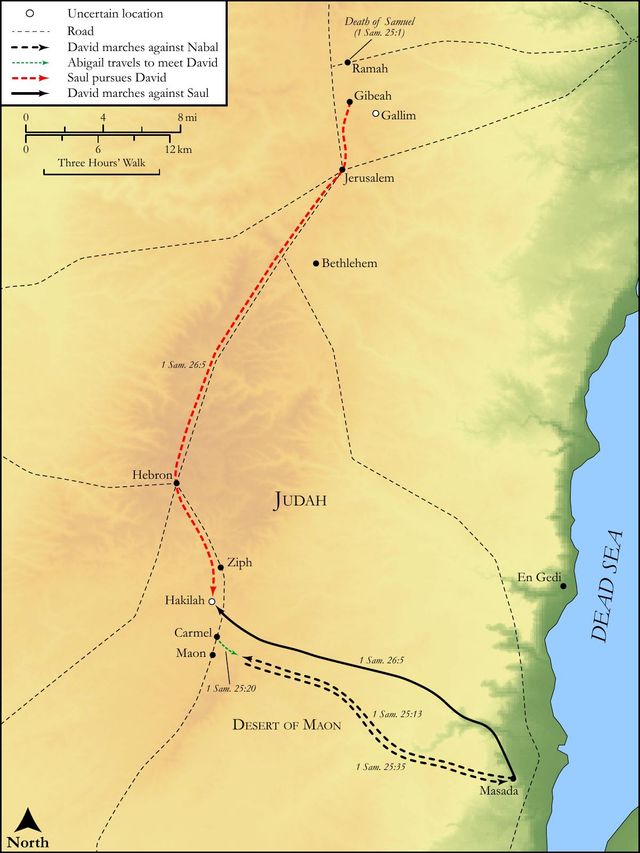
See on the biblical-era map
Study this verse
Public-domain commentary
Matthew Henry
From his Commentary on the Whole Bible. Henry comments on passages, not single verses — this entry covers 1 Samuel 25:12–17. His two-level outline is real structure in the source text, so it is rendered as structure.
Here is, I. The report made to David of the abuse Nabal had given to his messengers (Sa1 25:12): They turned their way. They showed their displeasure, as became them to do, by breaking off abruptly from such a churl, but prudently governed themselves so well as not to render railing for railing, not to call him as he deserved, much less to take by force what ought of right to have been given them, but came and told David that he might do as he thought fit. Christ's servants, when they are thus abused, must leave it to him to plead his own cause and wait till he appear in it. The servant showed his lord what affronts he had received, but did not return them, Luk 14:21.
II.David's hasty resolution hereupon.
He girded on his sword, and ordered his men to do so too, to the number of 400, Sa1 25:13. And what he said we are told, Sa1 25:21, Sa1 25:22.
1.He repented of the kindness he had done to Nabal, and looked upon it as thrown away upon him. He said, "surely in vain have I kept all that this fellow hath in the wilderness. I thought to oblige him and make him my friend, but I see it is to no purpose. He has no sense of gratitude, nor is he capable of receiving the impressions of a good turn, else he could not have used me thus. He hath requited me evil for good." But, when we are thus requited, we should not repent of the good we have done, nor be backward to do good another time. God is kind to the evil and unthankful, and why may not we?
2.He determined to destroy Nabal and all that belonged to him, Sa1 25:22. Here David did not act like himself. His resolution was bloody, to cut off all the males of Nabal's house, and spare none, man nor man-child. The ratification of his resolution was passionate: So, and more also do to God (he was going to say to me, but that would better become Saul's mouth, Sa1 14:44, than David's, and therefore he decently turns it off) to the enemies of David. Is this thy voice, O David? Can the man after God's own heart speak thus unadvisedly with his lips? Has he been so long in the school of affliction, where he should have learned patience, and yet so passionate? Is this he who used to be dumb and deaf when he was reproached (Psa 38:13), who but the other day spared him who sought his life, and yet now will not spare any thing that belongs to him who has only put an affront upon his messengers? He who at other times used to be calm and considerate is now put into such a heat by a few hard words that nothing will atone for them but the blood of a whole family. Lord, what is man! What are the best of men, when God leaves them to themselves, to try them, that they may know what is in their hearts? From Saul David expected injuries, and against those he was prepared and stood upon his guard, and so kept his temper; but from Nabal he expected kindness, and therefore the affront he gave him was a surprise to him, found him off his guard, and, by a sudden and unexpected attack, put him for the present into disorder. What need have we to pray, Lord, lead us not into temptation!
III.The account given of this matter to Abigail by one of the servants, who was more considerate than the rest, Sa1 25:14.
Had this servant spoken to Nabal, and shown him the danger he had exposed himself to by his own rudeness, he would have said, "Servants are now-a-days so saucy, and so apt to prescribe, that there is no enduring them," and, it may be, would have turned him out of doors. But Abigail, being a woman of good understanding, took cognizance of the matter, even from her servant, who,
1.Did David justice in commending him and his men for their civility to Nabal's shepherds, Sa1 25:15, Sa1 25:16. "The men were very good to us, and, though they were themselves exposed, yet they protected us and were a wall unto us." Those who do that which is good shall, one way or other, have the praise of the same. Nabal's own servant will be a witness for David that he is a man of honour and conscience, whatever Nabal himself says of him. And,
2.He did Nabal no wrong in condemning him for his rudeness to David's messengers: He railed on them (Sa1 25:14), he flew upon them (so the word is) with an intolerable rage; "for," say they, "it is his usual practice, Sa1 25:17. He is such a son of Belial, so very morose and intractable, that a man cannot speak to him but he flies into a passion immediately." Abigail knew it too well herself.
3.He did Abigail and the whole family a kindness in making her sensible what was likely to be the consequence. He knew David so well that he had reason to think he would highly resent the affront, and perhaps had had information of David's orders to his men to march that way; for he is very positive evil is determined against our master, and all his household, himself among the rest, would be involved in it. Therefore he desires his mistress to consider what was to be done for their common safety. they could not resist the force David would bring down upon them, nor had they time to send to Saul to protect them; something therefore must be done to pacify David.
Historical interpretation
Historical reception
1 surviving comment on this verse from the historical church.
Wherefore consider and reflect upon what you do, because, etc. I have explained, he says, what benefit and grace the faith of Christ has, and how great a hardness our leaders have shown in resisting it. Wherefore consider and reflect upon, by what order you have declined and avoided the malice of the proud, who did not want the blessing, and it will be prolonged from them, that you might not only escape His wrath but also be deemed worthy to receive the blessing of inheritance; because the malice of vindication against the leaders of your people, and against your own people, has been fulfilled; who, having formerly killed and stoned the prophets, to complete the malice of their sin, did not fear to lay hands on the Lord, the uniquely powerful one among the prophets, and they are the sons of the devil, choosing Barrabas the robber for themselves instead of Christ the Savior; so hardened in their minds, that they are unable to grasp the words of any of the spiritual teachers.
Continue studying 1 Samuel 25:17 across the web’s major study libraries — every link below opens this exact verse, chapter, or book on the destination site.
Read & Compare
 BibleGatewayThis verse in more than 200 translations and 70 languages.
 Bible.comThe YouVersion reader — hundreds of translations, reading plans, and highlights.
 ESV.orgCrossway's official English Standard Version reader.
 NET BibleThe NET translation with 60,000+ translators' notes on every rendering decision.
 STEP BibleTyndale House's free study tool — original text, vocabulary, and scholarly resources.
 BibliaLogos Bible Software's free web reader.
 USCCBThe New American Bible (Revised Edition) with the U.S. bishops' study notes.
Commentaries
 BibleHub CommentariesDozens of classic commentaries on this verse, gathered on one page.
 StudyLightMore than 100 commentary sets — the largest collection on the web.
 BibleRefPlain-English commentary on what this verse means, verse by verse.
 Enduring WordDavid Guzik's free commentary on this chapter, widely used by Bible teachers.
 Bible Study ToolsVerse commentary alongside Greek and Hebrew study aids.
Original Language & Research
- BibleHub InterlinearThe verse word by word — original language, transliteration, and English.
- BibleHub LexiconEvery word's original-language definition and Strong's entry.
 Blue Letter BibleDeep-study tools — Strong's numbers, concordance, and word studies.
 SefariaThe Hebrew text with Rashi and centuries of Jewish commentary.
Sermons, Hymns & Audio


TrulyRandomVerse is not affiliated with these sites and doesn’t control their content. They’re linked because they’re genuinely useful.
Summary
1 Samuel 25:17 captures a moment of profound urgency and desperation, as one of Nabal's young men implores Abigail, Nabal's discerning wife, to intervene. The verse vividly portrays the immediate and severe danger facing Nabal's entire household due to his foolish, arrogant, and irredeemable behavior towards David and his men. It serves as a stark warning and a desperate plea for swift, decisive action, emphasizing Nabal's utter unreasonableness and the impending doom his actions have invited.
Context
ShowHideLiterary Context
This pivotal verse is situated within the dramatic narrative of 1 Samuel chapter 25, a significant episode during David's period as a fugitive from King Saul. David, having provided protection for Nabal's shepherds and flocks in the wilderness, sent his men to request provisions during the sheep-shearing festival—a customary time for generosity and reciprocal hospitality. Nabal, a wealthy but churlish man, responded with contemptuous insults and a blatant refusal, questioning David's identity and legitimacy, as recorded in 1 Samuel 25:10-11. Enraged by this profound disrespect and ingratitude, David swore an oath to annihilate Nabal and every male in his household, a vow explicitly stated in 1 Samuel 25:22. It is at this critical juncture, with David's vengeful party already on the march, that a servant, witnessing Nabal's folly and recognizing the imminent catastrophe, bypasses his master and turns directly to Abigail, hoping her renowned wisdom and discernment can avert the impending disaster. The verse highlights the servant's initiative and his desperate attempt to prevent the tragic consequences of Nabal's actions.
Historical & Cultural Context
The setting is the wilderness of Paran, a semi-arid region where nomadic or semi-nomadic groups like David's men often interacted with settled agriculturalists like Nabal. Sheep-shearing was not merely an economic activity but a festive occasion, often marked by banquets and generous hospitality, making Nabal's refusal particularly egregious. In a society without a strong central government or police force, protection from bandits was a valuable service, and the expectation of tribute or reciprocal generosity for such protection was common. Nabal's rejection of David's request was not just impolite but a profound insult, challenging David's honor and authority in a culture where honor was paramount. The patriarchal structure of the household meant Nabal's actions had direct, life-threatening consequences for his entire family, not just himself. The servant's appeal to Abigail also underscores the societal recognition of a wise woman's influence, even within a patriarchal framework, especially when the male head of the household is incapable or unwilling to act reasonably.
Key Themes
ShowHideThis verse powerfully contributes to several overarching themes within 1 Samuel: The Peril of Foolishness and Arrogance, exemplified by Nabal's character, described earlier as "churlish and evil in his doings" in 1 Samuel 25:3, where his arrogance and refusal to listen or reason lead directly to a determination of "evil" against his entire household, illustrating how one person's folly can bring widespread calamity, standing in stark contrast to the wisdom and humility that characterize those favored by God. The Urgency of Intervention and Discernment, as the servant's desperate plea underscores the critical need for immediate, discerning action when facing a determined threat, highlighting the importance of recognizing danger and seeking wise counsel, especially when the principal actor is beyond reason, with Abigail's subsequent actions exemplifying the power of timely and prudent intervention to avert disaster. The Contrast Between Characters, as the narrative implicitly sets up a profound contrast between Nabal, the "son of Belial" who cannot be spoken to, and Abigail, the woman of "good understanding" and "beautiful countenance" as described in 1 Samuel 25:3, where this verse is the catalyst that brings Abigail's wisdom to the forefront, demonstrating its redemptive power against Nabal's destructive folly. Finally, Divine Providence and Restraint, as while not explicitly stated in this verse, the unfolding narrative reveals how God uses Abigail's intervention to prevent David from taking vengeance into his own hands, thus preserving David's integrity and preventing him from incurring bloodguilt before becoming king, with the "evil determined" against Nabal ultimately resolved by divine intervention through human agency.
Exposition and Analysis
ShowHideKey Word Analysis
ShowHideThis powerful Hebrew term literally means "worthlessness," "wickedness," or "nothingness." When someone is called a "son of Belial," it signifies a person of extreme moral depravity, a scoundrel, a good-for-nothing, or one utterly without restraint or regard for proper conduct. It implies a character so corrupt or rebellious that they are beyond redemption, reason, or communication. In this context, it is the ultimate condemnation from Nabal's own servant, underscoring Nabal's incorrigible nature and the servant's despair regarding any direct appeal to him.
This verb means "to end," "to cease," "to be finished," "to be consumed," or "to be decided." The use of this word here indicates that the "evil" (destruction) is not merely a possibility but a fixed, inevitable outcome, a settled matter that will be executed unless drastic measures are taken. It conveys a sense of finality and impending doom, amplifying the urgency of the servant's appeal to Abigail.
This primitive root means "to arrange," but figuratively, "to speak," "to communicate," or "to reason." The servant's declaration that Nabal is such that "a man cannot speak to him" highlights Nabal's utter unreasonableness and imperviousness to counsel. It signifies that any attempt at rational discourse, persuasion, or warning is futile, emphasizing Nabal's stubborn, unyielding nature and the necessity of finding an alternative solution through Abigail.
Verse Breakdown
ShowHide"Now therefore know and consider what thou wilt do;"
This opening phrase is a direct, urgent appeal to Abigail's agency and wisdom. The servant is not merely informing her of a problem but is actively calling her to assess the situation ("know" - yâdaʻ H3045, to ascertain by seeing/experience; "consider" - râʼâh H7200, to see/discern) and to take decisive, immediate action ("what thou wilt do" - ʻâsâh H6213, to do or make). It implies that the situation requires a plan and execution beyond what he or anyone else can manage, placing the burden of salvation squarely on her shoulders.
"for evil is determined against our master, and against all his household:"
This clause states the grave and imminent threat. The "evil" (Hebrew, raʻ H7451, bad or moral evil) here refers to the violent destruction that David has sworn to inflict upon Nabal. The phrase "is determined" (as discussed above) conveys an unalterable fate if no intervention occurs. Crucially, the threat extends beyond Nabal himself to "all his household" (Hebrew, bayith H1004, house/family), encompassing every male, highlighting the collective peril and the innocent who stand to suffer due to one man's folly.
"for he [is such] a son of Belial, that [a man] cannot speak to him."
This final clause provides the critical justification for the servant's desperate appeal to Abigail and the urgency of the situation. Nabal's character is so utterly depraved and unreasonable ("a son of Belial") that any attempt at rational communication, persuasion, or warning is futile. This renders Nabal impervious to counsel and leaves Abigail as the only conceivable hope for averting the catastrophe, as she is the only one who might possess the wisdom and influence to navigate such an impossible situation.
Literary Devices
ShowHideThe verse effectively employs several literary devices to convey its urgent message. Foreshadowing is prominent, as the servant's stark warning about "evil... determined" against Nabal's household directly anticipates David's vengeful oath and Nabal's eventual demise. Characterization is powerfully achieved through the servant's description of Nabal as a "son of Belial," a concise yet devastating indictment that reinforces the narrator's earlier portrayal of Nabal as "churlish and evil" in 1 Samuel 25:3. This phrase functions as a definitive label, instantly communicating Nabal's incorrigible nature and the impossibility of reasoning with him. The verse also sets up a strong contrast between Nabal's destructive folly and Abigail's potential for wise, redemptive action, which becomes the central dynamic of the chapter. The overall tone is one of intense urgency and pathos, as the servant's desperate plea underscores the high stakes and the profound despair felt by those under Nabal's leadership, appealing to Abigail's compassion and discernment as the last hope.
Theological and Thematic Connections
ShowHide1 Samuel 25:17 serves as a powerful illustration of the profound and often devastating consequences of unbridled foolishness and arrogance, particularly when coupled with a refusal to receive counsel. Nabal's character as a "son of Belial" highlights a spiritual condition of moral bankruptcy and an unwillingness to acknowledge authority or wisdom, whether human or divine. This narrative underscores the principle that personal character has far-reaching ripple effects, impacting not only the individual but also their entire community or household. Furthermore, the verse implicitly points to the necessity of intercession and wise intervention in the face of impending judgment or self-inflicted harm, demonstrating how God can use unexpected agents to avert disaster and guide the paths of His chosen ones. It emphasizes the divine value placed on wisdom, discernment, and humility, contrasting them sharply with the destructive nature of pride and folly.
Reflection and Application
ShowHideThe desperate plea in 1 Samuel 25:17 offers profound lessons for contemporary life, urging us to cultivate discernment and act wisely in the face of escalating conflict or impending crisis. Nabal's story is a stark reminder that unchecked arrogance and an unwillingness to listen to reason can lead to catastrophic outcomes, not just for ourselves but for those connected to us. We are called to be attentive to the "evil determined" in our own spheres—be it in personal relationships, community dynamics, or societal trends—and to recognize when prudent, timely intervention is required. Like the servant, we must have the courage to speak truth and seek out wisdom, even when it means bypassing conventional channels or confronting difficult realities. Like Abigail, we are challenged to embody wisdom, humility, and a willingness to act decisively and peacemakingly, becoming instruments of de-escalation and reconciliation in a world often driven by pride and impulsiveness. Our character, whether marked by Nabal's folly or Abigail's wisdom, inevitably shapes the destiny of those around us.
Questions for Reflection
ShowHideFAQ
ShowHideWhat does "son of Belial" truly mean in the biblical context?
ShowHideThe term "son of Belial" (Hebrew: ben beliya'al) is a strong pejorative phrase used throughout the Old Testament to describe an individual of extreme worthlessness, wickedness, or moral depravity. "Belial" itself means "worthlessness," "wickedness," or "nothingness." Therefore, a "son of Belial" is someone characterized by utter depravity, a scoundrel, a good-for-nothing, or one who is rebellious and lawless. It implies a person who is beyond redemption or reasoning, utterly without restraint or regard for proper conduct, often associated with rebellion against God or legitimate authority. In 1 Samuel 25:17, it signifies Nabal's incorrigible nature, making him impossible to reason with or persuade.
Why did the servant go to Abigail instead of Nabal directly?
ShowHideThe servant explicitly states the reason: Nabal "is such a son of Belial, that a man cannot speak to him." This indicates that Nabal was so unreasonable, arrogant, and churlish that any attempt to warn him or reason with him would be futile and potentially dangerous for the speaker. The servant recognized Nabal's stubbornness and lack of discernment, understanding that Nabal would not listen to counsel or acknowledge the gravity of the situation. Therefore, he bypassed Nabal and turned to Abigail, whom he knew to be a woman of "good understanding" and wisdom, as highlighted in 1 Samuel 25:3, believing she was the only one capable of devising and executing a plan to avert the impending disaster.
How does this verse relate to the broader narrative of David's rise to kingship?
ShowHideThis verse, and the subsequent actions of Abigail, are crucial to David's narrative. It highlights David's human impulsiveness and his initial intent to take vengeance into his own hands, which would have resulted in bloodguilt and stained his future reign. Abigail's intervention, prompted by the servant's warning, prevents David from acting rashly and committing a great sin. This episode thus serves as a divine test and a moment of restraint for David, demonstrating God's providence in guiding his future king away from personal vengeance and towards a reliance on divine justice. It shows how God uses unexpected individuals—a wise woman and a fearful servant—to shape David's character and preserve his integrity as the anointed king, preventing him from becoming like Saul, who often acted out of uncontrolled anger.
Christ-Centered Fulfillment
ShowHideThe desperate plea in 1 Samuel 25:17, warning of "evil determined" against Nabal's household due to his incorrigible nature, powerfully foreshadows humanity's perilous state under the dominion of sin and our inability to save ourselves. Nabal, the "son of Belial" who cannot be reasoned with, stands as a type of fallen humanity, alienated from God by our own rebellion and foolishness, incapable of responding to divine counsel on our own. The "evil determined" against Nabal's household mirrors the righteous judgment that stands against a sinful world, a consequence of humanity's rejection of God's authority and wisdom, as articulated in Romans 1:18. In this dire situation, Abigail's courageous and wise intercession, acting as a mediator to avert David's wrath, beautifully prefigures the ultimate intercession of Jesus Christ. Just as Abigail stood between David's righteous anger and Nabal's undeserving household, Christ stands as our mediator, reconciling us to God through His sacrificial death. We, like Nabal's household, were dead in our trespasses and sins, with a "determined evil" (the just consequence of sin) hanging over us, as described in Ephesians 2:1-3. But God, in His rich mercy, demonstrated His love for us by sending Christ to die for us while we were still sinners, unable to speak for ourselves or make amends, as Romans 5:8 proclaims. Jesus, the true Son of God, became the ultimate intercessor, taking away the sin of the world, as declared in John 1:29, and canceling the record of debt that stood against us, as Colossians 2:13-14 affirms. Through His perfect wisdom and sacrifice, the "evil determined" against us is averted, and we receive peace with God, a truth foundational to Romans 5:1. He is our advocate, who ever lives to make intercession for us, as assured in Hebrews 7:25, delivering us from the wrath to come.