


2 Samuel 23:7
Bible text: King James Version (1769 Blayney text) · Public domain
Bible text: Berean Standard Bible · Public domain
Bible text: American Standard Version (1901) · Public domain
Bible text: World English Bible, Messianic edition · Public domain
Bible text: Geneva Bible (1599) · Public domain
Bible text: Young's Literal Translation · Public domain
- וְאִישׁve·'Ishand anyoneH376Conj-w ¦ N-msNoun Singular Masculine Absoluteוְandאִישׁanyone
- יִגַּעyi·Ga'[who] he will touchH5060V-Qal-Imperf-3msVerb Qal Imperfect 3rd Singular Masculine
- בָּהֶםba·Hem<in> <the> themPrep-b ¦ 3mpSuffix Personal 3rd Plural Masculineבָּ<in> <the>הֶםthem
- יִמָּלֵאyi·ma·Le'he will arm himselfH4390V-Niphal-Imperf-3msVerb Niphal Imperfect 3rd Singular Masculine
- בַרְזֶלvar·ZelironH1270N-msNoun Singular Masculine Absolute
- וְעֵץve·'Etzand [the] wood ofH6086Conj-w ¦ N-mscNoun Singular Masculine Constructוְandעֵץ[the] wood of
- חֲנִיתcha·Nita spearH2595N-fsNoun Singular Feminine Absolute
- וּבָאֵשׁu·va·'Eshand with <the> fireH784Conj-w ¦ Prep-b ¦ N-csNoun Singular common gender Absoluteוּandבָwith <the>אֵשׁfire
- שָׂרוֹףsa·Rofcertainly <to burn>H8313V-Qal-InfAbsVerb Qal Infinitive Absolute
- יִשָּׂרְפוּyi·sa·re·Futhey will be burnedH8313V-Niphal-Imperf-3mpVerb Niphal Imperfect 3rd Plural Masculine
- בַּשָּׁבֶתba·Sha·vetat the dwellingH7675Prep-b ¦ N-fsNoun Singular Feminine Absoluteבַּat theשָּׁבֶתdwelling
English is a literal word-by-word gloss of the Hebrew, not the KJV's wording. Why?
This is the original text the KJV's translators worked from — each Hebrew word with its own literal English meaning in this verse, prepared by scholars at Tyndale House, Cambridge. The KJV translates whole sentences, not word by word, so its wording differs: one Hebrew word can become several English words, and the KJV may choose “the LORD” where the gloss reads “Yahweh”. Both are faithful — they answer different questions. For the KJV's own rendering, switch to the KJV text.
Details
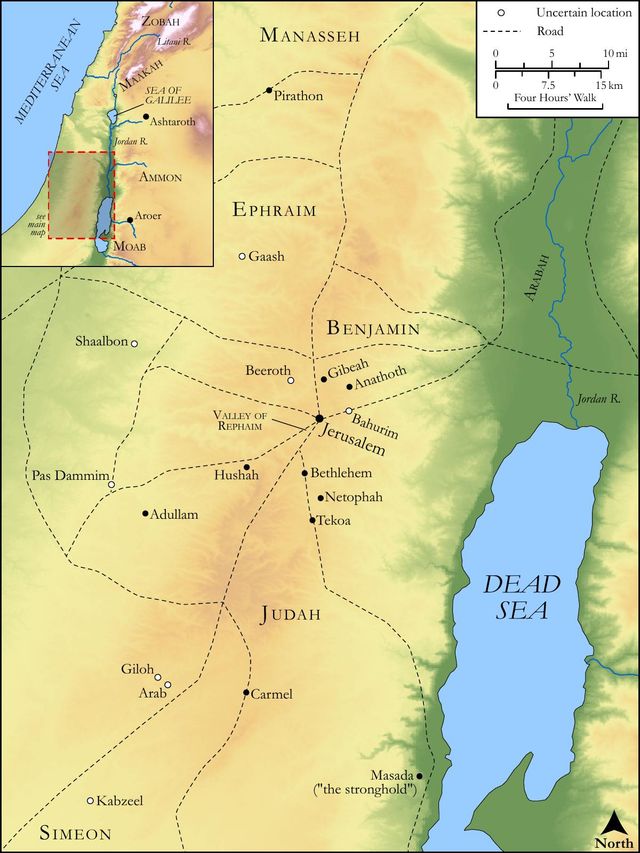
See on the biblical-era maps

Study this verse
Continue studying 2 Samuel 23:7 across the web’s major study libraries — every link below opens this exact verse, chapter, or book on the destination site.
Read & Compare
 BibleGatewayThis verse in more than 200 translations and 70 languages.
 Bible.comThe YouVersion reader — hundreds of translations, reading plans, and highlights.
 ESV.orgCrossway's official English Standard Version reader.
 NET BibleThe NET translation with 60,000+ translators' notes on every rendering decision.
 STEP BibleTyndale House's free study tool — original text, vocabulary, and scholarly resources.
 BibliaLogos Bible Software's free web reader.
 USCCBThe New American Bible (Revised Edition) with the U.S. bishops' study notes.
Commentaries
 BibleHub CommentariesDozens of classic commentaries on this verse, gathered on one page.
 StudyLightMore than 100 commentary sets — the largest collection on the web.
 BibleRefPlain-English commentary on what this verse means, verse by verse.
 Enduring WordDavid Guzik's free commentary on this chapter, widely used by Bible teachers.
 Bible Study ToolsVerse commentary alongside Greek and Hebrew study aids.
Original Language & Research
- BibleHub InterlinearThe verse word by word — original language, transliteration, and English.
- BibleHub LexiconEvery word's original-language definition and Strong's entry.
 Blue Letter BibleDeep-study tools — Strong's numbers, concordance, and word studies.
 SefariaThe Hebrew text with Rashi and centuries of Jewish commentary.
Sermons, Hymns & Audio


TrulyRandomVerse is not affiliated with these sites and doesn’t control their content. They’re linked because they’re genuinely useful.
Summary
2 Samuel 23:7 concludes David's "Last Words," a profound poetic oracle that contrasts the ideal, righteous ruler with the "sons of Belial"—wicked individuals likened to dangerous thorns. This verse declares that such persistent evil cannot be handled lightly but requires decisive, robust tools, symbolized by iron and a spear staff, for removal. Ultimately, these "thorns" are destined for complete and utter destruction by fire, emphasizing God's uncompromising judgment against intractable wickedness and the absolute necessity of eradicating evil to maintain the purity and integrity of His kingdom.
Context
ShowHideLiterary Context
This verse serves as the climactic conclusion to "David's Last Words" (2 Samuel 23:1-7), a deeply significant poetic and prophetic testament delivered by the aged King David. It immediately follows the stark portrayal of the "sons of Belial" (2 Samuel 23:6), who are presented as the antithesis of the "righteous ruler" described earlier in the oracle (2 Samuel 23:3-4). The entire passage begins with a powerful declaration of divine inspiration, underscoring the authoritative nature of David's message as one spoken by the Spirit of the Lord. The preceding verses vividly depict the blessings that flow from a just and God-fearing king, whose reign brings forth life and renewal "like the light of the morning when the sun rises" and "tender grass after the rain" (2 Samuel 23:4). Verse 7, therefore, completes this theological framework by addressing the inevitable and decisive fate of those who stand in direct opposition to such righteous governance, providing a stark counterpoint to the covenant blessings promised to David's house (2 Samuel 23:5).
Historical & Cultural Context
David's "Last Words" are delivered at a pivotal moment, as his long and impactful reign draws to a close. This oracle functions as a profound summation of his understanding of divine justice and the nature of kingship, reflecting the foundational principles upon which the Israelite monarchy was meant to operate under God's covenant. The agricultural imagery of "thorns" (2 Samuel 23:6) and their removal is deeply rooted in ancient agrarian societies, where such weeds were a constant threat to cultivated land, symbolizing chaos, unfruitfulness, and a curse upon the ground. The specific mention of "iron" and "spear staff" points to the heavy-duty tools of warfare and demanding labor, signifying a forceful, decisive, and even violent approach to dealing with intractable problems. In a society where the king was divinely appointed to uphold justice and maintain order, this imagery speaks to the necessity of purging deep-seated evil to ensure the well-being, purity, and spiritual health of the community, reflecting God's own character and His demands for holiness within His covenant people.
Key Themes
ShowHideThe primary themes embedded within 2 Samuel 23:7 include Divine Judgment and the Nature of Wickedness. The verse vividly portrays the ultimate, decisive judgment awaiting those who embody persistent evil, emphasizing God's intolerance for unrighteousness. The comparison of the wicked to "thorns" (2 Samuel 23:6) underscores their destructive, troublesome, and ultimately useless nature, posing a direct threat to societal order and spiritual purity. This imagery also highlights the theme of Separation and Purity, as the wicked must be forcefully removed from the righteous, much like thorns are cleared from a field to allow for fruitful growth. This resonates powerfully with the broader biblical principle of God's desire for a holy people, set apart from corruption, a theme echoed in passages like Leviticus 19:2 and the warnings against idolatry and abominable practices found in Deuteronomy 18:9-14. The verse implicitly reinforces the Covenant Faithfulness of God, as it implies that while God is faithful to His covenant with the righteous king (2 Samuel 23:5), His justice also demands the removal of those who oppose His righteous rule, ensuring the integrity of His promises and the purity of His kingdom.
Exposition and Analysis
ShowHideKey Word Analysis
ShowHideThis primitive root means "properly, to touch, i.e. lay the hand upon (for any purpose; euphemistically, to lie with a woman); by implication, to reach (figuratively, to arrive, acquire); violently, to strike (punish, defeat, destroy, etc.)." In this context, it refers to the act of handling or engaging with the dangerous "thorns." The implication is that direct, unprotected contact is perilous, requiring specialized tools.
This word, often meaning "to fill" or "be full of," here carries the sense of being "filled" or "equipped" with something, specifically "with iron and the staff of a spear." The Strong's definition includes "be fenced," indicating that the individual must be thoroughly prepared or armed in a way that provides protection or enables forceful action against the dangerous elements. It implies being fully furnished with the necessary means to confront and manage the threat.
Derived from a root meaning "cutting," this term refers to the metal iron, known for its hardness, strength, and ability to cut or crush. In biblical imagery, iron often symbolizes power, rigidity, and unyielding force. Here, it represents the unyielding, decisive, and robust nature of the tools required to deal with the wicked. It suggests that gentle or weak methods are insufficient; only something as hard and strong as iron can effectively manage such a destructive and intractable element.
Verse Breakdown
ShowHide"But the man [that] shall touch them must be fenced with iron and the staff of a spear"
This clause describes the necessary, forceful, and protected method for dealing with the "sons of Belial" (the wicked, likened to thorns from the preceding verse). Direct, bare-handed contact is impossible and dangerous due to their destructive nature. The "man" represents anyone who must confront or manage this kind of intractable evil. To be "fenced with iron and the staff of a spear" indicates that specialized, robust, and potentially destructive tools are required. The iron suggests an unyielding, strong instrument, while the spear staff implies a long reach and the capacity for piercing or forceful removal, keeping the handler at a safe distance. This imagery conveys the extreme difficulty and inherent danger of dealing with persistent wickedness, requiring a decisive and uncompromised approach, not gentle handling or mere containment.
"and they shall be utterly burned with fire in the [same] place"
This clause pronounces the ultimate, decisive fate of the wicked, once they have been forcibly removed. These "thorns" are not merely discarded or suppressed but are subjected to complete annihilation by fire. The phrase "utterly burned" is an emphatic construction, signifying total consumption and eradication, leaving no trace or potential for resurgence. "In the same place" emphasizes the immediacy and localized nature of this final judgment, implying that evil will be dealt with decisively where it is found, ensuring its complete removal from the community or land. This is a powerful metaphor for divine judgment, where persistent evil is not merely suppressed or contained, but entirely consumed and purged from existence.
Literary Devices
ShowHide2 Samuel 23:7 employs several potent literary devices to convey its message with vivid intensity. The central device is Metaphor, specifically an extended metaphor that likens the wicked, identified as the "sons of Belial" in the preceding verse, to troublesome and dangerous thorns. This imagery immediately communicates their destructive, unruly, and unwanted nature, which cannot be handled directly without harm. Building on this, Symbolism is heavily utilized: "iron" and "the staff of a spear" symbolize the necessary strength, force, and decisive tools required to confront and remove such deep-seated evil. These are not tools for cultivation or gentle pruning, but for eradication and defense. Furthermore, "fire" serves as a powerful symbol of complete purification and destructive judgment, signifying the absolute end of the wicked. The phrase "utterly burned" utilizes Hyperbole and Emphasis through its redundant construction (a verb followed by its cognate noun in Hebrew) to underscore the totality and finality of the destruction, leaving no doubt about the absolute nature of the judgment. The entire oracle also functions as a stark Contrast, setting the blessed reign of the righteous ruler against the inevitable, destructive fate of the unrighteous, thereby highlighting the profound consequences of both obedience and rebellion against God's established order.
Theological and Thematic Connections
ShowHideThis verse powerfully articulates the biblical principle of divine justice and the ultimate eradication of evil. It underscores that while God is patient and longsuffering, His holy nature demands the eventual, decisive removal of persistent wickedness. The vivid imagery of thorns requiring forceful handling and fiery destruction speaks to the absolute incompatibility of entrenched evil with God's holy kingdom. It highlights that certain forms of deep-seated wickedness are beyond reform or gentle persuasion; they must be utterly purged. This serves as a solemn warning to the unrighteous and a profound comfort to those who suffer under injustice, assuring them that God will not forever tolerate evil but will bring about a complete and final reckoning, ensuring the purity and peace of His creation.
Reflection and Application
ShowHideWhile 2 Samuel 23:7 speaks to the societal and divine handling of extreme evil, its spiritual lessons are profoundly relevant for believers today. It calls us to a sober recognition of the destructive nature of sin and persistent wickedness, both in the world and, more subtly, within our own hearts and communities. Just as thorns threaten to choke out a cultivated field, unchecked sin can suffocate spiritual life and hinder the flourishing of God's kingdom within us and around us. This verse reminds us that dealing with deeply rooted sin often requires decisive, even painful, action—not gentle compromise or passive acceptance. It calls for spiritual discernment and courage to identify and remove corrupting influences, trusting in God's ultimate justice to make all things right. Furthermore, it offers immense hope: the unwavering assurance that God will not allow evil to triumph indefinitely. He is the righteous Judge who will ultimately purify His creation, bringing complete eradication to all unrighteousness. This profound truth should motivate us to pursue holiness with zeal, to stand against injustice in ways that honor God, and to rest in the certainty of God's sovereign plan for redemption and final judgment.
Questions for Reflection
ShowHideFAQ
ShowHideWho are "the sons of Belial" mentioned in the preceding verse, and how do they relate to this verse?
ShowHide"The sons of Belial" (2 Samuel 23:6) is a Hebrew idiom meaning "worthless ones," "wicked individuals," or "ungodly people." In this context, they refer to those who are rebellious, lawless, and actively oppose God's righteous rule and the order He establishes through His chosen king. They are likened to dangerous, unruly thorns that cannot be handled directly. Verse 7 directly describes how these "sons of Belial" must be dealt with, outlining the forceful handling and fiery destruction that is their ultimate fate. They represent those who persist in wickedness and rebellion against God, underscoring the necessity of their complete removal for the purity and safety of the community.
What is the significance of "iron and the staff of a spear" in dealing with the wicked?
ShowHide"Iron and the staff of a spear" are symbolic of the necessary strength, force, and decisive action required to deal with deep-seated, dangerous wickedness. They are not tools for gentle persuasion or cultivation, but for forceful removal and potential destruction. Iron signifies unyielding strength and hardness, implying that soft approaches are ineffective against such hardened evil. The spear staff indicates a tool for piercing, prodding, or keeping a safe distance, emphasizing the danger of direct contact with the "thorns." This imagery underscores that certain forms of evil are so intractable and dangerous that they cannot be merely contained or reformed; they must be decisively removed and eradicated for the safety and purity of the community, reflecting God's uncompromising justice.
Does this verse advocate for violence against wicked people?
ShowHideWhile the language of 2 Samuel 23:7 is vivid and describes forceful, destructive action, it is primarily a prophetic and poetic declaration of divine judgment, not a direct command for individuals or even the king to commit literal violence against all "wicked people" in society. The phrase "utterly burned with fire" points to God's ultimate, eschatological judgment. In the Old Testament, the king's role included maintaining justice and punishing severe crimes, but the imagery here transcends typical judicial processes, pointing to a divine, absolute eradication of evil. For New Testament believers, this verse serves as a powerful reminder of God's intolerance for sin and His commitment to ultimate justice, which will be fully realized at Christ's return (e.g., Matthew 13:40-42). Our call is to spiritual warfare, to confront sin in our lives and communities through the power of the Gospel, and to trust God for final judgment.
Christ-Centered Fulfillment
ShowHide2 Samuel 23:7, with its stark imagery of dealing with intractable wickedness, finds its ultimate and perfect fulfillment in Jesus Christ. While David, as an earthly king, could only imperfectly manage the "thorns" of his kingdom, Jesus is the perfectly righteous King whose reign will bring about the complete eradication of all evil. He is the one who, unlike any mere man, can "touch" the defilement of sin without being corrupted by it, as powerfully demonstrated by His healing touch on lepers (e.g., Matthew 8:3) and His willingness to bear the sins of the world upon Himself. He is the divine "iron and staff of a spear," not in terms of physical weaponry, but as the embodiment of God's unyielding justice, sovereign power, and decisive authority. His first coming saw Him separating the wheat from the weeds through His teaching and the call to repentance (e.g., Matthew 13:24-30), but His second coming will be the ultimate fulfillment of this verse's promise. At His glorious return, Christ will definitively "burn with fire" all unrighteousness, casting the wicked into the "lake of fire" (e.g., Revelation 20:14-15). He is the true "Lamb of God who takes away the sin of the world" (John 1:29), not by gently pruning it, but by utterly consuming its power through His atoning sacrifice and ultimately, by His final, decisive judgment, ensuring a purified new heavens and new earth where righteousness alone dwells (e.g., 2 Peter 3:13).