


2 Thessalonians 1:8
Bible text: King James Version (1769 Blayney text) · Public domain
Bible text: Berean Standard Bible · Public domain
Bible text: American Standard Version (1901) · Public domain
Bible text: World English Bible, Messianic edition · Public domain
Bible text: Geneva Bible (1599) · Public domain
Bible text: Young's Literal Translation · Public domain
- ἐνeninG1722PREPPreposition
- πυρὶpuria fireG4442N-DSNNoun Dative Singular Neuter
- φλογόςphlogosof flameG5395N-GSFNoun Genitive Singular Feminine
- διδόντοςdidontosinflictingG1325V-PAP-GSMVerb Present Active Participle Genitive Singular Masculine
- ἐκδίκησινekdikēsinvengeanceG1557N-ASFNoun Accusative Singular Feminine
- τοῖςtoison thoseG3588T-DPMDefinite article Dative Plural Masculine
- μὴmēnotG3361PRT-NNegative Particle Negative
- εἰδόσινeidosinknowingG1492V-RAP-DPMVerb Perfect Active Participle Dative Plural Masculine
- θεὸνtheonGodG2316N-ASM-TNoun Accusative Singular Masculine Title
- καὶkaiandG2532CONJConjunction
- τοῖςtoison thoseG3588T-DPMDefinite article Dative Plural Masculine
- μὴmēnotG3361PRT-NNegative Particle Negative
- ὑπακούουσινhupakouousinobeyingG5219V-PAP-DPMVerb Present Active Participle Dative Plural Masculine
- τῷtōtheG3588T-DSNDefinite article Dative Singular Neuter
- εὐαγγελίῳeuangeliōgospelG2098N-DSNNoun Dative Singular Neuter
- τοῦtouof theG3588T-GSMDefinite article Genitive Singular Masculine
- κυρίουkuriouLordG2962N-GSM-TNoun Genitive Singular Masculine Title
- ἡμῶνhēmōnof usG3165P-1GPPersonal pronoun Genitive 1st Plural
- ἸησοῦIēsouJesusG2424N-GSM-PNoun Genitive Singular Masculine Individual
- Χριστοῦ·ChristouChristG5547N-GSM-TNoun Genitive Singular Masculine Title
English is a literal word-by-word gloss of the Greek, not the KJV's wording. Why?
This is the original text the KJV's translators worked from — each Greek word with its own literal English meaning in this verse, prepared by scholars at Tyndale House, Cambridge. The KJV translates whole sentences, not word by word, so its wording differs: one Greek word can become several English words, and the KJV may choose “charity” where the gloss reads “love”. Both are faithful — they answer different questions. For the KJV's own rendering, switch to the KJV text.
Details
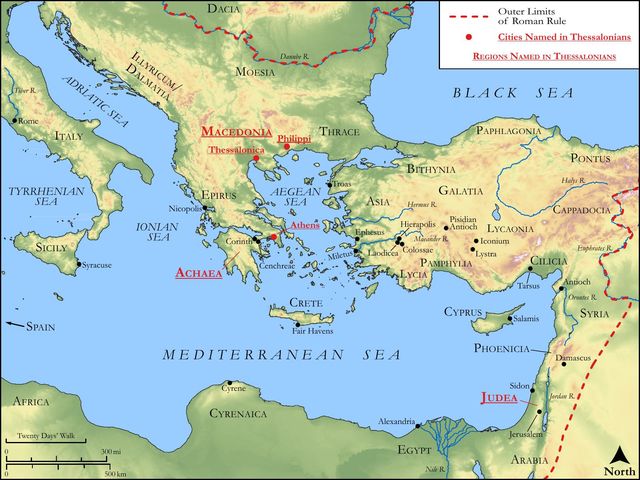
See on the biblical-era maps

Study this verse
Public-domain commentary
Matthew Henry
From his Commentary on the Whole Bible. Henry comments on passages, not single verses — this entry covers 2 Thessalonians 1:5–10. His four-level outline is real structure in the source text, so it is rendered as structure.
Having mentioned their persecutions and tribulations, which they endured principally for the cause of Christ, the apostle proceeds to offer several things for their comfort under them; as,
I.He tells them of the present happiness and advantage of their sufferings, Th2 1:5.
Their faith being thus tried, and patience exercised, they were improved by their sufferings, insomuch that they were counted worthy of the kingdom of God. Their sufferings were a manifest token of this, that they were worthy or meet to be accounted Christians indeed, seeing they could suffer for Christianity. And the truth is, Religion, if it is worth any thing, is worth every thing; and those either have no religion at all, or none that is worth having, or know not how to value it, that cannot find in their hearts to suffer for it. Besides, from their patient suffering, it appeared that, according to the righteous judgment of God, they should be counted worthy of the heavenly glory: not by worthiness of condignity, but of congruity only; not that they could merit heaven, but they were made meet for heaven. We cannot by all our sufferings, any more than by our services, merit heaven as a debt; but by our patience under our sufferings we are qualified for the joy that is promised to patient sufferers in the cause of God.
II.He tells them next of the future recompence that shall be given to persecutor and persecuted.
1.In this future recompence there will be,
(1.)A punishment inflicted on persecutors: God will recompense tribulation to those that trouble you, Th2 1:6. And there is nothing that more infallibly marks a man for eternal ruin than a spirit of persecution, and enmity to the name and people of God: as the faith, patience, and constancy of the saints are to them an earnest of everlasting rest and joy, so the pride, malice, and wickedness of their persecutors are to them an earnest of everlasting misery; for every man carries about with him, and carries out of the world with him, either his heaven or his hell. God will render a recompence, and will trouble those that trouble his people. This he has done sometimes in this world, witness the dreadful end of many persecutors; but especially this he will do in the other world, where the portion of the wicked must be weeping, and wailing, and gnashing of teeth.
(2.)A reward for those that are persecuted: God will recompense their trouble with rest, Th2 1:7. There is a rest that remains for the people of God, a rest from sin and sorrow. Though many may be the troubles of the righteous now, yet God will deliver them out of them all. The future rest will abundantly recompense all their present troubles. The sufferings of this present time are not worthy to be compared with the glory that shall be revealed. There is enough in heaven to countervail all that we may lose or suffer for the name of Christ in this world. The apostle says, To you who are troubled rest with us. In heaven, ministers and people shall rest together, and rejoice together, who suffer together here; and the meanest Christian shall rest with the greatest apostle: nay, what is far more, if we suffer for Christ, we shall also reign with him, Ti2 2:12.
2.Concerning this future recompence we are further to observe,
(1.)The certainty of it, proved by the righteousness and justice of God: It is a righteous thing with God (Th2 1:6) to render to every man according to his works. The thoughts of this should be terrible to wicked men and persecutors, and the great support of the righteous and such as are persecuted; for, seeing there is a righteous God, there will be a righteous recompence. God's suffering people will lose nothing by their sufferings, and their enemies will gain nothing by their advantages against them.
(2.)The time when this righteous recompence shall be made: When the Lord Jesus shall be revealed from heaven, Th2 1:7. That will be the day of the revelation of the righteous judgment of God; for then will God judge the world in righteousness by that man whom he hath appointed, even Jesus Christ the righteous Judge. The righteousness of God does not so visibly appear to all men in the procedure of his providence as it will in the process of the great judgment-day. The scripture has made known to us the judgment to come, and we are bound to receive the revelation here given concerning Christ. As,
[1.]That the Lord Jesus will in that day appear from heaven. Now the heavens retain him, they conceal him; but then he will be revealed and made manifest. He will come in all the pomp and power of the upper world, whence we look for the Saviour.
[2.]He will be revealed with his mighty angels (Th2 1:7), or the angels of his power: these will attend upon him, to grace the solemnity of that great day of his appearance; they will be the ministers of his justice and mercy in that day; they will summon the criminals to his tribunal, and gather in the elect, and be employed in executing his sentence.
[3.]He will come in flaming fire, Th2 1:8. A fire goeth before him, which shall consume his enemies. The earth, and all the works that are therein, shall be burnt up, and the elements shall melt with fervent heat. This will be a trying fire, to try every man's work, - a refining fire, to purify the saints, who shall share in the purity, and partake of the felicity, of the new heaven and the new earth, - a consuming fire to the wicked. His light will be piercing, and his power consuming, to all those who in that day shall be found as chaff.
[4.]The effects of this appearance will be terrible to some and joyful to others.
First, They will be terrible to some; for he will then take vengeance on the wicked. 1. On those that sinned against the principles of natural religion, and rebelled against the light of nature, that knew not God (Th2 1:8), though the invisible things of him are manifested in the things that are seen. 2. On those that rebel against the light of revelation, that obey not the gospel of our Lord Jesus Christ. And this is the condemnation, that light is come into the world, and men love darkness rather than light. This is the great crime of multitudes - the gospel is revealed to them, and they will not believe it; or, if they pretend to believe it, they will not obey it. Note, Believing the truths of the gospel is in order to our obeying the precepts of the gospel: there must be the obedience of faith. To such persons as are here mentioned the revelation of our Lord Jesus Christ will be terrible, because of their doom, which is mentioned, Th2 1:9. Here observe, (1.) They will then be punished. Though sinners may be long reprieved, yet they will be punished at last. Their misery will be a proper punishment for their crimes, and only what they have deserved. They did sin's work, and must receive sin's wages. (2.) Their punishment will be no less than destruction, not of their being, but of their bliss; not that of the body alone, but both as to body and soul. (3.) This destruction will be everlasting. They shall be always dying, and yet never die. Their misery will run parallel with the line of eternity. The chains of darkness are everlasting chains, and the fire is everlasting fire. It must needs be so, since the punishment is inflicted by an eternal God, fastening upon an immortal soul, set out of the reach of divine mercy and grace. (4.) This destruction shall come from the presence of the Lord, that is, immediately from God himself. Here God punishes sinners by creatures, by instruments; but then he will take the work into his own hands. It will be destruction from the Almighty, more terrible than the consuming fire which consumed Nadab and Abihu, which came from before the Lord. (5.) It shall come from the glory of his power, or from his glorious power. Not only the justice of God, but this almighty power, will be glorified in the destruction of sinners; and who knows the power of his anger? He is able to cast into hell.
Secondly, It will be a joyful day to some, even to the saints, unto those that believe and obey the gospel. And then the apostle's testimony concerning this day will be confirmed and believed (Th2 1:10); in that bright and blessed day, 1. Christ Jesus will be glorified and admired by his saints. They will behold his glory, and admire it with pleasure; they will glorify his grace, and admire the wonders of his power and goodness towards them, and sing hallelujahs to him in that day of his triumph, for their complete victory and happiness. 2. Christ will be glorified and admired in them. His grace and power will then be manifested and magnified, when it shall appear what he has purchased for, and wrought in, and bestowed upon, all those who believe in him. As his wrath and power will be made known in and by the destruction of his enemies, so his grace and power will be magnified in the salvation of his saints. Note, Christ's dealings with those who believe will be what the world one day shall wonder at. Now, they are a wonder to many; but how will they be wondered at in this great and glorious day; or, rather, how will Christ, whose name is Wonderful, be admired, when the mystery of God shall be finished! Christ will not be so much admired in the glorious esteem of angels that he will bring from heaven with him as in the many saints, the many sons, that he will bring to glory.
Historical interpretation
Seven Centuries of Reception
9 surviving comments on this verse. Each one is dated, so this reads as a timeline rather than a list.
Select a marker to jump to its quote. Markers stagger vertically where authors wrote within a few decades of each other.
Thus on this consideration too we must, notwithstanding Marcion's opposition, conclude that Christ belongs to a God who kindles the flames (of vengeance), and therefore to the Creator, inasmuch as He takes vengeance on such as know not the Lord, that is, on the heathen. For he has mentioned separately "those who obey not the gospel of our Lord Jesus Christ," whether they be sinners among Christians or among Jews. Now, to inflict punishment on the heathen, who very likely have never heard of the Gospel, is not the function of that God who is naturally unknown, and who is revealed nowhere else than in the Gospel, and therefore cannot be known by all men.
To Him, therefore, does it appertain to punish such as know not God, for none ought to be ignorant of Him. In the (apostle's) phrase, "From the presence of the Lord, and from the glory of His power," he uses the words of Isaiah who for the express reason makes the self-same Lord "arise to shake terribly the earth.
For as the apostle declares that the Lord will come "to take vengeance on them that know not God and that obey not the gospel, who," he says, "shall be punished with everlasting destruction from the presence of the Lord, and from the glory of His power" -it follows that, as He comes to inflict punishment, He must require "the flaming fire.
do not know God
This refers to the pagans who do not know that God is the Father of Jesus Christ.
"In flaming fire rendering vengeance to them that know not God, and to them that obey not the Gospel of our Lord Jesus."
If they that have not obeyed the Gospel suffer vengeance, what will not they suffer who besides their disobedience also afflict you? And see his intelligence; he says not here those who afflict you, but those "who obey not." So that although not on your account, yet on His own it is necessary to punish them. This then is said in order to full assurance, that it is altogether necessary for them to be punished: but what was said before, was said that they also might be honored, because they suffer these things on your account. The one causes them to believe concerning the punishment; the other to be pleased, because for the sake of what has been done to them they suffer these things.
by a flame of fire
This refers to what was said about those assembled at Armageddon.
by a flame of fire
The fire is either a visible fire as happened to the two commanders of fifty men in the presence of Elijah (2 Kgs 1:9-11) or the coming of Christ in glory will destroy them by the breath of his mouth (Is 11:4), and the aforementioned nations, also devouring their general, the devil, and He (Christ) will deliver the devil to the lake of fire together with the Antichrist and the false prophet to be tortured forever and ever.
who are not obedient to the Gospel
It also refers to the heretics and the false Christians
by a flame of fire
Perhaps it is about that which is read in the Apocalypse of John, "and fire came down from heaven and consumed them." (Rev 20;9)
who are not obedient to the Gospel
And this even refers to evil Catholics who do not obey the Gospel of our Lord though they say they believe, but they do not live according to what they believe.
Continue studying 2 Thessalonians 1:8 across the web’s major study libraries — every link below opens this exact verse, chapter, or book on the destination site.
Read & Compare
 BibleGatewayThis verse in more than 200 translations and 70 languages.
 Bible.comThe YouVersion reader — hundreds of translations, reading plans, and highlights.
 ESV.orgCrossway's official English Standard Version reader.
 NET BibleThe NET translation with 60,000+ translators' notes on every rendering decision.
 STEP BibleTyndale House's free study tool — original text, vocabulary, and scholarly resources.
 BibliaLogos Bible Software's free web reader.
 USCCBThe New American Bible (Revised Edition) with the U.S. bishops' study notes.
Commentaries
 BibleHub CommentariesDozens of classic commentaries on this verse, gathered on one page.
 StudyLightMore than 100 commentary sets — the largest collection on the web.
 BibleRefPlain-English commentary on what this verse means, verse by verse.
 Enduring WordDavid Guzik's free commentary on this chapter, widely used by Bible teachers.
 Bible Study ToolsVerse commentary alongside Greek and Hebrew study aids.
Original Language & Research
- BibleHub InterlinearThe verse word by word — original language, transliteration, and English.
- BibleHub LexiconEvery word's original-language definition and Strong's entry.
 Blue Letter BibleDeep-study tools — Strong's numbers, concordance, and word studies.
 CNTR CollationThe earliest Greek manuscripts of this verse, collated letter by letter.
Sermons, Hymns & Audio


TrulyRandomVerse is not affiliated with these sites and doesn’t control their content. They’re linked because they’re genuinely useful.
Summary
Second Thessalonians 1:8 powerfully describes the terrifying aspect of divine judgment that will accompany the glorious return of the Lord Jesus Christ. It specifies that this judgment, characterized by "flaming fire," will be unleashed upon two distinct yet related groups: those who willfully refuse to acknowledge God and those who deliberately reject and disobey the saving message of the gospel of Jesus Christ. This verse serves as both a comfort to persecuted believers, assuring them of God's ultimate justice, and a stark warning to those who remain in rebellion against divine truth.
Context
ShowHideLiterary Context
This verse is situated within the opening chapter of Paul's second letter to the Thessalonian church, a community enduring significant persecution for their faith. Paul begins by commending their steadfastness and love, affirming that their suffering is evidence of God's righteous judgment at work, which will ultimately lead to their vindication and rest. Second Thessalonians 1:7 sets the immediate stage, promising relief for the afflicted when the Lord Jesus is revealed from heaven "with his mighty angels." Verse 8 then immediately follows, detailing the nature and recipients of the judgment that will accompany this revelation, contrasting the rest for believers with the fiery retribution for the ungodly. The subsequent verses 2 Thessalonians 1:9-10 further elaborate on the eternal consequences of this judgment and the glorification of Christ and His saints.
Historical & Cultural Context
The Thessalonian believers were experiencing real and intense suffering, likely from both Jewish and Gentile opposition, as indicated in Paul's first letter (1 Thessalonians 2:14-16). This persecution was not merely social ostracization but involved significant tribulation, which raised questions about God's justice and the timing of Christ's return. Among the Greeks and Romans, the concept of divine retribution for impiety was not unfamiliar, but Paul's description of "flaming fire" echoes Old Testament imagery of God's judgment, particularly theophanies (divine appearances) and judgments against the wicked, such as those found in Isaiah 66:15-16 or Daniel 7:9-10. The cultural expectation of a conquering deity or emperor returning to exact justice would have resonated with Paul's audience, though his portrayal of Christ's return transcends earthly paradigms.
Key Themes
ShowHideThis verse contributes significantly to several major theological themes within 2 Thessalonians and the broader biblical narrative. Foremost is the theme of Divine Justice and Retribution, emphasizing God's unwavering commitment to righting all wrongs and holding humanity accountable for their choices. This "vengeance" is not capricious but a righteous and holy response to willful rebellion against God's truth and authority, as also seen in Romans 12:19. Closely intertwined is Eschatology, particularly the Second Coming of Christ (the Parousia), which is depicted as a climactic event bringing both salvation for the faithful and definitive judgment for the ungodly. The verse also highlights the Consequences of Disbelief and Disobedience, clearly delineating that rejection of God manifests both as ignorance of His being and refusal to submit to His revealed truth in the gospel. Finally, the imagery of "flaming fire" underscores the Nature of Divine Judgment—its intensity, purity, and inescapable finality.
Exposition and Analysis
ShowHideKey Word Analysis
ShowHideDerived from the verb meaning "to do justice," this term signifies vindication or retribution. In the context of divine action, it is not an emotional, spiteful act, but a righteous and just recompense for sin and rebellion. It is God's holy response to injustice and willful disobedience, ensuring that His moral order is upheld and that those who oppose Him face the consequences of their choices.
While primarily meaning "to see," in its perfect tense, as used here, it carries the implication of "to know" in a deep, experiential, and relational sense, not merely intellectual awareness. "To know not God" therefore implies a willful, moral, and spiritual blindness, a deliberate refusal to acknowledge, relate to, or submit to the Creator. It is a state of active ignorance and estrangement from God.
This word means "to hear under" or "to listen attentively," and by implication, "to heed or conform to a command or authority." When applied to the gospel, it signifies that the good news demands more than just intellectual assent; it requires a response of submission, faith, and obedience that transforms one's life. "To obey not the gospel" is thus a rejection of God's gracious offer of salvation through Christ, a refusal to believe and follow its precepts.
Verse Breakdown
ShowHide"In flaming fire"
This phrase describes the medium and nature of the Lord's revelation and judgment. The imagery of fire (Greek: pŷr) and flame (Greek: phlóx) is potent, signifying a consuming, purifying, and destructive force. It evokes the holiness and wrath of God, reminiscent of Old Testament theophanies (e.g., Exodus 3:2), and prophetic judgments (e.g., Malachi 4:1). It conveys the intensity, purity, and inescapable nature of this divine judgment.
"taking vengeance on them that know not God"
This clause identifies the first group targeted by divine judgment. The "vengeance" (Greek: ekdíkēsis) is God's righteous retribution. "Those that know not God" are not merely intellectually ignorant, but those who have willfully rejected or suppressed the innate knowledge of God accessible through creation and conscience (Romans 1:18-20). Their lack of "knowing" is a moral failure, a refusal to acknowledge and honor their Creator.
"and that obey not the gospel of our Lord Jesus Christ"
This second clause identifies a related but distinct group. While "knowing not God" speaks to a general rebellion against the Creator, "obeying not the gospel" refers to a specific rejection of God's revealed plan of salvation through Jesus Christ. The gospel demands a response of faith and obedience (Romans 10:16). To disobey it is to refuse the only means of salvation, thus sealing one's condemnation. The phrase "our Lord Jesus Christ" emphasizes the divine authority and redemptive work of the one whose gospel is rejected.
Literary Devices
ShowHideThe verse employs several powerful literary devices to convey its message. Imagery is prominently used with the phrase "flaming fire," which vividly portrays the intensity, purity, and destructive power of divine judgment. This imagery is deeply rooted in biblical tradition, symbolizing God's holy presence and His consuming wrath against sin. Parallelism is evident in the two groups identified for judgment: "them that know not God" and "that obey not the gospel of our Lord Jesus Christ." While distinct, these two phrases are parallel in structure and describe two facets of human rebellion against divine truth—a general rejection of the Creator and a specific rejection of His saving message. Furthermore, Symbolism is at play, as "fire" serves as a potent symbol not only of destruction but also of purification and the unapproachable holiness of God. The entire verse functions as a Proleptic Statement, foreshadowing the ultimate and decisive judgment that will occur at Christ's return, providing both warning and assurance.
Theological and Thematic Connections
ShowHide2 Thessalonians 1:8 stands as a profound theological statement on divine justice, eschatology, and the critical importance of humanity's response to God. It affirms God's absolute sovereignty and His unwavering commitment to righteousness, demonstrating that His "vengeance" is not an act of human spite but a holy and just recompense for willful rebellion against His truth and authority. This judgment is inextricably linked to the Second Coming of Christ, underscoring that His return will bring not only salvation and rest for believers but also definitive condemnation for those who have rejected Him. The verse highlights that the ultimate division of humanity will be based on their relationship to God and their response to the gospel, emphasizing the eternal consequences of both active ignorance and deliberate disobedience.
Reflection and Application
ShowHideThis powerful verse offers profound implications for both believers and non-believers. For those who are suffering for their faith, it provides immense comfort and assurance that God sees their tribulation and will ultimately administer perfect justice. Believers are not called to seek personal revenge, for God Himself will execute righteous vengeance against those who oppose His people and His truth. This truth should foster patience and perseverance in the face of adversity, knowing that God's timing and judgment are perfect. For those who have not yet embraced the gospel, 2 Thessalonians 1:8 serves as a solemn and urgent warning. The severe consequence for those who "know not God" and "obey not the gospel" underscores the critical importance of hearing, understanding, and responding to God's gracious offer of salvation through Jesus Christ. It compels believers to share the good news with urgency, compassion, and clarity, recognizing the eternal stakes involved. Furthermore, it prompts self-examination for all: Do I truly "know God" in a living, relational way, or is my knowledge merely intellectual? Am I consistently "obeying the gospel" not just in belief, but in my daily walk, submission to Christ, and active love for others? This verse calls us to live in light of Christ's certain return, with a deep reverence for God's holiness and a passionate commitment to His mission.
Questions for Reflection
ShowHideFAQ
ShowHideWhat does "flaming fire" mean in the context of divine judgment?
ShowHide"Flaming fire" (Greek: en phlogi pyros) is a powerful biblical image that describes the intense, pure, and destructive nature of God's judgment. It symbolizes His holiness, which consumes all impurity, and His righteous wrath against sin. This imagery is rooted in Old Testament depictions of God's presence (e.g., Exodus 19:18) and His judgments against the wicked (e.g., Isaiah 66:15). It conveys that the judgment will be inescapable, thorough, and utterly devastating for those who face it.
What does it mean to "know not God" in this verse?
ShowHideTo "know not God" (Greek: tous mē eidotas theon) goes beyond mere intellectual ignorance. The Greek word for "know" (eídō) implies a deep, experiential, and relational knowledge. Therefore, "knowing not God" signifies a willful, moral, and spiritual blindness—a deliberate refusal to acknowledge, relate to, or submit to the Creator. It speaks to a state of active rebellion or suppression of the truth about God, which is revealed through creation and conscience (Romans 1:18-20). It is a rejection of God's rightful place as sovereign Lord.
Is God's "vengeance" just, or is it a human emotion of spite?
ShowHideGod's "vengeance" (Greek: ekdíkēsis) is fundamentally different from human vindictiveness or spite. In the biblical context, especially when applied to God, it refers to righteous retribution and vindication. It is an act of divine justice, where God upholds His holy character and moral order by responding righteously to sin, rebellion, and injustice. As the perfect Judge, God's vengeance is always just, proportionate, and necessary to demonstrate His holiness and ensure ultimate accountability. It is His prerogative to execute this justice, as stated in Romans 12:19.
Christ-Centered Fulfillment
ShowHide2 Thessalonians 1:8 finds its ultimate Christ-centered fulfillment in the person and work of Jesus Christ, who is both the gracious Savior and the righteous Judge. While the verse speaks of divine vengeance, it is the Lord Jesus Christ Himself who will return "in flaming fire taking vengeance." This underscores His divine authority and His ultimate role in God's plan of judgment and redemption. He is the one whose "gospel" is to be obeyed, and it is through Him that humanity can come to "know God" in a saving relationship. His first coming was characterized by grace and salvation, as He came not to condemn the world but to save it (John 3:17). However, His second coming will bring the full revelation of His justice, where those who rejected His gracious offer will face the consequences of their unbelief. Jesus, the Lamb of God who takes away the sin of the world, is also the one to whom all judgment has been committed by the Father (John 5:22). Thus, the terrifying judgment described in this verse is executed by the very one who offered Himself as the only means of escape, highlighting the profound seriousness of rejecting the Son of God.