


2 Samuel 23:6
- וּבְלִיַּעַלu·ve·li·Ya·'aland a worthless personH1100Conj-w ¦ N-msNoun Singular Masculine Absoluteוּandבְלִיַּעַלa worthless person
- כְּקוֹץke·Kotz[is] like thorn[s]H6975Prep-k ¦ N-msNoun Singular Masculine Absoluteכְּ[is] likeקוֹץthorn[s]
- מֻנָדmu·Nad[which is] chased awayH5074V-Hophal-PassPrtcpl-msVerb Hophal Participle Passive Singular Masculine Absolute
- כֻּלָּהַםku·La·hamall of themH3605N-msc ¦ 3mpNoun Singular Masculine Constructכֻּלָּall ofהַםthem
- כִּיkiforH3588PrtParticle Conditional
- לֹאlo'notH3808NegParticle Negative
- בְיָדve·Yadin a handH3027Prep-b ¦ N-csNoun Singular common gender Absoluteבְinיָדa hand
- יִקָּחוּyi·Ka·chupeople will takeH3947V-Qal-Imperf-3mpVerb Qal Imperfect 3rd Plural Masculine
English is a literal word-by-word gloss of the Hebrew, not the KJV's wording. Why?
This is the original text the KJV's translators worked from — each Hebrew word with its own literal English meaning in this verse, prepared by scholars at Tyndale House, Cambridge. The KJV translates whole sentences, not word by word, so its wording differs: one Hebrew word can become several English words, and the KJV may choose “the LORD” where the gloss reads “Yahweh”. Both are faithful — they answer different questions. For the KJV's own rendering, switch to the KJV text.
Details
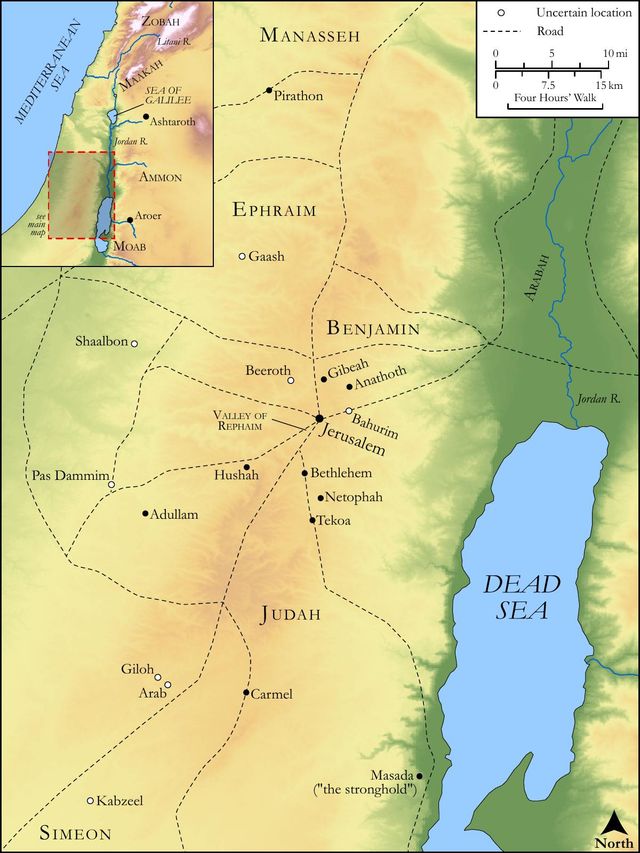
See on the biblical-era maps

Study this verse
Continue studying 2 Samuel 23:6 across the web’s major study libraries — every link below opens this exact verse, chapter, or book on the destination site.
Read & Compare
 BibleGatewayThis verse in more than 200 translations and 70 languages.
 Bible.comThe YouVersion reader — hundreds of translations, reading plans, and highlights.
 ESV.orgCrossway's official English Standard Version reader.
 NET BibleThe NET translation with 60,000+ translators' notes on every rendering decision.
 STEP BibleTyndale House's free study tool — original text, vocabulary, and scholarly resources.
 BibliaLogos Bible Software's free web reader.
 USCCBThe New American Bible (Revised Edition) with the U.S. bishops' study notes.
Commentaries
 BibleHub CommentariesDozens of classic commentaries on this verse, gathered on one page.
 StudyLightMore than 100 commentary sets — the largest collection on the web.
 BibleRefPlain-English commentary on what this verse means, verse by verse.
 Enduring WordDavid Guzik's free commentary on this chapter, widely used by Bible teachers.
 Bible Study ToolsVerse commentary alongside Greek and Hebrew study aids.
Original Language & Research
- BibleHub InterlinearThe verse word by word — original language, transliteration, and English.
- BibleHub LexiconEvery word's original-language definition and Strong's entry.
 Blue Letter BibleDeep-study tools — Strong's numbers, concordance, and word studies.
 SefariaThe Hebrew text with Rashi and centuries of Jewish commentary.
Sermons, Hymns & Audio


TrulyRandomVerse is not affiliated with these sites and doesn’t control their content. They’re linked because they’re genuinely useful.
Summary
2 Samuel 23:6, a poignant segment of David's final prophetic discourse, sharply contrasts the fate of the wicked with the blessings promised to the righteous ruler. It vividly portrays those designated as "sons of Belial"—individuals utterly worthless and rebellious—as dangerous, intractable thorns that must be decisively removed. The verse emphasizes their inherent resistance to ordinary human means of control, thereby foreshadowing a necessary, forceful, and ultimately divine separation of evil from God's righteous order.
Context
ShowHideLiterary Context
This verse immediately follows David's profound "last words" in 2 Samuel 23:1-5, where he describes the ideal, righteous ruler who governs justly and in the fear of God. Such a leader is likened to the morning light and fresh grass after rain, bringing life and blessing. David also reaffirms the everlasting covenant God made with his house, which is "ordered in all things, and sure." Verse 6 introduces a stark and deliberate antithesis to this divine order and covenant faithfulness. While the preceding verses speak of blessing, stability, and growth under righteous rule, verse 6 shifts abruptly to the inevitable judgment and forceful removal of those who oppose such righteousness, highlighting the binary nature of God's kingdom—either aligned with His covenant or decisively cast out.
Historical & Cultural Context
David's reign, though marked by great successes and the establishment of the monarchy, was also characterized by significant internal strife, rebellion (e.g., Absalom's revolt), and moral failures within his own family and among his people. The concept of "sons of Belial" (worthless ones) was a common descriptor for individuals who defied social and divine order, often associated with rebellion, lawlessness, and moral depravity, as seen in the story of the Benjamites in Judges 19:22 or the sons of Eli in 1 Samuel 2:12. Thorns were a ubiquitous agricultural nuisance in ancient Israel, symbolizing barrenness, curse, and difficulty, often requiring forceful removal, sometimes by fire, to clear land for cultivation (Genesis 3:18). This imagery would have resonated deeply with an agrarian society familiar with the persistent danger and uselessness of thorns.
Key Themes
ShowHideThe primary theme is the stark contrast between righteousness and wickedness, demonstrating that God's covenant order inherently necessitates the decisive removal of all that opposes it. This verse contributes to the broader biblical theme of divine judgment and separation, asserting that evil, personified by the "sons of Belial," cannot coexist indefinitely with God's righteous rule. It underscores the nature of ungodliness as something inherently destructive and intractable, requiring decisive action rather than gentle persuasion or reform. This aligns with the prophetic understanding that God will ultimately purify His people and His land, separating the wheat from the tares, as seen in later prophetic literature like Malachi 4:1 and the New Testament parables of judgment in Matthew 13.
Exposition and Analysis
ShowHideKey Word Analysis
ShowHideDerived from בְּלִי (beli, "without") and יַעַל (yaʻal, "profit" or "usefulness"), this term literally means "worthlessness," "destruction," or "wickedness." When used in the phrase "sons of Belial," it designates individuals who are utterly depraved, rebellious, and without moral or spiritual value. They embody a spirit of lawlessness and destruction, consistently used in the Old Testament to describe scoundrels, rebels, and wicked individuals, such as the men of Gibeah (Judges 19:22) or the sons of Eli (1 Samuel 2:12).
This term refers to a thorn, often representing difficulty, curse, and danger in biblical imagery. Thorns are unproductive, harmful to both humans and useful plants, and signify the futility or barrenness of land. Here, they powerfully symbolize the harmful, irritating, and intractable nature of the wicked. Just as thorns choke out good crops and injure those who try to handle them, the "sons of Belial" are a destructive force that impedes righteousness and harms society.
This primitive root properly means "to wave to and fro," but figuratively, "to rove, flee, or (causatively) to drive away." It conveys a sense of forceful, decisive removal, not a gentle or gradual fading. This action is necessary because of the inherent danger and resistance of the "thorns." The imagery suggests a violent and complete expulsion, indicating that the wicked are not merely undesirable but actively harmful and must be eliminated from the presence of the righteous.
Verse Breakdown
ShowHide"But [the sons] of Belial [shall be] all of them as thorns thrust away"
This clause introduces a sharp contrast to the blessed state of the righteous ruler described previously. The "sons of Belial," representing the wicked and worthless, are likened to thorns. This metaphor emphasizes their inherent uselessness, their capacity for harm, and their resistance to gentle handling. The phrase "thrust away" signifies a forceful and decisive removal, indicating that their fate is one of expulsion and judgment, not integration or reform within the divine order.
"because they cannot be taken with hands"
This concluding clause explains why the forceful removal is necessary. Thorns are dangerous to handle directly; attempting to gather them by hand results in injury. This suggests that the "sons of Belial" are so inherently destructive, resistant, and perhaps numerous or pervasive, that ordinary, gentle, or human-initiated means of dealing with them are utterly ineffective. It implies that their removal requires a more robust, perhaps divine, intervention, highlighting their intractable and dangerous nature.
Literary Devices
ShowHideThe verse employs several powerful literary devices to convey its stark message. Metaphor is central, vividly likening the "sons of Belial" to "thorns." This comparison immediately evokes images of pain, uselessness, and the necessity of forceful removal, making the abstract concept of wickedness tangible and visceral. The entire verse functions as a Contrast to the preceding description of the righteous ruler, creating a clear binary between blessing and curse, order and chaos, righteousness and wickedness. The Imagery of thorns being "thrust away" because they "cannot be taken with hands" is particularly vivid and impactful, emphasizing the danger and intractability of the wicked. This strong imagery also carries a sense of Hyperbole, suggesting that the wickedness is so pervasive and resistant that no ordinary human effort can contain or remove it, thereby hinting at the necessity of divine intervention. The use of such strong negative imagery underscores the severity of the judgment awaiting those who oppose God's righteous rule.
Theological and Thematic Connections
ShowHideThis verse powerfully articulates the biblical principle of divine separation and judgment, a recurring theme throughout Scripture. It asserts that ultimately, wickedness cannot coexist with God's righteous kingdom. Just as a farmer must clear thorns to ensure a fruitful harvest, God's ultimate plan involves the decisive removal of all that is corrupt, worthless, and harmful. This is not merely a human act of discernment but a sovereign divine decree, ensuring the purity and integrity of His covenant people and His ultimate reign. The "thrusting away" speaks to the finality of God's justice against unrepentant evil, a necessary act to establish and maintain a realm of righteousness and peace.
Reflection and Application
ShowHideDavid's final words serve as a sobering reminder that life presents an inescapable choice between aligning with God's righteous order and succumbing to the path of worthlessness and rebellion. The vivid imagery of "thorns thrust away" compels us to consider the ultimate consequences of our moral and spiritual trajectory. It calls for a profound self-examination: are we cultivating fruitfulness in our lives, contributing to God's kingdom, or are we, like thorns, unproductive, harmful, and resistant to divine shaping? This verse encourages discernment, not only of others but primarily of our own hearts, prompting us to actively pursue righteousness and submit to God's refining work, knowing that His justice will ultimately separate what is valuable from what is worthless. It also provides comfort to those who suffer under the oppression of the wicked, affirming God's ultimate sovereignty and His promise to deal decisively with all evil.
Questions for Reflection
ShowHideFAQ
ShowHideWhat does "sons of Belial" mean, and why is it used here?
ShowHideThe phrase "sons of Belial" (Hebrew: bᵉlîyaʻal) literally translates to "worthless ones" or "wicked ones." It refers to individuals who are utterly depraved, rebellious, and without moral or spiritual value. They are characterized by lawlessness and opposition to divine and human order. It is used here in 2 Samuel 23:6 to provide a stark contrast to the righteous ruler described in the preceding verses. While the righteous bring blessing and order, the "sons of Belial" represent the destructive, intractable forces of wickedness that must be decisively removed for God's kingdom to flourish. This term emphasizes their inherent nature as a menace, beyond ordinary means of control or reform.
Why are the wicked compared to "thorns" that "cannot be taken with hands"?
ShowHideThe comparison of the wicked to "thorns" is a powerful metaphor for their harmful, unproductive, and irritating nature. Thorns are a nuisance in agriculture, choking out good plants and making land barren. They are also painful and dangerous to handle directly. The phrase "cannot be taken with hands" emphasizes the extreme difficulty and danger involved in dealing with such individuals. It suggests that ordinary, gentle, or human-initiated means of persuasion or control are ineffective against their deep-seated wickedness and resistance. This imagery underscores the idea that their removal requires a forceful, decisive, and perhaps even divine intervention, as seen in the ultimate judgment of the wicked in passages like Matthew 13:30.
How does this verse relate to God's justice and judgment?
ShowHideThis verse serves as a strong declaration of God's ultimate justice and His sovereign judgment over evil. Following the description of God's sure covenant with David and the blessings of righteous rule, 2 Samuel 23:6 makes it clear that those who embody wickedness ("sons of Belial") will not endure. The imagery of "thorns thrust away" signifies a decisive and forceful removal, implying that God will not tolerate unrepentant evil indefinitely within His creation or His kingdom. It foreshadows the ultimate separation of the righteous from the wicked, a theme consistently found throughout Scripture, culminating in the final judgment where all evil will be purged and cast out from God's holy presence, as described in Revelation 20:11-15.
Christ-Centered Fulfillment
ShowHideWhile 2 Samuel 23:6 speaks of the necessary removal of the "sons of Belial" by forceful means, foreshadowing divine judgment, its ultimate Christ-centered fulfillment lies in the work of Jesus, who perfectly embodies the righteous ruler David prophesied and who alone possesses the authority and power to decisively deal with all wickedness. Jesus, the true Son of David, came not to be served but to serve and to give His life as a ransom for many, offering a path for the "worthless" to be redeemed and transformed by His grace (Mark 10:45). Yet, His mission also includes the ultimate separation and judgment. He Himself spoke of the final harvest where the "weeds" (sons of the evil one) would be gathered and burned, while the "wheat" (sons of the kingdom) would be gathered into His barn (Matthew 13:36-43). The "thorns thrust away" find their ultimate resolution in Christ's triumph over sin, death, and the devil, culminating in His future return when He will fully establish His righteous kingdom, purging all evil and casting out everything that offends or causes sin (Revelation 19:11-16). Thus, the forceful removal of the "sons of Belial" is not merely an earthly act but a divine and eschatological reality accomplished through the sovereign reign of the Lamb of God.