


Matthew 3:10
Bible text: King James Version (1769 Blayney text) · Public domain
Bible text: King James Version with Strong's numbers · Public domain
Bible text: Berean Standard Bible · Public domain
Bible text: American Standard Version (1901) · Public domain
Bible text: World English Bible, Messianic edition · Public domain
Bible text: Geneva Bible (1599) · Public domain
Bible text: Young's Literal Translation · Public domain
- ἬδηĒdēAlreadyG2235ADVAdverb
- δὲdenowG1161CONJConjunction
- καὶkaiandG2532CONJConjunction
- ἡhētheG3588T-NSFDefinite article Nominative Singular Feminine
- ἀξίνηaxinēaxG513N-NSFNoun Nominative Singular Feminine
- πρὸςprostoG4314PREPPreposition
- τὴνtēntheG3588T-ASFDefinite article Accusative Singular Feminine
- ῥίζανrhizanrootG4491N-ASFNoun Accusative Singular Feminine
- τῶνtōnof theG3588T-GPNDefinite article Genitive Plural Neuter
- δένδρωνdendrōntreesG1186N-GPNNoun Genitive Plural Neuter
- κεῖταιkeitaiis appliedG2749V-PNI-3SVerb Present Middle Or Passive Deponent Indicative 3rd Singular
- πᾶνpaneveryG3956A-NSNAdjective Nominative Singular Neuter
- οὖνounthereforeG3767CONJConjunction
- δένδρονdendrontreeG1186N-NSNNoun Nominative Singular Neuter
- μὴmēnotG3361PRT-NNegative Particle Negative
- ποιοῦνpoiounproducingG4160V-PAP-NSNVerb Present Active Participle Nominative Singular Neuter
- καρπὸνkarponfruitG2590N-ASMNoun Accusative Singular Masculine
- καλὸνkalongoodG2570A-ASMAdjective Accusative Singular Masculine
- ἐκκόπτεταιekkoptetaiis cut downG1581V-PPI-3SVerb Present Passive Indicative 3rd Singular
- καὶkaiandG2532CONJConjunction
- εἰςeisintoG1519PREPPreposition
- πῦρpur[the] fireG4442N-ASNNoun Accusative Singular Neuter
- βάλλεταιballetaiis thrownG906V-PPI-3SVerb Present Passive Indicative 3rd Singular
English is a literal word-by-word gloss of the Greek, not the KJV's wording. Why?
This is the original text the KJV's translators worked from — each Greek word with its own literal English meaning in this verse, prepared by scholars at Tyndale House, Cambridge. The KJV translates whole sentences, not word by word, so its wording differs: one Greek word can become several English words, and the KJV may choose “charity” where the gloss reads “love”. Both are faithful — they answer different questions. For the KJV's own rendering, switch to the KJV text.
Details
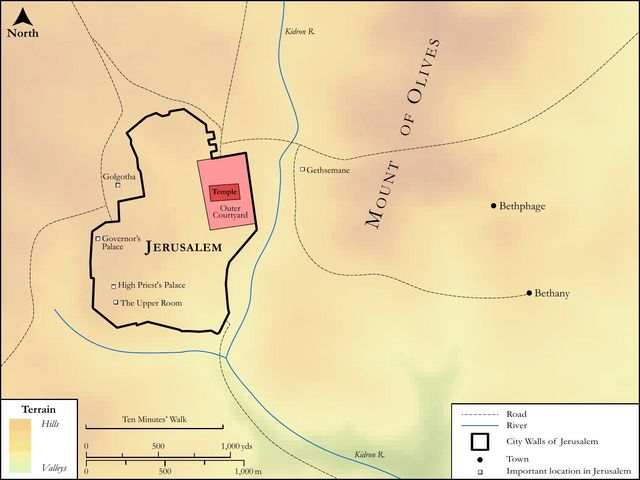
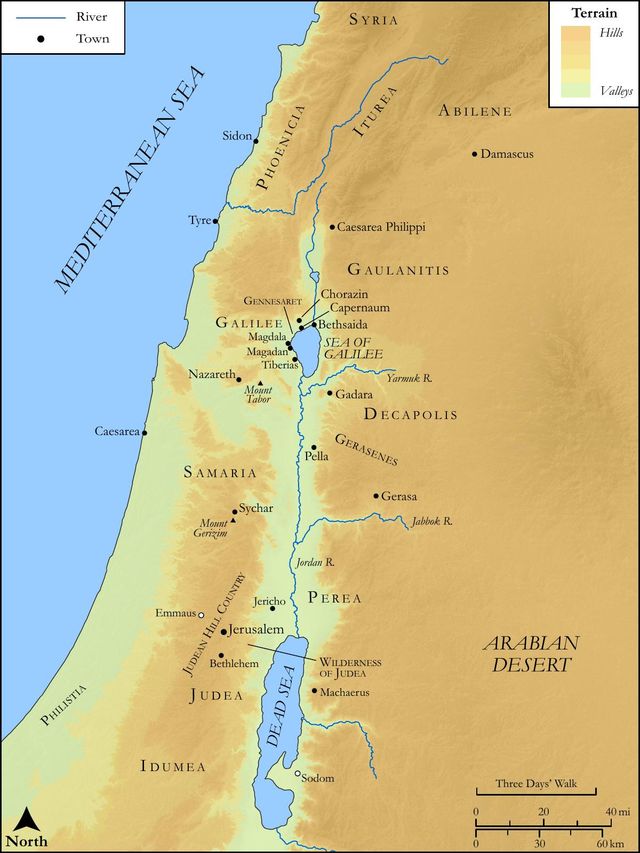
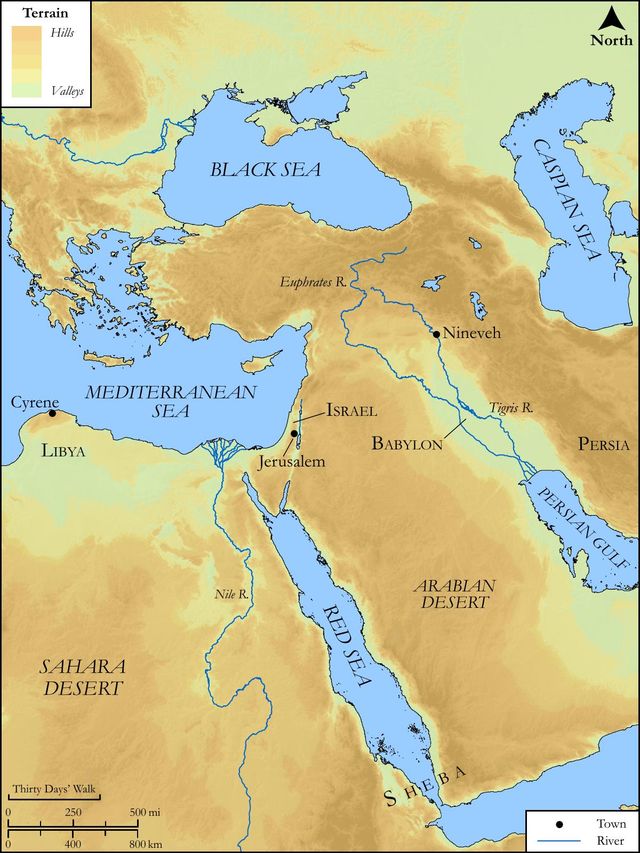
See on the biblical-era maps
Study this verse
Public-domain commentary
Matthew Henry
From his Commentary on the Whole Bible. Henry comments on passages, not single verses — this entry covers Matthew 3:7–12. His four-level outline is real structure in the source text, so it is rendered as structure.
The doctrine John preached was that of repentance, in consideration of the kingdom of heaven being at hand; now here we have the use of that doctrine. Application is the life of preaching, so it was of John's preaching.
Observe, 1. To whom he applied it; to the Pharisees and Sadducees that came to his baptism, Mat 3:7. To others he thought it enough to say, Repent, for the kingdom of heaven is at hand; but when he saw these Pharisees and Sadducees come about him, he found it necessary to explain himself, and deal more closely. These were two of the three noted sects among the Jews at that time, the third was that of the Essenes, whom we never read of in the gospels, for they affected retirement, and declined busying themselves in public affairs. The Pharisees were zealots for the ceremonies, for the power of the church, and the traditions of the elders; the Sadducees ran into the other extreme, and were little better than deists, denying the existence of spirits and a future state. It was strange that they came to John's baptism, but their curiosity brought them to be hearers; and some of them, it is probable, submitted to be baptized, but it is certain that the generality of them did not; for Christ says (Luk 7:29, Luk 7:30), that when the publicans justified God, and were baptized of John, the Pharisees and lawyers rejected the counsel of God against themselves, being not baptized of him. Note, Many come to ordinances, who come not under the power of them. Now to them John here addresses himself with all faithfulness, and what he said to them, he said to the multitude (Luk 3:7), for they were all concerned in what he said. 2. What the application was. It is plain and home, and directed to their consciences; he speaks as one that came not to preach before them, but to preach to them. Though his education was private, he was not bashful when he appeared in public, nor did he fear the face of man, for he was full of the Holy Ghost, and of power.
I.Here is a word of conviction and awakening.
He begins harshly, calls them not Rabbi, gives them not the titles, much less the applauses, they had been used to.
1.The title he gives them is, O generation of vipers. Christ gave them the same title; Mat 12:34; Mat 23:33. They were as vipers; though specious, yet venomous and poisonous, and full of malice and enmity to every thing that was good; they were a viperous brood, the seed and offspring of such as had been of the same spirit; it was bred in the bone with them. They gloried in it, that they were the seed of Abraham; but John showed them that they were the serpent's seed (compare Gen 3:15); of their father the Devil, Joh 8:44. They were a viperous gang, they were all alike; though enemies to one another, yet confederate in mischief. Note, A wicked generation is a generation of vipers, and they ought to be told so; it becomes the ministers of Christ to be bold in showing sinners their true character.
2.The alarm he gives them is, Who has warned you to flee from the wrath to come? This intimates that they were in danger of the wrath to come; and that their case was so nearly desperate, and their hearts so hardened in sin (the Pharisees by their parade of religion, and the Sadducees by their arguments against religion), that it was next to a miracle to effect anything hopeful among them. "What brings you hither? Who thought of seeing you here? What fright have you been put into, that you enquire after the kingdom of heaven?" Note,
(1.)There is a wrath to come; besides present wrath, the vials of which are poured out now, there is future wrath, the stores of which are treasured up for hereafter.
(2.)It is the great concern of every one of us to flee from this wrath.
(3.)It is wonderful mercy that we are fairly warned to flee from this wrath; think - Who has warned us? God has warned us, who delights not in our ruin; he warns by the written word, by ministers, by conscience.
(4.)These warnings sometime startle those who seemed to have been very much hardened in their security and good opinion of themselves.
II.Here is a word of exhortation and direction (Mat 3:8); "Bring forth therefore fruits meet for repentance.
Therefore, because you are warned to flee from the wrath to come, let the terrors of the Lord persuade you to a holy life." Or, "Therefore, because you profess repentance, and attend upon the doctrine and baptism of repentance, evidence that you are true penitents." Repentance is seated in the heart. There it is as a root; but in vain do we pretend to have it there, if we do not bring forth the fruits of it in a universal reformation, forsaking all sin, and cleaving to that which is good; these are fruits, axious tēs metanoias - worthy of repentance. Note, Those are not worthy the name of penitents, or their privileges, who say they are sorry for their sins, and yet persist in them. They that profess repentance, as all that are baptized do, must be and act as becomes penitents, and never do any thing unbecoming a penitent sinner. It becomes penitents to be humble and low in their own eyes, to be thankful for the least mercy, patient under the greatest affliction, to be watchful against all appearances of sin, and approaches towards it, to abound in every duty, and to be charitable in judging others.
III.Here is a word of caution, not to trust to their external privileges, so as with them to shift off these calls to repentance (Mat 3:9); Think not to say within yourselves, We have Abraham to our father. Note, There is a great deal which carnal hearts are apt to say within themselves, to put by the convincing, commanding power of the word of God, which ministers should labour to meet with and anticipate; vain thoughts which lodge within those who are called to wash their hearts, Jer 4:14. Mē doxēte - Pretend not, presume not, to say within yourselves; be not of the opinion that this will save you; harbour not such a conceit. "Please not yourselves with saying this" (so some read); "rock not yourselves asleep with this, nor flatter yourselves into a fool's paradise." Note, God takes notice of what we say within ourselves, which we dare not speak out, and is acquainted with all the false rests of the soul, and the fallacies with which it deludes itself, but which it will not discover, lest it should be undeceived. Many hide the lie that ruins them, in their right hand, and roll it under their tongue, because they are ashamed to own it; they keep in the Devil's interest, by keeping the Devil's counsel. Now John shows them,
1.What their pretense was; "We have Abraham to our father; we are not sinners of the Gentiles; it is fit indeed that they should be called to repent; but we are Jews, a holy nation, a peculiar people, what is this to us?" Note, The word does us no good, when we will not take it as it is spoken to us, and belonging to us. "Think not that because you are the seed of Abraham, therefore," (1.) "You need not repent, you have nothing to repent of; your relation to Abraham, and your interest in the covenant made with him, denominate you so holy, that there is no occasion for you to change your mind or way." (2.) "That therefore you shall fare well enough, though you do not repent. Think not that this will bring you off in the judgment, and secure you from the wrath to come; that God will connive at your impenitence, because you are Abraham's seed." Note, It is vain presumption to think that our having good relations will save us, though we be not good ourselves. What though we be descended from pious ancestors; have been blessed with a religious education; have our lot cast in families where the fear of God is uppermost; and have good friends to advise us, and pray for us; what will all this avail us, if we do not repent, and live a life of repentance? We have Abraham to our father, and therefore are entitled to the privileges of the covenant made with him; being his seed, we are sons of the church, the temple of the Lord, Jer 7:4. Note, Multitudes, by resting in the honours and advantages of their visible church-membership, take up short of heaven.
2.How foolish and groundless this pretence was; they thought that being the seed of Abraham, they were the only people God had in the world, and therefore that, if they were cut off, he would be at a loss for a church; but John shows them the folly of this conceit; I say unto you (whatever you say within yourselves), that God is able of these stones to raise up children unto Abraham. He was now baptizing in Jordan at Bethabara (Joh 1:28), the house of passage, where the children of Israel passed over; and there were the twelve stones, one for each tribe, which Joshua set up for a memorial, Jos 4:20. It is not unlikely that he pointed to those stones, which God could raise to be, more than in representation, the twelve tribes of Israel. Or perhaps he refers to Isa 51:1, where Abraham is called the rock out of which they were hewn. That God who raised Isaac out of such a rock, can, if there be an occasion, do as much again, for with him nothing is impossible. Some think he pointed to those heathen soldiers that were present, telling the Jews that God would raise up a church for himself among the Gentiles, and entail the blessing of Abraham upon them. Thus when our first parents fell, God could have left them to perish, and out of stones have raised up another Adam and another Eve. Or, take it thus, "Stones themselves shall be owned as Abraham's seed, rather than such hard, dry, barren sinners as you are." Note, As it is lowering to the confidence of the sinners in Zion, so it is encouraging to the hopes of the sons of Zion, that, whatever comes of the present generation, God will never want a church in the world; if the Jews fall off, the Gentiles shall be grafted in, Mat 21:43; Rom 11:12, etc.
IV.Here is a word of terror to the careless and secure Pharisees and Sadducees, and other Jews, that knew not the signs of the times, nor the day of their visitation, Mat 3:10. "Now look about you, now that the kingdom of God is at hand, and be made sensible."
1.How strict and short your trial is; Now the axe is carried before you, now it is laid to the root of the tree, now you are upon your good behavior, and are to be so but a while; now you are marked for ruin, and cannot avoid it but by a speedy and sincere repentance. Now you must expect that God will make quicker work with you by his judgments than he did formerly, and that they will begin at the house of God: "where God allows more means, he allows less time." Behold, I come quickly. Now they were put upon their last trial; now or never.
2."How sore and severe your doom will be, if you do not improve this." It is now declared with the axe at the root, to show that God is in earnest in the declaration, that every tree, however high in gifts and honours, however green in external professions and performances, if it bring not forth good fruit, the fruits meet for repentance, is hewn down, disowned as a tree in God's vineyard, unworthy to have room there, and is cast into the fire of God's wrath - the fittest place for barren trees: what else are they good for? If not fit for fruit, they are fit for fuel. Probably this refers to the destruction of Jerusalem by the Romans, which was not, as other judgments had been, like the lopping off of the branches, or cutting down of the body of the tree, leaving the root to bud again, but it would be the total, final, and irrecoverable extirpation of that people, in which all those should perish that continued impenitent. Now God would make a full end, wrath was coming on them to the utmost.
V.A word of instruction concerning Jesus Christ, in whom all John's preaching centered. Christ's ministers preach, not themselves, but him. Here is,
1.The dignity and pre-eminence of Christ above John. See how meanly he speaks of himself, that he might magnify Christ (Mat 3:11); "I indeed baptize you with water, that is the utmost I can do." Note, Sacraments derive not their efficacy from those who administer them; they can only apply the sign; it is Christ's prerogative to give the thing signified, Co1 3:6; Kg2 4:31. But he that comes after me is mightier than I. Though John had much power, for he came in the spirit and power of Elias, Christ has more; though John was truly great, great in the sight of the Lord (not a greater was born of woman), yet he thinks himself unworthy to be in the meanest place of attendance upon Christ, whose shoes I am not worthy to bear. He sees,
(1.)How mighty Christ is, in comparison with him. Note, It is a great comfort to the faithful ministers, to think that Jesus Christ is mightier than they, can do that for them, and that by them, which they cannot do; his strength is perfected in their weakness.
(2.)How mean he is in comparison with Christ, not worthy to carry his shoes after him! Note, Those whom God puts honour upon, are thereby made very humble and low in their own eyes; willing to be abased, so that Christ may be magnified; to be any thing, to be nothing, so that Christ may be all.
2.The design and intention of Christ's appearing, which they were now speedily to expect. When it was prophesied that John should be sent as Christ's forerunner (Mal 3:1, Mal 3:2), it immediately follows, The Lord, whom ye seek, shall suddenly come, and shall sit as a refiner, Mat 3:3. And after the coming of Elijah, the day comes that shall burn as an oven (Mal 4:1), to which the Baptist seems here to refer. Christ will come to make a distinction,
(1.)By the powerful working of his grace; He shall baptize you, that is, some of you, with the Holy Ghost and with fire. Note,
[1.]It is Christ's prerogative to baptize with the Holy Ghost. This he did in the extraordinary gifts of the Spirit conferred upon the apostles, to which Christ himself applies these words of John, Act 1:5. This he does in the graces and comforts of the Spirit given to them that ask him, Luk 11:13; Joh 7:38, Joh 7:39; See Act 11:16.
[2.]They who are baptized with the Holy Ghost are baptized as with fire; the seven spirits of God appear as seven lamps of fire, Rev 4:5. Is fire enlightening? So the Spirit is a Spirit of illumination. Is it warming? And do not their hearts burn within them? Is it consuming? And does not the Spirit of judgment, as a Spirit of burning, consume the dross of their corruptions? Does fire make all it seizes like itself? And does it move upwards? So does the Spirit make the soul holy like itself, and its tendency is heaven-ward. Christ says I am come to send fire, Luk 12:49.
(2.)By the final determinations of his judgment (Mat 3:12); Whose fan is in his hand. His ability to distinguish, as the eternal wisdom of the Father, who sees all by a true light, and his authority to distinguish, as the Person to whom all judgment is committed, is the fan that is in his hand, Jer 15:7. Now he sits as a Refiner. Observe here [1.] The visible church is Christ's floor; O my threshing, and the corn of my floor, Isa 21:10. The temple, a type of church, was built upon a threshing-floor. [2.] In this floor there is a mixture of wheat and chaff. True believers are as wheat, substantial, useful, and valuable; hypocrites are as chaff, light, and empty, useless and worthless, and carried about with every wind; these are now mixed, good and bad, under the same external profession; and in the same visible communion. [3.] There is a day coming when the floor shall be purged, and the wheat and chaff shall be separated. Something of this kind is often done in this world, when God calls his people out of Babylon, Rev 18:4. But it is the day of the last judgment that will be the great winnowing, distinguishing day, which will infallibly determine concerning doctrines and works (Co1 3:13), and concerning persons (Mat 25:32, Mat 25:33), when saints and sinners shall be parted for ever. [4.] Heaven is the garner into which Jesus Christ will shortly gather all his wheat, and not a grain of it shall be lost: he will gather them as the ripe fruits were gathered in. Death's scythe is made use of to gather them to their people. In heaven the saints are brought together, and no longer scattered; they are safe, and no longer exposed; separated from corrupt neighbours without, and corrupt affections within, and there is no chaff among them. They are not only gathered into the barn (Mat 13:30), but into the garner, where they are thoroughly purified. [5.] Hell is the unquenchable fire, which will burn up the chaff, which will certainly be the portion and punishment, and everlasting destruction, of hypocrites and unbelievers. So that here are life and death, good and evil, set before us; according as we now are in the field, we shall be then in the floor.
Historical interpretation
Eleven Centuries of Reception
21 surviving comments on this verse. Each one is dated, so this reads as a timeline rather than a list.
Select a marker to jump to its quote. Markers stagger vertically where authors wrote within a few decades of each other.
Seize the opportunity of unexpected felicity: that you, who sometime were in God's sight nothing but "a drop of a bucket," and "dust of the threshing-floor," and "a potter's vessel," may thenceforward become that "tree which is sown beside the waters, is perennial in leaves, bears fruit at its own time," and shall not see fire," nor "axe." Having found "the truth," repent of errors; repent of having loved what God loves not: even we ourselves do not permit our slave-lads not to hate the things which are offensive to us; for the principle of voluntary obedience consists in similarity of minds.
The wood was the old order, which is being pruned down by the new Gospel, in which withal "the axe has been laid at the roots." So, too, "Eye for eye, and tooth for tooth," has now grown old, ever since "Let none render evil for evil" grew young.
There the blood of the Lord serves for your purple robe, and your broad stripe is His own cross; there the axe is already laid to the trunk of the tree; there is the branch out of the root of Jesse.
The axe laid at the roots of the trees witnesses to the power present in Christ. The cutting down and burning of the trees signifies the destruction of barren faithlessness that is being prepared for the fire of judgment.
There is no doubt this axe signifies the power of the divine word, for God says through Jeremiah the prophet: “Is not my word like fire, says the Lord, and like a hammer which breaks the rock in pieces?” Therefore this axe which is laid at the very roots of interior faith in this forest of humanity always implies the severe threat of divine judgment. Unfruitful trees or barren people, bearing no fruit of faith, will be cut down and consigned to perpetual fire.
"And how," saith one, "shall we be able to bring forth fruit, when the edge is being applied, and the time so strait, and the appointed season cut short." "Thou wilt be able," saith he, "for this fruit is not of the same kind as that of common trees, waiting a long time, and in bondage to the necessities of seasons, and requiring much other management; but it is enough to be willing, and the tree at once hath put forth its fruit. For not the nature of the root only, but also the skill of the husbandman contributes the most to that kind of fruit-bearing."
(Hom. xi.) He does not forbid them to say they are his, but to trust in that, neglecting virtues of the soul.
That men should be made out of stones, is like Isaac coming from Sarah's womb; Look into the rock, says Isaiah, whence ye were hewn. Reminding them thus of this prophecy, he shows that it is possible that the like might even now happen.
By saying Every, he cuts off all privilege of nobility: as much as to say, Though thou be the son of Abraham, if thou abide fruitless thou shalt suffer the punishment.
Mark then how by what follows also he increases their alarm, and adds intensity to their agonizing fear.
For having said that "God is able of these stones to raise up children unto Abraham," he added, "And now also the axe is laid unto the root of the trees," by all means making his speech alarming. For as he from his way of life had much freedom of speech, so they needed his severe rebuke, having been left barren now for a long time. For "why do I say" (such are his words) "that ye are on the point of falling away from your relationship to the patriarch and of seeing other, even those that are of stones, brought in to your preeminence? Nay, not to this point only will your penalty reach, but your punishment will proceed further. For now," saith he, "the axe is laid unto the root of the trees." There is nothing more terrible than this turn of his discourse. For it is no longer "a flying sickle," nor "the taking down of a hedge," nor "the treading under foot of the vineyard;" but an axe exceeding sharp, and what is worse, it is even at the doors. For inasmuch as they continually disbelieved the prophets, and used to say, "Where is the day of the Lord:" and "let the counsel of the Holy One of Israel come, that we may know it," by reason that it was many years before what they said came to pass; to lead them off from this encouragement also, he sets the terrors close to them. And this he declared by saying "now," and by his putting it to "the root." "For the space between is nothing now," saith he, "but it is laid to the very root." And he said not, "to the branches," nor "to the fruits," but "to the root." Signifying, that if they were negligent, they would have incurable horrors to endure, and not have so much as a hope of remedy. It being no servant who is now come, as those before Him were, but the very Lord of all, bringing on them His fierce and most effectual vengeance.
Yet, although he hath terrified them again, he suffers them not to fall into despair; but as before he said not "He hath raised up," but "He is able to raise up children to Abraham" (at once both alarming and comforting them); even so here also he did not say that "it hath touched the root," but "it is laid to the root, and is now hard by it, and shows signs of no delay." However, even though He hath brought it so near, He makes its cutting depend upon you. For if ye change and become better men, this axe will depart without doing anything; but if ye continue in the same ways, He will tear up the tree by the roots. And therefore, observe, it is neither removed from the root, nor applied as it is doth it cut at all: the one, that ye may not grow supine, the other to let you know that it is possible even in a short time to be changed and saved. Wherefore he doth also from all topics heighten their fear, thoroughly awakening and pressing them on to repentance. Thus first their falling away from their forefathers; next, others being introduced instead; lastly, those terrors being at their doors, the certainty of suffering incurable evils (both which he declared by the root and the axe), was sufficient to rouse thoroughly those even that were very supine, and to make them full of anxiety.
But be not afraid; or rather, be afraid, but despair not. For thou hast yet a hope of change; the sentence is not quite absolute, neither did the axe come to cut (else what hindered it from cutting, close as it was to the root?); but on purpose by this fear to make thee a better man, and to prepare thee to bring forth fruit. For this cause he added, "Therefore every tree, which bringeth not forth good fruit, is hewn down, and cast into the fire." Now by the word "every," he rejects again the privilege which they had from their noble descent; "Why, if thou be Abraham's own descendant," saith he, "if thou have thousands of patriarchs to enumerate, thou wilt but undergo a double punishment, abiding unfruitful."
By these words he alarmed even publicans, the soldiers' mind was startled by him, not casting them into despair, yet ridding them of all security. For along with the terror, there is also much encouragement in what he saith; since by the expression, "which bringeth not forth good fruit," he signified that what bears fruit is delivered from all vengeance.
[Daniel 10:4] "And in the twenty-fourth day of the first month, I was beside the great river which is the Tigris." Ezekiel also had seen a great vision beside a river, the Chebar (Ezekiel 1:1). And it was by the stream of the Jordan that the heavens were opened to the gaze of our Lord and Savior and also to John the Baptist (Matthew 3:1-17). Therefore those critics should leave off their foolish objections who raise questions about the presence of shadows and symbols in a matter of historical truth and attempt to destroy the truth itself by imagining that they should employ allegorical methods to destroy the historicity of rivers and trees and of Paradise.
He intimates God's great power, who, as he made all things out of nothing, can make men out of the hardest stone.
These stones signify the Gentiles because of their hardness of heart. See Ezekiel, I will take away from you the heart of stone, and give you the heart of flesh. Stone is emblematic of hardness, flesh of softness.
Or, the preaching of the Gospel is meant, as the Prophet Jeremiah also compares the Word of the Lord to an axe cleaving the rock. (Jer. 23:29.)
(Verse 10, 11.) For now the axe is laid to the root of the trees. Every tree therefore that does not bear good fruit will be cut down and thrown into the fire. I indeed baptize you with water for repentance, but he who is coming after me is mightier than I. The preaching of the Gospel word, which is sharp on both sides, is called an axe, according to the prophet Jeremiah, who compares the word of the Lord to an axe cutting through a rock (Jeremiah 46).
Whose shoes I am not worthy to bear. In another Gospel: Whose, he said, I am not worthy to untie the strap of his shoe: here humility is shown, there mystery is demonstrated, that Christ is the bridegroom, and John does not deserve to untie the bridegroom's shoe, lest his house be called according to the law of Moses, and the example of Ruth, the house of the barefoot (Deut. XXV, and Ruth. IV).
He calls Christ an axe “sharper than a two-edged sword,” which was to cut off the unbelieving Jews and dissociate them from the honor and communion of the patriarchs. Those spoken of as “the root” are the fathers of old who remained well pleasing to God, those who with Abraham and as with many people in former times were holy. The unbelievers who sprang from them were cut off as fruitless branches. But the root remained, onto which those of the believing Gentiles were engrafted. And as Irenaeus reminds us, God’s Word is like an axe in accordance with Jeremiah’s saying: the word of the Lord is “like a pickaxe chopping stone.” Why am I saying that you are going to fall away? God did not spare the root.
As a skilful physician from the colour of the skin infers the sick man's disease, so John understood the evil thoughts of the Pharisees who came to him. They thought perhaps, We go, and confess our sins; he imposes no burden on us, we will be baptized, and get indulgence for sin. Fools! if ye have eaten of impurity, must ye not needs take physic? So after confession and baptism, a man needs much diligence to heal the wound of sin; therefore he says, Generation of vipers. It is the nature of the viper as soon as it has bit a man to fly to the water, which, if it cannot find, it straightway dies; so this progeny of vipers, after having committed deadly sin, ran to baptism, that, like vipers, they might escape death by means of water. Moreover it is the nature of vipers to burst the insides of their mothers, and so to be born. The Jews then are therefore called progeny of vipers, because by continual persecution of the prophets they had corrupted their mother the Synagogue. Also vipers have a beautiful and speckled outside, but are filled with poison within. So these men's countenances wore a holy appearance.
Or who hath showed you? Was it Esaias? Surely no; had he taught you, you would not put your trust in water only, but also in good works; he thus speaks, Wash you, and be clean; put your wickedness away from your souls, learn to do well. (Is. 1:16.) Was it then David? who says, Thou shall wash me, and I shall he whiter than snow; (Ps. 51:7.) surely not, for he adds immediately, The sacrifice of God is a broken spirit. If then ye had been the disciples of David, ye would have come to baptism with mournings.
What avails noble birth to him whose life is disgraceful? Or, on the other hand, what hurt is a low origin to him who has the lustre of virtue? It is fitter that the parents of such a son should rejoice over him, than he over his parents. So do not you pride yourselves on having Abraham for your father, rather blush that you inherit his blood, but not his holiness. He who has no resemblance to his father is possibly the offspring of adultery. These words then only exclude boasting on account of birth.
Stone is hard to work, but when wrought to some shape, it loses it not; so the Gentiles were hardly brought to the faith, but once brought they abide in it for ever.
The axe is that most sharp fury of the consummation of all things, that is to hew down the whole world. But if it be already laid, how hath it not yet cut down? Because these trees have reason and free power to do good, or leave undone; so that when they see the axe laid to their root, they may fear and bring forth fruit. This denunciation of wrath then, which is meant by the laying of the axe to the root, though it have no effect on the bad, yet will sever the good from the bad.
The manner of Scripture is to give names from the imitation of deeds, according to that of Ezekiel, Thy father was an Amorite; (Ezek. 16:3.) so these from following vipers are called generation of vipers.
When then he asks, who will show you to flee from the wrath to come,—'except God' must be understood.
But if we read, shall show, in the future, this is the meaning, 'What teacher, what preacher, shall be able to give you such counsel, as that ye may escape the wrath of everlasting damnation?'
There is a tradition, that John preached at that place of the Jordan, where the twelve stones taken from the bed of the river had been set up by command of God. He might then be pointing to these, when he said, Of these stones.
There follows: "For now the axe is laid to the root of the tree. For every tree not producing good fruit will be cut down and cast into the fire." The tree of this world is the entire human race. The axe, however, is our Redeemer, who is held as if by a handle and iron through His humanity, but cuts through His divinity. This axe is now laid to the root of the tree because, although He waits through patience, it is nevertheless seen what He is about to do. "For every tree not producing good fruit will be cut down and cast into the fire," because every perverse person more quickly finds the prepared burning of Gehenna who scorns to produce the fruit of good work here. And it should be noted that he says the axe is laid not beside the branches, but to the root. For when the children of the wicked are taken away, what else is done but the branches of an unfruitful tree are cut off? But when an entire lineage together with the parent is taken away, the unfruitful tree is cut off from the root, so that nothing may remain from which a wicked offspring might grow again.
(De Cur. Past. iii. in prol.) The words of the teachers should be fitted to the quality of the hearers, that in each particular it should agree with itself and yet never depart from the fortress of general edification.
(Hom. in Ev. xx. 8.) Observe, he says not merely fruits of repentance, but fruits meet for repentance. For he who has never fallen into things unlawful, is of right allowed the use of all things lawful; but if any hath fallen into sin, he ought so far to put away from him even things lawful, as far as he is conscious of having used unlawful things. It is left then to such man's conscience to seek so much the greater gains of good works by repentance, the greater loss he has brought on himself by sin. The Jews who gloried in their race, would not own themselves sinners because they were Abraham's seed. Say not among yourselves we are Abraham's seed.
(Hom. in Ev. xx. 9.) Or, the axe signifies the Redeemer, who as an axe of haft and blade, so consisting of the Divine and human nature, is held by His human, but cuts by His Divine nature. And though this axe be laid at the root of the tree waiting in patience, it is yet seen what it will do; for each obstinate sinner who here neglects the fruit of good works, finds the fire of hell ready for him. Observe, the axe is laid to the root, not to the branches; for that when the children of wickedness are removed, the branches only of the unfruitful tree are cut away. But when the whole offspring with their parent is carried off, the unfruitful tree is cut down by the root, that there remain not whence the evil shoots should spring up again.
Therefore every tree that bringeth not forth good fruit shall be cut down, and cast into the fire, because he who here neglects to bring forth the fruit of good works finds a fire in hell prepared for him.
(Orig. viii. 4.) The Pharisees and Sadducees opposed to one another; Pharisee in the Hebrew signifies 'divided;' because choosing the justification of traditions and observances they were 'divided' or 'separated' from the people by this righteousness. Sadducee in the Hebrew means 'just;' for these laid claim to be what they were not, denied the resurrection of the body, and taught that the soul perished with the body; they only received the Pentateuch, and rejected the Prophets.
Rightly are they who are to be baptized said to go out to the Prophet; for unless one depart from sin, and renounce the pomp of the Devil, and the temptations of the world, he cannot receive a healing baptism. Rightly also in Jordan, which means their descent, because they descended from the pride of life to the humility of an honest confession. Thus early was an example given to them that are to be baptized of confessing their sins and professing amendment.
Because as a preacher of truth he wished to stir them up, to bring forth fruit meet for repentance, he invites them to humility, without which no one can repent.
Otherwise; the Gentiles may be meant who worshipped stones.
Of stones there were sons raised up to Abraham; forasmuch as the Gentiles by believing in Christ, who is Abraham's seed, became his sons to whose seed they were united.
There are four sorts of trees; the first totally withered, to which the Pagans may be likened; the second, green but unfruitful, as the hypocrites; the third, green and fruitful, but poisonous, such are heretics; the fourth, green and bringing forth good fruit, to which are like the good Catholics.
The axe means the judgement of Christ, and the trees stand for each one of us. Therefore he who has not believed, and thus is rooted only in himself, is now and henceforward being cut down and cast into gehenna.
even though descended from Abraham,
He did not say, "which hath not brought forth," but "which bringeth not forth," for one must continually be bringing forth fruit. For if you gave alms yesterday but today you are greedy and grasping, you are not pleasing to God.
The fire, that is, of gehenna.
(non occ.) It was necessary that after the teaching which he used to the common people, the Evangelist should give an example of the doctrine he delivered to the more advanced; therefore he says, Seeing many of the Pharisees, &c.
(non occ.) When John saw those who seemed to be of great consideration among the Jews come to his baptism, he said to them, O generation of vipers, &c.
If then ye would escape this wrath, Bring forth fruits meet for repentance.
(ord.) It is faith's first lesson to believe that God is able to do whatever He will.
Continue studying Matthew 3:10 across the web’s major study libraries — every link below opens this exact verse, chapter, or book on the destination site.
Read & Compare
 BibleGatewayThis verse in more than 200 translations and 70 languages.
 Bible.comThe YouVersion reader — hundreds of translations, reading plans, and highlights.
 ESV.orgCrossway's official English Standard Version reader.
 NET BibleThe NET translation with 60,000+ translators' notes on every rendering decision.
 STEP BibleTyndale House's free study tool — original text, vocabulary, and scholarly resources.
 BibliaLogos Bible Software's free web reader.
 USCCBThe New American Bible (Revised Edition) with the U.S. bishops' study notes.
Commentaries
 BibleHub CommentariesDozens of classic commentaries on this verse, gathered on one page.
 StudyLightMore than 100 commentary sets — the largest collection on the web.
 BibleRefPlain-English commentary on what this verse means, verse by verse.
 Enduring WordDavid Guzik's free commentary on this chapter, widely used by Bible teachers.
 Bible Study ToolsVerse commentary alongside Greek and Hebrew study aids.
Original Language & Research
- BibleHub InterlinearThe verse word by word — original language, transliteration, and English.
- BibleHub LexiconEvery word's original-language definition and Strong's entry.
 Blue Letter BibleDeep-study tools — Strong's numbers, concordance, and word studies.
 CNTR CollationThe earliest Greek manuscripts of this verse, collated letter by letter.
Sermons, Hymns & Audio


TrulyRandomVerse is not affiliated with these sites and doesn’t control their content. They’re linked because they’re genuinely useful.
Summary
Matthew 3:10 presents John the Baptist's urgent and uncompromising message of impending divine judgment, employing vivid agricultural imagery to underscore the necessity of genuine repentance. It declares that the time for superficial religiosity is over, and God's decisive assessment of lives based on demonstrable spiritual fruitfulness is at hand, leading to severe consequences for those who fail to produce it.
Context
ShowHideLiterary Context
This powerful declaration is situated within John the Baptist's wilderness ministry, immediately following his sharp rebuke of the Pharisees and Sadducees who came to his baptism. John challenges their presumption of security based on their Abrahamic lineage, asserting that God can raise up children for Abraham from stones (Matthew 3:9). Verse 10 serves as the logical culmination of this warning, emphasizing that spiritual lineage or outward religious affiliation is insufficient; what truly matters is the internal transformation evidenced by outward actions, preparing the way for the coming Messiah, whose arrival is imminent as described in Matthew 3:11-12.
Historical & Cultural Context
John the Baptist preached in the wilderness of Judea, a region known for its rugged terrain and ascetic communities. His audience included various segments of Jewish society, from common people to religious leaders. Agricultural imagery, like trees and fruit, was deeply familiar in ancient Israel, where farming was central to life and livelihood. The concept of "fruit" was a common metaphor in Jewish thought for actions, character, and the outcome of one's life. The "axe" and "fire" were understood as tools of destruction and purification, respectively, resonating with prophetic warnings of divine judgment found throughout the Old Testament, such as in Isaiah 10:33-34 or Malachi 4:1.
Key Themes
ShowHideThe primary themes embedded in Matthew 3 and particularly in verse 10 include Imminent Judgment, signaled by the "axe laid unto the root," which implies a final, decisive reckoning rather than mere pruning. Another crucial theme is Fruitfulness as Evidence of True Repentance, emphasizing that genuine spiritual transformation is not merely a verbal profession but must be demonstrated through actions and character consistent with God's will. Finally, the verse highlights Divine Consequences, portraying the severe and ultimate destruction ("hewn down, and cast into the fire") awaiting those who fail to produce "good fruit," aligning with the broader biblical principle that God's justice will prevail.
Exposition and Analysis
ShowHideKey Word Analysis
ShowHideThis word refers to a tool for felling trees, not merely pruning them. Its placement "unto the root" signifies a radical, destructive act, implying that the judgment is not superficial but targets the very foundation of one's existence or identity. It suggests a complete removal, not just a trimming.
This term denotes the product or outcome of something, whether literal produce from a plant or, figuratively, the results of one's actions, character, or life. In this context, "good fruit" (G2570, kalós, meaning beautiful, good, valuable, or virtuous) refers to actions, attitudes, and character traits that are morally and spiritually excellent, demonstrating genuine repentance and alignment with God's will.
A primary word for "fire," used literally or figuratively. In biblical contexts, fire often symbolizes purification, testing, or, as here, ultimate destruction and judgment. It conveys the severity and finality of the consequences for those who do not bear good fruit, suggesting an unquenchable and consuming judgment.
Verse Breakdown
ShowHide"And now also the axe is laid unto the root of the trees:"
This clause conveys the immediacy and severity of impending judgment. The phrase "now also" (G2235, ḗdē) emphasizes that the time for decision has arrived. The "axe" (G513, axínē) being "laid" (G2749, keîmai, meaning to lie outstretched or be appointed) "unto the root" (G4491, rhíza) of the "trees" (G1186, déndron) signifies that the instrument of judgment is not merely present but is poised for action, targeting the very source or foundation of life, indicating a complete and decisive felling rather than a mere pruning.
"therefore every tree which bringeth not forth good fruit"
This segment establishes the criterion for judgment: the absence of "good fruit" (G2570, kalós G2590, karpós). The conjunction "therefore" (G3767, oûn) logically connects the imminence of judgment to the requirement of genuine spiritual productivity. "Every tree" (G3956, pâs G1186, déndron) indicates the universality of this standard, applying to all who claim a relationship with God. The phrase "bringeth not forth" (G4160, poiéō G3361, mḗ) highlights a lack of active, demonstrable spiritual output.
"is hewn down, and cast into the fire."
This final clause describes the irreversible and severe consequences of failing to produce good fruit. "Hewn down" (G1581, ekkóptō, to cut off or out) signifies complete removal and destruction. The phrase "cast into" (G906, bállō G1519, eis) "the fire" (G4442, pŷr) denotes utter destruction and condemnation, often a metaphor for eternal judgment or divine wrath.
Literary Devices
ShowHideMatthew 3:10 is rich in Metaphor, primarily using the imagery of a tree, its fruit, an axe, and fire. The "tree" metaphorically represents an individual or a group (like the people of Israel or those claiming religious affiliation). The "fruit" symbolizes their actions, character, and the spiritual outcomes of their lives. The "axe" is a powerful symbol of imminent and decisive divine judgment, poised to sever the connection between the unproductive "tree" and its life source. The "fire" represents the ultimate, consuming consequences of this judgment, often associated with purification or eternal destruction. The entire verse functions as an Allegory, where the agricultural scenario directly illustrates a spiritual truth about judgment based on spiritual productivity. The stark contrast between "good fruit" and the lack thereof, leading to either life or destruction, employs Antithesis to emphasize the critical choice and its binary outcomes.
Theological and Thematic Connections
ShowHideMatthew 3:10 powerfully articulates the biblical principle that genuine faith is evidenced by transformed living. It underscores that God's standard is not mere profession or lineage, but demonstrable righteousness and spiritual productivity. This aligns with the prophetic tradition's emphasis on ethical living as the true sign of covenant faithfulness, and it foreshadows Jesus's own teachings on the importance of "fruit" as the measure of a disciple's authenticity. The severity of the judgment ("hewn down, and cast into the fire") highlights the seriousness of failing to live in accordance with God's will, pointing to an ultimate, eschatological reckoning.
Reflection and Application
ShowHideMatthew 3:10 serves as a timeless and urgent call for profound self-examination and authentic spiritual living. It challenges us to move beyond superficial religious observance or reliance on past spiritual experiences, and instead to genuinely assess whether our lives are producing "good fruit"—tangible evidence of a heart transformed by repentance and faith. This means cultivating character marked by love, joy, peace, patience, kindness, goodness, faithfulness, gentleness, and self-control (Galatians 5:22-23), and engaging in actions that reflect justice, mercy, and humility. The imagery of the axe at the root reminds us that the opportunity for genuine change is present now, and that the consequences of spiritual barrenness are severe and final. It compels us to live intentionally, seeking to honor God not just with our words, but with the very fabric of our lives.
Questions for Reflection
ShowHideFAQ
ShowHideWhat does "the axe is laid unto the root of the trees" mean?
ShowHideThis vivid phrase signifies that divine judgment is not merely a distant possibility but is imminent and decisive. The "axe" is not for pruning branches but is positioned at the "root," indicating a complete felling of the tree. It means that the time for superficiality or delay is over; God is ready to cut off anything that does not bear good fruit, targeting the very source or foundation of its existence. It implies a final, irreversible judgment for spiritual unfruitfulness.
What is "good fruit" in this context?
ShowHide"Good fruit" refers to the tangible evidence of genuine repentance and a transformed life. It encompasses righteous actions, a changed character, and a life lived in obedience to God's will. This contrasts sharply with mere outward religious observance, lineage, or verbal profession without corresponding inner change. Jesus later elaborates on this concept, stating that "every good tree bears good fruit, but a bad tree bears bad fruit" (Matthew 7:17). It's about living out the values of God's Kingdom.
Christ-Centered Fulfillment
ShowHideWhile John the Baptist's message in Matthew 3:10 is a stark warning of judgment, it finds its ultimate fulfillment and deepest meaning in Jesus Christ. John's role was to prepare the way for the one "who is to come after me, mightier than I" (Matthew 3:11), who would baptize with the Holy Spirit and fire. Jesus, as the perfect "tree" who bore only "good fruit" in His sinless life and perfect obedience, embodies the very righteousness that John called for. He is the one who perfectly fulfilled the Law and prophets, demonstrating what true fruitfulness looks like (John 15:5). Moreover, Jesus is the ultimate Judge, the one who will indeed "hew down" and "cast into the fire" those who reject Him and fail to bear fruit consistent with repentance and faith (Matthew 25:41). Yet, He also offers the path to bear good fruit: by abiding in Him, the True Vine, believers are enabled by His Spirit to produce the fruit of righteousness, escaping the condemnation that John warned of (John 15:4). Thus, Matthew 3:10 points to Christ as both the standard of perfect fruitfulness and the one through whom we can be made fruitful and escape judgment.