


1 Samuel 22:3
Bible text: King James Version (1769 Blayney text) · Public domain
Bible text: King James Version with Strong's numbers · Public domain
Bible text: Berean Standard Bible · Public domain
Bible text: American Standard Version (1901) · Public domain
Bible text: World English Bible, Messianic edition · Public domain
Bible text: Geneva Bible (1599) · Public domain
Bible text: Young's Literal Translation · Public domain
- וַיֵּלֶךְvai·Ye·lekhand he wentH1980Conj-w ¦ V-Qal-ConsecImperf-3msVerb Qal Consecutive Imperfect 3rd Singular Masculineוַandיֵּלֶךְhe went
- דָּוִדda·VidDavidH1732N-proper-mNoun Proper Masculine
- מִשָּׁםmi·Shamfrom thereH8033Prep-m ¦ AdvAdverbמִfromשָּׁםthere
- מִצְפֵּהmitz·PehMizpah ofH4708N-mscNoun Singular Masculine Construct
- מוֹאָבmo·'AvMoabH4124N-properNoun Proper Location
- וַיֹּאמֶרvai·Yo·merand he saidH559Conj-w ¦ V-Qal-ConsecImperf-3msVerb Qal Consecutive Imperfect 3rd Singular Masculineוַandיֹּאמֶרhe said
- אֶל'eltoH413PrepPreposition
- מֶלֶךְMe·lekh[the] king ofH4428N-mscNoun Singular Masculine Construct
- מוֹאָבmo·'AvMoabH4124N-properNoun Proper Location
- יֵצֵאye·tze'let him go outH3318V-Qal-Imperf-3msVerb Qal Imperfect 3rd Singular Masculine
- נָאna'pleaseH4994PrtParticle Interjection
- אָבִי'a·Vimy fatherH1N-msc ¦ 1csNoun Singular Masculine Constructאָבִfatherיmy
- וְאִמִּיve·'i·Miand my motherH517Conj-w ¦ N-fsc ¦ 1csNoun Singular Feminine Constructוְandאִמִּmotherיmy
- אִתְּכֶם'i·te·Khemwith youH854Prep ¦ 2mpPreposition Definiteאִתְּwithכֶםyou
- עַד'aduntilH5704PrepPreposition
- אֲשֶׁר'a·SherthatH834RelParticle Relative
- אֵדַע'e·Da'I will knowH3045V-Qal-Imperf-1csVerb Qal Imperfect 1st Singular common gender
- מַהmahwhat?H4100InterrogPronoun Interrogative
- יַּעֲשֶׂהya·'a·sehwill he doH6213V-Qal-Imperf-3msVerb Qal Imperfect 3rd Singular Masculine
- לִּיlifor <the> mePrep-l ¦ 1csSuffix Personal 1st Singular common genderלִּfor <the>יme
- אֱלֹהִים'E·lo·HimGodH430N-mpNoun Plural Masculine Absolute
English is a literal word-by-word gloss of the Hebrew, not the KJV's wording. Why?
This is the original text the KJV's translators worked from — each Hebrew word with its own literal English meaning in this verse, prepared by scholars at Tyndale House, Cambridge. The KJV translates whole sentences, not word by word, so its wording differs: one Hebrew word can become several English words, and the KJV may choose “the LORD” where the gloss reads “Yahweh”. Both are faithful — they answer different questions. For the KJV's own rendering, switch to the KJV text.
Details
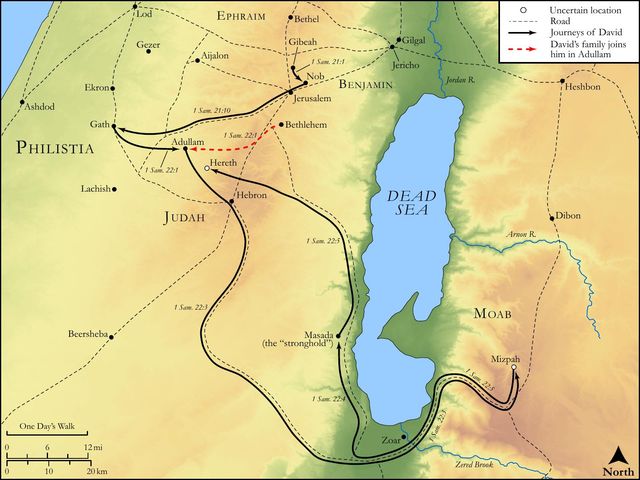
See on the biblical-era map
Study this verse
Public-domain commentary
Matthew Henry
From his Commentary on the Whole Bible. Henry comments on passages, not single verses — this entry covers 1 Samuel 22:1–5. His two-level outline is real structure in the source text, so it is rendered as structure.
Here, I. David shelters himself in the cave of Adullam, Sa1 22:1. Whether it was a natural or artificial fastness does not appear; it is probable that the access to it was so difficult that David thought himself able, with Goliath's sword, to keep it against all the forces of Saul, and therefore buried himself alive in it, while he was waiting to see (and he says here, Sa1 22:3) what God would do with him. The promise of the kingdom implied a promise of preservation to it, and yet David used proper means for his own safety, otherwise he would have tempted God. He did not do any thing that aimed to destroy Saul, but only to secure himself. He that might have done great service to his country as a judge or general is here shut up in a cave, and thrown by as a vessel in which there was no pleasure. We must not think it strange if sometimes shining lights be thus eclipsed and hidden under a bushel. Perhaps the apostle refers to this instance of David, among others, when he speaks of some of the Old Testament worthies that wandered in deserts, in dens and caves of the earth, Heb 11:38. It was at this time that David penned Psa 142:1-7, which is entitled, A prayer when David was in the cave; and there he complains that no man would know him and that refuge failed him, but hopes that shortly the righteous would compass him about.
II.Thither his relations flocked to him, his brethren and all his father's house, to be protected by him, to give assistance to him, and to take their lot with him. A brother is born for adversity. Now, Joab, and Abishai, and the rest of his relations, came to him, to suffer and venture with him, in hopes shortly to be advanced with him; and they were so. The first three of his worthies were those that first owed him when he was in the cave, Ch1 11:15, etc.
III.Here he began to raise forces in his own defence, Sa1 22:2.
He found by the late experiments he had made that he could not save himself by flight, and therefore was necessitated to do it by force, wherein he never acted offensively, never offered any violence to his prince nor gave any disturbance to the peace of the kingdom, but only used his forces as a guard to his own person. But, whatever defence his soldiers were to him, they did him no great credit, for the regiment he had was made up not of great men, nor rich men, nor stout men, no, nor good men, but men in distress, in debt, and discontented, men of broken fortunes and restless spirits, that were put to their shifts, and knew not well what to do with themselves. When David had fixed his headquarters in the cave of Adullam, they came and enlisted themselves under him to the number of about 400. See what weak instruments God sometimes makes use of, by which to bring about his own purposes. The Son of David is ready to receive distressed souls, that will appoint him their captain and be commanded by him.
IV.He took care to settle his parents in a place of safety.
No such place could he find in all the land of Israel while Saul was so bitterly enraged against him and all that belonged to him for his sake; he therefore goes with them to the king of Moab, and puts them under his protection, Sa1 22:3, Sa1 22:4. Observe here,
1.With what a tender concern he provided for his aged parents. It was not fit they should be exposed either to the frights or to the fatigues which he must expect during his struggle with Saul (their age would by no means bear such exposure); therefore the first thing he does is to find them a quiet habitation, whatever became of himself. Let children learn from this to show pity at home and requite their parents (Ti1 5:4), in every thing consulting their ease and satisfaction. Though ever so highly preferred, and ever so much employed, let them not forget their aged parents.
2.With what a humble faith he expects the issue of his present distresses: Till I know what God will do for me. He expresses his hopes very modestly, as one that had entirely cast himself upon God and committed his way to him, expecting a good issue, not from his own arts, or arms, or merits, but from what the wisdom, power, and goodness of God would do for him. Now David's father and mother forsook him, but God did not, Psa 27:10.
V.He had the advice and assistance of the prophet Gad, who probably was one of the sons of the prophets that were brought up under Samuel, and was by him recommended to David for his chaplain or spiritual guide. Being a prophet, he would pray for him and instruct him in the mind of God; and David, though he was himself a prophet, was glad of his assistance. He advised him to go into the land of Judah (Sa1 22:5), as one that was confident of his own innocency, and was well assured of the divine protection, and was desirous, even in his present hard circumstances, to do some service to his tribe and country. Let him not be ashamed to own his own cause nor decline the succours that would be offered him. Animated by this word, there he determined to appear publicly. Thus are the steps of a good man ordered by the Lord.
Historical interpretation
Historical reception
1 surviving comment on this verse from the historical church.
And David departed from there to Mizpah, etc. The law went forth from Zion, and the word of the Lord from Jerusalem (Isa. II), and it reached, growing towards the Church of the Gentiles, established on the highest peak of faith and virtues. Mizpah indeed is translated into a cave. He also went to the dialectical orators, philosophers, and even to the rulers of matters to reconcile them to himself; and to these, Christ commended the faith of God the Father and the piety of the Church to be protected with religious diligence until the fulfillment of the times of the nations.
Continue studying 1 Samuel 22:3 across the web’s major study libraries — every link below opens this exact verse, chapter, or book on the destination site.
Read & Compare
 BibleGatewayThis verse in more than 200 translations and 70 languages.
 Bible.comThe YouVersion reader — hundreds of translations, reading plans, and highlights.
 ESV.orgCrossway's official English Standard Version reader.
 NET BibleThe NET translation with 60,000+ translators' notes on every rendering decision.
 STEP BibleTyndale House's free study tool — original text, vocabulary, and scholarly resources.
 BibliaLogos Bible Software's free web reader.
 USCCBThe New American Bible (Revised Edition) with the U.S. bishops' study notes.
Commentaries
 BibleHub CommentariesDozens of classic commentaries on this verse, gathered on one page.
 StudyLightMore than 100 commentary sets — the largest collection on the web.
 BibleRefPlain-English commentary on what this verse means, verse by verse.
 Enduring WordDavid Guzik's free commentary on this chapter, widely used by Bible teachers.
 Bible Study ToolsVerse commentary alongside Greek and Hebrew study aids.
Original Language & Research
- BibleHub InterlinearThe verse word by word — original language, transliteration, and English.
- BibleHub LexiconEvery word's original-language definition and Strong's entry.
 Blue Letter BibleDeep-study tools — Strong's numbers, concordance, and word studies.
 SefariaThe Hebrew text with Rashi and centuries of Jewish commentary.
Sermons, Hymns & Audio


TrulyRandomVerse is not affiliated with these sites and doesn’t control their content. They’re linked because they’re genuinely useful.
Summary
1 Samuel 22:3 presents a pivotal moment in David's life as a hunted fugitive, powerfully illustrating his profound filial devotion and active trust in divine providence. Having narrowly escaped King Saul's relentless pursuit, David, in a state of extreme vulnerability, seeks a temporary sanctuary for his elderly parents in Mizpeh of Moab. His earnest plea to the Moabite king underscores his selfless concern for his family's safety, while his declaration, "till I know what God will do for me," reveals his absolute reliance on God's sovereign direction amidst his tumultuous and uncertain circumstances. This act of prudent care combined with unwavering spiritual dependence paints a vivid portrait of David's character as both a compassionate son and a man deeply committed to God's will.
Context
ShowHideLiterary Context
This verse is strategically placed within a deeply tumultuous period of David's life, immediately following his desperate flight from King Saul, whose irrational jealousy has escalated into a murderous obsession. David's journey has been one of increasing desperation: from the sanctuary of the tabernacle at Nob, where he inadvertently put the priests in grave danger, leading to their tragic slaughter by Saul's command (1 Samuel 22:18-19), he fled to Gath, the Philistine city, where he feigned madness to escape the notice of King Achish (1 Samuel 21:10-15), His trajectory then led him to the cave of Adullam, a desolate refuge where he was joined not only by his immediate family but also by a growing contingent of disaffected, distressed, and indebted men, eventually numbering around 400 (1 Samuel 22:1-2). It is from this precarious and increasingly crowded hideout that David takes the critical, compassionate step of securing his parents' safety, recognizing their extreme vulnerability in his nomadic, hunted existence. This act highlights his burgeoning leadership, demonstrating care for his dependents even before fully establishing a stable base for himself and his growing band of followers.
Historical & Cultural Context
The era depicted is a volatile transition from Saul's faltering monarchy to David's divinely appointed kingship, characterized by profound political instability and intense personal conflict. In Israel, elderly parents, particularly those whose primary provider was a fugitive or exiled, were exceptionally vulnerable. They lacked the means to protect themselves and could easily become targets for enemies or a burdensome responsibility for their children. Securing their safety was not merely an act of filial piety but a practical and moral imperative, deeply ingrained in the cultural fabric. David's choice of Mizpeh in Moab is highly significant. While Moab had a long and often adversarial history with Israel, marked by conflicts and theological warnings (e.g., the narratives involving Balaam and Balak in Numbers 22-24 and the oppression under King Eglon in Judges 3:12-30), David also possessed a unique, albeit distant, personal connection: his great-grandmother, Ruth, was a Moabitess (Ruth 1:4). This familial tie, however remote, likely provided a legitimate basis for seeking asylum and protection, appealing to ancient customs of kinship and hospitality that sometimes transcended national animosities. Kings often extended sanctuary to prominent exiles or their families, either to gain political leverage, out of a sense of honor, or in recognition of shared lineage.
Key Themes
ShowHideThis verse powerfully encapsulates several enduring theological and narrative themes central to David's story and the broader biblical narrative. Firstly, Filial Piety and Protection are paramount, showcasing David's deep love, responsibility, and unwavering commitment to his parents, prioritizing their security even above his own immediate safety. This resonates strongly with a core value in ancient Israelite society, explicitly enshrined in the Fifth Commandment (Exodus 20:12). Secondly, the profound declaration, "till I know what God will do for me," underscores David's absolute Trust in Divine Providence and Guidance. Despite his desperate and uncertain circumstances, he refrains from impulsive action, instead demonstrating an active, expectant faith, patiently waiting for God's clear direction. This spiritual posture is a hallmark of David's life and is frequently echoed in his psalms (e.g., Psalm 27:13-14). Thirdly, David's strategic action reveals Prudent Leadership and Wisdom in Adversity. He does not passively await divine intervention but proactively takes responsible, strategic steps to mitigate risk for his family, demonstrating a crucial balance between human responsibility and divine reliance. This blend of practical wisdom and spiritual dependence is a recurring characteristic of effective biblical leadership, exemplified by figures such as Joseph in his administration of Egypt (Genesis 41:33-40).
Exposition and Analysis
ShowHideKey Word Analysis
ShowHideMeaning "watchtower" or "outlook." This name typically designates a high place offering a broad view or strategic vantage point. In the context of David's flight, it symbolically represents not only a physical place of temporary security but also David's spiritual posture of watchful waiting. The name itself suggests a location from which one can observe and anticipate, fitting David's declaration of waiting to see "what God will do." It implies a place of refuge that simultaneously offers a perspective on the unfolding divine plan.
Referring to a Transjordanian kingdom situated east of the Dead Sea. Historically, Moab was related to Israel through Lot (as seen in Genesis 19:37) but often engaged in conflict with them. David's choice of Moab, despite its general animosity towards Israel, is striking and highlights his desperate situation. It also potentially indicates his reliance on the distant familial connection through Ruth. Seeking refuge in a foreign land underscores the extreme danger David faced within Israel itself due to Saul's relentless pursuit.
A primitive root meaning "to know" (properly, to ascertain by seeing), used in a great variety of senses including experiential knowledge, recognition, understanding, and instruction. In the phrase "till I know what God will do for me," this verb signifies not merely intellectual awareness but an active, experiential understanding of God's will and His next steps. It indicates David's recognition that his future, and the safety of his family, ultimately rested in God's sovereign hands, and he would not act decisively regarding his own long-term circumstances until he received clear divine direction.
Verse Breakdown
ShowHide"And David went thence to Mizpeh of Moab:"
This clause establishes David's strategic movement from his previous refuge, the cave of Adullam, to a specific location within Moabite territory. The word "thence" emphasizes his continued state of displacement and the necessity of seeking new, safer havens for himself and his dependents. The destination, Mizpeh of Moab, signifies a deliberate and carefully considered choice, likely based on the potential for asylum and the distant familial connection.
"and he said unto the king of Moab,"
This indicates David's direct and formal appeal to the highest authority in Moab. It suggests a structured request for asylum and protection, implying a negotiation or plea based on recognized customs of hospitality or the aforementioned familial link to Ruth. David, though a fugitive, approaches the king with the necessary respect and humility required for such a significant request.
"Let my father and my mother, I pray thee, come forth, [and be] with you,"
This is the core of David's specific request, revealing his immediate and primary concern. His parents, likely elderly and vulnerable, are his paramount priority. The earnest plea "I pray thee" (from the Hebrew particle na') adds a tone of deep supplication and urgency, highlighting the profound depth of his concern and filial piety. He is not seeking refuge for himself, but for those dearest and most vulnerable to him.
"till I know what God will do for me."
This concluding phrase provides the profound theological framework for David's entire action. It expresses his complete dependence on God's will and timing for his own future. He is in a state of profound uncertainty, but it is an uncertainty tempered by unwavering faith. David demonstrates that he will not make long-term plans or settle his own affairs until God reveals His next move, trusting implicitly that divine providence will guide him through his current crisis and beyond.
Literary Devices
ShowHideThe passage masterfully employs several literary devices that deepen its emotional and theological impact. Pathos is powerfully evident in David's vulnerable state as a hunted fugitive and his desperate, earnest plea for the safety of his elderly parents, evoking profound sympathy for his plight. The choice of Mizpeh (meaning "watchtower") can be interpreted as potent Symbolism, representing not only a physical place of temporary refuge but also David's spiritual posture of watchful, expectant waiting for God's clear direction. There is a subtle yet significant Irony in David, the divinely chosen future king of Israel, being compelled to seek asylum for his family in Moab, a nation historically and often antagonistically opposed to Israel. This highlights the extreme and unnatural nature of Saul's persecution, forcing David into an unlikely alliance. Furthermore, David's concluding declaration, "till I know what God will do for me," serves as powerful Foreshadowing, hinting at God's future, decisive actions to establish David's kingship and protect him through his trials, thereby reinforcing the overarching narrative of divine election and providence that permeates the entire book of Samuel.
Theological and Thematic Connections
ShowHide1 Samuel 22:3 stands as a profound testament to the intricate intertwining of human responsibility and divine sovereignty. David, often described as a man after God's own heart, does not passively await a miraculous intervention but actively seeks a safe haven for his vulnerable parents, demonstrating both profound filial piety and astute practical wisdom. Yet, his actions are entirely framed by his absolute dependence on God, acknowledging that his future and the ultimate resolution of his crisis rest solely in the divine will. This delicate balance between taking prudent, responsible steps and maintaining unwavering trust in God's ultimate plan is a recurring theological theme throughout Scripture, emphasizing that true faith is not an excuse for inaction but rather a foundational motivation for wise, prayerful, and courageous decision-making. David's willingness to humble himself and seek aid from a foreign king, all while patiently waiting for God's clear direction, exemplifies a deep-seated conviction that God's purposes would prevail, regardless of his immediate, challenging circumstances.
Reflection and Application
ShowHideDavid's actions in 1 Samuel 22:3 offer profound and enduring lessons for believers navigating periods of uncertainty, adversity, and transition in their own lives today. His immediate and selfless concern for his parents, even amidst his own life-threatening circumstances as a fugitive, serves as a powerful reminder of the biblical imperative to honor and care for our families, particularly the elderly and vulnerable among us. This principle extends beyond the immediate family to encompass our broader community of faith and society, urging us to consider how we can actively protect, support, and provide for those who are most susceptible to hardship or neglect. Furthermore, David's profound declaration, "till I know what God will do for me," provides an exemplary model for living in active, expectant trust. It teaches us that while we are indeed called to exercise wisdom, prudence, and take responsible, practical steps in our lives, our ultimate security, direction, and destiny come solely from God. In moments of great uncertainty, rather than succumbing to anxiety, fear, or making impulsive decisions driven by panic, we are encouraged to patiently wait on the Lord, diligently seeking His guidance and trusting that He will reveal His perfect will in His perfect timing. This posture of humble dependence allows us to act with both courage and prudence, knowing with assurance that our future, and the well-being of those we cherish, is securely held in His sovereign hands.
Questions for Reflection
ShowHideFAQ
ShowHideWhy did David choose Moab, given its historical relationship with Israel?
ShowHideDavid's decision to seek refuge in Moab, despite its often adversarial history with Israel, was primarily a pragmatic choice born of extreme desperation and likely influenced by a distant familial connection. David's great-grandmother, Ruth, was a Moabitess (Ruth 1:4), which may have provided a legitimate basis for appealing to the Moabite king for asylum and protection. Among the nations round about Israel, such kinship ties, however distant, could sometimes be invoked to secure hospitality or refuge. Furthermore, David was in dire, life-threatening danger from King Saul within Israelite territory, making a foreign land, even one with a complicated history, a safer and perhaps the only viable option for his vulnerable parents. This choice underscores the severity of Saul's relentless persecution and David's desperate need for a secure haven for his family.
What happened to David's parents after he left them in Moab?
ShowHideThe biblical text does not explicitly detail the fate of David's parents after this point. The narrative's focus shifts to David's own movements and the development of his band of followers. The next significant mention of David's family (or lack thereof) is when Abiathar joins David, bringing the ephod (1 Samuel 23:6). David's parents are not subsequently mentioned as being with him in the wilderness, suggesting they remained in Moab for a period. While later tradition and some rabbinic commentaries suggest that the Moabite king may have later betrayed David by killing his parents, sometimes cited as a reason for David's punitive actions against Moab in 2 Samuel 8:2, this is not explicitly stated in the canonical biblical narrative. The silence of the text implies that their safety was secured, at least for the duration David needed to establish himself, thereby fulfilling his immediate objective of protecting them.
What does "till I know what God will do for me" imply about David's faith?
ShowHideThis profound phrase reveals a crucial and active aspect of David's faith: an expectant, yet patient, dependence on God's sovereign will and timing. It is not a passive resignation to fate but a posture of seeking, listening, and readiness to obey once God's direction is clear. David recognized that his future, including his eventual kingship and the resolution of his current crisis, was entirely in God's hands. He was navigating a period of immense uncertainty and danger, yet he refused to make long-term plans or settle his own affairs without explicit divine guidance. This demonstrates his deep trust in God's providence, his remarkable patience amidst extreme pressure, and his unwavering commitment to aligning his actions with God's revealed will—a characteristic frequently highlighted throughout the Psalms (e.g., Psalm 37:7).
Christ-Centered Fulfillment
ShowHideDavid's poignant act of seeking refuge for his vulnerable parents in Moab, while he himself remained in a precarious and hunted state, beautifully foreshadows the ultimate care, provision, and secure refuge offered by Jesus Christ. Just as David, the divinely appointed future king, prioritized and ensured the safety of his vulnerable family before fully establishing his reign, so too does Christ, the eternal King of Kings, provide ultimate security and an everlasting refuge for His people. Jesus, in His earthly ministry, demonstrated profound and tangible care for His own mother, Mary, even in His final, agonizing moments on the cross, entrusting her to the devoted care of John (John 19:26-27). More broadly, Christ Himself became the ultimate fugitive and exile, fleeing Herod's murderous wrath as an infant (Matthew 2:13-15) and later, throughout His public ministry, famously declaring that He had "nowhere to lay his head" (Matthew 8:20). Yet, in His profound vulnerability and constant persecution, He always operated within the perfect, revealed will of the Father, consistently declaring His absolute dependence on God's plan and timing (John 5:19). Ultimately, Christ is our true "Mizpeh," our spiritual watchtower and secure refuge, where we can confidently entrust our lives and the lives of our loved ones, knowing that He is fully aware of "what God will do" and perfectly executes the Father's sovereign will for our salvation, protection, and eternal security (Hebrews 4:15-16). His perfect trust in the Father's plan, even unto the ultimate sacrifice of death on the cross, ensures our ultimate safety and provision in Him.