


1 Samuel 11:12
Bible text: King James Version (1769 Blayney text) · Public domain
Bible text: Berean Standard Bible · Public domain
Bible text: American Standard Version (1901) · Public domain
Bible text: World English Bible, Messianic edition · Public domain
Bible text: Geneva Bible (1599) · Public domain
Bible text: Young's Literal Translation · Public domain
- וַיֹּאמֶרvai·Yo·merand it saidH559Conj-w ¦ V-Qal-ConsecImperf-3msVerb Qal Consecutive Imperfect 3rd Singular Masculineוַandיֹּאמֶרit said
- הָעָםha·'Amthe peopleH5971Art ¦ N-msNoun Singular Masculine Absoluteהָtheעָםpeople
- אֶל'eltoH413PrepPreposition
- שְׁמוּאֵלshe·mu·'ElSamuelH8050N-proper-mNoun Proper Masculine
- מִיmiwho?H4310InterrogPronoun Interrogative
- הָאֹמֵרha·'o·Mer[is] the [one who] saidH559Art ¦ V-Qal-Prtcpl-msVerb Qal Participle Singular Masculine Absoluteהָ[is] theאֹמֵר[one who] said
- שָׁאוּלsha·'UlSaulH7586N-proper-mNoun Proper Masculine
- יִמְלֹךְyim·Lokhwill he reign?H4427V-Qal-Imperf-3msVerb Qal Imperfect 3rd Singular Masculine
- עָלֵינוּ'a·Lei·nuover usH5921Prep ¦ 1cpPreposition Definiteעָלֵיoverנוּus
- תְּנוּte·Nudeliver upH5414V-Qal-Imp-2mpVerb Qal Imperative 2nd Plural Masculine
- הָאֲנָשִׁיםha·'a·na·Shimthe menH582Art ¦ N-mpNoun Plural Masculine Absoluteהָtheאֲנָשִׁיםmen
- וּנְמִיתֵםu·ne·mi·Temso we may put to death themH4191Conj-w ¦ V-Hiphil-ConjImperf-1cp ¦ 3mpVerb Hiphil Conjunction+Imperfect 1st Plural common genderוּsoנְמִיתֵwe may put to deathםthem
English is a literal word-by-word gloss of the Hebrew, not the KJV's wording. Why?
This is the original text the KJV's translators worked from — each Hebrew word with its own literal English meaning in this verse, prepared by scholars at Tyndale House, Cambridge. The KJV translates whole sentences, not word by word, so its wording differs: one Hebrew word can become several English words, and the KJV may choose “the LORD” where the gloss reads “Yahweh”. Both are faithful — they answer different questions. For the KJV's own rendering, switch to the KJV text.
Details
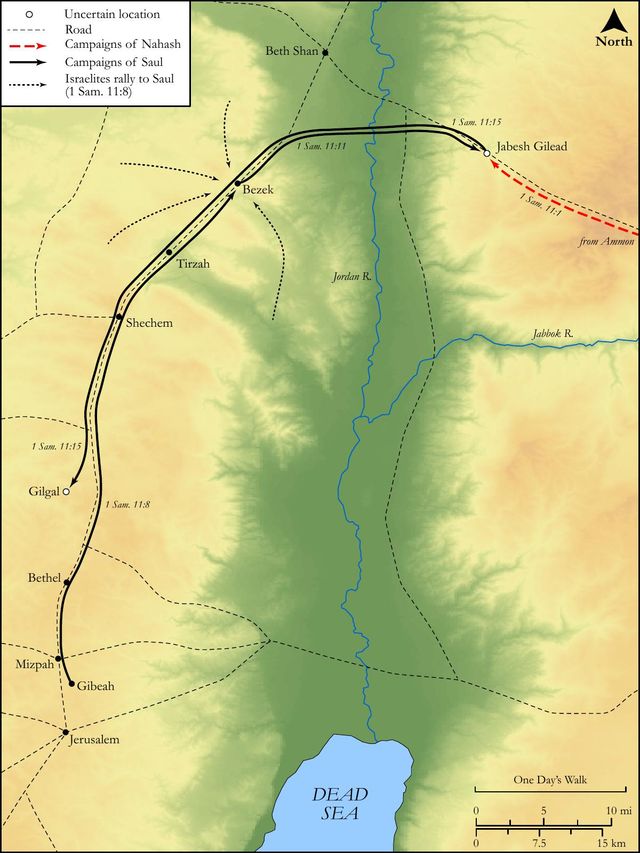
See on the biblical-era map
Study this verse
Public-domain commentary
Matthew Henry
From his Commentary on the Whole Bible. Henry comments on passages, not single verses — this entry covers 1 Samuel 11:12–15. His two-level outline is real structure in the source text, so it is rendered as structure.
We have here the improvement of the glorious victory which Saul had obtained, not the improvement of it abroad, though we take it for granted that the men of Jabesh-Gilead, having so narrowly saved their right eyes, would with them now discern the opportunity they had of avenging themselves upon these cruel enemies and disabling them from ever straitening them in like manner again; now shall they be avenged on the Ammonites for their right eyes condemned, as Samson on the Philistines for his two eyes put out, Jdg 16:28. But the account here given is of the improvement of this victory at home.
I.The people took this occasion to show their jealousy for the honour of Saul, and their resentment of the indignities done him.
Samuel, it seems, was present, if not in the action (it was too far for him to march) yet to meet them when they returned victorious; and to him, as judge, the motion was made (for they knew Saul would not be judge in his own cause) that the sons of Belial that would not have him to reign over them should be brought forth and slain, Sa1 11:12. Saul's good fortune (as foolish men commonly call it) went further with them to confirm his title than either his choice by lot or Samuel's anointing him. They had not courage thus to move for the prosecution of those that opposed him when he himself looked mean, but, now that his victory made him look great, nothing would serve but they must be put to death.
II.Saul took this occasion to give further proofs of his clemency, for, without waiting for Samuel's answer, he himself quashed the motion (Sa1 11:13): There shall not a man be put to death this day, no, not those men, those bad men, that had abused him, and therein reflected on God himself, 1. Because it was a day of joy and triumph: "To day the Lord has wrought salvation in Israel; and, since God has been so good to us all, let us not be harsh one to another. Now that God has made the heart of Israel in general so glad, let not us make sad the hearts of any particular Israelites." 2. Because he hoped they were by this day's work brought to a better temper, were now convinced that this man, under God, could save them, now honoured him whom before they had despised; and, if they are but reclaimed, he is secured from receiving any disturbance by them, and therefore his point is gained. If an enemy be made a friend, that will be more to our advantage than to have him slain. And all good princes consider that their power is for edification, not for destruction.
III.Samuel took this occasion to call the people together before the Lord in Gilgal, Sa1 11:14, Sa1 11:15.
1.That they might publicly give God thanks for their late victory. There they rejoiced greatly, and, that God might have the praise of that which they had the comfort of, they sacrificed to him, as the giver of all their successes, sacrifices of peace-offerings.
2.That they might confirm Saul in the government, more solemnly than had been yet done, that he might not retire again to his obscurity. Samuel would have the kingdom renewed; he would renew his resignation, and the people should renew their approbation, and so in concurrence with, or rather in attendance upon, the divine nomination, they made Saul king, making it their own act and deed to submit to him.
Historical interpretation
Historical reception
1 surviving comment on this verse from the historical church.
And the people said to Saul: Who is this who said? etc. When the Samaritans did not wish to receive the Lord, the sons of thunder said: Lord, do you want us to call fire to come down from heaven and consume them? And Jesus turned and rebuked them: You do not know of what spirit you are; The Son of Man did not come to destroy, but to save (Luke 9).
Continue studying 1 Samuel 11:12 across the web’s major study libraries — every link below opens this exact verse, chapter, or book on the destination site.
Read & Compare
 BibleGatewayThis verse in more than 200 translations and 70 languages.
 Bible.comThe YouVersion reader — hundreds of translations, reading plans, and highlights.
 ESV.orgCrossway's official English Standard Version reader.
 NET BibleThe NET translation with 60,000+ translators' notes on every rendering decision.
 STEP BibleTyndale House's free study tool — original text, vocabulary, and scholarly resources.
 BibliaLogos Bible Software's free web reader.
 USCCBThe New American Bible (Revised Edition) with the U.S. bishops' study notes.
Commentaries
 BibleHub CommentariesDozens of classic commentaries on this verse, gathered on one page.
 StudyLightMore than 100 commentary sets — the largest collection on the web.
 BibleRefPlain-English commentary on what this verse means, verse by verse.
 Enduring WordDavid Guzik's free commentary on this chapter, widely used by Bible teachers.
 Bible Study ToolsVerse commentary alongside Greek and Hebrew study aids.
Original Language & Research
- BibleHub InterlinearThe verse word by word — original language, transliteration, and English.
- BibleHub LexiconEvery word's original-language definition and Strong's entry.
 Blue Letter BibleDeep-study tools — Strong's numbers, concordance, and word studies.
 SefariaThe Hebrew text with Rashi and centuries of Jewish commentary.
Sermons, Hymns & Audio


TrulyRandomVerse is not affiliated with these sites and doesn’t control their content. They’re linked because they’re genuinely useful.
Summary
Following King Saul's decisive victory over Nahash the Ammonite, the Israelite people, now unified and emboldened by their deliverance, passionately address Samuel. They demand the identification and immediate execution of those individuals who had previously questioned and despised Saul's kingship, demonstrating a fervent, albeit impulsive, loyalty to their newly vindicated leader and a desire to purge any remaining opposition to his reign, reflecting the volatile nature of public sentiment in response to divine intervention.
Context
ShowHideLiterary Context
This verse immediately follows the dramatic account of Saul's initial military triumph over the Ammonites, detailed in 1 Samuel 11:1-11. Prior to this, Saul had been privately anointed by Samuel (1 Samuel 10:1) and publicly proclaimed king at Mizpah (1 Samuel 10:17-24). However, his kingship was not universally accepted; a group of "worthless fellows" had expressed contempt and refused to bring him tribute (1 Samuel 10:27). The victory over the Ammonites, empowered by the Spirit of God (1 Samuel 11:6), served as a powerful, divine validation of Saul's leadership, transforming popular opinion and setting the stage for the people's zealous demand for retribution against his former detractors. This sudden shift highlights the immediate impact of God's hand in establishing authority.
Historical & Cultural Context
The early Israelite monarchy emerged from a period of tribal disunity and constant external threats, as vividly illustrated by the Ammonite aggression against Jabesh-Gilead. The Ammonite demand to gouge out the right eyes of the city's inhabitants was a deliberate act of humiliation and incapacitation, reflecting the brutal nature of the warfare of that day, designed to render a population subservient and militarily ineffective. In this volatile context, a strong, unifying leader was desperately sought, and Saul's decisive action filled this vacuum. The people's demand for the execution of those who had rejected Saul aligns with a practice seen later in Israel's own history, where a new king's authority was consolidated through the swift elimination of opposition, as when Solomon put Adonijah, Joab, and Shimei to death. This act would serve as a public demonstration of loyalty and a powerful deterrent against future dissent, reflecting the intense communal honor-shame dynamics prevalent in the culture, where public affirmation or rejection carried profound social and political weight.
Key Themes
ShowHideThis verse is central to the theme of divine vindication of God's chosen leader. Saul's military success, clearly attributed to the Spirit of God, undeniably legitimizes his kingship in the eyes of the people, silencing the earlier opposition mentioned in 1 Samuel 10:27. It also highlights the theme of popular zeal and impulsiveness, demonstrating how quickly public sentiment can shift from skepticism to fervent, even vengeful, support when a charismatic leader achieves a visible triumph. This intense demand for retribution sets up a crucial contrast with Saul's subsequent display of mercy and magnanimity in 1 Samuel 11:13, underscoring the nature of true leadership that transcends immediate human desires for vengeance and aligns with a more profound, divinely inspired wisdom.
Exposition and Analysis
ShowHideKey Word Analysis
ShowHideFrom the primitive root H559, meaning "to say" with great latitude. In this verse, the root ʼâmar is used twice: first, to describe the collective voice of the people addressing Samuel, indicating their unified and passionate declaration; and second, to refer to those who "said, Shall Saul reign over us?", highlighting their verbal opposition. This word underscores the power of spoken word, whether in expressing loyalty or contempt, and its immediate impact on the socio-political landscape of Israel.
From the primitive root H4427, meaning "to reign" or "to ascend the throne." This word is central to the question posed by Saul's detractors: "Shall Saul reign over us?" It encapsulates the very essence of the dispute over Saul's legitimacy as king. The people's demand for retribution against those who questioned his ability to mâlak (reign) demonstrates their newfound conviction that his kingship is now divinely established and beyond dispute.
From the primitive root H4191, meaning "to die" or, causatively, "to kill." The phrase "put them to death" uses this root in its causative form, expressing an unequivocal and absolute demand for capital punishment. This stark and uncompromising language underscores the extreme emotional fervor and unified resolve of the populace, reflecting a desire for total eradication of opposition to their now-validated king, signifying the ultimate consequence for perceived treason against God's anointed.
Verse Breakdown
ShowHide"And the people said unto Samuel,"
This opening clause establishes the collective voice of "the people" (H5971, ʻam), indicating a unified and passionate public sentiment. Their address to Samuel (H8050, Shᵉmûwʼêl), the prophet who anointed Saul and served as a spiritual authority, highlights his continued mediating role between the populace and the newly established monarchy, and implicitly, between the people and God's will. It signifies a moment of national consensus and resolve.
"Who [is] he that said, Shall Saul reign over us?"
This rhetorical question is charged with indignation and serves as a direct accusation against those who had previously rejected Saul's leadership. It specifically references the "worthless fellows" from 1 Samuel 10:27, whose past contempt is now seen as an intolerable affront, especially in light of Saul's undeniable, God-given victory. The question implies a demand for accountability and severe punishment for such perceived treason against the newly established divine order.
"bring the men, that we may put them to death."
This command is the culmination of the people's outrage and newfound, zealous loyalty. It is a demand for immediate and ultimate justice, reflecting a desire to purge the nation of any disloyalty or challenge to the king's authority. The phrase "that we may put them to death" (H4191, mûwth) underscores their collective will to execute capital punishment, demonstrating the intensity of their fervor and their belief that such a drastic measure is warranted for those who dared to challenge God's chosen king, now divinely vindicated.
Literary Devices
ShowHideThe verse employs several potent literary devices that amplify its dramatic impact and theological significance. Dramatic Irony is profoundly evident as the very people who had been divided and some contemptuous of Saul's kingship now vehemently demand retribution against his former detractors, highlighting the volatile and often fickle nature of public opinion, swayed by immediate circumstances. The demand to "put them to death" can be interpreted as Hyperbole, an exaggerated expression of extreme loyalty and zeal, rather than a literal expectation of mass execution, though the intent for severe punishment is undeniably clear. This intense popular sentiment also serves as powerful Foreshadowing for Saul's noble and merciful response in the subsequent verse, setting up a profound Contrast between the people's vengeful impulse and the king's magnanimous, God-inspired wisdom, which ultimately elevates his leadership.
Theological and Thematic Connections
ShowHideThis verse vividly illustrates the volatile nature of human sentiment and the profound impact of divine vindication. The people's swift shift from skepticism and contempt to zealous, even vengeful, loyalty towards Saul underscores the human tendency to be swayed by immediate success and visible power. Theologically, it highlights how God, in His sovereignty, can use events like Saul's victory to confirm His chosen leader, silencing critics and establishing authority. However, it also raises crucial questions about the appropriate response to opposition, setting the stage for a demonstration of mercy that transcends immediate human impulses for retribution, aligning with a higher divine wisdom that values clemency over vengeance. This tension between human impulse and divine character is a recurring theme throughout biblical narrative.
Reflection and Application
ShowHideThe passionate demand of the Israelite people in 1 Samuel 11:12 serves as a timeless cautionary tale against the dangers of mob mentality and the impulsive pursuit of vengeance. While their newfound loyalty to Saul was understandable given his miraculous victory, their immediate call for capital punishment against dissenters reveals how easily collective emotion can override principles of justice, mercy, and due process. For believers today, this passage underscores the importance of exercising discernment, even when swept up in popular enthusiasm. It challenges us to reflect on our own reactions to those who oppose or criticize, reminding us that true strength and godly leadership often involve extending grace and forgiveness, rather than seeking retribution. Just as God vindicated Saul through his actions, we are called to trust in God's timing for vindication and to embody His character of mercy, rather than succumbing to the human desire for immediate, often harsh, justice. This narrative encourages us to cultivate a spirit of patience and long-suffering, even when our own convictions or those we support are challenged.
Questions for Reflection
ShowHideFAQ
ShowHideWhy were the people so eager to put these men to death?
ShowHideThe people's eagerness stemmed from a dramatic and immediate shift in public sentiment following Saul's decisive victory over the Ammonites. Prior to this triumph, a faction had openly questioned and despised Saul's kingship, refusing to acknowledge his authority (1 Samuel 10:27). Saul's military success, clearly empowered by the Spirit of God (1 Samuel 11:6), served as undeniable proof of his divine appointment and capability. The people, now unified and zealous in their support for their proven leader, viewed the previous dissenters as traitors who had defied God's chosen king. Their demand for execution was a passionate, albeit impulsive, expression of newfound loyalty and a desire to purge the nation of any perceived disloyalty, thereby solidifying Saul's reign through a display of severe, immediate justice. It was a reaction born of relief, vindication, and a desire for absolute unity under their newly confirmed king.
Christ-Centered Fulfillment
ShowHideThe people's fervent demand for retribution in 1 Samuel 11:12, born from Saul's vindication as king, finds its ultimate contrast and fulfillment in the kingship of Jesus Christ. Unlike Saul, who was a human king appointed by God and whose authority was initially questioned, Jesus is the eternal, divine King whose authority needed no earthly military victory to be established, though His resurrection served as the ultimate divine vindication of His claims and power (Romans 1:4). While the people of Israel sought to execute those who opposed their king, Jesus, the true King, came not to condemn the world but to save it (John 3:17). He did not demand the death of His detractors but rather offered His own life as a redemptive sacrifice for their sins (Mark 10:45). His reign is characterized by mercy, forgiveness, and reconciliation, extending grace even to those who reject and crucify Him (Luke 23:34). The ultimate "putting to death" under Christ's reign is the putting to death of sin and the old self, leading to new life in Him (Romans 6:6), rather than the physical execution of His enemies. He is the King who conquers not by vengeance, but by love and self-sacrifice, inviting all to enter His kingdom through repentance and faith, offering abundant life where the world demands death for opposition (John 10:10).