


Judges 11:13
Bible text: King James Version (1769 Blayney text) · Public domain
Bible text: King James Version with Strong's numbers · Public domain
Bible text: Berean Standard Bible · Public domain
Bible text: American Standard Version (1901) · Public domain
Bible text: World English Bible, Messianic edition · Public domain
Bible text: Geneva Bible (1599) · Public domain
Bible text: Young's Literal Translation · Public domain
- וַיֹּאמֶרvai·yo·Merand he saidH559Conj-w ¦ V-Qal-ConsecImperf-3msVerb Qal Consecutive Imperfect 3rd Singular Masculineוַandיֹּאמֶרhe said
- מֶלֶךְMe·lekh[the] king ofH4428N-mscNoun Singular Masculine Construct
- בְּנֵיbe·nei[the] people ofH1121N-mpcNoun Plural Masculine Construct
- עַמּוֹןa·MonAmmonH5983N-proper-mNoun Proper Masculine
- אֶל'eltoH413PrepPreposition
- מַלְאֲכֵיmal·'a·Khei[the] messengers ofH4397N-mpcNoun Plural Masculine Construct
- יִפְתָּחyif·TachJephthahH3316N-proper-mNoun Proper Masculine
- כִּיkithatH3588PrtParticle Conditional
- לָקַחla·Kachit tookH3947V-Qal-Perf-3msVerb Qal Perfect 3rd Singular Masculine
- יִשְׂרָאֵלYis·ra·'ElIsraelH3478N-properNoun Proper Location
- אֶת'et<obj.>H853DirObjMParticle Object Indicator
- אַרְצִי'ar·Tzimy landH776N-csc ¦ 1fsNoun Singular common gender Constructאַרְצִlandיmy
- בַּעֲלוֹתוֹba·'a·lo·Towhen came up itH5927Prep-b ¦ V-Qal-Inf ¦ 3msVerb Qal Infinitive Constructבַּwhenעֲלוֹתcame upוֹit
- מִמִּצְרַיִםmi·mitz·Ra·yimfrom EgyptH4714Prep-m ¦ N-properNoun Proper LocationמִfromמִּצְרַיִםEgypt
- מֵאַרְנוֹןme·'ar·Nonfrom [the] ArnonH769Prep-m ¦ N-properNoun Proper Locationמֵfromאַרְנוֹן[the] Arnon
- וְעַדve·'adand toH5704Conj-w ¦ PrepPrepositionוְandעַדto
- הַיַּבֹּקhai·ya·Bokthe JabbokH2999Art ¦ N-properNoun Proper LocationהַtheיַּבֹּקJabbok
- וְעַדve·'adand toH5704Conj-w ¦ PrepPrepositionוְandעַדto
- הַיַּרְדֵּןhai·yar·Denthe JordanH3383Art ¦ N-properNoun Proper LocationהַtheיַּרְדֵּןJordan
- וְעַתָּהve·'a·Tahand thereforeH6258Conj-w ¦ AdvAdverbוְandעַתָּהtherefore
- הָשִׁיבָהha·Shi·vahrestore !H7725V-Hiphil-Imp-2ms ¦ SfxVerb Hiphil Imperative 2nd Singular Masculineהָשִׁיבָrestoreה!
- אֶתְהֶן'et·Hen<obj.> themH853DirObjM ¦ 3fpParticle Object Indicatorאֶתְ<obj.>הֶןthem
- בְּשָׁלוֹםbe·sha·Lomin peaceH7965Prep-b ¦ N-msNoun Singular Masculine Absoluteבְּinשָׁלוֹםpeace
English is a literal word-by-word gloss of the Hebrew, not the KJV's wording. Why?
This is the original text the KJV's translators worked from — each Hebrew word with its own literal English meaning in this verse, prepared by scholars at Tyndale House, Cambridge. The KJV translates whole sentences, not word by word, so its wording differs: one Hebrew word can become several English words, and the KJV may choose “the LORD” where the gloss reads “Yahweh”. Both are faithful — they answer different questions. For the KJV's own rendering, switch to the KJV text.
Details
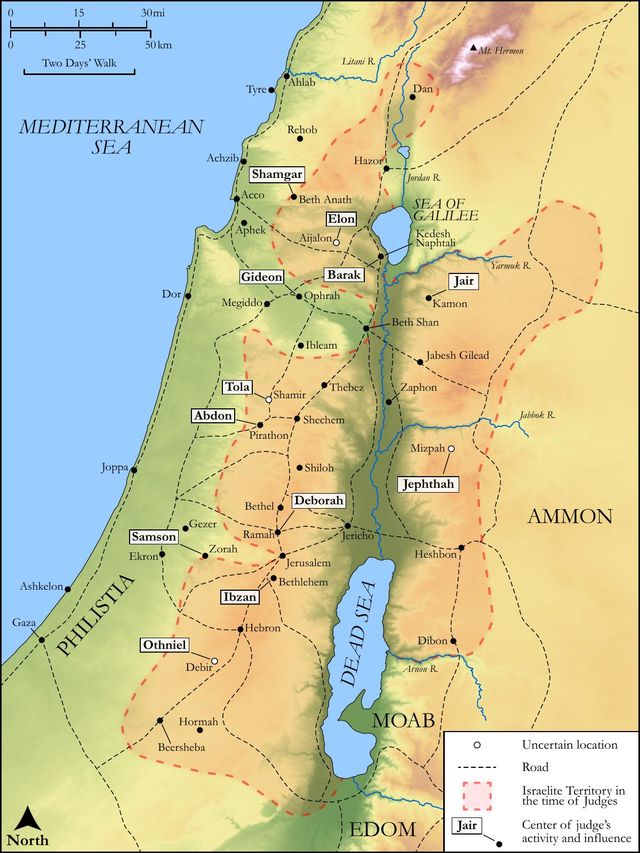
See on the biblical-era maps
Study this verse
Public-domain commentary
Matthew Henry
From his Commentary on the Whole Bible. Henry comments on passages, not single verses — this entry covers Judges 11:12–28. His two-level outline is real structure in the source text, so it is rendered as structure.
We have here the treaty between Jephthah, now judge of Israel, and the king of the Ammonites (who is not named), that the controversy between the two nations might, if possible, be accommodated without the effusion of blood.
I.Jephthah, as one having authority, sent to the king of Ammon, who in this war was the aggressor, to demand his reasons for invading the land of Israel: "Why hast thou come to fight against me in my land? Jdg 11:12. Had I come first into thy land to disturb thee in thy possession, this would have been reason enough for fighting against me, for how must force be repelled but by force? but what hast thou to do to come thus in a hostile manner into my land?" so he calls it, in the name both of God and Israel. Now this fair demand shows,
1.That Jephthah did not delight in war, though he was a mighty man of valour, but was willing to prevent it by a peaceable accommodation. If he could by reason persuade the invaders to retire, he would not compel them to do it by the sword. War should be the last remedy, not to be used till all other methods of ending matters in variance have been tried in vain, ratio ultima regum - the last resource of kings. This rule should be observed in going to law. The sword of justice, as well as the sword of war, must not be appealed to till the contending parties have first endeavoured by gentler means to understand one another, and to accommodate matters in variance, Co1 6:1.
2.That Jephthah did delight in equity, and designed no other than to do justice. If the children of Ammon could convince him that Israel had done them wrong, he was ready to restore the rights of the Ammonites. If not, it was plain by their invasion that they did Israel wrong, and he was ready to maintain the rights of the Israelites. A sense of justice should guide and govern us in all our undertakings.
II.The king of the Ammonites now gives in his demand, which he should have published before he had invaded Israel, Jdg 11:13.
His pretence is, "Israel took away my lands long since; now therefore restore those lands." We have reason to think the Ammonites, when they made this descent upon Israel, meant no other than to spoil and plunder the country, and enrich themselves with the prey, as they had done formerly under Eglon (Jdg 3:13) when no such demand as this was made, though the matter was then fresh; but when Jephthah demanded the cause of their quarrel, and they could not for shame own what was their true intent and meaning, some old musty records were searched, or some ancient traditions enquired into, and from them this reason was drawn to serve the present turn, for a colourable pretence of equity in the invasion. Even those that do the greatest wrong yet have such a conviction in their consciences of justice that they would seem to do right. Restore those lands. See upon what uncertain terms we hold our worldly possessions; what we think we have the surest hold of may be challenged from us, and wrested out of our hands. Those that have got to the heavenly Canaan need not fear having their titles questioned.
III.Jephthah gives in a very full and satisfactory answer to this demand, showing it to be altogether unjust and unreasonable, and that the Ammonites had no title to this country that lay between the rivers Arnon and Jabbok, now in the possession of the tribes of Reuben and Gad. As one very well versed in the history of his country, he shows,
1.That Israel never took any land away either from the Moabites or Ammonites. He puts them together because they were brethren, the children of Lot, near neighbours, and of united interests, having the same god, Chemosh, and perhaps sometimes the same king. The lands in question Israel took away, not from the Moabites or Ammonites (they had particular orders from God not to meddle with them nor any thing they had, Deu 2:9, Deu 2:19, and religiously observed their orders), but they found them in the possession of Sihon king of the Amorites, and out of his hand they took them justly and honourably, as he will show afterwards. If the Amorites, before Israel came into that country, had taken these lands from the Moabites or Ammonites, as it should seem they had (Num 21:26; Jos 13:25), Israel was not concerned to enquire into that or answer for it. If the Ammonites had lost these lands and their title to them, the children of Israel were under no obligation to recover the possession for them. Their business was to conquer for themselves, not for other people. This is his first plea, "Not guilty of the trespass."
2.That they were so far from invading the property of any other nations than the devoted posterity of cursed Canaan (one of the branches of which the Amorites were, Gen 10:16) that they would not so much as force a passage through the country either of the Edomites, the seed of Esau, or of the Moabites, the seed of Lot; but even after a very tedious march through the wilderness, with which they were sadly tired (Jdg 11:16), when the king of Edom first, and afterwards the king of Moab, denied them the courtesy of a way through their country (Jdg 11:17), rather than give them any offence or annoyance, weary as they were, they put themselves to the further fatigue of compassing both the land of Edom and that of Moab, and came not within the border of either, Jdg 11:18. Note, Those that behave themselves inoffensively may take the comfort of it, and plead it against those that charge them with injustice and wrong doing. Our righteousness will answer for us in time to come (Gen 30:33) and will put to silence the ignorance of foolish men, Pe1 2:15.
3.That in that war in which they took this land out of the hands of Sihon king of the Amorites he was the aggressor, and not they, Jdg 11:19, Jdg 11:20. They sent a humble petition to him for leave to go through his land, willing to give him any security for their good behaviour in their march. "Let us pass (say they) unto our place, that is, to the land of Canaan, which is the only place we call ours, and to which we are pressing forward, not designing a settlement here." But Sihon not only denied them this courtesy, as Edom and Moab had done (had he only done so, who knows but Israel might have gone about some other way?) but he mustered all his forces, and fought against Israel (Jdg 11:20), not only shut them out of his own land, but would have cut them off from the face of the earth (Num 21:23, Num 21:24), aimed at nothing less than their ruin, Jdg 11:20. Israel therefore, in their war with him, stood in their own just and necessary defence, and therefore, having routed his army, might justly, in further revenge of the injury, seize his country as forfeited. Thus Israel came to the possession of this country, and doubted not to make good their title to it; and it is very unreasonable for the Ammonites to question their title, for the Amorites were the inhabitants of that country, and it was purely their land and their coasts that the Israelites then made themselves masters of, Jdg 11:21, Jdg 11:22.
4.He pleads a grant from the crown, and claims under that, Jdg 11:23, Jdg 11:24. It was not Israel (they were fatigued with their long march, and were not fit for action so soon), but it was the Lord God of Israel, who is King of nations, whose the earth is and the fulness thereof, he it was that dispossessed the Amorites and planted Israel in their room. God gave them the land by an express and particular conveyance, such as vested the title in them, which they might make good against all the world. Deu 2:24, I have given into thy hand Sihon and his land; he gave it to them, by giving them a complete victory over the present occupants, notwithstanding the great disadvantages they were under. "Can you think that God gave it to us in such an extraordinary manner with design that we should return it to the Moabites or Ammonites again? No, we put a higher value upon God's favours than to part with them so easily." To corroborate this plea, he urges an argument ad hominem - directed to the man: Wilt not thou possess that which Chemosh thy god giveth thee? He not only appeals to the common resolutions of men to hold their own against all the world, but to the common religion of the nations, which, they thought, obliged them to make much of that which their gods gave them. Not that Jephthah thought Chemosh a god, only he is thy god, and the worshippers even of those dunghill deities that could do neither good nor evil yet thought themselves beholden to them for all they had (Hos 2:12, These are my rewards which my lovers have given me; and see Jdg 16:24) and made this a reason why they would hold it fast, that their gods gave it to them. "This thou thinkest a good title, and shall not we?" The Ammonites had dispossessed those that dwelt in their land before them; they thought they did it by the help of Chemosh their god, but really it was Jehovah the God of Israel that did it for them, as is expressly said, Deu 2:19, Deu 2:21. "Now," says Jephthah, "we have as good a title to our country as you have to yours." Note, One instance of the honour and respect we owe to God, as our God, is rightly to possess that which he gives us to possess, receive it from him, use it for him, keep it for his sake, and part with it when he calls for it. He has given it to us to possess, not to enjoy. He himself only must be enjoyed.
5.He pleads prescription. (1.) Their title had not been disputed when they first entered upon it, Jdg 11:25. "Balak who was then king of Moab, from whom the greatest part of these lands had been taken by the Amorites, and who was most concerned and best able to oppose us, if he had had any thing to object against our settlement there, yet sat still, and never offered to strive against Israel." He knew that for his own part he had fairly lost it to the Amorites and was not able to recover it, and could not but acknowledge that Israel had fairly won it of the Amorites, and therefore all his care was to secure what was left: he never pretended a title to what was lost. See Num 22:2, Num 22:3. "He then acquiesced in God's way of disposing of kingdoms, and wilt not thou now?" (2.) Their possession had never yet been disturbed, Jdg 11:26. He pleads that they had kept this country as their own now about 300 years, and the Ammonites in all that time had never attempted to take it from them, no, not when they had it in their power to oppress them, Jdg 3:13, Jdg 3:14. So that, supposing their title had not been clear at the first (which yet he had proved it was), yet, no claim having been made for so many generations, the entry of the children of Ammon, without doubt, was barred for ever. A title so long unquestioned shall be presumed unquestionable.
6.By these arguments Jephthah justifies himself and his own cause ("I have not sinned against thee in taking or keeping what I have no right to; if I had, I would instantly make restitution"), and condemns the Ammonites: "Thou doest me wrong to war against me, and must expect to speed accordingly," Jdg 11:27. It seems to me an evidence that the children of Israel, in the days of their prosperity and power (for some such days they had in the times of the judges) had conducted themselves very inoffensively to all their neighbours and had not been vexatious or oppressing to them (either by way of reprisal or under colour of propagating their religion), that the king of the Ammonites, when he would seek an occasion of quarrelling with them, was forced to look 300 years back for a pretence. It becomes the people of God thus to be blameless and harmless, and without rebuke.
7.For the deciding of the controversy, he puts himself upon God and his sword, and the king of Ammon joins issue with him (Jdg 11:27, Jdg 11:28): The Lord the Judge be judge this day. With this solemn reference of the matter to the Judge of heaven and earth he designs either to deter the Ammonites from proceeding and oblige them to retire, when they saw the right of the cause was against them, or to justify himself in subduing them if they should go on. Note, War is an appeal to heaven, to God the Judge of all, to whom the issues of it belong. If doubtful rights be disputed, he is hereby requested to determine them. If manifest rights be invaded or denied, he is hereby applied to for the vindicating of what is just and the punishing of wrong. As the sword of justice was made for lawless and disobedient persons (Ti1 1:9), so was the sword of war made for lawless and disobedient princes and nations. In war therefore the eye must be ever up to God, and it must always be thought a dangerous thing to desire or expect that God should patronise unrighteousness.
Neither Jephthah's apology, nor his appeal, wrought upon the king of the children of Ammon; they had found the sweets of the spoil of Israel, in the eighteen years wherein they had oppressed them (Jdg 10:8), and hoped now to make themselves masters of the tree with the fruit of which they had so often enriched themselves. He hearkened not to the words of Jephthah, his heart being hardened to his destruction.
Continue studying Judges 11:13 across the web’s major study libraries — every link below opens this exact verse, chapter, or book on the destination site.
Read & Compare
 BibleGatewayThis verse in more than 200 translations and 70 languages.
 Bible.comThe YouVersion reader — hundreds of translations, reading plans, and highlights.
 ESV.orgCrossway's official English Standard Version reader.
 NET BibleThe NET translation with 60,000+ translators' notes on every rendering decision.
 STEP BibleTyndale House's free study tool — original text, vocabulary, and scholarly resources.
 BibliaLogos Bible Software's free web reader.
 USCCBThe New American Bible (Revised Edition) with the U.S. bishops' study notes.
Commentaries
 BibleHub CommentariesDozens of classic commentaries on this verse, gathered on one page.
 StudyLightMore than 100 commentary sets — the largest collection on the web.
 BibleRefPlain-English commentary on what this verse means, verse by verse.
 Enduring WordDavid Guzik's free commentary on this chapter, widely used by Bible teachers.
 Bible Study ToolsVerse commentary alongside Greek and Hebrew study aids.
Original Language & Research
- BibleHub InterlinearThe verse word by word — original language, transliteration, and English.
- BibleHub LexiconEvery word's original-language definition and Strong's entry.
 Blue Letter BibleDeep-study tools — Strong's numbers, concordance, and word studies.
 SefariaThe Hebrew text with Rashi and centuries of Jewish commentary.
Sermons, Hymns & Audio


TrulyRandomVerse is not affiliated with these sites and doesn’t control their content. They’re linked because they’re genuinely useful.
Summary
Judges 11:13 captures the Ammonite king's calculated and confrontational reply to Jephthah's diplomatic overture, revealing the pretense for the impending military engagement. The king asserts that Israel unjustly seized his ancestral lands—specifically the fertile Transjordan territory stretching from the Arnon River to the Jabbok River, and extending to the Jordan—during their exodus from Egypt. This claim, demonstrably false from a historical perspective, serves as the Ammonite casus belli, culminating in a demand for the "peaceable" restoration of these lands, thereby framing the conflict as a matter of historical grievance and perceived injustice.
Context
ShowHideLiterary Context
This pivotal verse is situated within a critical diplomatic exchange (Judges 11:12-28) initiated by Jephthah, whom the Gileadites had reluctantly appointed as their leader against the escalating Ammonite threat (Judges 11:4-11). Jephthah, demonstrating strategic wisdom and a desire to avert bloodshed, sends messengers to the Ammonite king to ascertain the precise cause of their aggression. Judges 11:13 presents the king's direct, accusatory, and historically flawed response, which then prompts Jephthah's extensive and meticulously detailed historical and theological rebuttal in the subsequent verses (Judges 11:14-27). This exchange is central to the narrative, showcasing Jephthah's sagacity and his reliance on historical truth and divine sovereignty, which stands in stark contrast to the Ammonite king's distorted claims. The immediate literary context thus frames a conflict that is not merely one of military might, but fundamentally a clash of competing historical narratives and claims to divine favor and legitimate possession.
Historical & Cultural Context
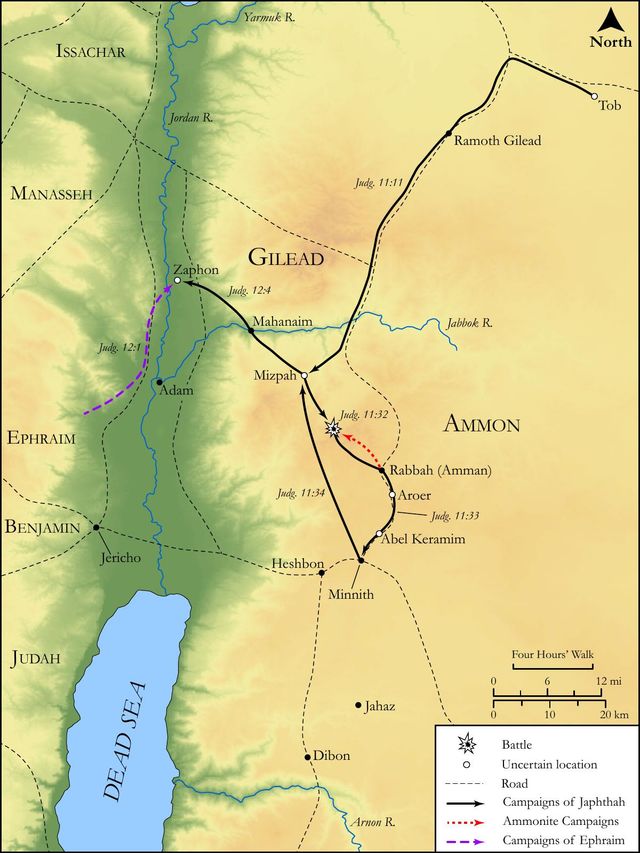
The disputed territory, defined as "from Arnon even unto Jabbok, and unto Jordan," refers to the strategically vital Transjordan region, east of the Jordan River. The Arnon River (modern Wadi Mujib) served as a significant natural boundary, historically separating Moab from the Amorite kingdom to its north, and later forming part of the southern border for Israel's tribes of Reuben and Gad. The Jabbok River (modern Nahr az-Zarqa), further north, marked the boundary between Ammon and the Amorites, and subsequently the northern extent of Gad's territory. The Ammonite king's assertion that Israel seized his land during their exodus is a deliberate and significant historical distortion. Historically, Israel conquered this land from Sihon, king of the Amorites, who had himself previously taken it from Moab (as detailed in Numbers 21:21-32). The Ammonites had no legitimate historical claim to this specific territory at the time of Israel's conquest. This practice of justifying territorial claims through selective, exaggerated, or fabricated historical narratives was a common diplomatic and military tactic among the nations, often serving as a casus belli for expansionist ambitions.
Key Themes
ShowHideJudges 11:13 powerfully highlights several enduring themes. Firstly, Territorial Disputes are presented as a primary catalyst for international conflict, illustrating how competing claims over land, historical grievances, and perceived injustices can ignite devastating wars between nations. The Ammonite king's demand for "restoration" frames the dispute as a matter of justice, albeit one founded on a false premise. Secondly, Misrepresentation of History emerges as a critical theme, as the Ammonite king's account is a clear and self-serving distortion of the actual events surrounding Israel's entry into the Transjordan. This underscores how narratives can be manipulated to legitimize aggression or demands, making the discernment of truth paramount for understanding and resolving conflict—a point Jephthah meticulously addresses in his comprehensive response (see Judges 11:14-27). Thirdly, the underlying theme of Divine Land Grant is implicitly challenged. Israel's possession of the land was rooted in God's covenantal promise and sovereign direction (e.g., Deuteronomy 1:8). The Ammonite king's demand directly assails this divinely ordained inheritance, setting up a profound clash between human ambition and divine decree, a tension that permeates the book of Judges and the broader Old Testament narrative of Israel's settlement in the promised land (e.g., Joshua 1:2-6).
Exposition and Analysis
ShowHideKey Word Analysis
ShowHideThis verb (H3947) implies seizure, taking possession, or even stealing. The Ammonite king employs it to accuse Israel of an act of unjust appropriation, framing their settlement as an act of theft rather than a divinely sanctioned conquest of land from the Amorites. It carries a strong connotation of illegitimacy and grievance, designed to cast Israel as the aggressor and justify Ammonite retaliation.
More than mere territory, 'erets (H776) here signifies a people's ancestral domain, their inheritance, and the very foundation of their national identity and security. The king's possessive claim to "my land" underscores the deep cultural, economic, and existential significance of land ownership among the nations round about, where control of territory was synonymous with power, prosperity, and national survival.
This verb (H7725) means to turn back, return, give back, or bring back. By demanding that Israel "restore" the lands, the Ammonite king positions himself as the rightful owner and Israel as the usurper. The demand for restoration, even "peaceably," carries the implicit threat of force if the demand is not met, making it a veiled ultimatum rather than a genuine offer of peaceful resolution.
Verse Breakdown
ShowHide"And the king of the children of Ammon answered unto the messengers of Jephthah,"
This opening clause formally establishes the diplomatic context, indicating that this is an official reply to Jephthah's inquiry. It highlights the gravity of the situation, as the king's words represent the official stance of the Ammonite nation, setting the stage for a potential large-scale conflict.
"Because Israel took away my land, when they came up out of Egypt,"
This is the core accusation, articulating the Ammonite king's justification for his aggressive posture. He grounds his claim in a specific historical event—Israel's exodus from Egypt—and accuses them of an unjust seizure of his territory. This statement forms the foundation of his grievance, despite its historical inaccuracies.
"from Arnon even unto Jabbok, and unto Jordan:"
This clause precisely specifies the geographical extent of the disputed territory. By naming these significant rivers, the king defines the exact boundaries of the land he claims was unjustly taken. This detail grounds the abstract claim in concrete, contested territory, emphasizing the vast scale and strategic importance of the land in question, which encompassed a significant portion of Israel's Transjordan inheritance.
"now therefore restore those [lands] again peaceably."
This concluding demand functions as an ultimatum. The phrase "now therefore" indicates a logical consequence derived from his accusation. The call to "restore... peaceably" is deeply ironic; it is a demand backed by the implicit threat of war if not met, presenting a false choice between capitulation and armed conflict.
Literary Devices
ShowHideJudges 11:13 skillfully employs several potent literary devices to convey its message and set the narrative's tone. Rhetoric is central, as the Ammonite king constructs a seemingly logical, albeit distorted, historical claim to justify his aggressive stance. His language is carefully chosen to frame Israel as the aggressor and himself as the aggrieved party, thereby legitimizing his demands. There is a profound element of Irony in the king's demand for the lands to be restored "peaceably" (Hebrew: shâlôwm, H7965), given that his very message is a declaration of intent to wage war if his terms are not met. This highlights the disingenuous nature of his "peace" offer and underscores the deceptive foundation of his claim. Geographical Specificity is used effectively by naming the Arnon, Jabbok, and Jordan rivers, which grounds the abstract territorial dispute in concrete, identifiable locations, emphasizing the real-world stakes and the vastness of the contested region. Finally, the verse sets up a clear Antithesis between the Ammonite king's false historical narrative and the true account that Jephthah will subsequently provide, establishing a thematic tension between truth and deception as fundamental drivers of conflict.
Theological and Thematic Connections
ShowHideJudges 11:13 serves as a stark illustration of how human ambition, distorted truth, and competing claims can ignite conflict, often directly challenging God's sovereign plan and promises. The Ammonite king's assertion of ownership over land that God had specifically designated for Israel, and which Israel had legitimately acquired from the Amorites, highlights the constant tension between human will and divine decree. It underscores the theological principle that God is the ultimate sovereign over all lands and nations, and His promises, particularly concerning Israel's inheritance, are inviolable. The king's demand is not merely a political grievance but, from a biblical perspective, an affront to God's established order and covenant with Israel. This verse implicitly calls believers to discern truth from falsehood, especially when claims are made that contradict God's revealed word or historical faithfulness.
Reflection and Application
ShowHideJudges 11:13 offers profound lessons for contemporary life, revealing how conflicts, whether personal, communal, or international, often stem from distorted narratives, historical grievances, and a lack of truth. The Ammonite king's self-serving reinterpretation of history demonstrates the pervasive human tendency to justify our desires or actions with incomplete, biased, or outright false information. This urges us to critically examine the narratives we encounter, especially those that seek to legitimize aggression or demand, and to cultivate a steadfast commitment to truth and accuracy. In our own relationships, how often do misunderstandings or disputes arise because we operate on partial information or a skewed version of events? The verse challenges us to seek the full and accurate context before making judgments or demands, fostering humility and a willingness to listen to opposing perspectives. Furthermore, it reminds us that while human claims and ambitions may clash, God's ultimate sovereignty and faithfulness to His promises remain unshaken. Our true peace and security ultimately rest not on human territorial claims, but on the unwavering truth of God's word and His divine providence, which transcends all earthly disputes.
Questions for Reflection
ShowHideFAQ
ShowHideWas the Ammonite king's claim historically accurate?
ShowHideNo, the Ammonite king's claim was emphatically not historically accurate. Jephthah's detailed response in Judges 11:14-28 meticulously clarifies the true history. Israel did not take land from the Ammonites. Instead, they conquered the land from Sihon, king of the Amorites, who had previously taken it from the Moabites. Furthermore, God had specifically commanded Israel not to harass or invade the Ammonites or Moabites (see Deuteronomy 2:9 and Deuteronomy 2:19), a command Israel faithfully respected. The Ammonite king's claim was therefore either a deliberate fabrication or a profound misunderstanding of historical events, strategically employed to justify his aggressive intentions against Israel.
What was the significance of the "Arnon," "Jabbok," and "Jordan" rivers in this claim?
ShowHideThese rivers were crucial geographical markers delineating the Transjordan region, a strategically important and fertile area east of the Jordan River. The Arnon River (Wadi Mujib) formed a significant natural boundary, historically separating Moab from the Amorites to the north, and later, the southern tribal territories of Reuben and Gad within Israel. The Jabbok River (Nahr az-Zarqa), further north, served as a boundary between Ammon and the Amorites, and subsequently, marked the northern extent of Gad's territory. The Jordan River formed the western boundary of this entire region, separating Transjordan from Canaan proper. By naming these specific and well-known rivers, the Ammonite king was claiming a vast and vital swath of land that encompassed the territories of Reuben, Gad, and half of Manasseh, which Israel had settled according to divine mandate. This geographical specificity underscored the scale of his demand and the perceived grievance, even though his underlying claim to the land was baseless and historically unfounded.
Christ-Centered Fulfillment
ShowHideThe territorial dispute in Judges 11:13, rooted in false claims, human ambition, and a desire for earthly dominion, finds its ultimate resolution and spiritual fulfillment in Jesus Christ. While the Ammonite king sought to reclaim a physical land, Christ offers an eternal inheritance, a spiritual "land" that cannot be taken away or disputed by any earthly power. The Old Testament narrative of Israel's promised land foreshadows the greater spiritual inheritance believers receive in Christ, who is the true heir of all things (e.g., Hebrews 1:2) and the one through whom we receive an inheritance (e.g., Ephesians 1:11). Just as the Ammonite king's claim was based on a lie, humanity's claim to self-sufficiency and independence from God is a fundamental deception that leads to spiritual estrangement. Christ, however, is the Truth (e.g., John 14:6), who exposes all false claims and establishes a kingdom founded on righteousness, justice, and unwavering truth. The "peace" (Hebrew: shâlôwm) demanded by the Ammonite king was conditional and elusive, a mere cessation of hostilities, but Christ is the Prince of Peace (e.g., Isaiah 9:6), who brings true and lasting peace between God and humanity through His atoning sacrifice (e.g., Romans 5:1, Colossians 1:20). He reclaims what was lost due to sin, not through military conquest, but through redemptive love and self-sacrifice, ushering believers into a spiritual inheritance that is incorruptible, undefiled, and unfading (e.g., 1 Peter 1:4). In Christ, the ultimate "land" is not a geographical territory, but a new creation and a reconciled relationship with God, where all true claims are validated and all false ones are rendered powerless before His sovereign reign.