


Judges 11:26
Bible text: King James Version (1769 Blayney text) · Public domain
Bible text: King James Version with Strong's numbers · Public domain
Bible text: Berean Standard Bible · Public domain
Bible text: American Standard Version (1901) · Public domain
Bible text: World English Bible, Messianic edition · Public domain
Bible text: Geneva Bible (1599) · Public domain
Bible text: Young's Literal Translation · Public domain
- בְּשֶׁבֶתbe·She·vetwhen dweltH3427Prep-b ¦ V-Qal-InfVerb Qal Infinitive Constructבְּwhenשֶׁבֶתdwelt
- יִשְׂרָאֵלYis·ra·'elIsraelH3478N-properNoun Proper Location
- בְּחֶשְׁבּוֹןbe·chesh·Bonin HeshbonH2809Prep-b ¦ N-properNoun Proper LocationבְּinחֶשְׁבּוֹןHeshbon
- וּבִבְנוֹתֶיהָu·viv·no·Tei·haand in its daughtersH1323Conj-w ¦ Prep-b ¦ N-fpc ¦ 3fsNoun Plural Feminine Constructוּandבִinבְנוֹתֶיdaughtersהָits
- וּבְעַרְעוֹרu·ve·'ar·'orand in AroerH6177Conj-w ¦ Prep-b ¦ N-properNoun Proper LocationוּandבְinעַרְעוֹרAroer
- וּבִבְנוֹתֶיהָu·viv·no·Tei·haand in its daughtersH1323Conj-w ¦ Prep-b ¦ N-fpc ¦ 3fsNoun Plural Feminine Constructוּandבִinבְנוֹתֶיdaughtersהָits
- וּבְכָלu·ve·Kholand in allH3605Conj-w ¦ Prep-b ¦ N-mscNoun Singular Masculine Constructוּandבְinכָלall
- הֶעָרִיםhe·'a·Rimthe citiesH5892Art ¦ N-mpNoun Plural Masculine Absoluteהֶtheעָרִיםcities
- אֲשֶׁר'a·SherwhichH834RelParticle Relative
- עַל'al[were] onH5921PrepPreposition
- יְדֵיye·Dei[the] sides ofH3027N-cdcNoun Dual common gender Construct
- אַרְנוֹן'ar·Non[the] ArnonH769N-properNoun Proper Location
- שְׁלֹשׁshe·LoshthreeH7969N-cscNoun Singular common gender Construct
- מֵאוֹתme·'othundred<s>H3967N-fpNoun Plural Feminine Absolute
- שָׁנָהsha·Nahyear[s]H8141N-fsNoun Singular Feminine Absolute
- וּמַדּוּעַu·ma·Du·a'and why?H4069Conj-w ¦ InterrogParticle Interrogativeוּandמַדּוּעַwhy?
- לֹאlo'notH3808NegParticle Negative
- הִצַּלְתֶּםhi·tzal·Temdid you recover [them]H5337V-Hiphil-Perf-2mpVerb Hiphil Perfect 2nd Plural Masculine
- בָּעֵתba·'Etat the timeH6256Prep-b ¦ N-csNoun Singular common gender Absoluteבָּat theעֵתtime
- הַהִיאha·Hi'<the> thatH1931Art ¦ Pro-3fsPronoun Personal 3rd Singular Feminineהַ<the>הִיאthat
English is a literal word-by-word gloss of the Hebrew, not the KJV's wording. Why?
This is the original text the KJV's translators worked from — each Hebrew word with its own literal English meaning in this verse, prepared by scholars at Tyndale House, Cambridge. The KJV translates whole sentences, not word by word, so its wording differs: one Hebrew word can become several English words, and the KJV may choose “the LORD” where the gloss reads “Yahweh”. Both are faithful — they answer different questions. For the KJV's own rendering, switch to the KJV text.
Details
See on the biblical-era maps
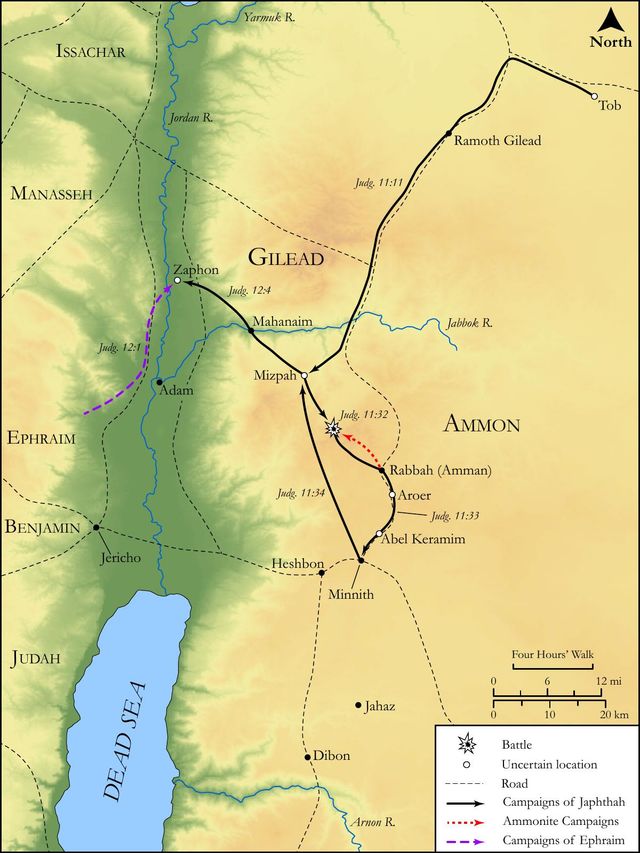
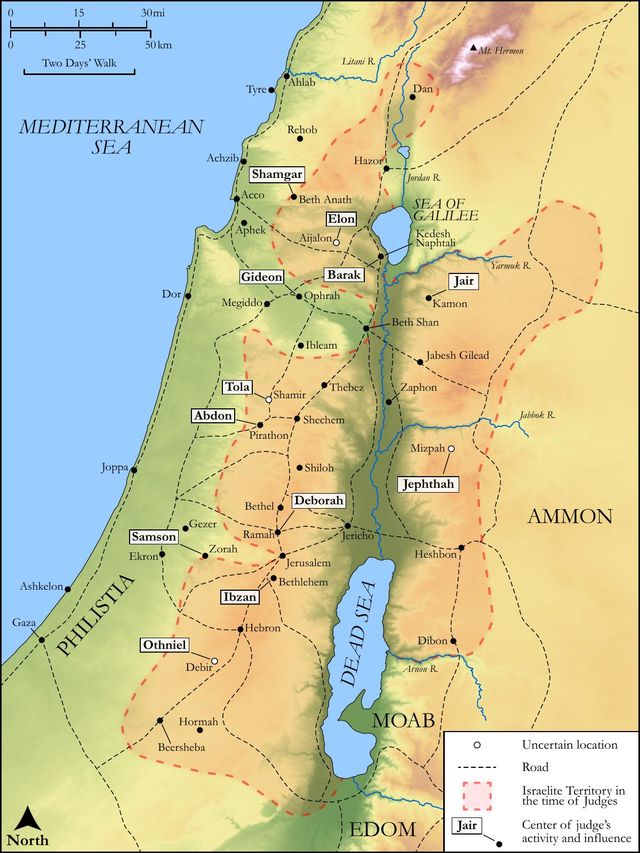
Study this verse
Public-domain commentary
Matthew Henry
From his Commentary on the Whole Bible. Henry comments on passages, not single verses — this entry covers Judges 11:12–28. His two-level outline is real structure in the source text, so it is rendered as structure.
We have here the treaty between Jephthah, now judge of Israel, and the king of the Ammonites (who is not named), that the controversy between the two nations might, if possible, be accommodated without the effusion of blood.
I.Jephthah, as one having authority, sent to the king of Ammon, who in this war was the aggressor, to demand his reasons for invading the land of Israel: "Why hast thou come to fight against me in my land? Jdg 11:12. Had I come first into thy land to disturb thee in thy possession, this would have been reason enough for fighting against me, for how must force be repelled but by force? but what hast thou to do to come thus in a hostile manner into my land?" so he calls it, in the name both of God and Israel. Now this fair demand shows,
1.That Jephthah did not delight in war, though he was a mighty man of valour, but was willing to prevent it by a peaceable accommodation. If he could by reason persuade the invaders to retire, he would not compel them to do it by the sword. War should be the last remedy, not to be used till all other methods of ending matters in variance have been tried in vain, ratio ultima regum - the last resource of kings. This rule should be observed in going to law. The sword of justice, as well as the sword of war, must not be appealed to till the contending parties have first endeavoured by gentler means to understand one another, and to accommodate matters in variance, Co1 6:1.
2.That Jephthah did delight in equity, and designed no other than to do justice. If the children of Ammon could convince him that Israel had done them wrong, he was ready to restore the rights of the Ammonites. If not, it was plain by their invasion that they did Israel wrong, and he was ready to maintain the rights of the Israelites. A sense of justice should guide and govern us in all our undertakings.
II.The king of the Ammonites now gives in his demand, which he should have published before he had invaded Israel, Jdg 11:13.
His pretence is, "Israel took away my lands long since; now therefore restore those lands." We have reason to think the Ammonites, when they made this descent upon Israel, meant no other than to spoil and plunder the country, and enrich themselves with the prey, as they had done formerly under Eglon (Jdg 3:13) when no such demand as this was made, though the matter was then fresh; but when Jephthah demanded the cause of their quarrel, and they could not for shame own what was their true intent and meaning, some old musty records were searched, or some ancient traditions enquired into, and from them this reason was drawn to serve the present turn, for a colourable pretence of equity in the invasion. Even those that do the greatest wrong yet have such a conviction in their consciences of justice that they would seem to do right. Restore those lands. See upon what uncertain terms we hold our worldly possessions; what we think we have the surest hold of may be challenged from us, and wrested out of our hands. Those that have got to the heavenly Canaan need not fear having their titles questioned.
III.Jephthah gives in a very full and satisfactory answer to this demand, showing it to be altogether unjust and unreasonable, and that the Ammonites had no title to this country that lay between the rivers Arnon and Jabbok, now in the possession of the tribes of Reuben and Gad. As one very well versed in the history of his country, he shows,
1.That Israel never took any land away either from the Moabites or Ammonites. He puts them together because they were brethren, the children of Lot, near neighbours, and of united interests, having the same god, Chemosh, and perhaps sometimes the same king. The lands in question Israel took away, not from the Moabites or Ammonites (they had particular orders from God not to meddle with them nor any thing they had, Deu 2:9, Deu 2:19, and religiously observed their orders), but they found them in the possession of Sihon king of the Amorites, and out of his hand they took them justly and honourably, as he will show afterwards. If the Amorites, before Israel came into that country, had taken these lands from the Moabites or Ammonites, as it should seem they had (Num 21:26; Jos 13:25), Israel was not concerned to enquire into that or answer for it. If the Ammonites had lost these lands and their title to them, the children of Israel were under no obligation to recover the possession for them. Their business was to conquer for themselves, not for other people. This is his first plea, "Not guilty of the trespass."
2.That they were so far from invading the property of any other nations than the devoted posterity of cursed Canaan (one of the branches of which the Amorites were, Gen 10:16) that they would not so much as force a passage through the country either of the Edomites, the seed of Esau, or of the Moabites, the seed of Lot; but even after a very tedious march through the wilderness, with which they were sadly tired (Jdg 11:16), when the king of Edom first, and afterwards the king of Moab, denied them the courtesy of a way through their country (Jdg 11:17), rather than give them any offence or annoyance, weary as they were, they put themselves to the further fatigue of compassing both the land of Edom and that of Moab, and came not within the border of either, Jdg 11:18. Note, Those that behave themselves inoffensively may take the comfort of it, and plead it against those that charge them with injustice and wrong doing. Our righteousness will answer for us in time to come (Gen 30:33) and will put to silence the ignorance of foolish men, Pe1 2:15.
3.That in that war in which they took this land out of the hands of Sihon king of the Amorites he was the aggressor, and not they, Jdg 11:19, Jdg 11:20. They sent a humble petition to him for leave to go through his land, willing to give him any security for their good behaviour in their march. "Let us pass (say they) unto our place, that is, to the land of Canaan, which is the only place we call ours, and to which we are pressing forward, not designing a settlement here." But Sihon not only denied them this courtesy, as Edom and Moab had done (had he only done so, who knows but Israel might have gone about some other way?) but he mustered all his forces, and fought against Israel (Jdg 11:20), not only shut them out of his own land, but would have cut them off from the face of the earth (Num 21:23, Num 21:24), aimed at nothing less than their ruin, Jdg 11:20. Israel therefore, in their war with him, stood in their own just and necessary defence, and therefore, having routed his army, might justly, in further revenge of the injury, seize his country as forfeited. Thus Israel came to the possession of this country, and doubted not to make good their title to it; and it is very unreasonable for the Ammonites to question their title, for the Amorites were the inhabitants of that country, and it was purely their land and their coasts that the Israelites then made themselves masters of, Jdg 11:21, Jdg 11:22.
4.He pleads a grant from the crown, and claims under that, Jdg 11:23, Jdg 11:24. It was not Israel (they were fatigued with their long march, and were not fit for action so soon), but it was the Lord God of Israel, who is King of nations, whose the earth is and the fulness thereof, he it was that dispossessed the Amorites and planted Israel in their room. God gave them the land by an express and particular conveyance, such as vested the title in them, which they might make good against all the world. Deu 2:24, I have given into thy hand Sihon and his land; he gave it to them, by giving them a complete victory over the present occupants, notwithstanding the great disadvantages they were under. "Can you think that God gave it to us in such an extraordinary manner with design that we should return it to the Moabites or Ammonites again? No, we put a higher value upon God's favours than to part with them so easily." To corroborate this plea, he urges an argument ad hominem - directed to the man: Wilt not thou possess that which Chemosh thy god giveth thee? He not only appeals to the common resolutions of men to hold their own against all the world, but to the common religion of the nations, which, they thought, obliged them to make much of that which their gods gave them. Not that Jephthah thought Chemosh a god, only he is thy god, and the worshippers even of those dunghill deities that could do neither good nor evil yet thought themselves beholden to them for all they had (Hos 2:12, These are my rewards which my lovers have given me; and see Jdg 16:24) and made this a reason why they would hold it fast, that their gods gave it to them. "This thou thinkest a good title, and shall not we?" The Ammonites had dispossessed those that dwelt in their land before them; they thought they did it by the help of Chemosh their god, but really it was Jehovah the God of Israel that did it for them, as is expressly said, Deu 2:19, Deu 2:21. "Now," says Jephthah, "we have as good a title to our country as you have to yours." Note, One instance of the honour and respect we owe to God, as our God, is rightly to possess that which he gives us to possess, receive it from him, use it for him, keep it for his sake, and part with it when he calls for it. He has given it to us to possess, not to enjoy. He himself only must be enjoyed.
5.He pleads prescription. (1.) Their title had not been disputed when they first entered upon it, Jdg 11:25. "Balak who was then king of Moab, from whom the greatest part of these lands had been taken by the Amorites, and who was most concerned and best able to oppose us, if he had had any thing to object against our settlement there, yet sat still, and never offered to strive against Israel." He knew that for his own part he had fairly lost it to the Amorites and was not able to recover it, and could not but acknowledge that Israel had fairly won it of the Amorites, and therefore all his care was to secure what was left: he never pretended a title to what was lost. See Num 22:2, Num 22:3. "He then acquiesced in God's way of disposing of kingdoms, and wilt not thou now?" (2.) Their possession had never yet been disturbed, Jdg 11:26. He pleads that they had kept this country as their own now about 300 years, and the Ammonites in all that time had never attempted to take it from them, no, not when they had it in their power to oppress them, Jdg 3:13, Jdg 3:14. So that, supposing their title had not been clear at the first (which yet he had proved it was), yet, no claim having been made for so many generations, the entry of the children of Ammon, without doubt, was barred for ever. A title so long unquestioned shall be presumed unquestionable.
6.By these arguments Jephthah justifies himself and his own cause ("I have not sinned against thee in taking or keeping what I have no right to; if I had, I would instantly make restitution"), and condemns the Ammonites: "Thou doest me wrong to war against me, and must expect to speed accordingly," Jdg 11:27. It seems to me an evidence that the children of Israel, in the days of their prosperity and power (for some such days they had in the times of the judges) had conducted themselves very inoffensively to all their neighbours and had not been vexatious or oppressing to them (either by way of reprisal or under colour of propagating their religion), that the king of the Ammonites, when he would seek an occasion of quarrelling with them, was forced to look 300 years back for a pretence. It becomes the people of God thus to be blameless and harmless, and without rebuke.
7.For the deciding of the controversy, he puts himself upon God and his sword, and the king of Ammon joins issue with him (Jdg 11:27, Jdg 11:28): The Lord the Judge be judge this day. With this solemn reference of the matter to the Judge of heaven and earth he designs either to deter the Ammonites from proceeding and oblige them to retire, when they saw the right of the cause was against them, or to justify himself in subduing them if they should go on. Note, War is an appeal to heaven, to God the Judge of all, to whom the issues of it belong. If doubtful rights be disputed, he is hereby requested to determine them. If manifest rights be invaded or denied, he is hereby applied to for the vindicating of what is just and the punishing of wrong. As the sword of justice was made for lawless and disobedient persons (Ti1 1:9), so was the sword of war made for lawless and disobedient princes and nations. In war therefore the eye must be ever up to God, and it must always be thought a dangerous thing to desire or expect that God should patronise unrighteousness.
Neither Jephthah's apology, nor his appeal, wrought upon the king of the children of Ammon; they had found the sweets of the spoil of Israel, in the eighteen years wherein they had oppressed them (Jdg 10:8), and hoped now to make themselves masters of the tree with the fruit of which they had so often enriched themselves. He hearkened not to the words of Jephthah, his heart being hardened to his destruction.
Continue studying Judges 11:26 across the web’s major study libraries — every link below opens this exact verse, chapter, or book on the destination site.
Read & Compare
 BibleGatewayThis verse in more than 200 translations and 70 languages.
 Bible.comThe YouVersion reader — hundreds of translations, reading plans, and highlights.
 ESV.orgCrossway's official English Standard Version reader.
 NET BibleThe NET translation with 60,000+ translators' notes on every rendering decision.
 STEP BibleTyndale House's free study tool — original text, vocabulary, and scholarly resources.
 BibliaLogos Bible Software's free web reader.
 USCCBThe New American Bible (Revised Edition) with the U.S. bishops' study notes.
Commentaries
 BibleHub CommentariesDozens of classic commentaries on this verse, gathered on one page.
 StudyLightMore than 100 commentary sets — the largest collection on the web.
 BibleRefPlain-English commentary on what this verse means, verse by verse.
 Enduring WordDavid Guzik's free commentary on this chapter, widely used by Bible teachers.
 Bible Study ToolsVerse commentary alongside Greek and Hebrew study aids.
Original Language & Research
- BibleHub InterlinearThe verse word by word — original language, transliteration, and English.
- BibleHub LexiconEvery word's original-language definition and Strong's entry.
 Blue Letter BibleDeep-study tools — Strong's numbers, concordance, and word studies.
 SefariaThe Hebrew text with Rashi and centuries of Jewish commentary.
Sermons, Hymns & Audio


TrulyRandomVerse is not affiliated with these sites and doesn’t control their content. They’re linked because they’re genuinely useful.
Summary
Judges 11:26 is a crucial component of Jephthah's diplomatic and theological argument to the Ammonite king, asserting Israel's legitimate claim to the disputed territories east of the Jordan River. In this verse, Jephthah highlights the remarkable fact that Israel had continuously occupied cities like Heshbon, Aroer, and all the cities along the Arnon River for three hundred years. He then poses a powerful rhetorical question, challenging the Ammonite king to justify why, if the land was truly theirs, they had not attempted to reclaim it during this extensive period of Israelite possession. This verse serves as a historical and legal cornerstone of Israel's right to the land, underscoring the baselessness of the Ammonite's sudden and aggressive demands.
Context
ShowHideLiterary Context
Judges 11:26 is situated within a pivotal diplomatic exchange (Judges 11:12-28) between Jephthah, the newly appointed judge and military leader of Israel, and the Ammonite king. The Ammonites had initiated hostilities, claiming that Israel had unlawfully seized their ancestral lands during the Exodus. Jephthah, demonstrating remarkable statesmanship and theological acumen, dispatches messengers to refute this claim. His elaborate argument systematically traces Israel's historical journey, emphasizing that they did not conquer Ammonite territory but rather defeated Sihon, king of the Amorites, who had previously taken the land from Moab. The land in question was then divinely granted to Israel. This verse forms the climax of Jephthah's historical evidence, using the long duration of Israel's undisputed occupation as irrefutable proof against the Ammonite's recent aggression. The preceding verses detail Israel's victory over Sihon and their subsequent peaceful settlement in his former domain, which included the very cities the Ammonites now contested.
Historical & Cultural Context
The era of the Judges (approximately 14th-11th centuries BCE) was a turbulent period marked by cycles of Israelite apostasy, foreign oppression, and divine deliverance through divinely appointed judges. Among Israel and its neighbours, land ownership and territorial claims were often established through conquest, divine decree, or long-standing, undisputed occupation. The Ammonites, a Transjordanian people related to Israel through Lot (Genesis 19:38), were frequent adversaries. Their claim to the land east of the Jordan was based on a distorted historical narrative, asserting that Israel had taken their ancestral lands. Jephthah's detailed historical rebuttal was not merely a diplomatic maneuver but a legal and theological defense, appealing to established principles of international law and divine right. The specific mention of Heshbon, Aroer, and the Arnon River identifies strategic locations that had been under Israelite control since the time of Moses, as documented in foundational texts like Numbers 21:21-35 and Deuteronomy 2:26-37. The "three hundred years" signifies a period far exceeding any customary statute of limitations for challenging land claims, rendering the Ammonite king's sudden demand baseless and opportunistic.
Key Themes
ShowHideJudges 11:26 powerfully contributes to several overarching themes within the book of Judges and the broader Old Testament narrative. Firstly, it underscores the theme of Divine Sovereignty and Land Grant. Jephthah's argument is fundamentally theological: the land was not taken from Ammon, but from Sihon, and it was given to Israel by Yahweh, their God, who is superior to the Ammonite deity Chemosh (Judges 11:21-24). This echoes the foundational promise to Abraham and the subsequent covenantal grant of the land to Israel (Genesis 12:7; Deuteronomy 1:8). Secondly, it highlights the theme of Historical Precedent and Legitimate Possession. The "three hundred years" of continuous occupation serves as irrefutable evidence of Israel's established claim, appealing to a principle of customary law where long-term, undisputed possession validates ownership. This historical argument is a cornerstone of Israel's identity and their right to the land. Finally, the verse exemplifies Justice and Rhetorical Argumentation. Jephthah's pointed rhetorical question exposes the inherent weakness and injustice of the Ammonite claim, challenging their logic and moral standing. It demonstrates how historical truth, coupled with divine backing, forms the basis for a righteous defense against aggression and oppression.
Exposition and Analysis
ShowHideKey Word Analysis
ShowHideThis verb, derived from a primitive root meaning "to sit down," implies more than just temporary presence. In this context, it signifies "to settle," "to remain," and "to inhabit." It emphasizes the continuous, established, and long-term presence of Israel in these territories. This suggests that Israel had not merely passed through but had built homes, cultivated land, established communities, and lived a permanent way of life for centuries, thereby solidifying their claim of legitimate possession.
This precise chronological marker is profoundly significant. It is not an approximation but a deliberate statement of the vast duration of Israel's occupation. This period, from the conquest under Moses and Joshua to Jephthah's time, serves as a powerful legal and historical argument, indicating undisputed possession that far exceeds any ancient statute of limitations for challenging land claims. It underscores the absurdity and opportunistic nature of the Ammonites' belated demands, as such a long period of peaceable possession typically established unassailable rights.
This primitive root means "to snatch away," "to deliver," or "to rescue." In Jephthah's rhetorical question, "why therefore did ye not recover [them] within that time?", it carries the sense of "to reclaim" or "to take back" what is purportedly one's own. Jephthah challenges the Ammonites' historical inaction. If the land was truly theirs by right, their failure to attempt to reclaim it at any point during Israel's three centuries of occupation implies that their current claim is baseless, opportunistic, and lacks genuine historical or legal foundation.
Verse Breakdown
ShowHide"While Israel dwelt in Heshbon and her towns, and in Aroer and her towns, and in all the cities that [be] along by the coasts of Arnon, three hundred years?"
This clause establishes the indisputable fact of Israel's long-term, continuous, and peaceful occupation of specific, well-known territories east of the Jordan. Heshbon was the capital of Sihon, the Amorite king, and Aroer was a key city on the northern bank of the Arnon River, marking the traditional southern boundary of Israelite Transjordan. The phrase "all the cities that [be] along by the coasts of Arnon" further defines the precise extent of this territory. The explicit mention of "three hundred years" serves as the core of Jephthah's historical argument, emphasizing the profound duration of Israel's legitimate presence and the established nature of their claim.
"why therefore did ye not recover [them] within that time?"
This is a powerful rhetorical question that serves as the climax of Jephthah's argument. It directly challenges the Ammonite king's logic and exposes the inherent weakness and injustice of his claim. If the land truly belonged to Ammon, their failure to reclaim it for three centuries renders their current aggression baseless and unjustifiable. It implies that their present claim is an opportunistic invasion driven by greed or power, rather than a legitimate recovery of ancestral lands, thereby undermining their moral and legal standing.
Literary Devices
ShowHideJudges 11:26 powerfully employs Rhetorical Question as its primary literary device. Jephthah's pointed query, "why therefore did ye not recover [them] within that time?", is not posed to elicit information but to make an emphatic point and expose the logical fallacy and moral bankruptcy of the Ammonite king's position. This question serves as a crushing counter-argument, highlighting the absurdity of a claim that has been left unchallenged for three centuries. Furthermore, the verse utilizes Historical Argumentation, grounding its claim in verifiable facts of long-term, continuous occupation. This reliance on historical precedent and the passage of time lends a strong sense of legal and moral authority to Jephthah's defense. The specific naming of cities like Heshbon and Aroer, along with the Arnon River, also employs Geographical Specificity, lending concrete detail and undeniable reality to Israel's historical presence in the region, making Jephthah's argument all the more compelling and difficult to refute.
Theological and Thematic Connections
ShowHideJudges 11:26 profoundly underscores the theological truth that God's promises and grants are enduring and legitimate, even when challenged by human adversaries. Jephthah's argument for Israel's right to the land is not merely based on human conquest or long occupation, but fundamentally on the divine grant by Yahweh, the true God, in contrast to Chemosh, the Ammonite deity (Judges 11:24). This highlights the sovereignty of God over nations and territories, and His unwavering faithfulness to His covenant promises to Israel. The "three hundred years" serves as a testament to God's sustained presence and blessing upon His people, even through periods of unfaithfulness, demonstrating His long-suffering patience and the enduring nature of His divine decrees. The verse implicitly teaches that divine truth, once established, is not subject to human whims or opportunistic challenges, and that God's people are called to stand firm on the truths He has revealed and the inheritance He has provided.
Reflection and Application
ShowHideJephthah's steadfast defense of Israel's inheritance, rooted in historical fact and divine decree, offers a powerful paradigm for believers today. In a world constantly challenging truth and seeking to erode established foundations, we are called to stand firm on the enduring promises and truths of God's Word. Just as Israel's long occupation validated their claim, the enduring nature of God's faithfulness throughout history provides an unshakable foundation for our faith. We possess a spiritual inheritance in Christ, not earned by our merit but granted by divine grace, which no adversary can legitimately reclaim or nullify. This verse encourages us to be well-versed in the "history" of God's redemptive work, understanding the long-standing nature of His covenant with humanity, culminating in Christ. When faced with spiritual attacks, doubts, or worldly philosophies that seek to undermine our faith or identity in Christ, we can draw strength from the irrefutable evidence of God's unchanging character and His eternal purposes. We are to "recover" and boldly proclaim the truth of our spiritual possession, refusing to yield ground to the enemy's baseless claims, remembering that our citizenship is in heaven and our inheritance is secure.
Questions for Reflection
ShowHideFAQ
ShowHideWhy is the "three hundred years" so important in Jephthah's argument?
ShowHideThe "three hundred years" is critically important because it represents an extraordinary period of undisputed possession, far exceeding any customary statute of limitations for challenging land claims. In a culture where land ownership was often established by conquest and maintained through continuous occupation, three centuries of settled presence provided irrefutable proof of Israel's legitimate claim. Jephthah's rhetorical question, "why therefore did ye not recover [them] within that time?", highlights the absurdity of the Ammonite king's sudden demand. It implies that if the land truly belonged to Ammon, they would have attempted to reclaim it much earlier. This long duration effectively nullifies any historical basis for the Ammonite's claim, demonstrating that their aggression is an opportunistic invasion rather than a righteous recovery of ancestral lands. It underscores the principle that long-term, peaceful possession often establishes a valid right to property, especially when that possession is rooted in a divine grant, as Jephthah asserts throughout his argument in Judges 11.
Christ-Centered Fulfillment
ShowHideWhile Judges 11:26 primarily functions as a historical and legal argument within the Old Testament narrative, it finds profound Christ-centered fulfillment in the ultimate and eternal inheritance secured for believers through Jesus Christ. Just as Israel's claim to the land was based on a divine grant and long-standing possession, so too is the believer's spiritual inheritance in Christ. Through His atoning work, Jesus, the true Lamb of God who takes away the sin of the world, has secured for us an inheritance that is "imperishable, undefiled, and unfading, kept in heaven for you" (1 Peter 1:4). This inheritance is not subject to human claims or the passage of time; it is guaranteed by the eternal covenant established in His blood. The "three hundred years" of Israel's temporal possession foreshadows the eternal nature of the believer's spiritual dwelling in Christ, where we are made "fellow citizens with the saints and members of the household of God" (Ephesians 2:19). Our "possession" in Christ is not merely a temporary dwelling but an eternal reality, rooted in the finished work of the One who has conquered all adversaries and secured our place in the heavenly realms (Ephesians 1:3). We are heirs according to the promise (Galatians 3:29), and no power, seen or unseen, can "recover" what Christ has eternally granted us, for He holds all authority in heaven and on earth (Matthew 28:18).