


Judges 3:11
- וַתִּשְׁקֹטva·tish·Kotand it was at peaceH8252Conj-w ¦ V-Qal-ConsecImperf-3fsVerb Qal Consecutive Imperfect 3rd Singular Feminineוַandתִּשְׁקֹטit was at peace
- הָאָרֶץha·'A·retzthe landH776Art ¦ N-fsNoun Singular Feminine Absoluteהָtheאָרֶץland
- אַרְבָּעִים'ar·ba·'ImfortyH705N-mpNoun Plural Masculine Absolute
- שָׁנָהsha·Nahyear[s]H8141N-fsNoun Singular Feminine Absolute
- וַיָּמָתvai·Ya·motand he diedH4191Conj-w ¦ V-Qal-ConsecImperf-3msVerb Qal Consecutive Imperfect 3rd Singular Masculineוַandיָּמָתhe died
- עָתְנִיאֵל'a·te·ni·'ElOthnielH6274N-proper-mNoun Proper Masculine
- בֶּןben[the] son ofH1121N-mscNoun Singular Masculine Construct
- קְנַזke·NazKenazH7073N-proper-mNoun Proper Masculine
English is a literal word-by-word gloss of the Hebrew, not the KJV's wording. Why?
This is the original text the KJV's translators worked from — each Hebrew word with its own literal English meaning in this verse, prepared by scholars at Tyndale House, Cambridge. The KJV translates whole sentences, not word by word, so its wording differs: one Hebrew word can become several English words, and the KJV may choose “the LORD” where the gloss reads “Yahweh”. Both are faithful — they answer different questions. For the KJV's own rendering, switch to the KJV text.
Details
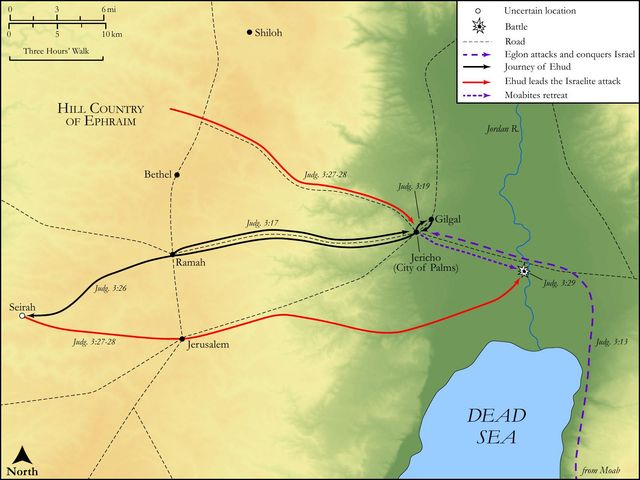
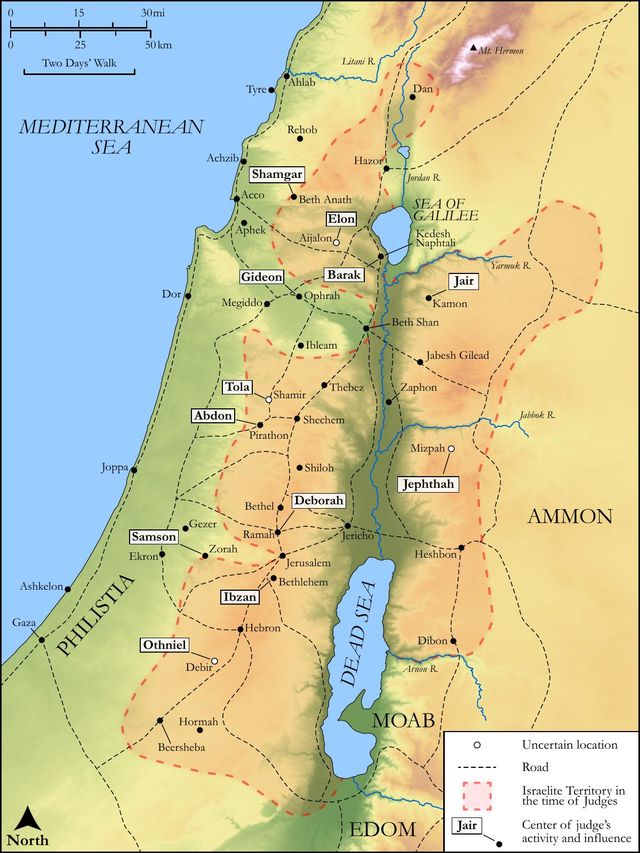
See on the biblical-era maps
Study this verse
Public-domain commentary
Matthew Henry
From his Commentary on the Whole Bible. Henry comments on passages, not single verses — this entry covers Judges 3:8–11. His two-level outline is real structure in the source text, so it is rendered as structure.
We now come to the records of the government of the particular judges, the first of which was Othniel, in whom the story of this book is knit to that of Joshua, for even in Joshua's time Othniel began to be famous, by which it appears that it was not long after Israel's settlement in Canaan before their purity began to be corrupted and their peace (by consequence) disturbed. And those who have taken pains to enquire into the sacred chronology are generally agreed that the Danites' idolatry, and the war with the Benjamites for abusing the Levite's concubine, though related in the latter end of this book, happened about this time, under or before the government of Othniel, who, though a judge, was not such a king in Israel as would keep men from doing what was right in their own eyes. In this short narrative of Othniel's government we have,
I.The distress that Israel was brought into for their sin, Jdg 3:8.
God being justly displeased with them for plucking up the hedge of their peculiarity, and laying themselves in common with the nations, plucked up the hedge of their protection and laid them open to the nations, set them to sale as goods he would part with, and the first that laid hands on them was Chushan-rishathaim, king of that Syria which lay between the two great rivers of Tigris and Euphrates, thence called Mesopotamia, which signifies in the midst of rivers. It is probable that this was a warlike prince, and, aiming to enlarge his dominions, he invaded the two tribes first on the other side Jordan that lay next him, and afterwards, perhaps by degrees, penetrated into the heart of the country, and as far as he went put them under contribution, exacting it with rigour, and perhaps quartering soldiers upon them. Laban, who oppressed Jacob with a hard service, was of this country; but it lay at such a distance that one could not have thought Israel's trouble would come from such a far country, which shows so much the more of the hand of God in it.
II.Their return to God in this distress:
When he slew them, then they sought him whom before they had slighted. The children of Israel, even the generality of them, cried unto the Lord, Jdg 3:9. At first they made light of their trouble, and thought they could easily shake off the yoke of a prince at such a distance; but, when it continued eight years, they began to feel the smart of it, and then those cried under it who before had laughed at it. Those who in the day of their mirth had cried to Baalim and Ashtaroth now that they are in trouble cry to the Lord from whom they had revolted, whose justice brought them into this trouble, and whose power and favour could alone help them out of it. Affliction makes those cry to God with importunity who before would scarcely speak to him.
III.God's return in mercy to them for their deliverance.
Though need drove them to him, he did not therefore reject their prayers, but graciously raised up a deliverer, or saviour, as the word is. Observe,
1.Who the deliverer was. It was Othniel, who married Caleb's daughter, one of the old stock that had seen the works of the Lord, and had himself, no question, kept his integrity, and secretly lamented the apostasy of his people, but waited for a divine call to appear publicly for the redress of their grievances. He was now, we may suppose, far advanced in years, when God raised him up to this honour, but the decays of age were no hindrance to his usefulness when God had work for him to do.
2.Whence he had his commission, not of man, nor by man; but the Spirit of the Lord came upon him (Jdg 3:10), the spirit of wisdom and courage to qualify him for the service, and a spirit of power to excite him to it, so as to give him and others full satisfaction that it was the will of God he should engage in it. The Chaldee says, The spirit of prophecy remained on him.
3.What method he took. He first judged Israel, reproved them, called them to account for their sins, and reformed them, and then went out to war. This was the right method. Let sin at home be conquered, that worst of enemies, and then enemies abroad will be the more easily dealt with. Thus let Christ be our Judge and Law-giver, and then he will save us, and on no other terms, Isa 33:22.
4.What good success he had. He prevailed to break the yoke of the oppression, and, as it should seem, to break the neck of the oppressor; for it is said, The Lord delivered Chushan-rishathaim into his hand. Now was Judah, of which tribe Othniel was, as a lion's whelp gone up from the prey.
5.The happy consequence of Othniel's good services. The land, though not getting ground, yet had rest, and some fruits of the reformation, forty years; and the benefit would have been perpetual if they had kept close to God and their duty.
Continue studying Judges 3:11 across the web’s major study libraries — every link below opens this exact verse, chapter, or book on the destination site.
Read & Compare
 BibleGatewayThis verse in more than 200 translations and 70 languages.
 Bible.comThe YouVersion reader — hundreds of translations, reading plans, and highlights.
 ESV.orgCrossway's official English Standard Version reader.
 NET BibleThe NET translation with 60,000+ translators' notes on every rendering decision.
 STEP BibleTyndale House's free study tool — original text, vocabulary, and scholarly resources.
 BibliaLogos Bible Software's free web reader.
 USCCBThe New American Bible (Revised Edition) with the U.S. bishops' study notes.
Commentaries
 BibleHub CommentariesDozens of classic commentaries on this verse, gathered on one page.
 StudyLightMore than 100 commentary sets — the largest collection on the web.
 BibleRefPlain-English commentary on what this verse means, verse by verse.
 Enduring WordDavid Guzik's free commentary on this chapter, widely used by Bible teachers.
 Bible Study ToolsVerse commentary alongside Greek and Hebrew study aids.
Original Language & Research
- BibleHub InterlinearThe verse word by word — original language, transliteration, and English.
- BibleHub LexiconEvery word's original-language definition and Strong's entry.
 Blue Letter BibleDeep-study tools — Strong's numbers, concordance, and word studies.
 SefariaThe Hebrew text with Rashi and centuries of Jewish commentary.
Sermons, Hymns & Audio


TrulyRandomVerse is not affiliated with these sites and doesn’t control their content. They’re linked because they’re genuinely useful.
Summary
Judges 3:11 succinctly concludes the narrative of Othniel, Israel's inaugural judge, marking a significant period of forty years of peace and stability for the land following his decisive victory over Cushan-rishathaim. This pivotal verse not only signifies the successful completion of the initial cycle of apostasy, divine judgment, Israel's cry for deliverance, and God's gracious provision of rest, but also subtly foreshadows the inevitable repetition of this pattern of decline and renewed servitude that characterizes the subsequent history of Israel throughout the Book of Judges after the death of its deliverer.
Context
ShowHideLiterary Context
Judges 3:11 serves as the concluding statement for the first complete cycle of sin, judgment, deliverance, and rest within the Book of Judges, setting a crucial narrative pattern for the chapters that follow. It immediately follows the account of Israel's initial apostasy after the death of Joshua's generation, where they "abandoned the Lord, the God of their fathers, who had brought them out of the land of Egypt, and went after other gods" (Judges 2:12). This spiritual rebellion led to divine judgment, with God delivering them into the hand of Cushan-rishathaim, king of Mesopotamia, for eight years (Judges 3:8). When Israel cried out, the Lord raised Othniel, who, empowered by the Spirit of the Lord, delivered them and subdued their oppressor (Judges 3:9-10). The "forty years" of rest in verse 11 are the direct consequence of Othniel's faithful judgeship, and his subsequent death acts as the narrative trigger for the immediate repetition of the cycle, as Israel once again "did evil in the sight of the Lord" (Judges 3:12).
Historical & Cultural Context
This verse is situated within the tumultuous period of Israel's early settlement in Canaan, a time marked by a loose tribal confederacy rather than a centralized monarchy. This era, spanning from Joshua's death to the rise of Saul, is characterized by the absence of a king, leading to the repeated observation that "everyone did what was right in his own eyes" (Judges 17:6). The "rest" described here refers specifically to a cessation of external military conflict and foreign subjugation, not necessarily internal societal peace or spiritual purity. The threat from "Cushan-rishathaim, king of Mesopotamia" (Aram-naharaim) underscores the wide geographical scope of the threats Israel faced and God's sovereign power to raise deliverers, even against distant empires. This period was also deeply influenced by the pervasive Canaanite polytheism, which constantly lured Israel away from their covenant with Yahweh, making the divinely granted periods of rest crucial opportunities for spiritual renewal, though often squandered.
Key Themes
ShowHideJudges 3:11 encapsulates several foundational themes central to the Book of Judges. Firstly, it highlights the theme of Divine Deliverance and Rest, demonstrating God's unwavering faithfulness to His covenant people, graciously providing respite from oppression when they turn to Him. The "forty years" of peace signify a divinely ordained period of stability, showcasing God's patience and commitment to His promises despite Israel's recurring unfaithfulness. Secondly, the verse explicitly marks the completion of the Cyclical Pattern of Judges, which defines the book's narrative and theological structure: Israel's sin leads to oppression, their cry for help prompts God to raise a deliverer (judge), who brings rest, and upon the judge's death, the cycle often repeats itself. Othniel's death is the critical trigger for the next iteration of this pattern. Lastly, the brevity and starkness of Othniel's death notice underscore the Transient Nature of Human Leadership and the constant need for divine guidance, pointing to the ultimate inadequacy of human judges to provide lasting spiritual peace or permanently break the cycle of sin, a theme that anticipates the need for a more perfect and eternal deliverer, as explored in Hebrews 4.
Exposition and Analysis
ShowHideKey Word Analysis
ShowHideThe Hebrew noun אֶרֶץ ('erets) refers to the earth at large, or more specifically, a particular land or country. In this context, it denotes the land of Israel, the Promised Land, which was the inheritance given by God to His people. The phrase "the land had rest" emphasizes that the peace was national and territorial, affecting the entire collective of Israel within their boundaries, signifying freedom from external threats and the ability to dwell securely.
The Hebrew verb שָׁקַט (shâqaṭ) means "to repose," "to be quiet," "to be undisturbed," or "to be tranquil." Here, it specifically denotes a cessation of hostilities and freedom from foreign oppression. It signifies a period of national security, peace, and prosperity, directly resulting from God's intervention through Othniel's judgeship. This "rest" is a temporary, earthly peace, distinct from the deeper, spiritual rest that God ultimately desires for His people.
The number אַרְבָּעִים ('arbâ'îym) "forty," frequently appears in biblical narratives, often symbolizing a significant period of testing, trial, purification, or a complete generation. Examples include the forty years of wandering in the wilderness (Numbers 14:33), Moses' forty days on Mount Sinai (Exodus 34:28), or Jesus' forty days of temptation (Matthew 4:2). Here, it denotes a substantial, divinely ordained period of stability and peace, representing a full generation under Othniel's righteous leadership, during which the land was free from foreign subjugation.
The Hebrew verb מוּת (mûwth) is a primitive root meaning "to die" (literally or figuratively), or causatively, "to kill." Its unadorned presence here emphasizes the finality of Othniel's life and the conclusion of his judgeship. This concise statement is crucial to the narrative structure of Judges, as the death of a judge consistently precipitates the next phase of Israel's spiritual decline and renewed oppression, highlighting the temporary nature of human leadership and the fragility of the peace it secured.
Verse Breakdown
ShowHide"And the land had rest forty years."
This clause declares a divinely granted period of peace and freedom from oppression for the nation of Israel. Following Othniel's decisive victory over Cushan-rishathaim, the external threat was removed, allowing the Israelites to dwell securely in their land without the burden of foreign domination or warfare. The specific duration of "forty years" is significant, often representing a full generation in biblical terms, suggesting a complete cycle of peace and stability under Othniel's influence. This "rest" was a direct gift from God, a demonstration of His faithfulness to His covenant people, even when their obedience was intermittent. It was a reprieve, a time for Israel to flourish, remember the Lord, and solidify their covenant relationship, but also implicitly a test of their spiritual fortitude in the absence of immediate crisis.
"And Othniel the son of Kenaz died."
This concise statement marks the definitive end of Othniel's life and, by extension, the conclusion of his era of leadership as a judge. In the cyclical narrative framework of the Book of Judges, the death of a judge is a critical turning point. It signifies the removal of the specific deliverer God had raised up, often leading directly to Israel's renewed apostasy and subsequent oppression. This clause underscores the transient nature of human leadership and highlights that the peace achieved was largely contingent on the presence and influence of a righteous leader. It sets the stage for the next phase of Israel's spiritual decline, as the people, left to their own devices without Othniel's guiding hand, would inevitably "do evil again in the sight of the Lord."
Literary Devices
ShowHideThe verse, though brief, employs several significant literary devices that contribute to its profound impact within the Book of Judges. The most prominent is Foreshadowing, as the death of Othniel and the preceding period of "rest" implicitly foreshadow the recurring cycle of sin, servitude, and salvation that will dominate the remainder of the book. His temporary deliverance highlights the inherent inadequacy of human judges to provide a permanent solution, hinting at the need for a more enduring deliverer. There is also a strong element of Repetition in the larger narrative structure, as this verse completes the first full iteration of the Judges cycle, a pattern that will be repeated with subsequent judges, reinforcing the book's central theological message about Israel's spiritual decline. The specific mention of "forty years" utilizes Symbolism, as this number frequently symbolizes a period of testing, purification, or a complete generation in biblical numerology, lending a deeper theological weight to the duration of peace and its ultimate impermanence. Finally, the stark simplicity of "died" provides a poignant Contrast to the preceding period of "rest," emphasizing the abrupt and definitive end of an era of peace and righteous leadership, setting the stage for renewed trouble.
Theological and Thematic Connections
ShowHideJudges 3:11 powerfully illustrates God's unwavering covenant faithfulness amidst Israel's persistent unfaithfulness. The "rest" granted for forty years is a testament to God's patience and His commitment to delivering His people when they cry out, even though their repentance is often superficial and short-lived. This temporary peace, however, also highlights the inherent limitations of the Old Covenant and the human judges. The rest was primarily external—freedom from oppression—but it did not fundamentally transform Israel's heart or permanently break their cycle of sin. This points to a deeper theological need: a rest that is not merely external or temporary, but internal, spiritual, and eternal. The earthly rest in Canaan, often contingent on obedience and the presence of a righteous leader, ultimately proved insufficient to secure lasting peace and communion with God, thus foreshadowing the need for a more perfect and permanent deliverance.
Reflection and Application
ShowHideJudges 3:11 offers profound insights for contemporary believers, serving as both a comfort and a challenge. It reminds us that periods of peace, stability, and prosperity in our lives, whether personal or communal, are often gracious gifts from God, extended through His divine favor and sometimes through the faithful leadership of individuals He raises up. However, like Israel's forty years of rest, such earthly seasons are frequently temporary and contingent. This verse challenges us to critically examine how we utilize times of peace: do we grow complacent, allowing spiritual disciplines to wane, or do we deepen our commitment to God, fortify our spiritual defenses, and prepare for future challenges? It underscores the critical importance of spiritual vigilance, warning against the subtle slide into compromise, idolatry, and moral relativism that can occur when external pressures subside. For us, the "rest" is not merely the absence of conflict, but an invitation to draw closer to the source of all true peace and to cultivate a heart of sustained gratitude and obedience, recognizing that genuine security is found only in God's abiding presence, not in external circumstances or human leaders.
Questions for Reflection
ShowHideFAQ
ShowHideWhat is the significance of "forty years" in this verse?
ShowHideThe "forty years" in Judges 3:11 is a significant biblical number, often symbolizing a complete generation or a divinely appointed period of testing, purification, or completion. In this context, it represents a substantial duration of peace and stability that Israel enjoyed under Othniel's judgeship. It signifies a full cycle of peace, demonstrating God's grace and patience with His people, allowing them a significant reprieve from oppression. However, as the subsequent narrative of the Book of Judges consistently shows, this period of rest did not fundamentally transform Israel's spiritual condition or prevent their eventual return to idolatry, highlighting the temporary and conditional nature of such earthly blessings.
Why is Othniel's death mentioned so simply?
ShowHideThe concise statement "And Othniel the son of Kenaz died" serves a crucial literary and theological purpose within the narrative structure of the Book of Judges. Firstly, it highlights the transient nature of human leadership; even the most righteous and Spirit-empowered judge has a finite tenure and cannot provide a permanent solution for Israel's spiritual problems. Secondly, and perhaps more importantly for the book's overarching message, it acts as a consistent narrative trigger, signaling the end of a period of rest and the immediate precursor to Israel's renewed apostasy and subsequent oppression. This simple declaration sets the stage for the recurring cycle of sin, servitude, supplication, and salvation that defines the book, emphasizing that the peace was dependent on the judge's presence and not on a lasting spiritual transformation in Israel's heart.
Does this "rest" mean Israel was fully obedient during this time?
ShowHideNot necessarily. The "rest" (שָׁקַט, shaqat) primarily refers to a cessation of external oppression and military conflict, a period of national tranquility and security from foreign enemies. While Othniel's righteous leadership likely fostered a greater degree of obedience and adherence to the covenant during his lifetime, the Book of Judges generally portrays a people prone to spiritual decline and compromise even in times of peace. The recurring cycle that immediately follows Othniel's death suggests that Israel's repentance was often superficial, driven by the pain of oppression rather than a deep, abiding love for God. Thus, the "rest" implies freedom from external enemies, but not necessarily a period of perfect internal spiritual fidelity or sustained national righteousness, as evidenced by the immediate return to "doing evil" after Othniel's passing.
Christ-Centered Fulfillment
ShowHideJudges 3:11, with its description of a temporary "rest" and the inevitable death of the human deliverer, powerfully foreshadows the ultimate and eternal rest found exclusively in Jesus Christ. Othniel, empowered by the Spirit of the Lord (Judges 3:10), brought a conditional and finite peace to Israel, a peace that was contingent on his presence and ended with his death. This points directly to Christ, the true and eternal Deliverer, upon whom the Spirit rests without measure (John 3:34). Unlike Othniel, whose death ushered in a new cycle of sin and oppression, Christ's death on the cross did not end His reign but inaugurated a new covenant, securing a perfect and permanent redemption for all who believe (Hebrews 9:12). He is the one who truly breaks the cycle of sin and death, offering a rest that is not merely from external enemies but from the bondage of sin itself and the condemnation of the law (Matthew 11:28-30). The "Sabbath rest" that remains for the people of God, as described in Hebrews 4:9-10, is found in Him, a rest that is spiritual, eternal, and not contingent on human performance or the transient leadership of men, but on His finished work as the ultimate King, High Priest, and Judge (Revelation 1:18).