


Judges 8:28
Bible text: King James Version (1769 Blayney text) · Public domain
Bible text: King James Version with Strong's numbers · Public domain
Bible text: Berean Standard Bible · Public domain
Bible text: American Standard Version (1901) · Public domain
Bible text: World English Bible, Messianic edition · Public domain
Bible text: Geneva Bible (1599) · Public domain
Bible text: Young's Literal Translation · Public domain
- וַיִּכָּנַעvai·yi·ka·Na'and it was subduedH3665Conj-w ¦ V-Niphal-ConsecImperf-3msVerb Niphal Consecutive Imperfect 3rd Singular Masculineוַandיִּכָּנַעit was subdued
- מִדְיָןmid·YanMidianH4080N-properNoun Proper Location
- לִפְנֵיlif·Nei<to> beforeH6440Prep-l ¦ N-mpcNoun Plural Masculine Constructלִ<to>פְנֵיbefore
- בְּנֵיbe·Nei[the] people ofH1121N-mpcNoun Plural Masculine Construct
- יִשְׂרָאֵלYis·ra·'ElIsraelH3478N-properNoun Proper Location
- וְלֹאve·Lo'and notH3808Conj-w ¦ NegParticle Negativeוְandלֹאnot
- יָסְפוּya·se·Futhey repeatedH3254V-Qal-Perf-3cpVerb Qal Perfect 3rd Plural common gender
- לָשֵׂאתla·Setto lift upH5375Prep-l ¦ V-Qal-InfVerb Qal Infinitive Constructלָtoשֵׂאתlift up
- רֹאשָׁםro·Shamtheir headH7218N-msc ¦ 3mpNoun Singular Masculine Constructרֹאשָׁheadםtheir
- וַתִּשְׁקֹטva·tish·Kotand it was at peaceH8252Conj-w ¦ V-Qal-ConsecImperf-3fsVerb Qal Consecutive Imperfect 3rd Singular Feminineוַandתִּשְׁקֹטit was at peace
- הָאָרֶץha·'A·retzthe landH776Art ¦ N-fsNoun Singular Feminine Absoluteהָtheאָרֶץland
- אַרְבָּעִים'ar·ba·'ImfortyH705N-mpNoun Plural Masculine Absolute
- שָׁנָהsha·Nahyear[s]H8141N-fsNoun Singular Feminine Absolute
- בִּימֵיbi·Meiin [the] days ofH3117Prep-b ¦ N-mpcNoun Plural Masculine Constructבִּinימֵי[the] days of
- גִדְעוֹןgid·'onGideonH1439N-proper-mNoun Proper Masculine
English is a literal word-by-word gloss of the Hebrew, not the KJV's wording. Why?
This is the original text the KJV's translators worked from — each Hebrew word with its own literal English meaning in this verse, prepared by scholars at Tyndale House, Cambridge. The KJV translates whole sentences, not word by word, so its wording differs: one Hebrew word can become several English words, and the KJV may choose “the LORD” where the gloss reads “Yahweh”. Both are faithful — they answer different questions. For the KJV's own rendering, switch to the KJV text.
Details
See on the biblical-era maps

Study this verse
Public-domain commentary
Matthew Henry
From his Commentary on the Whole Bible. Henry comments on passages, not single verses — this entry covers Judges 8:22–28. His three-level outline is real structure in the source text, so it is rendered as structure.
Here is, I. Gideon's laudable modesty, after his great victory, in refusing the government which the people offered him. 1. It was honest in them to offer it: Rule thou over us, for thou hast delivered us, Jdg 8:22. They thought it very reasonable that he who had gone through the toils and perils of their deliverance should enjoy the honour and power of commanding them ever afterwards, and very desirable that he who in this great and critical juncture had had such manifest tokens of God's presence with him should ever afterwards preside in their affairs. Let us apply it to the Lord Jesus: he hath delivered us out of the hands of our enemies, our spiritual enemies, the worst and most dangerous, and therefore it is fit he should rule over us; for how can we be better ruled than by one that appears to have so great an interest in heaven and so great a kindness for this earth? We are delivered that we may serve him without fear, Luk 1:74, Luk 1:75. 2. It was honourable in him to refuse it: I will not rule over you, Jdg 8:23. What he did was with a design to serve them, not to rule them - to make them safe, easy, and happy, not to make himself great or honourable. And, as he was not ambitious of grandeur himself, so he did not covet to entail it upon his family: "My son shall not rule over you, either while I live or when I am gone, but the Lord shall still rule over you, and constitute your judges by the special designation of his own Spirit, as he has done." This intimates, (1.) His modesty, and the mean opinion he had of himself and his own merits. He thought the honour of doing good was recompence enough for all his services, which needed not to be rewarded with the honour of bearing sway. He that is greatest, let him be your minister. (2.) His piety, and the great opinion he had of God's government. Perhaps he discerned in the people a dislike of the theocracy, or divine government, a desire of a king like the nations, and thought they availed themselves of his merits as a colourable pretence to move for this change of government. But Gideon would by no means admit it. No good man can be pleased with any honour done to himself which ought to be peculiar to God. Were you baptized in the name of Paul? Co1 1:13.
II.Gideon's irregular zeal to perpetuate the remembrance of this victory by an ephod made of the choicest of the spoils.
1.He asked the men of Israel to give him the ear-rings of their prey; for such ornaments they stripped the slain of in abundance. These he demanded, either because they were the finest gold, and therefore fittest for a religious use, or because they had had as ear-rings some superstitious signification, which he thought too well of. Aaron called for the ear-rings to make the golden calf of, Exo 32:2. These Gideon begged Jdg 8:24. And he had reason enough to think that those who offered him a crown, when he declined it, would not deny him their ear-rings, when he begged them, nor did they, Jdg 8:25.
2.He himself added the spoil he took from the kings of Midian, which, it should seem, had fallen to his share, Jdg 8:26. The generals had that part of the prey which was most splendid, the prey of divers colours, Jdg 5:30.
3.Of this he made an ephod, Jdg 8:27. It was plausible enough, and might be well intended to preserve a memorial of so divine a victory in the judge's own city. But it was a very unadvised thing to make that memorial to be an ephod, a sacred garment. I would gladly put the best construction that can be upon the actions of good men, and such a one we are sure Gideon was. But we have reason to suspect that this ephod had, as usual, a teraphim annexed to it (Hos 3:4), and that, having an altar already built by divine appointment (Jdg 6:26), which he erroneously imagined he might still use for sacrifice, he intended this for an oracle, to be consulted in doubtful cases. So the learned Dr. Spencer supposes. Each tribe having now very much its government within itself, they were too apt to covet their religion among themselves. We read very little of Shiloh, and the ark there, in all the story of the Judges. Sometimes by divine dispensation, and much oftener by the transgression of men, that law which obliged them to worship only at that one altar seems not to have been so religiously observed as one would have expected, any more than afterwards, when in the reigns even of very good kings the high places were not taken away, from which we may infer that that law had a further reach as a type of Christ, by whose mediation alone all our services are accepted. Gideon therefore, through ignorance or inconsideration, sinned in making this ephod, though he had a good intention in it. Shiloh, it is true, was not far off, but it was in Ephraim, and that tribe had lately disobliged him (v. 1), which made him perhaps not care to go so often among them as his occasions would lead him to consult the oracle, and therefore he would have one nearer home. However this might be honestly intended, and at first did little hurt, yet in process of time,
(1.)Israel went a whoring after it, that is, they deserted God's altar and priesthood, being fond of change, and prone to idolatry, and having some excuse for paying respect to this ephod, because so good a man as Gideon had set it up, and by degrees their respect to it grew more and more superstitious. Note, Many are led into false ways by one false step of a good man. The beginning of sin, particularly of idolatry and will-worship, is as the letting forth of water, so it has been found in the fatal corruptions of the church of Rome; therefore leave it off before it be meddled with.
(2.)It became a snare to Gideon himself, abating his zeal for the house of God in his old age, and much more to his house, who were drawn by it into sin, and it proved the ruin of the family.
III.Gideon's happy agency for the repose of Israel, Jdg 8:28.
The Midianites that had been so vexatious gave them no more disturbance. Gideon, though he would not assume the honour and power of a king, governed as a judge, and did all the good offices he could for his people; so that the country was in quietness forty years. Hitherto the times of Israel had been reckoned by forties. Othniel judged forty years, Ehud eighty - just two forties, Barak forty, and now Gideon forty, providence so ordering it to bring in mind the forty years of their wandering in the wilderness. Forty years long was I grieved with this generation. And see Eze 4:6. After these, Eli ruled forty years (Sa1 4:18), Samuel and Saul forty (Act 13:21), David forty, and Solomon forty. Forty years is about an age.
Continue studying Judges 8:28 across the web’s major study libraries — every link below opens this exact verse, chapter, or book on the destination site.
Read & Compare
 BibleGatewayThis verse in more than 200 translations and 70 languages.
 Bible.comThe YouVersion reader — hundreds of translations, reading plans, and highlights.
 ESV.orgCrossway's official English Standard Version reader.
 NET BibleThe NET translation with 60,000+ translators' notes on every rendering decision.
 STEP BibleTyndale House's free study tool — original text, vocabulary, and scholarly resources.
 BibliaLogos Bible Software's free web reader.
 USCCBThe New American Bible (Revised Edition) with the U.S. bishops' study notes.
Commentaries
 BibleHub CommentariesDozens of classic commentaries on this verse, gathered on one page.
 StudyLightMore than 100 commentary sets — the largest collection on the web.
 BibleRefPlain-English commentary on what this verse means, verse by verse.
 Enduring WordDavid Guzik's free commentary on this chapter, widely used by Bible teachers.
 Bible Study ToolsVerse commentary alongside Greek and Hebrew study aids.
Original Language & Research
- BibleHub InterlinearThe verse word by word — original language, transliteration, and English.
- BibleHub LexiconEvery word's original-language definition and Strong's entry.
 Blue Letter BibleDeep-study tools — Strong's numbers, concordance, and word studies.
 SefariaThe Hebrew text with Rashi and centuries of Jewish commentary.
Sermons, Hymns & Audio


TrulyRandomVerse is not affiliated with these sites and doesn’t control their content. They’re linked because they’re genuinely useful.
Summary
Judges 8:28 stands as a triumphant declaration, marking the definitive and complete subjugation of the Midianite oppressors before the children of Israel. This pivotal verse not only signifies the immediate cessation of the prolonged Midianite threat but also heralds a profound and enduring period of peace and tranquility for the land, a much-needed respite that spanned forty years under the leadership of Gideon. It powerfully underscores God's unwavering faithfulness in delivering His people and establishing a season of national rest after a period of intense distress and humiliation.
Context
ShowHideLiterary Context
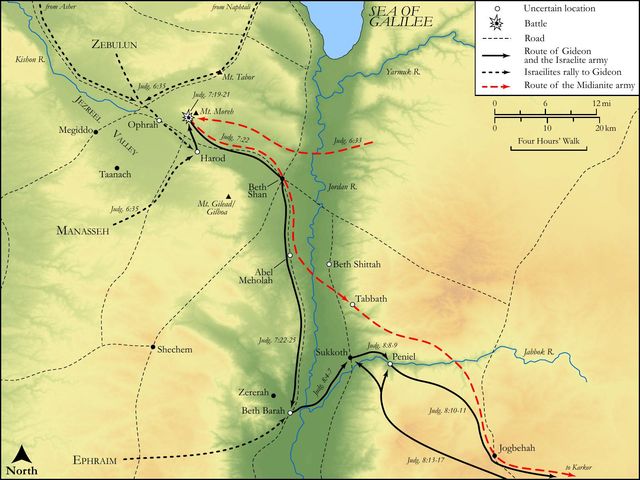
Judges 8:28 serves as the climactic conclusion to the extensive narrative of Gideon's campaign against Midian, which unfolds from Judges 6 through Judges 8. The preceding verses meticulously detail Gideon's relentless pursuit of the Midianite kings, Zebah and Zalmunna, following the miraculous victory achieved by his 300 men against the vast Midianite army in Judges 7. Gideon's unwavering resolve to avenge his slain brothers and utterly dismantle Midian's power is highlighted by his refusal to cease the pursuit until the kings were captured and executed. Therefore, this verse signifies the absolute completion of the military campaign, moving beyond the initial battlefield triumph to the final, comprehensive eradication of Midianite leadership and their capacity to oppress Israel. It effectively closes this major narrative arc, setting the stage for the subsequent accounts of Gideon's later life and the challenges that would eventually emerge, even during this period of peace.
Historical & Cultural Context
The era of the Judges was characterized by a recurring cycle of Israelite apostasy, divine judgment in the form of foreign oppression, the people's cry for deliverance, and God raising up a judge to provide salvation and rest. Midian, a formidable nomadic people from the eastern desert regions, had inflicted particularly severe oppression upon Israel, systematically raiding their harvests and livestock, forcing them to seek refuge in caves and strongholds, and consequently impoverishing the land, as vividly depicted in Judges 6:1-6. Their strategic use of camels provided a significant tactical advantage, enabling swift and devastating raids. The mention of "forty years" of peace in this verse is a common biblical idiom, often representing a complete generation or a significant, divinely appointed period. This signifies that the Midianite threat was not merely repelled but entirely neutralized for the duration of Gideon's effective leadership, ushering in a profound and lasting peace. This peace encompassed not only the absence of warfare but also a return to national stability, economic recovery, and the restoration of Israel's dignity, allowing them to "lift up their heads" free from the constant fear and humiliation of foreign domination.
Key Themes
ShowHideThis verse powerfully encapsulates several foundational themes prevalent throughout the book of Judges and the broader Old Testament narrative. Central among these is the theme of Divine Deliverance, where God, through His chosen instrument, orchestrates a complete and unequivocal victory for His people, thereby demonstrating His absolute sovereignty over all nations and His unwavering faithfulness to His covenant, even when Israel's actions render them undeserving, as highlighted in Judges 6:7-10. The vivid phrase "Midian subdued... so that they lifted up their heads no more" powerfully portrays the End of Oppression and the restoration of dignity and freedom to Israel, a recurring motif that follows each major divine intervention and deliverance, as seen in passages like Judges 3:11. The subsequent declaration of "forty years" of quietness emphatically underscores the theme of God-given Rest and Peace, a precious gift that directly follows divine intervention and provides the nation with an essential period for recovery and flourishing. This extended period of peace also highlights the Role of the Judge as a divinely appointed deliverer, whose leadership, though imperfect, brings about a crucial season of stability and order for the nation.
Exposition and Analysis
ShowHideKey Word Analysis
ShowHideThe Hebrew verb כָּנַע (H3665, kānaʻ') means "to bend the knee," "to humiliate," or "to vanquish." In the context of Judges 8:28, it signifies a complete and utter defeat, not merely in a military sense but extending to the very spirit and power of Midian. This implies that Midian was not just beaten; they were broken, their capacity to rise again as a dominant force against Israel utterly extinguished. The term suggests a profound psychological and political subjugation that went far beyond the battlefield.
The Hebrew verb שָׁקַט (H8252, shâqaṭ') means "to repose," "to be quiet," "to be undisturbed," or "to be at rest." It describes a deep, pervasive, and lasting peace that settled over the land of Israel. This "quietness" was a direct and profound result of the complete subjugation of Midian, signifying freedom from the harassment, fear, and economic devastation that had plagued Israel for years under Midianite oppression. It highlights the profound impact of God's deliverance on the daily lives and well-being of the Israelites.
Verse Breakdown
ShowHide"Thus was Midian subdued before the children of Israel"
This opening clause directly attributes the victory and the complete humbling of Midian to God's work through the children of Israel. The use of "subdued" (kānaʻ) emphasizes the decisive and irreversible nature of Midian's defeat, indicating that their power and threat were utterly broken. It underscores that this was not a temporary setback for Midian but a permanent cessation of their dominance over Israel, demonstrating God's sovereign hand in their deliverance.
"so that they lifted up their heads no more."
This vivid, idiomatic phrase powerfully conveys the absolute and lasting nature of Midian's defeat. To "lift up one's head" signifies pride, defiance, and a posture of power or resurgence. The inability to do so means they were utterly crushed, their spirit broken, and their capacity to wage war or oppress Israel eliminated. This speaks to a comprehensive psychological and political victory as much as a military one, ensuring no resurgence of Midianite aggression for the foreseeable future.
"And the country was in quietness forty years in the days of Gideon."
This final clause specifies both the duration and the quality of the peace that followed Gideon's decisive victory. "Quietness" (shâqaṭ) denotes a state of profound rest, tranquility, and freedom from disturbance, signifying a period of national recovery and stability. The "forty years" is a common biblical number signifying a complete generation or a significant, extended period, indicating that this peace was comprehensive and lasted throughout Gideon's effective leadership as judge, providing a much-needed era of stability and recovery for the nation of Israel.
Literary Devices
ShowHideJudges 8:28 employs several potent literary devices to convey its profound message. The phrase "so that they lifted up their heads no more" functions as a powerful Metonymy or Synecdoche, where the physical act of "lifting up heads" represents the broader concepts of pride, defiance, and military resurgence. This vivid imagery effectively communicates the total and permanent breaking of Midian's power and spirit. The declaration of "forty years" of quietness operates as Hyperbole or a Round Number, signifying a complete generation or a significant, extended period of peace rather than a precise chronological count, thereby emphasizing the comprehensive and enduring nature of the rest Israel experienced. Furthermore, the entire verse functions as a Culmination within the broader narrative of Gideon, providing a definitive and satisfying closure to the long and arduous story arc of Midianite oppression. Ultimately, the verse serves as a concise yet impactful Summary Statement, encapsulating the profound impact and lasting legacy of Gideon's divinely empowered deliverance.
Theological and Thematic Connections
ShowHideJudges 8:28 profoundly illustrates God's unwavering commitment to deliver His people from oppression, even when their unfaithfulness leads them into distress. The complete subjugation of Midian and the subsequent forty years of peace underscore the divine pattern of judgment followed by mercy, demonstrating that God's ultimate desire is for His people to live in security and rest. This verse highlights that true peace is a gift from God, achieved not merely through human strength or cunning, but through His sovereign intervention and the obedience of His chosen instruments. It serves as a powerful reminder that God is the ultimate source of victory and tranquility, capable of silencing even the most formidable enemies and ushering in seasons of profound rest for His beloved.
Reflection and Application
ShowHideJudges 8:28 offers profound encouragement and practical lessons for believers today. It reminds us that even after prolonged periods of struggle, oppression, or spiritual warfare, God is capable of bringing about complete victory and ushering in seasons of profound peace and rest. Just as Israel experienced "quietness" after Midian's defeat, we can trust that God will provide respite and tranquility in our lives when we lean on His strength for deliverance. This verse calls us to recognize God as our ultimate deliverer, to cherish the periods of peace He grants, and to use these times for spiritual renewal and growth, rather than complacency. It also teaches us the lasting impact of decisive spiritual victories; when God truly subdues an enemy or breaks a stronghold, its effects can bring long-term freedom and stability, allowing us to "lift up our heads" in renewed hope and confidence in Him. This encourages us to actively seek God's intervention in our struggles, knowing that His deliverance is complete and His peace is enduring.
Questions for Reflection
ShowHideFAQ
ShowHideWhat is the significance of "forty years" of quietness in Judges 8:28?
ShowHideThe "forty years" mentioned in Judges 8:28 is a common numerical motif in the Bible, often signifying a complete generation, a significant period of testing, or a divinely appointed, comprehensive span of time. In this specific context, it indicates that the peace Israel experienced under Gideon's leadership was thorough and enduring, effectively neutralizing the Midianite threat for that entire generation and lasting throughout Gideon's lifetime as judge. It emphasizes the completeness of God's deliverance and the profound, lasting impact of Gideon's victory, ensuring a period of national stability and recovery from the severe oppression described in Judges 6:1-6. This recurring motif of rest after deliverance is a key theme throughout the book of Judges, highlighting God's faithfulness to provide respite when His people turn to Him.
Christ-Centered Fulfillment
ShowHideJudges 8:28, with its declaration of the complete subjugation of an oppressive enemy and the ushering in of profound peace, powerfully foreshadows the ultimate and eternal work of Jesus Christ. Just as Gideon, a divinely appointed deliverer, subdued Midian and brought forty years of quietness to Israel, so Jesus, the greater Judge and Deliverer, came to utterly subdue the ultimate enemies of humanity: sin, death, and the devil. His decisive victory on the cross, as described in Colossians 2:15, disarmed the spiritual powers and authorities, ensuring they "lifted up their heads no more" in their dominion over believers. Through Christ's finished work, believers are granted a peace that surpasses all understanding (Philippians 4:7), a spiritual "quietness" that is eternal and not merely for a limited period like forty years. He is our true rest, inviting all who are weary and burdened to find solace in Him (Matthew 11:28). Jesus has definitively overcome the world and its trials (John 16:33), and through Him, we receive lasting deliverance and an enduring peace that is the very foundation of the New Covenant, entering into His eternal Sabbath rest (Hebrews 4:9-10).