


Judges 10:5
Bible text: King James Version (1769 Blayney text) · Public domain
Bible text: Berean Standard Bible · Public domain
Bible text: American Standard Version (1901) · Public domain
Bible text: World English Bible, Messianic edition · Public domain
Bible text: Geneva Bible (1599) · Public domain
Bible text: Young's Literal Translation · Public domain
- וַיָּמָתvai·Ya·motand he diedH4191Conj-w ¦ V-Qal-ConsecImperf-3msVerb Qal Consecutive Imperfect 3rd Singular Masculineוַandיָּמָתhe died
- יָאִירya·'IrJairH2971N-proper-mNoun Proper Masculine
- וַיִּקָּבֵרvai·yi·ka·Verand he was buriedH6912Conj-w ¦ V-Niphal-ConsecImperf-3msVerb Niphal Consecutive Imperfect 3rd Singular Masculineוַandיִּקָּבֵרhe was buried
- בְּקָמוֹןbe·ka·Monin KamonH7056Prep-b ¦ N-properNoun Proper LocationבְּinקָמוֹןKamon
English is a literal word-by-word gloss of the Hebrew, not the KJV's wording. Why?
This is the original text the KJV's translators worked from — each Hebrew word with its own literal English meaning in this verse, prepared by scholars at Tyndale House, Cambridge. The KJV translates whole sentences, not word by word, so its wording differs: one Hebrew word can become several English words, and the KJV may choose “the LORD” where the gloss reads “Yahweh”. Both are faithful — they answer different questions. For the KJV's own rendering, switch to the KJV text.
Details
See on the biblical-era maps
Study this verse
Public-domain commentary
Matthew Henry
From his Commentary on the Whole Bible. Henry comments on passages, not single verses — this entry covers Judges 10:1–5.
Quiet and peaceable reigns, though the best to live in, are the worst to write of, as yielding least variety of matter for the historian to entertain his reader with; such were the reigns of these two judges, Tola and Jair, who make but a small figure and take up but a very little room in this history. But no doubt they were both raised up of God to serve their country in the quality of judges, not pretending, as Abimelech had done, to the grandeur of kings, nor, like him, taking the honour they had to themselves, but being called of God to it. 1. Concerning Tola it is said that he arose after Abimelech to defend Israel, Jdg 10:1. After Abimelech had debauched Israel by his wickedness, disquieted and disturbed them by his restless ambition, and, by the mischiefs he brought on them, exposed them to enemies from abroad, God animated this good man to appear for the reforming of abuses, the putting down of idolatry, the appeasing of tumults, and the healing of the wounds given to the state by Abimelech's usurpation. Thus he saved them from themselves, and guarded them against their enemies. He was of the tribe of Issachar, a tribe disposed to serve, for he bowed his shoulder to bear (Gen 49:14, Gen 49:15), yet one of that tribe is here raised up to rule; for those that humble themselves shall be exalted. He bore the name of him that was ancestor to the first family of that tribe; of the sons of Issachar Tola was the first, Gen 46:13; Num 26:23. It signifies a worm, yet, being the name of his ancestor, he was not ashamed of it. Though he was of Issachar, yet, when he was raised up to the government, he came and dwelt in Mount Ephraim, which was more in the heart of the country, that the people might the more conveniently resort to him for judgment. He judged Israel twenty-three years (Jdg 10:2), kept things in good order, but did not any thing very memorable. 2. Jair was a Gileadite, so was his next successor Jephthah, both of that half tribe of the tribe of Manasseh which lay on the other side Jordan; though they seemed separated from their brethren, yet God took care, while the honour of the government was shifted from tribe to tribe and before it settled in Judah, that those who lay remote should sometimes share in it, putting more abundant honour on that part which lacked. Jair bore the name of a very famous man of the same tribe who in Moses's time was very active in reducing this country, Num 32:41; Jos 13:30. That which is chiefly remarkable concerning this Jair is the increase and honour of his family: He had thirty sons, Jdg 10:4. And, (1.) They had good preferments, for they rode on thirty ass colts; that is, they were judges itinerant, who, as deputies to their father, rode from place to place in their several circuits to administer justice. We find afterwards that Samuel made his sons judges, though he could not make them good ones, Sa1 8:1-3. (2.) They had good possessions, every one a city, out of those that were called, from their ancestor of the same name with their father, Havoth-jair - the villages of Jair; yet they are called cities, either because those young gentlemen to whom they were assigned enlarged and fortified them, and so improved them into cities, or because they were as well pleased with their lot in those country towns as if they had been cities compact together and fenced with gates and bars. Villages are cities to a contented mind.
Continue studying Judges 10:5 across the web’s major study libraries — every link below opens this exact verse, chapter, or book on the destination site.
Read & Compare
 BibleGatewayThis verse in more than 200 translations and 70 languages.
 Bible.comThe YouVersion reader — hundreds of translations, reading plans, and highlights.
 ESV.orgCrossway's official English Standard Version reader.
 NET BibleThe NET translation with 60,000+ translators' notes on every rendering decision.
 STEP BibleTyndale House's free study tool — original text, vocabulary, and scholarly resources.
 BibliaLogos Bible Software's free web reader.
 USCCBThe New American Bible (Revised Edition) with the U.S. bishops' study notes.
Commentaries
 BibleHub CommentariesDozens of classic commentaries on this verse, gathered on one page.
 StudyLightMore than 100 commentary sets — the largest collection on the web.
 BibleRefPlain-English commentary on what this verse means, verse by verse.
 Enduring WordDavid Guzik's free commentary on this chapter, widely used by Bible teachers.
 Bible Study ToolsVerse commentary alongside Greek and Hebrew study aids.
Original Language & Research
- BibleHub InterlinearThe verse word by word — original language, transliteration, and English.
- BibleHub LexiconEvery word's original-language definition and Strong's entry.
 Blue Letter BibleDeep-study tools — Strong's numbers, concordance, and word studies.
 SefariaThe Hebrew text with Rashi and centuries of Jewish commentary.
Sermons, Hymns & Audio


TrulyRandomVerse is not affiliated with these sites and doesn’t control their content. They’re linked because they’re genuinely useful.
Summary
Judges 10:5 succinctly records the death and burial of Jair in Camon, marking the conclusion of his twenty-two-year tenure as a judge over Israel. This brief, formulaic statement signals the end of a period of relative peace and stability under Jair's leadership, setting the stage for the subsequent decline into apostasy and the ensuing oppression that characterizes the cyclical narrative of the Book of Judges. It serves as a stark reminder of the temporary nature of human leadership and the persistent need for divine intervention in the life of God's people, implicitly foreshadowing the renewed spiritual decline that inevitably follows the passing of a deliverer.
Context
ShowHideLiterary Context
Judges 10:5 functions as a concluding statement for the account of Jair, following immediately after a summary of his judgeship in Judges 10:3-4. This pattern of recording a judge's death and burial is characteristic of the Book of Judges, serving as a narrative marker that closes one leader's era and anticipates the next phase of Israel's spiritual decline and subsequent oppression. It aligns with the overarching cyclical framework of sin, oppression, cry for deliverance, and the raising of a judge, as explicitly outlined in Judges 2:11-19. The brevity of Jair's account, similar to Tola's in Judges 10:1-2, contrasts with the more detailed narratives of other judges, suggesting a focus on the cyclical pattern itself rather than extensive biographical detail for every leader. The succinctness here prepares the reader for the detailed account of Jephthah that immediately follows.
Historical & Cultural Context
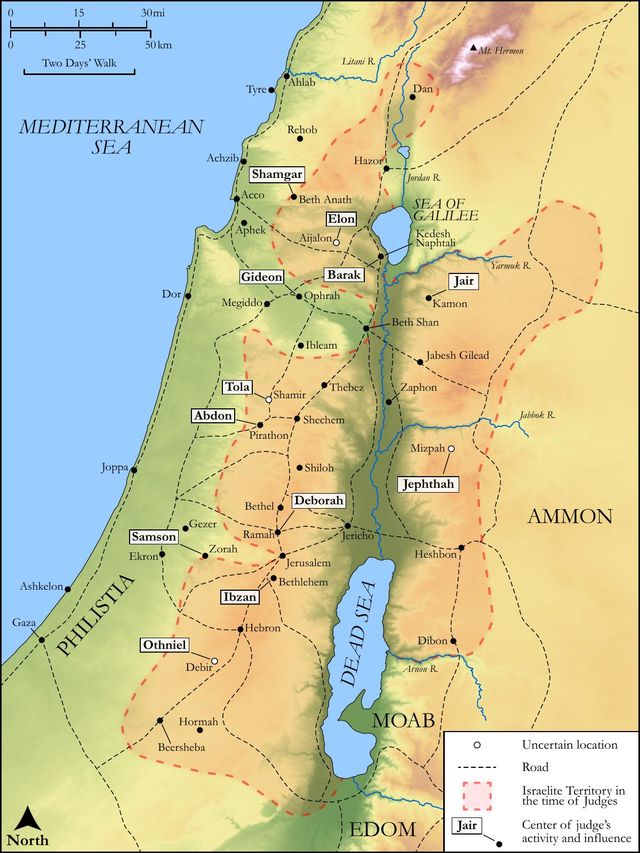
The period of the Judges (roughly 1200-1000 BC) was a turbulent time in Israel's history, marked by a loose tribal confederacy, frequent foreign incursions, and a lack of centralized leadership, as famously summarized by the refrain, "In those days there was no king in Israel; everyone did what was right in his own eyes" (Judges 17:6). Judges like Jair emerged as charismatic, divinely empowered leaders who delivered Israel from specific oppressors and maintained a degree of order. The mention of Jair's thirty sons riding on thirty donkey colts and possessing thirty cities (Judges 10:4) highlights his considerable wealth, influence, and perhaps a degree of regional authority, which was a significant marker of status and leadership in Israel. Burial in a specific location like Camon was a common practice, signifying a connection to ancestral lands and providing a historical anchor for the narrative, confirming the reality of the individual and their place within Israel's tribal territories, likely in Gilead.
Key Themes
ShowHideThe verse contributes to several key themes within the Book of Judges and broader biblical theology. Firstly, it underscores the mortality and temporality of human leadership. Even divinely appointed deliverers are subject to death, emphasizing that ultimate reliance must be placed on God alone, not on any human instrument. This theme prepares the reader for the eventual longing for a permanent king (1 Samuel 8:5) and ultimately, the eternal reign of the Messiah. Secondly, it reinforces the cyclical nature of Israel's spiritual experience. Jair's death, like those of previous judges, consistently precedes a renewed period of apostasy and oppression, demonstrating Israel's persistent failure to remain faithful to God, as highlighted in Judges 2:19. Finally, the verse subtly points to God's sovereign continuity even amidst human failure and changing leadership. Despite the passing of one judge, God's overarching plan for His people continues, and He will raise up another deliverer when Israel cries out to Him, as seen with the impending introduction of Jephthah in Judges 11:1.
Exposition and Analysis
ShowHideKey Word Analysis
ShowHideThe name יָאִיר (Yâʼîyr), derived from a root meaning "light" or "to shine," signifies "enlightener" or "he enlightens." This etymology is fitting for a judge who, for twenty-two years, brought a period of relative peace and order to Israel, effectively "enlightening" or bringing clarity and stability to a people often shrouded in spiritual darkness and oppression. His name may also carry a subtle ironic undertone, as his death often signals Israel's return to spiritual darkness.
The verb מוּת (mûwth), here rendered as "died," is a primitive root meaning "to die" (literally or figuratively), or causatively, "to kill." In Judges 10:5, its simple declarative use ("and Jair died") highlights the universality and finality of death, even for those divinely chosen and empowered. In the context of Judges, this formulaic declaration of a judge's death consistently serves as a narrative pivot, signaling the end of an era of deliverance and the imminent return to the cycle of apostasy and oppression.
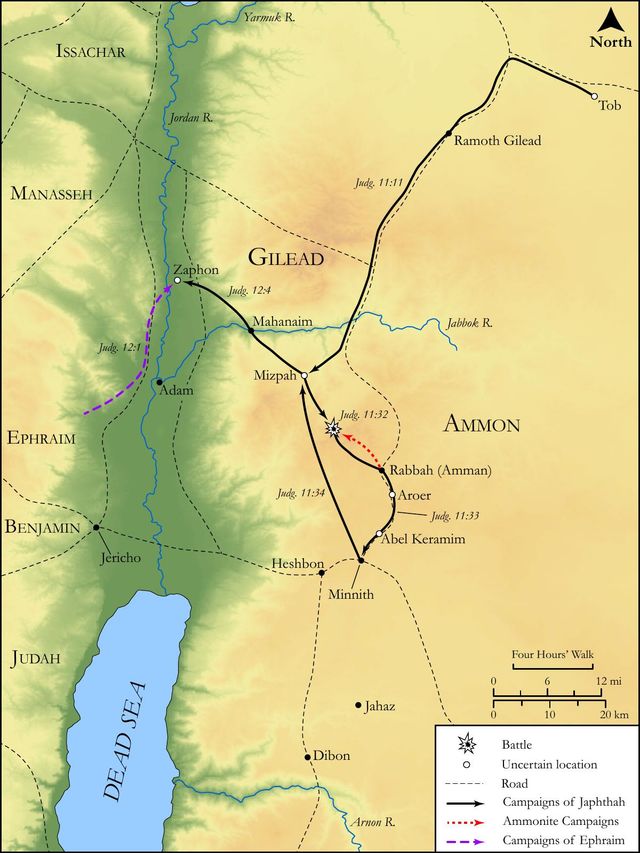
The place name קָמוֹן (Qâmôwn) is mentioned specifically as Jair's burial place. Derived from a root meaning "to rise" or "to stand up," it suggests "an elevation." While its exact modern identification is debated, it was clearly a known geographical location to the original audience, likely situated in Gilead, Jair's tribal territory east of the Jordan. The inclusion of this specific detail grounds the narrative in historical reality, providing authenticity and indicating that these were real people and events, not mere legends, connecting the judge to a tangible land.
Verse Breakdown
ShowHide"And Jair died"
This clause is a direct and unadorned statement of fact, emphasizing the finality of human life and leadership. It marks the cessation of Jair's active role as a judge, signifying the end of his influence and the period of peace he maintained. This brevity underscores the transient nature of human authority in contrast to God's eternal sovereignty, setting the stage for the inevitable spiritual decline that often followed the passing of a judge.
"and was buried in Camon"
This second clause provides a specific geographical detail, indicating the location of Jair's interment. The act of burial signifies the formal conclusion of a life, the respect shown to the deceased, and the establishment of a memorial. The mention of Camon, a specific place, roots the narrative in a tangible historical and geographical context, reinforcing the reality of the events for the ancient Israelite audience. It also implies a connection to his ancestral land or a place of significance for his family and tribe, likely in Gilead.
Literary Devices
ShowHideJudges 10:5, despite its brevity, employs several effective literary devices. The most prominent is Formulaic Language, as the phrase "and [Judge's name] died, and was buried in [place]" is a recurring motif throughout the Book of Judges (e.g., Judges 2:10, Judges 8:32, Judges 12:7). This repetition creates a sense of rhythm and predictability, reinforcing the cyclical nature of Israel's history during this period of spiritual decline and temporary deliverance. The Conciseness of the verse, a mere seven words in the KJV, lends it a stark, almost abrupt quality, highlighting the swift and definitive end of an era. This brevity also serves to underscore the relative unimportance of the human leader in comparison to the overarching divine narrative and the persistent spiritual problem of Israel. Furthermore, the verse functions as a narrative Transition and Foreshadowing. It marks the end of Jair's leadership and implicitly signals the impending return of apostasy and oppression, setting the stage for the next cycle of Israel's disobedience and God's subsequent judgment and deliverance, which will be introduced in the following verses with the rise of Jephthah.
Theological and Thematic Connections
ShowHideJudges 10:5, though a simple factual statement, carries profound theological weight. It serves as a stark reminder of the universal truth of human mortality, even for those divinely appointed to lead and deliver. This transient nature of human leadership stands in sharp contrast to the eternal, unchanging sovereignty of God. The consistent pattern of judges dying and Israel subsequently falling back into sin underscores the deep-seated spiritual problem within the nation—a problem that no temporary human leader, no matter how effective, could ultimately solve. It highlights Israel's persistent need for a more permanent, perfect, and divine solution to their sin problem, foreshadowing the longing for a king and ultimately, the true King. The verse also subtly emphasizes God's faithfulness; despite the continuous cycle of human failure and the passing of His chosen instruments, His overarching plan for His people continues, demonstrating His enduring commitment to His covenant.
Reflection and Application
ShowHideThe brief account of Jair's death and burial in Judges 10:5 offers a potent lesson for believers today. It reminds us that all human leaders, whether in the church, government, or any sphere of influence, are temporary. Their tenure is finite, and their wisdom and strength are ultimately limited. This truth should cultivate in us a healthy skepticism towards placing ultimate trust or hope in any individual, no matter how gifted or godly. Instead, our ultimate reliance, faith, and hope must be firmly rooted in God alone, whose sovereignty is eternal and whose faithfulness never wavers. The cyclical pattern of Israel's apostasy following the death of a judge also serves as a warning: spiritual vigilance is paramount. We must not become complacent during times of peace or strong leadership, but continually nurture our personal and corporate relationship with God, lest we fall into spiritual decline when circumstances change. This verse calls us to embrace a long-term, God-centered perspective, understanding that while human instruments come and go, God's purposes endure, and His kingdom is everlasting.
Questions for Reflection
ShowHideFAQ
ShowHideWhy is Jair's account, including his death, so brief compared to other judges?
ShowHideJair's account, like Tola's before him (Judges 10:1-2), is notably concise because the primary focus of the Book of Judges is not on providing detailed biographies of every leader. Instead, the narrative emphasizes the recurring cycle of apostasy, oppression, and deliverance that characterized Israel's spiritual journey during this period. The brevity of some judges' accounts highlights the formulaic nature of the cycle itself, showing that even during periods of relative peace under a judge, Israel's underlying spiritual condition remained precarious. Their deaths serve as narrative markers, signaling the end of one phase and the inevitable return to disobedience and subsequent oppression, setting the stage for the next major deliverer, such as Jephthah in Judges 11. This literary choice underscores the theological point that no human leader, however effective, could ultimately break Israel's cycle of sin; only a perfect and permanent solution would suffice.
Christ-Centered Fulfillment
ShowHideJudges 10:5, with its stark declaration of Jair's death, powerfully underscores the temporary and ultimately insufficient nature of human leadership, pointing forward to the eternal and perfect leadership of Jesus Christ. The cycle of judges dying and Israel repeatedly falling back into sin (Judges 2:19) reveals humanity's desperate need for a deliverer who is not subject to mortality or moral imperfection. While Jair, like other judges, brought temporary peace and deliverance, his death signals the end of that peace and the inevitable return to chaos. This stands in stark contrast to Jesus, who, as the ultimate Judge and King, "died once for all" (Romans 6:10) and then rose again, conquering death and establishing an eternal kingdom that will never end (Hebrews 7:23-25). He is the true and permanent deliverer, the "Lamb of God who takes away the sin of the world" (John 1:29), whose reign brings not temporary respite but eternal peace and righteousness (Isaiah 9:6-7). Unlike Jair, whose death led to further apostasy, Christ's death and resurrection secured a new covenant, empowering believers through the Holy Spirit to live in continuous faithfulness, anticipating His return as the righteous Judge (Acts 17:31). He is the "author and perfecter of our faith" (Hebrews 12:2), the one whose leadership transcends all human limitations and offers eternal salvation.