


Judges 8:32
Bible text: King James Version (1769 Blayney text) · Public domain
Bible text: Berean Standard Bible · Public domain
Bible text: American Standard Version (1901) · Public domain
Bible text: World English Bible, Messianic edition · Public domain
Bible text: Geneva Bible (1599) · Public domain
Bible text: Young's Literal Translation · Public domain
- וַיָּמָתvai·Ya·motand he diedH4191Conj-w ¦ V-Qal-ConsecImperf-3msVerb Qal Consecutive Imperfect 3rd Singular Masculineוַandיָּמָתhe died
- גִּדְעוֹןgid·'onGideonH1439N-proper-mNoun Proper Masculine
- בֶּןben[the] son ofH1121N-mscNoun Singular Masculine Construct
- יוֹאָשׁyo·'AshJoashH3101N-proper-mNoun Proper Masculine
- בְּשֵׂיבָהbe·sei·Vahin old ageH7872Prep-b ¦ N-fsNoun Singular Feminine Absoluteבְּinשֵׂיבָהold age
- טוֹבָהto·VahgoodH2896Adj-fsAdjective Singular Feminine Absolute
- וַיִּקָּבֵרvai·yi·ka·Verand he was buriedH6912Conj-w ¦ V-Niphal-ConsecImperf-3msVerb Niphal Consecutive Imperfect 3rd Singular Masculineוַandיִּקָּבֵרhe was buried
- בְּקֶבֶרbe·Ke·verin [the] tomb ofH6913Prep-b ¦ N-mscNoun Singular Masculine Constructבְּinקֶבֶר[the] tomb of
- יוֹאָשׁyo·'AshJoashH3101N-proper-mNoun Proper Masculine
- אָבִיו'a·Vivhis fatherH1N-msc ¦ 3msNoun Singular Masculine Constructאָבִיfatherוhis
- בְּעָפְרָהbe·'a·fe·Rahin OphrahH6084Prep-b ¦ N-properNoun Proper LocationבְּinעָפְרָהOphrah
- אֲבִי'a·Viof [the] Abi-H33N-mscNoun Gentilic Singular Masculine Construct
- הָעֶזְרִיHa·'ez·Ri<the> -ezrite[s]H33Art ¦ N-msNoun Gentilic Singular Masculine Absoluteהָ<the>עֶזְרִי-ezrite[s]
English is a literal word-by-word gloss of the Hebrew, not the KJV's wording. Why?
This is the original text the KJV's translators worked from — each Hebrew word with its own literal English meaning in this verse, prepared by scholars at Tyndale House, Cambridge. The KJV translates whole sentences, not word by word, so its wording differs: one Hebrew word can become several English words, and the KJV may choose “the LORD” where the gloss reads “Yahweh”. Both are faithful — they answer different questions. For the KJV's own rendering, switch to the KJV text.
Details
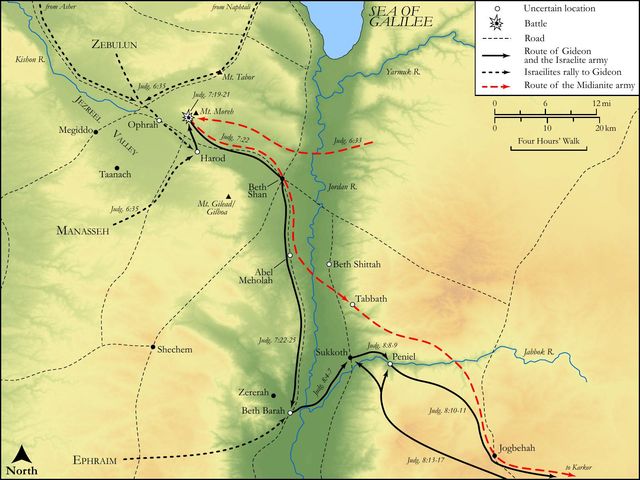
See on the biblical-era maps

Study this verse
Public-domain commentary
Matthew Henry
From his Commentary on the Whole Bible. Henry comments on passages, not single verses — this entry covers Judges 8:29–35.
We have here the conclusion of the story of Gideon. 1. He lived privately, Jdg 8:29. He was not puffed up with his great honours, did not covet a palace or castle to dwell in, but retired to the house he had lived in before his elevation. Thus that brave Roman Who was called from the plough upon a sudden occasion to command the army when the action was over returned to his plough again. 2. His family was multiplied. He had many wives (therein he transgressed the law); by them he had seventy sons (Jdg 8:30), but by a concubine he had one whom he named Abimelech (which signifies, my father a king), that proved the ruin of his family, Jdg 8:31. 3. He died in honour, in a good old age, when he had lived as long as he was capable of serving God and his country; and who would desire to live any longer? And he was buried in the sepulchre of his fathers. 4. After his death the people corrupted themselves, and went all to naught. As soon as ever Gideon was dead, who had kept them close to the worship of the God of Israel, they found themselves under no restraint, and then they went a whoring after Baalim, Jdg 8:33. They went a whoring first after another ephod (Jdg 8:27), for which irregularity Gideon had himself given them too much occasion, and now they went a whoring after another god. False worships made way for false deities. They now chose a new god (Jdg 5:8), a god of a new name, Baal-berith (a goddess, say some); Berith, some think, was Berytus, the place where the Phoenicians worshipped this idol. The name signifies the Lord of a covenant. Perhaps he was so called because his worshippers joined themselves by covenant to him, in imitation of Israel's covenanting with God; for the devil is God's ape. In this revolt of Israel to idolatry they showed, (1.) Great ingratitude to God (Jdg 8:34): They remembered not the Lord, not only who had delivered them into the hands of their enemies, to punish them for their idolatry, but who had also delivered them out of the hands of their enemies, to invite them back again into his service; both the judgments and the mercies were forgotten, and the impressions of them lost. (2.) Great ingratitude to Gideon, Jdg 8:35. A great deal of goodness he had shown unto Israel, as a father to his country, for which they ought to have been kind to his family when he was gone, for that is one way by which we ought to show ourselves grateful to our friends and benefactors, and may be returning their kindnesses when they are in their graves. But Israel showed not this kindness to Gideon's family, as we shall find in the next chapter. No wonder if those who forget their God forget their friends.
Continue studying Judges 8:32 across the web’s major study libraries — every link below opens this exact verse, chapter, or book on the destination site.
Read & Compare
 BibleGatewayThis verse in more than 200 translations and 70 languages.
 Bible.comThe YouVersion reader — hundreds of translations, reading plans, and highlights.
 ESV.orgCrossway's official English Standard Version reader.
 NET BibleThe NET translation with 60,000+ translators' notes on every rendering decision.
 STEP BibleTyndale House's free study tool — original text, vocabulary, and scholarly resources.
 BibliaLogos Bible Software's free web reader.
 USCCBThe New American Bible (Revised Edition) with the U.S. bishops' study notes.
Commentaries
 BibleHub CommentariesDozens of classic commentaries on this verse, gathered on one page.
 StudyLightMore than 100 commentary sets — the largest collection on the web.
 BibleRefPlain-English commentary on what this verse means, verse by verse.
 Enduring WordDavid Guzik's free commentary on this chapter, widely used by Bible teachers.
 Bible Study ToolsVerse commentary alongside Greek and Hebrew study aids.
Original Language & Research
- BibleHub InterlinearThe verse word by word — original language, transliteration, and English.
- BibleHub LexiconEvery word's original-language definition and Strong's entry.
 Blue Letter BibleDeep-study tools — Strong's numbers, concordance, and word studies.
 SefariaThe Hebrew text with Rashi and centuries of Jewish commentary.
Sermons, Hymns & Audio


TrulyRandomVerse is not affiliated with these sites and doesn’t control their content. They’re linked because they’re genuinely useful.
Summary
Judges 8:32 succinctly records the peaceful death and burial of Gideon, also known as Jerubbaal, marking the conclusion of his significant, albeit complex, tenure as one of Israel's judges. This verse signifies the end of a period of relative peace and stability for Israel under his leadership, emphasizing his longevity and his return to his ancestral home, Ophrah, within the tribal territory of the Abiezrites. It serves as a narrative bookend to Gideon's story, setting the stage for the tumultuous events that immediately follow in the Book of Judges.
Context
ShowHideLiterary Context
Judges 8:32 provides a concluding summary to the extensive narrative of Gideon's judgeship, which began in Judges 6 and spanned several chapters. Immediately preceding this verse, Gideon had refused the offer of kingship from the Israelites, declaring that "the Lord shall rule over you" (Judges 8:23). However, his subsequent actions, particularly the creation of a golden ephod that became a spiritual snare for Israel and his own household, are highlighted in Judges 8:27. This verse, therefore, encapsulates the finality of his life and leadership, drawing a curtain on a complex figure who brought deliverance but also introduced elements of spiritual compromise, foreshadowing the moral decline that characterizes much of the rest of the Book of Judges.
Historical & Cultural Context
The period of the Judges (roughly 1200-1000 BCE) was a transitional era for Israel, marked by a loose tribal confederacy rather than a centralized monarchy. The phrase "in those days there was no king in Israel; everyone did what was right in his own eyes" (Judges 17:6) aptly describes the socio-political landscape. Judges like Gideon emerged as charismatic, divinely appointed leaders who delivered Israel from foreign oppression, often operating within their specific tribal regions. Burial in the "sepulchre of his father" was a deeply significant cultural practice, emphasizing familial continuity, ancestral land rights, and the importance of being gathered to one's people in death, reflecting a peaceful and honored passing. Ophrah, Gideon's hometown, was located within the territory of the Abiezrites, a clan of the tribe of Manasseh, reinforcing his local identity and tribal roots.
Key Themes
ShowHideThis concluding verse contributes to several overarching themes in Judges. It marks The End of an Era, signifying the close of Gideon's specific period of deliverance and the transition to a new phase, often characterized by further cycles of apostasy and oppression. The phrase "died in a good old age" highlights A Blessed Longevity, a recurring biblical motif (e.g., Genesis 25:8) that often indicates divine favor and a life that has run its full course, irrespective of the individual's moral complexities. Furthermore, Gideon's burial in his ancestral land underscores the theme of Legacy and Lineage, emphasizing his rootedness in his clan and tribe, even as his immediate legacy would be tragically marred by the actions of his son Abimelech, detailed in Judges 9.
Exposition and Analysis
ShowHideKey Word Analysis
ShowHideThis primitive root means "to die" literally or figuratively, and causatively "to kill." In the context of Judges 8:32, it signifies the natural cessation of Gideon's earthly life and leadership, marking a definitive end to his active role in Israel's history. The verb form (H8799) indicates a completed action, emphasizing the finality of his passing.
Derived from H2896, this adjective describes something as "good" in the widest sense, encompassing beauty, favor, prosperity, and well-being. When coupled with "old age," it denotes a favorable and blessed conclusion to life, implying a peaceful and complete existence rather than a premature or violent end. It suggests a life that, despite its complexities, was ultimately seen as having run its full, appointed course.
This feminine noun specifically refers to "old age" or "gray hairs." Paired with "good" (ṭôwb), it forms the idiom "good old age," a significant biblical motif indicating longevity, the completion of one's life span, and often a sign of divine blessing. It contrasts with the often violent and premature deaths of other figures in the Book of Judges, highlighting a measure of grace extended to Gideon at the close of his life.
Verse Breakdown
ShowHide"And Gideon the son of Joash died"
This clause directly states the death of Gideon, identifying him by his paternal lineage, a common practice in ancient Israel that emphasizes family identity and continuity. It marks the definitive end of his active role in the narrative of Israel's judges.
"in a good old age"
This phrase describes the manner and timing of Gideon's death. As discussed in the Key Word Analysis, it indicates a natural, peaceful, and long life, often seen as a sign of divine blessing and a full completion of one's earthly course. It contrasts with the violent ends of many other figures in the Book of Judges, highlighting a degree of divine favor upon Gideon even amidst his flaws.
"and was buried in the sepulchre of Joash his father"
This detail specifies Gideon's burial location, emphasizing his return to his ancestral resting place. Burial in the family tomb was a significant cultural practice, signifying honor, continuity of lineage, and a peaceful repose among one's kin. It underscores his rootedness in his family and clan, even after his public role as a judge.
"in Ophrah of the Abiezrites"
This final clause provides the precise geographical and tribal location of Gideon's burial. Ophrah was his hometown, and the Abiezrites were his clan within the tribe of Manasseh. This detail firmly grounds Gideon's life and death within his specific tribal identity and territory, reinforcing the localized nature of the judges' authority and the tribal structure of Israel during this period.
Literary Devices
ShowHideJudges 8:32 primarily functions as a Narrative Summary and Conclusion. It provides a definitive end to Gideon's extensive story, offering a concise wrap-up of his life and passing. The phrase "died in a good old age" employs Formulaic Language, echoing similar descriptions of patriarchs and revered figures in biblical literature, which serves to elevate Gideon's stature and underscore a sense of divine blessing on his life's completion. There is also a subtle element of Irony or Foreshadowing in this peaceful conclusion. While Gideon dies in peace, the subsequent narrative in Judges 9 immediately plunges Israel into chaos and internal strife through the actions of his son Abimelech, highlighting the temporary nature of the peace Gideon secured and the persistent moral decay within Israel that even a "good old age" for a judge could not prevent.
Theological and Thematic Connections
ShowHideThis verse, marking Gideon's peaceful end, offers a complex theological reflection on God's faithfulness amidst human imperfection. Despite Gideon's significant flaws—his initial hesitancy (Judges 6:15), his vengeful actions against Succoth and Penuel (Judges 8:16-17), and especially his creation of the idolatrous ephod (Judges 8:27)—God allowed him to complete his life in peace and honor. This demonstrates God's sovereign use of imperfect vessels to accomplish His purposes and His grace in granting a blessed end even to those who falter. It underscores the theme that divine blessing is not solely contingent on human perfection but often reflects God's covenant faithfulness and His overarching plan for His people. The "good old age" signifies a life lived to its full appointed measure, a gift from God.
Reflection and Application
ShowHideGideon's life, culminating in this verse, offers profound lessons for believers today. It reminds us that God often chooses and uses imperfect people to achieve His divine purposes. Despite his moments of doubt, fear, and significant moral failings, Gideon was instrumental in delivering Israel, and he was granted a peaceful end. This should encourage us that our past mistakes or present imperfections do not necessarily disqualify us from God's continued grace and work in our lives. The concept of dying "in a good old age" invites us to consider what it means to finish well—not necessarily without blemish, but with a life that, on the whole, has been lived out in God's overarching plan, culminating in peace. It calls us to reflect on our own legacy and how we are stewarding the time and gifts God has given us, striving for faithfulness and seeking God's grace to complete our race with integrity, even if imperfectly.
Questions for Reflection
ShowHideFAQ
ShowHideWas Gideon truly a "good" judge despite his flaws, given his peaceful death?
ShowHideThe biblical narrative presents Gideon as a complex figure. He was undoubtedly a divinely chosen deliverer who brought significant victory and peace to Israel, as affirmed by his inclusion in the "faith hall of fame" in Hebrews 11:32. However, the text also honestly records his significant flaws, such as his testing of God (Judges 6:36-40), his vengeful actions, and especially his creation of the ephod, which became an idolatrous snare for Israel (Judges 8:27). His "good old age" signifies a life that ran its full course and ended peacefully, often seen as a blessing. It doesn't whitewash his mistakes but rather highlights God's grace in using and sustaining even flawed individuals for His purposes, and granting them a peaceful end. It underscores that God's assessment of a life is holistic and often extends mercy beyond human merit.
What is the significance of Gideon being buried in his father's sepulchre in Ophrah?
ShowHideThis detail is highly significant in ancient Israelite culture. Burial in the family tomb, particularly in one's ancestral land, emphasized several key aspects: Continuity of Lineage: It connected the deceased to their ancestors and future generations, reinforcing the importance of family and clan identity. Land Rights: It affirmed the family's claim to their inherited land, which was central to Israelite identity and the covenant promises. Honor and Peace: A peaceful burial among one's kin was considered an honorable end, contrasting with being unburied or buried in foreign soil. For Gideon, it signifies his deep roots in his community, the Abiezrites of Manasseh, and a peaceful return to the earth from which he came, despite the tumultuous nature of his public life. It also sets the stage for the next chapter, where his son Abimelech's actions directly relate to this very location and lineage (Judges 9:1-6).
Christ-Centered Fulfillment
ShowHideJudges 8:32, marking the peaceful end of Gideon's life, subtly points to the greater and ultimate Deliverer, Jesus Christ. Gideon, like all judges, was an imperfect, temporary deliverer whose leadership brought only fleeting peace and whose legacy was marred by human failure and the subsequent chaos of his son Abimelech's reign (Judges 9). This highlights Israel's desperate need for a perfect, eternal King, not just a temporary deliverer. Jesus, in contrast to Gideon's flawed leadership and the temporary peace he secured, is the true Prince of Peace, whose reign is eternal and whose peace transcends all understanding (Philippians 4:7). While Gideon died in a "good old age," signifying a full life, Jesus' death was a sacrificial act, not the end of a long life, but the beginning of eternal life for all who believe (John 3:16). His burial was not a return to an ancestral tomb, but a temporary rest before His glorious resurrection, which conquered death itself and secured an eternal inheritance for His people (1 Peter 1:3-4). Thus, Gideon's peaceful but limited legacy serves as a poignant reminder of the profound and everlasting peace, perfect leadership, and eternal life found only in Christ.